How is emotion change reflected in
manual and automatic annotations of
different modalities?
Master’s thesis
Ye Xiang
HMI, University of Twente
March 2017
Graduation committee:
ABSTRACT
The SEMAINE database consists of recordings of persons talking to different virtual characters. Each of the virtual characters speaks and behaves according to a repertoire of utterances. The repertoire designed the verbal and nonverbal behaviors of virtual character to influence the emotional state of persons via the conversational interaction. There are four characters - Obadiah, Poppy, Spike, and Prudence. The Obadiah character is gloomy and tries to make other person feeling depressed, whereas Poppy character is cheerful and is defined to make other person talking to it happily as well. The Spike character is angry and is intended to provoke other persons. The Prudence character is sensible. It tries to make other people sensible, too. The recordings have been annotated manually in several dimensions which indicating the emotional state of the person as it changes over the interaction.
The first goal of the thesis is to find out whether the emotions of the participants align with the character they interact with. Since there are 4 different characters, it is possible to explore how these characters differ in changing the emotions of participants.
In the manual annotations, the emotional states were indeed changed among characters. The changes in the dimensions of the Happiness, the Sadness, the Anger, and full rating dimensions (except the Intensity) were statistically different. The Poppy and Spike characters had unique impacts in the Happiness dimension. Compared to Poppy and Prudence characters, the Obadiah character had different impacts in the Sadness dimension. The Anger character had more advantages than Obadiah and Poppy characters in influencing the anger emotion of participants.
The second goal of the thesis is to investigate whether automatic emotion recognition tools assign the same emotions to the persons as the manual annotations. The selected tools included the FaceReader - a software program that recognizes the emotion of a person based on the detected facial expressions, and the LIWC (Linguistic Inquiry and Word Count) - a tool which is based on the words used by a person.
The emotions recognized by FaceReader match the annotated emotions more closely than the emotions recognized by LIWC. In the results of FaceReader, the dimensions of the happy, the sad, and the angry emotions were correctly correlated with the manual annotations in most characters. The FaceReader achieved almost 42% accuracy. In the results of LIWC, only the dimension of the Posemo (happy) well correlated with the Semaine annotation. The LIWC only had 33% accuracy.
DEDICATION
I dedicate my master thesis to my family, my teachers, and my friends. A special feeling of gratitude to my parents who support me soul and heart. My girlfriend LinYa Teng whose words of encouragement ring in my ears.
I also dedicate this work to my teachers. I express my sincere gratitude to professor Dennis Reidsma, my first supervisor, who provided me the patient guidance as well as shaped my sprit of scientific rigor. I appreciate the encouragement and the professional assistant from professor Dirk Heylen.
LIST OF ACRONYM
LIWC - Linguistic Inquiry and Word 2015
AVC - Arousal-Valence-Control
NLP - natural language processing
FACS - facial action coding system
AU - action units
PCA - principal component analysis
MMI - M&M initiative
USC - University of South California
CERT - computer expression recognition toolbox
GVC - good vibrations company
MFCC - mel frequency cepstral coefficient
LPC - linear predictive coding
NAQ - normalized amplitude quotient
QOQ - quasi-open quotient
PSP - parabolic spectral parameter
MDQ - maxima dispersion quotient
SAL - sensitive artificial listener
QA - quantitive agreement
GCI - Glottal Closure Instants
TE-MFCC - Alternative MFCCs extracted from True-Envelope spectral representation
NaN - not a number
WC - word count
WPS - words per sentence
CONTENTS
1. Introduction ---1
1.1. Problems---1
1.1.1. Deceptiveness---1
1.1.2. Measurement of emotion---2
1.1.3. Modalities Selection---2
1.2. Related Work ---2
1.2.1. Autonomous mechanism of machines---2
1.2.2. The framework of emotion recognition---3
1.3. Goals---3
1.3.1. Research requirements ---3
1.3.2. Hypotheses---3
2. Theory And Concept---4
2.1. Emotion Representation ---4
2.1.1. Categorical approach---4
2.1.2. Dimensional approach---4
2.1.3. Appraisal-based approach ---5
2.2. Sentiment Analysis---5
2.2.1. Natural language processing---6
2.2.2. Text analysis---6
2.3. Facial Expression ---6
2.3.1. Facial affect detection ---7
2.3.2. Facial muscle action detection---7
2.3.3. Posed vs spontaneous facial expression---8
2.4. Speech---8
2.4.1. Linguistic and paralinguistic---8
2.4.2. Emotional related speech variables---9
2.5. Fusion of modalities---12
2.6. Dimensionality of emotion recognition ---12
2.7. Resources---13
2.7.1. Database/Corpus ---13
2.7.2. Automatic Tools---14
3. Methodology---17
3.1. Semaine Database---17
3.1.1 Data type---18
3.1.2. Character ---19
3.1.3. Annotation---20
3.2.1. FaceReader ---22
3.2.2. Covarep---24
3.2.3. LIWC---25
4. Experiment Plan---29
4.1. Preprocess of data---29
4.1.1. Normalizing Semaine transcripts---29
4.1.2. Discarding failed facial videos---29
4.1.3. Filtering unnecessary text---29
4.2. Phase Ⅰ---30
4.2.1. Investigate the emotions/characters impacts as annotated in the Semaine annotation---30
4.2.2. Investigate the emotions/characters impacts as measured by the FaceReader---31
4.2.3. Investigate the dimensional correlation between FaceReader and Semaine annotation---32
4.3. Phase Ⅱ---34
4.4. Phase ⅡI---34
4.4.1. Investigate the emotions/characters impacts in LIWC---35
4.4.2. Investigate the dimensional correlation between LIWC and Semaine annotation---35
4.5. Participants and samples---36
5. Data analysis of Phase I---39
5.1. Emotion analysis of the Semaine annotation in the Phase I---39
5.1.1. Dimension usages of Semaine annotation in the Phase I---39
5.1.2. Value variations in Semaine annotation of Phase I---39
5.1.3. The significant analysis in Semaine annotation of Phase I---41
5.1.4. Summary ---46
5.2. FaceReader of Phase I---47
5.2.1. Value variations in FaceReader of Phase I---47
5.2.2. The significance difference in FaceReader of Phase I ---48
5.2.3. Correlations in FaceReader of Phase I---52
5.2.4. Summary ---55
5.3. Conclusion of Phase I---55
6. Data analysis of Phase II---57
6.1. Semaine annotation of Phase II---57
6.1.1. The dimensions distribution in Semaine annotation of Phase II---57
6.1.2. Variations in the Semaine annotation of Phase II---58
6.1.3. The one-way analysis of variance in Semaine annotation of Phase II---60
6.1.4. Summary in Semaine annotation of Phase II.---69
6.2. FaceReader of Phase II---70
6.2.1. Value variations in FaceReader of Phase II---70
6.2.2. Significant difference in FaceReader of Phase II---72
6.2.4. Summary in FaceReader of Phase II---79
6.3. Conclusion of Phase II---80
7. Data analysis of Phase ⅡI---82
7.1. Distribution and Variations in LIWC of Phase III---82
7.2. Word clouds of LIWC in Phase III---84
7.3. Significant difference in LIWC of Phase III---87
7.4. Correlations in LIWC of Phase III---95
7.5. Conclusion in LIWC of Phase III---96
8. Conclusion---98
8.1. Emotion impacts of characters---98
8.2. The correlation between Semaine annotation and the results of automatic tools---99
8.3. Limitations and future work---99
1. Introduction
In this thesis, there are two research questions. First one is the investigation of the emotional state change of a person with a fixed emotion impact. Second one is the validation of the automatic emotion recognition softwares.
For the first research question, the form of daily conversation is the most basic method of human emotional interaction. The daily conversation contains many channels of communication such as linguistics, facial expression and speech. These channels convey the emotion stimuli/impact which could influence the psychological state of people. In order to keep the accuracy of emotion recognition, the manual annotation of the professional annotators are used in the thesis.
For the second research question, the first problem of automatic emotion recognition tools is the selection of modalities. Because the automatic tools trace the participants’ emotion by using single/multiple modalities. The selected modalities of tools relate to the extraction and the comparison of emotions.
According to our current resources (section 2.5), the text, the speech, and the facial expression are selected as the input modalities of automatic tools. Since the tools of multiple modalities are more complex (section 1.1.3), the tools of single modality are chosen (section 3.2). In order to clearly describe the mental state of persons, dimensional approach is used to parameterize the person’s emotion in each selected modality of automatic tools (section 2.1).
1.1. Problems
Compare to the manual annotations of emotions, automatic emotion recognition is still in the early phase. There are still some problems unsolved.
1.1.1. Deceptiveness
Compared to technical algorithms and classification methods, Wagner (2005) argued that the input data has a greater impact on the performance quality of current multimodal affect recognizers.
The subjective impression of persons is not the perfect indicator of their emotions. Because there are many factors (culture, social context, and etc) which could influence the expression of people. For example, participants, who have different cultural background, are possible to express or intercept the same emotional information differently. Additionally, participants can manipulate their emotional expression, especially when they want to please the annotators.
1.1.2. Measurement of emotion
Most automatic tools use the dimensional approach and the emotional dimensions (section 2.1.2) to indicate the emotion of persons. Due to the lack of a widely recognized annotation theory, many tools measure the emotion of participants in different dimensions. Because of the differences among dimensions, it is difficult to conduct the data comparison or transformation across automatic tools.
1.1.3. Modalities Selection
A person’s emotion can be expressed by multiple modalities including face, voice, body movement and bio-signals. These channels could send primary, supplementary or even misleading information of emotion. Many modalities have been applied to extract the emotion. The text (Mairesse, Walker, Mehl, & Moore, 2007), the speech (Oudeyer, 2003; Schuller, Rigoll, & Lang, 2003), and the facial expression (P. Ekman & W. Friesen, 1978) have been widely used for emotion extraction and recognition. Besides that, bio-physiological signals (Cannon, 1927; Schachter, 1964) and bodily movement (S. Scherer et al., 2012) can also provide valuable information. These implementations have brought many benefits on selling and branding (iMotions, 2016), product promotion (Affectiva, 2016), improvement of the interaction experience (Picard, 2003; Sebe et al., 2007), and etc.
In terms of modality selection, the thesis mainly focuses on facial expression, text and speech. On the one hand, these modalities contributes a large proportion of semantic information of communication (Mehrabian, 2008). On the other hand, these modalities are widely applied in the industry. Consequently, the applications of these modalities created a massive scale of samples and annotations.
1.2. Related Work
1.2.1. Autonomous mechanism of machines
The autonomous mechanism of machines is the implementation of emotional capability (André, Klesen, Gebhard, Allen, & Rist, 2000). Researchers had made many contributions by utilizing machine learning algorithms (Blumberg et al., 2002; Pang, Lee, & Vaithyanathan, 2002) and other robot learning algorithms (Mavridis, 2015; C. Strapparava & Mihalcea, 2008; Trilla & Alías, 2009). By building the interaction configuration (digital mental state, optional action, selective utterances, and etc) of machine from the training samples, the machine can analyze current information and make the smart decision after the simulation of the human decision-making process.
1.2.2. The framework of emotion recognition
Emotion recognition is also a complex process which includes emotion detection, emotion extraction, and emotional analysis. The framework of the emotion recognition (Gunes, 2010) would fully use the context-specific interpretation of affective displays to improve the emotion analysis of the participants.
During the working process, the framework of emotion recognition integrally consider different issues, such as context interpretation, emotion representation, persons’ information mapping between emotions and behaviors, and the annotation of participants’ emotion. These work are all needed in the thesis.
1.3. Goals
This thesis is planed to investigate whether the participants’ emotion align with their received emotional stimulus. It is also intended to find out whether the automatic emotion recognition softwares assign the same emotions to the participants as the annotators’ judgement.
1.3.1. Research requirements
According to above goals, the key requirements of this research are displayed as follows:
I. To find a proper emotion representation which supports the computable state of participants’ emotions, regardless the modality and the type of the participants’ emotion.
II. To create multiple fixed emotional stimuli which aim to lastly influence the emotion of participants during the conversational interaction.
III. To find a trustworthy manual annotation which provides the authoritative analysis about the emotion of participants during the conversational interaction.
IV. To find a reliable source of participants’ multimodal emotional expressions which ensures the usages of the automatic emotion recognition tools in each selected modality.
1.3.2. Hypotheses
Based on the above discussion, we hypothesize as followed:
I. In the manual judgements of annotators and the results of automatic tools, the emotion of participants would align with the fixed emotional feedbacks.
II. In the results of automatic tools, the assigned emotions of participants should be consistent with the assigned emotions of participants in the manual annotations.
2. Theory And Concept
2.1. Emotion Representation
The representation of emotion is the first issue to be solved for the manual annotation as well as automatic recognition. In order to analyze the emotion change of participants during the conversational interaction, it is better for the emotion to be represented and annotated continuously. Fortunately, there is a manual annotation (G. McKeown, Valstar, Cowie, Pantic, & Schröder, 2012) which had annotated the emotion of participants in a continuous way.
In terms of the automatic annotation, the most widely accepted theories of emotion representation can be classified into three approaches: categorical, dimensional, and appraisal-based approaches (Grandjean, Sander, & Scherer, 2008). Dimensional approach is used in the thesis. Because it provides a representation of the computable psychological state with large scale of implementations.
2.1.1. Categorical approach
The categorical approach assumes that there are some basic emotions (including happiness, sadness, surprise, fear, anger, and disgust) which are widely recognized (Ekman, Friesen, & Ellsworth, 2013). These emotions are hard-wired in the brain (Darwin, Ekman, & Prodger, 1998; Ekman, 1992; Tomkins, 1962). This approach use the basic categories/labels of emotions to classify the emotions of participants. It is one of the most popular method to evaluate the connection between the emotional nonverbal expression and the basic emotions. For example, Schwartz and his colleagues (2013) had applied the categorical approach in the research of personality impacts on the vocabulary usage of Facebook. They compared the words of participants with the basic categories of emotional linguistics via the software - LIWC (J. W. Pennebaker, Chung, Ireland, Gonzales, & Booth, 2007).
The categorical approach cannot provide the access to blend or mix multiple labels/ categories. Therefore, many psychological researchers advocate the dimensional approach.
2.1.2. Dimensional approach
emotion while allowing the observer to distinguish the emotional expression continuously.
The dimensions of dimensional approach vary with time. Firstly, the Circumplex model of affect, assumes that each basic emotion is part of the emotional continuum, represents emotions in a circle with two bipolar dimensions (active and pleasant; Nowlis & Nowlis, 1956; Russell, 1980; Schlosberg, 1952, 1954). Another example is the Five Factor model (Digman, 1990; McCrae & John, 1992) which is widely applied in psychological research. It uses five basic dimensions of personality traits to indicate the emotional state. Then, Dietz and Lang (1999) had invented the Arousal-Valence-Control (AVC) dimensional model. The dimensional classification can simplify the complexity of emotion representations. The most commonly deployed method is to simplify the basic emotion representations into a 3 classes valence-related description: positive, neutral and negative emotion (e.g., Yu, Aoki, & Woodruff, 2004). Similarly, it is also possible to transfer the emotion classification problem into a 4-quadrant measurement by two dimensions of positive-negative and active-passive (Fragopanagos & Taylor, 2005). According to Revelle and Scherer (2009), the emotion is a psychological state which contains feeling, action, appraisal and wants over a certain time period. In terms of the emotion decay, the intensity (Gary McKeown, Valstar, Cowie, & Pantic, 2010) could be used to describe the emotion existence.
2.1.3. Appraisal-based approach
Appraisal-based approach detects the emotion during the continuous, recursive and subjective evaluation of both people’s internal state and the world external state (Grandjean et al., 2008). It views the emotion via both long-term and instant changes of all the relevant components including cognition, motivation, physiological reaction and etc. By linking the contextual information into an automatic emotion recognizer, it may improve the interpretation capability as well as enrich the choice of expressive behaviors (Mortillaro, Meuleman, & Scherer, 2012). The appraisals are used as an intermediate layer between expressive features (input) and emotion labeling (output).
Component process model (K. R. Scherer & Ekman, 1984; K. R. Scherer et al., 2001), which divides the emotion into five components as five distinctive functions, is the appraisal-driven synchronization of the changed component states as the response to the evaluation of a stimulus event (Sander, Grandjean, & Scherer, 2005). Component process model focuses on the variability of different emotional states and appraisal patterns. It enhanced the recognition of multiple emotions and integrated the contextual information with a better interpretation capability. There is a limited choice of automatic tools which are based on the appraisal-base approach.
2.2. Sentiment Analysis
attitude of the writer. Sentiment analysis aims to provide a chance to map the overall contextual subjective information of the text into an emotion model. However, some words/sentences may cause confusion (metaphor, exaggeration) or paradox (like typing mistake, sarcasm). This specialty makes the emotional annotation with lexical semantics still difficult (Carlo Strapparava & Mihalcea, 2007).
2.2.1. Natural language processing
NLP enables computers to automatically understand or derive the meaning of the inputed human natural language. In the early phase, NLP systems were based on the set of hand-written rules or restricted vocabularies to translate the sentence based on the language grammar or transformational grammar (Chomsky, 1995). After the introduction of machine learning, NLP systems are released from the annotated training data to semi-annotated and non-annotated data. Machine learning makes the NLP system more powerful to extract the emotion from the language (social software, online comments and etc).
There are many models, such as Hidden Markov model ( Baum, Petrie, Soules, & Weiss, 1970), Cache Language model (Kuhn & De Mori, 1990) and etc. These models focus on the probabilistic decision-making mechanism based on the weights or the features extracted from the input text. These models largely expanded the usage of the sentiment analysis from the extraction of subjective information in text to natural language understanding in the first-order logic. Therefore, NLP provides an easier format for the computer to parse the sentence regarding grammatical analysis, text simplification and so on.
2.2.2. Text analysis
Text analysis usually refers to the text mining, aims to derive novel and interesting information from the lexical analysis of text. Its tasks include text categorization, text clustering, entity relation modeling, etc. Text analysis parse the structure of sentence rather than the meaning of the sentence like NLP. Recently, text analysis shifts the focus from semantic structure to words classification. The main method of text analysis depends on the statical pattern learning and frequency distribution study. Its lexical analysis derives the linguistic features and remove irrelevant words.
Recently, Schwartz and his colleagues had conducted the research about the personality impacts on the vocabulary usage of Facebook (Schwartz et al., 2013) by using the dimensional approach of emotion representation, the Five Factor model of personality, and the standard software LIWC. It had been proven that different personalities as well as different emotions could influence the linguistic features of the vocabulary in the text (Hirsh & Peterson, 2009; Mairesse et al., 2007).
2.3. Facial Expression
expression is more beneficial to the emotional recognition than static facial image. Therefore, a short video is more persuasive than an image.
Currently, the automatic facial expression analysis has two approaches: facial affect detection and facial muscle action detection.
2.3.1. Facial affect detection
Since the basic emotions of facial expressions are universally interpreted (Ekman & Friesen, 2003; Keltner, Ekman, Gonzaga, & Beer, 2003), the annotation of six basic facial expressions is widely applied in the research (Cohn, 2006). The researchers have used the basic facial expressions to detect other cognitive states such as interests (El Kaliouby & Robinson, 2005), pain (Bartlett et al., 2006), and fatigue (Gu & Ji, 2005). Because the real world has fewer constraints and controls, the accuracy and reliability of facial emotion detection are seriously challenged.
[image:14.595.71.529.318.752.2]2.3.2. Facial muscle action detection
Facial Action Coding System (FACS; P. Ekman & W. V. Friesen, 1978), which consists of 44 different action units (AUs) as illustrated in figure 1, is the framework of the facial muscle action detection. It has been widely applied. Because the FACS and its AUs are capable of coding nearly any anatomical facial movement. Most emotions and cognitive states of facial expressions can be independently interpreted. While comparing to the subjective facial expression labels, FACS is objective and comprehensive to describe facial expressions. FACS associates the facial expressions with the meaning as perceived from previous research and literature.
In order to objectively test the accuracy of facial expression analysis, there are several facial expression databases to use, such as MMI database (Pantic, Valstar, 1
Rademaker, & Maat, 2005), Yin Facial Expression Database (Yin, Wei, Sun, Wang, & Rosato, 2006), and Cohn-Kanade Facial Expression database (Kanade, Cohn, & Yingli Tian, 2000).
2.3.3. Posed vs spontaneous facial expression
Although Ekman (1989a) supports the universals in facial expressions of emotions, human can still recognize the posed and the spontaneous facial expressions accurately via the difference between truthful and deceptive visual expressions of face and body (Ambadar, Schooler, & Cohn, 2005; Darwin et al., 1998; Ekman, 2003; Schmidt & Cohn, 2001). The posed and the spontaneous facial expressions are mediated separately with significantly different methods (Miehlke, Fisch, & Eneroth, 1973). Those differences lead to the variances of facial muscle movement (Ekman, 2009). Valstar had explored the method to automatically distinguish the spontaneous facial behavior from posed one by detecting the movement of eye brows including speed, intensity, duration, and etc (Valstar, Pantic, Ambadar, & Cohn, 2006). With more related features and details, affective states of facial expression are more difficult to be hidden.
2.4. Speech
Researchers also have made a great work to mapping the audio expression with emotional representations like dimensional approach (R. Cowie et al., 2001) as well as appraisal-based approach (Grandjean et al., 2008).
2.4.1. Linguistic and paralinguistic
Speech, as a main communicative method for human, consists of two types of information including the explicit message (linguistic) and the implicit/vocal message (paralinguistic) (R. Cowie et al., 2001). Linguistic information aims to identify the targets which are related to linguistic functions in the voice pitch, intensity and intonation. Paralinguistic information means the information with no linguistic function. For example, vibrations are just related to spectral properties instead of word identity.
The acronym MMI means M&M Initiative. The two ‘M’ represent the initials of the two main 1
However, the boundaries between those two types information are controversial. It had been proven that these explicit messages and implicit messages share a logical link (Ladd 2008). The linguists assumed that some linguistics, which could be intuitively understood by users, are mistakenly classified as paralinguistic (Cowie, Douglas-Cowie et al. 2001). The paralinguistic cues are (at least) partly and contextually associated with linguistic (Roach, Stibbard et al. 1998).
2.4.2. Emotional related speech variables
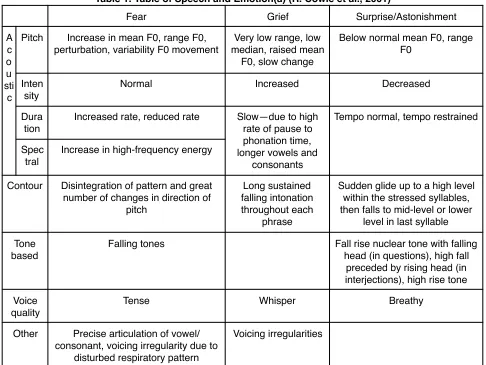
There are four broad speech variables related to the emotional expression. They are tone type, pitch contours, continuous acoustic measures and voice quality. Table 1 illustrates how these variables associate with emotions. The tone-based level of description is the focus of linguistic tradition. The prosody is usually described by intonational phrases or tone groups. Each tone group contains a prominent/nuclear tone which is usually the tone on the last stressed syllable. The prominent/nuclear tone could be a rising or falling or combined or level one. Cowie et al. suggested that different types of tones have the association with different emotions (2001).
[image:16.595.55.541.416.781.2]Pitch contours describe the geometric patterns of pitch variation. In the previous studies (Ladd, Silverman, Tolkmitt, Bergmann, & Scherer, 1985; Uldall, 1960), listeners were asked to indicate the emotion based on the contour types. In the study of Ladd et al. (1985), the results also showed that contour type was related to arousal states.
Table 1. Table of Speech and Emotion(a) (R. Cowie et al., 2001)
Fear Grief Surprise/Astonishment
A c o u sti c
Pitch Increase in mean F0, range F0, perturbation, variability F0 movement
Very low range, low median, raised mean
F0, slow change
Below normal mean F0, range F0
Inten sity
Normal Increased Decreased
Dura tion
Increased rate, reduced rate Slow—due to high rate of pause to phonation time, longer vowels and
consonants
Tempo normal, tempo restrained
Spec tral
Increase in high-frequency energy
Contour Disintegration of pattern and great number of changes in direction of
pitch
Long sustained falling intonation throughout each
phrase
Sudden glide up to a high level within the stressed syllables, then falls to mid-level or lower
level in last syllable
Tone based
Falling tones Fall rise nuclear tone with falling head (in questions), high fall
preceded by rising head (in interjections), high rise tone
Voice quality
Tense Whisper Breathy
Other Precise articulation of vowel/ consonant, voicing irregularity due to
disturbed respiratory pattern
Table 1. Table of Speech and Emotion(b) (R. Cowie et al., 2001)
Table 1. Table of Speech and Emotion(c) (R. Cowie et al., 2001)
Affection/Tenderness Coolness/Hostility Puzzlement
Acoustic Pitch Higher mean, lower mean, narrow range
Decrease in mean F0 High mean, wide range
Intensity Reduced Low
Duration Slow rate Slow
Spectral
Contour Slightly descending melody, steady and slightly upward
inflection
Tone based Low falling nuclear tone,
high head followed by rise-fall nuclear tone
Rising tones
Voice quality A little nasal articulation
Other Audible off-glide in long stressed syllables
Anger Happiness Sadness
A c o u sti c
Pitch Increase in mean, median, range, variability
Increase in mean, range, variability
Below normal mean F0, range F0
Intensity Raised Increased Decreased
Duration High rate, reduced rate Increased rate, slow tempo
Slightly slow, long pitch falls
Spectral High midpoint for av spectrum for nofric portions
Increase in high-frequency energy
Decrease in high-frequency energy
Contour Angular frequency curve, Stressed syllables ascend frequently and rhythmically, irregular up and down inflection, level average pitch except for jumps of about a musical fourth or fifth on
stressed syllables
Descending line, melody ascending
frequently and at irregular intervals
Downward inflections
Tone based Falling tones
Voice quality
Tense, breathy, heavy chest tone, blaring Tense, breathy, blaring Lax, resonant
Other Clipped speech, irregular rhythm basic opening and closing, articulatory gestures
for vowel/consonant alternation more extreme
Irregular stress distribution, capriciously alternating
level of stressed syllables
Slurring, rhythm with irregular
Table 1. Table of Speech and Emotion(d) (R. Cowie et al., 2001)
Table 1. Table of Speech and Emotion(e) (R. Cowie et al., 2001)
Continuous acoustic variables also correlate with emotions (R. Cowie et al., 2001) Particularly, pitch, duration, intensity, and spectral makeup are relevant. Lieberman and Michaels (1962) used single acoustic parameters (like F0) to test. The listeners were asked to identify what emotion is being expressed. The results had shown that some emotional information is expressed paralinguistically.
Voice quality is usually described auditorily by terms of tense, harsh and breathy. These auditory qualities may map on spectral patterns (Banse & Scherer, 1996; Roddy Cowie & Douglas-Cowie).
Excitement Warmth
Acoustic Pitch Wide range
Intensity High
Duration Fast
Spectral
Contour
Tone based Falling and rise-fall tones Wide ascending and descending heads
Voice quality
Other
Sarcasm/Irony Boredom Anxiety/Worry
Acoustic Pitch Decrease in mean F0 Increased in mean F0
Intensity Decreased
Duration Restrained tempo Increased rate, decreased rate
Spectral
Contour Stressed syllables glide to low level in wide arc
Tone based Low rise-fall tone preceded by rising glissando pretonic, level
nuclear tone
Level tone
Voice quality Tense articulation leading to grumbling, creaky phonation
2.5. Fusion of modalities
In the case of multiple modalities for emotional recognition, it is inevitable to deal with two issues : when to mix the modalities and how to mix the modalities. Currently, there are two approaches. The modalities are mixed either in the feature level (estimated with the maximum likelihood) or decision level (most joint statistical properties may lost) (Corradini, Mehta, Bernsen, Martin, & Abrilian, 2005). For both approaches, each single modality is assumed to be independent of others to track data. The decisional level approach uses separate classifier for each modality. Then, all the outputs are combined at a later stage to finalize the hypothesis of the detected affective behavior. The feature level approach assumes a strict time synchrony exists among different modalities. The decision level approach allows the asynchronous factors and the flexibility of modalities. Additionally, adaptive strategy can be used to weighing different modalities. Compared to decision level approach, feature level approach results in a higher and more complex dimensional data set. But feature level approach can perfectly contain the co-occurrence information of different modalities (multimodal cues exist at the same time).
Compared to automatic tools of single modality, the tools of multimodality provide a better result in terms of emotion classification and recognition (Jaimes & Sebe, 2007; Tan & Nareyek, 2009; Yang et al., 2008). But multimodal tools would lose the co-occurrence information of detected emotions in different modalities. The single modality tool just records the emotion change of persons in the selected modality. Therefore, single modality tools are better to classify the emotion change of people in different modalities/tools. In the thesis, the feature level approach and the single modal tools are more proper.
2.6. Dimensionality of emotion recognition
In the emotion recognition, the feature level approach of modalities fusion usually use dimensional approach to represent emotions. It has to deals with a large number of dimensions. It is a data space with a high dimensionality which consists of the emotion representations in different modalities. For example, 2520 features have been extracted for each frame of the input facial video (Valstar & Pantic, 2007), 4843 features have been extracted from each utterance (Wöllmer et al., 2008), and 61 features extracted from speech segments (Kim, 2007). In this case, each feature has less training samples than the proper requirement for target classification.
2.7. Resources
2.7.1. Database/Corpus
Table 2. Databases summary for multiple modalities of affect recognition (G. McKeown et al., 2012) 23
Database Semaine database The Vera am Mittal speech database
MHi-Mimicry database
USC Creative IT database
Reference McKeown, Valstar
et al., 2012 Grimm et al., 2008 Sun et al., 2011
Metallinou et al., 2010
Data Type Spontaneous Spontaneous Posed Posed
Modalities
Audiovisual, Facial expression, emotional speech text in transcripts
Audiovisual, facial and bodily expression, emotional speech Audiovisual, facial and bodily expression Audiovisual, speech, and bodily
expression
Subjects
One user and one operator (human/
virtual agent) interact conversationally
various participants in the show
28 males and 12 females participate
in one discussion and one role-playing game
19 actors
Categorical annotation
Basic categories of
emotions Not applicable
Social signaling
cues Not applicable
Dimensional Annotation Valence, activation, power, anticipation/ expectation, intensity Continuous annotation for valence, activation, and dominance Not applicable valence, activation, dominance, as well as interest,
naturalness, creativity and actor
verbs of theatrical performance rating
Appraisal
annotation Not applicable Not applicable Not applicable Not applicable
Annotators Feeltrace coders
and observers 17 observers
MHi-Mimicry annotation tool
Feeltrace tool and audience
Content
Three types of recordings based on the SAL. In total,
over hundreds videos have been
added and annotated.
12 hours of audio-visual recordings of
German TV talk show “Vera am Mittag” segmented
into dialogue acts and utterances
The dataset consists of 54 recordings and 43
subjects imagery. 34 recordings are discussions and 20 ones are of the role-playing game.
9 sessions of audiovisual data which contain 40 two-sentence exercises and 19
paraphrases
Speech
language English Germans English English
Public availability Yes Yes Yes Yes
MHi represents the mimicry in human-human interaction 2
Taking the consideration of our goals, a multiple modalities database is needed to simulate the real emotional interaction. The available options are illustrated in table 2.
2.7.2. Automatic Tools
According to the selection of modalities (section 1.3) and the fusion approach (section 2.5.1), a survey about existing tools was conducted. The tables from 3 to 5 display the tools of single modality in sentiment analysis, speech analysis and facial expression (G. McKeown et al., 2012).
Table 3. Sentiment analysis tools (Bradley & Lang, 1999; J. W. Pennebaker et al., 2007; Socher et al., 2013)
System LIWC Affective Norms for English Words
Deep learning
sentiment analysis Werfamous
Annotator External annotation file (dictionaries, linguistic list) Testers Sentence parsing model based on sentiment treebank
Its own analysis datasets, categories and subjects Features Physiologically meaningful categories, linguistic frequency The self-assessment manikin
Utterance of polarity/ objectivity
scored based on twitter and web searched results
Input source Text files individual word Text input Text input
Categorical annotation
Psychometrics of
words and its usage Not applicable
Sentiment treebank with emotionally labeled
words Not applicable Dimensional annotation Language dimensions based on linguistic categories (article, verb, noun and etc)
Dimensions of pleasure, arousal,
and dominance
Not applicable Positive/ Negative tone
Appraisal
annotation Not applicable Not applicable Not applicable Not applicable
Platform Mac/Windows/Linux Windows Windows/web-based web-based
Public availability
Yes (web-based version)
Only public to
Table 4. Facial expression tools (iMotions, 2015; Littlewort et al., 2011; Vicarvision, 2015)4
Name FaceReader CERT iMotions
Annotator
FaceReader coder, integrated classification models (including Asian
people)
Multivariate logistic regression classier based on final AU parameters, extension
modules,
iMotions’ coders
Features
Dimensional and affective representation, facial action units, stimuli
and event markers
Facial action units, facial features, expression
intensity
Emotional stimuli, facial feature, facial action units
Input source Video Video Video
Categorical annotation
6 basic facial expression category
6 basic facial expression category
7 basic facial expression and 2 advanced expressions
Dimensional annotation
Circumplex dimensions of valence, arousal, contempt
as well as time-frame
Not applicable Dimensions of valence and time-frame
Appraisal
annotation Not applicable Not applicable Not applicable
Platform Windows Windows Windows
Public availability Yes (only institution) No (server shut down) No (institution may accpeted)
Table 5. Speech analysis tools (Degottex, Kane, Drugman, Raitio, & Scherer, 2014; Eyben, Wöllmer, & Schuller, 2009; Vibrations, 2016; Vogt, André, & Bee, 2008)567891011121314
Name EmoVoice GVC emotion
recognition OpenEar Covarep
Annotator Classifiers of Naïve Bayes and SVM
Users, Good Vibrations’
classifiers
SVM based on LibSVM library
SVM with radial basis function kernel.
Features
Pitch, energy, Mel-frequency cepstral coefficients (MFCCs), duration, voice quality
and spectral information Pitch, intensity, resonances, dullness, sharpness, softness, tempo, and phrasing Signal energy, loudness (pseudo), mel-spectra, MFCCs, pitch, voice
quality formats and LPC coefficient
Glottal source and spectralenvelope
Input source Audio Voice Audio Audio
Categorical annotation
Predefined emotion categories by training
speech database
Basic emotion category and user feedback
Pre-trained models Not applicable
Dimensional
annotation Not applicable Not applicable Not applicable
NAQ, QOQ, PSP, H1– H2, peakSlope, MDQ
and Rd
Appraisal
annotation Not applicable Not applicable Not applicable Not applicable
Platform Mac/Windows/Linux Mac/Windows/
Linux/iPhone Mac/Windows/Linux Windows
Public availability Yes No Yes Yes
GVC equals the initials of the company name Good Vibrations Company 5
SVM means support vector machine learning algorithm 6
MFCC means Mel Frequency Cepstral Coefficient . MFCC is the coefficient of mel-frequency 7
cepstrum and represents the sound power spectrum in a short term.
LPC Linear predictive coding as an audio signal processing and speech processing tool. Its 8
coefficients represents the spectral envelope of speech signal.
NAQ means normalized amplitude quotient 9
QOQ means quasi-open quotient 10
PSP means parabolic spectral parameter 11
H1H2 means the difference of glottal harmonic amplitude 12
MDQ means maxima dispersion quotient 13
Rd means estimation of the Liljencrants-Fant glottal model. It represents the regression of the 14
3. Methodology
According to the research requirements (section 1.3.1), this research need a database that contains recordings of users interacting in a conversation. Then, the selected database should provide the manual annotation of the users’ emotional expressions during the conversation. Such manual annotation should be computable. Additionally, the database should also should contain the fixed emotional stimuli which aims to influence the emotions of users. Each recorded session of the selected database should have multimodal recordings (section 1.1.3) of the emotional expressions: video recordings for facial expression analysis, audio recordings for speech analysis, and transcriptions of the speech for the text analysis. According to the table 2, Semaine database is the best option.
According to section 2.5, the selected automatic tools should be single modality. The dimensional approach is suggested to provide the continuous and computable representation of people’s emotions for the automatic annotation in the section 2.1. Then, the automatic tools should also use the dimensional approach. FaceReader (version 6.0; Vicarvision, 2015), Covarep (1.4.1) and LIWC (version 2015) are selected.
3.1. Semaine Database
The Semaine database is based on the sensitive artificial listener (SAL) scenarios (Douglas-Cowie, Cowie, Cox, Amier, & Heylen, 2008) which could generate the emotionally colored conversation. In the scenario, a virtual character emotionally interacts with the participant via a conversation. There are four types of virtual characters (gloomy for Obadiah character, happy for Poppy character, angry for Spike character, and sensible for Prudence character). Each character can act as the emotional stimulus to influence the users’ emotions. Moreover, the sample of Semaine database contains the video, the audio and the text files of the person’s expression. Therefore, the automatic emotion analysis tools can annotate the emotion of participants during the interaction. In the database, there is a large amount of manual
annotations of the user emotions and other aspects, based on the judgement of the professional annotators.
The virtual characters of Semaine database respond to users according to a predefined script of emotional phrases. The script aims to enable the SAL character to emotionally influence the users.
3.1.1 Data type
Semaine Database recordings are built on SAL scenarios. These scenarios were designed to create conversations which have enough nonverbal features to sustain the verbal and emotional communication between two speakers. One of the speakers is the ‘operator’ who simulates a machine with very little competence of language. The ‘operator’ speaks according to a ‘script’ that composed of emotional phrases. The other speaker is called the ‘user’ and always acts as human. The ‘operator’ and the ‘user’ locate in separate rooms.
The database recordings can be classified into three types - Solid SAL, Semi-automatic SAL, and Automatic SAL.
Solid SAL: It is designed to record the behaviors of a conversation. But the ‘operator’ plays the SAL character and cannot answer any question asked by the ‘user’. But the ‘user’ is encouraged to talk to the SAL character as naturally as possible. Meanwhile, the ‘operator’ and the ‘user’ can see and talk to each other by a teleprompter screen and speakers.
Semi-automatic SAL: The ‘operator’ chooses one of the predefined phrases via the graphical interface in figure 2. Then, the selected phrase, which was recorded in an audio file, is spoken by the computer. The audio file was recorded by an actor with an
appropriate voice for the SAL character. Meanwhile, the ‘user’ can see an abstract face on the screen. The abstract face is illustrated in figure 2, too. Additionally, Semi-automatic SAL scenario has three cases. In the first one, the ‘operator’ can see and hear the ‘user’ before an appropriate utterance is chosen. In the second case, the ‘operator’ could only see the ‘user’. In the third case, the ‘operator’ could see the ‘user’ with the audio which is filtered to remove verbal information.
Automatic SAL: The ‘operator’ is the SAL character which displays as a life-like avatar (figure 3). Each character has its own stereotypical appearance and voice. Before the ‘operator’ speaks, the Semaine project system (Schroder et al., 2012) automatically decides the utterances and non-verbal actions for SAL character.
Solid SAL is the most useful version for our experiment, because it provides the most natural and least constrained emotional interaction. Semi-automatic SAL uses a simplified screen to display an abstract face which may omit the details of the nonverbal behaviors (the facial movements of eyes contact, lips, eye lids, eyebrows, and etc) of the operator and make the user feel unnatural. What’s worse, other two cases don’t provide the speech or the linguistic feedbacks. In this way, the user has the problem of fully receiving the emotion impacts from the operator. Automatic SAL interacts with ‘user’ via an avatar. Its utterances and non-verbal actions are chosen automatically. It has the same problem of the first case in the Semi-automatic SAL. Similarly, the user also has the problem of perceiving all the emotion details from the avatar.
3.1.2. Character
Table 6 . Dimensions for Semaine database annotation.
Full rating dimensio
ns
Optional dimensions
Basic emotions
Epistemic states Interaction process analysis
Validity
Valence fear certain/not certain shows solidarity breakdown of engagement
Activation angry agreeing/not agreeing shows antagonism anomalous simulation
Power happiness interested/not interested shows tension marked sociable concealment
Expectation sadness at ease/not at ease releases tension marked sociable simulation
Intensity disgust thoughtful/not thoughtful makes suggestion
contempt concentrating/not concentrating
asks for suggestion
amusement gives opinion
asks for opinion
gives Information
Initially, SAL technique was used to generate the natural conversation which was emotionally colored by virtual character (Douglas-Cowie et al., 2008). Then, it was proved that the character with a coherent personality and agenda can prevent the conversation from breaking down. There are four characters created. They are Spike (angry), Poppy (happy), Prudence (sensible), and Obadiah (gloomy). Each character has one personality which was designed to be coherent and different from other three. The designed personality will drive the character to influence expressed emotions of users in a certain direction by giving well designed types of responses. For example, the Spike character with angry personality responds empathically to the user’s angry expression, and critically to user’s other emotional expressions.
3.1.3. Annotation
For the Solid SAL scenarios, human annotators continuously recorded the perceived users’ emotion during the conversation. The Solid SAL manual annotation contains five full rating dimensions ( Valence, Activation, Power, Expectation and Intensity) and other 27 optional dimensions. These dimensions are displayed in table 6. The optional dimensions include basic emotions, epistemic states, interaction process analysis and validity. Most items of the basic emotions are selected from Ekman’s list (Ekman, 1992). Baron-Cohen and his colleagues (Baron-Cohen, 2003) defined the epistemic states. These states are used to label where a relatively clear epistemic state appears in the clip. The labels of interaction process analysis, as the subset of the system categories used in Interaction Process Analysis (Bales, 1950), are used to indicate when the issues become salient in the dialogue management. Validity indicates the cases when the user avoids a straightforward emotional communication.
Table 7. Distribution of Semaine optional traces for the 13 most used options. No others reach 5 per character or 10 across characters. (G. McKeown et al., 2012).
Bold numbers are referred in the text.
Optional Trace Obadiah Poppy Prudence Spike
Basic Emotions Happiness 2 15 5 1
Sadness 13 1 1 0
Anger 1 0 2 8
Amusement 8 14 13 12
Contempt 0 0 1 5
Epistemic States Certain 4 5 9 4
Agreeing 15 11 15 15
Interested 3 3 2 2
At Ease 5 6 7 9
Thoughtful 10 9 8 4
Interaction Process Analysis Show Antagonism 0 1 1 6
Gives Opinion 12 7 9 11
Gives Information 10 20 19 9
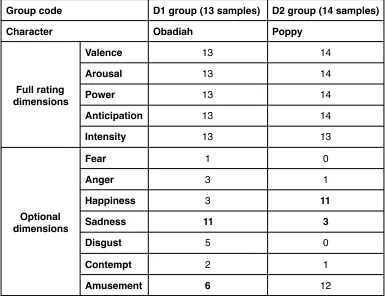
The optional dimensions are only annotated when raters think the optional dimensions could apply to the situation. During the interaction, the usages of each optional dimensions vary with the character. For example, sadness (13) appears frequently only in the conversational interaction with Obadiah character in table 7 (table 7 only includes the data from the 6 raters who traced all the clips for the sake of balance). The Anger (8) dimension is frequently annotated only during the interaction with Spike character. This table also shows that some optional dimensions are rarely used in the annotations. Besides the dimensional scripts of emotional data, Solid SAL sessions were transcribed and time aligned. The utterances of the ‘operator’ and the ‘user’ were also recorded in the transcripts.
Table 8. Alpha coefficient for functionals associated with each trace dimension (* indicates alpha>0.6 – the lowest value commonly considered acceptable ** indicates alpha>0.7 – almost always
considered acceptable † indicates non-acceptable values) (G. McKeown et al., 2012).
Bold numbers are referred in the text.
Table 9. Reliability Analysis (G. McKeown et al., 2012).
The annotations of the full rating dimensions are reliable. The reliability is measured in two levels. The first level of reliability is considered between clips. The reliability
Intensity Valence Activation Power Expectation
Mean all 0.74** 0.92** 0.73** 0.68* 0.71**
sd bins 0.83** 0.75** 0.65* 0.61* 0.68*
min bin 0.23† 0.90** 0.43† 0.43† 0.43†
median bin 0.72** 0.91** 0.72** 0.67* 0.68*
max bin 0.74** 0.92** 0.73** 0.68* 0.71**
AveMagnRise 0.74** 0.49† 0.53† 0.39† 0.58†
SDMagnRise 0.74** 0.60* 0.63* 0.32† 0.59†
MaxMagnRise 0.75** 0.56† 0.64* 0.25† 0.63*
AveMagnFall 0.68* 0.45† 0.55† 0.55† 0.51†
SDMagnFall 0.66* 0.45† 0.63* 0.60* 0.49†
MinMagnFall 0.60* 0.46† 0.59† 0.60* 0.41†
QA analysis Correlational (α) analysis
Total no. of datasets (i.e. sets of 6 or 8 traces of particular clip on a particular dimension)
305 303
Fail stringent test (alpha > 0.85, p(QAg) < 0.01) 90 104
Fail moderate test (alpha > 0.75, p(QAg) < 0.05) 43 41
between clips is based on the calculation of mean, standard deviation, etc. The reliability can measure the agreement of the same dimension (e.g. mean valence) between different ratings. Then, the standard Cronbach’s alpha is used (Cronbach, 1951). The results are illustrated in table 8. Most of the results are reliable. Mean all, sb bins, median bin and max bin are rated reliably in all the traces. Intensity shows consistent patterns of rises and falls in different aspects. The second level of reality is to measure the intra-clip agreement. It means the agreement between different ratings/ raters of a single aspect (e.g. valence rises) during the same clip. It is possible to calculate the correlation and the alpha coefficients between different lists of these rating values. But researchers are wary of the correlation calculation (G. McKeown et al., 2012). Because the successive values of each trace are not independent. In other words, the measurement is ordinal rather than interval. Therefore, an alternative method has been used to avoid these problems. It is the quantitive agreement (QA; R. Cowie & McKeown, 2010). Table 9 summarizes the results of 305 sets of traces. In terms of correlational analysis, less than 10 percents fail to reach the standard criterion (α = 0.7), and less than 30 percents fail to reach the stringent criterion (α > 0.85). In terms of QA analysis, more than 70 percents meet the stringent criterion. Overall, the QA analysis is more stringent than correlational analysis.
Among three types of Semaine database recordings, Solid SAL has the largest body of annotations. Each Solid SAL sample contains media files (video, video without audio, and audio, transcript files) and annotation files (FeelTraced annotation files). The annotation files have 5 full rating dimensions and 27 optional dimensions. Sometimes, the dimension/optional dimension has more than one corresponding annotation file. Because each user clip maybe rated by more than one annotator. When the filename ends with a number, it means an extra attempt of annotation. The file, which has the largest number at the end of its filename, is the most correct.
3.2. Selected tools
Based on above discussion, FaceReader, Covarep and LIWC were chosen. All of them use single modality and dimensional approach to recognize emotions.
3.2.1. FaceReader
Table 10. FaceReader outputs.
Basic emotions Full rating dimensions
Netural Arousal
Happy Valence
Sad
Angry
Surprised
Scared
Figure 4. FaceReader: Project Analysis Module (Vicarvision, 2015).
Clockwise from Top-right: the Circumplex model of affect, facial movements analysis, the intensities of basic emotions, and accumulated percentage of basic emotions.
Figure 5. FaceReader analysis interface (Vicarvision, 2015).
Clockwise from Top-left: input video, face movement analysis and continuous signals of basic emotions and rating dimensions.
videos and images, videos were selected as the sole form of input data for facial expression analysis in the thesis.
As a facial action coding system, FaceReader analyzes the facial movements/AUs to extract emotional information. The output dimensions are displayed in table 10. It includes basic emotional dimensions and full rating dimensions. In figure 4, the Circumplex model of emotion is used to label the percentage of basic emotions in a circular space with two bipolar dimensions (active and pleasant). In the figure 5, the analysis of facial expressions can be visualized as a group of continuous signals. In addition, the bar graph displays the intensity of each basic emotion. In the pie chart, the FaceReader calculates the total percentage of each basic emotion. The ‘other’ category of the pie chart contains any detected emotion with a total percentage less than 5%.
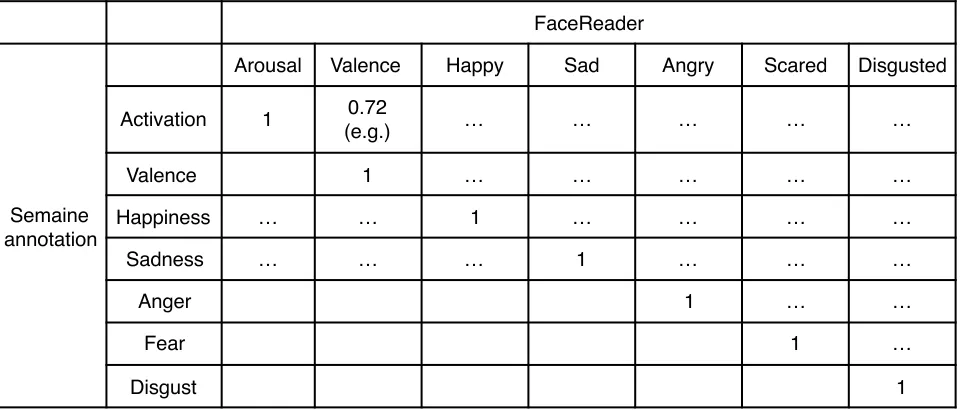
At last, the output file records the dimensional values of basic emotions and full rating dimensions. Each line of output file represents the detected results of one time frame. Some dimensions (Arousal, Valence, and etc) of FaceReader can directly compare with the corresponding dimensions of Semaine annotation. It reduces the dimensionality of emotional representation, breaks the boundary between the FaceReader and the Semaine database.
3.2.2. Covarep
Figure 6. Workflow of the methods in Covarep (Degottex et al., 2014). GCI represents glottal closure instant.
Covarep is the collaborative repository for speech processing algorithms. It aims to support the research by providing an easy access to new speech processing algorithms. Currently, there are five methods in Covarep. The workflow is illustrated in figure 6.
Firstly, the parts of periodicity and synchronization extract the pitch-synchronous information (fundamental frequency, speech polarity and glottal closure instants) for further methods (sinusoidal modeling, spectral envelope estimation and formant tracking, glottal analysis, and phase processing).
Periodicity and Synchronization Pitch
Tracking
Speech Signal
GCI Estimation Polarity
Detection
Glottal Flow Estimation
Glottal Flow Parameterization
Phase-based Representation Sinusoidal
Modeling
Formant Tracking Spectral Envelope
Figure 7. Top 10 features in terms of relative intrinsic information (Degottex et al., 2014).
A set of features, which is extracted by Covarep algorithms, includes MFCCs (O’Shaughnessy, 2008), TE-MFCCs (alternative MFCCs extracted from True-Envelope spectral representation), NAQ, QOQ, PSP, H1–H2, creaky voice, peakSlope, MDQ and Rd (Fant, 1995). Covarep conducted the feature selection based on the assessment of Drugman and Gurban (2007). The top 10 discriminative features are listed in figure 7. Unfortunately, it is difficult for these features to establish a direct psychological connection with Semaine annotation. Therefore, we had to regrettably give up speech analysis for the emotion analysis in the later study.
3.2.3. LIWC
LIWC, as one of the widely used text analysis tool, calculates the frequency of each word category within the targeted text file. LIWC application uses its internal dictionary/ library to classify the words. The internal dictionaries/libraries of words usually indicate the same linguistic domain/category/dimension. Psychologically, word category collects all the related words (e.g. Power category contains ‘boss’, ‘underling’, ‘president’, etc). All the word lists of dictionaries are iteratively edited and judged by LIWC research team. But the software still makes mistakes and errors in identifying and counting words (e.g. ‘mad’ is a positive word in ‘he is mad for her’). The problem could be seldom in the probabilistic model of language use (‘mad’ related words rarely appears in the same text if ‘mad’ is positive). This probabilistic approach is useful to solve the errors caused by irony, sarcasm, or metaphor.
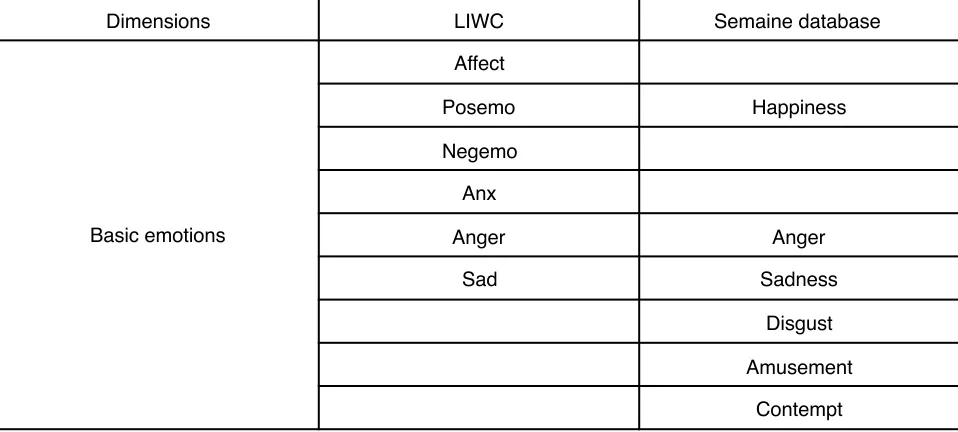
LIWC and Semaine annotation, the simplification of dimensionality only includes WC, WPS, and the affective process.
Table 11. LIWC output variables/dimensions (a). Within the same category, “Alphas” means Cronbach alphas (Cronbach, 1951) as the internal reliability of each specific words. The binary alphas are computed on each dictionary word’s occurrence/non-occurrence. The raw or uncorrected alphas are calculated by the usage percentage of each category word. (J. W. Pennebaker et al., 2007)
15
LIWC Dimension Abbrev Alpha:Binary/raw
Linguistic Processes
Word Count WC
Words per sentence WPS
Dictionary words dic
Words>6 letters sixltr
Total function words
funct .97/.40
Total pronouns
pronoun .91/.38
Personal pronouns ppron .88/.20
1st pers singular i .62/.44
1st pers plural we .66/.47
2nd person you .73/.34
3rd pers singular shehe .75/.52
3rd pers plural they .50/.36
Impersonal pronouns ipron .78/.46
Articles article .14/.14
Common verbs
verb .97/.42
Auxiliary verbs auxverb .91/.23
Past tense past .94/.75
Present tense present .91/.74
Future tense future .75/.02
Adverbs adverb .84/.48
Prepositions prep .88/.35
Conjunctions conj .70/.21
Negations negate .80/.28
quantifiers quant .88/.12
numbers number .87/.61
Swear words swear .65/.48
Table 11. LIWC output variables/dimensions (b). Within the same category, “Alphas” means Cronbach alphas (Cronbach, 1951) as the internal reliability of each specific words. The binary alphas are computed on each dictionary word’s occurrence/non-occurrence. The raw or uncorrected alphas are calculated by the usage percentage of each category word. (J. W. Pennebaker et al., 2007)
16
LIWC Dimension Abbrev Alpha:Binary/Raw
Psychological Processess
Social processes
social .97/.59
Family family .81/.65
Friends friend .53/.12
Humans human .86/.26
Affective processes
affect .97/.36
positive emotion posemo .97/.40
negative emotion
negemo .97/.61
Anxiety anx .89/.33
Anger anger .92/.55
Sadness sad .91/.45
Cognitive processes
cogmech .97/.37
Insight insight .94/.51
Causation cause .88/.26
Discrepancy discrep .80/.28
Tentative tentat .87/.13
Certainty certain .85/.29
Inhibition inhib .91/.20
Inclusive incl .66/.32
Exclusive excel .67/.47
Perceptual processes
percept .96/.43
See see .90/.43
Hear hear .89/.37
Feel feel .88/.26
Biological processes
bio .95/.53
Body body .93/.45
Health health .85/.38
Sexual sexual .69/.34
Ingestion ingest .86/.68
Social processes include all non-first-person-singular personal pronouns and human interaction 16
Table 11. LIWC output variables/dimensions (c). Within the same category, “Alphas” means Cronbach alphas (Cronbach, 1951) as the internal reliability of each specific words. The binary alphas are computed on each dictionary word’s occurrence/non-occurrence. The raw or uncorrected alphas are calculated by the usage percentage of each category word. (J. W. Pennebaker et al., 2007)
LIWC Dimension Abbrev Alpha:Binary/raw
Psychological Processess Relativity
relative .98/.51
Motion motion .96/.41
Space space .96/.44
Time time .94/.58
Personal Concerns
Work work .91/.69
Achievement achieve .93/.37
Leisure leisure .88/.50
Home home .81/.57
Money money .90/.53
Religion relig .91/.53
Death death .86/.40
Spoken categories
Assent assent .59/.41
Nonfluencies nonflu .28/.23.
Fillers filler 63/.18
Punctuation Total punctuation
Allpunc
Periods Period
Commas Comma
Colons Colon
Semicolons SemiC
Question mark QMrk
Exclamation mark Exclam
Dashes Dash
Quotation mark Quote
Apostrophes Apostro
Parentheses Parenth
4. Experiment Plan
The whole experiment plan contains the preprocess and three phases. The preprocess aims to prepare and format the data for the later processing. The Phase I is planned to conduct the research by exploring how Obadiah and Poppy characters impact the people’s emotion as measured by the FaceReader, or as recorded in the manual annotation of the Semaine Database. More characters would be investigated in the Phase II if the results of Phase I had indicated that Obadiah and Poppy characters had different impacts on the expressed emotions of users. Then, the Phase II aims to investigate how the four SAL characters influence the people’s emotion in the annotations of the FaceReader and the Semaine Database. After the exploration of the impacts from SAL characters on the facial emotions of users, the Phase III is planned to found out how these virtual characters influence the expressed emotion of participants in the text.
4.1. Preprocess of data
As mentioned above, LIWC and FaceReader were selected to process the multimodal recordings of Semaine database. The preprocess is used to ensure the data of Semaine recordings is well organized and formatted for automatic tools.
4.1.1. Normalizing Semaine transcripts
In the Semaine database, the multiple FeelTraced annotation files of the same recording could be generated by different raters or multiple rating attempts of the same annotator. But the annotated session is finished and the expressed emotions of each session are fixed. In order to reduce the bias of personal judgments, duplicated files were merged and time aligned according to the dimensions of the annotation. During the consolidation, the average value was calculated and kept by omitting the null and the non-numeric values of the merged files.
4.1.2. Discarding failed facial videos
Due to the failure of Facial expression detection, FaceReader generated null and non-numeric values in the automatic annotation. In this way, the consolidation and the calculation of FaceReader results can use the same method in section 4.1.1. If the video had too many time frames of detection failures (more than 30% of the whole video time), the video would be regarded as an unavailable file. Then, other related files (transcripts, FeelTraced annotation files, and audios) would be removed.
4.1.3. Filtering unnecessary text
During the session, only the spoken words of users were the targets. But the transcript files recorded the utterances of both SAL character and participant. Additionally, the transcript files also contained the concrete time of each sentence and the nonverbal descriptions of users and characters.