University of Warwick institutional repository: http://go.warwick.ac.uk/wrap
A Thesis Submitted for the Degree of PhD at the University of Warwick
http://go.warwick.ac.uk/wrap/36107
This thesis is made available online and is protected by original copyright. Please scroll down to view the document itself.
Creating a Learning Organization
by
Alan M Jones
A thesis submitted for the degree of
Doctor of Philosophy to the
University of Warwick
Warwick Business School
TABLE OF CONTENTS
Page
List of Figures 1
Declaration II
Summary of the Research in
List of Abbreviations iv
CHAPTER ONE: THE LEARNING ORGANIZATION
-AN
INTRODUCTION...1
Introduction...1
Backgroundto the Research Project ...1
TheDevelopment of the Learning Organization Project ...3
Impact of the Shell Oil Company in Spearheading the Concept ...4
TheImpact of Major Reports ...6
TheLanguage of the Learning Organization ...7
OrganizationalLearning ...8
TheSpecific Aims of the Thesis ...11
Conclusionand Summary ...12
CHAPTER TWO: A REVIEW OF LITERATURE AND PRACTICE
...13
Introduction...13
Whatis a Learning Organization 7 ...14
Background...14
Somedefinitions of the learning organization ...16
Learningorganization definitions: an analysis ...18
TheLearning Organization: some questions ...21
ChangingOrganizational Perceptions ...22
Changingorganizational contexts ...22
Risk, learning and change ...25
Holismand the learning organization ...26
Changingpower structures ...28
Leadership...29
Leadingchange ...30
Employeeship, vision, and a guiding philosophy ...31
Thespiritual dimension of the organization ...32
Corporateresponsibility ...33
Page
What New Theory and Practice Further Reveal about the Learning Organization
Concept...
35Facilitating and inhibiting learning and the formation of a learning
organizationethos ...38
The Philosophical Dimension of the Learning Organization ...42
Learningorganization: fad or fashion 9 ...43
Philosophical nature of learning organization theory ...44
Is the learning organization idea focusing on the right issues and questions 45
Conclusionand Summary ...46
CHAPTER THREE: A WAY AHEAD: THE DEVELOPMENT
OF LEARNING PHASES AND THEIR APPLICATION
TOORGANIZATIONS ...47
Introduction...47
Developinga Learning Organization ...47
Foundation/Dependency ...49
Formation...51
Continuation...51
Transformation...54
Transfiguration...
57Conclusionand Summary ...61
CHAPTER FOUR: ADULT LEARNING AND TIlE ORGANIZATION ...63
Introduction...63
Education, Training, and Learning ...64
Whatis learning ? ...
65Influence of learning theory on organizational structures ...66
Learningand training ...67
Learningtheories ...69
Howdo Adults Learn 7 ...71
Experientiallearning and learning styles ...73
Learninghow to learn ...74
HowOrganizations Hinder Learning ...
75Communication...
75Hierarchy, bureaucracy, and control ...76
Page
Facilitatinglearning through creativity and holism ...80
Conclusionand Summary ...84
CHAPTERFIVE: THE RESEARCH PROCESS ...85
Introduction...85
KeyEmpirical Questions in this Study...
85GeneralResearch Approach and the Problems Involved ...86
Decidingon the Research Approach ...87
Personalbias ...88
Theworld-view debate ...89
Theresearcher's specific world-view ...91
Modelsand metaphor ...92
Researchmethods ...93
Theresearcher as participant-observer ...95
Participantand non-participant observation ...96
Actionand applied research ...98
Accessto Organizations ...102
Selecting a Means for Presentation and Analysis of
theData Collected: The Use of Case Studies ...105
TheData Collection Process ...109
Documentaryevidence ...109
In-depth interviews ...110
Recordingthe data ...114
Observationof people, events, and activities ...115
Participation in training and organizational activities ...118
Dataanalysis ...119
Limitationsof the research ...120
Conclusionand Summary ...122
CHAPTER SIX: INTERNATIONAL TRAINERS: IT(UK) ...124
Introduction...124
Origins, Structure and Development of the Organization ...124
Ownership...125
Businessactivities ...126
Company organization and its management and development ...127
Page
Growingthe staff...131
How and Why IT(UK) Adopted the Learning Organization Idea ...132
Antecedents leading up to and creating interest in the learningorganization idea ...132
Externalcontexts ...133
Internalcontexts ...135
TheMcKinsey 7-S Model ...135
Sharedvalues ...135
Structure...137
Style...138
Staff...140
Skills...141
Strategy: the organizational response ...144
Systems...146
The formal adoption of the learning organization idea ...146
Unlocking and unfreezing the organization: the impact of developing learning orgamzation strategies ...148
Strategyand tactics ...148
Themarket place and product development ...149
Managementstyle and organization ...150
SecondPhase of Learning Organization Activity ...154
Corporate Responsibility: the 1T(UK) ethicof learning, value, and purpose ...154
Therole and use of the external consultant ... 156
Emergingthemes in product development ... 159
Newproducts and customer needs ...160
Thenew IT(UK) management grouping ...161
Refininglearning organization ideas ...164
OverallChange, Learning and Transformation ...166
Organizationalpurpose and values ...167
The moral and professional competence of managers ...168
Expandingpeople's competence ...169
Seniormanagement practice ...169
Had1T(UK) Become a Learning Organization 7 ...176
Generalobservations ...176
Conclusionand Summary ...181
CHAPTER SEVEN: WATER UTILITY LIMITED (WUL) ...182
Introduction...182
Page
Ownership...185
Businessactivities ...185
Company organization, its management and development ...186
Structure...188
Growingthe staff...189
How and Why Water Utility Limited Adopted the LearningOrganization Idea ...190
Antecedents leading up to and creating interest inthe learning organization idea ...190
CustomerService ...191
Relationship with the Director General of OFWAT...192
Competitionfrom UK and international competitors ...193
SharedValues ... 195
Structure...196
Style...198
Staff...199
Skills...200
Strategy: the organizational response ...201
Systems...202
The formal adoption of the learning organization idea ...203
Unlocking and unfreezing the organization: the impact of developing learning organization strategies...206
Theexternal environment ...206
Productquality and quality of service ...207
Management board/team and succession planning...210
The role of the newly formed human resource directorate ...215
SecondPhase in Developing a Learning Organization ...222
CommunicationsSurvey ...222
Therole of the external consultant ...226
Organizationalpurpose and value ...231
Positiveand negative value activities ...232
Someconcluding events and activities ...235
Had Water Utility Limited Become a Learning Organization 7 ...239
Conclusionand Summary ...240
CHAPTER EIGHT: CREATING A LEARNING ORGANIZATION ...242
Introduction...242
TheFive-Phase Model ...242
IT(UK and the five-phase model ...243
WaterUtility Limited and the five-phase model ...244
Page
The Learning Continuum . 246
IT(UK) On A Leaning Continuum ...249
Learningas choice ...250
Learningas indoctrination ... 254
Learningas training ...259
Summarising learning continuum activities at IT(UK) ...261
IT(UK)s Learning Agenda ...262
Some Conclusions and Observations About Learning at IT(UK) ...266
WaterUtility Limited on a Learning Continuum ...270
Learningas choice ...271
Learningas indoctrination ...272
Learningas training ...276
TheUtility Company's Learning Agenda ...278
Some Conclusions and Observations About Learning At WUL ...281
LearningContinuum Activity in the Two Organizations ... Quality: one clear goal ...285
Cleargoal: greater choice ...285
Timefactor ...286
Learningcycles and learning styles ...286
Learningin episodes ...287
Conclusionand Summary ...288
CHAPTER NINE: CREATING A LEARNINGORGANIZATION MODEL ...290
Introduction...290
Analysingand Evaluating Learning in Organizations ...291
How is learning in organizations to be analysed 7 ...293
Theassessment or evaluation of learning ...295
Thequalitative aspects of evaluation ...296
Evaluationas an interative process ...297
The researcher's role in the evaluation of learning andthe creation of a learning organization ...298
Summarisingadult learning theory ...300
Towardsa Model of a Learning Organization ...302
Learningpatterns ...303
Page
Learningstages ...309
Learningprocess ...314
Linkinglearning stages and learning processes ...317
Learningand change ...319
Thefinal stages for a learning organization schema ...324
Conclusionand Summary ...326
CHAPTER TEN: THE LEARNING ORGANIZATION RECONSIDERED. .329
Introduction...329
ASummary of the Research Aims and Thesis ...330
TheValidity of Learning Organization Defmitions ...332
Continuoustransformation ...332
LearningOrganizations Characteristics ...336
Putting 'learning' at the centre of
anorganization's activities ...336
Prioritisinglearning ...338
Flaws in Conventional Learning Organization Theory and
Practiceand Suggestions for Improving Practice ...338
Vision and mission statements and empoweflng processes ...338
Steadystate environments ...339
Creatingcontrol systems for development ...340
Learningin volatile environments ...342
Transformationor adaptation 9 ...343
Familiarity...345
Perfectingpractice ...345
Flexibility, innovation, and adaptation ...347
Recognizingdifferent learning styles ...348
Recognizinglearner characteristics ...349
SomeSuggestions for Future Research ...349
Learninghow to learn ...352
Learninglevels...
353Learningstyles ...353
Reflectivelearning, dialogue, and discussion ...
355Learning as illumination resulting in knowledge creation ...356
Learningrelationships ...
358Conclusionand Summary ...359
APPENDIX A ...360
APPENDIX B ...375
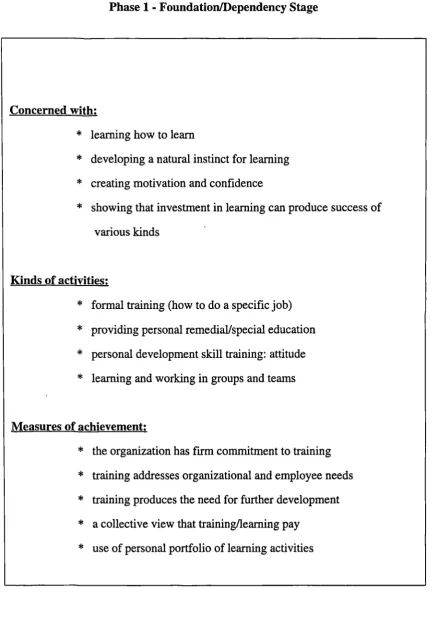
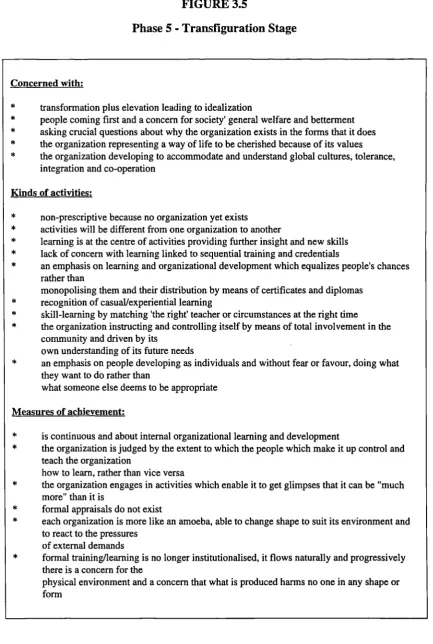
FIGURES 3.1 3.2 3.3 3.4 3.5 6.1 7.1 8.1 8.2 8.3 9.1 9.2 9.3 9.4 Page 50 52 53 55 58 175 237 248 2463 279 307 313 320 325 Phase 1 - Foundation/Dependency Stage
Phase 2 - Formation/Transitional Stage
Phase 3 - Continuation/Independency Stage
Phase 4- Transformation Stage
Phase 5 - Transfiguration Stage
IT(UK)
WUL
Rogers Learning Continuum
IT(UK) Learning Continuum Activity
WUTJs Learning Continuum Activity
The Learning Episode
Learning Stages
Learning Process
A Learning in Organizations Model
DECLARATION
This thesis contains developed aspects of the writer's already published work on learning organizations and adult learning, specifically:
Jones, A.M., and Hendry, C. (1992). The Learning Organization: A Review of Literature and Practice. London: Human Resource Development Partnership
Jones, A. M., and Hendry, C. (1994). 'The Learning Organization: Adult Learning and Organizational Transformation', British Journal of Management, Vol.5, 153-162.
SUMMARY OF THE RESEARCH
This thesis reviews and critically reflects on 'learning organization' theory and practice. Specifically, it reviews and assesses relevant theories of adult learning and links those theories to the learning organization literature. Using existing literature and practice, empirical research work was undertaken in two organizations to validate, or otherwise, key elements of learning organization theory and practice and to identify patterns in the content and process of creating a learning organization. A learning-in-organizations model is then developed which combines learning organization theory and practice, adult learning theory, and the management of change literature. The multi-layered character of the learning-in-organizations model synthesizes key aspects of the learning processes in the organizations studied. The model also provides a framework (a) for research purposes to systematically define and evaluate learning in organizations, and (b) for management, groups, and individuals to use as a prompt or aide-memoire to develop and evaluate learning activity in their organizations.
Key questions guiding the research include: What is meant by 'learning'? How can the complexity of learning be revealed? How can learning in organizations be evaluated? How do responses to the above questions change our understanding of what constitutes a 'learning organization'?
The research is qualitative to reveal more of the subtleties of the learning process at the individual and group levels in organizations. The research process comprises four main activities: a review of existing learning organization literature and practice to identify key proposed characteristics of a learning organization; a documentary search in the two research sites; in-depth interviews in the two research sites; and the writing of case studies and their comparison to reveal learning patterns and processes.
The research shows that much of current learning organization description remains anecdotal and rhetorical. Confusion exists regarding how learning in organizations is developed and assessed. Key learning organization hallmarks and characteristics are often flawed. In addition, defining and evaluating learning in organizations is often carried out in a rudimentary fashion.
This research contributes to learning organization theory and practice: (a) by providing a synthesis and critical analysis of existing learning organization literature, (b) by providing some of the first empirical data on the creation of a learning organization, (c) by linking theories of adult learning to thinking on learning in organizations, and (d) develops a new model for evaluating learning in an organization by linking learning organization theory to andragogy and the management of change literature using qualitative rather than quantitative criteria.
ABBREVIATIONS BBC BS BTEC CEO DWI HMIP HQ HR HRM IT IT(UK) MBA MCI MD NRA NVQ OFWAT PLC RSA SME UK USA WUL WULEC
British Broadcasting Corporation
British Standard
British Technical Education Council
Chief Executive Officer
Drinking Water Inspectorate
Her Majesty's Inspectorate of Pollution
Head Quarters
Human resource
Human resource management
Information Technology
International Trainers, United Kingdom
Master of Business Administration
Management Charter Initiative
Managing Director
National Rivers Authority
National Vocational Qualifications
Office of Water Services
Public Limited Company
Royal Society of Arts, Manufactures and Commerce
Small and Medium Enterprises
United Kingdom
United States of America
Water Utility Limited
Water Utility Limited Executive Committee
CHAPTER 1:
THE LEARNING ORGANIZATION: AN INTRODUCTION
INTRODUCTION
This chapter begins with an explanation of why the writer was attracted to
undertaking a research project on the 'learning organization'. This is followed by a
summary of learning organization antecedents, and a subsequent section highlights
the confusion between the various labels and descriptions being assigned to the
learning organization concept. The aims of the thesis are then provided and the
chapter concludes with a brief statement about the remaining chapters in the thesis.
BACKGROUND TO THE RESEARCH PROJECT
This thesis is about the development of the concept of 'the learning organization'. It
caught the writer's attention at the time it emerged in the United Kingdom as a
potentially influential management concept. Like so many others, however, there was
always the danger that it would be destined to join the ranks of the 'quick-fix, box of
tricks' management applications many organizations adopt in the pursuit of immediate
and successful change initiatives.
What captured the writer's interest was the emphasis on 'learning'. Having always
been interested in education, and especially how, when and why people learn, I was
immediately attracted to some of the commentary which was starting to emerge from
the learning organization literature, albeit in the form of popular management
journals.
Having trained as a teacher, and having been involved in education and training for
most of my career, I had always been intrigued by the education system as it has
evolved in Britain - a system which essentially has excluded the vast majority of
people from access to higher education. I was also concerned for the near two million
people who have left school, who are currently in the work place, and have severe
learning problems. It is estimated that in the United Kingdom there is an adult
population the size of the population of Greater Manchester unable to read and write
properly (Rogers, 1986), and many of these are in the work place. Thus, who has the
responsibility for the employed and unemployed, for ensuring basic skills are
acquired and developed? The learning organization project came initially as an
opportunity to explore some of these issues and concerns in post-school
environments.
My initial work at the Centre for Corporate Strategy and Change at the University of
Warwick focused on training and development in small-to-medium size enterprises.
In this work I found a number of organizations genuinely seeking to adopt more
flexible working environments based on greater employee participation. In many
cases human resource management was replacing the more prescriptive personnel
management approaches to employee development, with its focus on administration
and industrial relations. A number of organizations were actively starting to engage
with a range of additional activities which included corporate governance and
organizational purpose and values.
At the same time there was an increasing questioning in the United Kingdom about
the role of organizations vis a vis training, competition, and social responsibility. The
Royal Society of Arts, for example, was promoting an initiative that paying attention
to learning and development produces dividends for people and organizations as a
whole, and that people development was necessary for the future of society in general.
A number of management writers were also propounding fairly extravagant claims as
to how organizations should change and manage themselves - for example, Lessem
(1990, 1991); Senge (1990); and Peters (1992).
Against this background a decision was taken to engage with a research project which
would investigate: the origins of the learning organization idea in both existing
literature and practice; how these ideas and practices were being developed and
implemented; whether there was any substance in the notion of the learning
organization; and the extent to which the idea added to, or detracted from, existing
understanding of how organizations operate and develop their people.
THE DEVELOPMENT OF THE LEARNING ORGANIZATION PROJECT
Initially, the term 'learning company' emerged as a description of mainly commercial
firms which were engaging in change processes, especially in relation to human
resource management. Ideas about learning developed particularly during the 1960s
and 1970s, and were much informed by writers such as John Gardner (1963) who
coined the term 'self-renewal' and Lippitt (1969) who described development as
'organizational renewal'. Chris Argyris and Donald Schon (1977, 1978) subsequently
introduced the idea of a 'learning system' and in the 1980s the link between learning,
training, and company performance was further developed, with a range of
new-action-learning concepts and ideas from Hedberg (1981), Revans (1982), and Morgan
(1983, 1986). The work of Pettigrew (1975, 1985) and Pettigrew and Whipp (1991)
has further informed and widened the debate about organizational learning, corporate
culture, and strategies for change. More recently, the learning organization idea has
focused on the self-development of employees in the workplace (Pedler, Burgoyne,
Boydell and Welshman, 1990; and Pedler, Burgoyne, and Boydell, 1991).
The late 1980s and early 1990s has seen a shift towards making a clearer link between
training, development and human resource management on the one hand, and
company performance and competitiveness on the other. Companies and managers
have been forced to consider how they should train employees to equip them with the
skills to manage more effectively and to cope with a range of new production and
marketing objectives. In addition, advanced technology, which is also a driving force
in creating rapid change, is impacting on many organizations resulting in an appraisal
as to exactly how people should organize their work. The way in which information
flows, and how it is collected, stored and accessed is a further catalyst for change
which is producing new work practice methods (Macdonald, 1994 forthcoming).
The 'Total Quality Management' (TQM) concept has also been an important factor in
broadening approaches to training and company learning, linked to the view that
organizations that have to focus on superior product and service adopt different
managerial approaches and establish better means of organizational communication
(Macdonald, 1994 forthcoming). People learn as they do their work and this'
experiential learning seems to be a key issue in understanding how firms can more
readily utilize on-the-job learning (Rogers, 1986).
IMPACT OF THE SHELL OIL COMPANY IN SPEARHEADING THE CONCEPT
In the late 1980s Shell began to question its own systems of internal communication
and employment structures. There began an internal questioning about the techniques
and processes of strategic planning (De Geus, 1987). Shell came to the realization
that managers had to work together in more collaborative ways. Team-work, and a
greater sharing of information, were seen to be crucial factors in creating a more
coherent and cohesive organization. Shell spent twelve months, using workshops and
discussion groups, researching the implications of the learning company idea. In so
doing, they helped spearhead the concept into the more general public and
commercial domains.
Shell concluded that strategic planning consists of learning about the environment and
people having a total view of the business they are engaged in. If more could be
understood about how this learning process occurred, particularly with respect to
learning in teams, ways might be found of speeding it up. The firm further concluded
that a company which can accelerate its learning so that it gained a year or so on its
competition, ought thereby to gain valuable commercial advantage.
Shell has not been alone in seeking new ways and means of creating commercial
advantage. Rover, Cadbury Schweppes Plc, Cable and Wireless Plc, Sun Alliance
Group Plc, Digital, and a number of health authorities, are just a few organizations
which have begun to put in place new training and organizational techniques which
focus on individual and group learning - or at least education and development. In
addition, some of these, together with a variety of other organizations, have begun to
question prevailing organizational structures and practices and have funded national
projects which have, as their main generic theme, that of re-thinking what
organizations are going to be like in the future- for example, Whitbread Plc, Thorn
EMIl Plc, Anglian Water Plc, and British Gas Plc all contributed to the Royal Society
of Arts inquiry 'Tomorrow's Company: The Role of Business in a Changing World'
(1994).
TIlE IMPACT OF MAJOR REPORTS
The most current developed example of new thinking about organizations in a social
setting is probably the Royal Society of Arts 1994 report 'Tomorrow's Company: The
Role of Business in a Changing World: The Case for the Inclusive Approach'. This
focuses on organizational purpose and values, the need to address all an organization's
stakeholders, the responsibility to society at large, and the need to measure activities
and relationships across all an organization's activities, not simply the financial and
production ones.
Similar ideas also underpinned the 1992 Cadbury Report on corporate governance,
albeit that this focused more on financial responsibility. Cadbury highlights the need
for greater vigilance and diligence in how organizations look after their assets and
their people. This has meant a greater focus on ethical and moral issues in how
organizations do business and generally operate in terms of obligations to employees
and shareholders.
In the 1993 January/February edition of the RSA Journal, Sir Anthony Cleaver
(1993:82) as Chairman of IBM United Kingdom and Vice-chairman of the Royal
Society of Arts steering committee leading the inquiry into 'Tomorrow's Company',
outlined the concerns for the future:
The more-single minded business becomes in recognizing that there is no protection against the accelerating pace of global competition, the more it has to understand that all its stakeholders need each other. Few businesses can flower in an educational desert; few markets will grow in communities where the social fabric is cracking, and all business prospects are undermined if some companies destroy customer confidence by irresponsible behaviour.
Cleaver concludes that all organizations, whether in the public or private sector, need
to focus on a series of questions to help them widen their understanding of the
complexities of society of which they are a part. One of the key questions is the
extent to which organizations measure and report the right things, and over what
length of time.
THE LANGUAGE OF THE LEARNING ORGANIZATION
One other important issue must also be addressed at this point. Theorists and
practitioners alike regularly move from using 'learning organization' to 'organizational
learning' and this has created confusion which this writer does not believe assists
current learning organization development. The advent of the term 'learning
organization', and the work and activity it has produced, should have made a much
clearer distinction between these two descriptions. Indeed, a recently published book
by Thurbin (1994) entitled 'Implementing the Learning Organization: The 17 Day
Programme', is being marketed thus:
Implementing the Learning Organization is an exciting and practical guide to the discovery and implementation of organizational learning. Organizational learning creates the underpinning for major strategic change programmes such as Total Quality and Process Re-engineering as well as the more conventional Operational Management improvements.
What then is the distinction and do the two descriptions mean one and the same
thing?
Organizational Learning
The term 'organizational learning' was seemingly first used by Cangelosi and Dill
(1965) although it could also be argued that the notion, if not the actual phrase, lies at
the heart of the work of Cyert and March (1963). Nonetheless, it has been
subsequently indiscriminately used by a range of people who have sought to develop
the term. These include Argyris (1977, 1978), Hedberg (1981), Fiol and Lyles
(1985), Levitt and March (1988), and most recently Carley (1992). There is
insufficient space here to quote extensively from these and other writings but
throughout their work the majority of writers change the focus of what 'organization'
means at any given time when describing learning process and content. As Leymann
(1989) observes:
It is quite obvious that 'organization' sometimes is used as a synonym for 'the leader in power' and sometimes for a communication pattern
between people which binds behaviour to old customs.
Leymann questions the usefulness of 'organization' and 'organizational learning'
descriptions and concludes (1989:286) that they:
mystify what is going on in an organization and the applicability of organizational learning descriptions is dubious.
Some four years earlier Fiol and Lyles (1985:803) had highlighted this same issue and
again observed that there was still no accepted theory or model of organizational
learning. Most recently, and in very blunt fashion, Weick (1991), Huber (1991), and
Simon (1991) have again stressed the need for a developed theory:
Without working toward a higher level of consistency in terminology than prevails in organizational theory today, it will be difficult or impossible to culminate and assemble into a coherent structure the knowledge we are gaining from individual case studies and experiments.
(Simon, 1991:133)
• . . scholars of organizations have developed theories that not only don't work for them but won't work for others.
(Weick, 1991:116)
Inconsistent terminology applied to comparable concepts, disagreement on how the phenomenon should be defined and a lack of cumulative work and synthesis.. .has plagued and impeded . . . .progress.
(Huber, 1991:88)
The advent of the learning organization concept has added to this confusion, and
because different people are tending to look at learning in different organizational
contexts the confusion is likely to get worse. If nothing else, the learning
organization idea should be acting as a catalyst to speed up evidence and debate as to
exactly which terminology and research contexts should be investigated or
abandoned.
There appear to be two main strands discernible in the literature as to how
organizational learning is perceived. On the one hand learning is seen solely as being
in the heads of individuals with organizational learning being the sum total of
individual and group learning (March and Olsen, 1976; Simon, 1991) and on the
other, learning is seen as being an integral part of an organization, irrespective as to
whether people come and go (Argyris and Schon, 1978: Weick, 1979; Duncan and
Weiss, 1979).
The concept of organizational learning being centred on an organization's memory
which preserves mental maps, behaviours and values over time in such things as rule
books, seems hardly sustainable. In the management literature it has led to the
present disarray which surrounds the organizational learning/learning organization
labels. It is people who sustain behaviour patterns and values. People accept what
they find when they arrive in an organization, either because they wish to do so, and
are attracted to the contexts and activities which already exist, or because they are
indoctrinated with them, or they accept them simply to survive (Macdonald, 1994).
To infer that somehow an organization learns is surely an oxymoron (Leymann,
1989). The position has been recently further complicated by attempts to use the term
'interorganizational learning' (Pucik, 1988; Crossan and Inkpen, 1992).
The lack of a devolved and sound theory of organizational learning rests on theorists
and organizations' inability to focus on tht conttct, pocts, xc! co t.0f
specific situations (Cullingford, 1990). Current theory is also very end-result focused
rather than process centred. Failure to focus on the complexity of learning and to
define more precisely a theory of adulthood learning has resulted in this unsustainable
theory of organizational learning (Leymann, 1989). The learning organization
concept is faced with the same problem.
In the writer's view the difference between (a) organizational learning and (b) learning
organization is that (a) implies an organization learns, and (b) refers to the
organization as a site where (individual and group) learning takes place. The former
is dubious; the latter more valid. Thus, an organization can be designed, systems
created, and a climate developed where the organization is more conducive to
individual and group learning. In turn, this may make the organization more
effective.
In developing this thesis, therefore, use of the phrase organizational learning is
deliberately avoided in an attempt to discover whether the distinctive term 'learning
organization' is a sustainable additive concept for management theory and practice.
THE SPECIFIC AIMS OF THE THESIS
Against this background, the research work and resulting thesis have these specific
aims:
(1) To review and critically reflect on the research and writing on learning
organization theory and practice.
(2) To review and critically assess relevant theories of adult learning.
(3) To link theories of adult learning to the learning organization literature.
(4) In the context of the very minimal empirical research which exists in this area,
to conduct limited empirical research work in two organizations.
(5) To identify patterns in the content and process in creating a learning culture in
two organizations.
(6) To develop a model of learning in organizations which will inform future
research and practice.
CONCLUSION AND SUMMARY
This research project looks at two organizations which sought to engage with the
broad issues of developing a learning organization culture. The account of this
engagement forms a central focus of the thesis. However, it is not yet clear what a
learning organization consists of, the circumstances which trigger its creation and
development, whether change is involved and if so, how change is implemented.
Chapters 2 and 3 therefore concentrate on providing a critical analysis of the
theoretical background of the learning organization concept, and its application in
organizations. Chapter 3 provides a five phase model for understanding or
developing a learning organization, with the proviso that in reality most organizations
are likely to operate across a number of these phases at any one time as they
concentrate on different activities.
Chapter 4 reviews and analyses what we know about adult learning and illustrates that
much of what goes on in organizations, and which passes for learning, is misplaced
because it is not based, or practised, on any kind of learning model. Chapter 5
outlines the research process - that is, how the research as a whole was approached
and developed, and how the data was collected and analysed. Chapters 6 and 7
present the two case studies and report how each organization developed the learning
organization idea.
Chapter 8 offers an analysis of the case studies and provides some comparative
comment structured around Rogers (1986) approach to learning as training,
indoctrination, and choice. Chapter 9 develops a model to assess learning in
organizations and the link between learning and change. Chapter 10 provides a
summary of the thesis, suggests some broad themes arising from the case study
research, and additional future research themes.
CHAPTER 2:
THE LEARNING ORGANIZATION: A REVIEW OF LITERATURE AND PRACTICE
INTRODUCTION
As noted in the introductory chapter to the thesis, there is at the present time a growing
interest in alternative and innovatory styles of training and education, and how these can
be harnessed to improve company performance and comp tivenc&c. Oize of the more
innovatory concepts is that of the learning organization'. However, it is not yet clear
what a learning organization consists of, the circumstances which trigger its creation and
development, how change is then implemented, and what the benefits are to the
organization and the people who work within it. There is a need, therefore, for a critical
review which looks both at the concept of the learning organization in principle and
identifies attempts to implement it in practice.
The aim of this chapter is to review the theoretical literature, and practice arising from it,
to determine what is currently known about the following issues:
(a) what a 'learning organization' is; and
(b) what a 'learning organization' looks like in theory and in practice.
This review of literature and practice has therefore the following specific objectives.
First, it defines and analyses what a learning organization is and provides examples of
organizations which appear to be and/or have declared themselves to be a 'learning
organization'. Secondly, it identifies the characteristics and measures by which an
organization may be defined as a 'learning organization', including the means of assessing
personal performance and the performance of the organization as a whole. Thirdly, it
identifies both individual and group learning which results from implementing the
'learning organization' concept.
WHAT IS A LEARNING ORGANIZATION?
Background
Chapter 1 describes the influences and circumstances which have generated an interest
in, and concern for, the learning organization idea, but it has been developed further by
Mike Pedler, Tom Boydell, and John Burgoyne in a report they wrote in 1988 for the
Training Agency/the Department of Employment. The resulting report offers a short
definition of what a learning company is:
an organization which facilitates the learning of all of its members and continuously transforms itself
(1988:3)
The report concludes that:
At the present we know a lot about providing individual learning.., albeit still rather in the 'training' than the 'developmental' mode, but our knowledge of how to gather together the fruits of all this individual learning to enhance... the generic problem solving capacity of the organization is rudimentary. The great challenge of (the) Learning Company is to learn how this can be done.
(1988:3)
The notion of the learning organization' came to prominence in the USA,, where it was
coined by Hayes, Wheelwright, and Clark (1988), at roughly the same time as it dId in
the United Kingdom.
Each group of writers present different perspectIves which provide a framework for
developing the learning organization concept. However, for the purposes of this review
and research project, and in order to widen the scope of the analysis, the term 'learning
organization' rather than 'learning company' has been used. Much of the work which has
been developed to date concentrates on the idea of the learning company' but this term
has too many associations with industry and commerce - that is, manufacturing and
service industries which, in the main, exist to make money for profit. Many
organizations in the public and private sectors exist primarily as service orientated
activities - for example, local authorities, schools, and hospitals. They are not essentially
in the market to generate profits for shareholders or stakeholders, yet seek to address
issues of major change linked to learning. Therefore, by using the term 'learning
organization' this review seeks to evaluate and comment on any type of organization
which purports to base its activities around learning.
To conclude this section, and in fairness to them, it must be stated that Pedler, Burgoyne,
and Boydell (1991) have since brought out a book with the title 'The Learning Company'
In it they explain that they continue to use the term 'learning company' because their
emphasis is on self-development in organizations and how people collectively learn - that
is, in 'company' with one another.
Some definitions of the 1earnin organization
A learning organization:
is an organisation which facilitates the learning of all its members and continuously transforms itself
(Mike Pedler, Tom Boydell, and John Burgoyne, 1988)
facilitates participative (horizontal) and innovative (vertical) development within and between people and institutions, commercially, technologically and socially. It thereby transcends not only the business enterprise but also the hierarchical institution.
(Ronnie Lessem, 1990)
build(s) and continually renew(s) its competitiveness in alifunctions.
(Robert Hayes, Steven Wheelwright, and Kim Clark, 1988)
actually alter(s) the way in which we work.
(Richard Penn, 1990)
is a lot of people learning.
(Geoff Gaines, 1990)
is one which the general management style is to delegate responsibility in an attempt to foster employee involvement, personal initiative and generate effective internal communications.
(Smythe Dorward Lambert, 1991)
may be just another label for 'good practice'.
(Sir Christopher Ball, 1991)
emphasizes adaptability (which is) the first stage in moving toward learning organizations. This is why leading corporations are focusing on generative learning. which is about creating, as well as adaptive learning. which is about coping.
(Peter M Senge, 1990)
These sample definitions provide some indicators as to what a learning organization is
thought to be about. Some of the key themes or descriptors are:
• transformation, change, participation, innovation
• altering the way people work, adapting, management style
• delegation, fostering employee involvement
So, is a learning organization one which adopts one or more of these characteristics, or is
it something different which these descriptions fail to capture?
The 1988 Ashridge report by Barham, Fraser, and Heath perceives learning organizations
as those where training and personal development are an integral part of the organization
and where learning is a continuous process, rather than being a bolted-on activity at
various points in an individual's career. On-the-job learning is a natural aspect of every
day working life and the writers emphasise that learning about learning itself becomes a
key aspect of experiential learning.
Garratt (1987) initially came to more or less the same view as the writers of the Ashridge
report, seeing the focus of the learning organization centred on a hierarchy of 'policy',
'strategy' and 'operations', all interacting with each other and providing a double-loop of
learning which allows information to flow freely throughout all levels of the
organization, and with the direction-givers firmly at the centre rather than at the top of
the organization. He subsequently modified this view (Garratt, 1990), and came to the
conclusion that information flow is subject to what he describes as 'organizational
folklore' which can reduce the value of generated and collected information. For Garratt,
the main focus of creating a learning organization lies with managerial levels of
responsibility. He presents his learning organization in terms of a three-level hierarchy at
the centre of which are 'learning leaders' who chart the organization's strategic learning
and change processes. Garratt's view of the learning organization remains mechanistic
and based on orthodox models of levels of management where people are led rather than
encouraged to learn to be leaders themselves.
Edmonstone (1990) maintains that the Ashridge perception of the learning organization
overlaps that of Pedler (1987) and concentrates on corporate culture, strategy, structure,
and the individual employee. He concludes that the majority of writers seem to view
learning organizations as having general organizational strategies related to learning;
promoting second-order change/double-loop learning through reframing; and having
structures or cultures which enable learning to happen and harness it towards
organizational ends. He accepts, however, that the concept of the learning organization is
not yet well-defined.
Learning organization definitions: an analysis
The professional and academic literature, from which the sample definitions quoted
above are taken, provide some model characteristics of the learning organization. On the
one hand, the learning organization would seem to describe those organizations which
are making themselves flatter, taking out levels of management, providing greater access
to training (formal and informal) for the work force, and generally motivating personnel
at all levels within the organization to create a shared vision.
There is then a second aspect to the learning organization where an organization provides
greater openness, flatter structures and, in addition, implements these kind of activities to
unlock the hidden knowledge and skills which exist within the organization.
Collectively, this knowledge and skill base is traditionally often termed 'organizational
learning'. Organizations which are at this second level of development are concerned
with individual and group development (in terms of increasing skills and knowledge)
p]jj what perhaps can be termed 'hidden learning' or 'institutionalised learning'. Other
writers have also termed this 'organizational capability' (Pettigrew and Whipp, 1991).
Hidden or institutionalized learning is that skill and knowledge which people acquire and
develop in the course of actually doing their job. Although specific job descriptions and
practices may be produced by an organization, in reality there is a hidden agenda of
activity. People adapt what they do and how they do it, to accommodate their own level
of comfort within the organization and, as importantly, they make these adaptations as
the requirements for performing a particular job change because of market trends,
changing customer requirements, and so forth. As Whipp (1991) concludes:
Learning.., refers to how those within firms collectively change their knowledge, values and shared mental models of their company and its markets.
A third stage in the learning organization development cycle also seems to be present.
Having passed through the previous two stages which enable an organization to produce
better lines of communication, engage in project and other innovatory work, and, to
change management practices, and having unlocked collective learning within the
organization, it then becomes as important to engage in new forms of research and
development to determine how the organization needs to shape up for the future. This
results from what Brown (1991) calls 'corporate research'.
corporate research must protolype new mental models of the organization and its business. The successful company of the future must understand how people really work and how technology can help them work It must rethink traditional business assumptions and tap needs that customers don't even know they have yet.
For Brown and the Xerox Corporation, of which he is a corporate vice-president, the
learning company cannot simply tell or ask people what is going to happen to them in the
future. They need to experience it. To this end Xerox is developing 'envisioning
laboratories' which permit computerised simulation exercises to be experienced not only
by Xerox employees but also by the customers they serve. So, within the emerging
developmental model of the 'learning organization', there are actors or players who, as a
result of advanced technology, are taking leading roles in dictating what other
corporations may do in terms of organizational development.
This 'envisioning experience' combined with, at a more mundane level, flatter and more
open organizations, may well create a tension within organizations which results in
employees asking more searching questions of a social, ethical, moral, and personal kind
related to the purpose of work and the nature of society in general - a theme which has
underpinned the self-development work of Pedler, Burgoyne and Boydell for almost a
decade. In the past, the workplace has been a major focus for many people in their social
and personal development, developing and fulfilling a whole range of nee3s t1zrovg)2
personal interaction. As old values and ways of doing things disappear, new activities
challenge deep-rooted assumptions, and create what people will at first perceive as a
disruptive tension.
The idea of 'disruptive tension' provides the bridge to what is perhaps the most difficult
concept to grasp about the learning organization. The bridge to be built is between the
developmental and mechanistic descriptions about the learning organization on the one
hand, and the more philosophical definition pto'ided by Pedlet, Boyct,
on the other. Their definition of a learning organization has been consistently used,
especially in the UK, by those who seek to create a more structured model for the
concept. Herein lies the problem. The learning organization concept is being viewed as
a 'new frontier', and as something which has 'a lack of clarity about what it looks like'.
Yet, the many writers who propound this somewhat nebulous concept often fall back into
describing the learning organization in fairly mechanistic ways - that is, they tend to
revert back to first stage descriptions of the learning organization rather than exploring
the more intangible characteristics of a 'true' learning organization. The conclusion, then,
is that the learning organization needs to be endowed with a greater degree of substance
or integrity. What this substance is, and how it can be effectively introduced into
organizations, is an important aspect of this thesis..
The Learnin2 Organization: some questions
The learning organization definitions presented thus far pose a series of questions which
remain unanswered. They include:
• What is 'learning'?
• What do we mean by 'organization'?
• Are there types or levels of learning and how are they recognized?
• How does the organization facilitate and inhibit learning?
• What is it that is transformed?
• When is an organization transformed and why?
• How is an organization transformed, if at all?
Responses to the first four questions are provided in this chapter and chapters 3 and 4.
Chapters 8, 9 and 10 provide responses to the final questions.
CHANGING ORGANIZATIONAL PERCEPTIONS
The purpose of this section is not to provide an historical account of organizational
theory. The aim is to draw attention to some of the forces which may change not only
the shape of organizations but also widen our view as to what an organization is like in
terms of its operational contexts and in this sense picks up the theme of chapter 1.
Radical theory in terms of describing organizations and what they do is for some people
at the heart of the learning organization concept. The ways in which organizations are
depicted are deemed to be insufficiently radical. Morgan (1989) provides excellent
summaries of organizational descriptions and himself poses the challenge of how the
parts of the organization which make up the whole can learn to act like the whole and
thus create new whole organizations. Issues of gender, environmental contexts, and
language are, for Morgan, all new concentrations which will impact on how
organizations in the future are described from a theoretical view point.
These are some of the issues to do with the rethinking and awareness activities which are
emerging as part of the learning organization portfolio. Of particular importance are:
organizational contexts, the role of risk, learning and change, and corporate responsibility
- issues this chapter analyses in greater detail.
Changing organizational contexts
As has already been noted, new ways of describing organizations are now replacing the
orthodox models and theories of Taylor, Fayol, Weber, and others - for example, Senge
(1990) and Lessem (1990).
Peter Senge begins to provide greater depth of understanding about learning in his book
The Fifth Discipline: The Art and Practice of the Learning Organization. He maintains
that it is now necessary to think more carefully and more deeply as to what is meant by
learning and organization. His work challenges readers to be prepared to be more
theoretical. He states:
The most accurate word in Western culture to describe what happens in a Learning Organization is one that hasn't had much currency for the past several hundred years. The word is 'metanoia' and it means a shift of mind. To grasp the meaning of 'metanoia' is to grasp the deeper meaning of 'learning'. For learning also involves a fundamental shift or movement of mind.
(Senge,1990: 13)
In other words, he is emphasising looking beyond the immediate context by which
organizations are conceived, shaped and managed, and he challenges people to dare to
ask why organizations exist as they do.
Morgan (1989) picks up Senge's theme in more concrete terms. He challenges his
readers to look beyond the immediate, to consider looming problems, and to envisage
ones which, as yet, do not exist. For example, he explains how human exploitation may
give way to human uselessness as modern technology radically changes production and
communication. lEn turn, what organizations are going to be like, and how they are going
to be described, will need to be different to those models which management theorists
have provided in the past. Morgan argues that new organizational models are likely to be
based more on communication and information systems and less on describing how
people interact. How information is created, stored, accessed, communicated and
interpreted will be the cornerstone of new descriptive models of organizations
(Macdonald, 1994 forthcoming). Such a change will require a massive attitude shift
-that is, 'metanoia' (Senge, 1990). This will produce discomfort and may result in
organizations and individuals simply falling back on old ways of doing things because
orthodoxy provides comfort. As Morgan concludes:
• . .most workers believe in the validity of the very arrangements that waste their lives....
There are signs that some organizations - Rover, for example - are developing a wider
sense of their own organizational contexts. The firm now proclaims its first customers
are the people it employs. To keep the workforce, to prepare it for the years ahead, and
to give employees a stake in their own future, Rover believes it must invest in employee
development, based on both company and employees' needs. The second customers
Rover serves are those people to whom the firm sells cars. Rover also intends to involve
its retail outlets in its education and training scheme. The merger with BMW cars in
Germany will determine whether this policy will continue.
However, here is an example of how one firm's ideas about its organizational and
operational contexts have been adapted and widened to accommodate activities which,
hitherto, have been excluded. Such adaptation and expansion of the context in which an
organization operates will demand different structures and sets of activities. The
challenge now is to determine what that shape will be like. There is already some
evidence that Rover's new policy is having results. A report in 'The Times', November
11, 1991 (page 24), relates how Rover took more than 3,000 employees off the assembly
lines and out of offices and sent them to study management and assembly techniques in
companies around the world. They are not just concentrating now on car production.
Employees visited Sony, Sainsbury, and Honda. Rover saw the value of this expense
showing results in the production of its new Rover 800. This new version was designed
and built in just 24 months, compared with the usual 39-month lead time at Rover. This
new 24-month lead time compares favourably with the 35-month average for Japanese
car producers. Rover looked seriously at the processes required to produce a car. The
result was the scrapping of various functions and a merging of design and manufacturing
processes so that faults were ironed out as they happened. By bringing together a project
team representing all the major functions there was a ten per cent saving on development
costs. Rover is now generally able to deliver this new car from assembly line to the
showroom within 48 hours of an order being received.
As a second example, Xerox is developing technology which will do at least two new
things for its customers. First, it is producing new equipment which will greatly change
administrative and information handling roles, and probably customers t organizational
structures. Secondly, using the technology being developed, Xerox will be able to
simulate for other organizations how its equipment 'I%L tnangt 'hzt ,
(1991) indicates:
The most important invention that will come out of the corporate research lab in the future will be the corporation itself. It must design the new technological and organizational 'architectures' that make possible a continuously innovating company.
Risk learning and change
A further theme is beginning to emerge which is 'holistic' in principle, and which takes
account of the consequences of action. Where an organization concentrates on its total
activity, and addresses issues of how these impact on a whole variety of external and
internal organizational issues, then different systems and structures begin to emerge.
However, what seems to be crucial in this change process is the ability to take risk.
Further, as people and organizations begin to look more globally at what others are doing
they are likely to have to address issues which go beyond those concerned with work,
production and organizational systems. Cross-cultural fertilization may become of major
importance and a mind-shift is likely to be required in terms of many of the contingency
factors which influence and shape people's lives (Kanter, 1985). How business is
obtained and practised in other cultures, how the working day is organized, and how
organizations are managed and operated appear to be just some of the new contexts
which are influencing how organizations operate and develop. Wider issues concerned
with such things as the environment, pollution, and where and how organizations should
invest money, are also some of the new contextual issues organizations are facing, as
people begin to exert a greater influence on those things which shape their lives.
Thus, the literature and current practice of the learning organization indicate that there
are events, situations, and activities which trigger change and transformation. However,
these cannot be viewed in isolation. The contexts in which change and learning occur,
and the processes by which it is achieved, are key issues. In other words, looking
holistically at what happens in organizations is likely to provide richer and more
authentic analysis and information.
Holism and the learnin g organization
Senge (1990) indicates how this holism can be generated and identifies what he calls five
disciplines as the key characteristics which everyone must develop if they wish to create
a learning organization capable of facing the challenge of making sense of emerging
complexity. The five skills or characteristics, together with what he means by each of
them, are:
1. Systems thinking: Everyone must learn how to view things as a whole and that
one set of events impacts on others.
2. Personal mastery: For Senge this is 'the discipline of continually clarifying and
deepening.. .personal vision, of focusing.. .energies, of developing patience, and of
seeing reality objectively. As such, it is an essential cornerstone of the learning
organization - the learning organization's spiritual foundation.'
3. Mental models: These are about 'learning to unearth...internal pictures of the
world, to bring them to the surface, and hold them rigourously to scrutiny.'
4. Build a shared vision: This is about everyone holding a shared vision for the
future. For Senge 'leadership' is the key to creating and communicating the
vision. However, he sees leadership being about creating structures and activities
which relate to a person's total life activity. The leader creates vision but is
prepared to have it reshaped by others.
5. Team learning: Teams, not single individuals, are the key to successful
organizations of the future, maintains Senge, and individuals have to learn how to
learn in the context of the team.
Acknowledging the extravagant language used by Senge it is nonetheless true that much
of what he says may be correct. However, there are other skills as well. He omits some
important processes or elements in the creation of a learning organization. They are:
changing power structures, leading change, providing an early role model for success,
and expressing concern for social and ethical issues - that is, responsibility (Pedler,
Burgoyne, and Boydell, 1991; Pettigrew and Whipp, 1991; Tjosvold and Tjosvold,
1991).
These observations are also borne out by a number of commentators, most notably
Kanter (1985), who observes that the most successful firms she studied in the USA put an
emphasis on people development and involvement. They 'always operate at the edge of
their competence, focusing more of their resources and attention on what they do not
know....than on controlling what they already know' (1985:27). She also notes the
importance of a 'shared philosophy' and 'family feeling'. These cannot be simulated or
imposed artificially because top management want to cascade this type of organization
style throughout the organization. 'It has to derive from the way work is done.'
(1985:32). Like most British organizations, American firms are guided by a preference
for the way things have been done in the past rather than how they may be done in the
future. Successful organizations are those which know which parts of history to
accommodate and retain whilst at the same time moving forward to an unchartered future
- that is, learning how to take risk.
Kanter points out that there is not 'a single mould out of which innovative companies are
formed' (1985:131) and that change and transformation in organizations results from any
one of a number of activities or circumstances. This is to recognize that the impetus for
creating a learning organization may come from a variety of sources.
Changing nower structures
Kanter and others have shown that the influences creating change and new learning
include environmental pressures, government legislation, social forces, and industry
competition. In addition, change may be generated by individuals within organizations at
senior and middle management levels. Kanter points out though that successful change
and learning occurs only when change activities focus on both immediate and long-term
issues but this means recognizing that responsibility for issues and change, although it
may begin with management, belongs to others and that real change can only occur if
those who can make it happen have the authority and permission - that is, they are
'empowered'- to make it happen. Change for Kanter is therefore about change in power
structures.
For Kanter a learning organization then, is one which is able to re-assess its
understanding of roles and distribution of power.
This means, in turn, that things like job descriptions are seen as inadequate instruments
for organizational effectiveness. The learning organization is about having the ability to
raise questions about what is done, when, how, where, and by whom. This requires
totally new skills because it threatens the organization's very structures. Organizations
which engage in cost-cutting and other pruning exercises, and indulge in 'total quality
management' (TQM) type practices are not necessarily engaging in creating learning
organization characteristics if they are unable to create tension situations and ask
questions about the organization itself - seemingly an increasingly important aspect of
learning organization practice (Kanter, 1985; Senge, 1990).
However, Kornbluh and Greene (1989) question the motives of senior management, and
those behind change and innovation processes, noting that management interest in worker
participation, with a focus on democracy, tends to appear from time to time when it suits.
It may well be nothing more than a form of current organizational control (March 1988
and 1991) and because innovation often involves risk (Kanter, 1985; 1989) senior
management's inability to handle this shifts the focus of risk development to middle
management through notions of empowerment (Kombluh and Greene, 1989).
Leadershin
Kanter also found that the most successful companies often have to buy-in an original
entrepreneur and that large organizations cannot readily accommodate someone who
wishes to break down barriers and change management styles. The most successful
entrepreneurs are seemingly to be found in small enterprises (1985:23) where the
emphasis becomes one of collective responsibility rather than on departmental
organization effectiveness. The successful entrepreneur focuses attention not on
himself/herself but creates and generates a team capability. This same point is
highlighted by Pettigrew and Whipp (1991) who refrain from using the word 'leadership',
and concentrate on what they term 'leading change'. This is an important distinction
because it helps to focus interrelated issues and activities which are the result of team or
group led initiatives. For the learning organization then, the task is to create leadership
(individual) leading to 'leading change' (collective) and entrepreneurism in others.
Leading change
A further key issue in creating a learning organization seems to be not just effective
change but the variety of 'leading change' and how it is acquired, used, adapted, and
refined. What is new here is the importance of re-defining or expanding the idea of
leadership, for as Pettigrew and others have noted it seems to be about the ability 'to
influence' (1985:426) 'in a quiet and sustained way.' Pettigrew (1985:426) notes that
Harvey Jones' ability to lead at ICI rested in '...persistence, patience, the capacity to see
where they wanted to be but to make small additive moves in the desired direction.'
Regarded by many as being one of the generalist professional management gurus of the
day, Moller (1991) indicates that there is only so much management can do to empower
people. For him an organization can only learn and develop if there is 'shared
responsibility'. This means making links between work and what happens outside of it.
In turn, he believes that 'employeeship' is an aspect of leadership - that is, stewardship or
leadership of self is something every person can improve on through personal
relationships and communications with people at work, and in society at large, but it has
to be encouraged and developed. Employeeship as part of leadership is, for Moller, a
crucial aspect of the learning organization.