University of Warwick institutional repository: http://go.warwick.ac.uk/wrap
A Thesis Submitted for the Degree of PhD at the University of Warwick
http://go.warwick.ac.uk/wrap/36869
This thesis is made available online and is protected by original copyright. Please scroll down to view the document itself.
A Mobile Context-Aware Learning Schedule
Framework with Java learning objects
by
Jane Yin-Kim Yau
A thesis submitted in partial fulfilment of the requirements for the
degree of Doctor of Philosophy in Computer Science
University of Warwick, Department of Computer Science
Contents
List of Tables and Figures ix
Acknowledgements x
Declaration xi
Abstract xiv
1 Introduction 1
1.1 Background 1
1.2 A definition of mobile learning 8
1.3 Advantages and limitations of mobile learning 11
1.4 Structure of the thesis and the research questions 13
1.5 Publications in relation with the thesis content 21
2 Literature Review 23
2.1 Introduction to the m-learning generations 24
2.2 The non-adaptive m-learning generation 25
2.3 The ‘learners-preferences’-based adaptive m-learning generation 26
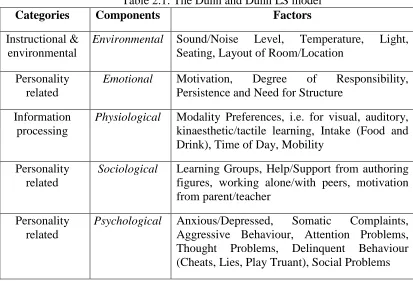
2.3.1 The concept of a ‘learning style’ 30
2.4.1 The concept of a ‘context’ 34
2.4.2 The concept of a ‘learning context’ 36
2.4.3 Deployment of learning contexts within m-learning applications 41
2.4.4 Advantages and challenges of deploying learning contexts 45
2.5 The ‘learning-contexts’-based adaptive m-learning generation 47
2.6 The ‘learning-contexts’-aware adaptive m-learning generation 54
2.6.1 Context-aware location independent m-learning applications 56
2.6.2 Context-aware location dependent m-learning applications 58
2.6.3 Context-aware situated learning m-learning applications 60
2.7 Other m-learning applications 61
2.7.1 Mobile learning organizers applications 62
2.7.2 Self-regulated learning strategy and applications 65
2.7.3 Java e-learning and m-learning applications 67
2.7.4 LOs and their applications 68
2.7.5 Supporting knowledge workers ‘on the move’ 72
2.8 Evaluation methods for m-learning applications 74
2.8.1 Evaluation methods from a pedagogical perspective 76
2.8.3 Evaluation methods from a technological perspective 80
2.9 Psychology literature relating to the learning process 81
2.10 Summary 82
3 Research Methodology 85
3.1. A process of deriving a theoretical framework 88
3.1.1 The validity and reliability of the derivation process 90
3.2 A pedagogical feasibility study via an interview study 91
3.2.1 The structure of the interview study 91
3.2.2 The validity and reliability of the interview study 94
3.2.3 Data collection of the interview study 97
3.2.4 Data analysis of the interview study 100
3.2.5 Limitations of the interview study 102
3.3 A usability feasibility study via a ‘diary: diary- questionnaire’ study 103
3.3.1 The structure of the diary study 104
3.3.2 The validity and reliability of the diary study 106
3.3.3 Data collection of the diary study 109
3.3.4 Data analysis of the diary study 111
3.4 Case study: Context-based recommendations of Java LOs 115
3.4.1 The validity and reliability of the Java LOs study 117
3.4.2 Data collection of the Java LOs study 118
3.5 Case study: Availability and quality of LOs in the public domain 119
3.5.1 The validity and reliability of the LOs study 122
3.6 A technological feasibility study via a technical design approach 123
3.6.1 The validity and reliability of the technical design approach 124
3.7 Data Triangulation 125
3.8 Summary 126
4 A Theoretical mCALS Framework 129
4.1 Scenarios of the potential outcome of the final framework 132
4.2 A proactive approach for the retrieval of learning contexts without the use of
sensor technologies 133
4.3 Learning contexts which are significant in the recommendation of appropriate
learning materials 137
4.4 The types of learning materials which are appropriate for recommendation to
students under different circumstances 142
4.5 Design modules of the framework 144
4.7 Summary and conclusion 156
5 The potential use of a learning schedule for retrieving learning contexts 158
5.1 Qualitative analysis of the potential use of a learning schedule for retrieving
learning contexts 159
5.2 Quantitative analysis of the potential use of a learning schedule for retrieving
learning contexts 166
5.3 Views of mobile devices as a learning tool 174
5.4 Summary and conclusion 178
6 Significant learning contexts and appropriate suggestion rules in a
context-aware suggestion mechanism 181
6.1 Qualitative analysis of significant learning contexts for a suggestion
mechanism 181
6.2 Quantitative analysis of significant learning contexts for a suggestion
mechanism 188
6.3 Suggestion rules for recommending appropriate Java learning materials to
students based on their situation 200
6.4 Related work on suggestion rules 206
6.5 Refined user requirements of the framework 206
7 Validation Study – validation of the suggestion rules for Java learning
materials in mCALS 210
7.1 Usefulness of studying LOs in appropriate learning contexts 213
7.2 Enjoyability of studying LOs in the appropriate contexts 218
7.3 Appropriateness of deployed suggestion rules 223
7.4 Time slots for studying LOs 227
7.5 Overall feedback of the case study 229
7.6 Summary and conclusion 231
8 Validation study – Availability of high-quality Java LOs incorporable into
mCALS 235
8.1 Availability of high-quality Java LOs from the public domain 236
8.2 Quality assessment of LOs based on an administrative criterion 241
8.3 Quality assessment of LOs based on the LORI 243
8.3.1 Quality assessment ratings using the LORI 245
8.3.2 Quality assessment results using the LORI 247
8.3.3 An example of quality assessment ratings using the LORI 250
8.4 Discussion and conclusion 253
8.5 Conclusions to the mCALS framework 254
9.1 Implementation of the proactive learning contexts retrieval approach 257
9.2 Strengthening the contexts-retrieval aspect of the framework 263
9.3 Incorporation of learning objects into the framework 268
9.4 Incorporation of a set of suggestion rules 274
9.5 System architecture and configuration of the final framework 281
9.6 Summary and conclusion 286
10 Future work, research contributions and conclusions 288
10.1 Suggestions and directions for future work 288
10.1.1 Proposal of an m-learning preferences model 288
10.1.2 A personalized m-learning application 298
10.1.3 Framework design for learner’s self-study materials 304
10.1.4 Implementation of the mCALS system 308
10.1.5 Enhancing motivation through m-learning designs 309
10.1.6 Cognitive psychology research relating to m-learning 310
10.1.7 Technological investigation of the efficiency of hard and software of
mobile devices 311
10.2 Research contributions 312
10.3 Limitations of the research work 315
Appendix A 348
Appendix B 351
Appendix C 356
Appendix D 364
Appendix E 369
Appendix F 373
List of Tables and Figures
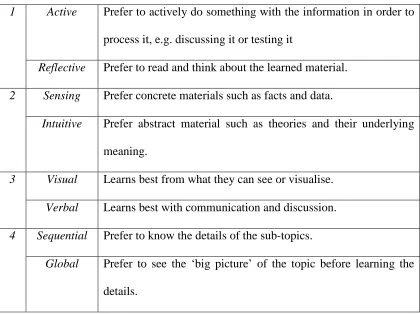
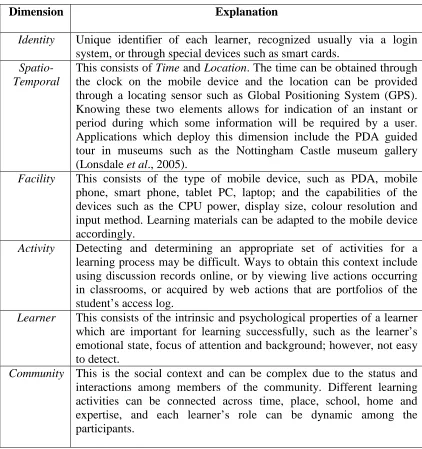
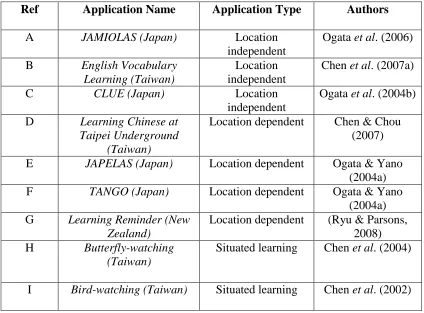
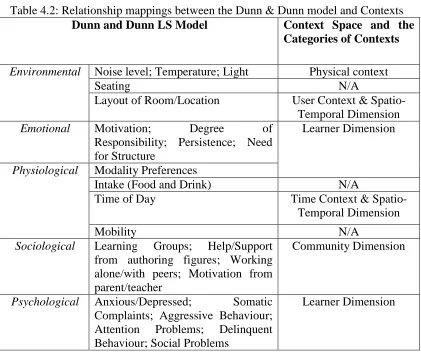
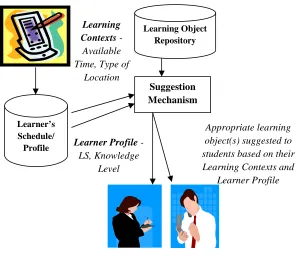
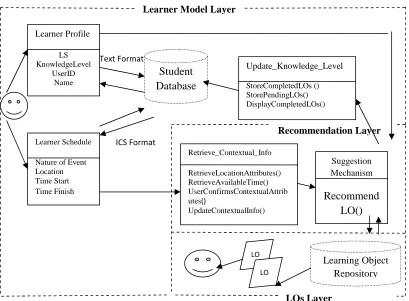
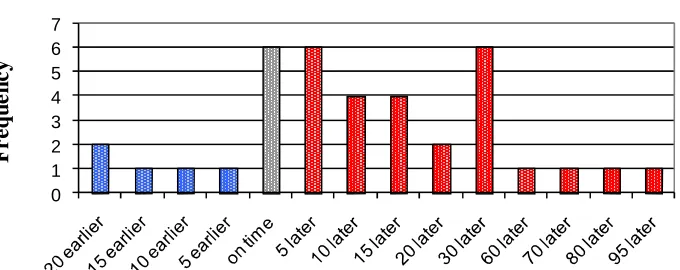
Table 2.1 – The Dunn and Dunn LS model 31 Table 2.2 – The Felder and Silverman LS model 32 Table 2.3 – Wang’s six dimensions of contexts in mobile learning 38 Table 2.4 – Related context-aware m-learning applications 56 Table 4.1 – Cui and Bull’s (2005) adaptation rules for recommendation 142 Table 4.2 – Relationship mappings between the Dunn and Dunn model and Contexts 146 Table 6.1 – Normal and partial correlations between concentration level and factors 192 Table 6.2 - A regression analysis between concentration level and the factors 194 Table 7.1 – Overview of quantitative results 213 Table 8.1 – Number of counts of the ratings 1-5 for each of the eight criteria of LORI 248 Table 9.1 – Strengths and weaknesses of electronic diary data 258 Table 10.1 – A proposed model of m-learning preferences dimensions 290 Table 10.2 – Significance of factors gathered by participants 295 Figure 3.1 – The research methodology consisting of six phases 88 Figure 4.1 – Conceptual model of the theoretical mCALS framework 150 Figure 4.2 – System architecture of the mCALS framework 153 Figure 5.1 – Actual start times of self-study events (participants of batch 1) 172 Figure 5.2 – Actual finish times of self-study events (participants of batch 1) 172 Figure 5.3 – Discrepancies between actual and planned amount of time for self-studies 173 Figure 6.1 – Estimated marginal means of concentration levels 197 Figure 7.1 -Suggested LOs based on contexts 211
Acknowledgements
First and foremost, I would like to express my deep and sincere gratitude to my PhD
supervisor, Dr Mike Joy, for giving me the chance to discover research and explore my
own paths as well as for his continuous encouragement and support, expert guidance
and constructive criticism throughout my doctoral study. I could not have asked for a
better supervisor and it has been a great privilege to work with him!
I am deeply grateful to my advisor, Dr Meurig Beynonfor his support and interest in
my work and for his constructive and detailed feedback. Special thanks to Professor
John Traxler for accepting my request to examine my thesis. I thank them both dearly
for the time and effort they spent on examining my thesis as well as the constructive
feedback they gave me for the re-working of this thesis.
Thank you also to past and present members of the Intelligent and Adaptive System
Group, particularly Georgina Cosma, Shanshan Yang, Amirah Ismail, Jenny Liu,
Shanghua Sun, Tao Li, for sharing my PhD journey and experiences with me. It would
not have been the same without their friendship and support throughout this journey.
My special thanks go to Georgina Cosma, who has supported me in many ways
throughout my studies and has helped me to obtain many volunteers for my diary study.
Thanks to Bernadette, who let me stay at her place whilst I was finalising my thesis.
I am deeply thankful to all of the students who participated in my studies.
I am deeply grateful to Margit, Stephan, Choi Lin and Alan for their continuous
encouragement and support throughout my studies. Last but certainly not least, my
deepest gratitude goes to my partner Andi for his unconditional love, care and support,
Declaration
The contents of this thesis are a result of my own work, and it contains nothing that is
based on collaborative research. No part of the work contained in this thesis has been
submitted for any degree or qualification at any other university. Parts of this thesis
were published in the following articles:
Book chapter
A) Yau, J. & Joy, M. (2011) M-learning generations and interview study results of a
mobile context-aware learning schedule framework. In “Combining E-Learning
and M-Learning: New Applications of Blended Educational Resources". IGI
Global, Hershey, PA. (Article also appears as Yau, J. & Joy, M. (2009) A mobile
context-aware framework for managing learning schedules - data analysis from
an interview study.International Journal of Mobile and Blended Learning,vol. 1,
no. 4, pp. 29-55.)
Journal publications
B) Yau, J. & Joy, M. (2011) A context-aware personalized m-learning application
based on m-learning preferences. International Journal of Mobile Learning and
Organisation, vol. 5, no. 1, pp. 1-14. (Paper also appears in the International
Conference on Wireless, Mobile and Ubiquitous Technologies in Education, pp.
11-18, Kaohsiung, Taiwan, 2010).
C) Yau, J. & Joy, M. (2010) Context-based recommendations of Java learning
objects: a case study. IEEE Multidisciplinary Engineering Education Magazine,
D) Yau, J. & Joy, M. (2010) Proposal of a mobile learning preferences model .
International Journal of Interactive Mobile Technologies, vol. 4, no. 4, pp. 49-51.
(Paper also appears in Special track: Interactive Mobile and Computer aided
Learning, International Conference on Interactive Computer Aided Learning,pp.
753-754, Hasselt, Belgium, 2010.
E) Yau, J. & Joy, M. (2010) An adaptive context-aware mobile learning framework
based on the usability perspective.International Journal of Mobile Learning and
Organisation, vol. 4, no. 4, pp. 378-390. (Paper based on A mobile and
context-aware adaptive learning schedule framework from a usability perspective - a 'diary:
diary-questionnaire' study. International Conference on Computers in Education,
pp. 512-19, Hong Kong, China, 2009.)
F) Yau, J., Joy, M. & Dickert, S. (2010) A mobile context-aware framework for
managing learning schedules - data analysis from a diary study. Special issue
"Innovations in designing mobile learning applications" of the Journal of
Educational Technology and Society, vol. 3, no. 3, pp. 22-32.
G) Yau, J. & Joy, M. (2008) A Self-Regulated Learning Approach: A Mobile
Context-aware and Adaptive Learning Schedule (mCALS) Tool. International
Journal of Interactive Mobile Technologies, vol. 2, no. 3, pp. 52-57.
Conference publications
H) Yau, J. & Joy, M. (2010) Designing and evaluating the mobile context-aware
learning schedule framework: challenges and lessons learnt. IADIS International
I) Yau, J. & Joy, M. (2009) A mobile context-aware framework for supporting
self-regulated learners. IADIS International Conference Cognition and Exploratory
Learning in Digital Age,pp. 415-418, Rome, Italy.
J) Yau, J. & Joy, M. (2007) Architecture of a Context-aware and Adaptive Learning
Schedule for Learning Java. International Conference on Advanced Learning
Technologies (ICALT),pp. 252-256, Niigata, Japan.
K) Yau, J. & Joy, M. (2007) A Context-aware and Adaptive Learning Schedule
framework for supporting learners' daily routines. Mobile Communications and
Learning Workshop (MCL), ICONS Conference,pp. 31-37, French Carribean.
L) Yau, J. & Joy, M. (2006) Context-Aware and Adaptive Learning Schedule for
Mobile Learning. Mobile and Ubiquitous Learning Workshop, International
Conference on Computers in Education (ICCE), Beijing, China.
M) Yau, J. & Joy, M. (2006) Application of Learning Styles to Effective Mobile
ABSTRACT
The focus of this thesis is the study of mobile learning, specifically learning in
different locations and under various contextual situations, from the perspective of
university students. I initially derived and designed a theoreticalmobile context-aware
learning schedule (mCALS) framework from an extensive literature review. Its
objective is to recommend appropriate learning materials to students based on their
current locations and circumstances. The framework uses a learning schedule (i.e.
electronic-based diary) to inform the location and available time a student has for
learning/studying at a particular location. Thereafter, a number of factors are taken
into consideration for the recommendation of appropriate learning materials. These
are the student’s learning styles, knowledge level, concentration level, frequency of
interruption at that location and their available time for learning/studying.
In order to determine the potential deployment of the framework as a mobile
learning application by intended users, I carried out three types of feasibility studies.
First, a pedagogical study was conducted using interviews to explore together with
students (a) what their learning requirements were when studying in a mobile
environment, (b) whether the framework could potentially be used effectively to
support their studies and, (c) using this user-centred understanding, refined user
requirements of the framework. Second, a diary study was conducted where I collected
data and analysed the usability feasibility of the framework by (a) determining whether
students could plan their daily schedule ahead and keep to it, (b) ascertaining which
learning contexts were important and, (c) establishing which learning materials were
appropriate under which situations. Two validation studies were conducted. The first
one was an online experiment utilising Java learning objects. Participants of this study
available time, current motivation level for learning and their proficiency level of Java.
The second validation study was an investigation into high-quality Java learning objects
available in the public domain. Finally, a technical design of the framework was carried
out to determine whether the framework at present could realistically be implemented
using current mobile technologies.
The data analyses of the feasibility studies show that (a) a learning schedule
approach is successful to an extent in obtaining location and available time information
to indicate accurate values of these contexts, (b) different learners may require different
personalisation strategies when selecting appropriate learning materials for them in
mobile environments, and (c) the mCALS framework is particularly well-suited for
self-regulated students. I also proposed a set of suggestion rules which can be used to
recommend appropriate Java learning materials to students in different contexts. The
validation studies show that 1) the proposed suggestion rules are effective in
recommending appropriate materials to learners in their situation, in order to enhance
their learning experiences, and 2) there are a sufficiently large number of high-quality
LOs available in the public domain that can be incorporated for use within my
framework. Finally, the development of mCALS has been considered from three
perspectives – pedagogical, usability and technical. These perspectives consist of
critical components that should be considered when developing and evaluating mobile
learning software applications. The results demonstrated that the mCALS framework
can potentially be used by students in different locations and situations, and appropriate
learning materials can be selected to them, in order to enhance their learning
Chapter 1
Introduction
1.1 Background
The mobile learning (hereafter abbreviated as m-learning) research field first emerged
around a decade ago. One of the earliest definitions of m-learning was “e-learning
through mobile computational devices” (Quinn, 2000) where electronic learning
materials were simply transferred onto mobile devices for learning purposes. Many
other researchers also viewed m-learning as an extension of e-learning (Sharples,
2006). The types of mobile devices concerned with m-learning included PDAs,
handheld computers, smart-phones, mobile phones and occasionally (smaller) laptop
computers. In other words, m-learning was fundamentally the utilization of mobile
devices equipped with learning materials (either stored offline or accessed online) for
learning/studying. The portability of these devices allowed learning opportunities to
be created anytime, anywhere and removed the restrictions for learners to learn/study
in fixed locations (such as classrooms, computer laboratories and libraries). These two
aspects formed the initial motivational grounds for m-learning and subsequently a
large wealth of information was constructed which could be accessible by learners
anytime, anywhere.
As research progressed, considerations from three different perspectives –
technological, usability and pedagogical - were incorporated into the design and
development of m-learning materials and applications. Technological considerations
different sizes of screens of mobile devices. Usability considerations included the
interaction between the user and device (also known as human computer interaction
(HCI)) and how the user interfaces of software applications on mobile devices should
be designed. Pedagogical considerations included the educational value of the
learning content and how materials should be designed to enhance the learning
experiences for students. Consequently, m-learning research could stem from the
following different research disciplines - Computer Science, Education, Psychology,
Electronic or Information Systems Engineering, Human Computer Interaction (HCI)
and Mobile HCI.
Much current ongoing m-learning research from a mixture of these disciplines
has been presented at a number of annual international m-learning conferences,
including mLearn, WMUTE (Wireless and Ubiquitous Technologies in Education),
IADIS Mobile Learning, and IMCL (International Conference on Mobile and
Collaborative Learning). International journals have also been dedicated to the
publication of m-learning research such as IJIM (International Journal of Interactive
Mobile Technologies), IJMBL (International Journal of Mobile and Blended Learning)
and RPTEL Special Issue of Context-aware and Ubiquitous Mobile Learning Systems.
Moreover, anInternational Association for Mobile Learning (IAML)
(mlearning.noe-kaleidoscope.org) has been set up ‘to promote excellence in research, development
and application of mobile and contextual learning’ as well as for sharing information
about current projects, emerging technologies and teaching resources. Research
activities, practices and issues/problems of m-learning at an international level are
shared across this research community. This illustrates an increasing global presence
of m-learning as well as the fact that research problems within this area are currently
An overview of past and current m-learning projects revealed that they had
been undertaken by researchers and developers across different parts of the world in
the past decade, in the educational as well as commercial sectors. These include many
European countries (such as England, Germany, Finland, Spain, Italy), Asian
countries (such as Taiwan, Japan, Hong Kong, Malaysia, Singapore), African
countries (such as Tanzania, Uganda, South Africa), as well as America, New Zealand
and Australia. The growth of research on m-learning has not been restricted within
specific areas in the world, rather it seems to be widely scattered across the globe.
The commercial projects were typically oriented towards employees, trainees
and/or learners in the business sector. In the educational sectors, projects were
targeted towards conventional students either for formal learning in educational
institutions (such as schools or universities) or for informal learning (such as in
museums or sightseeing around cities) or, increasingly, fordistance learningstudents.
Additionally, mobile technologies had great potential in enabling various types of
learning which could take place including situated learning, collaborative learning,
lifelong learning,independent learning, flexible learning andself-regulated learning.
In understanding this thesis, it is helpful to know the definitions of these different
types of learning, and the differences between them. Definitions of these different
types of learning are given below. In this thesis, I am specifically interested in
self-regulated learning, lifelong learning, independent learning and flexible learning. A
literature review of self-regulated learning is further provided in 2.7.2, and I describe
my work more specifically in relation to self-regulated learning in 4.2.
Formal learningis planned, structured and undertaken by students when they
are officially enrolled in an educational institution such as a school or
Informal learning is the spontaneous and unstructured learning which goes
beyond the school, and is the most prevalent kind of adult learning (Coombs,
1985).
Distance learningis the learning performed by a learner who is not physically
present at the institution, but rather is learning remotely via electronic media,
technology or printed media (Grahamet al., 2000).
Situated learningis learning that takes place in the same physical space and/or
context in which the learning or activity is applied. Mobile technologies have
the potential to a) support real situated learning to take place where feasible,
and b) imitate the physical space and/or context to allow situated learning to
be simulated if, for example, real situated learning is infeasible (Naismith et
al., 2004).
Collaborative learning involves joint intellectual effort by students who are
working together to achieve understanding and/or completion of a learning
task (Smith and McGregor, 1992).
Lifelong learningincludes all areas of learning – kindergarten, school, further
and higher education, informal learning at home, work or community, training
courses in industry, vocational and non-vocational adult courses in colleges
and universities (Vavoula, 2004).
Independent learning, which is also known as self-regulated learning, is
defined as students “being motivated to take responsibility for their learning”
(Meyeret al., 2008).
Flexible learning is centred on the student and their learning and
opportunities as well as time and place of study and pace at which the learning
takes place (Brown, 1999; Luckinet al., 2005)
Self-regulated learningis centred on the deployment of motivational strategies
such as self-talk, elaborative planning, processing and monitoring in order to
increase one’s willingness and/or motivation to learn/study (Codeet al., 2006).
I am interested in the context-based and context-aware m-learning research
areas; background on these is provided in 2.5 and 2.6 respectively. In particular, I am
interested in developing an m-learning framework which can eventually be
implemented to be used as a support tool for university students to support their
formal studies. The purpose of this tool is, however, not a replacement for formal
education. Learners may use the tool as informally as they wish, for the learning
purposes they require. This framework is not intended to be used in distance, situated
or collaborative learning situations. Rather, its ultimate aims are targeted at
supporting lifelong, independent, flexible and/or self-regulated learners.
As described, mobile technologies can be used to facilitate students, to enable
them to carry out different types of learning. Many other researchers have also
developed different types of m-learning applications. I have categorised these
different types of m-learning applications into three groups, as follows.
1. Content-specific applications such as for learning a particular language (such
as English, Chinese or Japanese) or a particular topic (such as maths, science,
butterflies or a city) have been developed for students to learn, improve and
extend their knowledge relating to these topics. References to these
applications by other authors are provided in 2.6.
2. M-learning applications may be aimed primarily at helping students plan or
be retrieved from the devices, such as a mobile learning organiser (Corlett et
al., 2004) or a personal learning organiser (Ryu and Parsons, 2008). The
research in my framework aims to build on these supportive m-learning
applications and these relating applications are further described in 2.7.1.
3. Mobile technologies can be used to create a learning infrastructure and to
provide rich multimedia learning materials, for example in Africa where
neither computers nor an infrastructure for the Internet are affordable or
available respectively (Traxler, 2005). Similarly, Attewell and Savill-Smith,
(2004) established a project to assist young adults who were deprived of
education because they had left formal schooling at a young age. The focus
involved retrieving text-messages on their mobile phones in order to improve
their literacy and numeracy rates.
My work aims to provide Java learning materials to students as the learning
content in my m-learning framework and as a supportive application, i.e. to help
students organize their workload.
M-learning has its limitations; these are described in 1.3. These include a)
technological constraints such as the small screen sizes of devices; b) usability
constraints such as interruptions in the physical environment affecting students’
abilities to concentrate; and c) pedagogical constraints such as whether students’
learning requirements are met. The advancement of technologies has helped to solve
some of the technological constraints whereas ongoing research and development of
m-learning software applications has led to more sophisticated m-learning systems,
which meet more precisely students’ usability and pedagogical requirements.
I have made a classification of previous and existing m-learning applications
‘learning-contexts’-based adaptiveand‘learning contexts’-aware adaptive, which are
discussed in 2.2, 2.3, 2.5 and 2.6 respectively.
Applications from the first ‘non-adaptive’ generation were not personalised to
the individual learner in any way. Subsequently, two important pedagogical as well as
usability requirements were realised and emerged as necessary attributes of a
well-designed pedagogical m-learning application. The first requirement was the concept
of developing applications which allowed the learning content to be personalised to
students based on their individual learning preferences (such as LS, strategies,
knowledge level). This relates to the second succeeding generation –
‘learning-preferences’-based adaptive.
The second requirement was the concept of developing applications which
were constructed to highlight the learning contexts relating to and/or surrounding the
learner. This allows the learning content or task to be personalised to the student
according to their learning contexts. These applications can be categorised into both
the third and fourth generations - ‘learning-contexts’-based adaptive and
‘learning-contexts’-aware adaptive. The difference between the applications of these two
generations is that the user’s learning contexts from the former generation are
typically input by the users, whereas the user’s learning contexts from the latter
generation are retrieved from the application, using context-aware or sensor
technologies. Note that learning contexts may also comprise learning preferences.
Learning contexts are described in 2.4.2.
The focus of my thesis is on constructing a pedagogical m-learning suggestion
mechanism framework for recommending possible appropriate learning materials for
students based on their learning contexts. Scenarios of which appropriate learning
described in 4.1. In the remainder of this first chapter, views of different perspectives
and definitions of m-learning are given in 1.2, and limitations of m-learning and using
mobile devices for learning are discussed in 1.3. The structure of the thesis and the
research questions are presented in 1.4.
1.2 A definition of mobile learning
Various views and perspectives of m-learning have been interpreted by different
researchers and developers. A broad encompassing definition of m-learning is the
“ability to learn independently of place and time, facilitated by a range of mobile
devices” by Ufi/learndirect and Kineo (2007), who further described five
characteristics of m-learning – ubiquitous, bite-sized, on demand, typically blended,
andcollaborative.
Ubiquitous denotes the availability of m-learning content via mobile devices
to be accessed anytime anywhere. M-learning services have an increasing
ubiquitous presence due to the growth of mobile network services. The
ubiquitous characteristic falls into the technological perspective of m-learning.
M-learning applications are intended to be accessed in environments which
may be full of potential interruptions. The content should therefore be
bite-sized to accommodate possible challenges to concentration due to
interruptions. These possible challenges are tackled in the usability perspective
of m-learning.
The portability of mobile devices with enhanced battery life suggests the
the learner whenever necessary (on demand). The portability characteristic
falls into the technological perspective.
It is uncommon for an m-learning device to be the primary platform or main
source of delivery or learning content for a learner. M-learning services are
typically used in addition to other course materials and act as part of a blended
approach to learning. Blended learningis defined as the accomplishment of a
combination of different modes of delivery, models of learning and teaching
styles (Heinze and Proctor, 2004). The typically blended characteristic falls
into the pedagogical perspective of learning. A context-aware blended
m-learning environment was described in Botickiet al. (2009).
M-learning can take advantage of the communication ability of mobile devices
to enable collaboration between peers. The collaborative characteristic also
falls into the pedagogical perspective.
Traxler (2009) also grouped similar categories of m-learning as above. These
categories include a) technology-driven mobile learning, b) miniature but portable
e-learning, c) connected classroom e-learning, d) informal, personalized, situated mobile
learning, e) mobile training/performance support, and f) remote/rural/development
mobile learning.
Specifically, the typical views of the definitions of m-learning can be
categorised into one of the three following perspectives:
Technologicalalso known astechno-centric(mobile devices being the focus).
Usability(learners being the focus).
Pedagogical(learners being the focus).
From atechnological perspective, Velascoet al. (2007) defined m-learning as
mobile phones or PDAs, that is to say, any handheld device with wireless connection.
Mobile learning solutions allow people to access the information technologies
whenever and wherever they need, facilitating the possibility of implementing
innovative ways of teaching and learning”. This range of wireless connections
includes - “Wi-Fi, Bluetooth, multi-hop wireless LAN and the global wireless
technologies such as GPS, GSM, GPRS, 3G and satellite systems” (O’Malley et al.,
2005). Similarly, Traxler (2005) defined it as “any educational provision where the
sole or dominant technologies are handheld or palmtop devices”. Common between
these definitions is that m-learning was viewed with technology at its centre, rather
than the user or learner. These definitions also implied that m-learning was a function
of the momentarily available and dynamically changing technology at a specific point
in time (Laouris and Eteokleous, 2005a).
In theusability and pedagogical perspectives, there was a shift of focus from
the mobile device to the learner. From the usability perspective, the interaction
between the mobile devices and the human users formed the focus; this is known as
Human Computer Interaction (HCI) or Mobile HCI. This included formatting
m-learning materials to fit appropriately onto the screens of mobile devices to enable
users to deploy the materials in the intended manner.
From the pedagogical perspective, m-learning was defined as “any sort of
learning that happens when the learner is not at a fixed, predetermined location, or
learning that happens when the learner takes advantage of learning opportunities
offered by mobile technologies” (O’Malley et al., 2005). The first part of this
definition implies that any type of learning that took place with or without mobile
devices could be classed as m-learning, where fixed locations may have included
m-learning was not necessarily an exclusive property of mobile technology, rather it was
the mobility of the learner, who during their everyday life moved from one situation
to another, being in different locations with different social groups, using different
portable and non-portable technologies and learning different topics. Under these
circumstances, the following examples would also constitute m-learning:
Language students studying/improving their language skills whilst at home or
abroad,
Students reading paper-based lecture notes on the bus to the university, and
Nurses or doctors accessing/updating their medical knowledge on hospital
grounds using medical books.
This same view was shared by Becking et al. (2004) who defined m-learning
as a learning process in which a learner had the time and was willing to learn either
alone or in a group, with or without mobile devices.
For the purpose of the thesis, I have defined m-learning as
“The learning/studying of learning/studying materials, in various locations,
with or without the use of mobile devices. These locations can primarily, but
not necessarily, be dedicated for learning/studying activities.”
1.3 Advantages and limitations of mobile learning
The advantages of using mobile devices for learning/studying include functionality,
portability, connectivity, space-saving, and cost. Much of the functionality of desktop
or laptop computers, and the learning materials which are stored thereon, can be
delivered on portable mobile devices. This can eliminate the need for users to carry
Mobile devices can have internet connectivity and email access, allowing usage of
academic or commercial software and deployment of other accessories such as video
recording, camera, dictionary, thesaurus, calculator and diary tool functions.
Electronic books can also be accessed. Less desk space is required due to the small
physical size of mobile devices and the cost of most mobile devices is less than that of
desktop or laptop computers. As anticipated by Lockitt (2005), technologies are
continuously advancing, which results in higher quality of mobile devices including
larger screen sizes and longer battery life.
The limitations of using mobile devices for learning/studying can be classified
into three inter-related categories – technological, usability and pedagogical. The
technological limitations of mobile devices include the small screen sizes and
keyboards of these devices which consequently make it more difficult to view content,
to input information, and to navigate around. Although improvements in mobile
devices are continuously and consistently being made relating to these technological
limitations, some users may still prefer the bigger screen sizes and keyboards of
traditional desktop and laptop computers. Mobile devices may not contain all of the
functionality of desktop or laptop computers and may also be harder to upgrade and
expand. The robustness of these devices is also questionable in that they may be more
susceptible to physical breakage and/or computing failure (Lockitt, 2005).
The usability limitations of using mobile devices for learning/studying relate
to the possible restrictions in the use of mobile devices for viewing content and
interacting with others in order to learn/study effectively. These include possible
interruptions by people, noise distractions and other factors. Mobile devices can be
used anytime, anywhere and the interruptions/distractions that may occur outside of
higher. These interruptions/distractions should be factored in when designing
m-learning materials for students to learn/study with at different locations. Other
limitations may include not having sufficient working space when learning/studying
whilst using public transport and not feeling comfortable.
The pedagogical limitations of using mobile devices to learn/study mainly
comprise the distractions, which can take the learner’s attention and/or focus away
from the actual learning materials on mobile devices. These include not being able to
meet the learning needs and requirements of mobile learners.
1.4 Structure of the thesis and the research questions
This thesis tackles the design of a potential pedagogical m-learning framework and
the development of a proactive (i.e. automatically without input required from users)
approach for retrieving users’ learning contexts without the use of context-aware
sensor technologies. The user’s learning contexts are taken into consideration, as well
as the learner’s current situation and/or location. The suggestion mechanism
framework makes recommendations for possible appropriate learning/studying
materials for students, enabling them to perform under their current circumstances and
location.
The purpose of this proactive approach is to reduce the number of interactions
that users may be required to enter into the mobile device to inform about their
current situation, whilst ‘on the move’. The target users of this framework are
university students. In particular, I wish to examine an appropriate set of suggestion
rules for the Java programming language subject to be incorporated into this
them based on their current learning contexts. The aim is to potentially enhance their
learning experiences and increase their learning effectiveness, whilst learning Java
‘on the move’. I envisage that careful consideration of which Java materials are
appropriate for which situations, and recommending only those appropriate materials
to learners for particular situations, can be beneficial for students in terms of their
learning/studying. This argument is supported by Martin and Carro (2009), Cui and
Bull (2005), and Beckinget al. (2004) among others.
I decided to incorporate Java LOs from existing online repositories for use
within my framework because there are a large number of existing high-quality
reusable LOs available. I also conducted an exercise to locate available high-quality
Java LOs, which can be feasibly incorporated into my framework (see chapter 8).
To help me examine these issues, I constructed a theoretical framework from
an extensive literature review. Subsequently, I conducted two feasibility studies, an
interview and diary study, relating to the framework to analyse their real potential, in
terms of two perspectives – pedagogical and usability. Then I conducted two
framework validation studies, a Java LOs experiment and an exercise to locate
available high-quality LOs. Finally, I conducted a technological feasibility study in
order to determine whether this framework can be potentially developed and
implemented with the required components.
My research was conducted from an interdisciplinary approach, combining
computer science and education. The aim was to bring together the three important
design fundamentals (pedagogical, usability and technological) to form a
well-designed pedagogical m-learning framework. The pedagogical and usability studies
have helped us to determine a) the significant learning contexts that should be
appropriate Java learning materials for different situations. The first validation study
helped to gain user feedback on my framework about the appropriateness of the
recommended Java learning materials for different situations as well as other resulting
enhanced learning experiences or benefits and so on. The second validation study has
helped me to visualise the potential number of Java LOs that can be deployed within
the framework in order for a larger set of materials to be made available to learners.
The refined requirements established via these studies are a contribution to the
technological design and potential implementation of my framework, as presented in
chapter 9.
The thesis was not focused on the technological use of mobile devices or an
implementation of a mobile software application, but rather the pedagogical and
usability design issues of a technologically-feasible m-learning framework. The two
validation studies have helped to prove the realistic deployment thereof.
Chapter two presents a review of the literature on m-learning and describes it
from the perspective of four succeeding generations – ‘non-adaptive’,
preferences’-based adaptive, ‘learning contexts’-based adaptive and
‘learning-contexts’-aware adaptive. I distinguish and highlight the differences between these
generations and provide related applications within these generations to illustrate the
respective characteristics. The initiation of a ‘context’ concept is explored and
subsequently a ‘learning context’ is derived for describing contexts with pedagogical
attributes. I identify and analyse challenges associated with learning contexts
including difficulties in retrieving them. Current context-aware m-learning research
primarily focuses on the technological and usability perspectives; there is a lack of
studies which focus on the pedagogical aspect. I have further classified the
different types of learning applications -context-aware location independent learning
applications, context-aware location dependent learning applications and
context-aware situated learning applications. The chapter concludes with a range of
methodologies and approaches which can be adopted for the evaluation of m-learning
applications. Each of these approaches focuses on the evaluation of one of the three
following aspects -pedagogical, usabilityandtechnological. Furthermore, difficulties
and challenges of evaluating m-learning applications are described.
Chapter three explains the research methodology I adopted to tackle the design
of a proactive context-aware m-learning framework which acts as a suggestion
mechanism to recommend appropriate materials to students in different situations.
Central to the thesis is the derivation of a theoretical framework based on an extensive
literature review and research findings – called mCALS (mobile context-aware
learning schedule) framework. The design of this framework comprises the use of the
student’s learning schedule (i.e. electronic diary) integrated in the mobile device to
retrieve their location and available time contexts. The process of the framework
derivation forms the first section of this chapter and is the first phase of the research
methodology. To examine the potential feasibility of the framework, the methodology
adopted includes a pedagogical, usability, technological and two validation studies.
Our chosen research methodologies are influenced by the difficulties and challenges
in evaluating m-learning, as described in 2.8. The rationales for conducting these
studies are described in the subsequent sections of this chapter. The pedagogical
study uses an interview methodology to ascertain from the qualitative perspective and
the usability study consists of a diary study to determine from the quantitative
perspective the following three aspects - 1) The potential deployment of a learning
contexts to be deployed within a context-aware suggestion mechanism; 3) A set of
suggestion rules to recommend appropriate Java learning materials to learners
studying in different circumstances. Subsequently, the procedures in which I
conducted the two validation studies are described in detail. Finally, thetechnological
study consists of a technical framework design to illustrate an implementation of
whether it is technically feasible at the present time. The final requirements of the
framework are elicited from the data analyses of the pedagogical and usability studies
to form the final technical framework design. The validity and reliability of these
research methodologies, together with the data collection and analysis methods are
explained in the relevant sections of this chapter.
Chapter four illustrates the derivation of the theoretical mCALS framework.
The intended functions of this framework are demonstrated with a set of scenarios
concerning four different Java-learning students. The proposed contributions resulting
from this framework are discussed in the context of related works. Five research
questions are addressed in this chapter, from a theoretical perspective.
4A: Can a proactive approach for the retrieval of learning contexts without
the use of sensor technologies be incorporated into a suggestion mechanism?
4B: Which learning contexts are significant in the recommendation of
appropriate learning materials?
4C: Which types of learning materials are appropriate for recommendation to
students under different circumstances?
4D: What are the design modules of the framework?
4E: What are the user requirements of the framework?
Chapter five presents the data analysis relating to the potential adoption of a
both the interview and diary studies. Three main research questions are addressed in
this chapter, from the qualitative and quantitative perspectives respectively.
5A: How feasible is the adoption of a learning schedule for retrieving learning
contexts from aqualitativeperspective?
5B: How feasible is the adoption of a learning schedule for retrieving learning
contexts from aquantitativeperspective?
Can users plan their schedule ahead, conform to it and keep it
up-to-date?
Can the location and available time be accurately retrieved from the
learner’s diary?
5C: How do participants view the use of mobile devices as a learning tool?
Chapter six presents the data analysis relating to a) the significance of the
proposed learning contexts (in chapter 4) to be used within a context-aware
suggestion mechanism, and b) the possible recommendations of appropriate learning
materials for different circumstances, i.e. a set of suggestion rules. The data obtained
from the interview and diary studies is analysed and presented from the qualitative
and quantitative perspectives respectively. We also describe the refined user
requirements of the framework, based on these results. Four research questions are
addressed in this chapter. Significance is in terms of how much the learning is
affected.
6A: How significant are the proposed learning contexts, which are to be used
within a context-aware suggestion mechanism, from aqualitativeperspective?
6B: How significant are the proposed learning contexts, which are to be used
6C: Can a set of suggestion rules be derived for recommending appropriate
Java learning materials to students based on their situation?
6D: What are the refined user requirements of the framework?
I conducted data triangulation of the study results of chapters five and six in
order to strengthen the integrity of my results. The data triangulation is presented in
3.7.
Chapter seven presents the data analyses of the first validation study of the
framework. I constructed a suggestion mechanism which students can access online
from any computer machine. At the beginning of the learning session, students are
asked to choose their current motivation level, their available time and their Java
proficiency level. A number of LOs which are thought to be appropriate for students
situated within these contexts are presented and the student may choose one to
learn/study with. After the student has completed the learning object, they are asked
to complete a questionnaire/feedback form to provide their opinions about their
learning experiences. Two main research questions are addressed in this chapter, as
follows:
7A: Is the proposed set of suggestion rules appropriate for use within my
context-based suggestion mechanism framework?
How useful had students found the study of learning objects in the
proposed contexts?
Were their learning experiences of the LOs more enjoyable as a result
of studying the objects in the proposed learning contexts?
How appropriate were the suggestion rules for recommending Java
LOs to students?
Chapter eight presents the data analyses of the second validation study of my
framework. In this chapter, I investigate the possibility of integrating a larger quantity
of high-quality and reusable LOs into the framework. One research question is
addressed in this chapter.
8A: Which Java LOs in the public domain are high-quality and reusable and
can be incorporated into the framework?
The refined framework and final requirements are illustrated in chapter nine.
A software engineering design approach is adopted to demonstrate the technical
feasibility of the framework using current mobile and context-aware technologies. Six
research questions are addressed, from a technical perspective.
9A: Can the proactive learning contexts retrieval approach be implemented?
9B: Can the framework be strengthened?
9C: Can users’ learning contexts be incorporated into the framework design?
9D: How can m-LOs be incorporated into the framework design?
9E: Can a set of suggestion rules be incorporated?
9F: What are the system architecture and configuration of the final framework?
In chapter ten, I conclude the thesis with recommendations for future work.
Then my research contributions and a discussion summarising how the research
questions are addressed in the thesis are presented. Finally, limitations of the research
1.5 Publications in relation with the thesis content
My thesis has gained the endorsement of the mobile learning research community.
The list of publications in the Declaration on pages xi-xiii is evidence that my thesis
work has been accepted for publication by peer review. All of the publications are
co-authored with my supervisor; however, the research conducted is my own original
work. This section lists where the content of these publications relates to the content
of the thesis, as follows:
Publication A in the Declaration describes the four m-learning generations
composed in the literature review as presented in 2.1 to 2.6 of the thesis and
the main qualitative interview study data results related to the framework, as
presented in 5.1, 5.3 and 6.1.
Publication B describes the personalized m-learning application presented in
10.1.2.
Publication C describes the validation study for validation of the suggestion
rules for Java learning materials in mCALS, as presented in chapter 7.
Publication D describes the proposal of an m-learning preferences model, as
presented in 10.1.1.
Publications E and F describe the quantitative diary study data results related
to the framework, as presented in 5.2 and 6.2 to 6.5.
Publication G describes the mCALS framework as a self-regulated learning
Publication H describes the research methodology, overall challenges of
evaluating the mCALS framework and the lessons learnt. These were
presented in parts of chapter 3.
Publication I describes the mCALS framework as a support for self-regulated
learners, as presented in 4.2 and 5.3.
Publications J, K and L describe the conceptual and architectural design of the
mCALS framework in its preliminary stages.
Publication M describes the relationship mappings between the Dunn & Dunn
Chapter 2
Literature Review
In this chapter, I present a detailed literature review of m-learning applications,
forming the majority of this chapter, i.e. from 2.1 to 2.7. An introduction of the four
different m-learning generations, which I have classified from a review of past and
present m-learning applications, is provided in 2.1. The four generations are ‘
non-adaptive’, ‘learning-preferences’-based adaptive, ‘learning contexts’-based adaptive
and ‘learning-contexts’-aware adaptive. These are described in 2.2, 2.3, 2.5 and 2.6
respectively. Learning contexts are used to aid the design of m-learning applications
in the subsequent generations; these are described in 2.4. My mCALS framework lies
between the ‘learning contexts’-based adaptive and ‘learning-contexts’-aware
adaptive, dependent on whether the proactive learning schedule approach can be
successfully adopted in the framework for the retrieval of users’ learning contexts.
Study results on this are presented in chapter 5.
Learning theories which have been incorporated into the design of m-learning
applications are discussed, where appropriate. Additionally, four different types of
m-learning (or non-mobile) applications are included in 2.7. These are 1) m-m-learning
organizer applications, 2) self-regulated learning applications, 3) Java-learning
applications, and 4) LOs applications. All are related to the framework in one aspect
or another. Further details are provided in 2.7.
In section 2.8 of this chapter, evaluation methods for m-learning applications
are presented. In 2.9, I provide a brief review on the psychology of the learning
2.1 Introduction to the m-learning generations
This section presents a literature review relating to the design, development and
application of both completed and ongoing m-learning research and studies. Much
research has been conducted and is ongoing by researchers in this field to expand and
advance pedagogical m-learning. A decade ago, the m-learning research paradigm
was new, with some projects having succeeded whereas others failed. Numerous
lessons were learnt within the m-learning community through these project
experiences. At the present time, most researchers are aware that an m-learning
application should comprise pedagogical components, and also that usability
considerations should be addressed. Most researchers are aware of the limitations and
disadvantages of using mobile devices for learning and attempt to compensate for
these factors with additional pedagogical values of using mobile devices for
learning/studying (Parsonset al., 2006).
As a result of ongoing m-learning research, I propose a classification of four
m-learning generations, which encompass the different varieties of m-learning
research and applications that researchers and developers had aimed to develop and
construct. The emergence of these generations was a result of the attempts to a)
overcome challenges within the m-learning field and b) include additional
pedagogical components within m-learning applications.
A review of the past and present m-learning applications revealed four
different varieties of applications, which I have classified into ‘non-adaptive’,
‘learning-preferences’-based adaptive, ‘learning contexts’-based adaptive and
‘learning-contexts’-aware adaptive, hence forming the four so-called “generations” of
notion of a ‘learning context’ is described prior to introduction of the latter two
generations, which deploy learning contexts in their m-learning applications.
Characteristics of these generations are described, and example applications are given.
Challenges and difficulties relating to various aspects within these generations have
also emerged and these are discussed in the relevant sections.
2.2 The non-adaptive m-learning generation
Some of the initial m-learning applications from this first m-learning generation were
built centred on transferring existing electronic learning (e-learning) materials onto
mobile devices to enable portability of these learning materials. Thereafter, it was
recognised that the format that e-learning materials were in may not be compatible
with the format required for materials to be viewed on a mobile device, in terms of
their size, font, quality and scope (Beckinget al., 2004); these are also technological
constraints of m-learning. Whilst some materials met the minimum requirements of
being m-learning materials, others did not due to, for example, not fitting onto screens
appropriately, or requiring too much scrolling. The learning content in the subsequent
applications within this generation was adapted more appropriately to be sufficiently
deployable on mobile devices for learning.
A common characteristic of applications within this generation was that the
learning content viewed by learners was generic. This is known as the ‘
one-size-fits-all’ approach and denotes that personalisation of learning content was not applied in
any way, such as, in terms of learning preferences or learning contexts. The main
a. providing learning content in a mobile format which can be accessed
irrespective of location and time,
b. facilitating portability of learning content where the use of desktop and/or
laptop computers was inconvenient or impractical, and/or
c. allowing communication via portable devices to enable collaborative learning
between teachers and/or peers situated in different locations.
Example applications are given below.
To facilitate learners in carrying out exam revisions anytime, anywhere,
revision materials on desktop computers were synchronised onto a PDA (Bull
and Reid, 2004). This is also known as individual and/or independent learning.
An application which can be used on a PDA was designed to act as a guided
tour tool in the Tate Modern museum (Proctor and Burton, 2004).
A language and cultural mobile application was developed for foreign students
to learn the local language and to help minimise ‘culture shock’ before or
when they went abroad to study (Maniar & Bennett, 2007).
Collaborative learning was enabled between students located on a field trip
and their classroom-based peers via the use of PDAs (Hineet al.,2004).
Many of the implications of m-learning between individual and collaborative
learning were described by Moura and Carvalho (2008).
2.3 The ‘learners-preferences’-based adaptive m-learning generation
“M-learning is causing educators to rethink how learning happens and how specific
learning needs and styles are expanded and enabled with multifunctional hand-held
The main aspect which was present within applications of this generation and absent
in the previous generation was that an adaptive learning mechanism was contained
within applications of this generation. This mechanism specifies the personalisation of
learning content (for use on mobile devices) for individual learners according to their
learning preferences. Learning preferences encompass all of the specific ways in
which a student prefers to learn or study, including
LS– students’ preferred styles of learning, (discussed in 2.3.1),
learning strategies– students’ preferred strategies for learning, and
learning characteristics– related to the personality of a learner and how these
may affect the way they prefer to learn. These characteristics may include
levels of motivation, background, strengths and weaknesses, interests,
ambitions, and sense of responsibility. For example, a conscientious learner
may want more detailed learning materials than a non-conscientious learner.
The aims of these applications were to a) move towards delivering
personalised and user-centred learning content to learners and b) enhance the learning
quality and experiences that may be given to users by matching the content to
students’ learning preferences (Laouris & Etekleous, 2005b). It was argued that
additional pedagogical benefits result for learners a) by presenting learners with
learning materials which are consistent with the learners’ preferences or
characteristics and/or b) when the material structure and content suited the students’
LS. These benefits include more effective understanding of learning concepts and
simpler acquisition or absorption of learning content (Riding, 1996). For example,
active students may learn and/or achieve more when attempting hands-on exercises
The concept ofadaptive learningis important within e-learning or web-based
education. This is because much generic learning content has been developed and
might not cater to the needs of individual learners. It is argued that a pedagogically-effective application should consist of materials which can be used by different
students with various kinds of LS. Different adaptive learning courses can also be
constructed to provide additional help to students with visual or physical handicaps,
for example (Muir, 2001). In particular, distance learning students may benefit most
from a personalised application (or learning materials) for the following two reasons.
1. Distance learning students are physically situated away from their educational
institution and usually work independently. Intelligent customisation of
learning materials may result in these students a) acquiring a higher level of
understanding of their course, b) becoming more motivated to learn/study, and
c) achieving better learning experiences and/or quality.
2. The participants in a distance learning course may constitute a more diverse
range of enrolled students. For example, there may be large differences in age,
educational background, family commitments and responsibilities, proficiency
levels, learning needs and requirements. A generic learning course may not be
sufficient in meeting the learning goals of the different participants. Therefore,
an adaptive learning course is essential in this regard (Meisaloet al., 2002).
The personalisation of e-learning materials (or similarly m-learning materials)
requires less effort than the personalisation of traditional learning materials such as
textbooks and lecture notes. This is because once the fundamental content or materials
have been electronically developed similar content can be built thereon to be directed
at students with different learning preferences (Muir, 2001). Similarly, adaptive
and b) possible interruptions and/or distractions in different locations where mobile
devices are used for learning/studying may possibly result in lower levels of
concentration. Related works include an adaptive m-learning application which adapts
learning content according to the students’ LS (Park, 2005).
In the development of a ‘learning-preferences’-based adaptive m-learning
application, four typical stages are involved, as follows.
1. A learning preference to be taken into consideration for the application is
determined. There are different reasons why a particular learning preference
(or a particular preference/style within a LS model) may be selected for
deployment. For example, the range of LS according to the Felder and
Silverman LS model (Felder and Silverman, 1988) may be deployed by an
application due to the flexibility of describing learners on a spectrum within
four categories.
2. A variety of learning materials appropriate for users with the different learning
preferences/styles, as determined in (1), are developed and/or incorporated
into the m-learning application.
3. Each learner’s learning preference/style is established prior to the use of the
application. There are two typical ways of detecting a learner’s LS - a) by
asking them to complete a learning style questionnaire which will determine
the LS they have (or approximately have), or b) if a learner is already aware of
their LS, they can simply enter this information into the application. There are
web-based systems which directly request LS information using the Index of
LS questionnaire (Felder and Silverman, 1988) from learners such as in