Bachelor´s Thesis
Can the Dual Processor Model account for task integration with a
sequential movement task?
Nils Hatger
Prof. Dr. Ing. Willem Verwey
Jonathan Barnhoorn, PhD student
BMS Faculty/Cognitive Psychology and Ergonomics
20172 Abstract
The purpose of the present study is to elaborate on the Dual Processor Model by examining
whether it is possible to integrate the discrete sequence production task with a tone counting
task. In consequence of the integration, we expected task interference under novel task
conditions. 24 participants practiced with the discrete sequence production task while they
identified and counted tones at the same time. The tone could either be low or high-pitched and
was presented simultaneously with the fifth stimulus. In the test phase, the practiced condition
with the tone at position 5 (Tp5) was compared with two altered task conditions. In one
condition (Tp3), the tone was presented simultaneously with the third stimulus, in the other
condition (no-tone) the tone was removed. The results showed that there was no significant
difference between the Tp5 and the Tp3 condition and therefore no task interference at Tp3 was
observed. However, the no-tone condition was significantly slower than the Tp5 condition. We
concluded that task integration did not take place and that the cognitive processor is probably
able to gradually distribute processing recourses, which can operate as almost independent
3 Introduction
Behaviour like driving a car obviously requires skilled sequential motor behaviour, like
engaging the clutch and changing the gear fast and accurately. Over the last decades the
development of skilled sequential motor behaviour has been studied thoroughly, for example
via the discrete sequence production (DSP) task (Verwey, 1999). However, in real life situations
it is often required to perform multiple tasks at the same time. Like performing the motor
sequence of switching the gear while making the decision whether to overtake another car or
not. For someone who starts driving it requires a lot of cognitive effort to engage in the multiple
tasks, but after months of practice it becomes much easier.
Research on sequential movement production with the DSP task resulted in a cognitive
model that explains the processes that underlie sequential movement production, the dual
processor model (DPM) (Abrahamse, Ruitenberg, Kleine & Verwey, 2013). However, the
model is not worked out in every detail. This study has the purpose to extend the knowledge
base surrounding the DPM, by examining if it can account for the integration of the DSP task
with a tone counting task. We will first outline the DSP task, thengive a description of the DPM
and finally propose how task integration could be possible.
The DSP task
The discrete sequence production (DSP) task is a method to study sequential motor learning
(Abrahamse, et al., 2013). In the DSP task, participants react to two sequences of 3-7 visual
stimuli. The stimuli are rectangular placeholders on a monitor that successively get filled with
green color. The participants react to the stimuli by pressing the spatially corresponding key on
the keyboard. When participants begin to practice the DSP task, they first translate every single
stimulus into the right response. If the sequence is repeated often enough, the series of single
responses can gradually be represented by motor chunks (Abrahamse, et al., 2013). Motor
4 as one single response (Abrahamse, et al., 2013). A typical phenomenon that can be observed
in the DSP task is a relatively slow first key press. The point in time when the first stimulus is
presented and processed is referred to as the initiation of the sequence. During the initiation
participants select and prepare the sequence. This leads to the slower reaction times (RTs) of
the first key press. The key presses that follow initiation are only affected by execution
processes and not by higher order cognition. They are referred to as execution key-presses and
are relatively fast (Abrahamse, et al., 2013). Because of the limited number of responses that
can be represented by a single motor chunk, sequences that involve 6 or more stimuli trigger
the segmentation of the whole sequence into two or more motor chunks. Due to practice, the
discrete motor chunks become associated and one motor chunk primes the next one. This leads
to a rapid transition from one motor chunk to another, what is referred to as concatenation. The
point of transition, the concatenation point, is typically observed halfway through the sequence.
The concatenation point is indicated by a key press with slower RTs, however with ongoing
practice the concatenation point gets faster (Abrahamse, et al., 2013).
The Dual Processor Model
Various observations from the DSP task led to the development of the dual processor model
(DPM), proposed by Verwey (2001). The DPM is a cognitive model to explain discrete
sequential motor behavior. In the present study, we refer to a more recent version of the DPM,
which was introduced by Abrahamse, et al. (2013). The DPM assumes that two distinct
processors are responsible for the execution of discrete movement sequences i.e., the cognitive
processor and the motor processor. When participants begin to practice the DSP task, they first
translate every single stimulus into the correct response and this is assumed to be done by the
cognitive processor. When the single stimuli become represented by motor chunks, the
cognitive processor is only needed during the sequence initiation. Once the cognitive processor
5 execute the sequence. One can consider the sequence execution to be automatic in the sense
that once the right sequence is selected, the execution requires no further cognitive guidance
(Verwey, Abrahamse, De Kleine, & Ruitenberg, 2014).
The DPM assumes three processing modes. In the beginning of the task, when novel
stimuli are presented and every single stimulus is translated, participants are said to operate in
the reaction mode. With ongoing practice, one stimulus primes the next, this is referred to as
the associative mode. When sequence execution relies on motor chunks, participants are
performing in the chunking mode (Verwey, & Abrahamse, 2012). When participants perform
sequence execution in the chunking mode, the cognitive processor is not needed anymore, once
the right motor chunk has been selected. However, the cognitive processor can still contribute
to sequence execution. The two execution modes run in parallel and sometimes the cognitive
processor is faster than the motor processor. Therefore, the processors are said to “race” for the
execution of each single response (Abrahamse, et al., 2013).
Task Integration
Verwey, et. al (2014) showed that adding a second cognitive task to the DSP task slowed down
the overall reaction times. For the second task a tone counting task was chosen because it was
assumed to use cognitive processor resources. Further, interference of the tone counting with
motor sequence execution at the perceptual level was assumed to be unlikely (Verwey, et al.,
2014). The study showed a slowing of overall reaction times when the tone counting task was
introduced. This slowing was explained by the notion that the cognitive processor could not
contribute to the race with the motor processor anymore, because of the second cognitive task.
The findings show that the processor involved in the counting task is the same as the cognitive
processor proposed in the DPM model (Verwey, et al., 2014). In the Verwey et al. (2014) study,
the dual task situation was a novel situation in the test phase and not practiced before, this leaves
6 Extensive practice is associated with the development of cognitive representations that organize
action (Land, Volchenkov, Bläsing & Schack, 2013). These representations can be highly task
specific. The representation of grasping movements for example involves exteroceptive effects
like auditory feedback (Land, et al., 2013). Similarly, the tone counting task and the discrete
sequence production task could be integrated with practice into a single task specific cognitive
representation. Ruthruff, Van Selst, Johnston, & Remington (2006) define efficient task
integration as a re-organization “[…] of two tasks into a single super-task, thus eliminating
resource competition.” (p. 126). Combining the notions of Land et. al (2013) and Ruthruff et
al. (2006) we define task integration as the re-organization of two cognitive task representations
into one single cognitive representation. This integrated representation is assumed to be task
specific, to eliminate dual task interference and to require extensive practice to develop.
This leads to our main hypothesis that the sequence execution task and the tone counting
task integrate with practice into a single task specific representation. We therefore expect to
observe task interference under changed task conditions. This task interference can be measured
as slower reaction times in the novel task conditions (i.e., Tp3 and no-tone), compared to the
practiced task condition (i.e., Tp5). In the Tp3 condition, the tone will be presented
simultaneously with the third stimulus. We therefore hypothesize that especially the third key
press will be affected by task interference. We thus expect slower reaction times of the third
key presses in the Tp3 condition, compared to the reaction times of the third key presses in the
Tp5 condition.
To test the hypotheses an experiment was conducted, in which the participants
performed a modified version of the above explained DSP task. The modified version included
a second task, the tone counting task. During the practice phase, the experimental group
executed two keying sequences and counted and identified tones, that were given
7 focused on the key pressing aspect of the task. In the test phase, both groups were tested in three
conditions: no-tone, tone at position 3 (Tp3) and tone at position 5 (Tp5).
Methods
Participants
The participants were students at the University of Twente. They took part in the experiment in
exchange for course credits. From the 24 participants 17 were female and 7 were male. The
participants were aged between 18 and 27 with an average age of 20. All participants had a
normal vision or glasses, normal motor function and no impaired hearing.
Materials
The experiment took place under laboratory conditions in a small (ca.5 m²) cubicle. The
participants were seated about 50 cm in front of the desk and the window shade was largely
closed. The task was programmed with the E-Prime 2.0 software. The software also gathered
and organized the data of each participant in corresponding data files. The task ran on a Dell™
OptiPlex™ 9010 computer with Windows 7. Unnecessary Windows background processes
where shut down to improve the reliability of the measurement. The monitor on which the
stimuli were presented, was a LG Flatron™ E2210 (LCD) and a Dell™ KB212-B keyboard
was used. A Sennheiser™ PC 3 Chat headphone was used for the tone counting.
Task
The task was a modified version of the discrete sequence production (DSP) task. It was a
stimulus-response reaction time task. The stimuli involved filling one of 4 rectangular
placeholders (0.9 x 0.9 cm) with green color. The placeholders were presented in a horizontal
row. There were 0,7 cm gaps between the placeholders to increase stimulus response
compatibility with the keys. If one placeholder was filled, the participants responded by
8 B, N and the participants put their middle and index fingers of the left hand on C and V and
their index and middle fingers of the right hand on B and N, respectively. If the participants
pressed the correct key, the placeholder became white again and the second stimulus appeared,
i.e., another placeholder was filled in green. If a participant pressed the wrong key the word
“error” appeared above the placeholder for 2000 ms. If a participant responded too slow the
words “waited too long” appeared above the placeholder. There were two sequences of seven
key presses to be learned. The two key press sequences remained the same throughout the 7
blocks for the same participant, but they varied across participants to counterbalance finger
specific and spatial effects.
The secondary task involved identifying and counting tones. The tones occurred
simultaneously with the fifth stimulus and either were low-pitched (440 hz) or high-pitched
(698 hz). The participants heard the tones via a headphone and had to count the low-pitched
tones. At the end of each block, they typed in the number of tones in a screen window that
popped up. The first six blocks were practice blocks, they consisted of 240 trials i.e., sequences
and it took the participants about 22 minutes in average to finish each block. When the first half
of a practice block was finished, there was a short pause of 15 seconds. One half of the
participants got the instruction to count the low-pitched tones, the other half had to ignore the
tones. The seventh block was the test block. It was divided in three relatively short
sub-blocks with 48 trials per block. The sub-sub-blocks differed from the practice sub-blocks with respect
to the tone counting task. In the Tp3 condition the tones were given simultaneously with the
third stimulus, in the no-tone condition the tones were absent and in the Tp5 condition the tones
were presented simultaneously with the fifth stimulus. The keying sequences were the same as
9 Procedure
When the participants entered the lab, they got a verbal instruction about the experiment. The
instruction was printed on paper. Afterwards, the participants signed an informed consent.
When the experimenter started the first practice block, an instruction of the task was shown on
the screen. The instruction specified the verbal instruction of the experimenter, the participants
read which fingers they were supposed to rest on which keys and they listened to a high pitched
and low-pitched example tone. The experiment consisted of six practice blocks and a seventh
test block. After each practice block, there was a pause of 4 minutes. During the pause the
average reaction time, the percentage of wrong key presses (error rate) and the number of
counting errors was shown on screen. It was allowed for participants to stand up and walk
around in the room during the pause. After the pause, the experimenter started the next block.
The experiment ended after the test block. It took a total time of about 2,5-3 hours for a
participant to pass through the whole experiment.
Results
Practice phase
To examine the development of sequencing skill we conducted a mixed ANOVA on RTs with
a 2 (Group: count vs. ignore) x 6 (Block) x 2 (Pitch: high vs. low) x 7 (Key) design, with Group
as between-subject factor. The ANOVA revealed a main effect for Block, F(5, 110) = 298.71,
p < 0.001. As expected there was a decline in RTs from 425ms in block 1, over 295 ms in block
2, to 212 ms in block 6. Another main effect was found for Key, F(6, 132) = 90.76, p < 0.001.
The first key press was about 200 ms slower than the other key presses and the fifth key press
was 34 ms slower than the sixth key press. It also revealed a significant interaction between
Block and Key, F(30, 660) = 20.1, p < 0.001. This interaction indicates that improvement in
10 To rule out the option that the observed effects are due to a speed-accuracy tradeoff a
second mixed ANOVA with the above design was conducted for the arcsine transformed error
proportion. The ANOVA revealed a main effect for Block F, (5, 110) = 4.53, p = 0.001,
however the observed increase was small (from 2.1% in block 1, over 2% in block 2, to 3% in
block 6). A further main effect for Pitch was found, F(1, 22) = 9.95, p = 0.005. However, the
difference was small, the error percentage in the trials with the high-pitched tone was 2.4%, in
the low-pitched tone trials it was 2.5%. The effect for Key was significant, F(6, 132) = 6.64, p
< 0.001. The ANOVA further revealed an interaction between Block and Key, F(30, 660) =
3.2, p < 0.001.
Test phase
To examine if task integration had occurred we conducted a mixed ANOVA with a 2 (Group:
count vs. ignore) x 3 (Position: no-tone, Tp3, Tp5) x 7 (Key) design, in which Group was a
between-subject variable. To be able to test all three levels of the variable Position, we excluded
the variable Pitch. Therefore, only the data from the low-pitched trials were analyzed. Against
our expectations no main effect for Position was found, F(2,44) = 2.75, p = 0.075. However,
post-hoc tests using the Bonferroni correction revealed that the difference between the no-tone
and the Tp5 condition was significant p = 0.028. The mean RTs were 13 ms faster in the Tp5
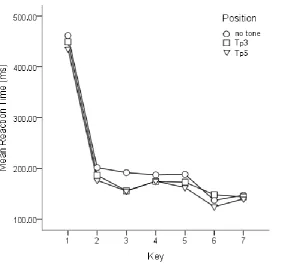
condition. Further, a main effect for Key was found, F(6, 132) = 89.13, p < 0.001. A post-hoc
comparison revealed that the first key press was significantly (p < 0.001) slower than all
following key presses with mean differences from 235 ms to 283 ms. Furthermore, the sixth
11
Figure 1. Mean reaction time per key in the test phase for three tone positions in the tone
counting group.
To examine if task integration is observable at the third key press, we conducted three
paired sample t-tests on Tp5 vs. Tp3, Tp5 vs. no-tone and Tp3 vs. no-tone. The t-tests compared
average RTs of the third key presses of the low-pitched trials. The t-tests revealed that the
no-tone condition is 36 ms slower than both, the Tp3 and the Tp5 condition, t(11)= 2.79, p= 0.018
and t(11)= 2.5, p= 0.029, respectively. Against our expectations, no significant difference was
found between the conditions Tp3 and Tp5, t(11)= 0.14, p= 0.9
To analyze the influence of the variable Pitch, we conducted an ANOVA with a 2
(Group: count vs. ignore) x 2 (Position: Tp3 vs. Tp5) x 2 (Pitch: high vs. low) x 7 (Key) design
and Group as between-subject variable. The ANOVA revealed an interaction between Position
and Pitch, F(1, 22) = 6.73, p = 0.017. When the tone was high-pitched, the tone position had
almost no influence on average RTs. When the tone was low-pitched, the tone position had
[image:11.595.76.381.71.337.2]12
Figure 2. Mean reaction time per tone position, for high- and low-pitched tones in the tone
counting group.
To analyze if the error proportions in the test phase differ across the three tone positions
a mixed ANOVA on the arcsine square root transformed error proportions from the low-pitched
trials was conducted. The ANOVA had a 2 (Group: count vs. ignore) x 3 (Position: no-tone,
Tp3, Tp5) x 7 (Key) design, with Group as between-subject variable. Only the main effect of
Key was significant, F(6, 132)= 10.0, p < 0.001. To analyze if Pitch had an impact on the error
proportions a mixed ANOVA on the transformed error proportions, with a 2 (Group: count vs.
ignore) x 2 (tone position: tone at Tp3 vs. tone at Tp5) x 2 (Pitch: high vs. low) x7 (key) design,
with Group as between-subject variable was performed. Again, there was only a significant
effect for Key, F(6, 132) = 9.36, p <0.001.
Discussion
Practice phase
The present study had the objective to test whether it is possible to integrate the discrete
[image:12.595.74.348.75.334.2]13 practice for an integrated representation of the tone counting and motor task to develop (Land
et. al, 2013). A consequence of extensive practice is the development of sequence skill
(Abrahamse et. al, 2013). Therefore, we first wanted to asses if the participants have acquired
sequence skill, to ensure that it was generally possible to develop the integrated representation.
The results from the practice phase are indicating that the participants acquired sequence skill.
This could be observed in a typical decline in RTs and furthermore by the typical slow first key
press i.e., the initiation phase (Abrahamse et. Al, 2013), that was observed in all ANOVAS
conducted. It is important to note, that no speed-accuracy tradeoff (Wickelgreen, 1977) was
observed. There was only a marginal increase of 1% in error proportions. The acquired
execution speed does not trade-off with a higher error proportion. We can conclude, that
participants developed sequence skill and thus had sufficient practice to develop an integrated
representation.
Test phase
Our main hypothesis was that the sequence execution task and the tone counting task become
integrated with practice. We therefore expected to observe task interference under novel task
conditions. In the test phase, we introduced two novel task conditions. We expected overall
slower reaction times in the Tp3 condition and the no-tone condition compared to the Tp5
condition. Against our expectations, the results indicate that task interference did not occur.
When comparing the RTs in the low-pitched trials, requiring counting, for the independent
variables Position and Key and the between-subject variable Task, no main effect for Position
was found. This means that the RTs did not overall differ across the three tone positions and
that there was no task interference. We can therefore conclude that the first hypothesis has to
be rejected. No task interference was found in the Tp3 condition and therefore no task
integration occurred.
We further hypothesized that, instead of several key presses that are affected by task
14 interference. We thus expected slower average third key presses in the Tp3 condition compared
to the Tp5 condition. The t-test revealed that there was no significant difference in RTs between
Tp3 and Tp5. This is in line with the above-mentioned findings because it means that no task
interference was observed at the third key press and thus no task integration occurred.
Therefore, the second hypothesis has to be rejected too.
Pitch, Position interaction
The results revealed an interaction between tone Pitch and tone Position, which contradicts the
above discussed findings. The tone position had more influence on RTs in the low-pitched
tones, which were to be counted during the practice phase, compared to the high-pitched tones,
which were not to be counted. Figure 2 indicates that the key presses in the low pitched Tp5
condition were faster than the key presses in the low pitched Tp3 condition. Furthermore, the
low-pitched trials were overall faster than the high-pitched trials. The findings would indicate
that task interference occurred in the Tp3 condition and further that the performance was better
under dual task compared to single task conditions. Consequently, we could assume that task
integration took place.
Verwey, Groen, & Wright (2016) assume that various representations could underlie
sequence skill. The representations could develop at different processing levels and can involve
various codes. Thus, maybe an integrated representation of the DSP and the tone counting task
developed during early practice. But it did not contribute to sequence execution anymore after
extensive practice because other representations like the motor chunks won the race for
sequence execution. This also means that the observed interaction effect could become stronger
when the practice phase is short. However, the main effects for tone pitch and tone position
both were non-significant and the differences in RTs we found in this study are relatively small,
less than 10ms (see Figure 2). In the light of the other findings we do not interpret this finding
15 No-tone slower than tone at Tp5
Eventually, the results revealed an observation that was not anticipated. A post hoc comparison
in the test phase revealed that the overall RTs were slightly but significantly slower in the
no-tone position, compared to the Tp5 condition. In line with this, the t-test for the third key press
revealed that the RTs in the no-tone condition were significantly slower than the RTs in the Tp3
and Tp5 condition. This observation raises the question how it is possible that task interference
was observed in the no-tone condition, while it was not observed in the Tp3 condition.
One could argue that due to the absence of the extra cognitive load that the tone counting
task requires, the RTs should be faster in the no-tone condition compared to Tp5. Because the
cognitive processor can contribute to the race with the motor processor again. But the opposite
was observed, so maybe there was some sort of integration of the tone counting task and the
DSP task, but not as task specific as we initially defined it. Ruitenberg, Abrahamse, De Kleine,
& Verwey (2012a) showed that the cognitive processor is very sensitive to changes in the task
context. Maybe due to the relative long (about 2 hours) practice, the participants associated the
DSP task with the tone, a context dependency developed and the absence of the tone led to
interference. On the other hand, Ruitenberg, De Kleine, Van der Lubbe, Verwey, & Abrahamse
(2012b) observed that changing of contextual cues indeed has detrimental influence on the
performance of a motor sequence, but the removal of contextual cues has not. Moreover, the
effect of context dependence decreases after extensive practice (Ruitenberg, et al., 2012b).
Another explanation could be that the tone counting task was not executed by the
cognitive processor of the DPM. Maybe a third processor was accountable for the counting task
and the cognitive processor could contribute to the race with the motor processor. This could
explain why there was no significant difference in RTs observed between the tone counting and
the ignore tone group. This hypothesis would support Verwey´s (2014) notion that the cognitive
16 recourses between different tasks, that run in parallel. In this sense, we did not observe task
integration, but improved dual task automation.
Ruthruff, et. al (2006), supports this view. Thy showed that dual task practice did not
result in an effectively integrated super-task, but instead some participants were able to
automate both tasks. Maybe the cognitive processor just uncoupled a processing unit and that
unit got better in counting or even automated counting. But it did not matter if the tone was
presented at Tp3 or Tp5. However, removal of the tone led to interference and slowed down
overall task performance, maybe because the extensive practice phase led to an automatization
of the counting task. Future research could try to answer if this explanation is true and if so,
aim to understand how the cognitive processor distributes its processing resources between
different tasks and how the processing units interact.
Conclusion
We can state that we were not able to demonstrate task integration in terms of a shared single
cognitive representation of the DSP and a tone counting task. Because there was no significant
difference in RTs between the conditions Tp3 and Tp5 and thus no task interference was
observed. The DPM can account for this finding by the notion that with extensive practice the
motor processor can execute the sequence almost independently and the cognitive processor
can just focus on the counting task and ignore the key sequence task. However, the observation
that the tone-counting and the ignore-tone group did not differ in task performance led to the
idea that the cognitive processor distributes its processing recourses between the keying and the
tone counting task and that both processing units are relative independent. The observation of
the interaction effect and the observation that the no-tone condition was significantly slower
17 References
Abrahamse, E. L., Ruitenberg, M. F. L., de Kleine, E., & Verwey, W. B. (2013). Control of
automated behavior: insights from the discrete sequence production task. Frontiers in
Human Neuroscience, 7(82), 1-16. DOI:10.3389/fnhum.2013.00082
Land, W. M., Volchenkov, D., Blässing, B. E., & Schack, T. (2013). From action
representation to action execution: exploring the links between cognitive and
biomechanical levels of motor control. Frontiers in Computational Neuroscience,
7(127), 1-14. DOI:10.3389/fncom.2013.00127
Ruitenberg, M.F., Abrahamse, E.L., De Kleine, E., Verwey, W. B. (2012a).
Context-dependent motor skill: perceptual processing in memory-based sequence production.
Experimental Brain Research, 222(1-2), 31-40. DOI:10.1007/s00221-012-3193-6
Ruitenberg, M.F., De Kleine, E., Van der Lubbe, R. H. J., Verwey, W. B., & Abrahamse, E.
L. (2012b). Context-dependent motor skill and the role of practice. Psychological
Research, 76(6), 812-820. DOI:10.1007/s00426-011-0388-6
Ruthruff, E., Van Selst, M., Johnston, J. C., & Remington, R. (2006). How does practice
reduce dual-task interference: Integration, automatization, or just stage-shortening?
Psychological Research, 70(2), 125-142. DOI:10.1007/s00426-004-0192-7
Verwey, W. B. (2001). Concatenating familiar movement sequences: the versatile cognitive
processor. Acta Psychologica, 106(1-2), 69–95. DOI:10.1016/S0001-6918(00)00027-5
Verwey, W.B. (1999). Evidence for a multistage model of practice in a sequential movement
task. Journal of Experimental Psychology Human Perception & Performance,
18 Verwey, W. B., & Abrahamse, E. L. (2012). Distinct modes of executing movement
sequences: Reacting, associating, and chunking. Acta Psychologica, 140(3), 274-282.
DOI:10.1016/j.actpsy.2012.05.007
Verwey, W.B., Abrahamse, E. L., De Kleine, E., & Ruitenberg, M. F. L. (2014). Evidence for
graded central processing resources in a sequential movement task. Psychological
Research, 78(1), 70-83. DOI:10.1007/s00426-013-0484-x
Verwey, W.B.,Groen, E. C., & Wright, D. L. (2016). The stuff that motor chunks are made of:
Spatial instead of motor representations? Experimental Brain Research, 234(2),
353-66. DOI:10.1007/s00221-015-4457-8
Wickelgren, W. A. (1977). Speed-accuracy tradeoff and information processing dynamics.