University of Warwick institutional repository:
http://go.warwick.ac.uk/wrap
A Thesis Submitted for the Degree of PhD at the University of Warwick
http://go.warwick.ac.uk/wrap/71025
This thesis is made available online and is protected by original copyright.
Please scroll down to view the document itself.
Classes of Maximal-Length Reduced Words
in Coxeter Groups
Anthony Scott
Thesis Submitted for the Degree of Doctor of Philosophy
~:Iathematics Institute
University of Warwick, Coventry, U.K.
IMAGING SERVICES NORTH
Boston Spa, WetherbyWest Yorkshire, LS23 7BQ www.bl.uk
BEST COpy AVAILABLE.
Contents
Index of Figures 3
Acknow ledgements 4
Declaration 4
Summary
5
Index of Notation 6
1 Comlllutation Classes of Reduced Words 7
1.1 Finite Coxeter Groups and Root Systems 7
1.2
The Coxeter Groups of Classical Type 9J.:3 Reduc.ed Words
10
1.4
Commutation Classes11
1.5 Generation of Fundamental Groups
15
2 Normal Representatives of COllllllutation Classes 17
2.1
Introduction17
2.2
Normal Representatives in Type AI 172.:3
Normal Represent.at.ives in Type BI21
2.4
Normal Representatives in Type DI26
2.5
Embeddings of Commutation Classes 343 Quiver-Compatible Reduced 'Vords 37
:3.1 Equivalence of Quiver-Compatible \\lords 37
:3
.2
A Characterisa.tion of Quiver-Compatibilit.y40
:3.:3
Explicit Quiver-Compatible \Yords46
4 General Properties of Root Components 48
4.1
III t.rocl uct ion4
'
4.2
Root Component.s and Root \'ectors48
4.:3
Equi\'aJel1le of Root Components51
~ Rout Components in Type AI 61
5.1
Introduction61
5.2
Graph Autornorphisll1s of C61
5.:3 Action on Root Components
64
5.4
An Inductive Calc.ulation of Cl'] 655.·~ Highest-Root Components
6
"
:").6 The Hypercube Poset. 7:3
G Root Components in Type BI 78
6.1
Properties of Handedness7
8
6.2
Highest-Root Components81
G.:3 The Face Poset of a Hypercube 89
7 Root Components in Type DI 97
7.1 Relationship with Type BI
97
7.2
Labelling of Components103
Index of Figures
The irreducible Coxeter graphs.
The part.ial order graph of [1243412312].
The graphs n(Ad, R.(A2 ) and n(A3 ), with commutation classes circled. The graphs C(A1 ), C(A2) and C(A3).
The graphs
C(B2 )
andC(B3)
.
ConstructingCl.
The b-fibre of C of Figure 2.2.7 (a). Const.ruct.ing CI2,!, .
The 6-fibre of C of Figure 2.3.9 (a). Constructing eI2,1,.
Th<:> b-11br<:> of C of Figure 2.4.8 (a). Constructing a total order on Q(~I).
(a) The (0'1
+
0'2+
0'3)-c,omponents of C(A3 ), (b) Corresponding quotient graph, Int<:>rpreting b-fibres a') permutations.The partial quiver poset Q(B4)+' The fa.ce poset of a 2-cube. The poser. Q(B4
)o.
The labelled graph of O'o-c.omponents in t'ype B4. The labelled graph of O'o-components in t.ype D4.
3
Acknow ledgements
I thank Professor Roger Carter for kindly agreeing to be my supervisor during the production of this t,hesis and for being patient despite my erratic progress.
I thank Serge Elnitsky, John St.embridge and Ruth Lawrence for some useful e-mail correspondence.
I wish to thank three of my undergraduate tutors, Florence Tsou, Charles Batty and Peter Neumann, for sett,ing interesting questions which were far too difficult.
\lost especially I wish to thank David Whetton for his inspirational teaching of A-Level mathematics.
I am grateful to my parents, Patricia and Ken, and sister Andrea for llot understanding what I have been doing for the past three years. This has been enormously useful when I have needed a break from ma t hematics and mathemat.ic.ians.
I acknowledge the Engineering and Physical Sciences Research Council for funding the first tl\'O years of this work (Award no. 92006518) and the Mathematics Institute at the University of Warwick for providing t.eaching work during the final year.
Declaration
Summary
This thesis is concerned with the graph
n
of all reduced words for the longest element in the Coxeter groups of classical type, the edges representing braid relations.In chapter 2 we consider the equivalence relation on the vertices of
n
generated by commuting adjacent letters if the corresponding simple reflections commute. An inductive way of describing all of the resulting commutation classes is described.A characterisation of the quiver-compatible commutation classes, couched in terms of let.ter-multiplicities, is presented in chapter 3.
Chapter 4 introduces for each positive root /3 an equivalence relation on
n
whose equivalence dasses are connected subgraphs called j3-componellts. It is shown that the /3-components are in bijective correspondence with the root vectors for /3 (following Bedard) when./3 is the highest root 0'0; in general there are more /3-components.It happens that the natural quotient graph of /3-c.omponents is determined up to isomorphism by the length of /3; we choose to focus on the aa-components. In chapter 5 we show that each eta-component in type A, contains a unique quiver-compatible commutation class.
In chapter 6 we count t.he aa-components in type E, by exhibiting explicit represent.atives which have a natural interpretation as partial quivers. The edges of the graphs of (l'o-components in types A, and E, are determined by interpreting maximal chains in certain posets as elements of the Coxeter group of t.ype A,-2 or B'-2, respectively.
Cj C(i) (l'j (1'0 Si Wo N Ii (1)+ f( u;)
f(i)
supp(i) mult(i) nJ ~<
.
1:Se
(i / j)(i '"
'+
'-
j),--I , 1 , I, Id
[i]
[Q]
-Q
('(Q, u)[
(.J
,
11]
( ',1 ).V lV, l\'(BI_1 )+ R, C
CI.3
cJ
cJ(BIl+ cJ(BI)o I.,
.3
Lt
i ""'1'. (;"~I' i-, (," (J 'P 'Po li [IQ
IQ
,
n
Index of Notation
Standard basis element.
Edge number i of Coxeter graph. Simple root.
Highest root. Simple reflection. Longest element.
Length of Wo. Coxeter number. Set of positive roots. Length of element.
Length of word.
Support of a word.
M ultiplicity of letter
t
in i.An m-braid.
Adjacency relation for root. components.
Braid-equivalence.
Commutation-equivalence.
Total order on <1>+ induced by the word i.
Partial order on <1>+ induced by the commutation class
C.
Inc.reasing sequence of lett.ers. Decreasing sequence of letters. Increment and dec.rement operators. Let.t.er corresponding to t.he root
/3
.
Commutation dass.
Quiwr-compatible c,ommutation class. Reverse all arrows in the quiver Q.
Lefthanded commutation c.lass in type
B"
Left,ha.nded representative of Cl a-component in type 8,. Root, component,
C::oxet,er group.
Parabolic subgroup.
The ,-image of left.handed vertices in type
B/.
Graph of reduced words.C;raph of commutat.ion classes.
(';raph of {i-components, Set of quivers,
Face poset.
Poset of partial quivers. Opposition involution,
Opposit.ion involution of word and c.ommutation class. Reversal of word and commutation class.
Product of reversal and opposition involution, Promotion operator.
Autol11orphism of
C(A,).
Biject.ion of <1>+
(A,).
Lowers rank of commutation class.
Mapping of commutation classes into the Coxeter group. A variant of c.
A mapping into the Coxeter group of type A'-l. A mapping into the Coxeter group of type Bl-1 ,
9 7.5 7 8 7 7 7 39 7 7 10 15 17 10 59 10 10 11 11 17 17 17
52
1140
:39 "1 "1 4 " 7'
4
12 12 4 "3
7
92
95
14 14 14 17 6162
20,25,3168
1.
Commutation Classes of Reduced Words
1.1 Finite Coxeter Groups and Root Systems
We begin with a brief overview of basic Coxeter group theory, following [Humphreys]. No originality is claimed for any of the calculations in chapter 1.
Let V be an I-dimensional real Euclidean vector space equipped with positive-definite symmetric bilinear form ( , ). For each 0' E V \ {O} define the reflection in the hyperplane orthogonal to 0' by
(v, 0')
SOl: v ... v - 2-(--)0'; v E V. 0',0'
A reflection group is a group generated by reflections.
Any finit.e subset <I> ~ V \ {O} satisfying <I>
n
Ra=
{a, -a} and
sa(<I»=
<I> for all 0' E <I> is called a root system. The members of <I> are roots. Let W<I' := (SOlI
0' E <1» be the associated reflection group. In fact. W'I> is a finit.e reflection group, and every finite reflection group occurs as some W'I', possibly for many choices of <I). Now let <}> be a fixed root system and set W :=Wt\>
.
A positive system is a subset I1 of <I> consisting of all roots which are positive relative to some total
order on V. We have <I>
=
I10( - I1) whenever 11 is a positive system.A simple system is a subset 6. of <I> such that 6. is a basis of V and, further, each root is a linear combination of 6. with coefficients all
2':
0 or all:5
O. The members of 6. are called simple roots.Each posit.ive system contains a unique simple system and each simple system is contained in a unique
posit.ive syst.em. In particular, simple syst.ems exist., as positive systems are easy to construct. By definition the cardinalit.y of any simple system equals I, and we call this number the rank of W.
If 6. is the simple system determined by some positive ystem IT then for any W E W, w(~) is another sirnple system, with corresponding positive system w(I1). In fact, all simple systems are conjugate under W, and similarly for posit.ive systems. From now, let 6. :=
{O'
l
, ... ,
Q
·
d
be a fixed simple system, and let <1)+ denot.e the corresponding positive system containing 6.. Set <1>- := -<1>+. The members of <1>+ are positive roots Clnd those of <1>- negative roots. We have <1>=
<1>+0<1>-.,..\ simple reflection is a reflection
sa,
for some simple root (\'i. We will denote ('t, by Si for brevity. It happens t.hat W is generat.ed by the simple r flections alone. In fac.t, W is generated by the simple reflections8i. and the only rela.tions are of the form (SiSj )m,j
= id for
certain positive integers 1nij= I1lji
with 7n;;=
I for all i. Any group wit.h such a presenration is a Coxetel' group. Therefore W is a finite Coxeter group. It is well known that. the finite Coxeter groups are precisely the finite reflection groups; see [Humphreys, 6.4].For
w
E W, let .('(w), the length of w be the least integer l' for whichw
may be expressed as a product of l' sirnple reflections. There is a geomet.rical interpret.atioll ofC
(
w)
as the number of positive roots sent to sorne negative root by w, that is, ((11,')=
1{Cl'
E <1)+I
w(Q~) E <I>-}I. The relationship betweent(tL·)
anci (SilL') is as follows.1.1.1 LE~'1~1A.
(a) We ha\'e f(sjtu)
=
('(tu)+ 1 if
and only ifw-1(O'i
)
E <1>+.(b) We have f(Si W )
=
f(w) -1
if and only if w-1(CI'i) E <1>-. I~ote t.hat., as
.t(Sj)
=
I a.ndS
j(O';)
=
-(\'i, it follows thatO'j
is the unique positive root sent to <1>- bvS
j.
A wnsequence of the geometrical interpretat.ion of l{w) is that the only wE W satisfying w(<I>+)=
<1>+ is t.he ident.ity. Now, <1>+ is the posit.ive system corresponding to some total order on V, so it is clear that <1>- is the positive system corresponding to the reverse total order. Since positive systems are W-conjugate, there1.1.2 LEMMA.
(a) "'/e have Wo
=
W0
1.(b) The element Wo is the unique element of length N and no element has greater length. (c) For all
W
E W there exists some w' such thatWo
=
w'w
andl
(wo)
=
f(w')
+
few).
(d) For each simple reflection Si we have WOSi Wo
=
Sr for some i.I
By virtue of (c),
Wo
is called the longest element. In (d), the correspondence i ... i is an involution (it may be trivial) and so induces involutions of et> and W in the obvious manner, bot.h called the opposition iuvolution. Clearly, the opposition involution is t.rivial if and only if Wo is central.There is a part.ial order on W defined by saying u ~ W if there exists some u' such that w
=
u'u andfew)
=
f(u')+
feu). This is properly called the left-sided weak Bruhat order, but we will call it the weak order for brevit.y. The weak order has bottom element id and top elementWo.
In fact, W is a ranked posetwit.h this ordering if we define the rank of an element to be its length. We shall sometimes find it convenient t.o view W as t.he graplJ underlying the Hasse diagram of the weak order.
If 1 ~ {I, ... , I}, set W/ := (Si liE
1)
,
a parabolic subgroup of W. Also define Wl to be the set {w E WI
((WSi)>
P(w) for all i El}
.
1.1.3 PROPOSITION. Given wE W, there is a unique u E W/ and aunique v E W/ such that w
=
tlv. We have P( w)=
R(1t)
+
l( v). Further, u is the unique element of smallest length in w W/.I
We shall now outline the r.Iassification of finite Coxeter groups. The Coxeter graph of W, also denoted ~, has vert.ex set in bijection with the simple roots, with the vertex corresponding to (l:j being labelled i in the graph. Vertex i is joined to vertex j by an edge if and only if 7nij
2:
3. If mij2:
4 this edge is labelled mU' lf..l is a connected graph then W is called irreducible. Clearly, every Coxeter group is a direct product. of irreducible Coxeter groups.1.1.4 THEOREM. Every irreducible finite Coxeter group W of rank I has an associated Coxet.er graph which is olle of the t.ypes AI with I
2:
I, El with I2:
2, DI with I2:
4, E6, E7, E8, F4, H3 H4 or Hm) where 1ll2:
5. figure 1.1..) shows these graphs (with a particular labelling of the vertices).I
1.1.5 FIGURE. The irreducible Coxeter graphs.
• •
.
....
.
• •
F·
4•
•
A/
~
E·
•
I
:
•
•
•
2 3 /./ /
'6
I 2 4 54)
2 3 44 5
B,
~
•
2•
3..
...
.
/•
.)•
E
•
•
H
•
•
•
1
3•
•
•
3 /
2 37 )
2 4 5 6H
•
5• • •
7
4 /
23 4
DlrddO
•
E8~
•
I
3
•
•
•
•
•
2 4 5 6 7, 3 4 U I /11
12
(m)~2 8
The Coxeter groups of types AI, BI and DI are the classical types.
If :2(O'j, (lj) / (O'j, O'j) is integral for all simple roots (l:i, Ctj then <I> is a crystallographic root system and W is c.a.lled a. Weyl group. In this situation, each root is an iIltegral linear combination of the simple roots.
If mij is t.he order of Si,sj in the Weyl group W, it may be shown that mij E {2, 3, 4, 6} whenever i
::f
j. Itfollows that the irreducible ''''eyl groups are the Coxeter groups of types AI, BI, DI, El (I
=
6,7,8), F4 and (,'2 := 12(6).We now state two properties of irreduc.ible Weyl groups. Partially order V by saying v ~ Vi if v - Vi is a non-negative linear c'ombination of ~. This induc.es a partial order on the set of positive roots.
In crystallographic root systems with irreducible Weyl group, there are at most two lengths of roots. If all edges in the Coxeter graph are unlabelled, all roots have the same length. If only one root length occurs,
all roots are called long, otherwise we have short roots also. The ratio of lengths of long roots to short
roots can only be
J2
or .;3.1.1. 7 PROPOSITION. If W is an irreducible Weyl group then all roots of the same length form a single
orbit under W.
I
We shall now summarise how the Weyl group acts on the set of roots. Let i and j be two vertices of t.he Coxet.er graph.
First, we have Si(O'i)
=
-O'i.If i, j are not joined by an edge, that is, 171ij
=
2
then 5i(O'j)=
O:j.If i, j are joined by an unlabelled edge, that is, TIlij
=
3 then 5i(O:j)=
O:j+
O:j.Lastly, suppose i, j are joined by an edge labelled 4, that is, TIlij
=
4. Without loss of generality, let O'jbe t.he short root and O'j the long root. We have 5i(O'j)
=
20:j+
O'j and 5j(O'i)=
O:j+
O:j.1.2 The Coxeter Groups of Classical Type
We shall describe the Coxeter groups and root systems of t.ypes AI, BI and DI. Refer to Figure
1
.
1
..
5
for t.he numbering of the vertic.es of the Coxeter graphs.In t.hese ('.Onrrete desc.ript.ions, since W acts on the left of V, we always c.ompose permutations from
right-t.o-left. Let {Cl, ... , CI+l} be the standard basis of RI+l.
1.2.1 TYPE AI. Let V ~ RI
+
J be t.he hyperplane of vectors whose coordinates sum to O. Define(I>(AI) := {f.'i - Cj 11 ~
i::f
j ~ /+
I} and let the simple roots be Cl'i := ej - ei+1 for 1 5 i ~ 1. In terms oft.he simple root.s, we have
<1>+(.-\1)
=
{O:i+
O:i+1+
...
+
Cl'j 11 5 i ~ j 5I}
.
W
e
have 1<1>+(.1/)1=
1(1
+
1)/2 and highest root 0'0 := (/.1+
...
+
Ocl. The Coxet.er group W(A,) acts onV
by perrnu ting the Cj, and we identify it. wit h the symmetric group on {I, ... , l+ I}
. The sim pie reflections areI he t.ranspositions Si := (i , i
+
1
).
Tbe relations are
sl
=
id, SiSj=
8j8, ifli -
jl
>
1 and Sj5j+l$j=
Si+JSjSi+1 if 1 5 i ~ 1-1..
(1
2
..
·
1+
1)
.
,
We have IW(Adl
=
(l+
I)! and the longest element IS Wo=
1+1
1 .. , 1 . The oppositIOn il1\'olut.ion rnaps i to i::=1+
1 - i for all i.1.2.2 TYPE BI . Let V
=
RI and define <[>( BI) to be the union of the 21 short roots ±e.i and the21(/ - 1)
long roots ±Ci
±
ej, where i< j
and t.he signs are c.hosen independently. Let t.he simple roots be 0'1 := ( I and Cl; := Ci - Ci-I for i>
1. [n terms of t.he simple roots, we have(I>+(BI)
=
{crl+02+"'+O'iI15i5l}U{ O'i + O'i+1 + ... + O'j 12 5 i 5 j 5
l}
U{2(O'1 + 0'2 + '" + O'i) + O'i+l + O'i+2 + ... + O:j 11 5 i
< j
51}.\Ve have I<I>+(BI)I
=
12 and the highest root is 0'0 := 20:1 + 2Q2+
...
+ 20'1-1 + 0:1. We identify WeB!) with the group ofall
signed permutationsof
{I,
... ,
I},
with simple reflections 51 :=(1
,
-1)
and 5i := (i -1
,
i)for i
>
1. Not.e that 81(0'2)= 20'1
+ 0'2 and 82(0'1)= 0:1
+ 0'2.The relations are
S[
=
id, 8i8j=
SjSj ifli - jl
>
1, 5j5i+15j=
5i+lSj5j+1 if 2 :::;i
5 1- 1 and8182$1$2
=
82$IS2 8 \.''''e have
IW(B,)I
=
21/! and the longest element is Wo=
(~1
!2 :::~l)'
The opposition involution1.2.3 TYPE D,. Let V
=
R' and define <t>(D,):=
{±e; ± ej11
~ i<
j ~ I}, where the signs are chosenindependently. Let the simple roots be 0'1 := el + e2 and 0'; := ei - ei-l for i
>
1. In terms of the simpleroots, we have
<t>+(DI)
=
{O'i+O'i+I+···+O'j 13~i~jSl}U{O'I
+
0'3
+
0'4
+
...
+
0'1, 0'2 +0'3
+0'4
+ ...
+ O'dU{O'l
+
0'2
+ 2(0'3 +0'4 + .
.
.
+ O'i)+
O'i+l+
O'i+2 + ... +O'j12
Si<
j SI}.'Ve have
1<I>+(Ddl
=
l(l-
1) and the highest root is 0'0:=
0'1 +0'2
+2(0'3
+ ... + ai-I) + 0'1. Note t.hat (1)+ (Dd is the set of all lOIlg roots in <1>+(E,).
To avoid confusion, letO'f
denote the simple roots of typeB,
andO'p
the simple roots of type D,. The positive roots of type D, are precisely the positive roots in typeB, whose coefficient of O'f is 0 or 2. We have the relationships
O'f
=
20'f +O'f
ando'p
=
o:f
if i"#
1. We ident,ify W( D,) with the group of signed permutations of {I, ... , I} with an even number of sign changes. The simple reflections are SI := (I ,-2)
and Si := (i - I ,i)
for i>
1.The relations, which are cumbersome to list explicitly, are self-evident from the labelling of the Coxeter
graph D,.
We have
IW(Ddl
=
2'-1/!. If I is even then Wo=
(~1!2
~/)
and the opposition involutionis trivial. If I is odd then Wo
=
(~!2
~/)
and the opposition involution swaps 1 and 2, fixing everyt.hing else.1.3 Reduced Words
A word is an element of the free monoid on N with multiplication defined by concatenation and unit element t.he null word,
0.
Elements of N are called letters.LE't i:= ir .. . i
z
i1 be a word. The length ofi, denoted R(i), is 1'; the null word has length O. Lt. thE' ::;ytnbol Si denote Sir ' .• .5;2S;" If [(Si)=
C
(i)
then i is a reduced word for si'A subword of i is a product of COll eClltil'e letters from i. Any subword of a reduced word is re luced. Froll1 no\\'. all words are reduc.ed unless stated otherwise.
Let. 11lij be t.he order of SiSj and . uppose i has a ubword bij := ijij ... of I ngth 11lij. If i' is the
\Yord obtained by replac.ing this sub\\'ord wit.h bji then
i
andi'
are related by a braid. Specifically. if)))ij
>
2"'e call t.his an 7nij-bl'aid and write i '';..!j i'. If 7nij=
2, that is, SjSj=
SjSi, we call this lypeof braid a cOllllllutation. Two reduced words related by some sequence of braids are braid-equivalent; this is an equivalenc.e relation. The term commutation-equivalent is similarly defined. Let
==
denote braid-equivalence and - denote commutation-equivalenc.e.The follo\\'ing three Propositions are well known.
1.3.1 PROPOSITION. Any two reduced words for the same element are braid-equivalent.
I
1.3.2 PROPOSITION. If i is a reduc.ed word but j i is nonreduc.ed then i is braid-equivalent to a word with fiJ'~t lett,er j. (A symmetric.al statement holds if i j is nonreduced.)
I
1.3.3 PROPOSITION. If iw and jw are braid-equivalent reduced words, both ending with the same sub\\'ord, then i and j are braid-equivalent. (The same is true if both words begin with w.)
I
A similar, yet trivial, observation will be used often in the sequel.
1.3.4 LEMMA. If iw andjw are c.ommutation-equivalent reduc.ed words, both ending with the same sub\\'ord, t.hen i and j are c.ommutation-equivalent. (The same is true if both words begin with w.)
I
1.3.5 LEMMA. Let i := ir ... il be a reduced word for w. The r positive roots 4>~ can be totally ordered as
Let <i denote this tot.al order, the first root above being lowest in the order. Distinct reduced words give rise t.o distinct t.ot.al orders.
I
1.3.6 PROPOSITION. Let i and i' be reduced words.
(a) If i' is obtained from i by a commutation, the effect on the total order <i is to replace two c.onsecutive
posit.ive roots 0', {3 by (3,0', where 0'
+
,3 ~ <1>+.(b) If i' is obtained from i by a 3-braid, then three consecutive positive roots of the form 0',0'
+
(3, (3 are replaced by (3,0'+
{3, 0'.(c) If
i'
is obtained from i by a 4-braid, and i contains ijij, O'i being t.he short root and O'j the long root,then four consecutive positive roots of the form 0',0'
+
(3, 0'+
2(3, (3 are replaced by (3,0'+
2(3, Cl:+
(3,0'. Here,p
is short and 0' is long.I
To illustrate (c), i := 1212 is a reduced word for Wo in type B2 , and it gives rise to the total order 0'2,
{/I
+
CY:!, 20'1+
CY2, al. Applying the 4-braid, i' := 2121 induces the opposite ordering on these roots.1.3.7 LEMMA. If 0', (3 and 0'
+
(3 E <I>~ then for all reduced words i for w, the root 0'+
f3
lies inbetween Cl'and (3 with respect to the total order <i'
I
1.3.8 NOTE. Consider any reduc.ed longest word iN" , il; ... i1 and suppose that (3 corresponds to the
let.ter ik) that is
\\'e could however 'start from the other end' and instead c.alculate
,,)},O\'idl:'d we undo the effect of the opposition involution. (Verifying t.his is a simple calc.ulation.) We make
this rernark because in practise it is often easier to calculate the root corresponding to a lett.er uSIng one
forrnula. ra.ther the t.he ot.her.
1.4 Commutation Classes
Let [i] denote ihe equivalen('e class of i under c.ommutation-equivalence.
Following an idea of Roger Carter, commutation classes can be described by certain diagrams which are sirnilal' to those found in [Knuth. p.29].. in the context of parallel sorting algorithms. Let i := 1r ... 11 be a reduced word whose letl.ers belong to {I, ... , I}. Draw I para.llel horizontal lines, numbered J to I from bott.orn \.0 top. Pla.ce l' (unlabelled) \'ertices Vr, . .. , VI on these lines, vertex Vj on line ij . It is con\'enient
1.0 place ea.('h vert.ex Vj slightly to t.he left. of vert.ex Vj -1. Partially order these vertices by saying that. Vj precedes Vk if the letter ij lies to the right of ik in all words which are commutation-equivalent to i. Thus,
vertices which are mi1limal in this partial order are placed towards the
ri
ght
of the diagram. The resulting diagra.m is called the partial order graph of [i].The words comprising a commutation class
C
are precisely the linear extensions of the partial ordergraph of C, that is, the total orders which are compatible with the partial order. Thus, different commutation
classes have different partial order graphs. For example, if i := 1243412312, which happens to be a reduced
word for Wo
E
W(A4 ), then [i] has t.he partial order graph shown in Figure 1.4.1.We now desr.ribe another characterisation of commutation c.lasses. Let i be reduced for w. Define the
relat.ioll :S[i] on <I>~ by saying 0' :S[i]
/3
if, for all j such that j '" i, we have 0':Sj
(3. This relation is a partial order. Clearly, if we label each vertex Vj of the partial order graph of[i]
with the positive root1.4.1 FIGURE. The partial order graph of [1243412312].
~
-~~---'k::---The following two observations will not be required until chapter 5, but it is natural to include them here. In (b) we say that (3 covers a if (3 is' one step higher in the partial order.
1.4.2 LEMMA. Let
C
be a commutation class of reduced words for W E W, and let a,f3
E <I>~.(a) If {3 is maximal with respect to
:5c
then there exists some representative j E C such that (3 is the maximum with respect to <j'(b) If (3 covers 0' with respect to
:5c
then there exists some representative j E C such that (3 coy rs 0' with respect to <j'PROOF. Let i := ir ... il be any representative of
C.
(a) We have (3
=
Sit, .. Sik_t (O'ik)
for some k. If k=
r, we can set j:=
i.
Otherwise, if some letter ip ofi wit.h p
>
k fails to commute with ik then the positive root, := Si) . . . Si,_t(ai,)
satisfiesf3
<j , for all j E C. Thus (3:5
c
"
contradicting the maximality of (3. Thereforei ""
j := iki', wherei'
:=ir ...
ik
.
..
i],and we have (3
=
S~l(O'ik)' which shows thatf3
is t.he maximum root relative to <j.(h) Let 0'
=
Sit . . . Sih_t(O'ih) and (3=
Sit . . . sik_)(aik), where, necessarily, h<
k. For any 9 sat.isfyingh
<
9<
k, t,he letter i 9 must be able to commute to the right of ih or to the left of ik, for oth rwi e theposit.ive root l' := Sit '" Sih_t . . . S':g_1 (O'i g ) would satisfy a
<c
l'<c
f3
(strict inequalities), which contradictsour hypothesis. Thus, by commuting all letters ig with 9
=F
h, k out of the subword ik ... ig ... ih. we obtain a word j in which 0' and (3 are consecutive with respect to <j'I
We can now prove that different commutation classes give rise to different partial orders.
1.4.3 LDl~fA. Let
i.
j be reduced words for w E W. If the partial orders:5[i
)
a.nd:5l
i)
on (1)~ are identical 1 hen[
i]
=
li)
.
PROOF. \\'e use induction on f(u'). If (tu) is 0 or 1, the result is immediate, so suppose [(u')
>
1. Let ibe {,he first, letter of i, so that i = ii', say. Thus, the positive root (3:= s~l(ai) is maximal with respect to
bot'h
:5i
i)
and, by hypot,hesis,:5
0)
'
It follo\\"s from 1.4.2 (a.) that there exists some c.ommutation-equivalencej - ,ij' suc.h that S~l (OJ)
=
(3, whence~Iultiply the left. side by tu
=
SjSj' and the right side byw
=
sisi, to deduce that -C\'i=
-Dj , ",hence i=
j
.
Therefore i""i
i'
and j '"i
j'.
Set, tu':=
Si'=
Sj" so that f(w')=
t
(
tu
) -
1 and <I>~,=
<[>~ \{
;:I
}.
Since[
i'l
and
li']
dearly induce jhe same partial order on <I>~" we have by induction thati' '"
j'. Therefore i '" j.I
Let R. dE-note the graph whose vertices are the reduced words for tuo and whose edges join pairs of words related by a single braid.
Let C denote the graph whose wrtices are the commutation classes for Wo and whose edges join pairs of commutation dasses which contain representatives related by a single braid.
In [Stanley] the following formula is obtained for the number of reduced words for Wo in type AI:
et1)
!IR
.
(Adl
=
1131-151-2 ...(2/-
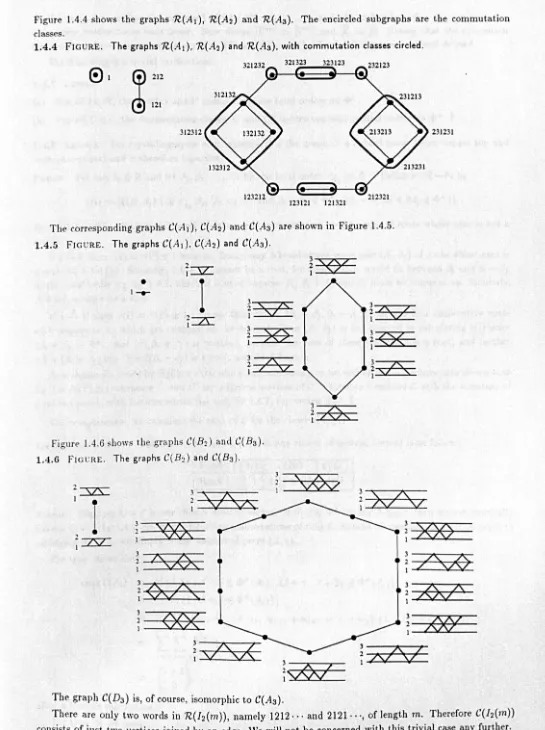
1)1 .Figure 1.4.4 shows the graphs n(Ad, n(A2 ) and n(A3)' The encircled subgraphs are the commutation
dasses.
1.4.4 FIGURE. The graphs n(Ad. n(A2) and n(A3). with commutation classes circled.
Cll
2120
121321323 323123
312312 231231
123121 121321
The corresponding graphs C(AI), C(A2) and C(A3) are shown in Figure 1.4.5.
1.4.5 FIGURE. The graphs C(A\). C(A2 ) and C(A3)'
~
::sz:
•
1 .-I
3S 7S
2S/
i
::zL
3 12
~
1
3
/ '
-2 Z
I ' J '
F'igUl'e 1.4.6 shows the graphs C(B2 ) and C(B3). 1.4.6 FIGt:RE. The graphs C(B2) and C(B3).
3 " 7 ' C r
-2 ~_r_ ...
___.E'--The graph C(D3) is, of course, isomorphic to C(A3).
3 ~Z
i37
i
I~~
3ZS
i
Sl
S
'VOV
3 2
\
3
2
\
3
2
•
tOO
~
~/0\7
[image:15.574.16.561.17.747.2]If i = ir ... il , define the reversal of i by irev := il . . . ir , and also define
i
:=i; . ...
ij, applying theopposition involution to each letter. Now define
[W
ev := [i'ev] and[i]
:=[i]
.
Noting that the oppositioninvolution and reversal commute, set i" :=
i
rev and[W
:=[i"].
These definitions are all well defined.The following is a trivial verification.
1.4.7 LEMM A.
(a) For all i
En
.,
the words i and i· induce opposite tot.al orders on 4>+.(b) For all eEC, the commutation classes
C
andC·
induce opposite partial orders on 4>+.I
1.4.8 LEMMA. For crystallographic root systems, C is the graph of a ranked poset (with unique top and bottom vert.ices) and is therefore bipartite.
PROOF. Fix any io En and let (31, (32, ... , (3N be the total order
<iD
on <1>+. Define r : 'R.-+N byBy 1.:3.6 (a), if i -
i'
then7'(i)
=
7
'
(i')
because any c.ommutation swaps a pair of roots whose sum is /Jot a root.If i ~ i' then
l
'
(i)
=
7'(i')
±
1 because, firstly, any 3-braid swaps some pair ((3i, (3j) of roots whose sumi
s
a root.; by 1.3.6 (b). Secondly, 2(3i + (3j cannot be a root, for otherwise it would lie between (3j and (3; + (3j in the tot,al order<i,
by 1.3.7, which is absurd because (3j, (3j + (3j and (3j must be consecutive. Similarly,di
+
2{3j cannot. be a root.If i ~ i' then
"(i)
=
"(i')±
1. To see this, let (3j, 2(3. + (3j, (3i + (3j, (3j be the four consecutive rootswith respect to
<i
which get swapped by the 4-braid. Then ((3i, (3j) is 110t c.ounted in calc.ulating!'(i)
since2;3i
+
'ij E <1>+. But(13
;
,
(3i + (3j)is
counted, because the sum of these two roots i.a
root, and neith I'2;3;
+
(;3;+
Jj) nor {3i+
2({3i+
Pj) is a root, using 1.3.7 again.Now define r: C-+N· by f([i]) := r(i), which we have shown to be well defined. We have also .. hown that
r(C)
=
f((;')±
1 wheneverC
andC
'
are adjacent vertices of C. Thereforer
endows C with the structure of a ranked poset, with bot.tom vertex[iD)
and, by 1.4.7, top vertex[i
o)·.I
Fol' completeness, \Ye calc.ulate the rank of
C
for the classical types.1.4.!) PROPOSITION. The rank of the poset C (wit.h any choice of bottom vert.ex) is a follo\\' .
Poset C(AI) C(BI) C(DI)
Rank e~I)
4W
+ (;)
4m
PROOF. Suppose
C
E C is our chosen bottom vert.ex. If/3,
'Y E <1>+ . atisfy {3 ~c 'Y then we automat icallyha\'e l' ~(" J, by 1.4.7. So, in ollr following enumerations of rank C, instead of counting ordered pairs (.3, ", )
satisfying.3 ~c 'Y, we simply count ullordered pairs {p,'Y}.
For type A/ we have
rank C(AI)
aft.er a routine calculation.
For type El we have
1{{(3,'Y}
I
p+r E <I>+(AI); 2{3+r, {3+2r~
<I>+(A I)}I
1{{(3,'Y}
I
{3+'Y E <I>+(AI)}II{
{a:i + 0';+1 + ... + a:j, O'jtI + a:jt2 + ... + O'd 11~
i~
j<
k~
I}I1-11-1 I
LL L
1i=I j=i k=j+I
rankC(Bl)
=
1{{,8,'Y} 1,8+'YE<1>+(Bl)j 2,8+1', ,8+21'\t
<1>+(B/)} 1 1{{0'1+a2+ .. ·+ aj, 0'1+a2+"'+O'j}ll~i<j~/}1+ I{{O';
+
0';+1 + ... + O'j, O'j+l + aj+2 + ... + ad12
~i
~ j < k ~ l}1+
t, {{
ai + ai+1 + ... + O'j,~20'1
+ 0'2-t:.. .
.
..
+ O'i-d,+
~a2
+ 0'3~
... +Q
'
k))}
,
:=2(\'1 If ;=2 :=0 If k=1where, in the last line, for fixed i, the index j obeys i ~ j ~ I, (giving 1 + 1 - i choices), and, for fixed j as
well, the index k obeys 1 ~ k ~ 1 and k:/; i - l,j (giving 1-2 choices). Therefore
rankC(B1)
=
G)
+G)
+t,(l
+ 1 -i)(l-
2)G)
+4G)
·
For type D/, we have
rank C(Dd
=
1 {{,8, 'Y} 1,8 + l' E <1>+ (D1) }I
·
lhorne unordered pair {,8, ,} is counted in the enumeration ofrank C( D/) then ,8, " ,8+1' E <1>+ (D!) S; <1>+(B!)
and 2f3
+
"
(3 + 2, \t <1>+ (Dd· For a c.ontradiction, suppose, however, that 2,8 +, E <1>+ (B/). Then this rootmust be of t he form
a
f
+ a~ + ... +ap
for some i2:
1. However, 2,8 + l' visibly cannot have all nomeroe.oei'fie.ients equal to 1. This is our required contradiction. By a symmetrical argument we therefore obtain
2/3 + r,
!3
+ 2"),\t <1>+(B
1). Consequent.ly, the pair {,8,,} is also counted in the enumeration of rankcc
8/ ). Wecan therefore make use of our calculation of rankC(B/). The only pairs {,8,r} of roots in <1>+(8/) t.hat. we need to exdude are those of the form
{
a
f
+af
+
..
.
+
a
p
,
a
f
+af
+ ... +a?
}
, wh
ere 1 ~ i<
j ~ I, becausethe~e roots do not belong to <1>+(Dl). There are
W
such pairs. So rankC(Dl)=
rankC(Bl) - (;)=
4W.
I
1.5 Generation of Fundamental Groups
In t.his ;;eet-ion we rnake a simple observation about the closed paths in C, although thi will not be used
t'1st'where.
:\ lllorphislll (,'-(;' of e.onnected graphs is a surjective mapping of the vertices of G onto the YE'rtices of
(;' such t.hat pairs of adjacent vert.ices of G are mapped to vertic.es which are either adjac.ent or coincident.
We call (;' a quotient graph of G.
By 1.:3.1.
R
.
and Care connec.ted graphs, and C is clearly a quotient graph ofn.
Let. A be a set of dosed paths in the c.onnected graph G. The fundamental group of G is generated by
A if. given a \'ertex v E G, t.he fundamental group of G relative to v is generated by paths of the form p-I ap,
where p is a pat.h from v to the origin of the loop a E A, and p-l is p traced backwards. (We compose maps
from right-ta-left,.) This property is independent of v, by connec.tedness of C.
The support of a reduced word i := ir ... il is the set supp(i) :=
{i
l, i2, •.. ,i
r}.The following theorem is due to [Tits, ~4] and can also be found in [Ronan, Theorem 2.17]. Recall the
not.ation bij
=
ijij ... with 11l.;j letters, where 5i5j has order m.ij.1.5.1 THEOREM. The fundamental group of
n
is generated by the closed paths of the form(a) (iobiji, il biji, i1 bjji, iobjji, iobjji);
1.5.2 COROLLARY. The fundamental group of C is generated by
(i) quadrilaterals and octagons in types A" D, and E6 , E7 ,
E8;
(ii) qua.drilaterals, octagons and 14-gons in types
R,
andF
4.PROOF. The fundamental group of C is generated by the images of the paths (a) and (b) of 1.5.1 under the
natural morphism R-C.
Let p denote the image of a path of type (a). Clearly, p has no more than four vertices. We therefore
only have to rule out the possibility that P. is a triangle. This, however, follows from 1.4.8, which showed I,hat C is bipartite.
Now let p denote the image of a path of type (b). Let
{i,
j,k}
be the three letters involved in the braids and let 6.' be the subgraph of the Coxeter graph with these three vertices. If 6.' is of type At $ At $ AI2. Normal Representatives of Commutation Classes
2.1 Introduction
In this chapter we obtain representatives of all commutation classes, called normal representatives, which have a particularly simple form. In general, each commutation class has many normal representatives, but t.hey do not differ widely from one another. Vole will show how normal representatives can be used to give an inductive method for constructing commutation classes.
In order to describe normal representatives concisely, we introduce the following notation. Let i, j E N.
Define words
(.
/
.) ._
{i
i+
1
i
+
2
.
..
j if i:5
jl ) .-
0
'f . .1 l
>
)
,
. . { i i - l i - 2 ... j
(t
"")) :=0
if if i i<
~ j j.For example, (1/4) = 1234, (4".4) = 4 and (4'\. 5) = 0.
If i is a yertex of the Coxeter graph of type AI or BI then define adjacent vertices
i+ := i + 1 (i # I) and i- := i - 1 (i # 1). If i is a vert.ex of the Coxeter graph of t.ype DI, define
i+:=i+l(i#I,/), 1+ :=3, i-- :=i-:=i-l(i#I,2,3), 3- :=2, 3--:=1.
If now i
= ir
... iJ , define i+ :=it
...
it
,
and similarly for i-, i--.Further, in type DI, let iaut denote the word obtained from i by interchanging 1 and 2, fixing everything
else. (This differs from
I
only in that the opposition involution is trivial if I is even.)If i is a reduced word and tEN then the multiplicity of t in i, denoted mult(i), is the number of o('.wrren('es of t,he letter t. Clearly, commutations leave letter multiplic.ities unchanged, so we ('an define the
multiplicity of t in [i] to be mulj([i]) := mult(i).
We define t,he promotion operator to be the map
0:
'R -
R
.
",here 1.] is the effect of the opposit,ion involution; see 1.1.2 (d). This terminology and notation is moti\'atecl
by
[EG],
in which a bijection between R.(AI) and the set of all balanced tableaux of shape(1-
1, .... I) is Q·ivpn. The elementary promotion operator on the tableaux corresponds to our definition ofO.
o
2.2 NOl'mal Representatives in Type AI
Let
C
E C(A/). Any representative ofC
of the formA(I
'\.
1)(>, for certain subwords A and (> is calleda llol'mall'epreselltative of C, For example, the commutation class [1243412312] E C(A4 ), whose partial orde.r graph is Figure 1.4.1, has 1214:321432 as a possible normal representative. Here, A = 121 and (>
=
4:32.2.2.1 PROPOSITION. Let
C
E C(Al) have a normal representativeA(l '\.
1)(>. Each of the following is a normal representative of someC'
E C(Al) which is adjacent toC
.
The possibilities are given intuitive names which suggest howC
'
is obtained fromC
.
(The restrictions in parentheses will be known to hold aut,omat,ically once Lemma 2.2.2 is proven.)'left'
A#(l '\.
1)(>, where A# is obtained from A by commutations, followed by a 3-braid.'right'
A(I'"
1 )Q# , where (># is obtained from (> by commutations, followed by a 3-braid.'left to right' A'(l'" l)i+ (>, where A"" A'i,
(i
# I).PROOF. This is clear for the first two cases.
Consider case 'left to right'. The hypotheses allow us to apply the following sequence of braids:
A{l "- 1)" A'i{l ",. 1)"
A'(I "-
i+
2) i i+
1
i (i -1 ",. 1)"
~
A'(I"-i+2)i+1ii+1 (i-1 ",.1)"
A'(/,,- 1)
i+ ".Informally, i hops from left to right over (I "- 1) and increases by 1. Since one 3-braid occurs amongst the
above sequence of commutations,
C'
is adjacent toC.
The last case is similar.I
2.2.2 LEMMA. if A(I "- I)" is a normal representative then I
rt.
SUpp(A) and 1rt.
supp(,,).PROOF. Suppose that I E SUpp(A), and consider the rightmost 1 in A. By 2.2.1, we can apply 'left to right' Inoves t.o each letter of A lying to t,he right of this I, leaving a word containing the subword 11, which is
nonreduced. This is absurd, so I
rt.
SUpp(A). The other part is proved similarly.I
'\le now show that the normal representatives of a commutation· class do not differ widely from one
another.
2.2.3 LEMMA. Let A{l "- I)" and A'(1 '" I),,' be normal repre entatives of
C
andC
'
,
respectively. ThenC
=
C
'
if and only if A ~ A' and ,,~,,'.PROOF. Sufficiency is clear. For the converse we will establish a slightly more general result. Suppose we
are given ('Qrnmutation-equivalent reduced words L(I '\. l)R,
1'(1 '\.
l)R' satisfying 1 rt. uppeR), suppeR')and I
rt.
supp(L), supp(L'). '\le will prove t.hat L ~ l ' and R ... R' by induction upon feR).If e(R)
=
0 t.hen L(I "- 1) ...1'(1
'"
I)R'. The letter 1 of (l '\. 1) in1'(1 '\.
1)R' is t.he rightmost. occurrence of I, so this 1 commutes w'ith R'; in particular, 2rt.
suppeR'). So L(I "- 1) '"1'(1 "-
2)R'I, which implies that L(I "- 2) ... L'(/ '" 2)R', by 1.:3.4.;\'ow repeat this argument, considering the right most 2,
:3
.
..
,
/-1
in turn; we see that supp(R') contain.none of :3, 4 .... , /. So R'
=
0. Therefore L(I ",.J)
--
1'(1 "- 1), which implies that L --1'. applyincr 1.3.4.\ ow let (eR)
>
O. Write R=
R1i,.0 that L(I '\. I)RJi '" L'(I '\. l)R'. Since the right mosti in
the "t>('ond word commutes 1.0 the lid. and since i::f I. we must have i E uppeR'). So R' '" RJi for .ome R'1' So, by 1.:3.4 we obtain L(I '\. 1 )R1 '" 1'(1 '" I)R'1' By induction L --l ' and R1 '" R'1 0 R", R'.I
2.2.4 LEMMA. Let)..(I '\. 1)" be a normal representat.ive. onsider the corresponding total or I r on
(I>+(A
,);
see1.:3
.5.
The I1 ositive root,. corresponding to the letter of the ubword(I
'\.
1) are preciselyI.hose wit.h surnmand (\'1, namely
in some order.
PROOP. For each 1 ~ i ~ I, the positive root corresponding to the letter i in
(l '\,
1) isSince, by 2.2.2, 1
rt.
supp(,,), it follows that SI} -1 cannot delete the summand 0'1. So i gives rise to a rootwith sU1l1mand (\'\. So the [ letters of
(l '\.
1) must correspond toalii
positive roots with summand (\'\.I
We can now prove the c.onverse of 2.2.1.
2.2.5 PROPOSITION. Let
C
E
C(A/)
have a normal representat.ive A(l ",. 1)" and suppose thatC'
is adjacent toC.
ThenC'
has a normal representative of exactly one of the four types listed in 2.2.1.roots, throughout the commutations; see 1.3.6 (a). We note whether each letter comes from A, (l , 1) or (}. Let iji be the 3-letter subword to which the 3-braid is applied. Let 0', 0'
+
p,
P
be the corresponding positive roots; see 1.3.6 (b). Visibly, either none or exactly two of these three roots may have summand a). So by 2.2.4, either none or exactly two of the letters in iji come from (l , 1). We look at the two cases in turn.Suppose that no letter of iji comes from (/ , 1). It is impossible for iji to be a mixture of letters from A and (} because the intervening subword (l , 1) would prevent the letters of iji commuting into adjacent posit.ions. So C' contains a normal representative of type 'left' or 'right' according as iji comes entirely from A or (}.
If exactly t.wo letters of iji come from (l , 1), they must be either the first or last two of iji. If it. is t.he last t.wo, then j
=
i+
1 and the first letter, i, comes from A. It is clear that i may commute to the rightmost let.t.er of A, that is, A '" A'i, because otherwise it would be impossible to commute the letters of iji into adjac.ent positions. Therefore C' has a representative of type 'left to right', since, by 2.2.2, we have i-:f
I.If the first two letters of iji come from (l , 1), we similarly obtain type 'right to left'.
Finally,
C'
cannot have normal representatives of more than one of the four types, because, using thecrit.erion in 2.2.:3, it is easily checked that no two types lie in the same commutation class.
I
2.2.6 PROPOSITION. Every coml11utat,ion class in C(A,) contains a normal representative.
PROOF. Proposition 2.2.1 shows that if some vertex of the graph C(A,) contains a normal representative then so do all adjacent vertices. Sinc.e C(A,) is connected we therefore only have to exhibit one normal
representative. If w~1) denotes the longest element of W(A,) then a calculation shows that
w
~
1)
=
wg-I)SI ... S2S) and£
(w~l))
=
e
(w~/-)
)
)
+ /
for I
>
1. Therefore1(2' 1)(3' 1) ... ( / , 1)
belongs t.o R.(A/) a.nd is dearly a normal representative.
I
We now describe an algorit.hm for constructing all the c.ommutation classes in C(A/) from tho e of C(...l,_ I)'
Let. C E C(A,-I) and let I be an
ideal
of the partial order graph of C, that is, as t of vertices such that ifi
E I and j is lower in the partial order, then j E I. LetiJ
be the word corresponding t.o any linear ext.ension of [, and extend to a reduced longest word, so thatfor sorne word
i
2. Sincebil
E 'R.{Al-d, we havei
2h(l'
1) En(
A
,).
So, by applying f(i1) 'Ieft to right.'moves (see 2.2.1), we obtain i2
(l
~ l)i{. (See 2.1 for the notationit
.
)
SetSiJlce all linear extensions of I are commu tation-equivalent to one another, Cl is unambiguously defi ned.
For example, if
C
E C(Aa) has t.he partial order graph shown in Figure 2.2.7 (a), and if I is the ideal indicated in (b) t.henCl
is shown in(
c.
)
.
We shall omit t.he numbered horizoutallines in the partial order graphs from now onwards; if drawn in, !.hey would be numbered from bottom to top, as usual.
In t.erms of words, C
= [132132],
the word 32 is a linear extension of I, andCl
= [1321432143]
.2.2.7 FIGURE. Constructing
Cl
.
(n) (b)
2.2.8 PROPOSITION. The mapping
{(C,
J)
ICE C(A/-d,J
is an ideal of C} -+ C(A/)(C
,
l) ...
Cl
is bijec.tive.
PROOF. For surjec.tivity, take any [A(I '\,. 1)0] E C(A/), set C := [A 0-] E C(A/-d, and let J be the ideal of the partial order graph of C formed by the letters of 0-. By definition, (C, I) maps to [A(I '\.
J),,]
.
For injedivity, suppose that
Cl
=
C]"
with the obvious notation. Then[i
z
(l '\.
l)it]=
[i~(l '\.J)j't].
By2
.
:,U
we haveh '"
i2
andit
'" i't
,
henceit '"
i~. So C=
[i
2i1]
=
[i2iD
=
C' and sincei1 '"
i~, we have I=
I'.I
Before giving an example, we shall introduce a useful map and list some elementary properties.
2.2.9 PROPOSITION. Define
6: C(A/)
-+ C(A/-d[A
(I "1),,] ...
[,\
,,-).
(a) The map 6 is a surjedive graph morphism. Eac.h fibre is a connected subgraph and any two vertices of the same fibre are related to one another by 'left to right' and right to left' moves.
(h) The 6-fibre of
C
E C(AI-d is{Cl
I
J is an ideal ofC
l·
This is a poset with unique top and bott.om by setting
(c) Each b-fibre is a ranked poset with rank function
and highest. rank
G)
.
Adjacent Yertices of C(AJ} related to one another by a 'left' or 'right' move have t.hesa me rank (in 1.heir respect.i ve fibres).
PROOF. First note that 6 is well defined, by
2
.
2
.
3
.
(a) If
c:
=
[
i]
E C(AI-l) then[i(l
'\,. 1))
maps to C, so 6 is onto. Using2.2
.
1
,
it is easily c.hecked that under 'Ieft' and 'right' moves, the 6-images of adjacent Yertices are t.hemselves adjacent. l nder 'left to right.' and·right. to left' moves, the 6-images coincide. So 6 is a morphism.
\low consider a general vertex
[A(l
'\,.
1
)
,,]
E 6-1(
C
)
.
By definition, A ,,- '"i
.
So, by applying t(,,) left to right' moves to[i(l '\. 1
)
]
,
we obtain a connected path, lying in 6- J(C), joining[
i(l
'"
1
)
)
to [A(I '" l)g].Thus, 6-1 (C) is connected.
(b) This is immedia.t.e from the definit.ions; in the notation of (a), we have
{[A(l'"
1),,]
I
C
=
[A
g-n
{Cl
I
C=
[A
g-]
andI
is the ideal formed byg-}
{Cl
I
I is an ideal ofC}.The claimed poset struct.ure is dear.
(c)
This is clearly a valid ranking function, because ifCl'
coversCl
in the partial order then J' has one rnore vertex thanI
and henc,e rank(Cl')
=
1+
rank(
C
l
).
So, in order to obtain all the commutation classes in C(A/), we construct the a-fibre of each C E C(A/_1 ) in turn.
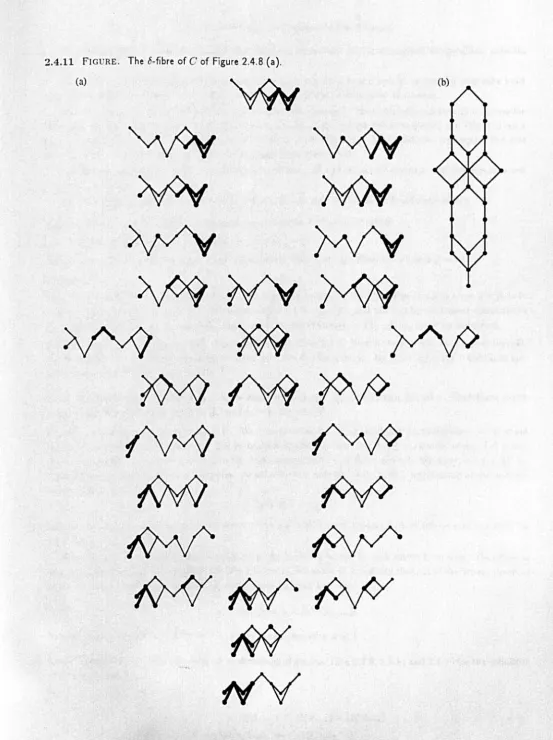
Let 8 : C(A4)-C(A3)' The 8-fibre of C (see Figure 2.2.7 (a)) is shown in Figure 2.2.10 (a). The way C splits into two parts is highlighted in the heavily drawn parts of the partial order graphs. Figure 2.2.10 (b) shows the poset structure of this a-fibre. Note that it is a ranked poset with top rank 6
=
(~), agreeing with2.2.9
(c.)
.
2.2.10 FIGURE. The a-fibre of C of Figure 2.2.7 (a).
Cb)
2.3 Normal Representatives in Type BI
L t,
c:
E C(Bt). Any represent.ative ofC o
f the form),,
(
1
'\,
2),.,,1(2 / 'I
)
e
which sati fie I,he conditioll_I
rt.
supp()..). supp(a) and J, 2ft
supp(,.,,) is c.a.lled a normal representative of C.2.3.1 ~OTES.
(a) In 2.:3.7 we will prove t.hat any word in 'R.(Bt) of the form )..(t '\, 2)1-"1(2 /'
I
)
e
is in fact a normal represent.a.tiw. However, we find it cOJ)\'enient to start with the stronger definition.(b) OI'mal representatives appear asymmetrical but this is misleading sinc.e the conditions 1 \ :2 ~ supp(p.) illJply that p.l ...., 1// ..
2.3.2 PROPOSITION. Let
C
E C(Bt) have a normal repre.entati\'e)..(1
'\,
2),.,,1(2 / ' I)g. Each of the following is a normal representative of some C' which is adjacent toC
.
'left' )..#(1 "" 2),.,,1(2 / '
I)e,
where )..# is obtained from)" by c.ommutations and a 3- or 4-braid.'middle' )..(1 "" 2),.,,# 1(2 / ' l)g, where ,.,,# is obtained from,." by commutations and a 3- or 4-braid.
'right' )..(1 "" 2),.,,1(2 / ' I)g#, where g# is obtained from
e
by commutations and a 3-or 4-braid.'left to middle'
)..'(1 "" 2)
i
+
,.,,1(2 / ' I)g, where).. ....,)..'i
and ii=
1. 'middle to left' ).. i- (/ "" 2),.,,'1(2//)a
,
where,." ....,i,.,,'.
'right to middle'
)..(1 '\,
2),." i+ 1(2/I)l?'
,
where g'" ig' and ii=
1. 'middle to right')..(1 ""
2),.,,'1(2 / 'I)
i-e,
where,." '" IJ'i.'left to right'
)..'(1 ""
2),.,,1(2/I)
1e,
where).. ... )..'1 and 3 ~ suPP(J.l.).In the last two cases, C and C' have representatives which are related to one another by a 4-braid.
PROOF. This is clear for the first three cases.
Consider ('ase 'left to middle'. We may apply the following sequence of braids:
>.(1 ""
2)111(2 /I){}>.'i
(I "" 2)111(2 / /)(}>"(1 "" i
+
2) i i+
1 i (i - 1 "" 2)111(2 / /)(}2.
>"(1 "" i+
2) i + 1 i i+
1 (i - 1 "" 2)1J1(2 /I){}>"
(I "" 2) i+ IJ 1 (2 / I) (}.Since one :3-braid occurs amongst these commutations,
C'
is adjacent toC.
The next three cases are provedsimilarly.
Consider case 'left to right'. We may apply the following sequence of braids:
>,'1 (I "" 2)111 (2/ I)(}
>.'(1'"
3)
1212 1J(3 / /)(}~
>.'(1'"
3)
21211J(3 / /)(}>"(1'" 2)1J1(2 / I) l{}.
Since Olle 4-braid oc('.urs amongst these commutations, C' is adjacent to C. The last case is similar. I
2.3.3 LEMMA. Let >'(1'" 2)111(2 / I){} and >"(1 "" 2)11'1(2/ /){}' be normal represent.atives of
C
and C', respectively. ThenC
=
C' if and only if>. '">"
,
11 '" 11' and {} '" {}'.PROOF. Sufficiency is dear.
For the converse, suppose we have commutation-equivalent reduced words L(I "" 2)Ml(2 / I)R and L'(l '" 2)M'l(2 / /)R' satisfying 1 ~ supp(L), supp(L'), supp(R), suppeR') and I, 2 ~ supp(M), supp(M').
We shall prove t.hat L '" L', M '" M' and R -- R' by induction upon feR).
If f(R)
=
0 f.hen L(I '" 2)Ml(2 / /) -- L'(I '" 2)M'I(2 / I)R'. So, since I ~ supp(R'), the letter / of (2 / /) in t.he right-hand \\'ord must be able t.o commute to the rightmost position. This impli s/ - ) ~ supp(R'). By 1.:3.4 we obtain L(I "" 2)MI(2 / / - 1) "" L'U "" 2)M'l(2 / / - l)R'. Similarly,
('onsiderillg the rightrnost O('.(,.llrrenc.es of 1-1, /-2, ... , 2 in turn, we also obtain /-2, /-3, ... , 1 rf:. supp( R'). Therefore R'
=
0=
R. It, follo\\'s t.hat L(I '" 2)M -- L'(I '" 2)M'. Now, since [rf:. supp(L),supp(L') and 1, 2 ~ supp(M), sllpp(M'), we haye exac.tly the same situation as in the proof of 2.2.3, xcept with differ ilL not.at.ion. Therefore L -- L' and M -- M', as required.Now suppose that feR)
>
O.
Writ.e R=
R)i
,
so Lhat L(I '" 2)Ml(2 / /)Rli "" L'(l '" 2)M'1(2 / /)R'.So, i commutes to t.he rightmost position in the right.-hand word. Since i
#
I, we t.herefore ha\'e i E supp(R'), hence R' ... R~ i for some R~. By l.:3.4 we obtain L(I ". 2)M 1 (2 / /)RI "" L'(l '" 2)M'1 (2 / I)R;. Byindu('tion, L ... L', M"" M' and RI --R'}, hence R -- R'.
I
2.3.4 LEM:-'1A. Let ).(I '" 2)1J1 (2 / l){} be a normal representative. Consider the corresponding total order on (1)+(81).
(a) The root c.orresponding to the letter 1 adjacent to IJ is 0')
+
0'2+
...
+
0'/.(b) The roots corresponding to the subwords (l
".
2) and(2/
I)
are precisely the remaining positive root.s wit,h sumrnand 0'/, namelyand
20'1
+
0'2+ .
.
.
+
0'1, 2(0)+
0'2)+
0'3+ .
..
+
0'1, ... ,2(0'1+
...
+
0'1-1)+
0'1·PROOF. This is a simple calculation, using the restrictions on the supports of >',11 and {}.