
Becoming a reflective educational professional : an interpretative phenomenological analysis of students' experiences
60
0
0
Full text
(2) Acknowledgements I would like to express my gratitude to my supervisor Dr. Erik van Rossum, for the support in my learning process and the positive and constructive comments. I would like to thank Marlo Kengen for her support in enabling me to undertake this research at the HAN University. I would like to express my gratitude to my the participants of this study who were willing to share their time and their experiences with me. I want to thank my friends and colleagues for their support and encouragement throughout my study. Finally yet importantly, a big thank you to my family for their love and endless encouragement throughout my study. To my husband, daughter and son for their understanding and patience when I have had to lock myself away in the study- thank you for all your help and support.. 2.
(3) Abstract Developing the ability to reflect is an important goal in higher vocational education. This goal is mentioned in the European Qualifications Framework for Lifelong Learning (European Commission, 2008) that describes the qualifications for the several educational levels. For higher vocational education it states that students should be able to review and improve their own achievements and that of others. Students are more and more encouraged to examine how they succeeded or failed or improved on a task or set goals for future work and to make this knowledge public and open to scrutiny through a portfolio (Lyons, Hyland, & Ryan, 2002; Klenowski, 2002). In this process of professionalization the role of reflection is recognized as being important, it is supposed to have a positive influence on self-knowledge (Procee, 2006), and on the ability to steer one’s own development. In many teacher education programs reflection has become one of the essential goals (Korthagen & Vasalos, 2005), while portfolio’s are considered tools that stimulate and promote reflection (Mansvelder-Longayroux, Beijaard & Verloop, 2007). This phenomenological study aimed at gaining understanding of the experiences of students engaged in reflective activities in an educational setting. Semi-structured interviews were conducted with five students of which four interviews were included in the present study. Interpretative Phenomenological Analysis (IPA) was used to analyse the interviews and three super-ordinate themes were identified. The first describes how the reflection process is conceptalized, the second detailes the experiences of being engaged in educational reflective activities, the third describes what opportunities and resources students need when learning to reflect. Existing literature on reflection in education was utilised in order to shed light on the results, and in order to clarify the material. The findings reveal a dynamic experience, full of conflicts, which can be understood as a the start of a learning proces. Being engaged in challenging reflective activities students go through periods of selfdeception, not knowing how to continue or where to start. This leads to feelings of being de-skilled. A important finding was that participants have mixed feelings about structured reflection. Different styles seemed to be in conflict, to reflect right according a given model competes with the desire to reflect on ones own way. Consideration therefore needs to be given to the compulsary structures of reflective approaches in educational settings. The significance of the study include a recommendation for awareness building on the difficulty of learning reflection, a focus on support and also ensuring that mentors (or teachers) are familiar with difficulties students’ run into when they get engaged in reflective activities. Keywords:. Interpretative Phenomenological Analysis, IPA, Reflection, Higher education, Perception, Experience, Level of reflection, Reflective practice. 3.
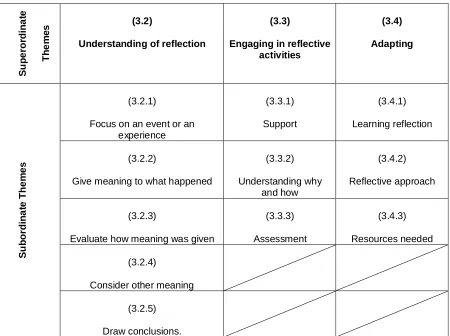
(4) Content Acknowledgements..................................................................................................................... 2 Abstract ...................................................................................................................................... 3 1. Introduction to the research ................................................................................................. 6 1.1. Introduction .............................................................................................................................. 6. 1.2. Reflection in education ............................................................................................................. 6. 1.2.1 1.2.2 1.2.3. 2. 1.3. Study setting ........................................................................................................................... 12. 1.4. Personal reflections: My identity as a researcher.................................................................... 14. 1.5. Research purpose and research questions .............................................................................. 15. 1.6. Scientific and practical relevance ............................................................................................ 16. 1.7. Structure of the thesis ............................................................................................................. 17. Methods ............................................................................................................................. 18 2.1. Introduction ............................................................................................................................ 18. 2.2. Choosing a qualitative research approach............................................................................... 18. 2.3. Research paradigm .................................................................................................................. 19. 2.3.1. Implications for this study ..........................................................................................................................19. 2.4. Ontological and epistemological assumptions ........................................................................ 19. 2.5. Theoretical perspectives: Hermeneutic phenomenology ........................................................ 19. 2.5.1. Hermeneutics ..............................................................................................................................................20. 2.6. Methodology: Interpretative Phenomenological Analysis (IPA) .............................................. 20. 2.7. Methods.................................................................................................................................. 21. 2.7.1 2.7.2 2.7.3 2.7.4 2.7.5. 2.8. 3. Defining reflection.........................................................................................................................................6 Reflective practice .........................................................................................................................................8 Summary ......................................................................................................................................................11. Participants ..................................................................................................................................................21 Data collection .............................................................................................................................................23 Data analysis ................................................................................................................................................24 Ethical considerations .................................................................................................................................25 Trustworthiness...........................................................................................................................................26. Chapter summary .................................................................................................................... 27. Findings .............................................................................................................................. 28 3.1 3.1.1 3.1.2. 3.2 3.2.1 3.2.2 3.2.3. Introduction ............................................................................................................................ 28 Participants ..................................................................................................................................................28 Themes.........................................................................................................................................................28. Superordinate theme: Understanding of reflection ................................................................ 30 Focus on an event or an experience ..........................................................................................................30 Give meaning to what happened ...............................................................................................................31 Evaluate how meaning was given ..............................................................................................................31. 4.
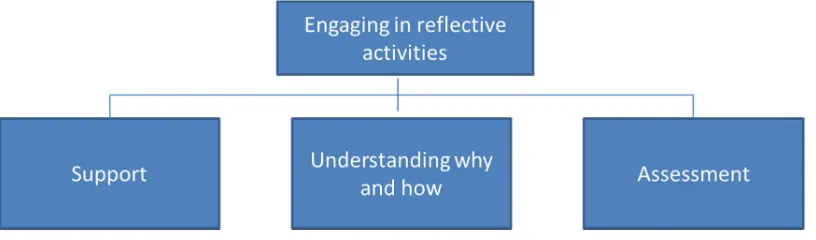
(5) 3.2.4 3.2.5. 3.3 3.3.1 3.3.2 3.3.3. 3.4 3.4.1 3.4.2 3.4.3. 3.5. 4. Consider other meaning .............................................................................................................................32 Draw conclusions ........................................................................................................................................33. Superordinate theme: Engaging in reflective activities ........................................................... 34 Support.........................................................................................................................................................34 Understanding why and how .....................................................................................................................36 Assessment ..................................................................................................................................................37. Superordinate theme: Adapting .............................................................................................. 38 Learning reflection ......................................................................................................................................38 Reflective approach ....................................................................................................................................39 Resources needed .......................................................................................................................................40. Chapter summary .................................................................................................................... 41. Discussion ........................................................................................................................... 42 4.1. Introduction ............................................................................................................................ 42. 4.2. The findings and existing literature ......................................................................................... 42. 4.2.1 4.2.2 4.2.3. 4.3 4.3.1 4.3.2. Understanding of reflection .......................................................................................................................42 Engaging in reflective activities ..................................................................................................................43 Adapting.......................................................................................................................................................45. Implications and recommendations ........................................................................................ 45 Implications for education ..........................................................................................................................46 Suggestions for further research................................................................................................................47. 4.4. Research issues arising from the study.................................................................................... 47. 4.5. Final reflections ....................................................................................................................... 48. R EFERENCE LIST ............................................................................................................................ 49 APPENDICES ................................................................................................................................. 58 APPENDIX A: INTERVIEW O UTLINE .......................................................................................................... 58 APPENDIX B: OPLEIDINGSKUNDE’ S CURRENT MODEL OF STRUCTURED REFLECTION (2014)............................. 59 APPENDIX C: TOETSKADER REFLECTEREN O PLEIDINGSKUNDE ..................................................................... 60. 5.
(6) 1 Introduction to the research 1.1. Introduction. The current study is an Interpretative Phenomenological Analysis (IPA) (Smith & Osborn, 2003; Smith, Flowers & Larkin, 2009) of the experience of students with structured reflection. The purpose of this study is to explore the experiences of students who are engaged in reflective activities in an educational setting, from their own perspective. The study was undertaken in 2014-2015, as part of the Master’s programme Educational Science and Technology at the University of Twente in Enschede, in collaboration with the HAN University of Applied Sciences. In this introductory Chapter I provide background information about reflection in education by exploring existing literature highlighting the role of reflection in education. I also explain the rationale and aims of the study, the research question, and its significance for educators and my position as a researcher including the decision to adopt an IPA approach.. 1.2. Reflection in education. Reflection has been considered important for learning by educators and researchers in the field of education (Dewey, 1910; 1933; Schön, 1983; Kolb, 1984; Higgs, 1988; Mezirow, 1990; Hatton & Smith, 1995; Van Manen, 1995; Procee, 2006). John Dewey (1910; 1933), the inspirer of reflection in education today, argues that it is important to reflect, because “we do not learn from experience. We learn from reflecting on experience” (p. 78). Kolb (1984) elaborates that adults learn from their experiences, and reflection is the engine that moves the learning process. Schön (1983) argues that reflection leads the professional to become an expert. Thus developing reflective capacity is essential for professionals to gap the bridge between the static knowledge found in textbooks and the dynamic, adaptive knowledge that is needed in the dynamic, complex, and unstructured settings in which professionals work (Schön, 1983). Mezirow (1990), asserts that learning occurs when we reflect on content, process and personal foundational beliefs, we will us change our assumptions, attitudes and believes. Higgs (1988) argues that through reflection students will learn to clarify their thoughts, which will lead to insight and understanding of the information they receive. The link between learning, making meaning and changing practice starts when students are initiated in their specific practice (Procee, 2006). They learn the technical competencies associated with the quality standards of a practitioner in the profession. Reflection can thus be seen as a necessary competency for practitioners if they want to be able to act with confidence in a professional manner (Procee, 2006). It seems that reflective practice is considered in education because it encourages learners to explore new ways of thinking and to develop alternative explanations for experiences. Educators believe it contributes to learning and personal development. However there is no consensus on how to determine, facilitate, and assess reflective practice. For this reason, I have decided to review the different notions of reflection in education and develop further understanding of the aims, focus, and processes of reflection in education. In my selection of literature I have tried to provide the most helpful context I can for understanding the research I have undertaken, and the reasons why it is interesting, relevant and necessary.. 1.2.1 Defining reflection The concept and the practice of reflection have been explained by educational scientist in different ways (Mezirow, 1981, 1990, 1991; Schön, 1983, 1987; Hatton and Smith, 1995; Van Manen, 1984). According to Rogers (2001) who performed an analysis of common definitions of reflection, educational scientists seem to agree that reflection is a cognitive activity or process. In the reflection process, a person has to be examining his or her own emotional or cognitive responses to situations or experiences actively, with the overall purpose to improve his effectiveness (Rogers, 2001). In their description of reflection and the reflection process, the educational scientist have identified several types of reflection based on the object. 6.
(7) or the outcome of reflection and most scientist seem to share the idea that learning occurs through reflection, through questioning one’s own ideas, methods, and beliefs (Rogers, 2001). Procee (2006) argues that the most influential approaches are the pragmatist school of Dewey and the so-called Frankfurt school of critical social theory. Dewey (1933), an influential educational philosopher, conceptualized reflection as a rational and purposeful act. According to Dewey (1933), we learn through routine action, and reflective action. Impulse and external circumstances such as “tradition and authority” (p. 9) guide routine and therefore routine is not considered actively. Dewey (1933) explains, that reflective action on the other hand requires “active, persistent, and careful consideration of any belief or supposed form of knowledge in the light of the grounds that support it and the further conclusions to which it tends” (p. 9). Dewey argues that when a practitioner has taken actions as a result of reflective thinking, the practitioner has rationally considered the aspects of the issue and has undergone periods of doubt and uncertainty while working towards finding a solution. Reflective thinking, according to Dewey (1933), is mainly triggered by practical events that created feelings of doubt, uncertainty or difficulty. This perplexity leads to reflective thinking; the need to solve these feelings is the goal that guides the reflection process. Dewey (1933) conceptualized a cyclic reflection process in which he identified the following phases of reflection: interpretation of experience (recognition of possible solutions to the problem); description of experience (problematizing or intellectualizing the situation); analysis (generating hypotheses that might lead to possible solutions) and overt action on the part of the thinker (experimenting, testing hypothesis). Nevertheless, Dewey (1933) argued that reflection should not be learned as a series of steps or procedures, because reflection is more than just logical problem-solving processes. He believed that the reflective skills could be improved by having an understanding of the reflection process and experimenting with forms of thinking and that the improvement of these skills should be initiated by formal education (Moon, 1999). Dewey (1916; 1933) explains that for reflective thinking a person needs to develop four attitudes: whole-heartedness, directness, open-mindedness and responsibility. An individual with enthusiasm for his subject matter shows whole-heartedness. Directness refers to confidence an individual has that his own experience is valid without worrying about the judgements of others (Dewey, 1916). Open-mindedness refers to the ability of an individual to remain open to different perspectives and to accept that there are strengths and weaknesses to one’s own perspective and to that from others. An individual shows responsibility, first, by being whole-hearted, open-minded and directed and, second, by acknowledging that he or she acts on his or her own meaning. When these attitudes guide reflection, there is a better chance that reflection may improve one’s knowledge and awareness (Dewey, 1933). Schön (1983), inspired by Dewey, described reflection as an ongoing process aiming at developing professional knowledge. He distinguished between two processes in which reflective thinking occurs. Reflection-in-action refers to reflection on behavior while it happens or while being engaged in an experience. During practice, the professional makes conscious decisions about practice and adjustments to practice based on feedback. The process of reflection-on-action is a critical reflection process that starts after practice. This process produces new theories and improves practice in similar future situations. Professionals face unique and challenging situations every day. Reflection-on-action helps professionals develop the theories-in-use that underlie competent, expert decision-making (Schön, 1983; 1987). Schön (1987) argues that professionals should use their previous experiences to understand how and why things happen, in order to be more effective. Schön (1987) also introduced the term “knowing in action” to describe tacit knowledge, the knowledge and skills that a professional possesses and uses within a given context. The school of critical social theory sees reflection as a way of making meaning in life (Mezirow & Taylor, 2009), or as a transformative learning process to change beliefs (Mezirow 1997). Mezirow’s (1991) transformational learning theory implies that reflection is more than a cognitive process; it also involves affective aspects such as emotions and feelings. According to Mezirow (1991), a person’s experiences and the assumptions, which are used to interpret experience, can be described as frames of reference. These frames “selectively shape and delimit expectations, perceptions, cognition, and feelings” (Mezirow, 1997, p. 5). Mezirow (1997) explains that we have “a strong tendency to reject ideas that fail to fit our preconceptions, labelling those ideas as unworthy of consideration, aberrations, nonsense, irrelevant, weird, or mistaken" (p. 5). In his transformational learning theory, Mezirow (1991) identified three types of. 7.
(8) reflection based on what one is reflecting on: the content, the process or the premises. These three types of reflection help learners think reflectively upon their external situations. Content reflection focuses on the examination of ‘what’ or the content of a problem. It causes a learner to think back to what was done. Content reflection may lead to a transformation of a meaning scheme. Process reflection focuses on ‘how’ to handle or solve the problem. It causes a learner to consider problem-solving strategies. Process reflection might also lead to transformation of a meaning scheme. In premise reflection, the focus is on exploration of the problem to find out ‘why’. It requires the learner to see the larger view of how his or her value system is being operated. Premise reflection can lead to transformation of a meaning perspective. Premise reflection, is the process of critical reflection. Mezirow (1991) argues that critical reflection is much deeper, more complex, the one who reflects needs to analyze the premises and assumptions that are inherent in his personal perspectives. It includes questioning how and why specific ways of thinking and examination are part of the reflective process and not others. Mezirow (1991) argues that if we critically reflect on our assumptions, we are in a position to change our frames of reference, which then results in transformative learning. This process in which we become critically aware of how and why the assumptions we have about the world influence the way we see ourselves and the way we relate to others, is called ‘perspective transformation’ (Mezirow, 1991). Mezirow (1991) further explains that these higher levels of reflection, the critical consciousness levels, require capacities that are unique for adults and should therefore be a major learning domain in adult education.. 1.2.2 Reflective practice Reflective Practice, a term developed by Donald Schön (1983), refers to the professional who examines his or her actions and “takes [on] the form of a conversation with a situation” (p. 295) or with one’s self in an effort to improve in the future. Educators support the view that reflection is a cognitive process or activity that can serve as a learning tool (Dewey, 1933; Boud, Keogh & Walker, 1985; Mezirow, 1997; Schön, 1983; Korthagen & Vasalos, 2002). In discussing the aspects and depth of reflective thoughts, they distinguish between several stages, levels or themes (Van Manen, 1977; Mezirow, 1981, 1991; Boyd & Fales, 1983, Goodman, 1984; Kolb, 1984; Boud et al., 1985; Schön, 1883, 1991; Korthagen & Vasalos, 2005; Procee, 2006). Most of these educators developed models to provide structure for the practice of reflection. In 2001 Rogers analyzed seven influential models of reflection and revealed four key features of reflection models. Reflection is a cognitive process or activity: (1) in which an individual needs to be actively engaged; (2) after being triggered by an unusual or surprising situation or experience; (3) to examine his or her responses, beliefs, and premises in light of the situation at hand; (4) resulting in integration of the new understanding into his or her experience (Rogers, 2001). Kolb (1984), also inspired by Dewey’s notion of reflection, developed an experiential learning model that incorporates four key elements: concrete experience, reflective observation, abstract conceptualization, and active experimentation. In Kolb’s model, reflection is crucial for learning to occur. The cycle starts with a concrete experience; this experience is the basis for observation and reflection. That means that where a person carries out an action he can then both observe and reflect upon the processes that initiated the action and on the possible consequences. The person then formulates a ‘theory’ based on observations, sets goals based on theory, and takes action. On the basis of this new experience, the person devises a new action or plan. For day-to-day learning the loop is productive and within the given variables and framework, the learner gains competence and confidence. Schön (1983, 1987), argues that the experience of learning by doing a challenging, focused, and critical assessment of one's own behavior is a way to developing one's own craftsmanship. In Schön’s (1983) view of the reflection process, reflection guides decision-making. Reflection requires one to engage actively in intellectual processes, to explore problems or experiences, in order to gain a changed perspective or new insights (Wainwright, Shepard, Harman & Stephens, 2010) subsequently. Wainwright et al. (2010) described five stages in Schön’s reflection process. The process starts with knowing-inaction, the knowledge and skills that a person possesses and uses in a certain context. Knowing-in-action is tacit; it becomes knowledge-in-action when we describe it. Until we describe it, we just do it intelligently. Once we know how to do these actions, we do them spontaneously without putting words to them. In the second stage, the learner becomes aware of uncomfortable feelings and thoughts. Schön (1991) calls this the experience of surprise. Surprise arises when we realize that in a situation, the knowledge we are. 8.
(9) applying is not sufficient in itself to explain what was happening in that unique situation. In the third stage, reflection-in-action, a person critically analyses the situation. This means that we need to examine our feelings and knowledge to inform our decision making process. The fourth stage, experimentation, is informed by the reflection-in-action stage. It starts when we try to apply other knowledge to find an explanation of that unique situation. When we look back on what has happened, we enter the fifth stage, the reflection-on-action stage. The basic cycle of Schön’s approach, the iteration of knowing-in-action, surprise, reflection-in-action, experimentation and reflection-on-action, reflects Dewey’s reflective action, according to Wainwright et al. (2010). Boud et al. (1985) argue that reflection provides a bridge between experience and learning; it involves both cognition and feelings. They claim that negative and positive emotional associations with topics and environments will affect the mind’s ability to work with an experience. Negative emotions can work as obstructing feelings and block the efficacy of learning. The reflective process can be used to remove these obstructing feelings through a thorough examination of the experience. In their model, Boud et al. (1985) focus on emotion. Boud et al.’s (1985) model of reflection consists of two main components: the experience of a learner, and the reflective activity on this experience. Within the reflective activity, Boud et al. (1985) identified three important stages: returning to experience, attending to feelings and reevaluating the experience. During the first stage returning to experience, the learner describes to others what happened during the experience. The description provides data and possible clarification for the learner and may provide insight into particular feelings that the learner did not recognize during the experience. In the second stage, attending to feelings, the learner focuses on how the feelings at the time of the event may have affected his response. By describing the event to others, the learner engages in reflection on his actions and obtains a view of what happened from the perspective of others. In the third stage, re-evaluating the experience, the learner evaluates via four elements: association, integration, validation and appropriation. Association means that the learner links new ideas and feelings to the existing knowledge and attitudes. By integration, the learner is seeking for relationships between pieces of information. If associations are meaningful, the learner can integrate new knowledge into patterns of ideas and attitudes. The learner then tests whether the new appreciations correspond with existing knowledge and beliefs to determine the authenticity of the ideas and feelings. This is the process of validation. Appropriation means that a learner is making knowledge his own. According to Boud et al. (1985), some learning can enter our sense of identity, and become highly significant in our value systems. An important reflection model in the context of this study is the ALACT model (Figure 1) proposed by Korthagen (1985), an influential contributor to the practice of reflection in teacher education. Korthagen originally developed the ALACT model for the use in teacher education programs. The cyclic ALACT model consists of five phases: (1) action, (2) looking back on the action, (3) awareness of essential aspects, (4) creating alternative methods of action, and (5) trial. The first stage is the real practice in the classroom. The second stage involves answering concreting guiding questions (Korthagen & Kessels, 1999) to clarify what has been done during the class. This is a way for the practioner to discover the essential aspects of what happened during the class. In the third stage, the awareness of essential aspects stage, the practitioner uses the answers of the guiding questions from the previous stage to become aware of the influence the problem or the advantage of this experience has on him. At this stage, the practioner may use some theoretical insights (Korthagen, Kessels, Koster, Lagerwerf, & Wubbels, 2001). In the fourth stage, the practitioner is aware of the situation from different perspectives and creates alternatives to improve the situation. The practitioner compares the advantages and disadvantages of each of these alternatives, in order figure out which alternative could be the best in the specific situation. In the last stage, the practitioner tries out the alternative. The last stage is also the first stage of a new cycle. Korthagen and Vasalos (2005), like Dewey (1933), recognize that successful reflection requires some guidance and support. Korthagen and Vasalos (2005) propose different strategies that supervisors can use to support their students in the different phases of reflection. The supervisor can help the practitioner identify useful experiences, discuss the guiding questions with the practitioner, discuss theoretical information, discuss alternatives and support the practitioner in applying alternatives (Korthagen & Vasalos, 2005).. 9.
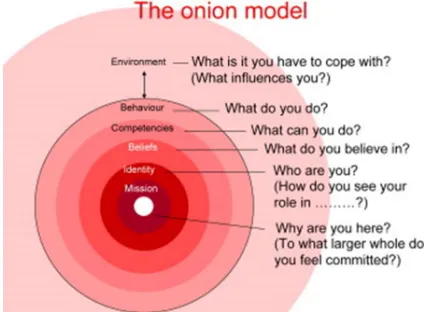
(10) Figure 1: The ALACT model of reflection. (Korthagen, 1985). Although the ALACT model describes a structured reflective process, it does not reveal the content of reflection. Korthagen and Vasalos (2005) explain the content of reflection in the onion model (Figure 2). The onion model contains six levels on which reflection can take place: the environment (everything outside of the person); a person’s effective and ineffective behaviour; different competences of a person; different beliefs of a person; identity (the self-understating of a person); mission (callings and inspirations) (Korthagen & Vasalos, 2005). Korthagen and Vasalos (2005) distinguish between two concepts: reflection and core reflection. Core reflection refers to reflection at the two deepest levels in the onion-model. A key element of core reflection is the attention to core qualities in people (e.g. empathy, compassion, love and flexibility, courage, creativity, sensitivity, decisiveness, and spontaneity). These core qualities can help the novice practitioner to handle the critical situations better (Korthagen & Vasalos, 2005). Korthagen and Vasalos came to the insight that the ALACT model can make reflection somewhat superficial, because it does not support the practitioner in knowing what to reflect on (Korthagen & Vasalos, 2005).. Figure 2: The Onion model. (Korthagen & Vasalos, 2005). Korthagen and Vasalos (2005) adapted their ideas about how core reflection could be established in the ALACT model and introduced their Phase model of Core Reflection in (Figure 3). In this phase model, Korthagen and Vasalos (2005) introduced the idea to focus on an ideal situation in the reflection process in order to arrive at a notion of the ideal situation. They argued that an individual, who takes his or her. 10.
(11) ideals or successes as a starting point of the reflection process, could understand the essence of the problem he or she encountered in a more effective way. Because when the individual describes his or her ideal situation, not only he or she is cognitively engaged, but also emotionally and motivationally. Through this process, the individual becomes more aware of the core qualities that are embedded in his or her ideal functioning. This close connection between ideals and core qualities is in line with the onion model (Korthagen & Vasalos, 2009).. Figure 3: Phase model of Core Reflection (korthagen & Vasalos, 2005). Korthagen and Vasalos (2005) refer to the self-determination theory (Ryan & Deci, 2002) in their explanation of the core reflection process. According to the self-determination theory people have three basic psychological needs, autonomy, relatedness and competency. Autonomy refers to the desire to act psychologically free; to act from one’s own interests and values. Relatedness refers to the desire to build positive relationships with others, to feel connected to others and to experience care for others. People want to feel connected with others socially and want to belong to a group. Competence comes from the idea that people are born with the desire to influence the environment, check and create opportunities. It refers to the desire to deal with the environment effectively and it refers to the feeling that one is effective in the interaction with the social environment and experience opportunities to express abilities. Deci and Ryan (2002) argue that that the fulfilment of the three basic needs is related: only if the needs to relationship and autonomy are met, the need for competence becomes optimally fulfilled. Personal relationships, based on authentic contact with others, are essential in fulfilling the need for relationships. For the fulfilment of the need for autonomy, it is it is essential to keep in touch with yourself, with your own core. Focused reflection around the six levels, helps to come in touch with your own core (Korthagen & Vasalos, 2005). Authentic contact with the self and others are conditions for the fulfilment of the need for competence. Korthagen and Vasalos (2005) emphasize that fundamental changes in the middle layers of the onion model only take place when persons invest in relationships with others and in contact with their own deeper layers (the sources of autonomy).. 1.2.3 Summary The literature has shown that the reflective process can lead to greater self-awareness, critical review, the development of new knowledge about professional practice, and to improvement of professional behaviour. Also it can lead to emotional outcomes such as a change in feelings, attitudes and values. This suggests that learning happens through the process of reflection and that the expected outcomes of reflection are learning and enhanced personal and professional functioning. Furthermore, the literature research revealed that reflection is a difficult concept to explain, however, some similarities have. 11.
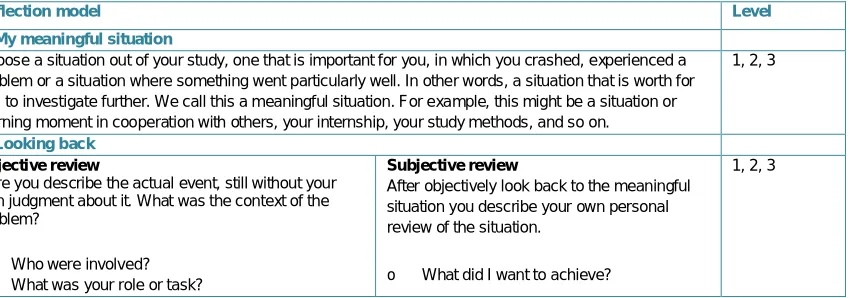
(12) emerged. For instance, the exploration of experience and the analysis of feelings, the assumption that reflection will involve a changed perspective and action, elements of experimentation and review, and purposeful learning through experience.. 1.3. Study setting. The site of the study is the HAN University of Applied Sciences (hereafter abbreviated as HAN), a vocational university of applied sciences. The HAN offers a unique Bachelor's programme Education in the Netherlands. This four years course educates students to become educational advisor, designer, developer, trainer and coach. The Han aims at educating committed training professionals that contribute to the development of employees and organisations. These professionals are recognizable by their knowhow, consistent approach, and (self-) reflective ability and by an inquisitive and professional attitude (ILSHAN, 2012). To achieve this, the HAN also devotes attention to reflective learning in their education and assessment. One aspect that plays a central role within this vision on education is personal development with regard to the job. According to the HAN personal development is a mean for the student to engage himself as efficiently and effectively as possible in the training-oriented environment in which he is employed. Working on personal development is divided by the HAN into three development areas: professional identity, learning competence and personal effectiveness. Among other things via reflection the HAN facilitates students in their personal development with regard to the job. The aim is the professional development of the student. The HAN recognizes the role of reflection as being important for professional development. The HAN defines reflection as a process to "become aware, to think over and critically consider one’s own actions, feel and think like an educational professional in training with the aim of learning, to strengthen the professional identity and personal effectiveness" (ILS-HAN, 2012). This definition is based on other definitions of reflection (Groen, 2011; Korthagen & Vasalos; 2002, and Van Woerkom, 2012). The HAN implemented a reflective approach to bridge the gap between theory and practice. The motivation here is that learning professionals should be able to reflect well. To guide reflective learning students are offered a framework for reflection, Reflection model Opleidingskunde, developed by the HAN. This framework for reflection is based on the phase model of core reflection (Figure 3) from Korthagen and Vasalos (2005). The Reflection model Opleidingskunde includes a question guide (Table 1) to structure and guide reflection. This question guide is based on the guiding questions from the model of core reflection (Korhagen & Vasalos, 2005), combined with two questions from the critical incidents method. The text that supports the questions provides an explanation for each stage of the reflection cycle.. Table 1: Reflection model Opleidingskunde - Question guide Reflection model. Level. 1: My meaningful situation Choose a situation out of your study, one that is important for you, in which you crashed, experienced a problem or a situation where something went particularly well. In other words, a situation that is worth for you to investigate further. We call this a meaningful situation. For example, this might be a situation or learning moment in cooperation with others, your internship, your study methods, and so on. 2: Looking back Objective review Subjective review Here you describe the actual event, still without your After objectively look back to the meaningful own judgment about it. What was the context of the situation you describe your own personal problem? review of the situation. o o. Who were involved? What was your role or task?. o. 1, 2, 3. 1, 2, 3. What did I want to achieve?. 12.
(13) o. What was the role or task of the other stakeholders?. o o o o. How did I behave in this situation? What can the effect of my behaviour on others, and on the situation? What thoughts went through me in this situation? How did I feel?. Phase 3. Become aware of the essence for me In this phase you investigate what for you is the essence in this situation. You take a closer look at yourself, as to learn more about yourself. Why was I acting like that?. o o o o o o. Why was I behaving like that? Why was I thinking and feeling like that? Does it happen often that I act, think or feel that way? Do I recognize a pattern in this? What qualities do I need or can I deploy stronger next time? What discoveries about myself I do now? So, what is the problem?. o. What qualities and pitfalls are affecting my acting, thinking and feeling? In a positive and negative sense?. Phase 4: Develop alternative actions In this phase you investigate any other (and sometimes better) ways you can act in the future. This is done to reflect, among other things by yourself to others and to general knowledge about that which you encountered.. o o o. What will I do differently next time? How am I going to deploy my qualities in this? What learning needs or learning objectives do I see?. o o o. How would an experienced professional act in this situation? What does the literature say? How can I use this knowledge? Now that I have this information, what alternatives do I see?. 1, 2, 3. 3. 1, 2, 3. 2, 3. The HAN acknowledges that the development of reflective skills or how to think reflectively is an iterative process. Therefore the HAN distinguishes between three competence levels at the study task reflection. On level 1 students should be able to evaluate their behaviour, thinking and feeling, as well as their impact on the environment, formulate behavioural alternatives and learning points as a logical result of their evaluation. On level 2 students should be able to evaluate their behaviour, thinking and feelings, as well as their impact on the environment, formulate behavioural alternatives and learning points on the basis of relevant literature or theory. On level 3 students should be able to reflect, or they can reflect on their behaviour, thinking and feeling, but also on their underlying beliefs, recurring qualities and pitfalls and its impact on their environment. They should also be able to formulate behavioural alternatives and learning points on the basis of relevant literature or theory. In the first year of the study students are introduced to the concept of reflection. Opleidingskunde has developed student portfolio to stimulate students to reflect on the aspects of becoming an educational professional. Reflection assignments are part of almost every subject in the curriculum. These reflection assignments offer students opportunities to practice and develop their reflective skills. The assignments involve a variety of reflective activities (Table 2). To further facilitate students’ reflective learning, the HAN has developed an e-learning course in which is explained to the students what is meant by reflecting and how it can be done according to the framework for reflection. In addition, the e-learning module is a. 13.
(14) practical tool for students who are learning how to address their reflective ability and are learning how to describe their experiences in reflective assignments.. Table 2: Courses with obligatory reflection assignments Subject Professional task. Reflective activity. Purpose of reflection assignment. Mentoring learners. Reflective journal (level 1) Reflection report (level 2, 3). . Trainen. Reflection report (level 1, 2, 3) . Educational design. Reflection report (level 1, 2). . Educational consulting. Reflection report (level 1, 2). . Practice learning. Reflection report. . . Proof of competence. 1.4. Reflection report. . Year of study. Required level of reflection. 1 capture critical events and experiences in training, coaching and intervision situations. 2 3, 4 to reflect on the learning process at the personal level to act as a channel for exploration between the student, peers and the class facilitator.. 1 2 3. 1 2 3, 4. 1 2 3. capture critical events and experiences in training situations as a trainer. to reflect on the learning process in becoming a trainer become consciously aware of their actions as a trainer in every moment.. 1, 2, to give students space to reflect on themselves as educational designers. students indirectly reflect on the course content. focus is on the personal impact of the course content.. 1, 2. 3, 4 to give students space to reflect on themselves as internal HRD advisors. To reflect on the decision-making processes in organisations from solely educational, to more organisationally, logistically and financially aware actions.. 3. 1, 2, 3, 4 1, 2, 3 to reflect on themselves as (collaborative) learners, gain insight in ono’s own behavior, thinking and feeling, impact on the environment and professional development. become consciously aware of their learning needs. to reflect on the overall learning process at the personal level and on the development of the professional identity. 3, 4. 3. Personal reflections: My identity as a researcher. As a researcher I wanted to undertake a study that fits with what I do as an educational advisor, that is helping employers and employees with educational needs. I thought about undertaking a quantitative study that looked at impact, cause and effect and the measurement of an outcome. However, I did not think It would have produced the information I needed to improve my own practice. When I started writing my research proposal, the initial literature search confirmed my believes that a qualitative approach would. 14.
(15) be more appropriate for a study on students’ reflective experiences. My desire was to study a group of students who were engaged in reflective activities, hear what they thought and felt about it, and mirror what I already do as an educational advisor in other areas of work: facilitate, listen, question, interpret, reflect and act. I wanted to hear the students’ voices without limiting what they wanted to say. I find that a study like this requires personal commitment of the researcher at the phenomenon that is being investigated. Being an educational professional over the last ten years I have been aware of the conflicts and tensions coming from reflective exercise. In the basic course that I teach, I ask participant who in their daily life write planning permissions not only to just follow the regulations, but also to look at the applications from the applicants’ perspective. Reflective commands are used as a means to practice this. In another course starting prosecutors are asked increasingly to weigh the interests of all parties involved in cases. A way they can become proficient in it is by reflecting on their actions and the impact of their actions. While I write this thesis, I realize what tension there can arise if you're asked to view your job in a 'holistic' way to while in your working environment you're constrained by rules, guidelines and laws on the basis of which you have to make a decisions. As an educational advisor I have always promoted reflection as a way to work on your professional development. I know that my personal experiences with reflection are on the base of this belief. I consider this study therefore not only as a research, I see it also as a personal development process, in which I hope to find answers and new questions arise. I have also in the context of this study reviewed my views and perspectives with regard to reflection in the context of professional practice. Schön (1991) describes reflection as a continuing process, whereby you as a professional engage in a dialogue with your environment or with a question you are stuck with. This requires that you stay open for the effects of what you are doing and that it is clear for yourself why you do things in a certain way. I have not previously been so aware of my identities: a full-time working educational advisor, a part-time student, a mother of two teenagers, a wife; and just myself. Every day I experience that these identities are each other's competitor, one even more than the other. For the participants in this research I'm not only a researcher, I am also a colleague, or someone who understands their experiences or maybe assesses them. As an insider I have had my own experiences with reflection in the context of a study task. Recently I realized why I find reflection so important, yet at the same time so difficult. During this study, I had to reflect on what I have understood from the experiences of the participants with reflections. I have tried to make sense of the participants making sense of their experiences. I've tried to view the experiences from multiple perspectives: as an advisor, lecturer, participant and peer. Doing this I had to take into account the vague boundaries between my professional and personal identities and my objective role as a researcher. This consideration is also embedded in my methodological choices during the research. In acknowledging that the values, interpretations and assumptions of the researcher will always influence the research, I consider myself an educational professional who operates from an interpretive and constructivist position. Wanting to explore opinions, viewpoints and experiences has led to a qualitative, phenomenological research approach. This approach focuses on the mapping of subjective human experiences; it focuses on how an individual experiences the world (van Manen, 2005). I have therefore opted for Interpretative Phenomenological Analysis (IPA), according to Smith and Osborn (2003; p. 51) a qualitative approach which aims at exploring “in detail how participants are making sense of their personal and social world” and for research questions, methodology and data collection and analysis methods that support this approach. This is evidenced by exploring opinions and experiences of individuals about learning reflection. Understanding their views and experiences therefore gets priority over quantifying variables or hypothesis testing during the research.. 1.5. Research purpose and research questions. To understand the development of becoming an reflective educational professional, or to understand the experiences involved in this process of professional development, educators need to know how student educational professionals experience making meaning of their early experiences of themselves as educational professionals. In a constructivist view, students discover and construct meaning from active. 15.
(16) experiences where they make sense from what they already know and build upon background knowledge (Heidegger 1966; Dewey, 1991). Educators need to understand how the students experience being a reflective educational professional so they can to create opportunities for learning the being of a reflective educational professional. If educators do not understand how students make meaning of early professional experiences, they will not know how to enhance learning. As an educational advisor, I am concerned with how students learn to be reflective, because the reflection process is such a vital part of being an educational professional. The purpose of this study was to understand the experiences of students who were engaged in reflective activities in an educational setting, from their own perspective. An enquiry into the backgrounds, perspectives and problems that students face when practicing reflective skills in assignments, requires a study, which explores the perspectives of the students themselves. The participants identified the main issues of the study. The study focused on the reflective process and the way it was experienced by students. The research question is a link between the phenomenological approach and the procedures of data collection and analysis: What is the experience of being engaged in reflective activities in an educational setting from the perspective of students? The following areas of interest were explored: How the participants currently describe the concept of reflection Whether participants experience changes in their view of reflection as a result of reflective practice The participants view on the role of instruction programs on acquiring reflective skills The participants view on faculty’s support and guidance during reflective activities The participants view in reflective assignments in the development of reflective skills The participants view and experiences’ regarding what is needed for reflective practice.. These guiding questions are not specific questions to be answered, but rather, they are those that suggest themselves at the beginning of the study as being the most productive guides to generate data relevant to the central area of interest. These guiding questions will guide the data collection process.. 1.6. Scientific and practical relevance. The audience for this study includes lecturers and educational designers of higher education. Information gathered in this study may inform the audience of higher education professionals about the unique reflective needs of diverse student population. A primary audience for this study includes lecturers and educational designers of the HAN. This study can contribute to the understanding of opportunities and resources that students need when learning to reflect on their practice in the following ways: It can contribute to the understanding of how students develop reflective skills in an educational context. It can contribute to the development of a shared vision among educators about assessments for reflective practice that match the reflective skills of the students.. 16.
(17) The participants in the research may benefit from the study through self-reflection on their higher educational journey.. 1.7. Structure of the thesis. In this introductory Chapter I provided background information about reflection in education by exploring relevant existing literature highlighting the role of reflection in education. I also explained the rationale and aims of the study, the research question, and its significance for educators and my position as a researcher including the decision to adopt an IPA approach. Chapter two is where I present the epistemological and theoretical underpinnings of the research followed by the specific research methods used to collect and analyse the data and the ethical considerations of the study. In Chapter three I present the inductively derived themes from the data along with my analysis and interpretations. In Chapter four I discuss the themes in relation to the existing literature. I also consider the trustworthiness and transferability of the study findings and I suggest implications for education practice and further research. At the end of the Chapter I reflect on the research and the research process.. 17.
(18) 2 Methods 2.1. Introduction. An appropriate methodological approach is of great importance in scientific research; it gives direction to the research questions, units of analysis, data sources, and analysis tools and ultimately supports the findings. The purpose of this study was to understand the experiences of students who are engaged in reflective activities in an educational setting, from their own perspective. This research explored the reflective experiences of students by answering the question: What is the experience of being engaged in reflective activities in an educational setting from the perspective of students? The following questions guided the research: How can the concept of reflection be described? What do students reflect upon? What is the structure of assessments for reflection? What are important similarities and differences within and between assessments? Do instruction programs on reflection improve the skill level in students’ reflective reports? How does students experience learning how to reflect in instruction programs? This Chapter describes the research procedures I used to answer the research questions. It describes the study’s philosophical underpinnings and assumptions, the study’s methodological approach and the actions I took to ensure trustworthiness throughout the study. It also describes the selection of the participants, the data collection methods, the analysis of the data and the ethical considerations of this study.. 2.2. Choosing a qualitative research approach. A qualitative approach is appropriate, if the aim of a study is to understand how individuals perceive a particular issue (Patton, 2002). It involves detailed exploration and analysis of a particular topic. There are several key understandings that underpin qualitative inquiry: ontology, epistemology, methodology (Guba & Lincoln, 1994; Crotty, 1998; Creswell, 2007) and methods (Crotty, 1998; Creswell, 2007). Ontology refers to questions of reality or real existence or how we believe reality exists. Epistemology refers to the nature of the relationship between the knower or would-be knower and what can be known (Guba & Lincoln, 1994) or “how we know what we know” (Crotty, 1998, p. 8). Methodology is concerned with how the researcher can find out what he believes can be known (Guba & Lincoln, 1994), while methods refer to how evidence about reality can be collected (Crotty, 1998; Creswell, 2007). Guba and Lincoln (1994) suggest the importance of research paradigms when conducting a study. A research paradigm is a framework that guides the research process of a study. A paradigm can be viewed as a set “of basic beliefs (or metaphysics) that deal with ultimates of first principles” (Guba & Lincoln, 1994, p. 107). It consists of beliefs and assumptions about how we should approach research. A qualitative research paradigm usually includes the ontological, epistemological and methodological aspects of the study (Guba, 1990). Crotty (1998) provided a theoretical framework for research; he identified four elements of the research process: epistemology, theoretical perspective, methodology and methods. Furthermore, Crotty (1998) explains that there is an interrelationship between the theoretical stance adopted by the researcher, the methodology and methods used, and the researcher’s view of the epistemology.. 18.
(19) 2.3. Research paradigm. I chose an interpretivist paradigm, sometimes referred to as constructivist paradigm, for this study. A paradigm where there is no objective truth and meaning only occurs in relation to the mind (Crotty, 1998). As Lincoln and Guba (1985) emphasise, this has several implications for the study. Firstly, the research has to “produce multiple constructed realities that can be studied holistically” (Lincoln & Guba 1985, p. 37). Secondly, the primary data collection instrument should be a human to be able to interact with participants to reveal their multiple constructed realities. Thirdly, the research should be done in a natural setting. Fourthly, the researcher should be the key instrument for collecting data. Fifthly, the focus of the research has to be the identification of the contextualised meaning of the participants multiple views to create a collaborative reconstruction from the multiple realities.. 2.3.1 Implications for this study In this study I was the researcher, the human research instrument (Creswell, 2007). I interacted with all participants and was able to realise a holistic study of all students’ reflective realities. As a trained professional educational consultant with 20 years of experience in interviewing, assessing and recognizing themes of stories which are the foundation of qualitative research (Patton, 2002); I focused on getting the participants stories by becoming a partner with the participants. I possess similar experiences as the participants of the study; I graduated from the HAN with a Bachelor’s degree in Education. In addition to this, as a part-time and a fulltime student I have been engaged in several reflective activities during my education. Besides my experiences as a student, I have tutored adults in vocational courses that I have taught. These experiences have given me an insight into some reflective demands students face. I have used this asset to stimulate engaging dialogue with the participants of this study during the interviews. With the information I collected, I formed a tentative reconstruction of the participants’ reflective experiences. I presented these findings to the participants for comments to ensure that their meaning has been accurately captured and to gain more insights.. 2.4. Ontological and epistemological assumptions. Ontology, the study of being (Crotty, 1998; Gray, 2009), concerns questions about the nature of social reality, “what exists, what it looks like, what units make it up and how these units interact with each other” (Blaikie, 2000, p. 3). Ontology attempts to distinguish what constitutes true knowledge, how it can be acquired, and how it can be communicated. The ontological assumptions of this study are based on a relativist philosophy. Relativists emphasize the diversity of interpretations that can be applied to the world, they believe that knowledge is a social reality, value-laden and it only becomes known through individual interpretation (Gray, 2009). Epistemology is philosophically linked to ontology and is concerned with the theory of knowledge (Guba & Lincoln, 1994). A constructivist philosophy underpins the epistemological assumptions of this research. Constructivist research is relativist, transactional and subjectivist (Guba & Lincoln, 1994). Relativists emphasize that there is no objective truth and that the world can be interpret in diverse ways (Crotty, 1998). Transactional refers to knowledge being constructed through interaction between humans and their world, and developed and transmitted within a social context (Berlin, 1987). Constructivist believe that a person constructs his or her own reality and that humans develop a sense about what occurs as they engage with the world they are interpreting. In subjectivists research the world, including the psychological world of research participants, is positioned as unknowable. The role of the researcher is to construct an impression of the world as they see it (Ratner, 2008). The participants own experiences are the main area of research for this study.. 2.5. Theoretical perspectives: Hermeneutic phenomenology. Studying a phenomenon - in this case reflection – suggests, by definition, phenomenology. Applied to research, phenomenology is the study of the nature and meanings of phenomena (Finlay, 2009) or the study of experience (Smith, Flowers & Larkin, 2009). Phenomenology “differs from almost every other science in that it attempts to gain insightful descriptions of the way we experience the world pre-. 19.
(20) reflectively, without taxonomizing, classifying, or abstracting it” (Van Manen 1990, p. 9). The essence of phenomenological research is a reduction of individuals’ experiences with a particular phenomenon to a description of the universal essence of that phenomenon (Creswell, 2007). Phenomenological research has its roots in the philosophical traditions of Edmund Husserl and Martin Heidegger (Cresswell, 1994). In the descriptive tradition, conceptualized by Edmund Husserl (1859-1938), it is believed that phenomenological research suspends all personal opinions, is related to consciousness, and is based on the meaning of the individual’s experience (Creswell, 1994). In the interpretive tradition, conceptualized by Martin Heidegger (1889-1976), it is believed that in phenomenological research one’s fore-structures (background, values, experiences) cannot be eliminated from understanding and interpreting. A researcher needs to account for these interpretive influences (Creswell, 1994; Dowling, 2007; Smith et al., 2009). Other existential phenomenological philosophers who influenced the development of phenomenological research are Merlau-Ponty and Sartre (Smith et al., 2009). Sartre’s concern was the “developmental processual aspect of human being” (Smith et al., 2009; p. 19). Merlau-Ponty was concerned with the relationship between the body and the world. In Merlau-Ponty’s view humans see themselves as different from everything in the world, because their sense is holistic and focused on looking at the world, not on being subsumed in the world. An individual can observe and experience empathy for another, yet he or she can never share the other’s experiences, because the experiences are not lived through (Smith et al., 2009). According to Sartre an individuals is always in a process of becoming rather than being. In this action-oriented process, an individual has the freedom to choose, while being responsible for his or her own choices (Smith et al., 2009).. 2.5.1 Hermeneutics Heidegger, whose interest was existence and the meaning of being (Crotty, 2005; Smith et al., 2009), developed interpretive phenomenology by extending hermeneutics, the philosophy of interpretation (Creswell, 1994; Dahlberg, Drew & Nystrom, 2008). Heidegger adopted ontology, the science of being and rejected epistemology, the theory of knowledge (Creswell, 1994). According to Dahlberg, Drew and Nystrom (2008), the critical question for Heidegger was: What is being? Heidegger studied the concept of being in the world rather than knowing the world, broadening hermeneutics. Heidegger believed personal awareness was intrinsic to phenomenological research and that it was impossible to negate our experiences related to the phenomenon under study (Dahlberg, Drew & Nystrom, 2008). He argued that human existence is a more fundamental notion than human consciousness and human knowledge. Heidegger’s interpretive phenomenology explains that the essence of human understanding is hermeneutic, and that our interpretation of everyday world determines our understanding of it. A central component of hermeneutic phenomenology is the method of understanding a text, and thereby interpreting its meaning (Smith, 2007). Gadamer (1900-2002), another influential hermeneutic phenomenologist, was concerned with the influence of the researcher’s fore-structures on the interpretation of the phenomenon (Smith, et al., 2009). Gadamer proposed that a researcher’s prejudgments and biases should be made explicit in hermeneutical research (Dowling, 2007; Smith, et al., 2009). A hermeneutical research approach focuses on the reflexive and existential aspects by examining the experience of self, place, time, physicality and relations of a person (Scott, 1996; Stanley & Wise, 1993). In this study, students are engaged in meaningful action-orientated projects, reflective activities, to develop their identity and to achieve their goal of becoming an educational professional. The focus of this process should be on finding their true sense of self and transform into the professionals that they have the potential and the will to become. Students education could be regarded part of their existential project.. 2.6. Methodology: Interpretative Phenomenological Analysis (IPA). Crotty (1998) argues that the theoretical stance of the researcher informs the methodology, it provides a context for the process and a ground for logic and criteria. He explains that a researcher should consider a number of important issues before choosing the methodology. These issues involve what the researcher wants to discover about the phenomenon and the kind of data that is required. I am interested in exploring. 20.
(21) students’ experiences with reflective activities in an educational context. I acknowledge that participants are experts on their own experiences and that these experiences will be influenced in turn by a wide range of factors and the subjective nature of these experiences. Based on these issues I concluded that an interpretivist approach would be appropriate for this study, because understanding another person’s experience of a phenomenon requires an interpretation. I decided to choose an Interpretative Phenomenological Analysis (hereafter called IPA) approach (Smith, 1996; Smith & Osborn, 2003; Smith et al. 2009). IPA theoretically origins from phenomenology and hermeneutics (Laverty, 2003,); it aims at gaining a deeper and richer understanding of the nature or meaning of our everyday lived experience, offering insight rather than theory (Van Manen, 1997). IPA aims to understand experience through the insights provided by the research participants themselves, those best suited to provide it (Reid, Flowers & Larkin, 2005). As the aim of the study was to explore students’ experiences with reflective activities in an educational context I felt IPA was appropriate as an analytical tool for the following reasons: Firstly, IPA aims at capturing and exploring the meanings that participants give to their own experiences, or how they make sense of their experiences (Smith et al. 2009). When employing IPA, the researcher tries to make sense of the participants trying to make sense of their experience, this is known as a double hermeneutics (Smith & Osborn, 2003; Smith et al. 2009). Secondly, IPA is also idiographic by nature. Through detailed and rigorous analysis of each participant’s interview, IPA provides an interpretative, transparent and reflective account of the outcome and a plausible interpretation of the experience of each of the participants involved and shared aspects of experiences across the participant group. Thirdly, IPA is concerned with personal experience but also involves interpretation, involving a consideration of context. This research focused on the experiences of students engaged in reflective activities and how they experience the development of their reflective skills in the educational context. An important step is considering the nature and the circumstances of the reflective activities within the school context. Fourthly, the phenomenon that is being studied is reflection, which is conceptualized as a way of making meaning in life (Mezirow, 1991). IPA is considered of positive use when the topic being studied is: ‘dynamic, contextual and subjective, relatively under-studied and where issues relating to identity, the self and sense-making are important’ (Smith & Osborn, 2007: p. 520).. 2.7. Methods. 2.7.1 Participants 2.7.1.1 Research population The site for this study was the HAN University of Applied Sciences. The rationale for selecting only one university, complies with IPA’s aim to develop deeper understanding of a phenomenon shared by a group. As I did not aim for generalization in this study, nor did I want to create universal or generalizable theory (Smith et al., 2009), it was not necessary to choose more than one university. In IPA research, homogenous samples are used to explore a phenomenon that is shared by a group. 2.7.1.2 Recruitment Initial access to the potential participants was obtained through the administration of the Opleidingskunde department. I provided the administration with a copy of the research protocol and the inclusion and. 21.
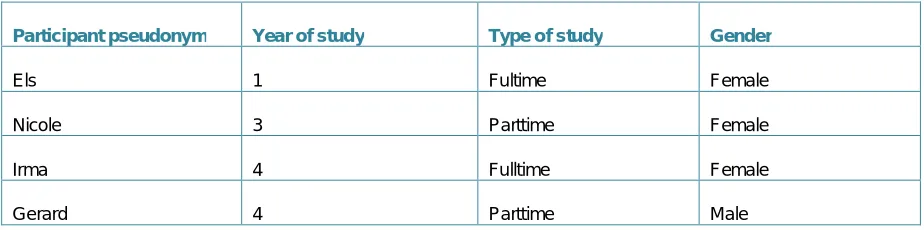
(22) exclusion criteria, so they should be aware of what the study involved and which students could be suitable for participation. The administration identified 12 students and provided me with their names and institutional e-mailadresses. I contacted these potential participants by e-mail, sent them copies of the information brochure (Appendix B) and asked if they wanted to take part in the study. I received low response to this initial recruitment strategy. I think that this may have been a result of using the information brochure (Appendix B) as a recruitment tool. The information brochure needed to be lengthy in order to incorporate all the information necessary to allow participants to give informed consent. To some individuals the information brochure might have been too long and it is likely that they simply did not read it as it was too long. As a result of the poor response to recruitment, I decided to adjust my recruitment procedure recruitment in order to complete the project. I had originally proposed to recruit eight participants; at this point I had only completed two interviews. I approached the administration to find out if it was possible to recruit participants through the newsletter for students. After the invitation was published in the newsletter I managed to increase my sample to four. Based on Smith et al. (2009), who emphasise that IPA studies should focus on a detailed account of individual experience, which benefits from a small number of cases, I decided to stop recruiting participants. Smith et al. (2009), recommend that a sample between three and six participants is reasonable for a student at undergraduate or master’s level using IPA.. 2.7.1.3 Inclusion and exclusion criteria In keeping with IPA requirements, I selected the participants purposively. Participants had to be persons who were receiving an applied university education at the HAN with a mayor in Education. All participants must have been engaged in reflective activities in an educational setting and had the potential to articulate their experiences (Creswell, 2007). Participants indicated that they had completed the e-learning course Reflection and they had completed several reflective reports that the lecturers had graded above average. Being under the age of 18 was an exclusion criterion. I believed adult participants would have the advantage of the capacity to critically reflect (Mezirow, 2000), in addition to being able to give consent for themselves. However, as all of the participants that volunteered were over the age of 18, it was not necessary to exclude anybody for this reason. I also planned to exclude individuals if they were unable to give informed consent, however I did not have to exclude anybody for this reason. 2.7.1.4 The sample In an IPA study the sample is small, homogenous and purposively selected because they share the experience of a particular situation, event or condition (Willig, 2008). The sample size is contextual and should be considered on a study-by-study basis, according to Smith et al. (2009). As a rough guide they suggest between three and six participants for an undergraduate or master’s level. Homogeneity does not refer to sample characteristics, but more to participants’ shared experience, which is important for an IPA study. The sample consisted of four students from the Bachelor’s programme Education. Each student had been engaged in reflective activities in the Education programme.. 22.
Figure

+3
Related documents
This essay asserts that to effectively degrade and ultimately destroy the Islamic State of Iraq and Syria (ISIS), and to topple the Bashar al-Assad’s regime, the international
Background: This study was designed to inspect the effects of Kinesio tape on the pressure pain threshold and normalized resting myoelectric activity at upper trapezius
The scattergram represents the distribution with age of 69 determinations of concentration of potassium in serum of 39 premature infants with respiratory distress syndrome (Table
Channels of Distribution – how products and services their customers and the businesses ; aka place functiond. NEEDS OF THE CUSTOMER NEEDS OF
This study aimed to analyze the performance of all of Palestinian Commercial Banks for the year 2014 using CAMEL approach, to evaluate Palestinian Banks’ capital adequacy,
a flam transcripts (red) and nuclear membrane (green) in stages 5 of oogenesis are visualized by RNA-FISH and immunofluorescence using respectively flam 508 RNA probe and
Figure 1 illustrates how the nonparametric regression of the ratios between the conditional and unconditional efficiency measures on Z is able to capture the favorable effect of Z
(2012) makes use of the Multi- Actor Multi-Criteria Analysis (MAMCA) to evaluate the sustainability of different transport initiatives; and Bana e Costa (2001) finds that MCDA
