Abstract—An optimal negotiation agent should have capability for maximizing its utility even for negotiation with incomplete information in which the agents do not know opponent’s private information such as reserve price (RP) and deadline. To support negotiation with incomplete negotiation, this work focuses on designing learning agents called Bayesian learning (BL) based negotiation agents (BLNA) adopting a time-dependent negotiation model. In BLNA, BL is used for estimating opponent’s RP and the corresponding deadline is computed using the estimated RP. BLNA also has the capability of maximizing its utility using estimated deadline information when its deadline is shorter than or equal to the estimated deadline. To evaluate the performance of BLNA, BLNA is compared to an agent with complete information and an agent with incomplete information. Empirical results showed that BLNA achieved: 1) always higher utility than the agent with incomplete information for all cases, 2) close to or slightly lower utility than the agent with complete information when its deadline is lower and equal to opponent’s deadline, and 3) lower utility than the agent with complete information when deadline is higher than opponent’s deadline.
Index Terms—Automated negotiation, negotiation agents, intelligent agents, Bayesian learning, negotiation with incomplete information
I. INTRODUCTION
UTOMATED
negotiation is defined as a process for resolving differences and conflicting goals among interacting agents. There are two types of negotiation environment, one for agents with complete negotiation settings and the other for agents with incomplete negotiation settings. While agents with complete information know opponent private information such as reserve price and deadline, agents with incomplete information do not know opponent private information. For negotiation with complete information, optimal solutions, for an agent can be easily determined using the interacting agent‟s private information, e.g., [1] and [2]. However, it is not easy for an agent with incomplete information to achieve optimal solutions. For optimal solutions in negotiation with incomplete information, a learning method is required. In this work, Bayesian learning
Manuscript received January 12, 2011. This work was supported by the Korea Research Foundation Grant funded by the Korean Government (MEST) (KRF-2009-220-D00092).
Jeonghwan Gwak is with the School of Information and Communications (SIC), Gwangju Institute of Science and Technology, South Korea (phone:
82-62-715-2280; fax: 82-62-715-2204; e-mail: [email protected]).
Kwang Mong Sim is with the School of Information and Communications (SIC), Gwangju Institute of Science and Technology, South Korea (phone: 82-62-715-2235; fax: 82-62-715-2204; e-mail:
(BL) is adopted for supporting negotiation with incomplete information by finding an opponent‟s private information.
There are some related works [1], [2], [3] using BL for supporting negotiation with incomplete information. In [3], BL framework was first introduced to support negotiation. In [1] and [2], BLGAN uses the synergy of BL and a genetic algorithm (GA).
A. Contribution of this work
The differences between the above related works and this work are as follows:
1) Compared to [1] and [2], this work suggests a new BL method for estimating an opponent‟s reserve price (RP) by designing a new conditional probability of BL.
2) Since estimation of the exact RP using BL is not possible, there exist some estimation errors of RP. To compensate for the estimation errors, a GA was used in [2] for making tradeoff between an agent‟s proposal and its opponent proposal. However, negotiation using the GA can be finished quickly without reaching optimal results. Even though the agent adopting a GA-based tradeoff algorithm can increase the negotiation success rates, it should give up some amount of utility. As a primarily research report, this paper is focused on enhancing BL part only but not focusing using a GA-based tradeoff algorithm.
3) Although this paper is based on [1] and [2], there exist several different points. Compared to [1] and [2], this work uses different equations in generating proposals for both learning and no-learning agents. While estimation of opponent RP and deadline in [1] and [2]
is carried out separately, we calculate opponent deadline using estimated opponent RP because estimation of opponent RP and deadline is inter-dependent (see Section II-C). Furthermore, the calculated opponent deadline information is used for generating proposals to increase its utility when the calculated opponent deadline is longer than or equal to its deadline.
The paper is organized as follows. The negotiation model in this work is described in Section II, and the design of proposed BL-based negotiation agents (BLNA) are described in Section III. Section IV shows experimental results and analyzes the performance. The final section concludes this work with summary and suggests future works.
Bayesian Learning based Negotiation Agents for Supporting Negotiation with Incomplete Information
Jeonghwan Gwak and Kwang Mong Sim
A
II. N
EGOTIATIONM
ODELA. Time-dependent Negotiation Model
In this work, we consider bilateral negotiation between two self-interested agents over an issue, e.g., price, quality of service, etc. The two agents have conflicting roles such as seller (S) and buyer (B). The agents negotiate by exchanging proposals using Rubinstein‟s alternating-offers protocol [4].
The fixed (no learning) agent x { , } B S generates proposals at a time round t, 0 t
x, as follows:
( 1)
x x
t x x x
x
P IP t RP IP , (1)
where 1 for S and 0 for B. IP
xand RP
xis the initial price (the most favorable price that can afford) and reserve price (the least favorable price that can afford) of x, respectively.
xis the deadline and
x, 0
x , is the time-dependent strategy of x. The concession behavior of x is determined by the values the time-dependent strategy [5] and is classified as follows:
1) Conciliatory (0
x 1) : x makes larger concession in earlier negotiation rounds and smaller concessions in later rounds.
2) Linear (
x1) : x makes a constant rate of concession.
3) Conservative (1
x ) : x makes smaller concession in earlier negotiation rounds and larger concessions in later rounds.
Let D be the event in which x fails to reach an agreement.
The utility function of x is defined as :[ , ] [0,1]
x x x
U IP RP D such that U D
x( ) 0 and for any P
tx[ IP RP
x,
x], U
x( P
tx)
U
x( ). D U
x( P
tx) is given as follows:
min min
( ) (1 )
x
x t
x
x t
x x
RP P
U P u u
RP IP , (2) where u
minis the minimum utility that x receives for reaching an agreement at RP
x. For experimental purpose, the value of
u
minis set as 0.1. At P
tx RP ,
xU RP
x(
x) 0.1 U D
x( ) 0.
For the bilateral negotiation in this work, it is assumed that S starts the negotiation by making proposals to B. The negotiation process between the two agents will be terminated: 1) in making an agreement when an offer or a counter-offer is accepted, or 2) in a conflict when one of the two agents‟ deadlines is reached. An agreement is reached when one agent proposes a deal that matches or exceeds what another agent asks for, i.e., U
S( P
tB)
U
S( P
tS1) or
(
B1) (
S)
B t B t
U P
U P .
B. Optimal Negotiation Strategy with Complete Information The optimal strategy of x is defined as the strategy that maximizes the utility of x at agreement time T
c. Let P
cbe the agreement price (i.e.,
Tc x
P
cP ). The maximum strategy ensures U P
x(
c)
U P
x(
tx) for all t T
c.
For negotiation with complete information between S and B, [1] and [2] proved the following Theorems 1 and 2 (refer [1]
and [2] for detailed illustrations):
Theorem 1 (
B
S) : S achieves maximal utility when it adopts the strategy
log
B S
S B
S
S S
IP RP IP RP .
Theorem 2 (
B
S) : B achieves maximal utility when it adopts the strategy
log
S
B
S B
B
B B
RP IP RP IP . C. Negotiation with Incomplete Information
For a negotiation with incomplete information, if an agent can estimate opponent‟s RP and deadline exactly, the agent can find an optimal strategy using its corresponding theorem between Theorems 1 and 2.
The relationship between RP and deadline is given as follows. The formulas for calculating RP in (3) and deadline in (4) are derived from (1).
x x
t x
x x
x
P IP
RP IP
t
(3)
x x
t x
x
x x
P IP
t RP IP (4) For the given IP
x, t , P and
tx
x, the calculation of RP
xis related with
xand the calculation of
xis related with RP
x. Hence, calculation of RP
xand
xis not separable but closely related with each other. If we can estimate either RP or deadline, the other can be calculated from the estimated variable using (3) or (4).
If it is assumed that IP
xis known (it can be easily assumed if the first proposal is IP
x),
xcan be calculated using IP
xand two proposals with different time rounds as follows:
( )
x x
t x x x
x
P IP t RP IP (5)
1
1 ( )
x x
t x x x
x
P IP t RP IP (6)
By dividing (5) by (6), the following equation is achieved.
1
1
x x
t x
x
t x
P IP t
t
P IP
Finally, the following
xis calculated.
1 1
log , where 3
x
t x
x t x
t x
t
P IP
P IP t , (7)
In summary, if IP
xis known, exact
xcan be calculated by (7) when t 3 . Then, if either RP or deadline is estimated, the other can be computed using (3) or (4). In this work, we estimated RP and the corresponding deadline calculation is conducted using (4).
III. B
AYESIANL
EARNING BASEDP
ROPOSEDA
PPROACHIn this section, we will describe the design of BLNA to
support negotiation with incomplete information.
A. Bayesian Learning of opponent’s RP
Let the price range be in [MIN
P, MAX
P]. An agent adopting BL forms a set of hypotheses {H
i} of opponent‟s RP, where H
i i (MAX
P MIN ) /
PN
Hand N
His the number of hypotheses. The i-th hypothesis of an opponent‟s RP is defined as RP
ioppand the estimated opponent RP is defined as
.
opp
RP
iThe following relation (domain knowledge) between P
txand RP
xis derived from (3).
( ) ,
x
t x
x x
x d
P IP
RP IP
R t (8)
where R t
dx( ) is the discount ratio of x and measured by
( ) .
x x
d
x
R t t
For example, given IP
B= 5, RP
B= 85,
B50 and
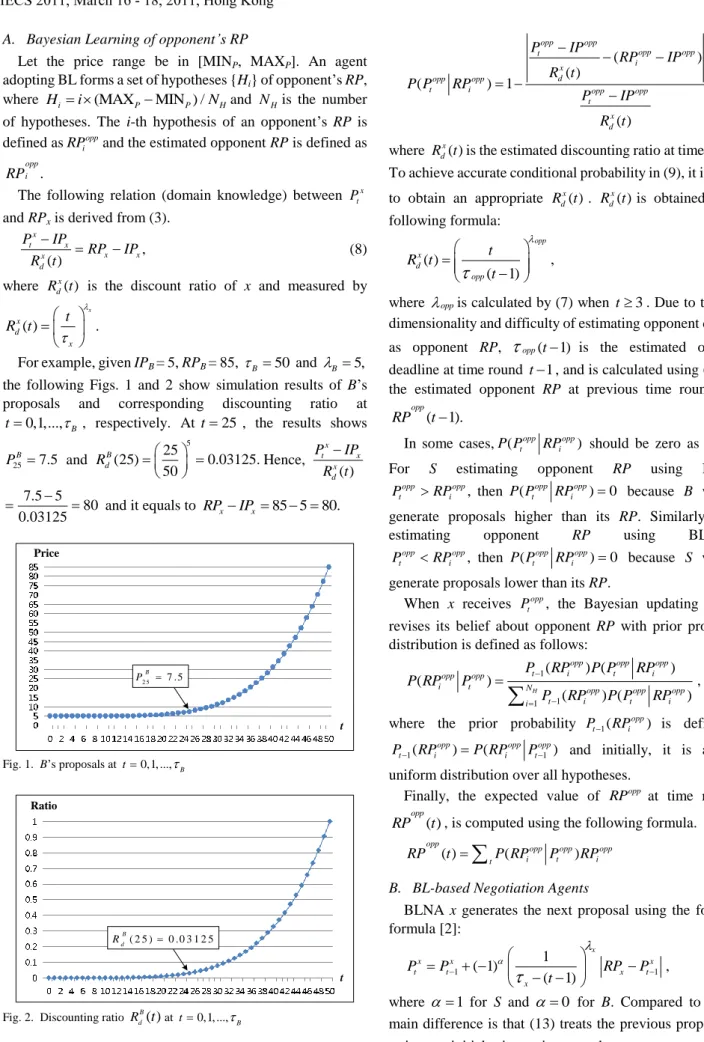
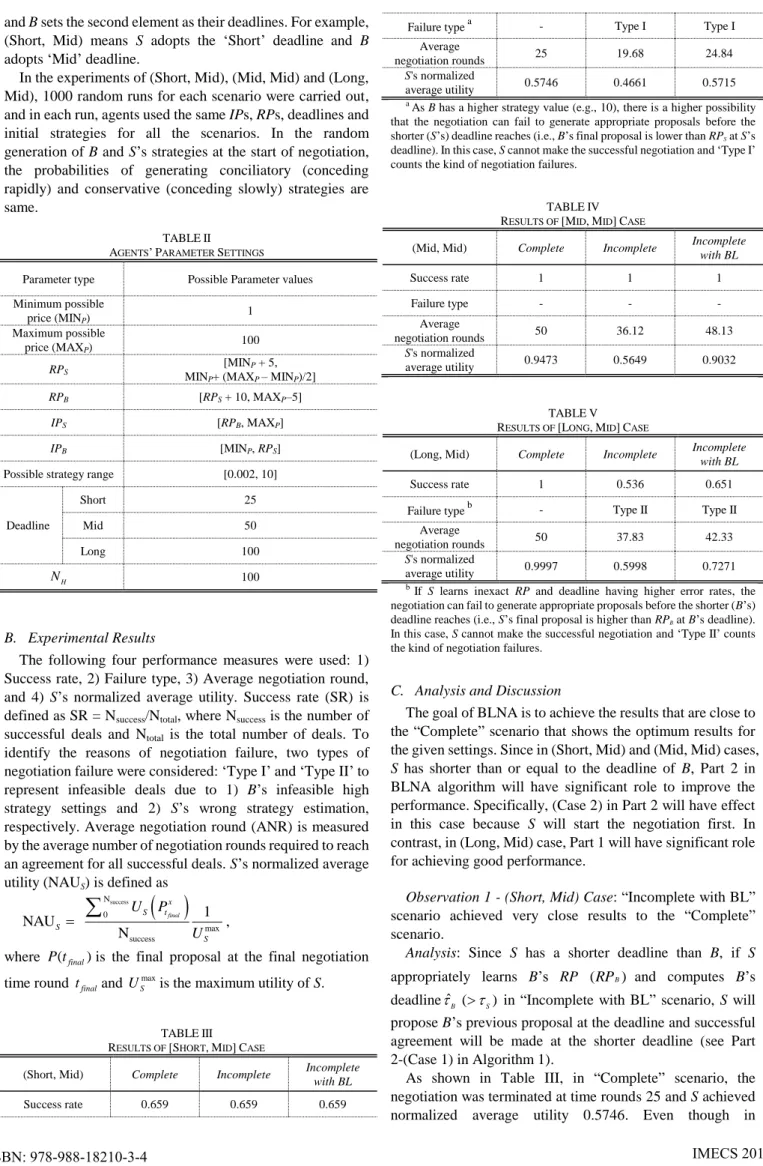
B5, the following Figs. 1 and 2 show simulation results of B‟s proposals and corresponding discounting ratio at
0,1,...,
Bt , respectively. At t 25 , the results shows
25B
7.5
P and
25
5(25) 0.03125.
50
B
R
d Hence, ( )
x
t x
x d
P IP
R t
7.5 5
0.03125 80
and it equals to RP
x IP
x 85 5 80.
Price
t
2 5B 7 .5 P
Fig. 1. B‟s proposals at t0,1, ...,B
Ratio
t ( 2 5 )0 .0 3 1 2 5
B
Rd
Fig. 2. Discounting ratio RdB
( ) t
at t0,1, ...,BUsing the formula in (8) representing relation between P
txand RP
x, the conditional probability (likelihood) distribution is designed as follows:
( )
( ) 1 ( )
( )
opp opp
opp opp
t x i opp opp d
t i opp opp
t x d
P IP
RP IP P P RP R t
P IP R t
, (9)
where R t is the estimated discounting ratio at time round t.
dx( ) To achieve accurate conditional probability in (9), it is crucial to obtain an appropriate R t .
dx( ) R t is obtained by the
dx( ) following formula:
( )
( 1)
opp x
d
opp
R t t
t
, (10)
where
oppis calculated by (7) when t 3 . Due to the same dimensionality and difficulty of estimating opponent deadline as opponent RP,
opp( t 1) is the estimated opponent deadline at time round t 1 , and is calculated using (4) from the estimated opponent RP at previous time round t 1 ,
( 1).
opp
RP t
In some cases, ( P P
toppRP
iopp) should be zero as follows.
For S estimating opponent RP using BL, if
,
opp opp
t i
P RP then P P (
toppRP
iopp)
0 because B will not generate proposals higher than its RP. Similarly, for B estimating opponent RP using BL, if
,
opp opp
t i
P RP then P P (
toppRP
iopp)
0 because S will not generate proposals lower than its RP.
When x receives P
topp, the Bayesian updating formula revises its belief about opponent RP with prior probability distribution is defined as follows:
1
1 1
( ) ( )
( )
( ) ( )
Hopp opp opp
t i t i
opp opp
i t N opp opp opp
t i t i
i
P RP P P RP P RP P
P RP P P RP
, (11)
where the prior probability P
t1( RP
iopp) is defined as
1
( ) (
1)
opp opp opp
t i i t
P RP P RP P and initially, it is assumed uniform distribution over all hypotheses.
Finally, the expected value of RP
oppat time round t, ( )
opp
RP t , is computed using the following formula.
( )
( )
opp opp opp opp
i t i
RP t
tP RP P RP (12)
B. BL-based Negotiation Agents
BLNA x generates the next proposal using the following formula [2]:
1 1
( 1) 1
( 1)
x
x x x
t t x t
x
P P RP P
t , (13)
where 1 for S and 0 for B. Compared to (1), the main difference is that (13) treats the previous proposal P
tx1as its new initial price at time round t.
Until now, all materials for generating (optimal) strategy
are studied and prepared. The procedure for generating
optimal strategy is described in Algorithm 1.
Set x as BLNA
Part 1 (BL stage): Generating Proposals using BL information If time round t3
Compute ( )
opp
RP t as an average value in feasible price range.
Compute opp using (4) and ( )
opp
RP t . Compute x using Theorem 1 or 2 with ( )
opp
RP t andopp. Generate a proposal Ptx using (13) withx.
If time round t2
Set Pt1(RPiopp) as RPopp(t2) for all i.
If time round t3
Compute
opp(t1) using RPopp(t1).Compute opp using (7).
Compute R tdx( ) using (10).
Compute P P( topp RPiopp) using (9) for all i.
Compute P RP( iopp Ptopp) using (11) for all i.
Set Pt1(RPiopp)P RP( iopp Ptopp1).
Compute ( )
opp
RP t using (12).
Compute opp using (4) and ( )
opp
RP t . Compute x using Theorem 1 or 2 with ( )
opp
RP t andopp. Generate a proposal Ptxusing (13) withx.
Part 2: Generating Proposals using Deadline Information (Case 1: the case when x started the negotiation first)
If tx and x ˆopp
If x started the negotiation first
If
U RP( x) and (U Ptx)
U P( topp1)U P( tx1)Generate a proposal PtxasPtopp1 . Else,
Generate a proposal Ptxas its RPx.
(Case 2: the case when opponent started the negotiation first) If tx and x ˆopp
If opponent started the negotiation first Accept a proposal
x
Popp.
Algorithm 1. BL-based Negotiation Agents
Algorithm 1 consists of two parts. Part 1 for generating proposals using BL information is the main part of the algorithm as discussed in Section III-A. Part 2 is the procedure for generating proposals using deadline information. If BLNA can learn its deadline is lower than or equal to opponent deadline exactly (
x ˆ
opp), it can still maximize its utility even though it reaches its deadline t
x. Depending on which agent started the negotiation first, Part 2 is divided into the following two cases:
(Case 1) If BLNA x started the negotiation first, there is still room for x to achieve its maximum utility at time round
x
.
t This can be carried out by making the proposal
x
P
xas opponent proposal
x
P
oppat t
xon the condition that
1 1
( ) ( ).
each U RP
x(
x) and U P
x(
tx)
Ux Ptopp Ux PtxHowever,
because estimating the opponent proposal will be difficult and there will exist errors in estimating the proposal using BL, BLNA x will generate the proposal P
txas the opponent proposal
x
P
oppat t (
x 1) .
(Case 2) If opponent started the negotiation first, x will achieve its maximum utility at time round t
xby not making a proposal
( opp) ( tx1)x x x
U P U P
and accepting the opponent proposal
oppPx
at time round t
x.
IV. E
XPERIMENTALR
ESULTSTo evaluate the effectiveness and performances of BLNA empirically, three types of negotiation scenarios between S and B were studied as in Table I. Throughout the three negotiation scenarios, B is set as a fixed and no-learning agent in which it generates proposals using (1) and a strategy randomly fixed at start of negotiation. S has three types according to the following scenarios.
TABLEI
THREE NEGOTIATION SCENARIOS
Scenario Agent S Agent B
Complete Complete information Incomplete information Incomplete Incomplete information Incomplete information Incomplete
with BL
Incomplete information
S learns opponent‟s RP using BL Incomplete information
Scenario 1 (S as the optimal agent): S has complete information about B and B has incomplete information about S. Since S knows B‟s RP and deadline, S generates proposals by adopting its optimal strategy using Theorem 1. The negotiation result corresponds to the best-case scenario that BLNA is targeting for.
Scenario 2 (S as the fixed and no-learning agent): Both S and B have incomplete information about each other. S does not know B‟s RP and deadline. S and B generate proposals using a strategy randomly fixed within the possible strategy range at the start of negotiation. The negotiation result corresponds to the worst-case scenario.
Scenario 3 (S as BLNA): Both S and B have incomplete information about each other. However, S generates proposals by adopting estimated strategies using Theorem 1 with estimated B‟s RP using BL and the corresponding calculation of B‟ deadline. Furthermore, S uses some deadline information for generating proposals (see Part 2 in Algorithm 1)
A. Experimental Settings
The agents‟ parameter settings are summarized in Table II.
Initially, S and B‟s IPs, RPs and deadlines were randomly
selected in the given ranges at start of negotiation. Three type
of deadlines „Short‟, „Mid‟, and „Long‟ were used. (Short,
Mid), (Mid, Mid) and (Long, Mid) were used for comparing
negotiation results with respect to deadline effects (i.e., with
different bargaining advantage). The representation
(Deadline of S, Deadline of B) means S sets the first element
and B sets the second element as their deadlines. For example, (Short, Mid) means S adopts the „Short‟ deadline and B adopts „Mid‟ deadline.
In the experiments of (Short, Mid), (Mid, Mid) and (Long, Mid), 1000 random runs for each scenario were carried out, and in each run, agents used the same IPs, RPs, deadlines and initial strategies for all the scenarios. In the random generation of B and S‟s strategies at the start of negotiation, the probabilities of generating conciliatory (conceding rapidly) and conservative (conceding slowly) strategies are same.
TABLEII AGENTS‟PARAMETER SETTINGS
Parameter type Possible Parameter values Minimum possible
price (MINP) 1
Maximum possible
price (MAXP) 100
RPS [MINP + 5,
MINP+ (MAXP – MINP)/2]
RPB [RPS + 10, MAXP–5]
IPS [RPB, MAXP]
IPB [MINP, RPS]
Possible strategy range [0.002, 10]
Deadline
Short 25
Mid 50
Long 100
NH 100
B. Experimental Results
The following four performance measures were used: 1) Success rate, 2) Failure type, 3) Average negotiation round, and 4) S‟s normalized average utility. Success rate (SR) is defined as SR = N
success/N
total, where N
successis the number of successful deals and N
totalis the total number of deals. To identify the reasons of negotiation failure, two types of negotiation failure were considered: „Type I‟ and „Type II‟ to represent infeasible deals due to 1) B‟s infeasible high strategy settings and 2) S‟s wrong strategy estimation, respectively. Average negotiation round (ANR) is measured by the average number of negotiation rounds required to reach an agreement for all successful deals. S‟s normalized average utility (NAU
S) is defined as
success N 0
max success
NAU 1
N
final x
S t
S
S
U P
U
,
where ( P t
final) is the final proposal at the final negotiation time round t
finaland U
Smaxis the maximum utility of S.
TABLEIII RESULTS OF [SHORT,MID]CASE
(Short, Mid) Complete Incomplete Incomplete with BL
Success rate 0.659 0.659 0.659
Failure type a - Type I Type I
Average
negotiation rounds 25 19.68 24.84
S's normalized
average utility 0.5746 0.4661 0.5715
a As B has a higher strategy value (e.g., 10), there is a higher possibility that the negotiation can fail to generate appropriate proposals before the shorter (S‟s) deadline reaches (i.e., B‟s final proposal is lower than RPS at S‟s deadline). In this case, S cannot make the successful negotiation and „Type I‟
counts the kind of negotiation failures.
TABLEIV RESULTS OF [MID,MID]CASE
(Mid, Mid) Complete Incomplete Incomplete with BL
Success rate 1 1 1
Failure type - - -
Average
negotiation rounds 50 36.12 48.13
S's normalized
average utility 0.9473 0.5649 0.9032
TABLEV RESULTS OF [LONG,MID]CASE
(Long, Mid) Complete Incomplete Incomplete with BL
Success rate 1 0.536 0.651
Failure type b - Type II Type II
Average
negotiation rounds 50 37.83 42.33
S's normalized
average utility 0.9997 0.5998 0.7271
b If S learns inexact RP and deadline having higher error rates, the negotiation can fail to generate appropriate proposals before the shorter (B‟s) deadline reaches (i.e., S‟s final proposal is higher than RPB at B‟s deadline).
In this case, S cannot make the successful negotiation and „Type II‟ counts the kind of negotiation failures.
C. Analysis and Discussion
The goal of BLNA is to achieve the results that are close to the “Complete” scenario that shows the optimum results for the given settings. Since in (Short, Mid) and (Mid, Mid) cases, S has shorter than or equal to the deadline of B, Part 2 in BLNA algorithm will have significant role to improve the performance. Specifically, (Case 2) in Part 2 will have effect in this case because S will start the negotiation first. In contrast, in (Long, Mid) case, Part 1 will have significant role for achieving good performance.
Observation 1 - (Short, Mid) Case: “Incomplete with BL”
scenario achieved very close results to the “Complete”
scenario.
Analysis: Since S has a shorter deadline than B, if S appropriately learns B‟s RP ( RP
B) and computes B‟s deadline ˆ
B(
S) in “Incomplete with BL” scenario, S will propose B‟s previous proposal at the deadline and successful agreement will be made at the shorter deadline (see Part 2-(Case 1) in Algorithm 1).
As shown in Table III, in “Complete” scenario, the
negotiation was terminated at time rounds 25 and S achieved
normalized average utility 0.5746. Even though in
“Incomplete” scenario, S achieved normalized average utility 0.4661 at average time rounds 19.68, in “Incomplete with BL” scenario S achieved normalized average utility 0.5715 at average time rounds 24.84. The values of “Incomplete with BL” scenario are very close to “Complete” scenario. The results showed that S (the BLNA) can learn its opponent‟s (B‟s) RP and deadline when B has longer deadline than S
ˆ
(S
B) almost exactly in (Short, Mid) case.
Observation 2 - (Mid, Mid) Case: “Incomplete with BL”
scenario achieved results that are close to the “Complete”
scenario.
Analysis: Since S and B have the same deadline, if S learns B‟s RP ( RP
B) and computes B‟s deadline ˆ
B(
S) appropriately in “Incomplete with BL” scenario, S will propose B‟s previous proposal at the deadline and successful agreement will be made at the deadline (see Part 2-(Case 1) in Algorithm 1).
As shown in Table IV, in “Complete” scenario, the negotiation was terminated at time rounds 50 and S achieved normalized average utility 0.9473. Even though in
“Incomplete” scenario, S achieved normalized average utility 0.5649 at average time rounds 36.12, in “Incomplete with BL” scenario S achieved normalized average utility 0.9032 at average time rounds 48.13. The values of “Incomplete with BL” scenario are close to “Complete” scenario. The results showed that S (the BLNA) can learn the opponent‟s (B‟s) RP and deadline when B‟s does not have shorter than S‟s deadline
(S
ˆB) appropriately with some errors in (Mid, Mid) case.
Observation 3 - (Long, Mid) Case: “Incomplete with BL”
scenario achieved results not close to the “Complete”
scenario but achieved results better than “Incomplete”
scenario.
Analysis: Since S has the longer deadline than B, if S appropriately learns B‟s RP ( RP
B) and computes B‟s deadline ( ˆ
B
S) appropriately in “Incomplete with BL”
scenario, S will make proposals using the strategy by Theorem 1 with RP and
B ˆ
B.
As shown in Table V, in “Complete” scenario, the negotiation was terminated at time rounds 50 and S achieved normalized average utility 0.9997. Although S has longer deadline than B, S cannot achieved the maximum utility 1.
This is because if S starts negotiation first, B will decide whether it accept S‟s proposal or not. In “Incomplete”
scenario, S achieved normalized average utility 0.5998 at average time rounds 37.83. In “Incomplete with BL” scenario S achieved normalized average utility 0.7271 at average time rounds 42.33. The values of “Incomplete with BL” scenario are not close to “Complete” scenario but they are higher than
“Incomplete” scenario. The results show that S (the BLNA) can learn the opponent‟s (B‟s) RP and deadline with some errors in (Long, Mid) case.
V. C
ONCLUSION ANDF
UTUREW
ORKSIn this paper, we showed the performance of proposed BLNA by considering the case that one agent uses BL and deadline information for generating its next proposal in the three deadline combinations, (Short, Mid), (Mid, Mid) and (Long, Mid). The performance showed that:
1) In (Short, Mid) case, BLNA can learn the opponent deadline is longer than its opponent almost exactly.
2) In (Mid, Mid) case, BLNA can learn the opponent deadline is not shorter than its opponent with some errors.
3) In (Long, Mid) case, BLNA can learn the opponent‟s RP and deadline with more higher errors.
From the results 1) to 3), we conclude BLNA can support the negotiation with incomplete information. However, we need to improve the performance, especially in the case of (Long, Mid) case, in terms of both the success rate and utility.
Due to the space limitation, we only considered one fixed case of deadline (Mid case) for B. There are still plenty of deadline combinations such as (Short, Short), (Mid, Short), (Long, Short), (Short, Long), (Mid, Long) and (Long, Long) to figure out the whole system performance of proposed BLNA. Furthermore, although we only considered the case that one agent (S) learns opponent‟s information using BL and deadline information, it will be interesting to analyze the case that both agents can learn each other. In our future work, we will consider the above issues. Moreover, the research for supporting negotiation with incomplete information is still being carried out to increase the performance of BLNA by incorporating evolutionary algorithms in BL stage of BLNA.
R
EFERENCES[1] K. M. Sim, Y. Guo, and B. Shi, "Adaptive bargaining agents that negotiate optimally and rapidly." pp. 1007-1014.
[2] K. M. Sim, Y. Guo, and B. Shi, “BLGAN: Bayesian learning and genetic algorithm for supporting negotiation with incomplete information,”
IEEE Trans. Syst. Man Cybern. B, Cybern., vol. 39, no. 1, pp. 198-211, Feb. 2009.
[3] D. Zeng, and K. Sycara, “Bayesian learning in negotiation,” Int. J.
Hum.-Comput. Stud., vol. 48, no. 1, pp. 125-141, 1998.
[4] A. Rubinstein, “A bargaining model with incomplete information about time preferences,” Econometrica, vol. 53, no. 5, pp. 1151-1172, Sep.
1985.
[5] K. M. Sim, “Equilibria, prudent compromises,and the "waiting" game,”
IEEE Trans. Syst. Man Cybern. B, Cybern., vol. 35, no. 4, pp. 712-724, Aug. 2005.