Developing a scheduling heuristic
for Domo Borculo
Master Thesis, January 2014
Author:
Supervisors:
Lianne Schmidt University of Twente Dr. ir. J.M.J. Schutten, University of Twente Master: Industrial Engineering and Management Dr. ir. L.L.M. van der Wegen, University of Twente Track: Production and Logistics Management Ing. D. Roessink MBA, FrieslandCampina
iii
Preface
This thesis is written to obtain my master’s degree in Industrial Engineering and Management. Reflecting upon this process, I thank some people that were directly or indirectly involved in the completion of this thesis. First, I thank Marco Schutten and Leo van der Wegen, my supervisors from the University of Twente, for guiding me through the process of writing my Master thesis. Their guidance and constructive feedback have been very valuable to the quality of this thesis.
Second, I thank my colleagues from FrieslandCampina. I had a wonderful time at the production facility in Borculo and I learned a lot. Special thanks go to Detmar Roessink and Aart Jan van den Berg, who helped and supported me during the research.
Finally, I thank my family and friends for their unconditional support during my studies. Your patience, support, and encouragement have been of great help for successfully ending my studies.
iv
Management Summary
This research is conducted as part of the Master Industrial Engineering and Management at the University of Twente. It aims to improve the control of the lactose production of FrieslandCampina Domo Borculo.
Research motivation
The volume development in 2012 of the Ingredients group of FrieslandCampina was limited due to the maximum utilization of the production capacity. This also holds for Domo Borculo; the demand for (most of the) Domo products is higher than its current production. In order to achieve a higher production output, control over the production process is required. The complexity of the production process, the autonomy of the operators, and the uncertainty in the arrival of raw materials makes it difficult to control the production process. This research focusses on the lactose-rich products, since Domo Borculo encounters the most problems with this process. Therefore, the main research question of this research is:
How can FrieslandCampina Domo Borculo get control over the production of lactose-rich products?
The theoretical bottleneck of the lactose production is the dissolving street. However, due to the long waiting times of a batch in K1, this is currently the bottleneck. So the output of the production process is lower than possible, while the demand of the lactose production is higher than the current output of the production system. This makes the current way of working in the production system a problem and the control of the lactose production should be improved. Production control is concerned with the coordination of manufacturing activities. At the goods flow level, it is concerned with planning and, at the unit control level, it is linked to scheduling.
Scope
Since the lactose production is connected to the protein production and the exact arrival times of the raw materials are not known in advance, we set the scheduling scope from the pasta tanks to the dissolving street. We focus this research on the future state of the production system and therefore we have three materials in scope: whey, permeate, and SW Yellow.
Method
To answer the research question, we developed a scheduling heuristic for the lactose production of Domo Borculo. The initial goal of scheduling is to provide Domo Borculo with control over the production system. The heuristic provides a schedule with all the start and finish times at the production equipment for the chosen product. The main goal of the heuristic is to maximize the utilization of the bottleneck. K1 is currently the bottleneck due to the long waiting times in the tanks. With the scheduling method, we can eliminate unnecessary waiting time and therefore we assume that the dissolving street is the bottleneck. From the main scheduling goal we derived a secondary goal: a minimum number of product switches at the bottleneck.
Results
v to be degraded to a lower quality due to mixing, which happens during a product switch. Case study I and II both have significant more lactose product in storage than case study III. So, the heuristic is able to drastically decrease the number of product switches, but only if there is enough lactose product available.
Case study I Case study II Case study III
Reduction in product switches 77% 73% 30%
Table 1: Results of the case studies
The idle time due to product switching is thus increased. However, we were only able to demonstrate a slightly improvement in idle time that was caused by product unavailability. This was mainly due to the fact that there was not enough raw material available. Nevertheless, the schedule does show when idle time at the dissolving street will occur and how much residual is produced, which is currently not known at Domo Borculo. With this information Domo Borculo is able to improve planning of their special production, maintenance, and processing of residuals. Overall, we conclude that the scheduling heuristic has the potential to become a scheduling support tool to assist schedulers and operators.
Recommendations
First, we recommend having a real-life test period before Domo Borculo should implement the scheduling method. When the outcome is positive, Domo Borculo should acquire a professional scheduling tool in which the proposed heuristic can be implemented. Furthermore, we identified two crucial parameters that Domo Borculo should monitor and analyze constantly during the test and further implementation. First parameter is the capacity of the dissolving street; we know that the capacity varies and this cannot be predicted beforehand. Nevertheless, the varying production capacity can influence the production output in such a way that it harms the reliability of the schedule. The second parameter is the amount and the percentage of dry content of SWML, a residual of SW Yellow that emerges at the dissolving street and which is added to the raw material whey. Since the current scheduling method does not include the scheduling of SWML, we cannot indicate if the SWML is always available and is thus added to the whey pasta.
During this study we observed several subjects that are of interest for future research at Domo Borculo:
The scheduling method should consider the pipeline restrictions.
The scheduling method must consider the integration of the lactose production with other production lines.
The integration of the scheduling with the planning processes.
vi
Table of Contents
Chapter 1:
Introduction ... 1
1.1 Introduction to FrieslandCampina and Domo ... 1
1.2 Research Motivation ... 2
1.3 Problem description ... 2
1.4 Research questions and methodology ... 3
Chapter 2:
Production and planning of lactose ... 6
2.1 Production at the Borculo Factory ... 6
2.2 Detailed description of the lactose production process ... 6
2.3 Other aspects of the production process ... 10
2.4 Planning & Scheduling at Domo Borculo ... 10
2.5 Capacity of the lactose production ... 12
2.6 Utilization of capacity the bottleneck(s) ... 14
2.7 Conclusion ... 16
Chapter 3:
Literature review ... 17
3.1 Strategic, Tactical and Operational planning ... 17
3.2 Characterization of the Domo production process ... 18
3.3 Classification of scheduling problems ... 18
3.4 Classification of solution models ... 19
3.5 Solution models ... 20
3.6 Measuring the quality of the schedule... 24
3.7 Summary... 25
Chapter 4:
Scheduling problem and solving ... 26
4.1 Scope ... 26
4.2 Basic characteristics of scheduling problem ... 28
4.3 Decisions in scheduling problem ... 30
4.4 Scheduling objective, restrictions, and assumptions ... 32
4.5 Solution method ... 34
4.6 The proposed heuristic ... 37
4.7 Motivation for the proposed heuristic ... 43
4.8 Conclusion ... 48
Chapter 5:
Testing the solution ... 50
5.1 Performance measurements ... 50
5.2 Performing the test ... 51
vii
Chapter 6:
Conclusion & Recommendations... 56
6.1 Conclusions ... 56
6.2 Limitations ... 57
6.3 Recommendations from this research ... 57
6.4 Recommendations for future research ... 58
Bibliography ... 59
Appendix A: Capacity calculation ... Error! Bookmark not defined.
viii
List of terms and abbreviations
B&B Branch-and-bound
FIS Finite intermediate storage
GA Genetic algorithm
GOS Galacto-oligosaccharides K1 Crystallization process 1 K2 Crystallization process 2
MILP Mixed Integer Linear Programming
ML Mother Liquor
NIS No intermediate storage
OPL Desugared permeate liquid
Post K1 Crystallization process, after K1
SA Simulated annealing
STN State task network
SW refined Refined sugar water
SW WvW Sugar water white from white SW Yellow Sugar water yellow
SWML Sugar water mother liquor
TS Tabu search
UIS Unlimited intermediate storage
1
Chapter 1:
Introduction
This report describes a research performed at FrieslandCampina Domo Borculo in the context of a master thesis for Production and Logistics Management at the University of Twente. We begin with a brief introduction in Section 1.1 to FrieslandCampina and Domo, which is a brand of FrieslandCampina. Section 1.2 provides the motivation of FrieslandCampina for this research, followed by Section 1.3 which describes the problem description at the production site at Borculo. We end this chapter with an overview of our research questions and methodology in Section 1.4.
1.1
Introduction to FrieslandCampina and Domo
[image:9.595.112.484.357.537.2]FrieslandCampina is the largest dairy company in the Netherlands and one of the five largest dairy companies in the world. The company is fully owned by Dairy Cooperation FrieslandCampina, which consists of almost 20,000 members of dairy farmers in the Netherlands, Belgium, and Germany. The current structure of FrieslandCampina is the result of many mergers and acquisitions. Currently, FrieslandCampina has a total of 19,946 employees in 28 countries, an annual revenue of 10.3 billion euro in 2012, and a market of 100 countries (FrieslandCampina, 2013). Its activities are divided into four market-oriented business groups: Consumer Products Europe, Consumer Products International, Ingredients, and Cheese, Butter & Milk powder. Each business group is again divided into different groups per country or product brand.
Figure 1.1: Governance FrieslandCampina
1.1.1 Domo
The production chains of the different FrieslandCampina brands are closely linked to each other. This research concerns Domo, which operates in the Ingredients division of FrieslandCampina. In the case of Domo, the main raw material is whey, a liquid that is left after preparing cheese from milk at other FrieslandCampina production locations. Whey is rich in vitamins, minerals, proteins, and lactose. Domo processes these substances into separate ingredients. These ingredients, the final products, have many applications in pharmaceuticals, infant nutrition, and cell nutrition. The products must meet strict quality requirements, because of the vulnerable users: infants and patients.
2 when Friesland Foods decided that the production of high quality products, such as infant food, was more profitable than feed production.
Currently, the production process in Borculo is divided in two main flows: the production of protein-rich products and of lactose-protein-rich products. Both production flows produce different qualities of lactose and proteins for different applications. For example, low quality lactose (milk sugar) is used in bakery products, while high quality lactose is used as a carrier in pharmaceuticals by the customers of Domo.
1.2
Research Motivation
In 2012, the volume development of the Ingredients group was limited due to the maximum utilization of the production capacity. This also holds for Domo Borculo; the demand for (most of the) Domo products is higher than its current production (FrieslandCampina, 2012).
At the moment, Domo Borculo cannot indicate when and how much product will be ready. The output of the production process is sometimes higher and sometimes lower than expected. For the make-to-order products, this makes them an unreliable partner, since the Sales department has made agreements with customers about delivery dates and quantities, which cannot always be met. In case of the make-to-stock products, Domo Borculo sometimes goes beneath the safety level of inventory, which is undesirable. A reliable planning from Domo Borculo is necessary to be a reliable partner in the process. In order to achieve this, insight and control of the production process is required, which is currently missing. In Section 1.3 we describe the underlying problems why Borculo is currently not able to manage and control the production process.
1.3
Problem description
In this research the main focus is on the production of lactose-rich products, because Domo Borculo encounters the most problems with this process. Section 1.3.1 describes the complexities of the production process and Section 1.3.2 describes the current controlling of the process.
1.3.1 Complex production process
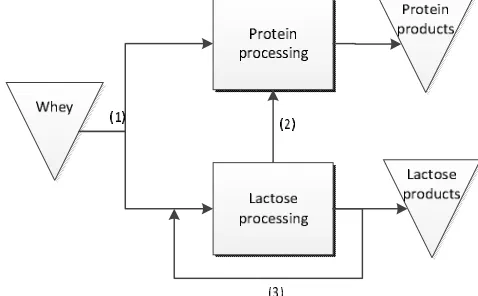
The production of protein- and lactose-rich products are connected to a certain extent: the whey is split into these two flows (1), as Figure 1.2 shows. Next to that, some of the residuals of the lactose process are used in the protein process (2). The lactose process is divergent, which means that in the output of the process multiple flows
emerge. There are also two retour flows (3), where a part of the production flow goes back into an earlier flow of the process and merges with it. Another difficulty that emerges in controlling the process is that all the different processes use the same factory equipment. In other words, there are no dedicated production lines. The divergent production process in combination with the retour flows, no
[image:10.595.282.521.573.721.2]3 exchange of flows between the two main processes is what makes the scheduling of the production process complex.
Furthermore, there are many restrictions added to this complexity. For example, most of the semi-finished products are perishable and can only stay a limited time in the buffers before further processing. Due to the high quality standards of the end product and production process, the cleaning of the equipment must be done regularly, because the products must not be ‘contaminated’ with each other or with bacteria. The cleaning process can take up a long time for some equipment and gives long interruptions in production. There are also restrictions on the sequencing of products on certain production equipment.
1.3.2 Current controlling of the process
There is no specific software available at Domo Borculo to support the scheduling process. The planning department only schedules two process steps, both concerning the protein process, based on their own insights. For the other process steps, the operators are responsible. They determine the sequence for their process step and decide what the impact will be on the prior or remaining process steps. For some process steps, the operator gets a weekly target that has to be met. Due to the high autonomy of the operator, it can happen that a large part of the production is stopped, because one operator cannot foresee that the buffer of another operator will be full soon. There is no overall synergy by coming up with a consistent schedule.
1.3.3 Uncertainty
At the Borculo factory there are two large uncertainties, or in other words variabilities: variability in the degrees of separation and variability in the arrival of the raw material whey.
In the two steps of the lactose production, the flow is separated into the main product and residuals. The exact degree of separation and the new composition of the main flow and residuals is not an exact science, but an approximation. Within the lactose production process, there is currently one part where the degree of separation is not under control, the variation is too large. Reasons for the variability are inter alia the quality of whey, the used equipment, the utilities used, and the settings of the equipment.
Domo is obliged to take all the whey from the cheese factories, where it is released as a waste product. Currently, there are hardly any arrangements about the delivery of the whey to the Borculo factory. The transport of the whey is pushed to Domo, done by the needs of the cheese factory, not those of Domo Borculo.
1.4
Research questions and methodology
The causes described in Section 1.3 lead to the following central research question:
How can FrieslandCampina Domo Borculo get control over the production of lactose-rich products?
4 the schedule to see that the plan is carried out, using whatever systems have proven satisfactory for the purpose”. Production control is a large field and is decomposed into several levels. Production control at the goods flow level is concerned with planning, and at the unit control level it is linked to scheduling (McKay et al., 2003). This research focuses on the scheduling of the lactose production process.
To find a solution to the problem statement of this thesis, we divide the central research question into a series of sub questions. Beneath each sub-question we briefly describe the research method. The combined answers to the sub questions form the answer to the central research question.
1. What are the characteristics of the lactose production & planning process and to what problems do they lead? (Chapter 2)
This question gives an overview of characteristics and conditions of the production and planning process to get a better understanding of the underlying problems described in Section 1.3. To obtain information about these subjects, we have a series of interviews with staff of the production and planning department and do observations at the workplace. We collect associated documentation, such as schematic overviews and historical data of the production process, in order to obtain a complete view. With all this knowledge, we analyze the current situation of the production process, which provides a starting point for improvement opportunities.
2. Which methods for scheduling, for a situation similar to Domo Borculo, can be found in literature? (Chapter 3)
To answer this question we perform a review and analysis of the relevant scientific literature. We focus on scheduling methods applied in industries with similar characteristics. We describe a review of similarities, differences and applications of the planning and scheduling models and discuss which knowledge can be applied at Domo Borculo. Also, we review the evaluation criteria that are mentioned in literature to review the quality of a schedule and the scheduling process.
3. What is a useful scheduling method for the lactose production at FrieslandCampina Borculo? (Chapter 4)
This question provides a solution for the problems described in Chapter 2. First we outline the scheduling problem. The scheduling problem beholds the details and the conditions of the production process as well as the decisions that are needed to solve the scheduling problem. Finally, we propose a method for scheduling the lactose production. The scheduling method is based on the literature study and the main characteristics of the system. We test the model against practical instances and study the differences between the proposed method and the current way of working. To motivate the choice of the proposed solution, we perform a case study based on historical data. Also, we let experts analyze the proposed method and the case studies.
4. How can Domo Borculo test the proposed scheduling method? (Chapter 5)
5 generated by the scheduling method. We set up evaluation criteria with the use of the literature review to assess the quality of the schedules that are generated by our scheduling method during the test. Furthermore, we discuss how the project team should be composed, how the schedule is communicated to the operators and who is responsible for recording the criteria.
6
Chapter 2:
Production and planning of lactose
This chapter answers the research question: “What are the characteristics of the lactose production
& planning process and to what problems do they lead?”. We provide an overview of the lactose
production and planning process at the FrieslandCampina Domo Borculo factory at different abstraction levels. The first part of the chapter, Section 2.1 to Section 2.3, aims at explaining the production process. The second part, Section 2.4, describes the planning and control processes at Domo Borculo. The last part, Section 2.5 and Section 2.6, describes the current performance of the lactose production.
2.1
Production at the Borculo Factory
Overall, we distinguish two main production processes in Borculo: the production of protein-rich products and the production of lactose-rich products as shown in Figure 2.1. As said in Chapter 1, the focus of the research is on the lactose production. To explain the lactose production clearly, we first give a basic description of the process in this section. The production process can be separated into three stages: pre-processing, lactose processing, and packaging. At the pre-processing the different kinds of whey arrive. There are basically two types: whey and permeate (whey where most of the protein has been filtered out).
Pre-processing Pre evaporators Whey Post evaporators Crystallization1 (K1) Dissolving
Street Dryers Packaging
Crystallization 2 (K2)
Post K1 Lactose processing
[image:14.595.71.546.349.517.2]End product Only whey By products Gos production Packaging Pasta
Figure 2.1: Overview of lactose production
After the pre-evaporator stage, all kinds of whey have approximately the same percentage of dry content and the products are called ‘pasta’. Then the materials go to the second stage, lactose processing, where the different end products are developed. The pasta is processed at the post-evaporators, whereafter it goes to the Crystallization 1 (K1). Only the whey goes to the ‘Post Crystallization’ step (Post K1), while the permeate goes directly to the dissolving street from the K1. After the dissolving street, part of the material goes to the GOS production. This is a (partly) separate production line for the product GOS; we will not focus any further on this product. The remaining material goes to the crystallization 2 (K2) processing stage. Next, the materials receive their final form as a powder when dried at the drying stage. The last step is to pack the final product in different kinds of packaging material and store it in the warehouse.
2.2
Detailed description of the lactose production process
7 proportions of lactose, protein, water, and minerals. Whey and permeate are called ‘high quality’ products. Sugar water Yellow (SW Yellow) is a low quality product, while sugar water refined (SW refined) has an average quality. The lowest quality product is sugar water white from white (SW WvW) and is not depicted in the legend, because it is directly added to the SW refined. The mother liquor (ML), sugar water mother liquor (SWML) and OPL are all residuals of the lactose production, but do still contain lactose and protein.
[image:15.595.72.447.451.751.2]The return flows in the lactose production exist because Domo Borculo wants to filter as much as lactose as possible.
Figure 2.2: Legenda for flowcharts
2.2.1 Pre-processing
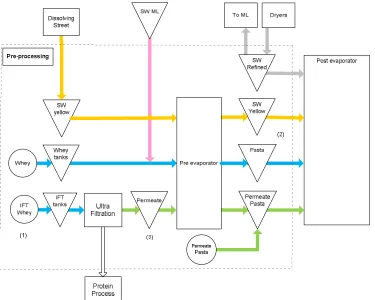
Before the whey is ready for the lactose processing stage it needs to have a certain percentage of dry content. In the pre-processing this is achieved by the use of evaporators. Figure 2.3 indicates the different process flows.
8 There are two storage steps in the pre-processing, where the product can be stored briefly. One is at the arrival of the whey (1) and the other is after the pre-evaporator(2); permeate has a third storage possibility after the Ultrafiltration (3). The SWML is added to the whey in a certain percentage in order to increase the total lactose yield, but only if the product is available. The pre-evaporators consist of continuous production equipment. This means that the lactose product flows through the pre-evaporator while being processed. So during production, the lactose product flows out of the first storage stage, through the pre-evaporator, to the second storage stage.
2.2.2 Lactose processing
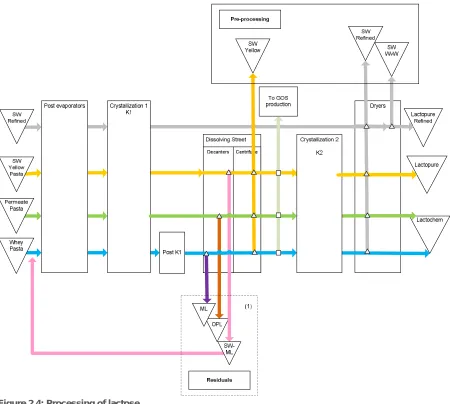
[image:16.595.73.523.278.682.2]The processing of whey into lactose is broadly done in five steps: post-evaporator, crystallization 1 (K1), dissolving, crystallization 2 (K2), and drying. Figure 2.4 shows a schematic overview. There are mainly four different materials (whey, permeate, SW yellow, SW refined) that are processed in the lactose processing stage.
Figure 2.4: Processing of lactose
9 The post-evaporators also consist of continuous production equipment. The K1 stage consists of tanks and thus has batch equipment. The dissolving streets have semi-continuous production equipment.
After the dissolving street the material can go into two directions: to the GOS production or further to the lactose processing. The operator views if there is material required at the GOS production. If this is the case the material goes to the GOS production, otherwise the material goes further to the crystallization 2. Here the product is cooled down again. Then finally the material goes to the dryers, were it gets its final solid state. The dryers are continuous production equipment. At the drying process, two kinds of residuals arise: the SW WvW contains the lowest amount of lactose and the SW refined contains somewhat more lactose. Domo Borculo adds SW WvW to the SW Yellow at the pre-processing or sells it. The SW refined goes to the pre-pre-processing.
2.2.3 Residuals Lactose processing
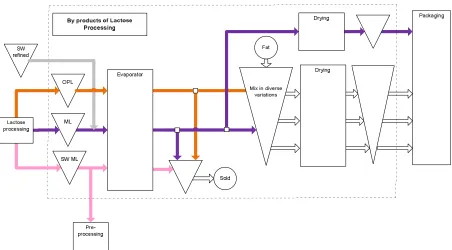
[image:17.595.72.524.370.620.2]At the dissolving street three kinds of residuals emerge: Mother Liquor (ML), Sugar Water Mother Liquor (SWML) and OPL. Figure 2.5 depicts these residual flows. These residuals contain different proportions of lactose and protein. Some of the SWML is dosed to the whey pasta tanks and some of the SW refined is dosed to the ML. All the residuals go to the pre-evaporators. After that, Domo Borculo sells the residuals or processes them into other kinds of products.
Figure 2.5: Flows of three residuals
2.2.4 Packaging
10
2.3
Other aspects of the production process
Next to the description of the production process, there are other relevant aspects of the production process that we introduce in this section.
2.3.1 Raw material: Whey
The main raw material of all end products made in Borculo is whey. The whey is delivered in several forms to the factory. The forms differ in two main ways: (I) the amount of dry content and (II) if the whey is IFT or non-IFT1. The non-IFT whey can only be used for regular production; the IFT whey can be used for regular and special production. So, a shortage in the supply of non-IFT whey can be forestalled. Hence it is more expensive to use the IFT-whey for products that can also be made out of non-IFT whey. Each kind of whey needs a different kind of preparation before it can go to the lactose processing; Figure 2.3 shows this. When the whey is already filtered it arrives as permeate. This process is also done at the factory in Borculo at the ultra-filtration.
2.3.2 Cleaning
To prevent contamination of the products, Domo Borculo cleans all equipment with acid, lixivium or a combination. How often the cleaning takes places depends on the equipment, the kind of product switch that is made, and the hours between cleanings.
Now we discussed the production flows at Domo Borculo, we explain more about the planning and scheduling of these production flows.
2.4
Planning & Scheduling at Domo Borculo
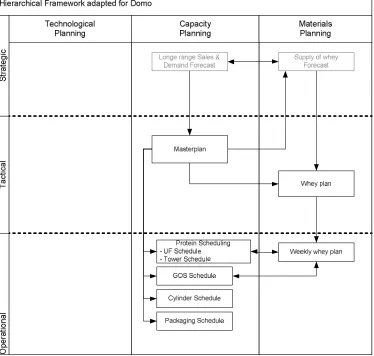
In Section 1.3 we stated that the main problem is that Domo Borculo has no control over the production of lactose-rich products. Before the effects of this problem are further explained, this section first describes the managing and planning of the lactose production. We explain the manufacturing planning and control process at the tactical and operational level. Figure 2.6 gives an overview of the planning process described in this subsection.
2.4.1 Masterplan
The masterplan is an overview of the production that is planned at Domo Borculo for the coming months. The first input for the masterplan follows from the comparison of the monthly sales forecast with the capacity of each Domo factory. The capacity for the lactose processing for Borculo is set to the capacity of the dissolving street, which Domo Borculo assumes is the bottleneck of the production process. Currently, the sales forecast is always higher than the production capacity and thus mainly the priority of the products is discussed between the masterplanners of the different Domo factories. Domo Borculo has two masterplanners: one for the protein products and one for the lactose products. The masterplan has a timespan of one year. For the next 13 weeks Domo Borculo receives a demand on week-level; for the rest of the year it receives a monthly demand.
11
Figure 2.6: Overview of planning processes at Domo and Domo Borculo
2.4.2 Whey planning
The cheese factories give a forecast of the whey they will produce and then the whey is divided on the different Domo production locations. FrieslandCampina is obliged to take all the whey from the internal as well as the external factories. Currently, FrieslandCampina makes more profit from processing of whey than from the direct sales of the whey. Therefore, the factory in Borculo utilizes the production capacity to its fullest. First, the whey is divided over the locations based on sales forecast (market driven) and then divided on available production capacity of each factory (supply driven). The amount of whey that is left after market driven partition is divided over the production location based on capacity of the particular location. In case not all whey can be processed the remaining whey will be sold; in weeks where there is a whey shortage FrieslandCampina buys extra. 2.4.3 Operational: weekly planning
The operational planners receive the two-week planning from the masterplanners. They develop a detailed schedule for the UF filter, the packaging department, GOS production, and parts of the protein production. The lactose production has no schedule, but the packaging of the final lactose products is scheduled at day-level. The packaging department and the protein production are out of the scope of this research and we do not discuss them any further.
12 are. Some schedules, such as the UF-filter schedule, are detailed and describe a plan at hour-level. Other schedules, such as the GOS production, have a production guideline per day. The operator determines the exact execution of the plan. The lactose production does not have a schedule, but the planning department does have a weekly target for the lactose. This weekly target is based on the production capacity of the dissolving streets. The GOS production uses part of the lactose production from the dissolving street as ‘raw material’. The planning department decides how much product goes to the GOS production each week, but in regular production weeks this is about 40%. The operator at the dissolving street decides in consultation with the operator at the GOS production, when lactose product goes to the GOS production. When there is no lactose product needed at the GOS production, the lactose product goes further in the lactose processing to the K2. 2.4.4 Operational whey planning
The operational planners send the UF plan to the operational whey planner. The operational whey planner makes a weekly plan for the whey based on the whey plan and the UF plan of Borculo. For every day, the wheyplanner determines for every kind of whey how many ton is sent to each Domo factory. This plan is adapted multiple times a day, depending on the request of the operational planners of the different locations and the available whey.
2.4.5 Day-to-day control of the lactose production
The operators of the three stages, pre-processing, processing, and packaging, all work at a different location in the factory. Every 8 hours a new shift starts and thus a new team of operators with one process coordinator is responsible for the lactose and protein production. Each production step, as depicted in Figure 2.1, has its own operator. The exception is for K2, which is operated by the operators from the previous and subsequent processing step. The operators decide themselves which product to process at which equipment, often in consultation with the operators of the subsequent production step. The main policy is to use the ´first in first out’- rule, but it is not always possible to use this rule for different reasons.
What differs in the strategy between the operators is, for instance, the amount of full or empty tanks they buffer before starting production. At the post-evaporators for example, one operator always waits until 3 tanks are empty in K1, while another operator waits until 1.5 tanks are empty. This can have a big influence on the utilization of the production step. There are also many other effects the operator needs to keep in mind such as the by-product buffers and the limited accessibility of the pipe works to and from the different processing equipment. The guidelines each operator works with are hard to capture in data, but have been extracted from conversations with operators.
2.4.6 Conclusion
At the tactical level, Domo Borculo bases the plan for the lactose production on the available whey and the production capacity that is based on the target at the dissolving street. At the operational level a daily plan for the arrival of whey is made. No plan or schedule is made for the lactose production; the daily controlling is left to the operators, which leads to a difference in performance at the dissolving street.
2.5
Capacity of the lactose production
13 and buffers to be infinite. Appendix A shows the exact calculations of the capacity and the accompanying assumptions. All the data is based on calculations from April to July 2013 unless mentioned otherwise.
Figure 2.7 depicts the theoretical capacity of the different steps in the lactose production. We include cleaning time, but do not account for maintenance. As one can see, the calculated capacities of all production steps lie very close to each other. After the dissolving street, part of the lactose production goes to the GOS production, which is approximately 40% of the flow. Thus we conclude that K2 and the drying stage both are not the bottleneck, because the production flow is almost halved.
Not depicted due to confidentiality
[image:21.595.71.513.452.622.2]Figure 2.7: Theoretical capacity of the lactose production in tons per hour (t/h)
Figure 2.7 shows that the dissolving street is the bottleneck of the production system. However, the capacity of the dissolving street is not constant and is thus based on an average. The capacity of the dissolving street depends inter alia on the degree of separation and the amount of product needed for one dissolving charge. Figure 2.8 depicts the amount of lactose product needed per charge and the accompanying capacity of the dissolving street. It is known that Domo Borculo does not have these two variables under control; therefore another research is started at Domo Borculo that focusses on these variables.
Not depicted due to confidentiality
Figure 2.8: Capacity of the dissolving street depending on the amount of product used per charge
Current capacity of the lactose production
14 Not depicted due to confidentiality
Figure 2.9: Current capacity of the lactose production
Conclusion
The capacity of the lactose production depends on the K1 or the dissolving street. Theoretically both can be the bottleneck in different situations. Currently the K1 stage is the bottleneck due to the long waiting times. About 40% of the lactose product goes to the GOS production after the dissolving street. Therefore K2 and the dryers only get part of the production flow to process, which eliminates these processing stages as potential bottleneck.
2.6
Utilization of capacity the bottleneck(s)
In Section 2.5 we concluded that the K1 and the dissolving street can both be the bottleneck. We also showed that the K1 is currently the bottleneck due to the long waiting times of a batch in K1. This section provides a calculation of the utilization of the dissolving street and the K1 stage; Appendix A provides a more detailed calculation.
2.6.1 Current utilization of capacity
The utilization of the bottleneck determines the output of the lactose production. Table 2.1 shows the utilization of the dissolving street and K1. The utilization of capacity at the dissolving street can be calculated in two ways. First, by the number of dissolving charges that is processed and second by the tons of product dissolved. Utilization differs between these two concepts, because the amount of product used for one dissolving charge is not always the same. Domo Borculo does not have a firm control over this step of the production process. In the desired situation these two utilizations should be close to one another, which would mean that the variation in the amount of lactose product used per charge is minimal. To determine the utilization of the dissolving street, we decide to use the number of dissolving charges. This shows the time the dissolving street is working, which is currently more accurate than the amount of product processed.
We base the utilization of capacity in the K1 processing stage on the amount of product processed in a certain time period in K1 compared to the theoretical capacity from Figure 2.7.
Note that the utilization calculation accounts for cleaning times and special production (when only one street is used). So the maximum utilization is based on a reachable production figure, which could be met weekly.
Utilization of dissolving street capacity in # dissolving charges 75.1%
Utilization of K1 63.9%
Table 2.1: Average utilization of capacity adjusted for maintenance, cleaning, and special production
15 underutilization of K1 and therefore Domo Borculo misses out on production. Section 2.6.2 discusses the causes of the current utilization at K1 and the dissolving street to illustrate where there is room for improvement.
2.6.2 Causes for current utilization of K1 and dissolving street
This section first discusses the causes for missed production at the dissolving street and then for the K1 processing stage to illustrate the complexity of eliminating the K1 as a bottleneck.
Dissolving street
Since a few months the operators keep track of the causes when the dissolving street is stopped or is tuned to a lower capacity. Table 2.2 shows these different causes. The utilization is based on the tons of product the dissolving street should be able to process. The percentages for each cause are related to the tons of production loss. For example, 15 % of the tons missed production is caused due to the fact there was no material available in K1 and Post-K1.
Cause Indicated by operator
1 Not enough product available (K1 & Post K1) 15.4%
2 Cleaning 12.7%
3 Special production 11.6%
4 K2 full 11.1%
5 Switch to other product 9.0 %
6 Maintenance 8.4%
7 By product buffers full 7.2%
8 Technical failure 6.3%
9 Bad filtration 2.6 %
10 SW Yellow buffer full 0.3%
11 Other 15.0 %
Table 2.2: Causes of missed production at the dissolving street (from week 17 to 34 2013)
A great part of the causes, 33.9% (1, 4, 7, 10), we can directly relate to the controlling of the lactose production. As a (potential) bottleneck, the dissolving street should always have product available for processing and a possibility to store the outgoing flow. The operators indicated that for 33.89% of all the causes this is not possible. The switching to other products is also related to the controlling of the process and can possible be reduced when having a better control of the process. Maintenance and technical failures are causes that cannot be fully eliminated, but could possibly be reduced. Causes of underutilization K1
The low utilization for K1 could be caused by two variables: the batch size and the batch time. In Section 2.5 we already showed that the capacity is influenced by the long batch times due to the waiting times in K1. The batch size has influence on the utilization, because the processing times are independent of batch size. When a tank is not filled to maximum, the used capacity is lower. Table 2.3 shows the average filling percentage of a tank in K1. For instance, if whey is in a K1 tank the tank is approximately filled for 89.2%.
Whey SW Yellow Permeate SW refined
89.2% 83.2% 90.9% 66.8%
16
2.7
Conclusion
The lactose production process of Domo Borculo mainly processes four materials: whey, permeate, SW Yellow, and SW refined. SW Yellow and SW refined are actually residuals that emerge during the production process, but are then used as raw material for the production process. These two products are a constant loop in the production process. Three other residuals that emerge (ML, OPL, and SWML) are processed further in another part of the production system.
Domo Borculo bases the tactical plan for the lactose production on the available whey and the available production capacity. On daily basis, a plan for the arrival of whey and permeate is made. No schedule is made for the lactose production; the operators are mainly in charge of managing and controlling the lactose production. Due to the number of variables an operator has to take into account, they cannot always foresee the outcome of their actions. Apparently, it is hard to consider the complete complexity of the production system only with human logic. We can relate 33.9% of the missed production directly to the planning of the lactose production.
17
Chapter 3:
Literature review
In Chapter 2 we did an elaboration of the current situation and a problem analysis. In this chapter we outline the theoretical framework for this research by answering the research question: “Which
methods for scheduling, for a situation similar to Domo Borculo, can be found in literature?”. First we
give a general description of the manufacturing planning and control processes in Section 3.1. There is a great amount of literature about planning and scheduling. To give a more focused literature review, we characterize the production process at Domo Borculo in Section 3.2. Section 3.3 describes the different characteristics of scheduling problems and Section 3.4 describes the characteristics of solution models. We use these characteristics to classify the solution methods found in literature and discussed in Section 3.5. The chapter closes with a brief summary and discussion.
3.1
Strategic, Tactical and Operational planning
Any manufacturing organization develops its production plans traditionally in three stages: strategic, tactical, and operational. These three stages have different types of decisions and objectives, managerial levels, time horizons and planning frequencies, levels of details, and also different modeling assumptions (Hans et al., 2007). Strategic planning has the basic objective to create a production environment that is able to meet the strategic goals of the company and is concerned with a long-term horizon (Hopp et al., 2008). In this stage, organizations develop an aggregate planning module that reflects timing and quantity of total future production over the long-range (APICS, n.d.).
Tactical planning is concerned with the medium-range planning horizon and allocates the resources as profitable and effectively as possible. Generally, the resources to be allocated are machines, workforce, and storage. The aggregated plan works as a constraint on the tactical planning, however, resources can be temporarily decreased or increased (Hans et al., 2007). In companies this information is often presented in a master production schedule, which represents what the company plans to produce expressed in specific configurations, quantities and dates (Das et al., 2000).
Operational planning has a greater level of detail and thus the planning horizon is considerably shorter, i.e. one or two weeks. This short-term planning, mostly referred to as scheduling, provides a feasible production schedule for every day operations; it describes the sequencing and assignment of products to machines (Das et al., 2000).
18
3.2
Characterization of the Domo production process
The scientific literature in the scheduling area is extensive. To give a focused literature review, we first characterize the production process of Domo Borculo within the scientific literature.
From literature we find that two types of manufacturing can be distinguished: process and discrete manufacturing. Discrete manufacturing is associated with bills of materials and routing while process manufacturing “adds value to materials by mixing, separating, forming or chemical reactions” (APICS, n.d.). The process industry consists of companies processing homogeneous products in at least one stage of the production process (Artiba et al., 1998). Fransoo et al. (1993) define typical characteristics of process manufacturing businesses such as the variability in the quality of raw materials and the residuals that emerge due to the divergence of the production process. Also, raw materials are often perishable in the process industry, which sets constraints on the production planning (Crama et al., 2001). Note that not all process industries are characterized by these issues, but that they will predominantly be found in the process industry and not in the discrete manufacturing industry (Kallrath, 2002b).
From the above information we conclude that Domo Borculo is in the process industry, since it adds value to whey (a perishable material) by separating it in a number of steps into different final products. Due to the special characteristics of the process industry, the scheduling formulations for discrete manufacturing do not fit and there is not a general technique proposed for scheduling (Crama et al., 2001; Rutten, 1993). In Section 3.3, we give an overview of the characteristics of scheduling problems in the process industry.
3.3
Classification of scheduling problems
The diversity of factors that should be taken into account in the process industry makes the development of a general schedule method difficult (Méndez et al., 2006). Table 3.1 gives an overview of the various characteristics and shows that there are many different scheduling problems. This section highlights a few important characteristics.
3.3.1 Process topology
All scheduling problems in the process industry can be broadly classified in network- or sequential-based processes. The basic difference between these two is that in a network-sequential-based plant the splitting, mixing, and recycling of batches is allowed. Contrary, with a sequential-based process the batch identity needs to be preserved (Méndez et al., 2006). Production processes of the sequential-based approach are again divided into two groups: multiproduct or multipurpose (Qian et al., 2009). The term multiproduct plant is used for a plant that uses a similar process for the sequential production of different but very similar products. Often these plants only produce a limited number of products. In multipurpose plants there are various products by various routes. Different products often require different settings of equipment and so equipment units can be used for different tasks. 3.3.2 Processing task
19 3.3.3 Changeovers
When switching to another task, the processing unit has a changeover policy. In a sequence dependent changeover, the processing unit may require cleaning or set-up, which obviously costs time. In time or frequency dependent changeovers, a changeover must be done after a certain amount of time or tasks processed. Changeovers can also be specific per unit of a processing task. The last changeover policy is to have none (Floudas et al., 2004).
3.3.4 Intermediate storage policy
The products and semi-products can be stored according to different policies. Broadly there are four different policies defined: unlimited intermediate storage (UIS), no intermediate storage (NIS), zero-wait (ZW), and finite intermediate storage (FIS) (Méndez et al., 2006). With no intermediate storage there are no storage tanks available for intermediate materials, but sometimes the materials can be held in the processing unit after the task is finished. With a zero-wait policy, the intermediate materials are required to be processed immediately at the following production step. Timing constraints are necessary to model the ZW policy (Floudas et al., 2004).
Process topology sequential, network
Processing task batch, continuous
Changeovers Sequence dependent, time/frequency
dependent, unit dependent, none Intermediate storage policy unlimited intermediate storage (UIS), no
intermediate storage (NIS), zero-wait (ZW), and finite intermediate storage (FIS)
[image:27.595.69.534.312.429.2]Degree of uncertainty Deterministic, stochastic
Table 3.1: Characteristics of scheduling problems
3.4
Classification of solution models
There are two important concepts that are used to classify the existing solution models for scheduling in the process industry. First, the approach to the modeling of the production system is described in Section 3.4.1 and second, the modeling of time in Section 3.4.2.
3.4.1 Material or batch based approach
Material-based models rely on the modeling of materials through material balances enforced at
different time points. These models address problems in network production environments, thus where batches can split or mix and a task can produce or consume multiple materials. Batch-based
models are used for sequential processes, where a fixed number of batches go through a series of
20 3.4.2 Event representation
Time representation can be done in discrete time or continuous time. In discrete-time models the time horizon is divided into finite number of intervals with predefined durations. The beginning and ending of tasks only happen at the boundaries of
the time intervals, consequently scheduling constraints only have to be observed at these known time points (Maravelias et al., 2003). This reduces the complexity of the models and makes the model structure simpler and easier to solve (Méndez et al., 2006). A major disadvantage of discrete scheduling is that it can create sub-optimal or even infeasible schedules, because the discrete-time formulations are only an approximation of the actual problem. However, a recent study suggest that discrete representation of time leads to formulations which are at least as effective as continuous time models (Velez et al., 2013).
Another way of handling time is to treat it as continuum, where the problem is divided into a set of events. The time horizon in continuous models is divided into intervals of unequal and unknown duration (Maravelias et al., 2003). The handling of variable time obtains a significant reduction of the number of variables in the model. However, the model complexity is increased due to extensive modeling of resource and inventory limitations (Méndez et al., 2006). Figure 3.1 provides an example of a continuous time representation, however there are different continuous time representations used.
3.5
Solution models
This section highlights the scheduling techniques that are often cited in literature. We discuss the mathematical programming methods in Section 3.5.1 and the heuristic methods in Section 3.5.2. For the review of planning and scheduling methodologies in the scientific literature we use the reviews of different authors. Tan et al. (2000) reviewed the integration of production planning and scheduling models. Kallrath (2002a), Stobbe et al. (2000), Crama et al. (2001), Dennis et al. (2000), Neumann et al. (2005), and Méndez et al. (2006) give an overview of scheduling for batch and continuous processes in the process industries. Furthermore, we used the review of Floudas et al. (2004) who provide a review of the scheduling of chemical processes. From all these reviews we discuss the articles that describe similar production process to that of Domo Borculo. Table 3.2 gives an overview of the discussed literature in Section 3.5.1 to Section 3.5.5.
Most models for process production scheduling are only suitable to limited classes of problems and use simplified assumptions. Assumptions often made are the batching problem has already been solved (and thus is decoupled from the scheduling problem) or that the batch size is fixed. The assumption that batches are fixed can be done under two conditions: (i) the demand is fixed and (ii) the parallel units in each stage are similar in terms of capacity (Prasad et al., 2008). Another assumption often stated is that of unlimited storage availability.
[image:28.595.316.486.120.301.2]21 3.5.1 Mathematical programming
Mathematical programming techniques are the most applied methods for scheduling problems in the process industry. Mixed-Integer Linear Programming (MILP) is used widely, because of its rigorousness, flexibility, extensive modeling capability, and the discrete decisions that are involved in assignment and sequencing decisions (Kopanos et al., 2011) (Grossmann et al.) Although the suggestions for modeling of scheduling problems is extensive, the ability to solve the resulting formulations remains limited (Velez et al., 2013). One of the most important issues in the application of mixed-integer programming techniques is the computational time of the solution due to the fact that realistic problems often produce large scale models. To decrease the computational time several approaches have been proposed. We discuss the most common used approaches: reformulation of the scheduling problem, decomposition methods, and interventions of the brand & bound procedure.
3.5.2 Reformulation
The constraints of the MILP can be written in an alternative form to decrease the computational time. Most literature here is aimed at the reduction of binary variables, as they determine the speed of the solution for a large part (Qian et al., 2009).
Neumann et al. (2005) deal with batch, semi-continuous, and continuous production in process industries with different intermediate storage facilities. They formulate a general production scheduling problem use a relaxation principle where the resource constraints are deleted. If any resource conflicts occur, they introduce linear constraints in the relaxation. The resolving of the resource conflicts and refining the resource relaxation is repeated until a feasible schedule is found or the resource conflict cannot be resolved, which results in a branch-and-bound algorithm. For larger problem instances they propose that one should use a truncated procedure.
3.5.3 Intervention of the branch and bound solution procedure
Another strategy is to intervene in the branch and bound search process to decrease the computational time. Schilling et al. (1996) present a general STN-based mathematical formulation for process scheduling with a continuous time presentation. They propose a branch-and-bound algorithm for the relaxation of the MILP that branches on the discrete as well as the continuous variables, this method will reduce the integrality gap. They apply their method to an example problem with 5 tasks, two raw materials, two final products, and limited intermediate storage capacity. They find a feasible solution, however they do acknowledge that the computational burden still is substantial and more has to be adjusted to have a practical applicability.
Velez et al. (2013) developed a parallel branch-and-bound algorithm using a discrete time model. A regular branch-and-bound algorithm divides the problem into a series of smaller problems (branching), called nodes, by bounding the integer variable. Nodes that are infeasible or have a lower bound that is greater than the current upper bound (for minimization problems) are pruned. Velez et al. (2013) bound the number of times a task runs in a processing unit. Each node is solved as an MIP for a short time, which allows them to find integer solutions while limiting the time.
3.5.4 Decomposition methods
22 batching problem is modeled as a MILP and solved with CPLEX; the solution provides the number and sizes of batches for all tasks. With this first step they aim to minimize the workload to be scheduled, so that the batch scheduling problem is easier. The batch scheduling problem assigns a processing unit and a time interval to each batch and is solved with a beam search procedure. Beam search is a heuristic, based on branch-and-bound, that explores the most promising node. However, Neumann et al. do not exactly indicate how they select this most promising node. They apply there method to a fictive plant with eight production steps, one raw material and six final products. After each production step there is finite intermediate storage available. They found a feasible solution within a time of 56 seconds.
3.5.5 Constructive and Meta heuristics
The use of heuristics can also be used to accelerate the solution process. Constructive heuristics are heuristics that can be used to build an initial schedule. Most constructive heuristics consist of dispatching rules. Examples of dispatching rules are earliest due date, first in first out, and longest processing time. Meta-heuristics, also called local search methods, start with an initial schedule that is gradually improved through an iterative procedure. A constructive heuristics in combination with a local search method usually obtains a good solution within reasonable time. Some well-known local search methods are: simulated annealing (SA), tabu search (TS) and genetic algorithm (GA). A drawback of these heuristics is that one can never be sure of the quality of the solution, i.e. how far the solution is from optimality. However SA and TS have the ability to move from local optima to better solutions. There are not many papers dealing with the scheduling problem in the process industry with a network based approach solely with heuristics.
Kudva et al. (1994) describe a heuristic algorithm for scheduling a multiproduct plant existing of multiple processing units, where each unit is either batch or semi continuous. Figure 3.2 depicts the problem they consider. The cylinders represent a storage facility and the units represent production equipment. Kudva et al. first assign a priority to the orders
based on due date. The scheduling heuristic consists of six steps: 1. Decide appropriate unit
2. Decide length of production run.
3. Find appropriate time slots in which the given task fits 4. Check if there is enough storage space available
5. If not enough storage space, go back to step 3 and select another time slot 6. If no feasible time slot is found, discard order
[image:30.595.280.537.428.528.2]The obtained schedule is improved by employing a heuristic that tries to schedule the orders as close to the due date as possible. The precise details of the improvement heuristic are not described. Kudva et al. have done 9 case studies to test their heuristic. They compare the outcome of their heuristic with a MILP relaxation and for all the 9 cases there is only a small gap between the heuristic and the relaxation solution (Kudva et al., 1994).
23 The research of Wang et al. (2009) deals with the scheduling problem of mixed batch and continuous processes in chemical plants where the objective is to minimize make span. They consider a scheduling case in a chemical plant of industrial salt. The salt is processed into four different final products. There are four production steps, from which the first three are continuous and the last one has batch equipment. The continuous processing steps are expressed in tons per hours and at the batch equipment the product has a fixed processing time. Between each processing step there is limited available storage capacity. To solve the scheduling they use a heuristic that is an improved form of the genetic algorithm. It is a very extensive heuristic. Every processing unit receives a gene: an assignment array based on random numbers.
3.5.6 Conclusion
Table 3.2 gives an overview of the literature we discussed in Section 3.5.1 to Section 3.5.5. None of the modeling formulations we found in literature are solved to optimality, due to time limitations. This suggests that our scheduling problem has the same limitations. The solution methods found in literature are not directly applicable to the lactose production process of Domo Borculo. Most MILP models focus on continuous or on batch production processes. We discussed the papers we found that could handle both batch as well as continuous processes which are from Neumann et al. (2005), Schilling et al. (1996), and Velez et al. (2013). However all of these methods are only suitable for small (non-realistic) problem instances. Also the details of their proposed methods are sometimes hard to reproduce. Therefore, we conclude that we will not be able to solve the scheduling problem for Domo to optimality.
[image:31.595.68.587.514.743.2]The heuristic proposed by Kudva et al. (1994) is very clear, but the method schedules only one production unit per iteration because there is intermediate storage available. The method proposed by Wang et al. (2009) has exactly the same limitation. At Domo Borculo, there is no intermediate storage and thus the production equipment cannot be scheduled independent of each other. So, from our literature study we can conclude that there are no suitable solution methods for Domo Borculo.
Table 3.2: Overview of characteristics of discussed scheduling problems and proposed methods
Author(s) Method Used process
topology
Process task Storage Level
Neumann, Schwindt & Trautmann (2005)
MILP relaxation b&b algorithm
Network Continuous, semi-continuous and batch
Finite intermediate storage, unlimited intermediate storage and no intermediate storage
Scheduling
Schilling & Pantelides (1996)
MILP relaxation branch & bound
Network Batch and continuous
Finite intermediate storage, unlimited storage for final and raw materials
Scheduling
Velez & Maravelias (2013)
Branch & Bound algorithm
Network or Sequential
Batch and continuous
Possibility for FIS and/or NIS Scheduling
Neumann, Schwindt & Trautmann (2002)
MILP solved with CPlex and beam search
Network Batch Finite intermediate storage Scheduling
Kudva, Elkamel, Pekny & Reklaitis (1994)
Heuristic Sequential Batch and semi-continuous
Finite intermediate storage Scheduling
Wang, Zao, Xu & Wang (2009)
Heuristic based on genetic algorithm
Network Batch and continuous
24
3.6
Measuring the quality of the schedule
After we develop a good scheduling algorithm for Domo Borculo, we need to evaluate the algorithm in practice. When implementing a scheduling method, the quality of the schedules it produces is very important. The quality of a schedule refers in this case to the gap between the proposed schedule and the execution of it (Chae, 2009). To evaluate the quality of the scheduling method in practice, we use evaluation criteria from literature. Although the literature about performance measurement on strategic level is extensive, the amount of literature on evaluating the quality of a schedule or scheduling method on operational level is minimal. In this section, we review the relevant literature. We use the criteria to evaluate the proposed solution in the test phase in Chapter 5.
Kempf et al. (2000) give three guidelines that one should keep in mind when evaluating a schedule. They state that these three guidelines are crucial to good schedule quality evaluation. First of all, the metrics should support the organizational goals. This is not always as easy as it seems, because often different organizational units have conflicting goals. For example, a sales department wants to have on-time delivery, while a production department wants to reduce costs. Second, there must not be too many layers of metrics between the long-term organizational goals and the schedule measurements. The relationship will become blurred or lost completely. Final, one should raise questions of the relationships between the metrics and explore if an improvement in one metric brings an improvement in the other. These kinds of relationships must be avoided as much as possible.
Bandinelli et al. (2005) propose a schedule evaluation framework consisting of three layers: the effectiveness domain, the robustness domain, and the flexibility domain. The effectiveness domain shows how the manufacturing system performs following the proposed schedule in a steady-state situation. This layer evaluates whether the schedule is reliable (are we able to deliver the correct quantity at the correct time and place), flexible (can it respond to market changes), and responsive (the speed at which the system provides products). In the robustness domain, one must verify the ability of scheduling systems to not degrade their performance in the face of disruptions. They state four robustness indicators: steady-state stability, fault tolerance, reactivity, and dynamic stability. The flexibility domain evaluates how the schedule would perform in a different manufacturing system or to changing circumstances. Changing circumstances can be a change in the size of the system or a change in the production plan.
De Snoo et al. (2010) propose a framework with more concrete scheduling evaluation measures. They divide the criteria into four groups. The product criteria focus on the schedule as a product, while the process criteria see scheduling as a service where information is collected and delivered. They also include indirect scheduling performance criteria and factors influencing the scheduling
performance.
25