Cloud Computing Based Cyber Defensive with
Redundancy and Intruder Detection
Mrs. Yamuna. S1, Selvamani. A2, Senthil Kumaran.S3, Sri Kumar.R4, Veeresh Kumar. R5
1
Asst.Professor, 2, 3, 4, 5UGStudent, Sri Shakthi Institude of Engineering And Technology, Coimbatore, India
Abstract: Ensuring the minimum safety for the industry and residential house has become the most necessary action nowadays. To prevent them from fire accident and intruder we come up with this safety device. This paper, propounded a system which is capable to detect fire and can provide the location of the affected region. Raspberry Pi 3 has been used to control which are integrated with a couple of sensors and camera. We have provided a confirmation of the fire suspecting system to avoid any false alarm. The system will immediately send a message along with the image of the affected spot and device location. An admin can confirm or deny the impeachment and if the admin confirms the situation as a breaking out of fire, then the system will immediately raise an alarm and an automatic message will be sent to the nearby fire brigade.
Keywords: Raspberry Pi, Flame sensor, MQ-2 gas sensor, PIR sensor, Relay, MCP
I. INTRODUCTION
Internet of Things (IoT) is a system of several physical devices which are interconnected with each other and can communicate and send data through the Internet. It consists of all the internet enabled devices which can collect, communicate and act upon data acquired using sensors, processors and communication hardware from the surrounding environments. IoT due to its connectivity, heterogeneity, dynamic nature and intelligence is widely used. It finds its application in several domains such as agriculture, industrial control, home automation, retail, healthcare, logistics, smart meter, and smart cities. With the internet of things, the physical world is becoming one big information system. It is the next generation of the Internet and is taking a huge leap in automation. IoT plays a major role in industrial safety and control. Technologies based on IoT make the industries smarter, safer and more environmentally sustainable. Fire accidents are a major threat to industries. It results in severe losses. IoT can help in intelligent fire monitoring and detection by integrating information from sensors to detect fires and take immediate response action. It helps in speeding up the response times and provides information for evacuation, rescue and fire sensors, so an Analog to Digital Converter is used to convert the Analog values into digital values since the Raspberry pi can accept only digital input. The relay acts as a switch to activate the sprinkler motor when the fire sensor detects fire. If fire is detected, a fire alarm will be generated. When motion is detected by the PIR sensor, the camera captures an image and sends an email alert to the industry owner. The sensor values are transmitted to the web server through the inbuilt Wi-Fi module in the Raspberry Pi.
II. EXISTING SYSTEM
Aurdino is used as controller with temperature and humidity sensor. It senses the environment and sends signal to the controller. It produces output according to the input signal and sends the result to the server through IP network.
III.PROPOSED SYSTEM
Raspberry pi is used instead of aurdino as controller both as master and slave. Gas sensor detects the gas present periodically and detects the toxic gas and activates the exhaust fan. Fire detection is done using color and shape and fake alarm is recognized using growth evaluation and it intimates to the nearby Fire station and Ambulance service.
Intruder can be detected using the PIR sensor which activates the camera and capture the intruder. These were monitored and controlled by IOT\Cloud Computing.
IV.SYSTEM ARCHITECTURE
Fig. 1 Block diagram
A. Raspberry pi
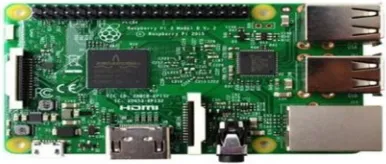
The Raspberry Pi 3 Model B is the third generation Raspberry Pi. This powerful credit-card sized single board computer can be used for many applications and supersedes the original Raspberry Pi Model B+ and Raspberry Pi 2 Model B. Whilst maintaining the popular board format the Raspberry Pi 3 Model B brings you a more powerful processer, 10x faster than the first generation Raspberry Pi. Additionally it adds wireless LAN & Bluetooth connectivity making it the ideal solution for powerful connected designs. The Raspberry Pi 3 is the third generation Raspberry Pi. It replaced the Raspberry Pi 2 Model B in February 2016. The Raspberry Pi 3 has an identical form factor to the previous Pi 2 (and Pi 1 Model B+) and has complete compatibility with Raspberry Pi 1 and 2.The best part about all this is that the Pi 3 keeps the same shape, connectors, and mounting holes as the Pi 2.Dual Core Video Core IV® Multimedia Co-Processor. Provides Open GL ES 2.0, hardware-accelerated Open CV, and 1080p30
[image:2.612.198.391.425.507.2]H.264 high-profile decode.
Fig. 1 Raspberry pi
B. Flame Sensor
A flame detector is a sensor designed to detect and respond to the presence of a flame or fire. It also can detect ordinary light source in the range of a wavelength 760nm-1100 nm. The detection distance is up to 100 cm. The Flame sensor can output digital or analog signal. It can be used as a flame alarm or in fire fighting robots. The flame sensor is most sensitive to ordinary light. In this, a small panel output interface can be directly connected with the microcontroller IO port. The sensor and the flame have to maintain a certain distance of 80cm, so as not to damage the sensor temperature of the test flame lighters. As the flame increases, the distance also increases. It also has small plate analog output mode and the A/D conversion process is possible to get a higher accuracy. It has a black LED which indicates the power and the output signal.
[image:2.612.239.343.654.708.2]C. Gas Sensor
The MQ-2 gas sensor has high sensitivity to LPG, Propane and Hydrogen and can also detect Methane and combustible steam. The gas sensor readings are taken and the gas level is displayed and updated to the server. Excellent performance CO2 Sensor, for use in a wide range of applications, including air quality monitoring, smoke alarms, mine and tunnel warning systems, greenhouses, etc. The sensor is easy to use and can be easily incorporated in a small portable unit. They are used in gas detecting equipment for carbon monoxide (CO) in family and industry or car.
Fig. 4 Gas sensor
D. PIR Sensor
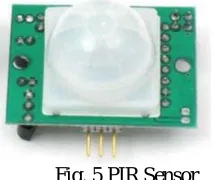
[image:3.612.243.349.369.459.2]The PIR (Passive Infra-Red) Sensor is a pyroelectric device that detects motion by measuring changes in the infrared levels emitted by surrounding objects. This motion can be detected by checking for a high signal on a single I/O pin. Pyroelectric devices, such as the PIR sensor, have elements made of a crystalline material that generates an electric charge when exposed to infrared radiation. The changes in the amount of infrared striking the element change the voltages generated, which are measured by an on-board amplifier. The device contains a special filter called a Fresnel lens, which focuses the infrared signals onto the element. As the ambient infrared signals change rapidly, the on-board amplifier trips the output to indicate motion.
Fig. 5 PIR Sensor
E. Single Relay Board
[image:3.612.220.356.649.718.2]Relays are simple switches which are operated both electrically and mechanically. Relays consist of a n electromagnet and also a set of contacts. The switching mechanism is carried out with the help of the electromagnet. The main operation of a relay comes in places where only a low-power signal can be used to control a circuit. It is also used in places where only one signal can be used to control a lot of circuits. They were used to switch the signal coming from one source to another destination. The high end applications of relays require high power to be driven by electric motors and so on. Such relays are called contactors. A relay is an electromechanical switch which is activated by an electric current. A single relay board arrangement contains driver circuit, power supply circuit and isolation circuit. A relay is assembled with that circuit. The driver circuit contains transistors for switching operations. The transistor is use for switching the relay. An isolation circuit prevents reverse voltage from the relay which protects the controller and transistor from damage. The input pulse for switching the transistor is given from the microcontroller unit. It is used for switching of a single device. When a current flows through the coil, the resulting magnetic field attracts an armature that is mechanically linked to a moving contact. The movement either makes or breaks a connection with a fixed contact.
F. Web Camera
Active WebCam captures images up to 30 frames per second from any video device including USB cameras, Analog cameras connected to capture card, TV-boards, camcorders with FireWire (IEEE 1394) interface and from Network cameras. When the program detects motion in the monitored area, it can sound an alarm, e-mail you the captured images, and start broadcasting or record a video. The program has features to add text captions and image logos to the images, to place a date/time stamp on each video frame, and to adjust the frame rate, picture size, and quality .A webcam is a video camera that feeds or streams its image in real time to or through a computer to computer network. When "captured" by the computer, the video stream may be saved, viewed or sent on to other networks via systems such as the internet, and email as an attachment. When sent to a remote location, the video stream may be saved, viewed or on sent there. Unlike an IP camera (which connects using Ethernet or Wi-Fi), a webcam is generally connected by a USB cable, or similar cable, or built into computer hardware, such as laptops.
Fig. 7 Web camera
G. Open CV
Open CV (Open Source Computer Vision Library) is an open source computer vision and machine learning software library. Open CV was built to provide a common infrastructure for computer vision applications and to accelerate the use of machine perception in the commercial products. This library has more than 2500 optimized algorithms, which includes a comprehensive set of both classic and state-of-the-art computer vision and machine learning algorithms. These algorithms can be used to detect and recognize faces, identify objects, classify human actions in videos, track camera movements, track moving objects, extract 3D models of objects.
[image:4.612.147.459.445.720.2]V. WORKING MODEL
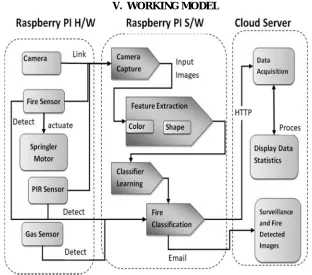
The flame, gas and PIR sensors are interfaced with the Raspberry Pi through the Analog to Digital converter. The alarm and camera are directly connected to the Pi. The relay acts as a switch and activates the sprinkler motor. Fire can be accidental fire due to the complex industrial environment or it can be intruder caused fire due to unethical reasons. On detection of fire, a fire alarm is generated immediately to alert the workers in the industry. Then, the sprinkler motor is activated. The concentration of gases is noted from the gas sensor. The status is displayed on the terminal with information about gas levels and fire and motion detection. When an intruder is detected the camera captures an image and sends an email alert along with the image attached to the industry owner.
[image:5.612.179.427.197.390.2]The gas sensor values are displayed in the terminal along with information regarding fire and motion detection. It also displays a success message after email alert is sent.
Fig. 9 Output
VI.PERFORMANCE
Safety in industries is a major concern. The system should be accurate and reliable and provide immediate alert. The Raspberry Pi 3 used has inbuilt Wi-Fi and Bluetooth which in turn helps in immediate alert to the industry on outbreak of fire.
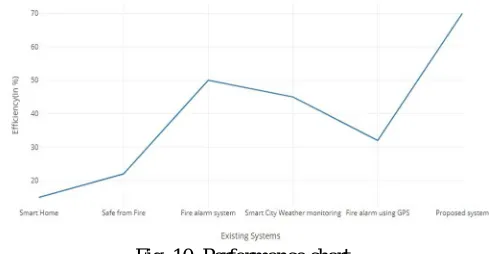
Fig. 10 Performance chart
This graph shows the Performance analysis with the help of a xy graph. The x-axis shows the existing systems and the proposed system. The y-axis shows the efficiency of the different systems.
VII. CONCLUSION
[image:5.612.185.430.469.596.2]A. Future Scope
From the video key frames is detected using background subtraction algorithm and hallucinated by Singular Value Decomposition to obtain high resolution images.
Face region is segmented from the key frames using Viola Jones algorithm. Recognition is done using multi key point descriptor. Future work may include additional features like electronic device control, power management could be added to the home automation system. Additional sensors and actuators could be added to the system.
An android application can be developed to provide confirmation on the decision to be taken on the outbreak of a fire. The sensor data can be combined with algorithm and big data analytics to develop better emergency evacuation strategies and analyse the entire system.
REFERENCES
[1] Ahmed Imteaj, Tanveer Rahman, Muhammad Kamrul Hossain, Mohammed Shamsul Alam and Saad Ahmad. “An IoT based Fire Alarming and Authentication System for Workhouse using Raspberry Pi 3,” International Conference on Electrical, Computer and Communication Engineering (ECCE), February 16-18, 2017, Cox’s Bazar, Bangladesh.
[2] Adil Hamid Malik, Aaqibjalal, Bilal Ahmed Parray, Meenakohli, ”Smart City IOT Based Weather Monitoring System”, 2017International journal of Engineering Science and Computing( IJESC) Volume 7 Issue no.5.
[3] S. Tanwar_, P. Pately, K. Patelz, S. Tyagix, N. Kumar, M. S. Obaidat,“An Advanced Internet of Thing based Security Alert System for Smart Home” Computer,
Information and Telecommunication Systems (CITS), 2017International Conference on21-23 July 2017.
[4] K.M.Gaikwad, Ahmed Quadri, Shelar Akshada, Zagade Reshma, “Fire Monitoring and Control System”, International Research Journal of Engineering and Technology (IRJET) Volume: 03 Issue: 05 | May-2016