Hidden Softmax Sequence Model for Dialogue Structure Analysis
Zhiyang He1, Xien Liu2, Ping Lv2, Ji Wu1
1Department of Electronic Engineering, Tsinghua University, Beijing, China 2Tsinghua-iFlytek Joint Laboratory for Speech Technology, Beijing, China
{zyhe ts, xeliu, luping ts, wuji ee}@mail.tsinghua.edu.cn
Abstract
We propose a new unsupervised learning model, hidden softmax sequence model (HSSM), based on Boltzmann machine for dialogue structure analysis. The model employs three types of units in the hidden layer to discovery dialogue latent struc-tures: softmax units which represent latent states of utterances; binary units which represent latent topics specified by dia-logues; and a binary unit that represents the global general topic shared across the whole dialogue corpus. In addition, the model contains extra connections between adjacent hidden softmax units to formu-late the dependency between formu-latent states. Two different kinds of real world dialogue corpora, Twitter-Post and AirTicketBook-ing, are utilized for extensive comparing experiments, and the results illustrate that the proposed model outperforms sate-of-the-art popular approaches.
1 Introduction
Dialogue structure analysis is an important and fundamental task in the natural language process-ing domain. The technology provides essential clues for solving real-world problems, such as pro-ducing dialogue summaries (Murray et al., 2006; Liu et al., 2010), controlling conversational agents (Wilks, 2006), and designing interactive dialogue systems (Young, 2006; Allen et al., 2007) etc. The study of modeling dialogues always assumes that for each dialogue there exists an unique latent structure (namely dialogue structure), which con-sists of a series of latent states.1
1Also called dialogue acts or speech acts in some past work. In this paper, for simplicity we will only use the term “latent state” to describe the sequential dialogue structure.
Some past works mainly rely on supervised or semi-supervised learning, which always involve extensive human efforts to manually construct la-tent state inventory and to label training samples. Cohen et al. (2004) developed an inventory of la-tent states specific to E-mail in an office domain by inspecting a large corpus of e-mail. Jeong et al. (2009) employed semi-supervised learning to transfer latent states from labeled speech corpora to the Internet media and e-mail. Involving exten-sive human efforts constrains scaling the training sample size (which is essential to supervised learn-ing) and application domains.
In recent years, there has been some work on modeling dialogues with unsupervised learn-ing methods which operate only on unlabeled ob-served data. Crook et al. (2009) employed Dirich-let process mixture clustering models to recog-nize latent states for each utterance in dialogues from a travel-planning domain, but they do not inspect dialogues’ sequential structure. Choti-mongkol (2008) proposed a hidden Markov model (HMM) based dialogue analysis model to study structures of task-oriented conversations from in-domain dialogue corpus. More recently, Ritter et al. (2010) extended the HMM based conversa-tion model by introducing addiconversa-tional word sources for topic learning process. Zhai et al. (2014) assumed words in an utterance are emitted from topic models under HMM framework, and topics were shared across all latent states. All these dia-logue structure analysis models are directed gener-ative models, in which the HMMs, language mod-els and topic modmod-els are combined together.
In this study, we attempt to develop a Boltz-mann machine based undirected generative model for dialogue structure analysis. As for the document modeling using undirected gener-ative model, Hinton and Salakhutdinov (2009) proposed a general framework, replicated
max model (RSM), for topic modeling based on restricted Boltzmann machine (RBM). The model focuses on the document-level topic anal-ysis, it cannot be applied for the structure analy-sis. We propose a hidden softmax sequence model (HSSM) for the dialogue modeling and structure analysis. HSSM is a two-layer special Boltzmann machine. The visible layer contains softmax units used to model words in a dialogue, which are the same with the visible layer in RSM (Hinton and Salakhutdinov, 2009). However, the hidden layer has completely different design. There are three kinds of hidden units: softmax hidden units, which is utilized for representing latent states of dia-logues; binary units used for representing dialogue specific topics; and a special binary unit used for representing the general topic of the dialogue cor-pus. Moreover, unlike RSM whose hidden binary units are conditionally independent when visible units are given, HSSM has extra connections uti-lized to formulate the dependency between adja-cent softmax units in the hidden layer. The con-nections are the latent states of two adjacent utter-ances. Therefore, HSSM can be considered as a special Boltzmann machine.
The remainder of this paper is organized as fol-lows. Section 2 introduces two real world dia-logue corpora utilized in our experiments. Section 3 describes the proposed hidden softmax sequence model. Experimental results and discussions are presented in Section 4. Finally, Section 5 presents our conclusions.
2 Data Set
Two different datasets are utilized to test the ef-fectiveness of our proposed model: a corpus of post conversations drawn from Twitter (Twitter-Post), and a corpus of task-oriented human-human dialogues in the airline ticket booking domain (AirTicketBooking).
2.1 Twitter-Post
Conversations in Twitter are carried out by re-plying or responding to specific posts with short 140-character messages. The post length restric-tion makes Twitter keep more chat-like interac-tions than blog posts. The style of writing used on Twitter is widely varied, highly ungrammatical, and often with spelling errors. For example, the terms “be4”, “b4”, and “bef4” are always appeared in the Twitter posts to represent the word “before”.
Here, we totally collected about 900, 000 raw Twitter dialogue sessions. The majority of conver-sation sessions are very short; and the frequencies of conversation session lengths follow a power law relationship as described in (Ritter et al., 2010). For simplicity , in the data preprocessing stage English sentences were dropped; and non-English characters, punctuation marks, and some non-meaning tokens (such as “&”) were also fil-tered from dialogues. We filfil-tered short Twitter alogue sessions and randomly sampled 5,000 di-alogues (the numbers of utterances in didi-alogues rang from 5 to 25) to build the Twitter-Post dataset.
2.2 AirTicketBooking
The AirTicketBooking corpus consists of a set of task-oriented human-human mandarin dialogues from an airline ticket booking service center. The manual transcripts of the speech dialogues are uti-lized in our experiments. In the dataset, there is always a relative clear structure underlying each dialogue. A dialogue often begins with a cus-tomer’s request about airline ticket issues. And the service agent always firstly checks the client’s personal information, such as name, phone num-ber and credit card numnum-berm, etc. Then the agent starts to deal with the client’s request. We totally collected 1,890 text-based dialogue sessions ob-taining about 40,000 conversation utterances with length ranging from 15 to 100.
3 Dialogue Structure Analysis
[image:2.595.322.497.538.603.2]3.1 Model Design
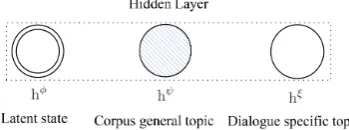
Figure 1: Hidden layer that consists of different types of latent variables
corre-sponds to the latent state “Time Information”. However, by carefully examining words in dia-logues we can observe that not all words are gener-ated from the latent states (Ritter et al., 2010; Zhai and Williams, 2014). There are some words rele-vant to a global or background topic shared across dialogues. For example, “about” and “that” be-long to a global (general English) topic. Some other words in a dialogue may be strongly re-lated to the dialogue specific topic. For exam-ple, “cake”, “toast” and “pizza” may appear in a Twitter dialogue with respect to a specific topic, “food”. From the perspective of generative model, we can also consider that words in a dialogue are generated by the mixture model of latent states, a global/background topic, and a dialogue specific topic. Therefore, there are three kinds of units in the hidden layer of our proposed model, which are displayed in Figure 1. hφ is a softmax unit, which indicates the latent state for a utterance.hψ and hξ represent the general topic, and the dia-logue specific topic, respectively. For the visible layer, we utilize the softmax units to model words in each utterance, which is the same with the ap-proach in RSM (Hinton and Salakhutdinov, 2009). In Section 3.2, We propose a basic model based on Boltzmann machine to formulate each word in ut-terances of dialogues.
A dialogue can be abstractly viewed as a se-quence of latent states in a certain reasonable or-der. Therefore, formulating the dependency be-tween latent states is another import issue for dia-logue structure analysis. In our model, we assume that each utterance’s latent state is dependent on its two neighbours. So there exist connections be-tween each pair of adjacent hidden softmax units in the hidden layer. The details of the model will be presented in Section 3.3.
3.2 HSM: Hidden Softmax Model
Notation Explanation
K dictionary size
J number of latent states
V observed visibles representing words in dialogues b bias term ofV
hφ latent variables representing latent states
hψ latent variable representing corpus general topic
hξ latent variables representing dialogue specific topics
aφ bias terms ofhφ
aψ bias term ofhψ
aξ bias terms ofhξ
Wφ weights connectinghφtoV
Wψ weights connectinghψtoV
Wξ weights connectinghξtoV
F,Fs,Fe weights between hidden softmax units
Table 1: Definition of notations.
Words of utterance 1
... ... ...
Words of utterance 2 Words of utterance 3
[image:3.595.314.518.62.282.2]Utterance 1 Utterance 2 Utterance 3
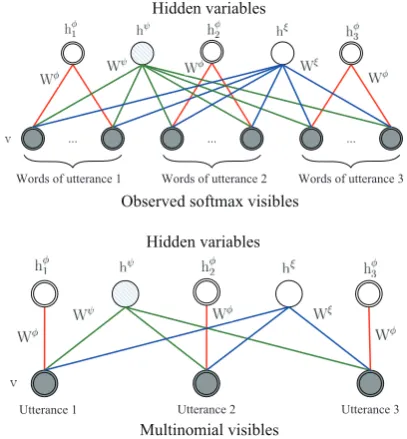
Figure 2: Hidden Softmax Model. The bottom layer are softmax visible units and the top layer consists of three types of hidden units: softmax hidden units used for representing latent states, a binary stochastic hidden unit used for represent-ing the dialogue specific topic, and a special bi-nary stochastic hidden unit used for representing corpus general topic. Upper: The model for a di-alogue session containing three utterances. Con-nection lines in the same color related to a latent state represent the same weight matrix. Lower: A different interpretation of the Hidden Softmax Model, in whichDr visible softmax units in the
rth utterance are replaced by one single multino-mial unit which is sampledDrtimes.
Table 1 summarizes important notations utilized in this paper. Before introducing the ultimate learning model for dialogue structure analysis, we firstly discuss a simplified version, Hidden Soft-max Model (HSM), which is based on Boltzmann machine and assumes that the latent variables are independent given visible units. HSM has a two-layer architecture as shown in Figure 2. The en-ergy of the state{V,hφ,hψ,hξ}is defined as fol-lows:
E(V,hφ,hψ,hξ) = ¯E
φ(V,hφ) + ¯Eψ(V,hψ)
+ ¯Eξ(V,hξ) +C(V),
(1)
where E¯φ(V,hφ), E¯ψ(V,hψ) and E¯ξ(V,hξ) are sub-energy functions related to hidden variables
[image:3.595.81.282.611.745.2]number of words in the rth utterance), and R is the number of utterances in the a dialogue.
For each utterance vr(r = 1, .., R) in the dia-logue session we have a hidden variable vectorhφr (with size ofJ ) as a latent state of the utterance, the sub-energy functionE¯φ(V,hφ)is defined by
¯
Eφ(V,hφ) =− R X r=1 J X j=1 Dr X i=1 K X k=1
hφrjWrjikφ vrik
− R X r=1 J X j=1 hφ
rjaφrj,
(2)
wherevrik= 1means theithvisible unitvriin the
rthutterance takes onkthvalue,hφ
rj = 1means the
rthsoftmax hidden units takes onjthvalue, andaφ
rj is the corresponding bias. Wrjikφ is a symmetric interaction term between visible unitvrithat takes onkth value and hidden variable hφ
r that takes on
jthvalue.
The sub-energy function E¯ψ(V,hψ), related to the global general topic of the corpus, is defined by
¯
Eψ(V,hψ) =− R X r=1 Dr X i=1 K X k=1 hψWψ
rikvrik−hψaψ. (3)
The sub-energy functionE¯ξ(V,hξ)corresponds to the dialogue specific topic, and is defined by
¯
Eξ(V,hξ) =− R X r=1 Dr X i=1 K X k=1
hξWrikξ vrik−hξaξ. (4)
Wrikψ in Eq. (3) andWrikξ in Eq. (4) are two sym-metric interaction terms between visible units and the corresponding hidden units, which are similar toWrjikφ in (2);aψ andaξ are the corresponding biases.C(V)is defined by
C(V) =−XR
r=1 Dr X i=1 K X k=1
vrikbrik, (5)
wherebrikis the corresponding bias.
The probability that the model assigns to a vis-ible binary matrix V = {v1, v2, ..., vD} (where
D=PRr=1Dris the dialogue session size) is
P(V) = 1Z X
hφ,hψ,hξ
exp(−E(V,hφ,hψ,hξ))
Z=X
V
X
hφ,hψ,hξ
exp(−E(V,hφ, hψ,hξ), (6)
whereZis known as the partition function or nor-malizing constant.
In our proposed model, for each word in the document we use a softmax unit to represent it. For the sake of simplicity, assume that the order of words in an utterance is ignored. Therefore, all of these softmax units can share the same set of weights that connect them to hidden units, thus the visible bias term C(V) and the sub-energy func-tionsE¯φ(V,hφ),E¯ψ(V,hψ)andE¯ξ(V,hξ)in Eq. (1) can be redefined as follows:
¯
Eφ(V,hφ) =− R X r=1 J X j=1 K X k=1 hφ
rjWjkφvˆrk
−XR
r=1
(Dr J
X
j=1 hφ
rjaφj)
(7)
¯
Eψ(V,hψ) =− K
X
k=1 hψWψ
kˆvk−Dhψaψ (8)
¯
Eξ(V,hξ) =− K
X
k=1 hξWξ
kvˆk−Dhξaξ (9)
C(V) =−
K
X
k=1
ˆ
vkbk, (10)
whereˆvrk = PDi=1r vrik denotes the count for the
kthword in therthutterance of the dialogue,vˆ k = PR
r=1vˆrk is the count for thekth word in whole dialogue session. Dr and D (D = PRr=1Dr) are employed as the scaling parameters, which can make hidden units behave sensibly when dealing with dialogues of different lengths (Hinton and Salakhutdinov, 2009).
The conditional distributions are given by soft-max and logistic functions:
P(hφ
rj= 1|V) =
exp(PK
k=1Wjkφvˆrk+Draφj)
PJ
j0=1exp(PKk=1Wjφ0kˆvrk+Draφj0)
(11)
P(hψ= 1|V) =σ(XK
k=1 Wψ
kvˆk+Daψ) (12)
P(hξ= 1|V) =σ(XK
k=1 Wξ
kvˆk+Daξ) (13)
P(vrik= 1|hφ,hψ,hξ) =
exp(PJ
j=1hφrjWjkφ +hψWkψ+hξWkξ+bk)
PK
k0=1exp(PJj=1hφrjWjkφ0+hψWkψ0+hξWkξ0+bk0),
3.3 HSSM: Hidden Softmax Sequence Model
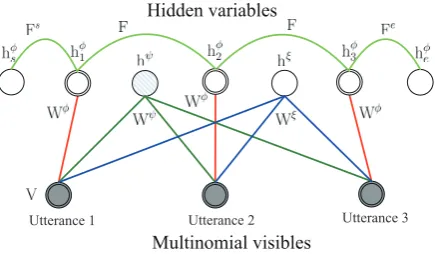
In this section, we consider the dependency be-tween the adjacent latent states of utterances, and extend the HSM to hidden softmax sequence model (HSSM), which is displayed in Figure 3. We define the energy of the state {V,hφ,hψ,hξ} in HSSM as follows:
E(V,hφ,hψ,hξ) = ¯E
φ(V,hφ) + ¯Eψ(V,hψ) + ¯Eξ(V,hξ)
+C(V) + ¯EΦ(hφ,hφ),
(15) where C(V), E¯φ(V,hφ), E¯ψ(V,hψ) and
¯
Eξ(V,hξ) are the same with that in HSM. The last term E¯Φ(hφ,hφ) is utilized to formulate
the dependency between latent variables hφ, which is defined as follows:
¯
EΦ(hφ,hφ) =− J
X
q=1
hφsFqshφ1q− J
X
q=1
hφRqFqehφe
−
R−1 X
r=1 J
X
j=1 J
X
q=1 hφ
rjFjqhφr+1,q,
(16)
wherehφs andhφe are two constant scalar variables (hφs ≡ 1, hφe ≡ 1), which represent the virtual beginning state unit and ending state unit of a di-alogue. Fs is a vector with size J, and its ele-ments measure the dependency between hφs and the latent softmax units of the first utterance. Fe also contains J elements, and in contrast to Fs,
Fe represents the dependency measure between
hφe and the latent softmax units of the last utter-ance.F is a symmetric matrix for formulating de-pendency between each two adjacent hidden units pair(hφr, hφr+1),r= 1, ..., R−1.
[image:5.595.73.291.572.699.2]Utterance 1 Utterance 2 Utterance 3
Figure 3: Hidden softmax sequence model. A con-nection between each pair of adjacent hidden soft-max units is added to formulate the dependency between the two corresponding latent states.
3.4 Parameter Learning
Exact maximum likelihood learning in the pro-posed model is intractable. “Contrastive Diver-gence” (Hinton, 2002) can be used for HSM’s learning, however, it can not be utilized for HSSM, because the hidden-to-hidden interaction term,
{F, Fs, Fe}, result in the intractability when ob-taining exact samples from the conditional distri-bution P(hφrj = 1|V), r = [1, R], j ∈ [1, J]. We use the mean-field variational inference (Hin-ton and Zemel, 1994; Neal and Hin(Hin-ton, 1998; Jordan et al., 1999) and a stochastic approxima-tion procedure (SAP) (Tieleman, 2008) to esti-mate HSSM’s parameters. The variational learn-ing is utilized to get the data-dependent expecta-tions, and SAP is utilized to estimate the model’s expectation. The log-likelihood of the HSSM has the following variational lower bound:
logP(V;θ)≥X
h
Q(h) logP(V,h;θ) +H(Q). (17)
Q(h) can be any distribution of h in theory.
θ = {Wφ, Wψ, Wξ, F, Fs, Fe} (the bias terms are omitted for clarity) are the model parameters.
h = {hφ,hψ,hξ} represent all the hidden vari-ables. H(·) is the entropy functional. In varia-tional learning, we try to find parameters that min-imize the Kullback-Leibler divergences between
Q(h) and the true posterior P(h|V;θ). A naive mean-field approach can be chosen to obtain a fully factorized distribution forQ(h):
Q(h) =
"R Y
r=1 q(hφ)
#
q(hψ)q(hξ), (18)
where q(hφrj = 1) = µrjφ, q(hψ = 1) = µψ,
q(hξ = 1) = µξ. µ = {µφ, µψ, µξ} are the pa-rameters ofQ(h). Then the lower bound on the log-probabilitylogP(V;θ)has the form:
logP(V;θ)≥ −E¯φ(V, µφ)−E¯ψ(V, µψ)−E¯ξ(V, µξ)
−C(V)−E¯Φ(µφ, µφ)−logZ,
(19) where E¯φ(V, µφ), E¯ψ(V, µψ), E¯ξ(V, µξ), and
¯
EΦ(µφ, µφ)have the same forms, by replacingµ
withh, as Eqs. (7), (8), (9), and (16), respectively. We can maximize this lower bound with respect to parametersµfor fixedθ, and obtain the mean-field fixed-point equations:
µφ rj=
exp(PK
k=1Wjkφˆvrk+Draφj+Dprevj +Djnext−1)
PJ
j0=1exp(PKk=1Wjφ0kˆvrk+Draφj0+Dprevj0 +Djnext0 −1)
,
µψ=σ(XK
k=1 Wψ
kvˆk+Daψ) (21)
µξ=σ(XK
k=1 Wξ
kvˆk+Daξ), (22)
whereDprevj andDnextj are two terms relevant to the derivative of the RHS of Eq. (19) with respect toµφrj, defined by
Dprevj =
Fs
j, r= 1
PJ
q=1µφr−1,qFqj, r >1
Dnextj =
PJ
q=1Fjqµφr+1,q, r < R.
Fe j, r=R
The updating ofµcan be carried out iteratively until convergence. Then,(V,µ)can be considered as a special “state” of HSSM, thus the SAP can be applied to update the model’s parameters, θ, for fixed(V,µ).
4 Experiments and Discussions
It’s not easy to evaluate the performance of a dia-logue structure analysis model. In this study, we examined our model via qualitative visualization and quantitative analysis as done in (Ritter et al., 2010; Zhai and Williams, 2014). We implemented five conventional models to conduct an extensive comparing study on the two corpora: Twitter-Post and AirTicketBooking. Conventional models in-clude: LMHMM (Chotimongkol, 2008), LMH-MMS (Ritter et al., 2010), TMHMM, TMHLMH-MMS, and TMHMMSS (Zhai and Williams, 2014). In our experiments, for each corpus we randomly se-lect 80% dialogues for training, and use the rest 20% for testing. We select three different num-ber (10, 20 and 30) of latent states to evaluate all the models. In TMHMM, TMHMMS and TMH-MMSS, the number of “topics” in the latent states and a dialogue is a hyper-parameter. We con-ducted a series of experiments with varying num-bers of topics, and the results illustrated that 20 is the best choice on the two corpora. So, for all the following experimental results of TMHMM, TMHMMS and TMHMMSS, the corresponding topic configurations are set to 20.
The number of estimation iterations for all the models on training sets is set to 10,000; and on held-out test sets, the numver of iterations for in-ference is set to 1000. In order to speed-up the
learning of HSSM, datasets are divided into mini-batches, each has 15 dialogues. In addition, the learning rate and momentum are set to 0.1 and 0.9, respectively.
4.1 Qualitative Evaluation
Dialogues in Twitter-Post always begin with three latent states: broadcasting what they (Twitter users) are doing now (“Status”), broadcasting an interesting link or quote to their followers (“Ref-erence Broadcast”), or asking a question to their followers (“Question to Followers”).2We find that
structures discoverd by HSSM and LMHMMS with 10 latent states are most reasonable to inter-pret. For example, after the initiating state (“Sta-tus”, “Reference Broadcast”, or “Question to Fol-lowers”), it was often followed a “Reaction” to “Reference Broadcast” (or “Status”), or a “Com-ment” to “Status”, or a “Question” to “Status” ( “Reference Broadcast”, or “Question to Follow-ers”’) etc. Compared with LMHMMS, besides ob-taining similar latent states, HSSM exhibits pow-erful ability in learning sequential dependency re-lationship between latent states. Take the follow-ing simple Twitter dialogue session as an example: :rt i like katy perry lt lt we see tht lol
:lol gd morning :lol gd morning how u :i’m gr8 n urself
:i’m good gettin ready to head out :oh ok well ur day n up its cold out here ...
LMHMMS labelled the second utterance (“lol gd morning ”) and the third utterance (“lol good morning how u” ) into the same latent state, while HSSM treats them as two different latent states (Though they both have almost the same words). The result is reasonable: the first “gd morning” is a greeting, while the second “gd morning” is a re-sponse.
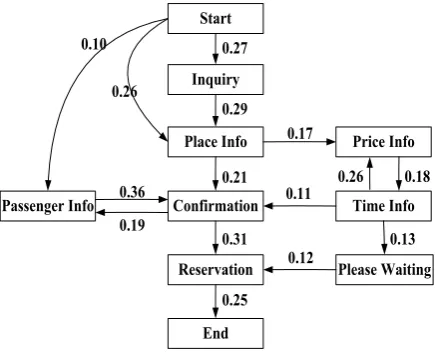
For AirTicketBooking dataset, the state-transition diagram generated with our model under the setting of 10 latent states is presented in Figure 4. And several utterance examples corresponding to the latent staes are also showed in Table 2. In general, conversations begin with sever agent’s short greeting, such as “Hi, very glad to be of service.”, and then transit to checking the passenger’s identity information or
inquiring the passenger’s air ticket demand; or it’s directly interrupted by the passenger with booking demand which is always associated with place information. After that, conversations are carried out with other booking related issues, such as checking ticket price or flight time.
The flowchart produced by HSSM can be rea-sonably interpreted with knowledge of air ticket booking domain, and it most consistent with the agent’s real workflow of the Ticket Booking Cor-poration3compared with other models. We notice
that conventional models can not clearly distin-guish some relevant latent states from each other. For example, these baseline models always con-found the latent state “Price Info” with the latent state “Reservation”, due to certain words assigned large weights in the two states, such as “打折
(dis-count)”, and “信用卡 (credit card)” etc.
Further-more, Only HSSM and LMHMMS have dialogue specific topics, and experimental results illustrate that HSSM can learn much better than LMHMMS which always mis-recognize corpus general words as belonging to dialogue specific topic (An exam-ple is presented in Table 3).
Please Waiting Confirmation
Inquiry Start
Place Info Price Info
Time Info Passenger Info
End Reservation
0.27
0.29 0.10
0.26
0.21 0.36
0.19
0.17
0.26 0.18
0.31
0.25 0.12 0.11
0.13
Figure 4: Transitions between latent states on AirTicketBooking generated by our HSSM model under the setting ofJ = 10latent states. Transi-tion probability cut-off is 0.10.
4.2 Quantitative Evaluation
For quantitative evaluation, we examine HSSM and traditional models with log likelihood and an ordering task on the held-out test set of Twitter-Post and AirTicketBooking.
3We hide the corporation’s real name for privacy reasons.
Latent States Utterance Examples Utterance Examples (Chinese) (English Translation)
Start 您好,很高兴为您服务。 Hello, very glad to be of service.
Inquiry 您想预定机票吗? Do you want to make a flight
reservation? Place Info 我想预定一张北京到上海的
机票。
I want to book an air ticket from Beijing to Shanghai. Time Info 明天上午10点左右。 Tomorrow morning, about 10
o’clock.
Price Info 成人机票1300元一张。 The adult ticket is 1300 Yuan.
Passenger Info 姓 名李东, 身份证
号12345。 My name is Li Dong, and my IDnumber is 12345. Confirmation 好的,可以。 Yes, that’s OK.
Please Waiting 请稍等,我帮您查询。 Please wait a moment, I’ll check
for you. Reservation 请预定一张,我想用信用卡
[image:7.595.308.535.61.193.2]支付。 Please make a reservation, I wantto use a credit card to pay. End 欢迎下次来电,再见。 Welcome to call next time. Bye.
Table 2: Utterance examples of latent states dis-covered by our model.
Model Top Words
HSSM 十ten o’clock, Dong Li (name), Fuzhou (city), Xiamen点,李东,福州,厦门,上航, ... (city), Shanghai Airlines, ...
LMHMMS 有have, ten o’clock, er, Dong Li (name), reserve, ...,十点,额,李东,预留, ...
Table 3: One example of dialogue specific topic learned on the same dialogue session with HSSM and LMHMMS, respectively.
[image:7.595.73.291.405.581.2]Log Likelihood The likelihood metric mea-sures the probability of generating the test set us-ing a specified model. The likelihood of LMHMM and TMHMM can be directed computed with the forward algorithm. However, since likelihoods of LMHMMS, TMHMMS and TMHMMSS are in-tractable to compute due to the local dependen-cies with respect to certain latent variables, Chib-style estimating algorithms (Wallach et al., 2009) are employed in our experiments. For HSSM, the partition function is a key problem for calculating the likelihood, and it can be effectively estimated by Annealed Importance Sampling (AIS) (Neal, 2001; Salakhutdinov and Murray, 2008).
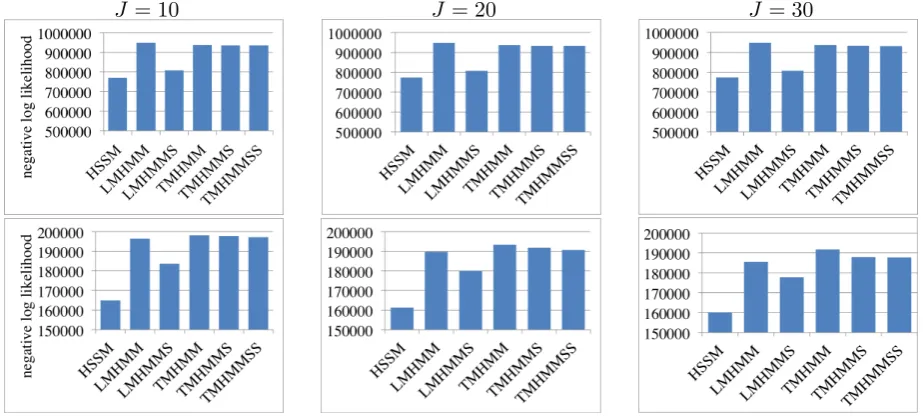
Figure 5 presents the likelihood of different models on the two held-out datasets. We can ob-serve that HSSM achieves better performance on likelihood than all the other models under different number of latent states. On Twitter-Post dataset our model slightly surpasses LMHMMS, and it performs much better than all traditional models on AirTicketBooking dataset.
Ordering Test Following previous work (Barzilay and Lee, 2004; Ritter et al., 2010; Zhai and Williams, 2014), we utilize Kendall’s
J = 10 J = 20 J = 30
Figure 5: Negative log likelihood (smaller is better) on held-out datasets of Twitter-Post (upper) and AirTicketBooking (lower) under different number of latent statesJ.
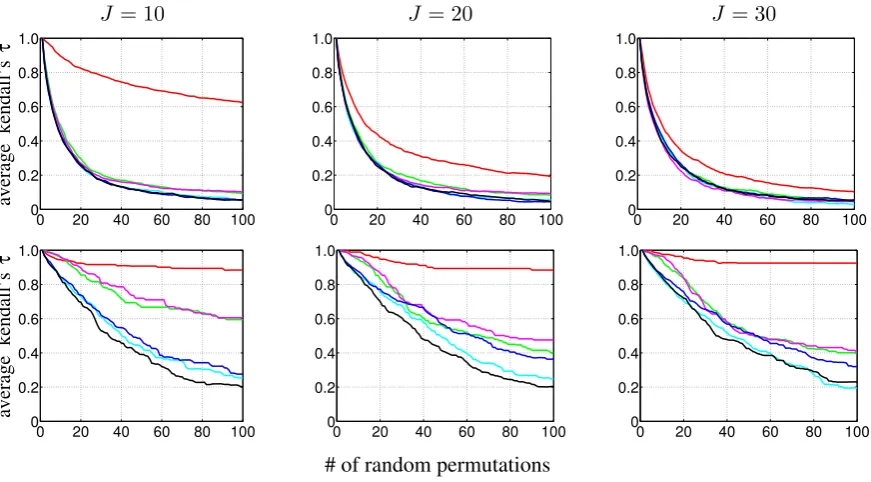
ordering). This is the basic idea: for each dialogue session withnutterances in the test set, we firstly generate all n! permutations of the utterances; then evaluate the probability of each permutation, and measure the similarity, i.e. Kendall’s τ, between the max-probability permutation and the original order; finally, we average τ values for all dialogue sessions as the model’s ordering test score. As pointed out by Zhai et al. (2014), it’s however infeasible to enumerate all possible permutations of dialogue sessions when the number of utterances in large. In experiments, we employ the incrementally adding permutation strategy, as used by Zhai et al. (2014), to build up the permutation set. The results of ordering test are presented in Figure 6. We can see that HSSM exhibits better performance than all the other models. For the conventional models, it is interesting that LMHMMS, TMHMMS and TMHMMSS achieve worse performances than LMHMM and TMHMM. This is likely because the latter two models allow words to be emitted only from latent states (Zhai and Williams, 2014), while the former three models allow words to be generated from additional sources. This also implies HSSM’s effectiveness of modeling distinct information uderlying dialogues.
4.3 Discussion
The expermental results illustrate the effective-ness of the proposed undirected dialogue struc-ture analysis model based on Boltzmann machine.
The conducted experiments also demonstrate that undirected models have three main merits for text modeling, which are also demonstrated by Hinton and Salakhutdinov (2009), Srivastava et al. (2013) through other tasks. Boltzmann machine based undirected models are able to generalize much bet-ter than traditional directed generative model; and model learning is more stable. Besides, an undi-rected model is more suitable for describing com-plex dependencies between different kinds of vari-ables.
J = 10
0 20 40 60 80 100 0
0.2 0.4 0.6 0.8 1.0
average kendall’s
τ
J = 20
0 20 40 60 80 100 0
0.2 0.4 0.6 0.8 1.0
J = 30
0 20 40 60 80 100 0
0.2 0.4 0.6 0.8 1.0
0 20 40 60 80 100 0
0.2 0.4 0.6 0.8 1.0
average kendall’s
τ
0 20 40 60 80 100 0
0.2 0.4 0.6 0.8 1.0
# of random permutations
0 20 40 60 80 100 0
0.2 0.4 0.6 0.8 1.0
[image:9.595.82.518.60.301.2]0.1 0.2 0.3 0.4 0.5 0.6 0.7 0.8 0.9 HSSM LMHMM LMHMMS TMHMM TMHMMS TMHMMSS
Figure 6: Average Kendall’sτ measure (larger is better) on held-out datasets of Twitter-Post (upper) and AirTicketBooking (lower) under different number of latent statesJ.
topics always represent some special information, such as the personal information, including name, phone number, birthday, etc. In summary, each di-alogue specific topic reflects special information which is different from other dialogues.
The three models, TMHMM, TMHMMS and TMHMMSS, which do not include dialogue spe-cific topics, should be utilized on the task-oriented domain dataset, in which each dialogue has little special or personnal information. For example, the three models perform well on the the BusTime and TechSupport datasets (Zhai and Williams, 2014), in which name entities are all replaced by different semantic types (e.g. phone numbers are replaced by “<phone>”, E-mail addresses are replaced by “<email>”, etc).
5 Conclusions
We develope an undirected generative model, HSSM, for dialogue structure analysis, and exam-ine the effectiveness of our model on two different datasets, Twitter posts occurred in open-domain and task-oriented dialogues from airline ticket booking domain. Qualitative evaluations and quantitative experimental results demonstrate that the proposed model achieves better performance than state-of-the-art approaches. Compared with traditional models, the proposed HSSM has more powerful ability of discovering structures of latent
states and modeling different word sources, in-cluding latent states, dialogue specific topics and global general topic.
According to recent study (Srivastava et al., 2013), a deep network model exhibits much ben-efits for latent variable learning. A dialogue may actually have a hierarchy structure of latent states, therefore the proposed model can be extended to a deep model to capture more complex structures. Another possible way to extend the model is to consider modeling long distance dependency be-tween latent states. This may further improve the model’s performance.
Acknowledgments
We are grateful to anonymous reviewers for their helpful comments and suggestions. We would like to thank Alan Ritter for kindly providing the raw Twitter dataset.
References
James Allen, Nathanael Chambers, George Ferguson, Lucian Galescu, Hyuckchul Jung, Mary Swift, and William Taysom. 2007. Plow: A collaborative task learning agent. InProceedings of the National Con-ference on Artificial Intelligence, volume 22, page 1514. Menlo Park, CA; Cambridge, MA; London; AAAI Press; MIT Press; 1999.
Regina Barzilay and Lillian Lee. 2004. Catching the drift: Probabilistic content models with applications to generation and summarization. In proceedings of HLT-NAACL 2004, pages 113–120.
Ananlada Chotimongkol. 2008. Learning the structure of task-oriented conversations from the corpus of in-domain dialogs. Ph.D. thesis, SRI International. William W Cohen, Vitor R Carvalho, and Tom M
Mitchell. 2004. Learning to classify email into“speech acts”. InEMNLP, pages 309–316. Nigel Crook, Ramon Granell, and Stephen Pulman.
2009. Unsupervised classification of dialogue acts using a dirichlet process mixture model. In Proceed-ings of the SIGDIAL 2009 Conference: The 10th An-nual Meeting of the Special Interest Group on Dis-course and Dialogue, pages 341–348. Association for Computational Linguistics.
Geoffrey E Hinton and Ruslan R Salakhutdinov. 2009. Replicated softmax: an undirected topic model. In Advances in neural information processing systems, pages 1607–1614.
Geoffrey E Hinton and Richard S Zemel. 1994. Autoencoders, minimum description length, and helmholtz free energy. Advances in neural informa-tion processing systems, pages 3–3.
Geoffrey E Hinton. 2002. Training products of experts by minimizing contrastive divergence. Neural com-putation, 14(8):1771–1800.
Minwoo Jeong, Chin-Yew Lin, and Gary Geunbae Lee. 2009. Semi-supervised speech act recognition in emails and forums. InProceedings of the 2009 Con-ference on Empirical Methods in Natural Language Processing: Volume 3-Volume 3, pages 1250–1259. Association for Computational Linguistics.
Michael I Jordan, Zoubin Ghahramani, Tommi S Jaakkola, and Lawrence K Saul. 1999. An intro-duction to variational methods for graphical models. Machine learning, 37(2):183–233.
Maurice G Kendall. 1938. A new measure of rank correlation. Biometrika, 30(1/2):81–93.
Jingjing Liu, Stephanie Seneff, and Victor Zue. 2010. Dialogue-oriented review summary generation for spoken dialogue recommendation systems. In Hu-man Language Technologies: The 2010 Annual Conference of the North American Chapter of the Association for Computational Linguistics, pages 64–72. Association for Computational Linguistics.
Gabriel Murray, Steve Renals, Jean Carletta, and Jo-hanna Moore. 2006. Incorporating speaker and discourse features into speech summarization. In Proceedings of the main conference on Human Lan-guage Technology Conference of the North Amer-ican Chapter of the Association of Computational Linguistics, pages 367–374. Association for Com-putational Linguistics.
Radford M Neal and Geoffrey E Hinton. 1998. A view of the em algorithm that justifies incremental, sparse, and other variants. InLearning in graphical models, pages 355–368. Springer.
Radford M Neal. 2001. Annealed importance sam-pling. Statistics and Computing, 11(2):125–139. Alan Ritter, Colin Cherry, and Bill Dolan. 2010.
Un-supervised modeling of twitter conversations. Ruslan Salakhutdinov and Iain Murray. 2008. On the
quantitative analysis of deep belief networks. In Proceedings of the 25th international conference on Machine learning, pages 872–879. ACM.
Nitish Srivastava, Ruslan R Salakhutdinov, and Geof-frey E Hinton. 2013. Modeling documents with deep boltzmann machines. UAI.
Tijmen Tieleman. 2008. Training restricted boltz-mann machines using approximations to the likeli-hood gradient. InProceedings of the 25th interna-tional conference on Machine learning, pages 1064– 1071. ACM.
Hanna M Wallach, Iain Murray, Ruslan Salakhutdinov, and David Mimno. 2009. Evaluation methods for topic models. InProceedings of the 26th Annual In-ternational Conference on Machine Learning, pages 1105–1112. ACM.
Yorick Wilks. 2006. Artificial companions as a new kind of interface to the future internet.
Steve J Young. 2006. Using pomdps for dialog man-agement. InSLT, pages 8–13.