A Study of Convolution Tree Kernel with Local Alignment
Lidan Zhang
Department of Computer Science HKU, Hong Kong
Kwok-Ping Chan
Department of Computer Science HKU, Hong Kong
Abstract
This paper discusses a new convolu-tion tree kernel by introducing local alignments. The main idea of the new kernel is to allow some syntactic al-ternations during each match between subtrees. In this paper, we give an algorithm to calculate the composite kernel. The experiment results show promising improvements on two tasks: semantic role labeling and question classification.
1 Introduction
Recently kernel-based methods have become a state-of-art technique and been widely used in natural language processing applications. In this method, a key problem is how to de-sign a proper kernel function in terms of dif-ferent data representations. So far, there are two kinds of data representations. One is to encode an object with a flat vector whose ele-ment correspond to an extracted feature from the object. However the feature vector is sen-sitive to the structural variations. The ex-traction schema is heavily dependent on dif-ferent problems. On the other hand, kernel function can be directly calculated on the ob-ject. The advantages are that the original topological information is to a large extent preserved and the introduction of additional noise may be avoided. Thus structure-based kernels can well model syntactic parse tree in a variety of applications, such as relation extraction(Zelenko et al., 2003), named en-tity recognition(Culotta and Sorensen, 2004), semantic role labeling(Moschitti et al., 2008) and so on.
To compute the structural kernel function, Haussler (1999) introduced a general type of kernel function, called“ Convolution kernel”. Based on this work, Collins and Duffy (2002) proposed a tree kernel calculation by count-ing the common subtrees. In other words, two trees are considered if and only if these two trees are exactly same. In real sentences, some structural alternations within a given phrase are permitted without changing its us-age. Therefore, Moschitti (2004) proposed partial trees to partially match between sub-trees. Kashima and Koyanagi (2002) general-ize the tree kernel to labeled order tree kernel with more flexible match. And from the idea of introducing linguistical knowledge, Zhang et al. (2007) proposed a grammar-driven tree kernel, in which two subtrees are same if and only if the corresponding two productions are in the same manually defined set. In addi-tion, the problem of hard matching can be al-leviated by processing or mapping the trees. For example, Tai mapping (Kuboyama et al., 2006) generalized the kernel from counting subtrees to counting the function of mapping. Moreover multi-source knowledge can benefit kernel calculation, such as using dependency information to dynamically determine the tree span (Qian et al., 2008).
Another problem in Collins and Duffy’s tree kernel is context-free. It does not con-sider any semantic information located at the leaf nodes of the parsing trees. To lexicalized tree kernel, Bloehdorn et al. (2007) consid-ered the associated term similarity by virtue of WordNet. Shen et al. (2003) constructed a separate lexical feature containing words on a given path and merged into the kernel in linear combination.
The paper is organized as follows. In sec-tion 2, we describe the commonly used tree kernel. In section 3, we propose our method to make use of the local alignment informa-tion in kernel calculainforma-tion. Secinforma-tion 4 presents the results of our experiments for two differ-ent applications ( Semantic Role Labeling and Question Classification). Finally section 5 provides our conclusions.
2 Convolution Tree Kernel
The main idea of tree kernel is to count the number of common subtrees between two trees T1 and T2. In convolutional
tree kernel (Collins and Duffy, 2002), a tree(T) is represented as a vector h(T) = (h1(T), ..., hi(T), ..., hn(T)), where hi(T) is the number of occurrences of theithtree frag-ment in the treeT. Since the number of sub-trees is exponential with the parse tree size, it is infeasible to directly count the common subtrees. To reduce the computation complex-ity, a recursive kernel calculation algorithm was presented. Given two treesT1 andT2,
K(T1, T2) = < h(T1), h(T2)> (1)
= X
i
hi(T1)hi(T2)
= X
i
( X
n1∈NT1 Ii(n1)
X
n2∈NT2
Ii(n2))
= X
n1∈NT1
X
n2∈NT2
4(n1, n2)
where,NT1andNT2 are the sets of all nodes in
treesT1 andT2, respectively.Ii(n)is the indi-cator function to be 1 ifi-th subtree is rooted at noden and 0 otherwise. And 4(n1, n2)is
the number of common subtrees rooted at n1
andn2. It can be computed efficiently
accord-ing to the followaccord-ing rules:
(1) If the productions atn1 andn2are
differ-ent,4(n1, n2) = 0
(2) If the productions atn1 andn2 are same,
and n1 and n2 are pre-terminals, then
4(n1, n2) =λ
(3) Else, 4(n1, n2) = λ
Qnc(n1)
j (1 + 4(ch(n1, j), ch(n2, j)))
where nc(n1) is the number of children of
n1 in the tree. Note that n1 = n2
be-cause the productions atn1 and n2 are same.
ch(n1, j) represents the jth child of node
n1. And 0 < λ ≤ 1 is the parameter
to downweight the contribution of larger tree fragments to the kernel. It corresponds to
K(T1, T2) =
P
iλsizeihi(T1)hi(T2), where
sizei is the number of rules in the i’th frag-ment. The time complexity of computing this kernel isO(|NT1| · |NT2|).
3 Tree Kernel with Local Alignment 3.1 General Framework
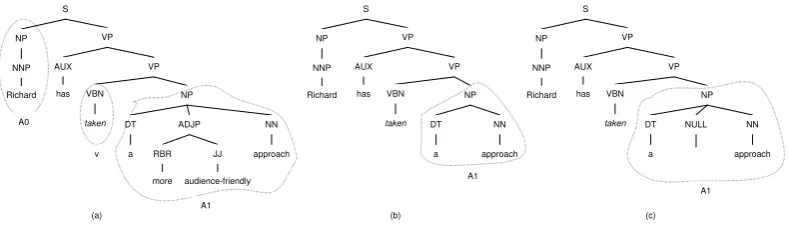
As we referred, one of problems in the ba-sic tree kernel is its hard match between two rules. In other words, at each tree level, the two subtrees are required to be perfectly equal. However, in real sentences, some modifiers can be added into a phrase with-out changing the phrase’s function. For ex-ample, two sentences are given in Figure 1. Considering “A1” role, the similarities be-tween two subtrees(in circle) are 0 in (Collins and Duffy, 2002), because the productions “NP→DT ADJP NN” and “NP→DT NN” are not identical. From linguistical point of view, the adjective phrase is optional in real sentences, which does not change the corre-sponding semantic role. Thus the modifier components(like “ADJP” in the above exam-ple) should be neglected in similarity compar-isons.
S
NP
NNP
Richard
VP
VP AUX
has VBN
taken
NP
DT
a
NN
approach ADJP
RBR more
JJ audience-friendly
S
NP
NNP
Richard
VP
VP AUX
has VBN
taken
NP
DT
a NN
approach
S
NP
NNP
Richard
VP
VP AUX
has VBN
taken
NP
DT
a
NN
approach NULL
v A0
A1
A1
A1
[image:3.595.100.495.68.183.2](a) (b) (c)
Figure 1: Syntactic parse tree with “A1” semantic role
an alignment might be “DT ADJP NN” vs “DT - NN”, by inserting a symbol(-). The symbol(-) corresponds to a “NULL” subtree in the parser tree. And the “NULL” subtree can be regarded as a null character in the sen-tence, see Figure 1(c).
Convolution kernels, studied in (Haussler, 1999) gave the framework to construct a com-plex kernel from its simple elements. Suppose
x ∈ X can be decomposed intox1, ..., xm ≡
~x. LetRbe a relation overX1×...×Xm×X such that R(~x) is true iff x1, ..., xm are parts of x. R−1(x) = {~x|R(~x, x)}, which returns
all components. For example,xis any string, then~xcan be its characters. The convolution kernelK is defined as:
K(x, y) = X
~x∈R−1(x),~y∈R−1(y)
m
Y
d=1
Kd(xd, yd)
(2) Considering our problem, for example, a derived string sequence xby the rule “n1 →
x”. R(xi, x)is true iffxi appears in the right hand of x. Given two POS sequences x and
y derived from two nodesn1 and n2,
respec-tively, A(x, y)denotes all the possible align-ments of the sequence. The general form of the kernel with local alignment is defined as:
K0(n
1, n2) =
X
(i,j)∈A(x,y)
K(ni
1, nj2) (3)
40(n1, n2) = λ
X
(i,j)∈A(x,y)
AS(i,j)
ncY(n1,i)
d=1
(1 +40(ch(n
1, i, d), ch(n2, j, d))
where, (i, j)denotes the ith andjth variation forxandy,AS(i,j)is the score for alignmenti
andj. Andch(n1, i, d)selects thedth subtree
for theithaligned schema of noden
1.
It is easily to prove the above kernel is pos-itive semi-definite, since the kernelK(ni
1, nj2)
is positive semi-definite. The native computa-tion is impractical because the number of all possible alignments(|A(x, y)|) is exponential with respect to |x| and |y|. In the next sec-tion, we will discuss how to calculateAS(i,j)
for each alignment.
3.2 Local Alignment Kernel
The local alignment(LA) kernel was usually used in bioinformatics, to compare the sim-ilarity between two protein sequences(x and
y) by exploring their alignments(Saigo et al., 2004).
KLA(x, y) =
X
π∈A(x,y)
expβs(x,y,π) (4)
whereβ ≥ 0is a parameter, A(x, y) denotes all possible local alignments betweenxandy, ands(x, y, π)is the local alignment score for a given alignment schema π, which is equal to:
s(x, y, π) =
|π|
X
i=1
S(xπi
1, yπ2i)−
|π|−X1
j=1
[g(πi+1
1 −π1i) +g(πi2+1−πi2)]
(5)
In equation( 5),Sis a substitution matrix, and
case that ‘-’ symbol is inserted. In natural lan-guage processing, the substitution matrix can be selected as identity matrix and no penalty is accounted.
Obviously, the direct computation of the original KLA is not practical. Saigo (2004) presented a dynamic programming algorithm with time complexityO(|x|·|y|). In this paper, this dynamic algorithm is used to compute the kernel matrix, whose element(i, j) is used as
AS(i,j)measurement in equation(3).
3.3 Local Alignment Tree Kernel
Now we embed the above local alignment score into the general tree kernel computation. Equation(3) can be re-written into following:
40(n1, n2) =λ
X
π∈A(x,y)
(expβs(x,y,π)×
ncY(n1,i)
k=1
(1 +40(ch(n1, i, k), ch(n2, j, k))))
(6) To further reduce the computation com-plexity, a threshold (ξ) is used to filter out alignments with low scores. This can help to avoid over-generated subtrees and only select the significant alignments. In other words, by using the threshold (ξ), we can select the salient subtree variations for kernels. The fi-nal kernel calculation is shown below:
40(n1, n2) = λ
X
π∈A(x, y) s(x, y, π)> ξ
(εβs(x,y,π)×
ncY(n1,i)
k=1
(1 +40(ch(n
1, i, k), ch(n2, j, k))))
(7) After filtering, the kernel is still positive semi-definite. This can be easily proved using the theorem in (Shin and Kuboyama, 2008), since this subset selection is transitive. More specifically, if s(x, y, π) > ξVs(y, z, π0) >
ξ, thens(x, z, π+π0)> ξ.
The algorithm to compute the local align-ment tree kernel is given in algorithm 1. For
any two nodes pair(xiandyj), the local align-ment scoreM(xi, yj)is assigned. In the ker-nel matrix calculation, the worst case occurs when the tree is balanced and most of the alignments are selected.
Algorithm 1 algorithm for local alignment tree kernel
Require: 2 nodes n1,n2 in parse trees;The
productions aren1 → x1, ..., xm andn2 →
y1, ..., yn return 40(n
1, n2)
ifn1andn2 are not samethen
40(n
1, n2) = 0
else
ifbothn1andn2 are pre-terminalsthen
40(n
1, n2) = 1
else
calculate kernel matrix by equation( 4) foreach possible alignment do
calculate40(n
1, n2)by equation(7)
end for end if end if
4 Experiments
4.1 Semantic Role Labeling 4.1.1 Experiment Setup
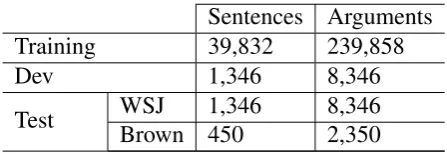
We use the CoNLL-2005 SRL shared task data(Carreras and Marquez, 2005) as our ex-perimental data. It is from the Wall Street Journal part of the Penn Treebank, together with predicate-arguments information from the PropBank. According to the shared task, sections 02-21 are used for training, section 24 for development and section 23 as well as some data from Brown corpus are left for test. The data sets are described in Table 1.
Sentences Arguments Training 39,832 239,858
Dev 1,346 8,346
Test WSJ 1,346 8,346
[image:4.595.306.530.668.745.2]Considering the two steps in semantic role labeling, i.e. semantic role identification and recognition. We assume identification has been done correctly, and only consider the semantic role classification. In our experi-ment, we focus on the semantic classes in-clude 6 core (A0-A5), 12 adjunct(AM-) and 8 reference(R-) arguments.
In our implementation, SVM-Light-TK1
(Moschitti, 2004) is modified. For SVM multi-classifier, the ONE-vs-ALL (OVA) strategy is selected. In all, we prepare the data for each semantic role (r) as following:
(1) Given a sentence and its correct full syn-tactic parse tree;
(2) LetP be the predicate. Its potential argu-mentsAare extracted according to (Xue and Palmer, 2004)
(3) For each pair < p, a >∈ P ×A: if a
covers exactly the words of semantic role of p, put minimal subtree< p, a > into positive example set (T+
r ); else put it in the negative examples (T−
r )
In our experiments, we setβ= 0.5.
4.1.2 Experimental Results
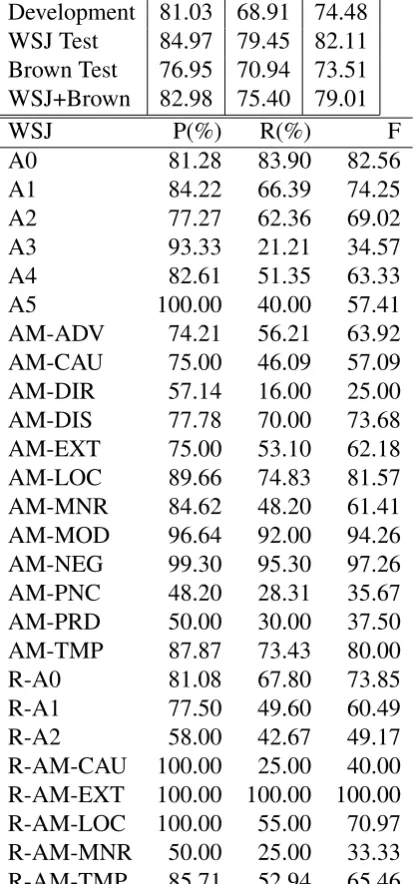
The classification performance is evalu-ated with respect to accuracy, precision(p), recall(r) andF1 = 2pr/(p+r).
Accuracy(%) (Collins and Duffy, 2002) 84.35
(Moschitti, 2004) 86.72
(Zhang et al., 2007) 87.96
[image:5.595.318.526.59.525.2]Our Kernel 88.48
Table 2: Performance comparison between different kernel performance on WSJ data
1http://dit.unitn.it/ moschitt/Tree-Kernel.htm
P(%) R(%) Fβ=1
Development 81.03 68.91 74.48 WSJ Test 84.97 79.45 82.11 Brown Test 76.95 70.94 73.51 WSJ+Brown 82.98 75.40 79.01
WSJ P(%) R(%) F
A0 81.28 83.90 82.56
A1 84.22 66.39 74.25
A2 77.27 62.36 69.02
A3 93.33 21.21 34.57
A4 82.61 51.35 63.33
A5 100.00 40.00 57.41
AM-ADV 74.21 56.21 63.92 AM-CAU 75.00 46.09 57.09 AM-DIR 57.14 16.00 25.00 AM-DIS 77.78 70.00 73.68 AM-EXT 75.00 53.10 62.18 AM-LOC 89.66 74.83 81.57 AM-MNR 84.62 48.20 61.41 AM-MOD 96.64 92.00 94.26 AM-NEG 99.30 95.30 97.26 AM-PNC 48.20 28.31 35.67 AM-PRD 50.00 30.00 37.50 AM-TMP 87.87 73.43 80.00
R-A0 81.08 67.80 73.85
R-A1 77.50 49.60 60.49
R-A2 58.00 42.67 49.17
[image:5.595.321.529.78.521.2] [image:5.595.78.288.624.699.2]R-AM-CAU 100.00 25.00 40.00 R-AM-EXT 100.00 100.00 100.00 R-AM-LOC 100.00 55.00 70.97 R-AM-MNR 50.00 25.00 33.33 R-AM-TMP 85.71 52.94 65.46 Table 3: top: overall performance result on data sets ; bottom: detail result on WSJ data
Table 2 compares the performance of our method and other three famous kernels on WSJ test data. We implemented these three methods with the same settings described in the papers. It shows that our kernel achieves the best performance with 88.48% accuracy. The advantages of our approach are: 1). the alignments allow soft syntactic structure match; 2). threshold can avoid over-generation and selected salient alignments.
Similarity Definition
Wu and Palmer simW U P(c1, c2) = d(c1,lso(c1,c2))+2d(depc2,lso(lso((cc11,c,c22))+2)) dep(lso(c1,c2))
Resnik simRES(c1, c2) = −logP(lso(c1, c2))
[image:6.595.108.488.61.129.2]Lin simLIN(c1, c2) = log2 logP(Pc1()+loglso(c1P,c(2c))2)
Table 4: popular semantic similarity measurements
4.2 Question Classification
4.2.1 Semantic-enriched Tree Kernel Another problem in the tree kernel (Collins and Duffy, 2002) is the lack of semantic in-formation, since the match stops at the pre-terminals. All the lexical information is en-coded at the leaf nodes of parsing trees. How-ever, the semantic knowledge is important in some text applications, like Question Classi-fication. To introduce semantic similarities between words into our kernel, we use the framework in Bloehdorn et al. (2007) and rewrite the rule (2) in the iterative tree kernel calculation(in section 2).
(2) If the productions at n1 and
n2 are same, and n1 and n2 are
pre-terminals, then 4(n1, n2) =
λαkw(w1, w2)
wherew1 andw2 are two words derived from
pre-terminalsn1 andn2, respectively, and the
parameter α is to control the contribution of the leaves. Note that each preterminal has one child or equally covers one word. So
kw(w1, w2) actually calculate the similarity
between two wordsw1 andw2.
In general, there are two ways to mea-sure the semantic similarities. One is to de-rive from semantic networks such as Word-Net (Mavroeidis et al., 2005; Bloehdorn et al., 2006). The other way is to use statisti-cal methods of distributional or co-occurrence ( ´O S´eaghdha and Copestake, 2008) behavior of the words.
WordNet2 can be regarded as direct graphs
semantically linking concepts by means of relations. Table 4 gives some similarity measures between two arbitrary concepts c1
2http://wordnet.princeton.edu/
and c2. For our application, the
word-to-word similarity can be obtained by maximiz-ing the correspondmaximiz-ing concept-based similar-ity scores. In our implementation, we use WordNet::Similarity package3(Patwardhan et
al., 2003) and the noun hierarchy of WordNet. In Table 4, depis the length of path from a node to its global root, lso(c1, c2) represents
the lowest super-ordinate of c1 and c2. The
detail definitions can be found in (Budanitsky and Hirst, 2006) .
As an alternative, Latent Semantic Anal-ysis(LSA) is a technique. It calculates the words similarities by means of occurrence of terms in documents. Given a term-by-document matrixX, its singular value decom-position is: X =UΣVT, whereΣis a diago-nal matrix with singular values in decreasing arrangement. The column of U are singular vectors corresponding to the individual singu-lar value. Then the latent semantic simisingu-larity kernel of termsti andtj is:
simLSA=< Uki(Ukj)T > (8) whereUk = IkU is to projectU onto its first
kdimensions. Ikis the identity matrix whose firstkdiagonal elements are 1 and all the other elements are 0. And Ui
k is the i-th row of the matrix Uk. From equation (8), the LSA-based similarity between two terms is the in-ner product of the two projected vectors. The details of LSA can be found in (Cristianini et al., 2002; Choi et al., 2001).
4.2.2 Experiment Results
In this set of experiment, we evaluate differ-ent types of kernels for Question Classifica-tion(QC) task. The duty of QC is to cat-egorize questions into different classes. In
Accuracy(%) 1000 2000 3000 4000 5500
BOW 77.1 83.3 87.2 87.3 89.2
TK 80.2 86.2 87.4 88.6 91.2
LATK 80.4 86.5 87.5 88.8 91.6
α = 1
[image:7.595.150.450.60.181.2]WUP 81.3 87.3 88.0 89.8 92.5 RES 81.0 87.1 87.9 89.5 92.2 LIN 81.1 87.0 88.0 89.3 92.4 LSA(k = 50) 80.8 86.9 87.8 89.3 91.7
Table 5: Classification accuracy of different kernels on different data sets
this paper we use the same dataset as intro-duced in(Li and Roth, 2002). The dataset is divided4 into 5500 questions for training and
500 questions from TREC 20 for testing. The total training samples are randomly divided into 5 subsets with sizes 1,000, 2,000, 3,000, 4,000 and 5,500 respectively. All the ques-tions are labeled into 6 coarse grained cate-gories and 50 fine grained catecate-gories: Abbre-viations (abbreviation and expansion), Entity (animal, body, color, creation, currency, med-ical, event, food, instrument, language, let-ter, plant, product, religion, sport, substance, symbol, technique, term, vehicle, word), De-scription (definition, deDe-scription, manner, rea-son), Human (description, group, individual, title), Location (city, country, mountain, state) and Numeric (code, count, date, distance, money, order, percent, period, speed, temper-ature, size, weight).
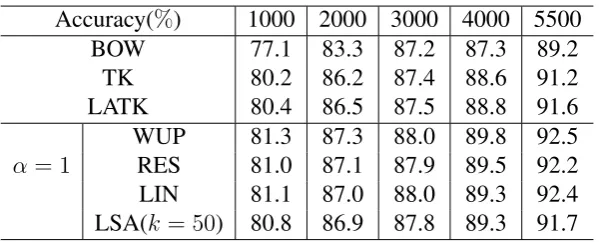
In this paper, we compare the linear ker-nel based on bag-of-word (BOW), the original tree kernel (TK), the local alignment tree ker-nel (section 3, LATK) and its correspondences with LSA similarity and a set of semantic-enriched LATK with different similarity met-rics.
To obtain the parse tree, we use Charniak parser5 for every question. Like the
previ-ous experiment, SVM-Light-TK software and the OVA strategy are implemented. In all ex-periments, we use the default parameter in SVM(e.g. margin parameter) and setα = 1. In LSA model, we set k = 50. Finally, we use multi-classification accuracy to evaluate
4http://l2r.cs.uiuc.edu/ cogcomp/Data/QA/QC/ 5ftp://ftp.cs.brown.edu/pub/nlparser/
the performance.
Table 5 gives the results of the experiments. We can see that the local alignment tree ker-nel increase the multi-classification accuracy of the basic tree kernel by about 0.4%. The introduction of semantic information further improves accuracy. Among WordNet-based metrics, “Wu and Palmer” metric achieves the best result, i.e. 92.5%. As a whole, the WordNet-based similarities perform better than LSA-based measurement.
5 Conclusion
In this paper, we propose a tree kernel calcula-tion by allowing local alignments. More flex-ible productions are considered in line with modifiers in real sentences. Considering text related applications, words similarities have been merged into the presented tree kernel. These similarities can be derived from dif-ferent WordNet-based metrics or document statistics. Finally experiments are carried on two different applications (Semantic Role La-beling and Question Classification).
For further work, we plan to study exploit-ing semantic knowledge in the kernel. A promising direction is to study the different effects of these semantic similarities. We are interested in some distributional similarities (Lee, 1999) given certain context. Also the effectivenss of the semantic-enriched tree ker-nel in SRL is another problem.
References
of feature similarity. InICDM ’06: Proceedings of the Sixth International Conference on Data Mining, pages 808–812, Washington, DC, USA. IEEE Com-puter Society.
Alexander Budanitsky and Graeme Hirst. 2006. Eval-uating wordnet-based measures of lexical semantic relatedness. Computational Linguistics, 32(1):13– 47.
X. Carreras and L. Marquez. 2005. Introduction to the conll-2005 shared task: Semantic role labeling. In
CoNLL ’05: Proceedings of the 9th Conference on Computational Natural Language Learning.
Freddy Y. Y. Choi, Peter Wiemer-hastings, and Johanna Moore. 2001. Latent semantic analysis for text segmentation. InIn Proceedings of EMNLP, pages 109–117.
Michael Collins and Nigel Duffy. 2002. New rank-ing algorithms for parsrank-ing and taggrank-ing: Kernels over discrete structures, and the voted perceptron. In
ACL, pages 263–270.
Nello Cristianini, John Shawe-Taylor, and Huma Lodhi. 2002. Latent semantic kernels. J. Intell. Inf. Syst., 18(2-3):127–152.
Aron Culotta and Jeffrey Sorensen. 2004. Dependency tree kernels for relation extraction. In ACL ’04: Proceedings of the 42nd Annual Meeting on Asso-ciation for Computational Linguistics, pages 423– 429, Morristown, NJ, USA. Association for Com-putational Linguistics.
David Haussler. 1999. Convolution kernels on discrete structures. Technical report.
Tetsuji Kuboyama, Kilho Shin, and Hisashi Kashima. 2006. Flexible tree kernels based on counting the number of tree mappings. InECML/PKDD Work-shop on Mining and Learning with Graphs.
Lillian Lee. 1999. Measures of distributional similar-ity. In37th Annual Meeting of the Association for Computational Linguistics, pages 25–32.
Xin Li and Dan Roth. 2002. Learning question clas-sifiers. In Proceedings of the 19th international conference on Computational linguistics, pages 1– 7, Morristown, NJ, USA. Association for Computa-tional Linguistics.
Dimitrios Mavroeidis, George Tsatsaronis, Michalis Vazirgiannis, Martin Theobald, and Gerhard Weikum. 2005. Word sense disambiguation for exploiting hierarchical thesauri in text classification. In Al´ıpio Jorge, Lu´ıs Torgo, Pavel Brazdil, Rui Camacho, and Gama Joao, editors, Knowledge discovery in databases: PKDD 2005 : 9th Eu-ropean Conference on Principles and Practice of Knowledge Discovery in Databases, volume 3721 ofLecture Notes in Computer Science, pages 181–192, Porto, Portugal. Springer.
Alessandro Moschitti, Daniele Pighin, and Roberto Basili. 2008. Tree kernels for semantic role label-ing. Comput. Linguist., 34(2):193–224.
Alessandro Moschitti. 2004. A study on convolution kernels for shallow semantic parsing. In ACL ’04: Proceedings of the 42nd Annual Meeting on Asso-ciation for Computational Linguistics, pages 335– 342, Morristown, NJ, USA. Association for Com-putational Linguistics.
Diarmuid ´O S´eaghdha and Ann Copestake. 2008. Se-mantic classification with distributional kernels. In
Proceedings of the 22nd International Conference on Computational Linguistics (Coling 2008), pages 649–656, Manchester, UK, August. Coling 2008 Or-ganizing Committee.
Siddharth Patwardhan, Satanjeev Banerjee, and Ted Pedersen. 2003. Using measures of semantic re-latedness for word sense disambiguation. InIn Pro-ceedings of the Fourth International Conference on Intelligent Text Processing and Computational Lin-guistics (CICLING-03), pages 241–257.
Longhua Qian, Guodong Zhou, Fang Kong, Qiaoming Zhu, and Peide Qian. 2008. Exploiting constituent dependencies for tree kernel-based semantic relation extraction. InProceedings of the 22nd International Conference on Computational Linguistics (Coling 2008), pages 697–704, Manchester, UK, August. Coling 2008 Organizing Committee.
Hiroto Saigo, Jean-Philippe Vert, Nobuhisa Ueda, and Tatsuya Akutsu. 2004. Protein homology detec-tion using string alignment kernels. Bioinformatics, 20(11):1682–1689.
Kilho Shin and Tetsuji Kuboyama. 2008. A gener-alization of haussler’s convolution kernel: mapping kernel. InICML, pages 944–951.
Nianwen Xue and Martha Palmer. 2004. Calibrat-ing features for semantic role labelCalibrat-ing. In Dekang Lin and Dekai Wu, editors,Proceedings of EMNLP 2004, pages 88–94, Barcelona, Spain, July. Associ-ation for ComputAssoci-ational Linguistics.
Dmitry Zelenko, Chinatsu Aone, and Anthony Richardella. 2003. Kernel methods for relation ex-traction. J. Mach. Learn. Res., 3:1083–1106.