Statistical Phrase Alignment Model
Using Dependency Relation Probability
Toshiaki Nakazawa Sadao Kurohashi
Graduate School of Informatics, Kyoto University Yoshida-honmachi, Sakyo-ku
Kyoto, 606-8501, Japan
[email protected] [email protected]
Abstract
When aligning very different language pairs, the most important needs are the use of struc-tural information and the capability of gen-erating one-to-many or many-to-many corre-spondences. In this paper, we propose a novel phrase alignment method which models word or phrase dependency relations in depen-dency tree structures of source and target lan-guages. The dependency relation model is a kind of tree-based reordering model, and can handle non-local reorderings which sequen-tial word-based models often cannot handle properly. The model is also capable of esti-mating phrase correspondences automatically without any heuristic rules. Experimental re-sults of alignment show that our model could achieve F-measure 1.7 points higher than the conventional word alignment model with sym-metrization algorithms.
1 Introduction
We consider that there are two important needs in aligning parallel sentences written in very differ-ent languages such as Japanese and English. One is to adopt structural or dependency analysis into the alignment process to overcome the difference in word order. The other is that the method needs to have the capability of generating phrase correspon-dences, that is, one-to-many or many-to-many word correspondences. Most existing alignment methods simply consider a sentence as a sequence of words (Brown et al., 1993), and generate phrase correspon-dences using heuristic rules (Koehn et al., 2003). Some studies incorporate structural information into
the alignment processafterthis simple word
align-ment (Quirk et al., 2005; Cowan et al., 2006). How-ever, this is not sufficient because the basic word alignment itself is not good.
On the other hand, a few models have been pro-posed which use structural information from the be-ginning of the alignment process. Watanabe et al. (2000) and Menezes and Richardson (2001) pro-posed a structural alignment methods. These meth-ods use heuristic rules when resolving correspon-dence ambiguities. Yamada and Knight (2001) and Gildea (2003) proposed a tree-based probabilistic alignment methods. These methods reorder, insert or delete sub-trees on one side to reproduce the other side, but the constraints of using syntactic informa-tion is often too rigid. Yamada and Knight flat-tened the trees by collapsing nodes. Gildea cloned sub-trees to deal with the problem. Cherry and Lin (2003) proposed a model which uses a source side dependency tree structure and constructs a discrim-inative model. However, there is the defect that its alignment unit is a word, so it can only find one-to-one alignments. Nakazawa and Kurohashi (2008) also proposed a model focusing on the dependency relations. Their model has the constraint that content words can only correspond to content words on the other side, and the same applies for function words. This sometimes leads to an incorrect alignment. We have removed this constraint to make more flexi-ble alignments possiflexi-ble. Moreover, in their model, some function words are brought together, and thus they cannot handle the situation where each func-tion word corresponds to a different part. The small-est unit of our model is a single word, which should solve this problem.
In this paper, we propose a novel phrase align-ment method which models word or phrase de-pendency relations in dede-pendency tree structures of source and target languages. For a pair of correspon-dences which has a parent-child relation on one side, the dependency relation on the other side is defined as the relation between the two correspondences. It is a kind of tree-based reordering model, and can capture non-local reorderings which sequential word-based models often cannot handle properly. The model is also capable of estimating phrase cor-respondences automatically without heuristic rules. The model is trained in two steps: Step 1 estimates word translation probabilities, and Step 2 estimates phrase translation probabilities and dependency re-lation probabilities. Both Step 1 and Step 2 are per-formed iteratively by the EM algorithm. During the Step 2 iterations, word correspondences are grown into phrase correspondences.
2 Proposed Model
We suppose that Japanese is the source language and English is the target language in the description of our model. Note that the model is not specialized for this language pair, and it can be applied to any language pair.
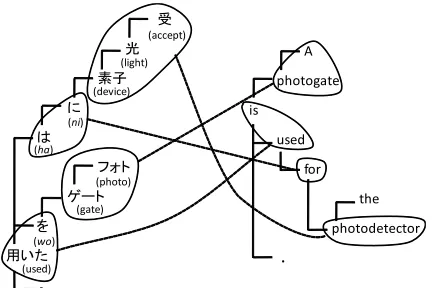
Because our model uses dependency tree struc-tures, both source and target sentences are parsed beforehand. Japanese sentences are converted into dependency structures using the morphological ana-lyzer JUMAN (Kurohashi et al., 1994), and the de-pendency analyzer KNP (Kawahara and Kurohashi, 2006). MSTparser (McDonald et al., 2005) is used to convert English sentences. Figure 1 shows an ex-ample of dependency structures. The root of a tree is placed at the extreme left and words are placed from top to bottom.
2.1 Overview
This section outlines our proposed model in compar-ison to the IBM models, which are the conventional statistical alignment models.
In the IBM models (Brown et al., 1993), the best
alignmentˆabetween a given source sentencef and
its target sentence e is acquired by the following
equation:
ˆ
a = argmax
a p(f,a|e)
= argmax
a p(f|e,a)·p(a|e) (1)
ཷ
ග
⣲Ꮚ
䛻
䛿
䝣䜷䝖
䝀䞊䝖
䜢
⏝䛔䛯
䚹
A
photogate
is
used
for
the
photodetector
.
(accept)
(light)
(device)
(photo)
(gate)
(used) (ni)
(ha)
[image:2.612.318.534.57.201.2](wo)
Figure 1: An example of a dependency tree and its align-ment.
where p(f|e,a) is called lexicon probability and
p(a|e)is calledalignment probability.
Supposefconsists ofnwordsf1, f2, ..., fn, ande
consists ofmwordse1, e2, ..., emand a NULL word
(e0). The alignment mappingaconsists of
associa-tionsj → i = aj from source position j to target
position i = aj. The two probabilities above are
broken down as:
p(f|e,a) = J
∏
j=1
p(fj|eaj) (2)
p(a|e) =
I
∏
i=1
p(∆j|ei) (3)
where ∆j is a relative position of words in the
source side which corresponds toei. Equation 2 is
the product of the word translation probabilities, and Equation 3 is the product of relative position proba-bilities.
In the proposed model, we refine the IBM models in three ways. First, as for Equation 2, we consider phrases instead of words. Second, as for Equation 3, we consider dependencies of words instead of their positions in a sentence.
Finally, the proposed model can find the best
alignmentˆaby not usingf-to-ealone, but
simulta-neously withe-to-f. That is, Equation 1 is modified
as follows:
ˆ
a = argmax
a
p(f|e,a)·p(a|e)·
p(e|f,a)·p(a|f) (4)
alignments, but they cannot consider a one-to-many or many-to-many alignment.
The models are estimated by EM-like algorithm which is very similar to (Liang et al., 2006). The important difference is that we are using tree struc-tures.
We maximize the data likelihood:
max θef,θf e
∑
f,e
(logpef(f,e;θef) + logpf e(f,e;θf e))
(5) In the E-step, we compute the posterior distribution
of the alignments with the current parameterθ:
q(a;f,e) :=pef(a|f,e;θef)·pf e(a|f,e;θf e) (6)
In the M-step, we update the parameterθ:
θ0:= argmax θ
∑
a,f,e
q(a;f,e) logpef(a,f,e;θef)
+∑
a,f,e
q(a;f,e) logpf e(a,f,e;θf e)
= argmax
θ
∑
a,f,e
q(a;f,e) logp(e)·pef(a,f|e;θef)
+∑
a,f,e
q(a;f,e) logp(f)·pf e(a,e|f;θf e)
(7)
Note that p(e) and p(f) have no effect on
maxi-mization, and pef(a,f|e;θef) and pf e(a,e|f;θf e)
appeared in Equation 1 or Equation 4.
In the following sections, we decompose the lexi-con probability and alignment probability.
2.2 Phrase Translation Probability
Supposefconsists ofN phrasesF1, F2, ..., FN, and
econsists ofM phrasesE1, E2, ..., EM. The
align-ment mapping aconsists of associations j → i =
Aj from source phrasejto target phrasei=Aj.
We consider phrase translation probability
p(Fj|Ei) instead of word translation probability.
There is one restriction: that phrases composed of more than one word cannot be aligned to NULL. Only a single word can be aligned to NULL.
We denote a phrase which the wordfjbelongs to
asFs(j), and a phrase which the wordei belongs to
asEt(i). With these notations, we refine Equation 2
as follows:
p(f|e,a) = J
∏
j=1
p(Fs(j)|EAs(j)) (8)
Suppose phraseFj andEi are aligned where the
number of words inFj is denoted by|Fj|and that
number inEiis|Ei|, the probability mass related to
this alignment in Equation 8 is as follows:
p(Fj|Ei)|Fj|·p(Ei|Fj)|Ei| (9)
We call this probability for the link betweenFj and
Eiphrase alignment probability. The upper part of
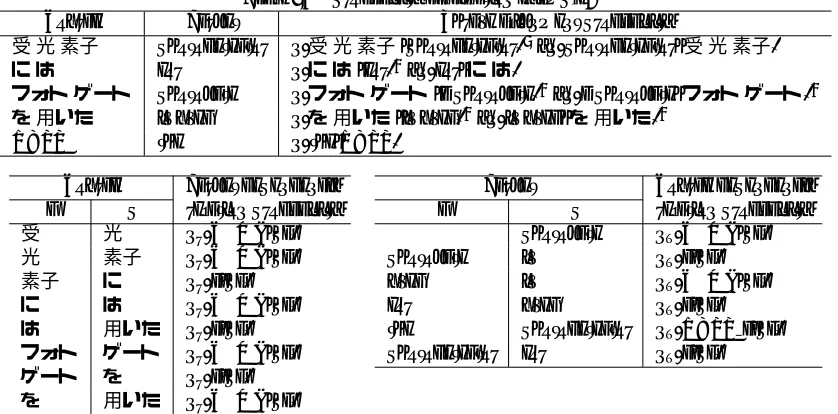
Table 1 shows phrase alignment probabilities for the alignment in Figure 1.
2.3 Dependency Relation Probability
The reordering model in the IBM Models is defined on the relative position between an alignment and its previous alignment, as shown in Equation 3. Our model, on the other hand, considers dependencies of words instead of positional relations.
We start with a dependency relation wherefc
de-pends onfp in the source sentence. In a possible
alignment,fc belongs toFs(c), fp belongs toFs(p),
andFs(c)depends onFs(p). In this situation, we
con-sider the relation betweenEAs(p) andEAs(c). Even
if two languages have different word order, their de-pendency structures are similar in many cases, and
EAs(c) tends to depend onEAs(p). Our model takes
this tendency into consideration. In order to de-note the relationship between phrases, we introduce
rel(EAs(p), EAs(c)). This is defined as the path from
EAs(p) toEAs(c). It is represented by applying the
notations below:
• ’c’ if going down to thechild node
• ’p’ if going down to theparent node
For example, in Figure 1, the path from “for” to “photodetector” is ’c’, from “the” to “for” is ’p;p’ because it travels across two nodes. All the phrases are considered as a single node, so the path from “photogate” to “the” is ’p;c;c;c’ with the alignment in Figure 1.
We refine Equation 3 usingrelas follows:
p(a|e) = ∏
(p,c)∈Ds-pc
pt(rel(EAs(p), EAs(c))|pc)
(10)
where Ds-pc denotes a set of parent-child
word pairs in the source sentence. We call
pt(rel(EAs(p), EAs(c))|pc) target side dependency
relation probability. pt is a kind of tree-based
Table 1: A probability calculation example.
Source Target Phrase alignment probability
受 光 素子 photodetector p(受 光 素子|photodetector)3·p(photodetector|受 光 素子) に は for p(に は|for)2·p(for|に は)
フォト ゲート photogate p(フォト ゲート|a photogate)2·p(a photogate|フォト ゲート)2 を 用いた is used p(を 用いた|is used)2·p(is used|を 用いた)2
NULL the p(the|NULL)
Source Target dependency Target Source dependency
c p relation probability c p relation probability
受 光 pt(SAME|pc) A photogate ps(SAME|pc)
光 素子 pt(SAME|pc) photogate is ps(c|pc)
素子 に pt(c|pc) used is ps(SAME|pc)
に は pt(SAME|pc) for used ps(c|pc)
は 用いた pt(c|pc) the photodetector ps(NULL c|pc)
フォト ゲート pt(SAME|pc) photodetector for ps(c|pc)
ゲート を pt(c|pc)
を 用いた pt(SAME|pc)
There are some special cases forrel. WhenFs(c)
and Fs(p) are the same, that is, fc and fp belong
to the same phrase, rel is represented as ’SAME’.
Whenfpis aligned to NULL,fcis aligned to NULL,
and both of them are aligned to NULL,relis
repsented as ’NULL p’, ’NULL c’, and ’NULL b’, re-spectively. The lower part of Table 1 shows depen-dency relation probabilities corresponding to Figure 1.
Actually, we extend the dependency relation probability to consider a wider relation, i.e, the grandparent-child relation, as follows:
p(a|e) = ∏
(p,c)∈Ds-pc
pt(rel(EAs(p), EAs(c))|pc)·
∏
(g,c)∈Ds-gc
pt(rel(EAs(g), EAs(c))|gc)
(11)
whereDs-gcdenotes a set of grandparent-child word
pairs in the source sentence.
3 Model Training
Our model is trained in two steps. In Step 1, word translation probability is estimated. Then, in Step 2, possible phrases are acquired, and both phrase trans-lation probability and dependency retrans-lation probabil-ity are estimated. In both steps, parameter estima-tion is done with the EM algorithm.
3.1 Step 1
In Step 1, word translation probability in each di-rection is estimated independently. This is done in
exactly the same way as in IBM Model 1.
In this process, the alignment unit is a word.
When we considerf-to-ealignment, each word on
the source sidefj can correspond to a word on the
target side ei or a NULL word, independently of
other source words. The probability of one possible
alignmentais calculated as follows:
p(a,f|e) =
J
∏
j=1
p(fj|eaj) (12)
By considering all possible alignments, p(f|e) is
calculated as:
p(f|e) =∑
a
p(a,f|e) (13)
As initial parameters of p(f|e), we use uniform
probabilities. Then, after calculating Equation 12
and 13, we give the fractional count p(a,f|e)
p(f|e) to all
word alignments in a, and we estimate p(f|e) by
MLE. We perform this estimation iteratively.
The inverse modele-to-f can be calculated in the
same manner.
3.2 Step 2
Both phrase translation probability and dependency relation probability are estimated, and one
undi-rected alignment is found using thee-to-fandf-to-e
by considering the dependency relation probability with a hill-climbing algorithm.
The initial parameters of Step 2 are calculated as follows. The dependency relation probability is calculated using the final alignment result of Step 1, and we use the word translation probability esti-mated in Step 1 as the initial phrase translation prob-ability.
3.2.1 Initial Alignment
We first create an initial alignment based on the phrase translation probability without considering the dependency relation probabilities.
For all the combinations of possible phrases (including NULL), phrase alignment probabilities are calculated (equation 9). Correspondences are adopted one by one in descending order of geomet-ric mean of the phrase alignment probabilities. All the words should be aligned only once, that is, the correspondences are adopted exclusively. Genera-tion of possible phrases is explained in SecGenera-tion 3.2.3.
3.2.2 Hill-climbing
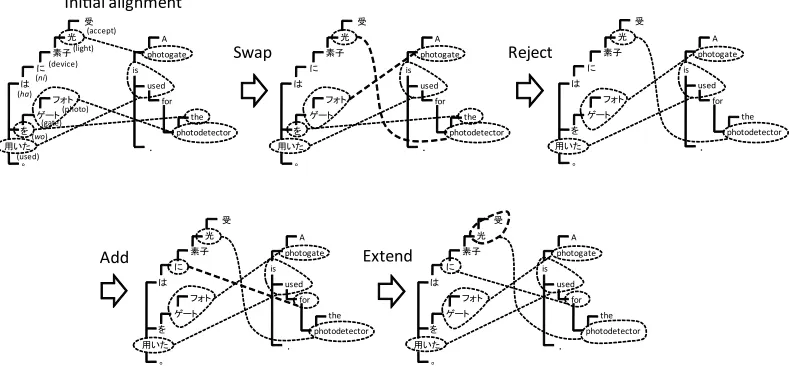
To find better alignments, the initial alignment is gradually revised with a hill-climbing algorithm. We use four kinds of revising operations:
Swap: Focusing on any two correspondences, the
partners are swapped. In the first step in
Figure2, the correspondences “光 ↔
photo-gate” and “フォト ゲート↔photodetector” are
swapped to “光↔photodetector” and “フォト
ゲート↔photogate”.
Extend: Focusing on one correspondence, the source or target phrase is extended to include its neighboring (parent or child) NULL-aligned word.
Add: A new correspondence is added between a
source word and a target word both of which are aligned to NULL.
Reject: A correspondence is rejected and the source and target phrase are aligned to NULL.
Figure 2 shows an illustrative example of hill climbing. The alignment is revised only if the align-ment probability gets increased. It is repeated un-til no operation can improve the alignment probabil-ity, and the final state is the best approximate
align-ment. As a by-product of hill-climbing, pseudon
-best alignment can be acquired. It is used in collect-ing fractional counts.
3.2.3 Phrase Generation
If there is a word which is aligned to NULL in the best approximate alignment, a new possible phrase is generated by merging the word into a neighbor-ing phrase which is not aligned to NULL. In the last
alignment result in Figure 2, for example, “素子”
is treated as being included in the correspondence
between “受 光” and “photodetector” and the
cor-respondence between “に” and “for”. As a result,
we consider the correspondence between “受 光 素
子” and “photodetector” and the correspondence
be-tween “素子 に” and “for” existing in parallel
sen-tences. The new possible phrase is taken into con-sideration from the next iteration.
3.2.4 Model Estimation
Collecting all the alignment results, we estimate phrase alignment probabilities and dependency rela-tion probabilities.
One way of estimating parameters of phrase alignment probabilities is using the following equa-tions:
p(Fj|Ei) =
C(Fj, Ei)
∑
kC(Fk, Ei)
p(Ei|Fj) =
C(Fj, Ei)
∑
kC(Ek, Fj) (14)
where C(Fj, Ei) is a frequency of Fj and Ei is
aligned.
However, if we use this in our model, the phrase translation probability of the new possible phrase can become extremely high (often it becomes 1). To avoid this problem, we use the equations below for the estimation of phrase translation probability in place of Equation 14:
p(Fj|Ei) =
C(Fj, Ei) C(Ei)
, p(Ei|Fj) =
C(Fj, Ei) C(Fj) (15)
C(Ei)is the frequency of the phraseEiin the
train-ing corpus which can be pre-counted. This definition can resolve the problem where the phrase translation probability of the new possible phrase becomes too high.
As for the NULL, we use Equation 14 because we cannot pre-count the frequency of NULL.
ཷ ග ⣲Ꮚ 䛻 䛿
䝣䜷䝖 䝀䞊䝖 䜢 ⏝䛔䛯 䚹
A photogate is
used for
the photodetector .
ཷ ග ⣲Ꮚ 䛻 䛿
䝣䜷䝖 䝀䞊䝖 䜢 ⏝䛔䛯 䚹
A photogate is
used for
the photodetector .
ཷ ග ⣲Ꮚ 䛻 䛿
䝣䜷䝖 䝀䞊䝖 䜢 ⏝䛔䛯 䚹
A photogate is
used for
the photodetector
.
ཷ ග ⣲Ꮚ 䛻 䛿
䝣䜷䝖 䝀䞊䝖 䜢 ⏝䛔䛯 䚹
A photogate is
used for
the photodetector .
ཷ ග ⣲Ꮚ 䛻 䛿
䝣䜷䝖 䝀䞊䝖 䜢 ⏝䛔䛯 䚹
A photogate is
used for
the photodetector .
Ini al alignment
Swap Reject
Add Extend
(accept) (light) (device) (ni) (ha)
(photo) (gate)
[image:6.612.108.503.62.245.2](used) (wo)
Figure 2: An example of hill-climbing. 4 Experimental Results
We conducted alignment experiments. A JST1
Japanese-English paper abstract corpus consisting of 1M parallel sentences was used for the model training. This corpus was constructed from a 2M
Japanese-English paper abstract corpus by NICT2
using the method of Uchiyama and Isahara (2007). As gold-standard data, we used 475 sentence pairs which were annotated by hand. The annotations
were only sure (S) alignments (there were no
possi-ble (P) alignments) (Och and Ney, 2003). The unit
of evaluation was word-base for both Japanese and English. We used precision, recall, and F-measure as evaluation criteria.
We conducted two experiments to reveal 1) the contribution of our proposed model compared to the existing models, and 2) the effectiveness of using dependency tree structure and phrases, which are larger alignment units than words. Trainings were run on the original forms of words for both the pro-posed model and the models used for comparison.
4.1 Comparison with Word Sequential Model
For comparison, we used GIZA++ (Och and Ney, 2003) which implements the prominent sequential word-base statistical alignment model of IBM Mod-els. We conducted word alignment bidirectionally with its default parameters and merged them using three types of symmetrization heuristics (Koehn et al., 2003). The results are shown in Table 2.
1http://www.jst.go.jp/ 2http://www.nict.go.jp/
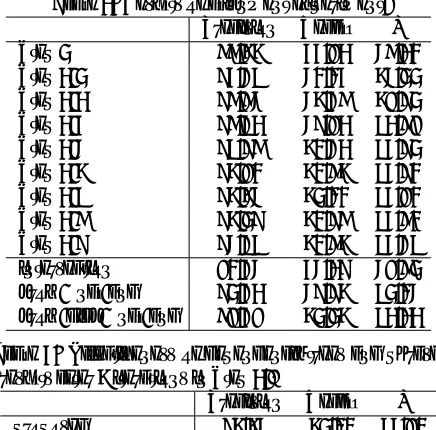
The result of ’Step 1’ uses parameters estimated after 5 iterations of Step 1. The alignment is ob-tained by the method of initial alignment shown in Section 3.2.1. In ’Step 2-1’, the phrase translation probabilities are the same as those in ’Step 1’. In ad-dition, dependency relation probabilities estimated from the ’Step 1’ alignment result are used. By com-paring ’Step 1’ and ’Step 2-1’, we can see the ef-fectiveness of dependency relation probability. We performed 5 iterations for Step 2 and calculated the alignment accuracy each time. As a result, the pro-posed model could achieve a higher F-measure by 1.7 points compared to the sequential model. ’In-tersection’ achieved best Precision, but its Recall is quite low. ’grow-diag-final-and’ achieved best Re-call, but its Precision is lower than our best result where the Recall is almost same. Thus, we can say our result is better than sequential word alignment models.
4.2 Effectiveness of Dependency Trees and Phrases
To confirm the effectiveness of dependency trees and phrases, we conducted alignment experiments on the following four conditions:
• Using both dependency trees and phrases
(re-ferred to as ’proposed’).
• Using dependency trees only.
• Using phrases only.
• Not using dependency trees or phrases (referred
to as ’none’)
Table 2: Results of alignment experiment. Precision Recall F
Step 1 77.55 33.92 47.20
Step 2-1 83.46 40.03 54.11
Step 2-2 87.74 45.37 59.81
Step 2-3 87.62 48.92 62.79
Step 2-4 86.87 50.42 63.81
Step 2-5 85.90 50.75 63.80
Step 2-6 85.54 51.00 63.90
Step 2-7 85.18 50.87 63.70
Step 2-8 84.66 50.75 63.46
[image:7.612.76.294.70.285.2]intersection 90.34 34.28 49.71 grow-final-and 81.32 48.85 61.04 grow-diag-final-and 79.39 51.15 62.22 Table 3: Effectiveness of dependency trees and phrases (results after 5 iterations in Step 2.)
Precision Recall F
proposed 85.54 51.00 63.90
dependency tree only 89.77 39.47 54.83 phrase only 84.41 47.33 60.65
none 85.07 38.06 52.59
a sequence of words instead of dependency tree re-lations. The results are shown in Table 3. All the results are the alignment accuracy after 5 iterations of Step 2.
5 Discussion
Table 2 shows that our proposed model could achieve reasonably high accuracy of alignment, and is better than sequential word-base models. As an example, alignment results of a word sequen-tial model are shown in Figure 3. The gray col-ored cells are the gold-standard alignments, and the black boxes are the outputs of the sequential model. The model failed to resolve the correspondence
am-biguities between “非(not) 去勢(castrated) マウ
ス(mice)”, and “去勢 マウス”; and “non-castrated
mice”, and “castrated mice” respectively. This is because these words are placed close to each other
and are also close to the correspondence “同様に
↔ as” which can be a clue to the word order.
Us-ing the tree structure in Figure 4, these words were correctly aligned. This is because in the English tree, the phrase “castrated mice” does not depend on “as”, and “non-castrated mice” does. Similarly
in the Japanese tree, “非 去勢 マウス” depends on “
同様に” and “去勢 マウス” does not.
As mentioned in Section 1, sequential statistical
䞉䞉䞉
exhibited 䕔 䕔
a
strong 䕔
inhibitory 䕔
effect 䕔
on 䕔 䕔
tumor 䕔
growth 䕔
in 䕔
the 䕔
castrated 䕔
mice 䕔
as 䕔 䕔
in 䕔
the
non-castrated 䕔
mice 䕔
࣭
࣭
࣭
㠀 ཤ ໃ 䝬 䜴 䝇
䛸 ྠ ᵝ 䛻 ཤ ໃ 䝬 䜴 䝇
䛾 ⭘ 䜘 䛖
䛾 ᡂ 㛗
䛻 ᑐ 䛧 ᙉ 䛔 ᢚ ไ ຠ ᯝ
䜢 ♧ 䛧 䛯
Figure 3: An alignment example of the word sequential model (grow-diag-final-and).
䞉䞉䞉
exhibited 䕔 䕔
ؒ ؐa
ؒ جؐstrong 䕔
ؒ جؐinhibitory 䕔
جؐeffect 䕔
جؐon
ؒ ؒ ؐtumor 䕔
ؒ ؤؐgrowth 䕔
جؐin 䕔
ؒ ؒ ؐthe
ؒ ؒ جؐcastrated 䕔
ؒ ؤؐmice 䕔
ؤؐas 䕔
ؤؐin 䕔
ؒ ؐthe
ؒ جؐnon-castrated 䕔 䕔
ؤؐmice 䕔
࣭ ࣭ ࣭ ؐ ؒ
㠀
ؐ ؒ ཤ ໃ ؐ ؒ
䝬 䜴 䝇
ؐ
ؒ
䛸
ؼ ؒ
ྠ ᵝ 䛻
ؐ ؒ ཤ ໃ ؐ ؒ
䝬 䜴 䝇
ؐ
ؒ
䛾
ؐ
ؒ
⭘ 䜘 䛖
ؐ
ؒ
䛾
ؐ
ؒ
ᡂ 㛗
ؐ
ؒ
䛻
ؼ ؒ
ᑐ 䛧
ؐ
ؒ
ᙉ 䛔
ؐ ؼ ؒ ᢚ ไ ؐ ؒ ຠ ᯝ ؼ ؒ
䜢 ♧ 䛧 䛯
Figure 4: An alignment example of the proposed model.
methods, which regard a sentence as a sequence of words, work well for language pairs that are not too different in their language structure. Japanese and English have significantly different structures. One of the issues is that Japanese sentences have a SOV word order, but in English, the word order is SVO, so the dependency relations are often turned over. For language pairs such as Japanese and English, deeper sentence analysis using NLP resources is necessary and useful. Our method is therefore suitable for such language pairs.
As another example of an alignment failure by the sequential model, Figure 5 shows the phrase
cor-respondence “受 光 素子↔photodetector”, which
[image:7.612.322.526.235.474.2]pro-A
photogate 䕔 䕔
is 䕔
used 䕔
for 䕔
the 䕔
photodetector 䕔 ཷ ග ⣲
Ꮚ 䛻 䛿 䝣
䜷 䝖
䝀 䞊 䝖
䜢 ⏝ 䛔 䛯
Figure 5: An unsuccessful example of phrase detection in the sequential model (grow-diag-final-and).
ؐA 䕔 䕔
ؐphotogate 䕔 䕔
is 䕔 䕔
ؤؐused 䕔 䕔
ؤؐfor 䕔 䕔
ؒ ؐthe
ؤؐphotodetector 䕔 䕔 䕔
ؒ
ཷ
ؒ
ග
ؒ
⣲ Ꮚ
ؒ
䛻
ؒ
䛿
ؐ
ؒ
䝣 䜷 䝖
ؐ
ؒ
䝀 䞊 䝖
ؼ ؒ
䜢 ⏝ 䛔 䛯
Figure 6: An example of phrase detection in the proposed model.
posed method of generating possible phrases during iterations works well and improves alignment.
From the result of our second experiment, we can see the following points:
1. Phrasal alignment improves the recall, but low-ers the precision.
2. By using dependency trees, precision can be improved.
3. We can find a balance point by using both phrasal alignment and dependency trees. The causes of alignment errors in our model can be summarized into categories. The biggest one is parsing errors. Since our model is highly dependent on the parsing result, the alignments would easily turn out wrong if the parsing result was incorrect.
Sometimes the hill-climbing algorithm could not revise the initial alignment. Most of these cases would happen when one word occurred several times on one side, but some of those occurrences were omitted on the other side. Let’s suppose there are two identical words on the source side, but the
target side has only one corresponding word. Initial alignment is created without considering the depen-dencies at all, so it cannot judge which source word should be aligned to the corresponding target word. In this case, the best alignment searching sometimes gets the local solution. This problem could be re-solved by considering local dependencies for am-biguous words.
One difficulty is how to handle function words. Function words often do not have exactly corre-sponding words in the opposite language. Japanese
case markers such as “は (ha)”, “が (ga)”
(subjec-tive case), “を(wo)” (objective case) and so on, and
English articles are typical examples of words, that do not have corresponding parts. There is a differ-ence between alignment criteria for function words of gold-standard and our outputs, and it is somewhat difficult to improve alignment accuracy.
6 Conclusion
In this paper, we have proposed a linguistically-motivated probabilistic phrase alignment model based on dependency tree structures. The model in-corporates the tree-based reordering model. Experi-mental results show that the word sequential model does not work well for linguistically different lan-guage pairs, and this can be resolved by using syn-tactic information. We have conducted the experi-ments only on Japanese-English corpora. To firmly support our claim that syntactic information is im-portant, it is necessary to do more investigation on other language pairs.
References
Peter F. Brown, Stephen A. Della Pietra, Vincent J. Della Pietra, and Robert L. Mercer. 1993. The mathemat-ics of statistical machine translation: Parameter esti-mation. Association for Computational Linguistics, 19(2):263–312.
Colin Cherry and Dekang Lin. 2003. A probability model to improve word alignment. InProceedings of the 41st Annual Meeting of the Association of Compu-tational Linguistics, pages 88–95.
Brooke Cowan, Ivona Ku˘cerov´a, and Michael Collins. 2006. A discriminative model for tree-to-tree trans-lation. In Proceedings of the 2006 Conference on EMNLP, pages 232–241, Sydney, Australia, July. As-sociation for Computational Linguistics.
Daniel Gildea. 2003. Loosely tree-based alignment for machine translation. In Proceedings of the 41st An-nual Meeting on ACL, pages 80–87.
Daisuke Kawahara and Sadao Kurohashi. 2006. A fully-lexicalized probabilistic model for japanese syntactic and case structure analysis. InProceedings of the Hu-man Language Technology Conference of the NAACL, Main Conference, pages 176–183, New York City, USA, June. Association for Computational Linguis-tics.
Philipp Koehn, Franz J. Och, and Daniel Marcu. 2003. Statistical phrase-based translation. In HLT-NAACL 2003: Main Proceedings, pages 127–133.
Sadao Kurohashi, Toshihisa Nakamura, Yuji Matsumoto, and Makoto Nagao. 1994. Improvements of Japanese morphological analyzer JUMAN. In Proceedings of The International Workshop on Sharable Natural Lan-guage, pages 22–28.
Percy Liang, Ben Taskar, and Dan Klein. 2006. Align-ment by agreeAlign-ment. In Proceedings of the Human Language Technology Conference of the NAACL, Main Conference, pages 104–111, New York City, USA, June. Association for Computational Linguistics. Ryan McDonald, Fernando Pereira, Kiril Ribarov, and
Jan Hajic. 2005. Non-projective dependency pars-ing uspars-ing spannpars-ing tree algorithms. InProceedings of Human Language Technology Conference and Confer-ence on Empirical Methods in Natural Language Pro-cessing, pages 523–530, Vancouver, British Columbia, Canada, October. Association for Computational Lin-guistics.
Arul Menezes and Stephen D. Richardson. 2001. A best-first alignment algorithm for automatic extraction of transfer mappings from bilingual corpora. In Proceed-ings of the 39th Annual Meeting of the Association for Computational Linguistics (ACL) Workshop on Data-Driven Machine Translation, pages 39–46.
Toshiaki Nakazawa and Sadao Kurohashi. 2008. Linguistically-motivated tree-based probabilistic phrase alignment. In In Proceedings of the Eighth Conference of the Association for Machine Translation in the Americas (AMTA2008).
Franz Josef Och and Hermann Ney. 2003. A systematic comparison of various statistical alignment models.
Association for Computational Linguistics, 29(1):19– 51.
Chris Quirk, Arul Menezes, and Colin Cherry. 2005. De-pendency treelet translation: Syntactically informed phrasal SMT. In Proceedings of the 43rd Annual Meeting of the Association for Computational Linguis-tics (ACL’05), pages 271–279.
Masao Utiyama and Hitoshi Isahara. 2007. A japanese-english patent parallel corpus. InMT summit XI, pages 475–482.
Hideo Watanabe, Sadao Kurohashi, and Eiji Aramaki. 2000. Finding structural correspondences from bilin-gual parsed corpus for corpus-based translation. In
Proceedings of the 18th International Conference on Computational Linguistics, pages 906–912.