Categorizing Local Contexts as a Step in Grammatical Category
Induction
Markus Dickinson
Indiana University Bloomington, IN USA
Charles Jochim
Indiana University Bloomington, IN USA
Abstract
Building on the use of local contexts, or frames, for human category acquisition, we explore the treatment of contexts as categories. This allows us to examine and evaluate the categorical properties that lo-cal unsupervised methods can distinguish and their relationship to corpus POS tags. From there, we use lexical information to combine contexts in a way which pre-serves the intended category, providing a platform for grammatical category induc-tion.
1 Introduction and Motivation
In human category acquisition, the immediate lo-cal context of a word has proven to be a reliable indicator of its grammatical category, or part of speech (e.g., Mintz, 2002, 2003; Redington et al., 1998). Likewise, category induction techniques cluster word types together (e.g., Clark, 2003; Sch¨utze, 1995), using similar information, i.e., distributions of local context information. These methods are successful and useful (e.g. Koo et al., 2008), but in both cases it is not always clear whether errors in lexical classification are due to a problem in the induction algorithm or in what con-texts count as identifying the same category (cf. Dickinson, 2008). The question we ask, then, is: what role does the contexton its ownplay in defin-ing a grammatical category? Specifically, when do two contexts identify the same category?
Many category induction experiments start by trying to categorize words, and Parisien et al. (2008) categorizeword usages, a combination of a word and its context. But to isolate the effect the context has on the word, we take the approach of categorizing contexts as a first step towards clus-tering words. By separating out contexts for word clustering, we can begin to speak of better
dis-ambiguation models as a foundation for induc-tion. We aim in this paper to thoroughly investi-gate what category properties contexts can or can-not distinguish by themselves.
With this approach, we are able to more thor-oughly examine the categories used for evaluation. Evaluation of induction methods is difficult, due to the variety of corpora and tagsets in existence (see discussion in Clark, 2003) and the variety of po-tential purposes for induced categories (e.g., Koo et al., 2008; Miller et al., 2004). Yet improving the evaluation of category induction is vital, as eval-uation does not match up well with grammar in-duction evaluation (Headden III et al., 2008). For many evaluations, POS tags have been mapped to a smaller tagset (e.g., Goldwater and Griffiths, 2007; Toutanova and Johnson, 2008), but there have been few criteria for evaluating the quality of these mappings. By isolating contexts, we can investigate how each mapping affects the accuracy of a method and the lexicon.
Using corpus annotation also allows us to ex-plore the relation between induced categories and computationally or theoretically-relevant cat-egories (e.g., Elworthy, 1995). While human cate-gory acquisition results successfully divide a lexi-con into categories, these categories are not neces-sarily ones which are appropriate for many com-putational purposes or match theoretical syntactic analysis. This work can also serve as a platform to help drive the design of new tagsets, or refinement of old ones, by outlining which types of categories are or are not applicable for category induction.
is lost by mapping. In section 4, in more prelimi-nary work, we add lexical information to contexts, in order to merge them together and see which still identify the same category.
2 Preliminaries
2.1 Background
Research on language acquisition has addressed how humans learn categories of words, and we use this as a starting point. Mintz (2002) shows that local context, in the form of aframeof two words surrounding a target word, leads to the target’s categorization in adults, and Mintz (2003) shows that frequent frames supply category information in child language corpora. A frame is not decom-posed into its left and right sides (cf., e.g., Reding-ton et al., 1998; Clark, 2003; Sch¨utze, 1995), but is taken as their joint occurrence (Mintz, 2003).1
For category acquisition, frequent frames are used, those with a frequency above a certain threshold. These predict category membership, as the set of words appearing in a given frame should represent a single category. The frequent frame
you it, for example, largely identifies verbs, as shown in (1), taken from child-directed speech in the CHILDES database (MacWhinney, 2000). For frequent frames in six subcorpora of CHILDES, Mintz (2003) obtains both high type and token ac-curacy in categorizing words.
(1) a. you put it b. you see it
The categories do not reflect fine-grained lin-guistic distinctions, though, nor do they fully ac-count for ambiguous words. Indeed, accuracies slightly degrade when moving from “Standard La-beling”2 to the more fine-grained “Expanded La-beling,”3 from .98 to .91 in token accuracy and from .93 to .91 in type accuracy. In scaling the method beyond child-directed speech, it would be beneficial to use annotated data, which allows for ambiguity and distinguishes a word’s cate-gory across corpus instances. Furthermore, even though many frames identify the same category,
1
This use offrameis different than that used for subcate-gorization frames, which are also used to induce word classes (e.g., Korhonen et al., 2003).
2
Categories = noun, verb, adjective, preposition, adverb, determiner, wh-word,not, conjunction, and interjection.
3Nouns split into nouns and pronouns; verbs split into
verbs, auxiliaries, and copula
the method does not thoroughly specify how to re-late them.
It has been recognized for some time that wider contexts result in better induction models (e.g., Parisien et al., 2008; Redington et al., 1998), but many linguistic distinctions rely on lexical infor-mation that cannot be inferred from additional context (Dickinson, 2008), so focusing on short contexts can provide many insights. The use of frames allows for frequent recurrent contexts and a way to investigate corpus categories, or POS tags (cf., e.g., Dickinson and Jochim, 2008). An added benefit of starting with this method is that it can be converted to a model of online acquisition (Wang and Mintz, 2007). For this paper, however, we only investigate the type of information input into the model.
2.2 Some definitions
Frequency The core idea of using frames is that words used in the same context are associated with each other, and the more often these contexts oc-cur, the more confidence we have that the frame in-dicates a category. Setting a threshold to obtain the 45 most frequent frames in each subcorpus (about 80,000 words on average), (Mintz, 2003) allows a frame to occur often enough to be meaningful and have a variety of target words in the frame.
To determine what category properties frames pinpoint (section 3), we use two thresholds to de-finefrequent. Singly occurring frames cannot pro-vide any information about groupings of words, so we first consider frames that occur more than once. This gives a large number of frames, cover-ing much of the corpus (about 970,000 tokens), but frames with few instances have very little informa-tion. For the other threshold, frequent frames are those which have a frequency of 200, about 0.03% of the total number of frames in the corpus. One could explore more thresholds, but for compar-ing tagset mappcompar-ings, these provide a good picture. The higher threshold is appropriate for combining contexts (section 4), as we need more information to tell whether two frames behave similarly.
other word in its category set.
Viewing the task as disambiguating contexts (see section 3), however, this measurement does not seem to adequately represent cases with a ma-jority label. For example, if three words have the tag X and one Y, pairwise comparison re-sults in an accuracy of 50%, even though X is dominant. To account for this, we measure the precision of the most frequent category instances among all instances, e.g., 75% for the above ex-ample (cf. the notion ofpurityin Manning et al., 2008). Additionally, we only use measurements of token precision. Token precision naturally han-dles ambiguous words and is easy to calculate in a POS-annotated corpus.
3 Categories in local contexts
In automatic category induction, a category is of-ten treated as a set, or cluster, of words (Clark, 2003; Sch¨utze, 1995), and category ambiguity is represented by the fact that words can appear in more than one set. Relatedly, one can clusterword usages, a combination of a word and its context (Parisien et al., 2008). An erroneous classification occurs when a word is in an incorrect set, and one source of error is when the contexts being treated as indicative of the same category are actually am-biguous. For example, in a bigram model, the con-text be identifies nouns, adjectives, and verbs, among others.
Viewed in this way, it is important to gauge the precision of contexts for distinguishing a cat-egory (cf. also Dickinson, 2008). In other words, how often does the same context identify the same category? And how fine-grained is the category that the context distinguishes? To test whether a frame defines a single category in non-child-directed speech, we focus on which categorical properties frames define, and for this we use a POS-annotated corpus. Due to its popularity for unsupervised POS induction research (e.g., Gold-berg et al., 2008; Goldwater and Griffiths, 2007; Toutanova and Johnson, 2008) and its often-used tagset, for our initial research, we use the Wall Street Journal (WSJ) portion of the Penn Treebank (Marcus et al., 1993), with 36 tags (plus 9 punc-tuation tags), and we use sections 00-18, leaving held-out data for future experiments.4
Defining frequent frames as those occurring at
4Even if we wanted child-directed speech, the CHILDES
database (MacWhinney, 2000) uses coarse POS tags.
least 200 times, we find 79.5% token precision. Additionally, we have 99 frames, identifying 14 types of categories as the majority tag (common noun (NN) being the most prevalent (37 frames)). For a threshold of 2, we have 77.3% precision for 67,721 frames and 35 categories.5 With precision below 80%, we observe that frames are not fully able to disambiguate these corpus categories.
3.1 Frame-defined categories
These corpus categories, however, are composed of a variety of morphological and syntactic fea-tures, the exact nature of which varies from tagset to tagset. By merging different tags, we can factor out different types of morphological and syntac-tic properties to determine which ones are more or less easily identified by frames. Accuracy will of course improve by merging tags; what is important is for which mappings it improves.
We start with basic categories, akin to those in Mintz (2003). Despite the differences among tagsets, these basic categories are common, and merging POS tags into basic categories can show that differences in accuracy have more to do with stricter category labels than language type. We merged tags to create basic categories, as in table 1 (adapted from Hepple and van Genabith (2000); see appendix A for descriptions).6
Category Corpus tags Determiner DT, PDT, PRP$ Adjective JJ, JJR, JJS
Noun NN, NNS, PRP, NNP, NNPS Adverb RB, RBR, RBS
Verb MD, VB, VBD, VBG, VBN, VBP, VBZ
[image:3.595.308.513.463.571.2]Wh-Det. WDT, WP$
Table 1: Tag mappings into basic categories
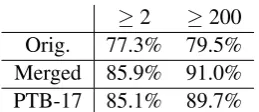
These broader categories result in the accuracies in table 2, and we also record accuracies for the similar PTB-17 tagset used in a variety of unsu-pervised tagging experiments (Smith and Eisner, 2005), which mainly differs by treating VBG and VBN uniquely. With token precision around 90%, it seems that frame-based disambiguation is gener-ally identifying basic categories, though with less
5
LS (List item marker) is not identified; UH (interjection) appears in one repeating frame, and SYM (symbol) in two.
6The 13 other linguistic tags were not merged, i.e., CC,
accuracy than in Mintz (2003).
[image:4.595.117.247.86.142.2]≥2 ≥200 Orig. 77.3% 79.5% Merged 85.9% 91.0% PTB-17 85.1% 89.7%
Table 2: Effect of mappings on precision
But which properties of the tagset do the frame contexts accurately capture and which do they not? To get at this question, we ex-plore linguistically-motivated mappings between the original tagset and the fully-merged tagset in table 1. Given the predominance of verbs and nouns, we focus on distinguishing linguistic prop-erties within these categories. For example, sim-ply by merging nouns and leaving all other orig-inal tags unchanged, we move from 79.5% token precision to 88.4% (for the threshold of 200).
Leaving all other mappings as in table 1, we merge nouns and verbs along two dimensions: their common syntactic properties or their com-mon morphological properties. Ideally, we pre-fer frames to pick out syntactic properties, since morphological properties can assumedly be deter-mined from word-internal properties (see Clark, 2003; Christiansen and Monaghan, 2006).
Specifically, we can merge nouns by noun type (PRP [pronoun], NN/NNS [common noun], NNP/NNPS [proper noun]) or by noun form, in this case based on grammatical number (PRP [pronoun], NN/NNP [singular noun], NNS/NNPS [plural noun]). We can merge verbs by finite-ness(MD [modal], VBP/VBZ/VBD [finite verb], VB/VBG/VBN [nonfinite verb]) or by verb form
(MD [modal], VB/VBP [base], VBD/VBN [-ed], VBG [-ing], VBZ [-s]). In the latter case, verbs with consistently similar forms are grouped—e.g.,
seecan be a baseform (VB) or a present tense verb (VBP).
The results are given in tables 3 and 4. We find that merging verbs by finiteness and nouns by noun type results in higher precision. This con-firms that contexts can better distinguish syntactic, but not necessarily morphological, properties. As we will see in the next section, this mapping also maintains distinctions in the lexicon. Such use of local contexts, along with tag merging, can be used to evaluate tagsets which claim to be distributional (see, e.g., Dickinson and Jochim, 2008).
It should be noted that we have only explored
Noun type Noun form Finiteness 82.9% 81.2% Verb form 81.2% 79.5%
Table 3: Mapping precision (freq.≥2)
Noun type Noun form Finiteness 86.4% 85.3% Verb form 84.5% 83.4%
Table 4: Mapping precision (freq.≥200)
category mappings which merge tags, ignoring possible splits. While splitting a tag like TO (to) into prepositional and infinitival uses would be ideal, we do not have the information automati-cally available. We are thus limited in our eval-uation by what the tagset offers. Some tag splits can be automatically recovered (e.g., splitting PRP based on properties such as person), but if it is au-tomatically recoverable from the lexicon, we do not necessarily need context to identify it, an idea we turn to in the next section.
3.2 Evaluating tagset mappings
Some of the category distinctions made by frames are more or less important for the context to make. For example, it is detrimental if we conflate VB and VBP because this is a prominent ambiguity for many words (e.g.,see). On the other hand, there are no words which can be both VBP (e.g., see) and VBZ (e.g.,sees). Ideally, induction methods would be able to distinguish all these cases—just as they often make distinctions beyond what is in a tagset—but there are differences in how problem-atic the mappings are. If we group VB and VBP into one tag, there is no way to recover that distinc-tion; for VBP and VBZ, there are at least different words which inherently take the different tags.
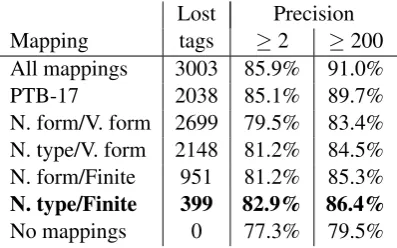
[image:4.595.329.502.144.184.2]We evaluate our mappings in table 5 by enumer-ating the number of word types whose distinctions are lost by a particular mapping (out of 44,520 word types); we also repeat the token precision values for comparison. Perhaps unsurprisingly, grouping words based on form results in high con-fusability (cf. the discussion ofseein section 3.1). On the other hand, merging nouns by type and verbs by finiteness results in something of a bal-ance between precision and non-confusability. It is thus these types of categorizations which we can reasonably expect induction models to capture.
Lost Precision Mapping tags ≥2 ≥200 All mappings 3003 85.9% 91.0% PTB-17 2038 85.1% 89.7% N. form/V. form 2699 79.5% 83.4% N. type/V. form 2148 81.2% 84.5% N. form/Finite 951 81.2% 85.3%
N. type/Finite 399 82.9% 86.4%
[image:5.595.73.272.237.361.2]No mappings 0 77.3% 79.5%
Table 5: Confusable word types
For induction evaluation, in addition to an ac-curacy metric, a metric such as the one we have just proposed is important to gauge how much cor-pus annotation information is lost when perform-ing tagset mappperform-ings. For example, the PTB-17 mapping (Smith and Eisner, 2005) is commonly used for evaluating category induction (Goldwa-ter and Griffiths, 2007; Toutanova and Johnson, 2008), yet it loses distinctions for 2038 words.
We could also define mappings which lose no distinctions in the lexicon. Initial experiments show that this allows no merging of nouns, and that the resulting precision is only minimally bet-ter than no mapping at all. We should also note that the number of confusable words may be too high, given errors in the lexicon (cf. Dickinson, 2008). For example, removing tags occurring less than 10% of the time for a word results in only 305 confusable words for the Noun type/Finiteness (NF) mapping and 1575 for PTB-17.
4 Combining contexts
We have narrowly focused on identical contexts, or frames, for identifying categories, but this could leave us with as many categories as frames (67,721 for≥2, 99 for≥200, instead of 35 and 30). We need to reduce the number of categories without
inappropriately merging them (cf. the notion of “completeness” in Mintz, 2003; Christiansen and Monaghan, 2006). Thus far, we have not utilized a frame’s target words; we turn to these now, in order to better gauge the effectiveness of frames for identifying categories. Although the work is somewhat preliminary, our goal is to continue to investigate when contexts identify the same cate-gory. This merging of contexts is different than clustering words (e.g., Clark, 2000; Brown et al., 1992), but is applicable, as word clustering relies on knowing which contexts identify the same cat-egory.
4.1 Word-based combination
On their own, frames at best distinguish only very broad categorical properties. This is perhaps un-surprising, as the finer-grained distinctions in cor-pora seem to be based on lexical properties more than on additional context (see, e.g., Dickinson, 2008). If we want to combine contexts in a way which maps to corpus tagsets, then, we need to examine the target words. It is likely that two sets share the same tag if they contain the same words (cf. overlap in Mintz, 2003). In fact, the more a frame’s word set overlaps with another’s word set, the more likely it is unambiguous in the first place, as the other set provides corroborating evidence. Therefore, we use overlap of frames’ word sets as a criterion to combine them.
This allows us to combine frames which do not share context words. For example, in (2) we find frames identifying baseform verbs (VB) (2a) and frames identifying cardinal numbers (CD) (2b), despite having a variety of context words. Their target word sets, however, are sufficiently similar.
(2) a. will to, will the, to the, to up, would the, to their, n’t the, to a, to its, to that, to to b. or cents, $ million, rose %,
a %, about %, to %, $ a, $ billion
By viewing frames as categories, in the fu-ture we could also investigate splitting cate-gories, based on subsets of words, morpho-logical/phonological cues (e.g., Christiansen and Monaghan, 2006), or on additional context words, better handling frames that are ambiguous.
fre-quency distance metric. We define sufficient over-lap as the case where a given percent of the words in one frame’s word set are found in the other’s word set. We define this test in either direction, as smaller sets can be a subset of a larger set. For example, the framesthe on(224 tokens) andthe of (4304 tokens) have an overlap of 78 tokens; overlap here is 34.8% (78/224). While we could use a more sophisticated form of clustering (see, e.g., Manning et al., 2008), this will help deter-mine the viability of this general approach.
Of course, two sets may share a category with relatively few shared words, and so we transitively combine sets of contexts. If the overlap of frames
AandBmeet our overlap criterion and the overlap of framesAandCalso meet the criterion, then all three sets are merged, even ifB andChave only a small amount of overlap.7
Using the threshold of 200, we test criteria of 30%, 40%, and 50% overlap and consider the frames’ overlap calculated as a percentage of word types or as a percentage of word tokens. For exam-ple, if a word type occurs 10 times in one word set and 20 in the other, the overlap of types is 1, and the overlap of tokens is 10. Token overlap better captures similarities in distributions of words.
[image:6.595.319.513.63.157.2]4.2 Evaluation
Table 6 shows the number of categories for the 30%, 40%, and 50% type-based (TyB) and token-based (ToB) overlap criteria for merging. As we can see, the overlap based on tokens in word sets results in more categories, i.e., fewer merges.
% TyB ToB 50% 59 75 40% 42 64 30% 27 50
Table 6: Number of categories by condition
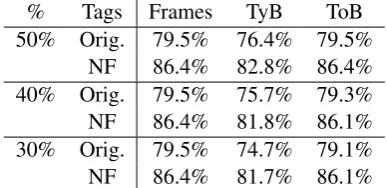
The precision of each of these criteria is given in table 7, evaluating on both the original tagset and the noun type/finiteness (NF) mapping. We can see that the token-based overlap is consistently more accurate than type-based overlap, and there is virtually no drop in precision for any of the token-based conditions.8 Thus, for the rest of the evaluation, we use only the token-based overlap.
7
We currently do not consider overlap of already merged sets, e.g., betweenA+BandC.
8Experiments at 20% show a noticeable drop in precision.
% Tags Frames TyB ToB 50% Orig. 79.5% 76.4% 79.5%
NF 86.4% 82.8% 86.4% 40% Orig. 79.5% 75.7% 79.3% NF 86.4% 81.8% 86.1% 30% Orig. 79.5% 74.7% 79.1% NF 86.4% 81.7% 86.1%
Table 7: Precision of merged frames
We mentioned that if frame word sets overlap, the less ambiguous their category should be. We check this by looking at the difference between merged and unmerged frames, as shown in table 8. The number of categories are also given in paren-theses; for example, for 30% overlap, 41 frames are unmerged, and the remaining 58 make up 9 categories. These results confirm for this data that frames which are merged have a higher precision.
Merged Unmerged Overall 50% 93.4% (7) 79.9% (68) 86.4% (75) 40% 89.7% (10) 81.1% (54) 86.1% (64) 30% 89.7% (9) 77.4% (41) 86.1% (50)
Table 8: Precision of merged & unmerged frames for NF mapping (with number of categories)
But are we only merging a select, small set of words? To gauge this, we measure how much of the corpus is categorized by the 99 most fre-quent frames. Namely, 46,874 tokens occur as tar-gets in our threshold of 99 frequent frames out of 663,608 target tokens in the entire corpus,9 a re-call of 7.1%. Table 9 shows some rere-call figures for the frequent frames. There are 9621 word types in the set of target words for the 99 frequent frames, which is 27.2% of the target lexicon. Crucially, though, these 9621 are realized as 523,662 target tokens in the corpus, or 78.9%. The words cate-gorized by the frequent frames extend to a large portion of the corpus (cf. also Mintz, 2003).
Tokens Types Coverage Merged (30%) 5.0% 20.0% 61.5% Unmerged (30%) 2.0% 11.5% 65.9% Total Overlap 7.1% 27.2% 78.9%
Table 9: Recall of frames
9Because we remove frames which contain punctuation,
[image:6.595.139.225.522.579.2]4.2.1 Qualitative analysis
To better analyze what is happening for future work, we look more closely at 30% overlap. Of the 58 frames merged into 9 categories, 54 of them have the same majority tag after merging. The four frames which get merged into a different category are worth investigating, to see the method’s limi-tations and potential for improvement.
Of the four frames which lose their majority tag after merging, two can be ignored when map-ping to the NF tags. The frameit thewith ma-jority tag VBZ becomes VBD when merged, but both are V-fin. Likewise, n’t tochanges from VB to VBN, both cases of V-nonfin. The third case reveals an evaluation problem with the orig-inal tagset: the frames million $ (IN) and %
$ (TO) are merged into a category labeled TO. The tag TO is for the wordtoand is not split into prepositional and infinitival uses. Corpus cate-gories such as these, which overlap in their def-initions yet cannot be merged (due to their non-overlapping uses), are particularly problematic for evaluation.
The final case which does not properly merge is the most serious. The frameis the(37% of to-kens as preposition (IN)) merges withis a(41% of tokens as VBG); the merged VBG category has an precision of 34%. The distribution of tags is rel-atively similar, the highest percentages being for IN and VBG in both. This highlights the point made earlier, that more information is needed, to split the word sets.
4.2.2 TIGER Corpus
To better evaluate frequent frames for determin-ing categories, we also test them on the German TIGER corpus (Brants et al., 2002), version 2, to see how the method handles data with freer word order and more morphological complexity. We use the training data, with the data split as in Dubey (2004). The frequency threshold for the WSJ (0.03% of all frames) leaves us with only 60 frames in the TIGER corpus, and 51 of these frames have a majority tag of NN.10 Thus, we adjusted the threshold to 0.02% (102 mini-mum occurrences), thereby obtaining 119 frequent frames, with a precision of 82.0%. For the 30% token-based overlap (the best result for English), frames merged into 81 classes, with 79.1% pre-cision. These precision figures are on a par with
10We use no tagset mappings for our TIGER experiments.
English (cf. table 7).11 Part of this might be due to the fact that NN is still a large majority (76% of the frames). Additionally, we find that, although the frame tokens make up only 5.2% of the corpus and the types make up 15.9% of the target lexi-con, those types correspond to 67.2% of the target corpus tokens.
5 Summary and Outlook
Building on the use of frames for human category acquisition, we have explored the benefits of treat-ing contexts—in this case, frames—as categories and analyzed the consequences. This allowed us to examine a way to evaluate tagset mappings and provide feedback on distributional tagset design. From there, we explored using lexical information to combine contexts in a way which generally pre-serves the intended category.
We evaluated this on English and German, but, to fully verify our findings, a high priority is to perform similar experiments on more corpora, em-ploying different tagsets, for different languages. Additionally, we need to expand the definition of a context to more accurately categorize contexts, while at the same time not lowering recall.
Acknowledgements
We wish to thank the Indiana University Compu-tational Linguistics discussion group for feedback, as well as the three anonymous reviewers.
A Some Penn Treebank POS tags
DT Determiner JJ Adjective
JJR Adjective, comparative JJS Adjective, superlative
MD Modal
NN Noun, singular or mass NNS Noun, plural
NNP Proper noun, singular NNPS Proper noun, plural PDT Predeterminer PRP Personal pronoun PRP$ Possessive pronoun
RB Adverb
RBR Adverb, comparative RBS Adverb, superlative VB Verb, base form VBD Verb, past tense
VBG Verb, gerund or present participle VBN Verb, past participle
VBP Verb, non-3rd person singular present VBZ Verb, 3rd person singular present WDT Wh-determiner
WP$ Possessivewh-pronoun
11Interestingly, thresholds of 20% and 10% result in
References
Brants, Sabine, Stefanie Dipper, Silvia Hansen, Wolfgang Lezius and George Smith (2002). The TIGER Treebank. In Proceedings of TLT-02. Sozopol, Bulgaria.
Brown, Peter F., Peter V. deSouza, Robert L. Mer-cer, T. J. Watson, Vincent J. Della Pietra and Jenifer C. Lai (1992). Class-Based n-gram Models of Natural Language. Computational Linguistics18(4), 467–479.
Christiansen, Morten H. and Padraic Monaghan (2006). Discovering verbs through multiple-cue integration. In Action Meets Word: How Chil-dren Learn Verbs, Oxford: OUP.
Clark, Alexander (2000). Inducing Syntactic Cat-egories by Context Distribution Clustering. In
Proceedings of CoNLL-00. Lisbon, Portugal. Clark, Alexander (2003). Combining
Distribu-tional and Morphological Information for Part of Speech Induction. InProceedings of EACL-03. Budapest.
Dickinson, Markus (2008). Representations for category disambiguation. In Proceedings of Coling 2008. Manchester.
Dickinson, Markus and Charles Jochim (2008). A Simple Method for Tagset Comparison. In Pro-ceedings of LREC 2008. Marrakech, Morocco. Dubey, Amit (2004). Statistical Parsing for
Ger-man: Modeling syntactic properties and anno-tation differences. Ph.D. thesis, Saarland Uni-versity, Germany.
Elworthy, David (1995). Tagset Design and In-flected Languages. InProceedings of the ACL-SIGDAT Workshop. Dublin.
Goldberg, Yoav, Meni Adler and Michael Elhadad (2008). EM Can Find Pretty Good HMM POS-Taggers (When Given a Good Start). In Pro-ceedings of ACL-08. Columbus, OH.
Goldwater, Sharon and Tom Griffiths (2007). A fully Bayesian approach to unsupervised part-of-speech tagging. In Proceedings of ACL-07. Prague.
Headden III, William P., David McClosky and Eugene Charniak (2008). Evaluating Unsu-pervised Part-of-Speech Tagging for Grammar Induction. In Proceedings of Coling 2008. Manchester.
Hepple, Mark and Josef van Genabith (2000). Experiments in Structure-Preserving Grammar Compaction. In 1st Meeting on Speech Tech-nology Transfer. Seville, Spain.
Koo, Terry, Xavier Carreras and Michael Collins (2008). Simple Semi-supervised Dependency Parsing. InProceedings of ACL-08. Columbus, OH.
Korhonen, Anna, Yuval Krymolowski and Zvika Marx (2003). Clustering Polysemic Subcatego-rization Frame Distributions Semantically. In
Proceedings of ACL-03. Sapporo.
MacWhinney, Brian (2000). The CHILDES project: Tools for analyzing talk. Mahwah, NJ: Lawrence Erlbaum Associates, third edn. Manning, Christopher D., Prabhakar Raghavan
and Hinrich Sch¨utze (2008). Introduction to In-formation Retrieval. CUP.
Marcus, M., Beatrice Santorini and M. A. Marcinkiewicz (1993). Building a large anno-tated corpus of English: The Penn Treebank.
Computational Linguistics19(2), 313–330. Miller, Scott, Jethran Guinness and Alex
Zama-nian (2004). Name Tagging with Word Clusters and Discriminative Training. InProceedings of HLT-NAACL 2004. Boston, MA.
Mintz, Toben H. (2002). Category induction from distributional cues in an artificial lan-guage. Memory & Cognition30, 678–686. Mintz, Toben H. (2003). Frequent frames as a
cue for grammatical categories in child directed speech. Cognition90, 91–117.
Parisien, Christopher, Afsaneh Fazly and Suzanne Stevenson (2008). An Incremental Bayesian Model for Learning Syntactic Categories. In
Proceedings of CoNLL-08. Manchester.
Redington, Martin, Nick Chater and Steven Finch (1998). Distributional Information: A Powerful Cue for Acquiring Syntactic Categories. Cogni-tive Science22(4), 425–469.
Sch¨utze, Hinrich (1995). Distributional Part-of-Speech Tagging. In Proceedings of EACL-95. Dublin, Ireland.
Smith, Noah A. and Jason Eisner (2005). Con-trastive Estimation: Training Log-Linear Mod-els on Unlabeled Data. In Proceedings of ACL’05. Ann Arbor, MI.
Toutanova, Kristina and Mark Johnson (2008). A Bayesian LDA-based Model for Semi-Supervised Part-of-speech Tagging. In Pro-ceedings of NIPS 2008. Vancouver.