Using NLP to Support Scalable Assessment of Short Free Text Responses
Alistair Willis
Department of Computing and Communications The Open University
Milton Keynes, UK
Abstract
Marking student responses to short answer questions raises particular issues for human markers, as well as for automatic marking tems. In this paper we present the Amati sys-tem, which aims to help human markers im-prove the speed and accuracy of their marking. Amati supports an educator in incrementally developing a set of automatic marking rules, which can then be applied to larger question sets or used for automatic marking. We show that using this system allows markers to de-velop mark schemes which closely match the judgements of a human expert, with the ben-efits of consistency, scalability and traceabil-ity afforded by an automated marking system. We also consider some difficult cases for auto-matic marking, and look at some of the com-putational and linguistic properties of these cases.
1 Introduction
In developing systems for automatic marking, Mitchell et al. (2002) observed that assessment based on short answer, free text input from stu-dents demands very different skills from assessment based upon multiple-choice questions. Free text questions require a student to present the appropri-ate information in their own words, and without the cues sometimes provided by multiple choice ques-tions (described respectively as improved verbalisa-tion and recall (Gay, 1980)). Work by Jordan and Mitchell (2009) has demonstrated that automatic, online marking of student responses is both feasible (in that marking rules can be developed which mark
at least as accurately as a human marker), and help-ful to students, who find the online questions a valu-able and enjoyvalu-able part of the assessment process. Such automatic marking is also an increasingly im-portant part of assessment in Massive Open Online Courses (MOOCs) (Balfour, 2013; Kay et al., 2013). However, the process of creating marking rules is known to be difficult and time consum-ing (Sukkarieh and Pulman, 2005; P´erez-Mar´ın et al., 2009). The rules should usually be hand-crafted by a tutor who is a domain expert, as small differ-ences in the way an answer is expressed can be sig-nificant in determining whether responses are cor-rect or incorcor-rect. Curating sets of answers to build mark schemes can prove to be a highly labour-intensive process. Given this requirement, and the current lack of availability of training data, a valu-able progression from existing work in automatic as-sessment may be to investigate whether NLP tech-niques can be used to support the manual creation of such marking rules.
In this paper, we present the Amati system, which supports educators in creating mark schemes for au-tomatic assessment of short answer questions. Am-ati uses informAm-ation extraction-style templates to en-able a human marker to rapidly develop automatic marking rules, and inductive logic programming to propose new rules to the marker. Having been devel-oped, the rules can be used either for marking further unseen student responses, or for online assessment.
Automatic marking also brings with it further ad-vantages. Because rules are applied automatically, it improves theconsistencyof marking; Williamson et al. (2012) have noted the potential of automated
marking to improve the reliability of test scores. In addition, because Amati uses symbolic/logical rules rather than stochastic rules, it improves the trace-abilityof the marks (that is, the marker can give an explanation ofwhya mark was awarded, or not), and increases the maintainability of the mark scheme, because the educator can modify the rules in the context of better understanding of student responses. The explanatory nature of symbolic mark schemes also support issues of auditing marks awarded in as-sessment. Bodies such as the UK’s Quality Assur-ance Agency1require that assessment be fully open
for the purposes of external examination. Tech-niques which can show exactly why a particular mark was awarded (or not) for a given response fit well with existing quality assurance requirements.
All experiments in this paper were carried out us-ing student responses collected from a first year in-troductory science module.
2 Mark Scheme Authoring
Burrows et al. (2015) have identified several differ-ent eras of automatic marking of free text responses. One era they have identified has treated automatic marking as essentially a form of information extrac-tion. The many different ways that a student can correctly answer a question can make it difficult to award correct marks2. For example:
A snowflake falls vertically with a con-stant speed. What can you say about the forces acting on the snowflake?
Three student responses to this question were: (1) there is no net force
(2) gravitational force is in equilibrium with air re-sistance
(3) no force balanced with gravity
The question author considered both responses (1) and (2) correct. However, they share no com-mon words (except forcewhich already appears in
1http://www.qaa.ac.uk
2Compared with multiple choice questions, which are easy to mark, although constructing suitable questions in the first place is far from straightforward (Mitkov et al., 2006).
the question, andis). And whilebalanceand equi-libriumhave closely related meanings, response (3) was not considered a correct answer to the ques-tion3. These examples suggest that bag of words
techniques are unlikely to be adequate for the task of short answer assessment. Without considering word order, it would be very hard to write a mark scheme that gave the correct mark to responses (1)-(3), par-ticularly when these occur in the context of several hundred other responses, all using similar terms.
In fact, techniques such as Latent Semantic Anal-ysis (LSA) have been shown to be accurate in grad-ing longer essays (Landauer et al., 2003), but this success does not appear to transfer to short answer questions. Haley’s (2008) work suggests that LSA performs poorly when applied to short answers, with Thomas et al. (2004) demonstrating that LSA-based marking systems for short answers did not give an acceptable correlation with an equivalent human marker, although they do highlight the small size of their available dataset.
Sukkarieh and Pulman (Sukkarieh and Pulman, 2005) and Mitchell et al. (2002) have demonstrated that hand-crafted rules containing more syntactic structure can be valuable for automatic assessment, but both papers note the manual effort required to develop the set of rules in the first place. To ad-dress this, we have started to investigate techniques to develop systems which can support a subject spe-cialist (rather than a computing spespe-cialist) in devel-oping a set of marking rules for a given collection of student responses. In addition, because it has been demonstrated (Butcher and Jordan, 2010) that mark-ing rules based on regular expressions can mark ac-curately, we have also investigated the use of a sym-bolic learning algorithm to propose further marking rules to the author.
term(R, Term,I) The Ith term in R is Term
template(R, Template,I) The Ith term in R matchesTemplate
precedes(Ii,Ij) TheIith term in a re-sponse precedes the Ith
j term
closely precedes(Ii,Ij) TheIith term in a re-sponse precedes the Ith
[image:3.612.71.299.59.278.2]j within a specified window
Figure 1: Mark scheme language
peated assessment” (i.e. where the assessment will be used multiple times), which is more likely to re-pay the investment in developing the mark scheme. We believe that the framework that we present here shows that rule-based marking can be more tractable than suggested by Burrows.
2.1 The Mark Scheme Language
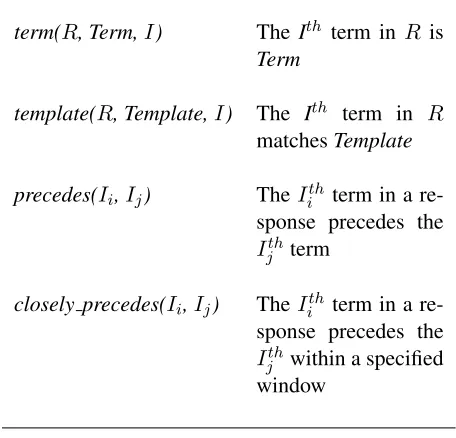
In this paper, I will describe a set of such marking rules as a “mark scheme”, so Amati aims to support a human marker in hand crafting a mark scheme, which is made up of a set of marking rules. In Am-ati, the mark schemes are constructed from sets of prolog rules, which attempt to classify the responses as either correct or incorrect. The rule syntax closely follows that of Junker et al. (1999), using the set of predicates shown in figure 1.
The main predicate for recognising keywords is term(R, Term, I), which is true when Term is the Ith term in the response R. Here, we use “term” to mean a word or token in the response, subject to simple spelling correction. This correction is based upon a Damerau-Levenshtein (Damerau, 1964) edit distance of 1, which represents the replacement, ad-dition or deletion of a single character, or a transpo-sition of two adjacent characters. So for example, if Rrepresented the student response:
(4) no force ballanced with gravity
thenterm(R, balanced, 3)would be true, as the3rd token inRisballanced, and at most 1 edit is needed to transformballancedtobalanced.
The predicate template allows a simple form of stemming (Porter, 1980). The statementtemplate(R, Template, I) is true ifTemplate matches at the be-ginning of theIth token in R, subject to the same spelling correction as term. So for example, the statement:
template(R, balanc, 3)
would match example (4), becausebalancis a sin-gle edit fromballanc, which itself matches the be-ginning of the 3rd token inR. (Note that it would not match as a term, becauseballance is two edits frombalanc.) Such templates allow rules to be writ-ten which match, for example, balance, balanced, balancingand so on.
The predicates precedes and closely precedes, and the index terms, which appear as the variables I andJ in figure 1, capture a level of linear prece-dence, which allow the rules to recognise a degree of linguistic structure. As discussed in section 2, tech-niques which do not capture some level of word or-der are insufficiently expressive for the task of rep-resenting mark schemes. However, a full grammat-ical analysis also appears to be unnecessary, and in fact can lead to ambiguity. Correct responses to the Rocks question (see table 1) required the students to identify that the necessary conditions to form the rock arehigh temperature andhigh pressure. Both temperatureandpressure needed to be modified to earn the mark. Responses such as (5) should be marked correct, with an assumption that the modi-fier should distribute over the conjunction.
(5) high temperature and pressure
While the precedence predicate is adequate to capture this behaviour, using a full parser creates an ambiguity between the analyses (6) and (7).
(6) (high (pressure)) and temperature ×
(7) (high (pressure and temperature)) √ The example suggest that high accuracy can be diffi-cult to achieve by systems which commit to an early, single interpretation of the ambiguous text.
term(R, oil,I)∧
term(R, less,J)∧
template(R, dens,K) precedes(I,J)→correct(R)
which would award the correct marks to responses (8) and (9):
(8) oil is less dense than water √
(9) water is less dense than oil ×
The use of a template also ensures the correct mark is awarded to the common response (10), which should also be marked as correct:
(10) oil has less density than water
2.2 Incremental rule authoring
The Amati system is based on a bootstrapping scheme, which allows an author to construct a rule-set by marking student responses in increments of 50 responses at a time, while constructing marking rules which reflect the marker’s own judgements. As the marker develops the mark scheme, he or she can correct the marks awarded by the existing mark scheme, and then edit the mark scheme to more ac-curately reflect the intended marks.
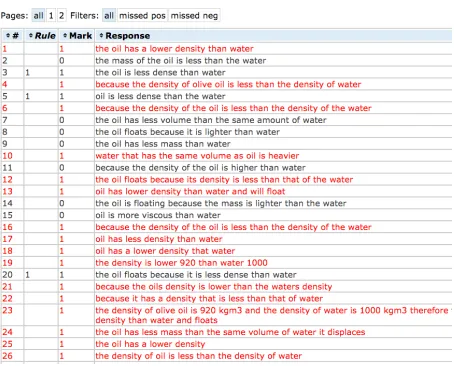
The support for these operations are illustrated in figures 2 and 3. To make the system more usable by non-specialists (that is, non-specialists in com-puting, rather than non-specialists in the subject be-ing taught), the authors are not expected to work di-rectly with prolog. Rather, rules are presented to the user via online forms, as shown in figure 2. As each rule is developed, the system displays to the user the responses which the rule marks as correct.
As increasingly large subsets of the student re-sponses are marked, the system displays the set of imported responses, the mark that the current mark scheme awards, and which rule(s) match agains each response (figure 3). This allows the mark scheme author to add or amend rules as necessary.
2.3 Rule Induction
[image:4.612.314.544.56.185.2]As the marker constructs an increasingly large col-lection of marked responses, it can be useful to use the marked responses to induce further rules auto-matically. Methods for learning relational rules to
Figure 2: Form for entering marking rules
Figure 3: Application of rule to theOilresponse set
[image:4.612.314.541.242.425.2]Our use of ILP to support markers in develop-ing rules has several parallels with the Powergrad-ing project (Basu et al., 2013). Both our work and that of Basu et al. focus on using NLP techniques primarily to support the work of a human marker, and reduce marker effort. Basu et al. take an ap-proach whereby student responses are clustered us-ing statistical topic detection, with the marker then able to allocate marks and feedback at the cluster level, rather than at the individual response level. Similarly, the aim of Amati is that markers should be able to award marks by identifying, via generated rules, commonly occurring phrases. The use of such phrases can then be analysed at the cohort level (or at least, incrementally at the cohort level), rather than at the individual response level.
In practice, we found that markers were likely to use the predicted rules as a “first cut” solution, to gain an idea of the overall structure of the final mark scheme. The marker could then concentrate on developing more fine-grained rules to improve the mark scheme accuracy. This usage appears to reflect that found by Basu et al., of using the machine learn-ing techniques to automatically identify groups of similar groups of responses. This allows the marker to highlight common themes and frequent misunder-standings.
3 Evaluation
The aim of the evaluation was to determine whether a ruleset built using Amati could achieve perfor-mance comparable with human markers. As such, there were two main aims. First, to determine whether the proposed language was sufficiently ex-pressive to build successful mark schemes, and sec-ond, to determine how well a mark scheme devel-oped using the Amati system would compare against a human marker.
3.1 Training and test set construction
A training set and a test set of student responses were built from eight questions taken from an entry-level science module, shown in table 1. Each student re-sponse was to be marked as either correct or incor-rect. Two sets of responses were used, which were built from two subsequent presentations of the same module. Amati was used to build a mark scheme
us-Short name Question text
Sandstone A sandstone observed in the field contains well-sorted, well rounded, finely pitted and reddened grains. What does this tell you about the origins of this rock?
Snowflake A snowflake falls vertically with a constant speed. What can you say about the forces acting on the snowflake?
Charge If the distance between two electri-cally charged particles is doubled, what happens to the electric force between them?
Rocks Metamorphic rocks are existing rocks that have “changed form” (metamorphosed) in a solid state. What conditions are necessary in order for this change to take place? Sentence What is wrong with the following
sentence?A good idea.
Oil The photograph (not shown here) shows a layer of oil floating on top of a glass of water. Why does the oil float?
Table 1: The questions used
ing a training set of responses from the 2008 student cohort, and then that scheme was applied to an un-seen test set constructed from the responses to the same questions from the 2009 student cohort.
cost of constructing a corpus in this way would usu-ally be prohibitive, relying as it does on subject ex-perts both to provide the preliminary marks, and to provide a final judgement in the reconciliation phase. In this case, the initial marks (including the ability to discuss in the case of a dispute) were gen-erated as part of the standard marking process for student assessment in the University4.
3.2 Effectiveness of authored mark schemes
To investigate the expressive power of the represen-tation language, a set of mark schemes for the eight questions shown in table 1 were developed using the Amati system. The training data was used to build the rule set, with regular comparisons against the gold standard marks. The mark scheme was then applied to the test set, and the marks awarded com-pared against the test set gold standard marks.
The results are shown in table 2. The table shows the total number of responses per question, and the accuracy of the Amati rule set applied to the unseen data set. So for example, the Amati rule set correctly marked98.42%of the 1711 responses to the Sand-stonequestion. Note that the choice of accuracy as the appropriate measure of success is determined by the particular application. In this case, the impor-tant measure is how many responses are marked cor-rectly. That is, it is as important that incorrect an-swers are marked as incorrect, as it is that correct answers are marked as correct.
To compare the performance of the Amati rule-set against the human expert, we have used Krip-pendorf’s α measure, implemented in the python Natural Language Toolkit library (Bird et al., 2009) following Artstein and Poesio’s (2008) presenta-tion. The rightmost column of table 2 shows the αmeasure between the Amati ruleset and the post-reconciliation marks awarded by the human expert. This column shows a higher level of agreement than was obtained with human markers alone. The 4We have not presented inter-annotator agreement measures here, as these are generally only meaningful when annotators have worked independently. This model of joint annotation with a reconciliation phase is little discussed in the literature, although this is a process used by Farwell et al. (2009). Our annotation process differed in that the reconciliation phase was carried out face to face following each round of annotation, in contrast to Farwell et al.’s, which allowed a second anonymous vote after the first instance.
Question #responses accuracy/% α/%
Sandstone 1711 98.42 97.5
Snowflake 2057 91.0 81.7
Charge 1127 98.89 97.6
Rocks 1429 99.00 89.6
Sentence 1173 98.19 97.5
[image:6.612.313.535.54.168.2]Oil 817 96.12 91.5
Table 2: Accuracy of the Amati mark schemes on unseen data, and the Krippendorf αrating between the marks awarded by Amati and the gold standard
agreement achieved by independent human markers ranged from a maximum ofα = 88.2%to a mini-mum ofα = 71.2%, which was the agreement on marks awarded for thesnowflakequestion. It is no-table that the human marker agreement was worst on the same question that the Amati-authored rule-set performed worst on; we discuss some issues that this question raises in section 4.3.
The marks awarded by the marker supported with Amati therefore aligned more closely with those of the human expert than was achieved between inde-pendent markers. This suggests that further devel-opment of computer support for markers is likely to improve overall marking consistency, both across the student cohort, and by correspondence with the official marking guidance.
4 Observations on authoring rulesets
It is clear from the performance of the different rule sets that some questions are easier to generate mark schemes for than others. In particular, the mark scheme authored on the responses to thesnowflake question performed with much lower accuracy than the other questions. This section gives a qualitative overview of some of the issues which were observed while authoring the mark schemes.
4.1 Modification of generated rules
mark theRocksquestion was:
template(R, bur,I)∧
template(R, hea,J)→correct(R)
As the official marking guidance suggests thatHigh temperature and pressureis an acceptable response, heacan easily be interpreted asheat. However, it is not immediately clear whatburrepresents. In fact, a domain expert would probably recognise this as a shortened form of buried(as the high pressure, the second required part of the solution, can result from burial in rock). As the training set does not contain terms with the same first characters asburial, such as burnished, Burghundy or burlesque, then this term matches. However, a mark scheme author might pre-fer to edit the rule slightly into something more read-able and so maintainread-able:
template(R, buri,I)∧
term(R, heat,J)→correct(R)
so that eitherburiedorburialwould be matched, and to make the recognition ofheatmore explicit.
A more complex instance of the same phe-nomenon is illustrated by the generated rule:
term(R, high,I)∧
term(R, temperature,J)→correct(R)
Although the requirement for the terms high and temperatureis clear enough, there is no part of this rule that requires that the student also mentionhigh pressure. This has come about because all the stu-dent responses that mention high temperature also explicitly mention pressure. Because Progol and Aleph use a greedy coverage algorithm, in this case Amati did not need to add an additional rule to cap-ture . Again, the mark scheme author would proba-bly wish to edit this rule to give:
term(R, high,I)∧
term(R, temperature,J)∧
term(R, pressure,K)∧
precedes(I,J)→correct(R)
which covers the need forhigh to precede temper-ature, and also contain a reference to pressure. A similar case, raised by the same question, is the fol-lowing proposed rule:
term(R, high,I)∧
term(R, pressure,J)∧
term(R, and,K)∧
precedes(I,K)→correct(R)
which requires a conjunction, but makes no mention oftemperature (or heat or some other equivalent). In this case, the responses (11) and (12):
(11) (high (pressure and temperature)) √
(12) (high (pressure and heat)) √
are both correct, and both appeared amongst the stu-dent responses. However, there were no incorrect responses following a similar syntactic pattern, such as, for example, (13) or (14):
(13) high pressure and altitude ×
(14) high pressure and bananas ×
Students who recognised that high pressure and something elsewere required, always got the some-thing elseright. Therefore, the single rule above had greater coverage than rules that looked individually forhigh pressure and temperatureorhigh pressure and heat.
This example again illustrates the Amati philoso-phy that the technology is best used to support hu-man markers. By hand-editing the proposed solu-tions, the marker ensures that the rules are more in-tuitive, and so can be more robust, and more main-tainable in the longer term. In this case, an author might reasonably rewrite the single rule into two:
term(R, high,I)∧
term(R, pressure,J)∧
term(R, temperature,K)∧
precedes(I,K)→correct(R)
term(R, high,I)∧
term(R, pressure,J)∧
term(R, heat,K)∧
precedes(I,K)→correct(R)
4.2 Spelling correction
It is questionable whether spelling correction is al-ways appropriate. A question used to assess knowl-edge of organic chemistry might require the term butane to appear in the solution. It would not be appropriate to mark a response containing the to-ken butene(a different compound) as correct, even thoughbutenewould be an allowable misspelling of butane according to the given rules. On the other hand, a human marker would probably be inclined to mark responses containingbuttaneorbutanas cor-rect. These are also legitimate misspellings accord-ing the table, but are less likely to be misspellaccord-ings of butene.
The particular templates generated reflect the lin-guistic variation in the specific datasets. A template such as temp, intended to cover responses contain-ing temperature (for example), would also poten-tially cover temporary, tempestuous, temperamen-tal and so on. In fact, when applied to large sets of homogenous response-types (such as multiple re-sponses to a single question), the vocabulary used across the complete set of responses turns out to be sufficiently restricted for meaningful templates to be generated. It does not follow that this hypoth-esis language would continue to be appropriate for datasets with a wider variation in vocabulary.
4.3 Diversity of correct responses
As illustrated in table 2, theSnowflakequestion was very tricky to handle, with lower accuracy than the other questions, and lower agreement with the gold standard. The following are some of the student re-sponses:
(15) they are balanced
(16) the force of gravity is in balance with air resis-tance
(17) friction is balancing the force of gravity
(18) only the force of gravity is acting on the hail-stone and all forces are balanced
The module chair considered responses (15), (16) and (17) to be correct, and response (18) to be incor-rect.
The most straightforward form of the answer is along the lines of response (15). In this case, there are no particular forces mentioned; only a general comment about the forces in question. Similar cases werethere are no net forces, all forces balance, the forces are in equilibriumand so on.
However, responses (16) and (17) illustrate that in many cases, the student will present particular examples to attempt to answer the question. In these cases, both responses identify gravity as one of the acting forces, but describe the counteracting force differently (as air resistance and friction re-spectively). A major difficulty in marking this type of question is predicting the (correct) examples that students will use in their responses, as each correct pair needs to be incorporated in the mark schemes. A response suggesting that air resistance counter-actsdragwould be marked incorrect. As stated pre-viously, developing robust mark schemes requires that mark scheme authors use large sets of previous student responses, which can provide guidance on the range of possible responses.
Finally, response (18) illustrates a difficult re-sponse to mark (for both pattern matchers and lin-guistic solutions). The response consists of two con-joined clauses, the second of which, all forces are balanced, is in itself a correct answer. It is only in the context of the first clause that the response is marked incorrect, containing the error that it isonly
the force of gravitywhich acts.
experienced authors develop skills in setting ques-tions which are appropriate for human markers.
4.4 Anaphora Ambiguity
The examples raise some interesting questions about how anaphora resolution should be dealt with. Two responses to theoilquestion are:
(19) The oil floats on the water because it is lighter
(20) The oil floats on the water because it is heavier
These two responses appear to have contradictory meanings, but in fact are both marked as correct. This initially surprising result arises from the am-biguity in the possible resolutions of the pronounit:
(21) [The oil]i floats on the water because iti is lighter.
(22) The oil floats on [the water]j because itj is heavier.
When marking these responses, the human mark-ers followed a general policy of giving the benefit of the doubt, and, within reasonable limits, will mark a response as correct if any of thepossible interpreta-tions would be correct relative to the mark scheme.
As with the ambiguous modifier attachment seen in responses (6) and (7), this example illustrates that using a different (possibly better) parser is unlikely to improve the overall system performance. Re-sponses such (21) and (22) are hard for many parsers to handle, because an early commitment to a single interpretation can assume that it must refer to the oilorthe water. Again, this example demonstrates that a more sophisticated approach to syntactic am-biguity is necessary if a parsing-based system is to be used. (One possible approach might be to use un-derspecification techniques (K¨onig and Reyle, 1999; van Deemter and Peters, 1996) and attempt to reason with the ambiguous forms.)
5 Discussion and Conclusions
We have presented a system which uses informa-tion extracinforma-tion techniques and machine learning to support human markers in the task of marking free text responses to short answer questions. The results
suggest that a system such as Amati can help mark-ers create accurate, reusable mark schemes.
The user interface to Amati was developed in col-laboration with experienced markers from the Open University’s Computing department and Science de-partment, who both gave input into the requirements for an effective marking system. We intend to carry out more systematic analyses of the value of us-ing such systems for markus-ing, but informally, we have found that a set of around 500-600 responses was enough for an experienced marker to feel satis-fied with the performance of her own authored mark scheme, and to be prepared to use it on further un-seen cases. (This number was for the Snowflake question, which contained approximately half cor-rect responses. For the other questions, the marker typically required fewer responses.)
The work described in this paper contrasts with the approach commonly taken in automatic mark-ing, of developing mechanisms which assign marks by comparing student responses to one or more tar-get responses created by the subject specialist (Ziai et al., 2012). Such systems have proven effective where suitable linguistic information is compared, such as the predicate argument structure used by c-rater (Leacock and Chodorow, 2003), or similarity between dependency relationships, as used by Au-toMark (now FreeText (Mitchell et al., 2002)) and Mohler et al. (2011). Our own experiments with FreeText found that incorrect marks were often a re-sult of an inappropriate parse by the embedded Stan-ford parser (Klein and Manning, 2003)), as illus-trated by the parses (6) and (7). In practice, we have found that for the short answers we have been con-sidering, pattern based rules tend to be more robust in the face of such ambiguity than a full parser.
Acknowledgments
The author would like to thank Sally Jordan for her help in collecting the students’ data, for answering questions about marking as they arose and for mak-ing the data available for use in this work. Also, David King who developed the Amati system, and Rita Tingle who provided feedback on the usabil-ity of the system from a marker’s perspective. We would also like to thank the anonymous reviewers for their valuable suggestions on an earlier draft of the paper.
References
James Stuart Aitken. 2002. Learning information extrac-tion rules: An inductive logic programming approach. InECAI, pages 355–359.
Ron Artstein and Massimo Poesio. 2008. Inter-coder agreement for computational linguistics. Computa-tional Linguistics, 34(4):555–596.
Stephen P Balfour. 2013. Assessing writing in MOOCs: Automated essay scoring and calibrated peer review. Research & Practice in Assessment, 8(1):40–48. Sumit Basu, Chuck Jacobs, and Lucy Vanderwende.
2013. Powergrading: A clustering approach to am-plify human effort for short answer grading. Transac-tions of the Association for Computational Linguistics, 1:391–402.
Steven Bird, Ewan Klein, and Edward Loper. 2009. Nat-ural Language Processing with Python. O’Reilly Me-dia.
Steven Burrows, Iryana Gurevych, and Benno Stein. 2015. The eras and trends of automatic short an-swer grading. International Journal of Artificial In-telligence in Education, 25(1):60–117.
Philip G. Butcher and Sally E. Jordan. 2010. A compari-son of human and computer marking of short free-text student responses.Computers and Education. Mary Elaine Califf and Raymond J. Mooney. 1997.
Re-lational learning of pattern-match rules for informa-tion extracinforma-tion. In T.M. Ellison, editor,Computational Natural Language Learning, pages 9–15. Association for Computational Linguistics.
F. J. Damerau. 1964. Technique for computer detection and correction of spelling errors. Communications of the Association of Computing Machinery, 7(3):171– 176.
David Farwell, Bonnie Dorr, Rebecca Green, Nizar Habash, Stephen Helmreich, Eduard Hovy, Lori Levin, Keith Miller, Teruko Mitamura, Owen Ram-bow, Florence Reeder, and Advaith Siddharthan.
2009. Interlingual annotation of multilingual text cor-pora and framenet. In Hans C. Boas, editor, Multi-lingual FrameNets in Computational Lexicography : Methods and Applications. Mouton de Gruyter, Berlin. Lorraine R Gay. 1980. The comparative effects of multiple-choice versus short-answer tests on retention. Journal of Educational Measurement, 17(1):45–50. Debra T. Haley. 2008. Applying Latent Semantic
Analy-sis to Computer AsAnaly-sisted Assessment in the Computer Science Domain: A Framework, a Tool, and an Evalu-ation. Ph.D. thesis, The Open University.
Sally Jordan and Tom Mitchell. 2009. E-assessment for learning? The potential of short free-text questions with tailored feedback.British Journal of Educational Technology, 40(2):371–385.
Markus Junker, Michael Sintek, and Matthias Rinck. 1999. Learning for text categorization and informa-tion extracinforma-tion with ILP. In J. Cussens, editor, Pro-ceedings of the First Workshop Learning Language in Logic, pages 84–93.
Judy Kay, Peter Reimann, Elliot Diebold, and Bob Kum-merfeld. 2013. MOOCs: So Many Learners, So Much Potential. . . .IEEE Intelligent Systems, 3:70–77. Dan Klein and Christopher D. Manning. 2003.
Accu-rate unlexicalized parsing. InProceedings of the 41st Meeting of the Association for Computational Linguis-tics, pages 423–430. Association for Computational Linguistics.
Esther K¨onig and Uwe Reyle. 1999. A general rea-soning scheme for underspecified representations. In Hans J¨urgen Ohlbach and U. Reyle, editors, Logic, Language and Reasoning. Essays in Honour of Dov Gabbay, volume 5 ofTrends in Logic. Kluwer. T. K. Landauer, D. Laham, and P. W. Foltz. 2003.
Auto-mated scoring and annotation of essays with the intel-ligent essay assessor. In M. Shermis and J. Burstein, editors,Automated essay scoring: a cross-disciplinary approach, pages 87–112. Lawrence Erlbaum Asso-ciates, Inc.
Nada Lavraˇc and Saˇso Dˇzeroski. 1994. Inductive Logic Programming. Ellis Horwood, New York.
Claudia Leacock and Martin Chodorow. 2003. C-rater: Automated scoring of short-answer questions. Com-puters and the Humanities, 37(4):389–405.
Mitchell P Marcus, Mary Ann Marcinkiewicz, and Beat-rice Santorini. 1993. Building a large annotated cor-pus of English: The Penn Treebank. Computational linguistics, 19(2):313–330.