UNITOR: Aspect Based Sentiment Analysis with Structured Learning
Giuseppe Castellucci(†), Simone Filice(‡), Danilo Croce(?), Roberto Basili(?)(†) Dept. of Electronic Engineering
(‡) Dept. of Civil Engineering and Computer Science Engineering (?) Dept. of Enterprise Engineering
University of Roma, Tor Vergata, Italy
{castellucci,filice}@ing.uniroma2.it;{croce,basili}@info.uniroma2.it
Abstract
In this paper, theUNITORsystem partici-pating in the SemEval-2014 Aspect Based Sentiment Analysis competition is pre-sented. The task is tackled exploiting Ker-nel Methods within the Support Vector Machine framework. The Aspect Term Extraction is modeled as a sequential tag-ging task, tackled through SVMhmm. The Aspect Term Polarity, Aspect Category and Aspect Category Polarity detection are tackled as a classification problem where multiple kernels are linearly combined to generalize several linguistic information. In the challenge,UNITORsystem achieves good results, scoring in almost all rank-ings between the2nd and the8thposition within about 30 competitors.
1 Introduction
In recent years, many websites started offering a high level interaction with users, who are no more a passive audience, but can actively produce new contents. For instance, platforms like Amazon1or
TripAdvisor2 allow people to express their
opin-ions on products, such as food, electronic items or clothes. Obviously, companies are interested in understanding what customers think about their brands and products, in order to implement correc-tive strategies on products themselves or on mar-keting solutions. Performing an automatic analy-sis of user opinions is then a very hot topic. The automatic extraction of subjective information in text materials is generally referred as Sentiment Analysis or Opinion Mining and it is performed This work is licensed under a Creative Commons At-tribution 4.0 International Licence. Page numbers and pro-ceedings footer are added by the organisers. Licence details: http://creativecommons.org/licenses/by/4.0/
1http://www.amazon.com 2http://www.tripadvisor.com
via natural language processing, text analysis and computational linguistics techniques. Task 4 in SemEval2014edition3(Pontiki et al., 2014) aims
at promoting research on Aspect Based Opinion Mining(Liu, 2007), which is approached as a cas-cade of 4 subtasks. For example, let us consider the sentence:
The fried rice is amazing here. (1) TheAspect Term Extraction(ATE) subtask aims at finding words suggesting the presence of as-pects on which an opinion is expressed, e.g.
fried ricein sentence 1. In theAspect Term Polarity (ATP) task the polarity evoked for each aspect is recognized, i.e. apositivepolarity is expressed with respect tofried rice. In the
Aspect Category Detection (ACD) task the cate-gory evoked in a sentence is identified, e.g. the
foodcategory in sentence 1). In theAspect Cat-egory Polarity(ACP) task the polarity of each ex-pressed category is recognized, e.g. apositive
category polarity is expressed in sentence 1. Different strategies have been experimented in recent years. Classical approaches are based on machine learning techniques and rely on sim-ple representation features, such as unigrams, bi-grams, Part-Of-Speech (POS) tags (Pang et al., 2002; Pang and Lee, 2008; Wiebe et al., 1999). Other approaches adopt sentiment lexicons in or-der to exploit some sort of prior knowledge about the polar orientation of words. These resources are usually semi-automatically compiled and provide scores associating individual words to sentiments or polarity orientation.
In this paper, the UNITOR system participat-ing to the SemEval-2014Aspect Based Sentiment Analysis task (Pontiki et al., 2014) is presented. The ATE task is modeled as a sequential labeling problem. A sentence is considered as a sequence of tokens: a Markovian algorithm is adopted in
3http://alt.qcri.org/semeval2014/task4/
order to decide what is an aspect term . All the remaining tasks are modeled as multi-kernel clas-sification problems based on Support Vector Ma-chines (SVMs). Various representation have been exploited using proper kernel functions (Shawe-Taylor and Cristianini, 2004a). Tree Kernels (Collins and Duffy, 2001; Moschitti et al., 2008; Croce et al., 2011) are adopted in order to capture structural sentence information derived from the parse tree. Moreover, corpus-driven methods are used in order to acquire meaning generalizations in an unsupervised fashion (e.g. see (Pado and La-pata, 2007)) through the analysis of distributions of word occurrences in texts. It is obtained by the construction of a Word Space (Sahlgren, 2006), which provides a distributional model of lexical semantics. Latent Semantic Kernel (Cristianini et al., 2002) is thus applied within such space.
In the remaining, in Section 2 and 3 we will ex-plain our approach in more depth. Section 4 dis-cusses the results in the SemEval-2014 challenge.
2 Sequence Labeling for ATE
The Aspect Term Extraction (ATE) has been mod-eled as a sequential tagging process. We con-sider each token representing the beginning (B), the inside (I) or the outside (O) of an argu-ment. Following this IOBnotation, the resulting ATE representation of a sentence like “The[fried rice]ASPECTTERMis amazing here” can be expressed by labeling each word according to its relative po-sition, i.e.: [The]O [fried]B [rice]I [is]O [
amaz-ing]O[here]O.
The ATE task is thus a labeling process that determines the individual (correct IOB) class for each token. The labeling algorithm used is
SV Mhmm (Altun et al., 2003)4: it combines
both a discriminative approach to estimate the probabilities in the model and a generative ap-proach to retrieve the most likely sequence of tags that explains a sequence. Given an input sequence x= (x1. . . xl) ∈ X of feature vec-tors x1. . . xl, the model predicts a tag sequence y = (y1. . . yl) ∈ Y after learning a linear dis-criminant functionF : X × Y → Rover input-output pairs. The labelingf(x)is thus defined as:
f(x) = arg maxy∈YF(x,y;w)and it is obtained by maximizing F over the response variable, y, for a specific given inputx. F is linear in some
4www.cs.cornell.edu/People/tj/svm light/svm hmm.html
combined feature representation of inputs and out-putsΦ(x,y), i.e.F(x,y;w) =hw,Φ(x,y)i.
InSV Mhmmthe observationsx1. . . x
lcan be naturally expressed in terms of feature vectors. In particular, we modeled each word through a set of lexical and syntactic features, as described in the following section.
2.1 Modeling Features for ATE
In the discriminative view of SV Mhmm, each word is represented by a feature vector, describ-ing its different observable properties. For in-stance, the wordricein the example 1 is modeled through the following features: Lexical features: its lemma (rice) and POS tag (NN);Prefixes and Suffixes: the first nand the last m characters of the word (n = m = 3) (e.g. ric andice); Con-textual features: the left and right lexical contexts represented by the 3 words before (BEGIN::BB
the::DTfried::JJ) and after (is::VBZamazing::JJ
here::RB); the left and right syntactic contexts as the POS bi-grams and tri-grams occurringbefore
(i.e. BB DT DT JJ BB DT JJ) and after (i.e.
VBZ JJ JJ RB VBZ JJ RB) the word; Gram-matical features: features derived from the de-pendency graph associated to the sentence, i.e. boolean indicators that capture if the token is in-volved in aSubj,ObjorAmodrelation in the cor-responding graph.
3 Multiple Kernel Approach for Polarity and Category Detection
We approached the remaining three subtasks of the pipeline as classification problems with multiple kernels, in line with (Castellucci et al., 2013). We used Support Vector Machines (SVMs) (Joachims, 1999), a maximum-margin classifier that realizes a linear discriminative model. The kernelized ver-sion of SVM learns from instancesxi exploiting rich similarity measures (i.e.the kernel functions)
K1. . . Kn can be independently defined and the combinations K1 +K2 + . . . of multiple func-tions can be integrated into SVM as they are still kernels. The next section describes the represen-tations as well as the kernel functions.
3.1 Representing Lexical Information
The Bag of Word (BoW) is a simple
repre-sentation reflecting the lexical information of the sentence. Each text is represented as a vector whose dimensions correspond to different words, i.e. they represent a boolean indicator of the pres-ence or not of a word in the text. The resulting kernel function is the cosine similarity (or linear kernel) between vector pairs, i.e. linBoW. In line
with (Shawe-Taylor and Cristianini, 2004b) we in-vestigated the contribution of the Polynomial Ker-nel of degree 2,poly2
BoW as it defines an implicit
space where also feature pairs, i.e. words pairs, are considered.
In the polarity detection tasks, several polarity lexicons have been exploited in order to have use-ful hints of the intrinsic polarity of words. We adopted MPQA Subjectivity Lexicon5(Wilson et
al., 2005) and NRC Emotion Lexicon (Moham-mad and Turney, 2013): they are large collection of words provided with the underlying emotion they generally evoke. While the former consid-ers only positive and negative sentiments, the lat-ter considers also eight primary emotions, orga-nized in four opposing pairs, joy-sadness, anger-fear, trust-disgust, and anticipation-surprise. We define theLexicon Based(LB) vectors as follows. For each lexicon, let E = {e1, ..., e|E|} be the emotion vocabulary defined in it. Letw ∈ sbe a word occurring in sentence s, with I(w, i) be-ing the indicator function whose output is 1 ifw
is associated to the emotion label ei, or 0 other-wise. Then, given a sentences, eachei, i.e. a di-mension of the emotional vocabularyE, receives a scoresi=Pw∈sI(w, i). Each sentence produces a vector~s∈R|E|, for each lexicon, on which a lin-ear kernellinLBis applied.
3.2 Generalizing Lexical Information
Another representation is used to generalize the lexical information of each text, without exploit-ing any manually coded resource. Basic lexical information is obtained by a co-occurrenceWord Space(WS) built accordingly to the methodology
5http://mpqa.cs.pitt.edu/lexicons/subj lexicon
described in (Sahlgren, 2006) and (Croce and Pre-vitali, 2010). A word-by-context matrixM is ob-tained through a large scale corpus analysis. Then theLatent Semantic Analysis (Landauer and Du-mais, 1997) technique is applied as follows. The matrixM is decomposed through Singular Value Decomposition (SVD) (Golub and Kahan, 1965) into the product of three new matrices: U,S, and
V so that S is diagonal and M = USVT. M is then approximated by Mk=UkSkVkT, where only the first k columns of U and V are used, corresponding to the firstk greatest singular val-ues. This approximation supplies a way to project a generic wordwiinto thek-dimensional space us-ingW =UkSk1/2, where each row corresponds to the representation vectorw~i. The result is that ev-ery word is projected in the reduced Word Space and a sentence is represented by applying an addi-tive model as an unbiased linear combination. We adopted these vector representations using a linear kernel, as in (Cristianini et al., 2002), i.e. linWS
and a Radial Basis Function KernelrbfWS.
In Aspect Category Detection, and more gen-erally in topic classification tasks, some specific words can be an effective indicator of the under-lying topic. For instance, in the restaurant do-main, the word tasty may refer to the quality of food. These kind of word-topic relationships can be automatically captured by a Bag-of-Word ap-proach, but with some limitations. As an exam-ple, a BoW representation may not capture syn-onyms or semantically related terms. This lack of word generalization is partially compensated by the already discussed Word Space. However, this last representation aims at capturing the sense of an overall sentence, and no particular rele-vance is given to individual words, even if they can be strong topic indicators. To apply a model-ing more focused on topics, we manually selected
mseed words {σ1, . . . , σm}that we consider re-liable topic-indicators, for example spaghettifor
food. Notice that for every seedσi, as well as for every word w the similarity functionsim(σi, w) can be derived from the Word Space represen-tations ~σi and ~w, respectively. What we need is a specific seed-based representation reflecting the similarity between topic indicators and sen-tences s. Given the words w occurring ins, the
Seed-Oriented(SO) representation ofsis an m -dimensional vectorso~(s) whose components are:
seeds σ refer to a set of evoked topics (i.e. as-pect categories such asfood) Σ1, ...,Σt, we can define a t-dimensional vector ~to(s)called Topic-Oriented (TO) representation for s, whose fea-tures are: toi(s) = maxw∈s,σk∈Σi sim(σk, w).
The adopted word similarity function sim(·,·)
over ~so(s)and ~to(s)depends on the experiments. In the unconstrained setting, i.e. the Word Space Topic Oriented WSTOsystem,sim(·,·) consists in the dot product over the Word Space represen-tations ~σi and ~w. In the constrained casesim(·,·) corresponds to the Wu & Palmer similarity based on WordNet (Wu and Palmer, 1994), in the so called WordNet Seed Oriented WNSO system. The Radial Basis Function (RBF) kernel is then applied onto the resulting feature vectors~to(s)and
~
so(s)in therbfWSTOandrbfWNSO, respectively.
3.3 Generalizing Syntactic Information
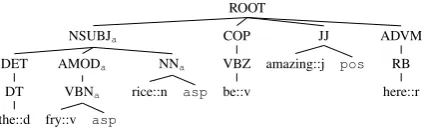
In order to exploit the syntactic information,Tree Kernelfunctions proposed in (Collins and Duffy, 2001) are adopted. Tree kernels exploit syntactic similarity through the idea of convolutions among syntactic tree substructures. Any tree kernel evalu-ates the number of common substructures between two treesT1andT2without explicitly considering the whole fragment space. Many tree represen-tations can be derived to represent the syntactic information, according to different syntactic theo-ries. For this experiment, dependency formalism of parse trees is employed to capture sentences syntactic information. As proposed in (Croce et al., 2011), the kernel function is applied to ex-amples modeled according the Grammatical Rela-tion Centered Tree representaRela-tion from the orig-inal dependency parse structures, shown in Fig. 1: non-terminal nodes reflect syntactic relations, such as NSUBJ, pre-terminals are the Part-Of-Speech tags, such as nouns, and leaves are lex-emes, such asrice::nandamazing::j6. In each
ex-ample, the aspect terms and the covering nodes are enriched with aasuffix and all lexical nodes are duplicated by the nodeaspin order to reduce data sparseness. Moreover, prior information derived by the lexicon can be injected in the tree, by du-plicating all lexical nodes annotated in the MPQA Subjectivity Lexicon, e.g. the adjectiveamazing, with a node expressing the polarity (pos).
Given two tree structures T1 and T2, the
6Each word is lemmatized to reduce data sparseness, but
they are enriched with POS tags.
ROOT
ADVM RB here::r JJ
pos
amazing::j COP
VBZ be::v NSUBJa
NNa
asp
rice::n AMODa
VBNa
asp
fry::v DET
[image:4.595.311.524.55.120.2]DT the::d
Figure 1: Tree representation of the sentence 1.
Tree Kernel formulation is reported hereafter:
T K(T1, T2) = Pn1∈NT1
P
n2∈NT2 ∆(n1, n2) where NT1 and NT2 are the sets of the T1’s and
T2’s nodes, respectively and∆(n1, n2)is equal to the number of common fragments rooted in then1 andn2 nodes. The function∆determines the na-ture of the kernel space. In the constrained case the Partial Tree Kernel formulation (Moschitti, 2006) is used, i.e. ptkGRCT. In the unconstrained
set-ting the Smoothed Partial Tree Kernel formulation (Croce et al., 2011) is adopted to emphasizes the lexicon in the Word Space, i.e. the sptkGRCT. It
computes the similarity between lexical nodes as the similarity between words in the Word Space. So, this kernel allows a generalization both from a syntactic and lexical point of view.
4 Results
In this Section the experimental results of the
UNITORsystem in the four different subtasks of Semeval 2014 competition are discussed. Teams were allowed to submit two different outcomes for each task: constrainedsubmissions (expressed by the suffix C in all the tables) are intended to mea-sure systems ability to learn sentiment analysis models only over the provided data;unconstrained
(expressed by the suffix U in all the tables) sub-missions allows teams to exploit additional train-ing data. The first two tasks, i.e. ATE and ATP, are defined on thelaptopandrestaurantdomains, while the last two tasks, i.e. ACD and ACP, are defined for therestaurantdataset only.
(e.g., useful for verbs): 40,000 dimensional vec-tors are thus derived for each target. The Singular Value Decomposition is applied and the space di-mensionality is reduced tok= 250. Two corpora are used for generating two different Word Spaces, one for the laptop and one for the restaurant do-main. The Opinosis dataset (Ganesan et al., 2010) is used to build the electronic domain Word Space, while the restaurant domain corpus adopted is the TripAdvisor dataset7. Both provided data and
in-domain data are first pre-processed through the Stanford Parser (Klein and Manning, 2003) in or-der to obtain POS tags or Dependency Trees.
A modified version of LibSVM has been adopted to implement Tree Kernel. Parameters such as the SVM regularization coefficientC, the kernel parameters (for instance the degree of the polynomial kernel) have been selected after a tun-ing stage based on a 5-fold cross validation.
4.1 Aspect Term Extraction
The Aspect Term Extraction task is modeled as a sequential labeling problem. The feature represen-tation described in Section 2.1, where each token is associated to a specific target class according to theIOBnotation, is used in theSV Mhmm learn-ing algorithm. In the constrained version of the
UNITOR system only the training data are used to derive features. In the unconstrained case the
UNITOR system exploits lexical vectors derived from a Word Space. Each token feature repre-sentation is, in this sense, augmented through dis-tributional vectors derived from the Word Spaces described above. Obviously, the Opinosis Word Space is used in the laptop subtask, while the Tri-pAdvisor Word Space is used in the restaurant sub-task. These allow the system to generalize the lex-ical information, enabling a smoother match be-tween words during training and test phases, hope-fully capturing similarity phenomena such as the relation betweenscreenandmonitor.
In Table 1 results in the laptop case are reported. Our system performed quite well, and ranked in
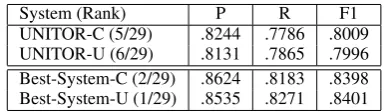
6th and10th position over28 submitted systems. In this case, the use of the Word Space is effec-tive, as noticed by the 4 position gain in the final ranking (almost 2 points in F1-measure). In Table 2 results in the restaurant case are reported. Here, the use of Word Space does not give an improve-ment in the final performance.
7 http://sifaka.cs.uiuc.edu/˜wang296/Data/index.html
Table 1: Aspect Term Extraction Results - Laptop.
System (Rank) P R F1
[image:5.595.318.511.175.231.2]UNITOR-C (10/28) .7741 .5764 .6608 UNITOR-U (6/28) .7575 .6162 .6795 Best-System-C (1/28) .8479 .6651 .7455 Best-System-U (2/28) .8251 .6712 .7403
Table 2: Aspect Term Extraction - Restaurants.
System (Rank) P R F1
UNITOR-C (5/29) .8244 .7786 .8009 UNITOR-U (6/29) .8131 .7865 .7996 Best-System-C (2/29) .8624 .8183 .8398 Best-System-U (1/29) .8535 .8271 .8401
In both cases, we observed that most of the errors were associated to aspect terms composed by multiple words. For example, in the sen-tenceThe portions of the food that came out were mediocrethe gold aspect term isportions of the foodwhile our system was able only to re-trievefood as aspect term. The system is mainly able to recognize single word aspect terms and, in most of the cases, double words aspect terms.
4.2 Aspect Term Polarity
The Aspect Term Polarity subtask has been mod-eled as a multi-class classification problem: for a given set of aspect terms within a sentence, it aims at determining whether the polarity of each aspect term ispositive, negative, neutral or con-flict. It has been tackled using multi-kernel SVMs in a One-vs-All Schema. In the constrained set-ting, the linear combination of the following ker-nel functions have been used:ptkGRCT,poly2BoW that consider all the lemmatized terms in the sen-tence, a poly2
BoW that considers only the aspect terms, poly2
lim-itation of the proposed model is the inability to capture deep semantic phenomena such as irony, as in the negative sentence “the two waitress’s looked like they had been sucking on lemons”. Table 3: Aspect Term Polarity Results - Restau-rant.
System (Rank) Accuracy UNITOR-C (12/36) .7248 UNITOR-U (8/36) .7495 Best-System-C (1/36) .8095 Best-System-U (5/36) .7768
Table 4: Aspect Term Polarity Results - Laptop. System (Rank) Accuracy
UNITOR-C (10/32) .6299 UNITOR-U (17/32) .5856 Best-System-C (1/32) .7048 Best-System-U (5/32) .6666
4.3 Aspect Category Detection
The Aspect Category Detection has been mod-eled as a multi-label classification task where 5 categories (ambience, service, food, price, anec-dotes/miscellaneous) must be recognized. In the constrained version, each class has been tack-led using a binary multi-kernel SVM equipped with a linear combination of poly2
BoW and
rbfW NSO. A category is assigned if the SVM classifiers provides a positive prediction. The anecdotes/miscellaneous acceptance threshold has been set to 0.3 (it has been estimated over a de-velopment set) due to its poor precision observed during the tuning phase. Moreover, considering each sentence is always associated to at least one category, if no label has been assigned, then the sentence is labelled with the category associated to the highest prediction.
In the unconstrained case, each class has been tackled using an ensemble of a two binary SVM-based classifiers. The first classifier is a multi-kernel SVM operating on a linear combination of
rbfW S andpoly2BoW. The second classifier is a SVM equipped with arbfW ST O. A sentence is la-belled with a category if at least one of the two cor-responding classifiers predicts that label. The first classifier assigns a label if the corresponding pre-diction is positive. A more conservative strategy is applied to the second classifier, and a category is selected if its corresponding prediction is higher than 0.3; again this threshold has been estimated over a development set. As in the constrained ver-sion, we observed a poor precision in the
anec-dotes/miscellaneous category, so we increased the first classifier acceptance threshold to 0.3, while the second classifier output is completely ignored. Finally, if no label has been assigned, the sentence is labelled with the category associated to the high-est prediction of the first classifier.
Table 5: Aspect Category Detection Results.
System (Rank) P R F1
UNITOR-C (6/21) .8368 .7804 .8076 UNITOR-U (2/21) .8498 .8556 .8526 Best-System-C (1/21) .9104 .8624 .8857 Best-System-U (4/21) .8435 .7892 .8155 Table 5 reports the achieved results. Consider-ing the simplicity of the proposed approach, the results are impressive. The ensemble schema, adopted in the unconstrained version, is very use-ful in improving the recall and allows the system to achieve the second position in the competition.
4.4 Aspect Category Polarity
The Aspect Category Polarity subtask has been modeled as a multi-class classification problem: given a set of pre-identified aspect categories for a sentence, it aims at determining the polarity ( pos-itive, negative, neutral or conflict) of each cate-gory. It has been tackled using multi-kernel SVMs in a One-vs-All Schema. In the constrained set-ting, the linear combination of the following ker-nel functions has been used: ptkGRCT,poly2BoW that consider all the lemmatized terms in the sen-tence, apoly2
BoW that considers only verbs, nouns adjective and adverbs in the sentence, linLB de-rived from the MPQA sentiment lexicon. In the unconstrained case thesptkGRCT replaces theptk counterpart and the rbfW S is added by linearly combining Word Space vectors for verbs, nouns adjective and adverbs.
Again, results shown in Table 6 suggest the pos-itive contribution of the lexical generalization pro-vided by the Word Space (in the sptkGRCT and
rbfW S) allows to achieve a good rank, i.e. the 4th position with the unconstrained system in the
restaurant domain. The error analysis underlines that the proposed features do not capture irony.
References
Yasemin Altun, I. Tsochantaridis, and T. Hofmann. 2003. Hidden Markov support vector machines. In
Proceedings of the International Conference on Ma-chine Learning.
Giuseppe Castellucci, Simone Filice, Danilo Croce, and Roberto Basili. 2013. Unitor: Combining syntactic and semantic kernels for twitter sentiment analysis. InSecond Joint Conference on Lexical and Computational Semantics (*SEM), Volume 2: Pro-ceedings of the Seventh International Workshop on Semantic Evaluation (SemEval 2013), pages 369– 374, Atlanta, Georgia, USA, June. ACL.
Michael Collins and Nigel Duffy. 2001. Convolution kernels for natural language. InProceedings of Neu-ral Information Processing Systems (NIPS’2001), pages 625–632.
Nello Cristianini, John Shawe-Taylor, and Huma Lodhi. 2002. Latent semantic kernels. J. Intell. Inf. Syst., 18(2-3):127–152.
Danilo Croce and Daniele Previtali. 2010. Mani-fold learning for the semi-supervised induction of framenet predicates: an empirical investigation. In
GEMS 2010, pages 7–16, Stroudsburg, PA, USA. ACL.
Danilo Croce, Alessandro Moschitti, and Roberto Basili. 2011. Structured lexical similarity via con-volution kernels on dependency trees. In Proceed-ings of EMNLP, Edinburgh, Scotland, UK.
Kavita Ganesan, ChengXiang Zhai, and Jiawei Han. 2010. Opinosis: a graph-based approach to abstrac-tive summarization of highly redundant opinions. In
Proceedings of the 23rd International Conference on Computational Linguistics, pages 340–348. ACL.
Gene Golub and W. Kahan. 1965. Calculating the sin-gular values and pseudo-inverse of a matrix. Journal of the Society for Industrial and Applied Mathemat-ics: Series B, Numerical Analysis, 2(2):pp. 205–224.
Thorsten Joachims. 1999. Making large-Scale SVM Learning Practical. MIT Press, Cambridge, MA.
Dan Klein and Christopher D. Manning. 2003. Ac-curate unlexicalized parsing. In Proceedings of ACL’03, pages 423–430.
Tom Landauer and Sue Dumais. 1997. A solution to plato’s problem: The latent semantic analysis the-ory of acquisition, induction and representation of knowledge. Psychological Review, 104.
Bing Liu. 2007. Web data mining. Springer.
Saif Mohammad and Peter D. Turney. 2013. Crowd-sourcing a word-emotion association lexicon. Com-putational Intelligence, 29(3):436–465.
Alessandro Moschitti, Daniele Pighin, and Robert Basili. 2008. Tree kernels for semantic role label-ing.Computational Linguistics, 34.
Alessandro Moschitti. 2006. Efficient convolution ker-nels for dependency and constituent syntactic trees. InECML, Berlin, Germany, September.
Sebastian Pado and Mirella Lapata. 2007. Dependency-based construction of semantic space models.Computational Linguistics, 33(2). Bo Pang and Lillian Lee. 2008. Opinion mining and
sentiment analysis. Found. Trends Inf. Retr., 2(1-2):1–135, January.
Bo Pang, Lillian Lee, and Shivakumar Vaithyanathan. 2002. Thumbs up?: sentiment classification us-ing machine learnus-ing techniques. In EMNLP, vol-ume 10, pages 79–86, Stroudsburg, PA, USA. ACL. Maria Pontiki, Dimitrios Galanis, John Pavlopou-los, Harris Papageorgiou, Ion AndroutsopouPavlopou-los, and Suresh Manandhar. 2014. Semeval-2014 task 4: Aspect based sentiment analysis. InProceedings of the International Workshop on Semantic Evaluation (SemEval).
Magnus Sahlgren. 2006. The Word-Space Model. Ph.D. thesis, Stockholm University.
John Shawe-Taylor and Nello Cristianini. 2004a. Ker-nel Methods for Pattern Analysis. Cambridge Uni-versity Press, New York, NY, USA.
John Shawe-Taylor and Nello Cristianini. 2004b. Ker-nel Methods for Pattern Analysis. Cambridge Uni-versity Press.
Janyce M. Wiebe, Rebecca F. Bruce, and Thomas P. O’Hara. 1999. Development and use of a gold-standard data set for subjectivity classifications. In
Proceedings of the 37th annual meeting of the ACL on Computational Linguistics, pages 246–253, Stroudsburg, PA, USA. ACL.
Theresa Wilson, Janyce Wiebe, and Paul Hoffmann. 2005. Recognizing contextual polarity in phrase-level sentiment analysis. InProceedings of Human Language Technologies Conference/Conference on Empirical Methods in Natural Language Processing (HLT/EMNLP 2005), Vancouver, CA.