Metaphor and space:
A cognitive-based analysis
of Irish and Italian prepositions
Alessio Salvatore Frenda
A dissertation submitted for the M.Phil. in Linguistics (2004/05)
to the Centre for Language and Communication Studies,
Declaration
I declare that this dissertation has not been submitted as an exercise for a degree at this or any other university and that it is entirely my work.
I agree that the Library may lend or copy this dissertation on request.
Signed: __________________________ Date: 30 September 2005
Acknowledgments
I wish to express my most deeply felt gratitude towards my parents for their en-couragement and support, both financial and emotional, without which this work could have never been completed.
My acknowledgment also goes to Dr. Brian Nolan, whose supervision and advice were fundamental for the completion of this thesis, and all the Irish speakers who generously helped me in my initial struggles with this fascinating language unfortu-nately threatened with extinction: Dr. Eoin Mac Cárthaigh,Brian Ó Raghallaigh,Áine Ní Bhriain, and Eoin Ó Céilleachair, whose competence and patience were mostly appreciated. I feel bound to precise that while I am most grateful to all of them, only I am responsible for any mistake that might have arisen from misentepreting their words.
I also wish to thank Prof. Robert H. Barnes (from the Institute of Social and Cultural Anthropology, Oxford) for his kindness and his bibliographic suggestions, and all the people whom I met in the course at the CLCS, lecturers and students alike, who might have variously contributed their support or suggestions.
Abstract
The present research study aims at providing an insight on the issue of metaphor and space conceptualization through the comparative analysis of Irish and Italian preposi-tions, based on the theoretical foundations of cognitive linguistics, an insight into which was provided in the form of a literature review.
Table of contents
Declaration ... 1
Acknowledgments... 2
Abstract... 3
Table of contents ... 4
Abbreviations... 7
1 Introduction ... 8
2 Polysemy, metaphor, and space ...10
2.0 Introduction ...10
2.1 Polysemy and metaphor: The centrality of space ...10
2.2 Space and the mind ...17
2.3 Space in language. Prepositions and metaphors...22
2.3.1 Ception and fictivity...22
2.3.2 Prepositions and space...25
2.4 Summary ...26
3 A comparative analysis of Irish and Italian prepositions: methodology ...28
3.0 Introduction ...28
3.1 Corpora...28
3.1.1 Content ...28
3.1.2 Sources for data...31
3.1.3 Translations...31
3.2 Analysis of data: Methodology outline...31
4 Spatial relations: The core meanings of prepositions ...33
4.0 Introduction ...33
4.1 Basic spatial meanings (BSMs): A repertoire ...33
4.1.1 Setting up the repertoire ...33
4.1.2 BSMs: A brief characterization ...34
4.2 Prepositions expressing BSMs: Examples ...37
4.2.1 Irish...37
4.2.1.1 OFF/FROM/OUT OF...37
4.2.1.3 TO, TOWARDS...40
4.2.1.4 THROUGH, ACROSS...41
4.2.1.5 BETWEEN, AMONG...42
4.2.1.6 ABOVE...42
4.2.1.7 ON, ONTO...42
4.2.1.8 IN, INTO...42
4.2.1.9 WITH...43
4.2.2 Italian...43
4.2.2.1 OFF/FROM/OUT OF...43
4.2.2.2 AT...44
4.2.2.3 TO, TOWARDS...44
4.2.2.4 THROUGH, ACROSS...45
4.2.2.5 BETWEEN, AMONG...46
4.2.2.6 ABOVE...46
4.2.2.7 ON, ONTO...46
4.2.2.8 IN, INTO...47
4.2.2.9 WITH...47
4.3 Summary ...48
5 Patterns of metaphorical extensions ...49
5.0 Introduction ...49
5.1 Metaphorical extensions: An analysis...49
5.1.1 Analysis methodology...49
5.1.2 IN(TO)...50
5.1.2.1 Static relations...50
5.1.2.2 Dynamic relations ...60
5.1.2.3 Graphic recap. ...65
5.1.3 WITH...65
5.1.3.1 COMPANY/VICINITY AND PART-WHOLE...66
5.1.3.2 POSSESSIVE...70
5.1.3.3 DESCRIPTIVE...72
5.1.3.4 COMMUNICATION AND TRADE-OFF...73
5.1.3.5 TEMPORAL COINCIDENCE...76
5.1.3.6 COMPARISON...78
5.1.3.8 METAPHORICAL COMPANY...87
5.1.3.9 ASSOCIATION AS METAPHORICAL VICINITY...92
5.1.3.10 AGENT/CAUSE AND EXPRESSIVE...98
5.1.3.11 MANNER...104
5.1.3.12 PURPOSIVE...105
5.1.3.13 Graphic recap. ...108
5.1.4 OFF/FROM/OUT OF...108
5.1.4.1 SEPARATION...109
5.1.4.2 PARTITIVE...123
5.1.4.3 BELONGING IN/TO AND TOKEN OF TYPE...126
5.1.4.4 MATTER...137
5.1.4.5 TIME: ORIGIN...143
5.1.4.6 CAUSE/AGENT AND PURPOSE...145
5.1.4.7 REPRESENTATION...150
5.1.4.8 COMPARISON...152
5.1.4.9 Graphic recap...155
5.1.4.10 Summary...155
6 Discussion ...157
6.0 Introduction ...157
6.1 Patterns of sense extensions for IN(TO), WITH, OFF/FROM/OUT OF...157
6.1.1 IN(TO)...157
6.1.2 WITH...158
6.1.3 OFF/FROM/OUT OF...160
6.2 Generalizations ...161
6.3 Theoretical implications...162
7 Conclusions ...164
References...166
Appendices...172
Appendix A: The most common forms of inflected prepositions in Irish and Italian170 Appendix B: Irish corpus... 175
Abbreviations
ADJ adjective
AdjP adjectival phrase
APSTPTC active past participle
AUT autonomous
AUX auxiliary
BSM basic spatial meaning Ch chapter
COMPL complementizer
COND conditional
COP copula
DET determiner
DIM diminutive
Eng. English
FEM feminine
FUT future
GER gerund
Gr. Greek
HAB habitual IE. Indo-European
IMP imperative
IMPF imperfect
IMPS impersonal
INF infinitive Ir. Irish It. Italian Lat. Latin lit. literally
MSC masculine
N noun
NEG negative particle
NOM nominative NP noun phrase
NT neuter
OBJ object
OBL oblique OIr. Old Irish
PASSV passive, passivizing
PERF perfect
PL plural
PLPF pluperfect
PP prepositional phrase
PPSTPTC passive past participle
PTC particle
RCPR reciprocal pronoun
REFL reflexive pronoun
REL relative pronoun
SG singular Sp. Spanish
SUBJ subject
SUBJN subjunctive
VN verbal noun VP verbal phrase
1 Introduction
The present research study aims at providing support, through a comparative, cross-linguistic analysis, to the positions of cognitive cross-linguistics theories with respect to the issues of spatial conceptualization and its centrality in structuring other, less concrete conceptual domains, such as time, causation, psychological affections and disposi-tions, and so on. According to a widespread view in cognitive linguistics, whose diffusion and defence is to a great degree due to the earlier studies of Andrew Ortony and, later, George Lakoff, metaphor is the key to understand how spatial thought can structure abstract and rather complex domains, and why it should be so.
We should like to begin with the ‘why’, and observe that Lakoff in particular has greatly stressed the importance of physical, everyday, and we daresay, trivial experience of the environment surrounding us as the source of our most basic concepts. In other words, what we can have direct, non-mediated experience of, is what we understand better. Therefore, it should come as no surprise that concepts that we cannot grasp as immediately be understood by analogy with concepts of which we have already got a secure comprehension, and it is precisely in the potential of establishing analogical connections that lies the power of metaphor as a tool capable of engendering new knowledge.
As to the ‘how’, analogy is the answer: analogical links are established between the physical, better known domain and the abstract one, yet to be understood, via what Lakoff terms as metaphorical mapping of structure, whose modalities and functioning shall be explored in chapter 2.
Our objective being to back the above exposed views, we set to doing so by disguising a comparison between two languages, Irish and Italian, and their preposi-tion systems.
On the other hand, the choice to examine the speech class of prepositions is mainly due to Talmy and Zelinsky-Wibbelt’s considerations about prepositions being both capable of great degrees of abstraction (in that they function according to spatial schemata, abstracting away from certain details and thus being capable to adapt to a gamut of very different relations) and highly polysemous in nature (which is but a consequence of their remarkable power of abstraction). We are going to examine mor-phologically simple prepositions with the aid of grammatical descriptions of the two languages and lexical repertoires (dictionaries), to show that all simple prepositions primarily express spatial relations. To prove that such spatial relations are primary in nature, an attempt will subsequently be made to explain non-spatial functions in terms of the spatial ones. To this end, two corpora have been set up comprised of textual strings drawn from Irish and Italian fictional works, with the aim of retrieving a number of different prepositional readings as well as a number of examples thereof. Patterns of sense extensions, that is metaphorical readings, that are found to be shown by either language will be examined in detail and compared cross-linguistically. Our hope is to find that such patterns will let themselves be explained by means of conceptual linking with the spatial meaning of prepositions
The present study is therefore structured as follows: chapter 2 will be devoted to the review of the existing studies on the topics we will be concerned with, i.e., space, con-ceptualizations, metaphor, and prepositions; chapter 3, to expounding the methods we have followed in setting up the corpora, their sources, and how we are going to compare the data thus obtained. Chapter 4 will be concerned the notion of basic spatial meanings (BSMs), that is, a series of categories, or simply labels, under which it will be possible to group together prepositions from both languages according to the kind of relation they profile in the spatial domain; a table of correspondences will be therein provided between Irish and Italian prepositions belonging under the same label, and various examples presented of spatial usages of prepositions arranged in BSMs. Chapter 5 will contain the detailed analysis of our linguistic data, carried out in a cross-linguistic fashion for three of the ten BSMs defined in chapter 4: they are IN(TO),
WITH,and OFF/FROM/OUT OF.In the course of the discussion, schematic diagrams will
2 Polysemy, metaphor, and space
2.0 Introduction
This chapter is devoted to the review of the existing literature related to the two fundamental issues on which our comparison of the Italian and Irish prepositions will be based. These are (i) polysemy as a pervasive feature of prepositions, and (ii) the assumption of spatial thought as a domain systematically exploited to make sense of other domains, and specifically less tangible ones like time, emotions, and so forth. These ideas are characteristic of the cognitively based approach to linguistics and have been set forth by such scholars as Lakoff (Lakoff and Johnson 1980, Lakoff 1987, Lakoff and Turner 1989), Talmy (Talmy 2000 is an extensive collection of previously published papers), Jackendoff (1996), and Bierwisch (1996). (A compendi-ary exposition of the cognitive view and its tenets can be found in Zelinsky-Wibbelt 1993b: pp.12–4.) These will provide the framework for the analysis which will be conducted in the present paper. Further observations on spatial thought as a culture-specific phenomenon have been presented by Levinson (Levinson 2003 employs ear-lier work and analyses in the scope of a more experimental, in-the-field setting).
Earlier studies of metaphor had already been conducted in the wake of the ad-vent of constructivism, which also provided the basic intuitions for much of the following studies carried out in the cognitive perspective (cf. Ortony 1979b).
2.1 Polysemy and metaphor: The centrality of space
A definition of polysemy as found in Cruse (1995) is based on a number of pa-rameters along which the degree of distinctness between two or more readings of a word is defined. Distinct readings of a word can be thus in a relation of increasing antagonism to one another. The limiting case is, according to Cruse, best defined by the term “polylexy”, which defines a subset of polysemic relations, namely those for which separate lexical entries would be – to a varying extent – justified. While, for instance, the two readings of book (book1 as the material object where a text is written
or printed, and book2 as the text or content) are characterized by Cruse as being
co-operating, the two readings of bank (bank1 ‘financial institution’, bank2 ‘edge of a
given polysemic relation along the co-operation ~ antagonism continuum is for exam-ple whether the competing readings may or may not occur simultaneously. The two co-operating readings of book, for instance, may occur simultaneously, as in (1):
(1) Mary is reading a book. (Cruse 1995: p.35)
while the two antagonistic readings of bank may not, as shown in (2), where one is forced to choose only one of them:
(2) We finally reached the bank. (Cruse 1995: p.35)
which cannot be uttered to mean that we at once reached both the bank of a river and a financial institution.
Polysemy is a distinctive feature of many a preposition. As an example, La-koff (1993) contrasts the two different meanings of through in (3) and (4):
(3) I drove through the tunnel. (Lakoff 1993: p.27)
(4) I got my job through my uncle. (Lakoff 1993: p.27)
Two distinct readings of through are shown here: the meaning of passage through a physical medium, which is found in (3), is not found in (4). Lakoff is concerned with the proliferation of cases (or semantic roles) within the Fillmorean theory of case grammar (Fillmore 1968). Through in (3) is an instance of the Fillmorean PATH role, just as to is an instance of the DESTINATION role in (5):
(5) He came to me. (Lakoff 1993: p.27)
Lakoff contrasts (5) with (6), which apparently requires that a new role be postulated for the same preposition:
According to Lakoff, either one states an ad hoc rule, like “EXPERIENCERS can be ex-pressed as an object of the preposition to”, or one can understand (6) as an instance of a conventional metaphor that ideas are external objects coming into one’s head from outside. If one adopts the second view, one should not draw upon ad hoc rules. This theory has an advantage over any ad hoc rule, namely that it is independently moti-vated.
Lakoff’s (1993) point is that truth conditional semantics proves inadequate to the task of studying semantic roles, and that a theory of metaphorical semantics is re-quired in order to capture such generalizations about language as those presented by prepositional polysemy, without leading to a proliferation of semantic roles. That is, the object of the preposition to in (6) is to be understood as a metaphorical DESTINA
-TION. This allows for just one semantic role to work in different contexts, one of
physical (more precisely, spatial) relationships, and one of metaphorical relationships, where THOUGHTS ARE EXTERNAL OBJECTS and people’s minds are DESTINATIONS for such objects.
Much of Lakoff’s work is devoted to the aim of explaining how metaphors are to be taken as conceptual, rather than merely linguistic, phenomena, and how a theory of metaphorical semantics leads to rejecting an objectivistic point of view on seman-tics (truth conditional semanseman-tics being an aspect thereof), allowing for wider generalizations about cognitive processes to be captured in a more economic way than positing homonyms or ad hoc rules (cf. Lakoff and Johnson 1980; Lakoff 1987; La-koff and Turner 1989).
are to be sorted out in a way that corresponds to the natural state of affairs. In Ortony (1979b: p.1), this view is termed as “logical positivism” and described as committed to the position that “reality could be precisely described through the medium of lan-guage in a manner that was clear, unambiguous, and, in principle, testable … literally describable”.
The major challenge Lakoff poses to the objectivist theory lies in its inade-quacy to account for prototype effects in categorization. In real life, categorization is a matter of gradients and continua: most categories have fuzzy edges and membership in a category is defined by what has been called prototypicality, that is, the existence of best examples within categories. Some members are better examples of a given category than others: for instance, sparrows are better examples of the category of birds than penguins are. Better examples of a category are the category’s prototypes. Prototypes, or prototypical members, are defined in terms of saliency and recurrence, i.e., basically, by the common observation that, when people are asked to name the member of a given category, prototypes tend to be picked up more often than non-prototypes. Such notions are ultimately linked to the work of the cognitive psycholo-gist Eleanor Rosch (see Lakoff and Johnson 1980 and Lakoff 1987 for references), whose experiments show a substantial correlation between prototypicality and judg-ments of membership on the subjects’ behalf.
The third way they see themselves as offering is what they dub experientialism. Experientialism is defined as a synthesis between the two alternatives. The core of such a view is that human cognition actively plays an important role in defining real-ity through categorization and conceptualization, as opposed to the objectivist claim that reality exists independent of its human experiencers, but that such cognitive operations as categorization and conceptualization are, anyhow, constrained by the real world, as opposed to the subjectivist claim that the world is what one conceives of it as. Thus, on the one hand, reality enters our cognitive systems through our every-day experience of it, so that our cognitive processes are constrained by the input pro-vided by what actually exists; on the other hand, reality cannot be assessed without the medium of our experience. Experience is possible for human beings through their bodily functioning in the environment they operate in, that is, through the various sen-sory faculties we are physically endowed with. This is an important point that we will come back to later, when discussing of how sensorial inputs of different kind are brought together at the conceptual level (section 2.2).
The nature and mechanics of metaphorical mappings are extensively consid-ered in Lakoff and Johnson (1980) and Lakoff and Turner (1989). It involves a source domain and a target domain. To exemplify, we shall consider the metaphor LIFE IS A
JOURNEY as examined in Lakoff and Turner (1989: pp.61ff.). Here, JOURNEY is the
source domain, i.e., where the structures involved in the mapping are taken from; LIFE is the target domain, i.e., the domain which is metaphorically structured in terms of the source domain.
To understand the LIFE IS A JOURNEY metaphor, it is necessary to know what a journey conventionally implies, that is, a path, a traveller, the fact that it can have a destination or can be simply wandering about. Then it is necessary to know what the correspondences are between those elements and the elements of the target domain, e.g., the path corresponds to one’s lifetime, the traveller to the person living their life, the starting point to birth, and the end of journey to death. They correspond to slots of the schema that must be filled – there may be other slots which are optional: the schema for a journey requires a TRAVELLER, a PATH, a STARTING POINT, and an END, whereas COMPANIONS and VEHICLES, for instance, are optional. These correspon-dences define the mapping itself: when we say the source-domain element x is mapped onto the target-domain element x′, we are saying that x corresponds to x′.
The strength of it is that the schema of journey is just a skeletal one, i.e., it has enough details to distinguish journeys from other kinds of activities, but not so many as to rule out any particular kind of journey. Therefore we are free to use the schema for a journey to characterize a wide range of different kinds of lifestyles, because we have many options as to the different kinds of journeys. For instance, someone who is strongly determined to achieve their goals can be said to be living a strongly oriented life, while someone who entertains no particular ambition can be said to be living their life as though they were wandering about.
As has already been recalled, most concepts are – according to this view – metaphorical in nature. Lakoff and Johnson (1980) go on questioning whether there exist concepts that are understood per se, i.e., non-metaphorically. The answer is that there do exist such basic concepts: simple spatial concepts like UP,for instance,are the prime candidates for concepts that are understood directly, because they come from our daily physical experience. Other such concepts, deeply rooted in our bodily experience, are taken to be NEAR–FAR, IN–OUT, FRONT–BACK, LIGHT–DARK, WARM–
COLD, MALE–FEMALE, OBJECT, SUBSTANCE, CONTAINER. Lakoff and Johnson clearly
pose spatial experience as a primary source for such basic concepts. Such a view is backed, for instance, by Levinson’s observation that
(i) [s]patial cognition is at the heart of our thinking. It has long been noted that spatial thinking provides us with analogies and tools for understanding other domains, as shown by the efficacy of diagrams, the pervasive spatial metaphors of everyday language, the evocativeness of place in memory … Spatial cognition probably plays this central role because it seems to be the evolutionarily earliest domain of systematic cross-modal cognition: any ani-mal needs to relate what its eyes, ears and limbs tell it about the immediate structure of the world around it. (Levinson 2003: p.xvii)
Jackendoff (1996: p.13) shares the same view (“many nonspatial concepts are semantically structured in a way very similar to spatial concepts”), and Bierwisch (1996: p.48) observes that time appears to be conceptualized as a one-dimensional, oriented space. Talmy (2000: p.179) points out that the conceptual domain of space “may play a central role by functioning as a (metaphoric) model for the structuring of other domains”, and Sweetser (1990: pp.18, 27ff. and passim) emphasizes that seman-tic shifts in general tend to go from concrete to abstract rather than the other way round. Zelinsky-Wibbelt (1993b: p.4), commenting upon Lakoff (1987), summarizes the point saying that “all abstract concepts are metaphorizations and metonymies of semantically concrete spatial predications”.
did it in ten minutes, Harry is in love).1 It is then clear that basic concepts, being themselves understood independent of any metaphorical structuring, provide the ulti-mate basis for grounding non-basic, metaphorically understood concepts in our daily experience.
Levinson (2003: p.276f.) puts forward the tempting idea that the centrality of space among the conceptual domains may be rooted in the physiology of our brain’s evolution. The hippocampus, which in mammals is the area of the brain endowed with the encoding of spatial experience, seems to “have been invaded by other functions in the case of humans and other primates”. Such “invasion of the ‘spatial organ’ by non-spatial functions accounts for the remarkable way in which non-spatial thinking seems to lie at the heart of much human reasoning” (ibid.).
In what follows, the notion of metaphor as permitting conceptual transposal from spatial domain to different areas of cognition shall be coupled with the observa-tion that “the meaning of a word relies on all knowledge resources which may be ac-cessed by the speakers […] linguistic meaning only being proac-cessed as part of a more comprehensive cognitive routine”, which magnifies the role of context in determining meaning resolution where polysemous items are involved and sanctions the insepa-rability of semantics and pragmatics (Zelinsky-Wibbelt 1993b: p.3).
2.2 Space and the mind
Having seen how metaphor is considered to function as an instrument for turn-ing abstract concepts into ones that are more easily dealt with in physical terms, and
1
how the spatial domain is considered, in this regard, to provide the source domain for a number of metaphorical mappings, we shall turn to the related issue of how space itself is conceptualized and how spatial concepts are linked to their linguistic expres-sions. The guidelines for this analysis are provided by Jackendoff (1996), Bierwisch (1996), Talmy (2000a), and Levinson (2003).
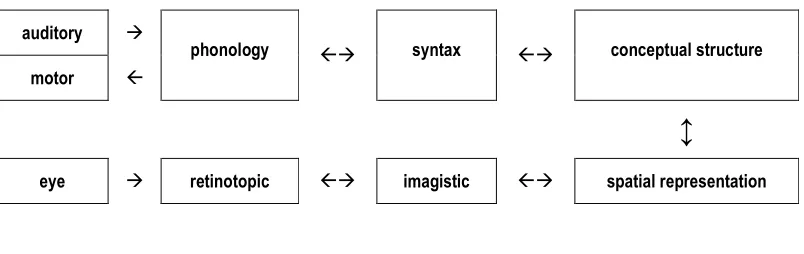
Jackendoff (1996) postulates the necessity of having a system of intermediate cognitive processes relating visual information and linguistic information, as – he points out – no direct relation can be maintained to exist between vision as a “reti-notopic map” and linguistic expression as “phonological encoding”. Such processes are structured, according to Jackendoff, in a modular way, with each module provid-ing a specific kind of spatial representation – hence the name of Representational Modularity whereby he dubs his theory. Whereas the modular structure of mental representation is borrowed from Fodor (1983), Jackendoff is here concerned with explaining how different modules communicate with each other. He proposes the idea that inter-modular communication takes place through highly-specialized interface modules. An interface module partially translates information from one module to the other (and vice versa), and only works between two adjacent modules, without having access to any other kind of information: thus, the interface module posited between the phonological and the syntactic modules only has access to phonological and syntactic information.
auditory
motor
phonology syntax conceptual structure
↕
eye retinotopic imagistic spatial representation
Figure 2.1: Jackendoff’s Representational Modularity schematized (slightly simplified version of Jackendoff 1996: p.3, Figure 1.2).
[image:19.612.107.509.474.601.2]“output”). Interface modules, which can be either unidirectional or bidirectional, are represented by the arrows. For instance, the phonology-syntax interface functions from left to right in speech perception and from right to left in speech production.
Jackendoff considers the upper layer of the schema (comprising the modules of phonology, syntax, and conceptual structure) as pertaining to the linguistic faculties, while the lower layer (retinotopic, imagistic, and spatial representation modules) as pertaining to visual faculties. (The sequence retinotopic – imagistic – spatial representation is said to correspond to Marr’s [1982] primal sketch – 2½-D sketch – 3-D model. Also cf. Levinson 2003.)
The crucial interface module is, according to Jackendoff, the one translating between conceptual structure (or CS) and spatial representation (or SR):
(ii) CS encodes “propositional” representations, and SR is the locus of “image schema” or “mental model” representations. (Jackendoff 1996: p.5)
CS is conceived of as being an encoding of linguistic meaning, independent of any specific language. Meaning in CS is represented in what Jackendoff calls an “alge-braic” fashion, where concepts are characterized in terms of “discrete primitive fea-tures and functions” (Jackendoff 1996: p.5). Although CS supports rules of inference, it is not “propositional” in the standard logical sense, in that its expressions refer nei-ther to the real world nor to possible worlds, but to the world as is conceptualized by the human mind. Lexical semantics is processed by CS in terms of semantic primes (i.e., in a decompositional fashion): lexical items are thus characterized in terms of their lexical conceptual structure (LCS). CS must also be able to distinguish between tokens and types, so as to account for the ability to tell apart any individual from its category.
As to the CS–syntax interface, Jackendoff maintains that a verb in syntax corresponds to a function in CS and the arguments of the verb are also the arguments of the function. The most striking difference between syntax and CS is that the latter is indifferent to linear order.
counterpart to the token/type distinction featured by CS, SR must include ways of distinguishing differences among similarities, so that one may at once, for example, recognize two cups as being both cups (“visual object categorization”) and tell them apart as to distinct cups (“visual object identification”). SR must also encode a full layout of a spatial scene, so that different perspectives of it can be somehow generated and taken into consideration. SR is characterized as being independent of any particu-lar spatial modality (e.g., haptic information, auditory localization, felt body position), so as to be able to bring all of these different kinds of information together – in Jackendoff’s (1996: p.9) terms, “[i]t is important to know by looking at an object where you expect to find it when you reach for it and what it should feel like when you handle it”.
The main difference between SR and CS is thus that the former is geometric in character (“quasi-topological”), while the latter is algebraic (or propositional). Strictly speaking, SR is not imagistic, in that an image may only be regarded from a particular point of view, while any SR must allow for multiple-perspective visualization. Also, as far as categorization is concerned, an image can record just one member of a given category, while an SR must include information sufficient for recognizing different members (e.g., different kinds of the type triangle). An image would also be an inade-quate comparison because, as hinted to before, SR is not restricted to the visual modality. Nevertheless, Jackendoff maintains, it makes sense to conceive of SR as image-schematic, i.e., encoding “abstract representations from which a variety of im-ages can be generated” (Jackendoff 1996: p.9; also compare Lakoff 1987: pp.453ff.).
what he calls I-space and E-space, corresponding to spatial representation in I-language and to external, physical space respectively. Following Jackendoff, Bierwisch (1996: p.45) describes CS as “abstract, propositional, algebraic, that is, nondepictive”, and SR as “depictive of or analogous to what it represents in crucial respects”.
In SR there are no explicit units representing relational concepts (e.g. OVER,
LEFT OF, etc.). In CS, on the other hand, there are no explicit elements representing the
geometric properties (angles, dimensions, etc.) of concepts like CIRCLE, SQUARE, etc. So an SR configuration can only be described in CS at the price of losing geometric or topological information, which is implicit in the SR but must be explicitly stated in CS (by means of separate coding for measures, for instance).
Since spatial structures appear to be extensively employed in the concep-tualization of many different domains, Bierwisch assumes that such conceptual structures organize conceptual knowledge at a general level; in order to do so, they must exceed the limits of I-space proper. The problem then is whether (i) such conceptual structures are general over different domains, so that SR is just an instantiation of more general schematic structures (as they are imposed onto the spatial domain); or (ii) they are originated within I-space proper and then projected to other (nonspatial) domains. Bierwisch tentatively suggests that alternative (ii) is the more plausible because “I-space is not only a privileged instantiation of spatial structure but is also the richest and most detailed instantiation of spatial structure, compared to other domains. Whereas I-space is basically three-dimensional, other domains are usually of reduced dimensionality” (Bierwisch 1996: p.49): time, for instance, is conceived of as a one-dimensional oriented space, as has already been noted.
(7) He entered the church. (Bierwisch 1996: p.32)
(8) He left the institute. (Bierwisch 1996: p.36)
Thus (7) can be taken to mean either that someone physically entered a temple (spatial domain) or that he became a priest (social domain). Accordingly, (8) means either that someone left a specific academic building (spatial domain) or that he resigned his affiliation with a social institution (social domain). Implicit transfer, according to Bierwisch, is what makes (7) and (8) sound ambiguous.
2.3 Space
in
language. Prepositions and metaphors
2.3.1 Ception and fictivity
The problem of how space is represented in language is specifically addressed by Talmy (2000), whose analysis is based on a functional distinction between closed-class and open-closed-class forms of linguistic expression. Briefly, closed-closed-class forms are taken to be relatively few and not easily augmentable in number, and to include both what are traditionally called free morphemes (e.g. autonomous lexical entries) and what are known as bounded morphemes (e.g. number and case endings). Open-class forms (otherwise “lexical” forms), on the other hand, belong to repertoires which members can be easily augmented in number (e.g. the word class of nouns, whose number is constantly accrued by loanwords and the formation of neologisms).
Talmy is not particularly concerned with issues of modularity in the mental representation of conceptual semantics, as is made clear by the introduction of the notion of ception, meant to be general over those of perception and conception, and which he founds on the claim that psychologists are unsure as to where to draw a boundary between perceptual and conceptual (cognitive) phenomena:
(iii) … as I view a particular figure before me, is my identification of it as a knife to be understood as part of my perceptual processing of the visual stimuli, or instead part of some other … cognitive processing?
(Talmy 2000: p.139)
unconscious, understood by the conjunction of perception and conception” (ibid.). However, Talmy does not mean to eliminate the distinction between perception and conception all together. He rather reckons that they are the two ends of a continuum and posits a number of parameters closely co-varying with one another, the most important being what Talmy terms the parameter of palpability. The maximum of palpability is thus associated with high values along such parameters as clarity, intensity, ostension, objectivity, localizability, identifiability, accessibility to con-sciousness, accessibility to physical manipulation (“actionability”), and stimulus de-pendence (the degree to which something can be evoked in awareness in the absence of perceptual stimuli) among the others. The minimum of palpability is therefore associated with low values along the same parameters.
While high degrees of overall palpability are typical of the physical domain (e.g., concrete objects), it is more interesting to examine closely the two “levels of palpability” dubbed by Talmy semiabstract and abstract respectively. According to Talmy, frames of reference (see below) and the recognition of an object’s structure belong in this level of palpability; the semantic referents of linguistic forms, which can also be evoked in awareness by hearing or thinking of those forms even without perceiving any physical stimulus, are instead taken to pertain to the abstract level.
con-tent subsystem, while closed-class forms generally refers to the structure subsystem only.
The structure subsystems of vision and language seem to work in parallel; therefore,
(iv) one can visually sense … an “inclusion” type of structural schema on viewing a two-object complex in which one object is sensed as located at a point or points of the interior space defined by the other object. This schema can be topologically … abstracted away from particulars of … size, shape, state of closure [etc.] … Now, the spatial schema specified by the English preposition in exhibits all these same properties. This closed-class form can thus be used … to refer to some object as located in a thimble, in a volcano, in a well, in a trench … (Talmy 2000: p.163)
This is viewed as the typical behaviour of prepositions, which also abstract away from other metrical features and are, for instance, magnitude neutral, as is the case of across, which “can be applied to paths of a few centimeters, as in The ant crawled across my palm, as well as to paths of thousands of miles, as in The bus drove across the country” (ibid.: p.164). Language and vision thus show the same kind of topology-like schematic abstractions, which is, according to Talmy, tantamount to saying that what is expressed grammatically is pretty much what is sensed visually.
In Talmy’s account, the topological abstractness of image schemas allows for the employment of the spatial-related conceptual structures in the characterization of other domains via the theory of fictivity. The opposition between fictive and factive, which is introduced for the purpose of motivating the linguistic description of static scenes in dynamic terms (Talmy 2000: pp.99–137), is explained as the contrast between what is sensed as more real and veridical (factive) and what is less real and non-veridical. The opposition can be exemplified by the sentence in (9):
(9) This fence goes from the plateau to the valley. (Talmy 2000: p.99)
The fictivity paradigm allows for a direct comparison with the theory of metaphor – in particular, as Talmy points out, with the detailed account thereof given by Lakoff and Johnson (1980):
(v) The source domain and the target domain of a metaphor supply the two discrepant representations. The representation of an entity within the target domain is understood as factive and more veridical. The representation from the source domain that is mapped onto the entity in the target domain, on the other hand, is understood as fictive and less veridical.
(Talmy 2000: p.168)
Talmy would thus rewrite each of Lakoff and Johnson’s (1980) three-term formulas (for example, LOVE IS A JOURNEY, i.e., “x is y”) by means of two complementary formulas, fictive “x is y” and factive “x is not y”. In other words, Talmy regards metaphor as essentially defined by the factive/fictive discrepancy.
2.3.2 Prepositions and space
Two characteristics of prepositions make them particularly suitable instru-ments for the task of gaining some insight into the mechanisms of metaphor and its bearings on human cognition processes: (i) the fact that “in their prototypical meaning most prepositions are spatial predicates”, and (ii) their being “highly polysemous” (Zelinksy-Wibbelt 1993b: pp.2, 10).
The relations outlined above as typical of image schemas are, typically, asymmetrical predications (Taylor 1993: p.153, Talmy 2000: pp.183ff.). As Taylor puts it, asymmetry occurs because the object of the preposition, i.e., the nominal in a prepositional phrase, introduces the background with respect to which something else is brought to the hearer/reader’s attention. Truth conditions are irrelevant when it comes to the foreground/background opposition, as the following examples are meant to show:
(10) a. the picture above the sofa
b. the sofa below the picture (Taylor 1993: p.153)
as the figure vs. ground:cf. Zelinsky-Wibbelt (1993b: p.9), who also points out that eligibility of the components of a given scenario as either figure or ground is not at all arbitrary, “although they depend largely on the focus of attention”:
(vi) They are not totally arbitrary in that ‘certain mental organizations are highly improbable either for gestalt reasons, or because they are unnatural or pragmatically unusual. […] The moving or moveable object of a scene is also the one which is likely to be conceived as foreground’. (ibid.)
When it comes to terminology, it should be observed that different authors use different terminology: Langacker (1987) adopts the binomial trajector vs. landmark to refer to the foregrounded and the backgrounded elements, respectively, and so does Taylor (1993), explicitly following him, whereas Talmy (2000: p.183) prefers to speak about primary and secondary objects. In the present research study, Lan-gacker’s binomial trajectory : landmark will be employed.
2.4 Summary
In this chapter the fundamental notions concerning space conceptualization, metaphor and prepositions have been presented. The point has been emphasized that the dialogic interaction between space perception (imagistic) and space conception (schematic) requires the ability of abstracting away from spatial details such as magnitude while preserving geometric relations such as proportions and relative positions of different bodies. It has also been observed that prepositions do precisely comply with such requirements, in that they typically abstract away from metric details and can thus be employed to express geometric relations between their trajectors and landmarks in a schematic way.
In this sense, metaphor is not what it has been long taken to be, that is, a mere rhetoric embellishment or a witty wordplay, apt to fall within the realm of literary criticism – as Lakoff, in particular, makes clear, metaphors which do fall within that realm are the less conventional ones, and are well distinct from conventional, productive metaphors which sometimes, due to their recurrent employ, have long ceased to be considered such and erroneously – still according to Lakoff’s viewpoint – defined as ‘dead’ metaphors.
The issues just presented will provide the theoretical background for the tasks undertaken in chapters 4 and 5, that is, setting up a repertoire of basic prepositional meanings out of a comparative analysis of the Irish and Italian prepositions, subse-quently used to fathom what sense extensions they are capable of yielding by means of metaphorical mappings.
3 A comparative analysis of Irish and Italian
prepositions: methodology
3.0 Introduction
We have seen in chapter 2 that wide consensus has gathered in cognitive linguistics around the view that spatial language informs a number of other conceptual domains such as time, social status, emotions, etc., by virtue of its power of visualizing and thus making tangible and understandable concepts that would otherwise appear fairly abstracted away from the immediately available domain of physical experience, which has been argued by theoreticians such as Lakoff to provide the basis for our understanding of the environment we live in. Such understanding, as has been claimed, is primarily achieved by means of metaphoric mappings that superimpose physical models onto abstract conceptual structures.
Another point made in Chapter 2 concerns the role of prepositions in expressing both spatial relations and metaphorically extended senses thereof. What will be addressed in the rest of this paper is a comparative analysis of Irish and Italian prepositions, whose aim is to search and describe patterns of similarity occurring between metaphorically extended senses of prepositions from a cross-linguistic point of view.
The present chapter will therefore be devoted to a brief outlining of the methodology that will be employed in order to (a) provide a consistent corpus of examples for each of the two languages and (b) establish and analyze the above mentioned correspondences or patterns of similarity.
3.1 Corpora
3.1.1 Content
proper prepositions by the grammarians. Simple prepositions and preposizioni proprie (‘proper prepositions’) are terms to be found in grammatical descriptions of Irish and Italian respectively (Mac Congáil 2004: p.62; Sensini 1992: p.240).2 Mac Congáil makes use of the term ‘simple prepositions’ to distinguish them from compound prepositions, i.e., phrases functioning as prepositions and generally comprised of a simple preposition plus a nominal. On the other hand, Sensini labels as “proper” those prepositions which can only act as such, as opposed to other lexical items which can also work as adverbs (the only exception being su, both a preposition ‘on, over’ and an adverb ‘up’, which is traditionally included in the list of proper prepositions). Since some Irish and Italian prepositions which we are going to take into account can also function as subordinating conjunctions (e.g., Irish go, chun, Italian di, per), we shall henceforth employ the term“simple preposition” to refer to the content of our corpora. Tables 3.1 and 3.2 show what prepositions are included in the Irish and Italian corpora respectively.
Followed by the nominative case:
gan, idir, seachas
Followed by the dative case:
ag, ar, as, chuig, de, do, faoi, go, i, le, ó, roimh, thar, trí, um
Followed by the genitive case:
chun, dála, fearacht, timpeall, trasna
Table 3.1: Simple prepositions as included in the Irish corpus.
2 The forms of Irish and Italian being considered in this study are the standard ones, as described, for
di, a, da, in, con, su, per, tra/fra3
Table 3.2: Proper prepositions as included in the Italian corpus.
The corpora were set up by using text-searching tools in Microsoft Word documents, which were obtained by optical scanning of printed material. Because only simple or proper prepositions were searched for, occurrences of compound prepositions (e.g., Irish in aghaidh + genitive, Italian di fronte a ‘in front of’) were included in our corpora as they were found, but no list of compound prepositions was prepared and used for the purposes of specifically retrieving them.
Most simple prepositions, in both Irish and Italian, can occur in different forms which can be arranged into specific paradigms. More precisely, (the majority of) Irish simple prepositions can incorporate personal pronouns and therefore be inflected according to person and number (“prepositional pronouns”), whereas (almost all) Italian simple prepositions can incorporate the definite article and therefore be inflected according to gender and number (“preposizioni articulate”). In addition, some Irish prepositions can also incorporate the article, the possessive and the relative pronouns. Tables showing the most recurrent inflected forms of Irish and Italian prepositions are to be found in Appendix A. For instance, Irish i ‘in’ can show the forms ionam ‘in me’, ionat ‘in you’ (singular), ann ‘in him/it’ etc. with a conflated pronoun, sa/san/sna ‘in the’ with a conflated article, ina ‘in his/her/its’/inár ‘in our’ with a conflated possessive pronoun, and ina/inar ‘in whom/in which’ with a conflated relative pronoun. Italian in ‘in’, on the other hand, can exhibit the inflected forms nel/nello ‘in the’ (masculine singular), nelle ‘in the’ (feminine plural), etc., with a conflated article. (Mac Congáil 2004: 62–83; Sensini 1992: p.240.)
3Tra and fra are traditionally considered variants of the same prepositions (although historically they
might have developed from two different Latin prepositions, i.e., ĭntra ‘within’ and īnfra ‘under’,
respectively). Synchronically, they have no difference whatever in meaning and their choice seems to be only determined by euphony, to avoid the repetition of the same consonant cluster (e.g., tra fratelli
‘between brothers’ is preferred to fra fratelli, fra Treviso e Venezia ‘between Treviso and Venice’ to
3.1.2 Sources for data
The prepositions contained in the corpora were retrieved from word-processed texts, allowing for a quick retrieval of all inflected forms of every single preposition to be included (where such forms were found). The Irish texts amounted to 5,660 words distributed as follows: 2,778 words making up the first chapter of Ní Dhuibhne (2000: pp.1–10) and the first 2,882 words of Ó Cíosóig (1997: pp.5–12). The Italian data were gathered from 17 short stories by Italo Calvino (1972), to the amount of 5,044 words. They are the following (the Roman number preceding each item is the number whereby they will be referred to in the examples and in appendix C):
I. Le città e il desiderio (2), p.20 II. Le città e il desiderio (3), p.25 III. Le città e la memoria (5), pp.37f. IV. Le città e il desiderio (4), p.39 V. Le città e i segni (3), p.40 VI. Le città e i segni (4), pp.53f. VII. Le città e il nome (1), pp.73f. VIII. Le città sottili (5), p.81 IX. Le città e gli occhi (3), p.83
X. Le città e gli scambi (5), pp.95f. XI. Le città e il nome (3), pp.99f. XII. Le città e i morti (2), p.101 XIII. Le città e il cielo (1), pp.103f. XIV. Le città e i morti (3), pp.115f. XV. Le città e i morti (4), p.133 XVI. Le città nascoste (1), p.136 XVII.Le città e il cielo (5), pp.156f.
3.1.3 Translations
Authorship for the English translations of Irish and Italian passages is thus flagged: all translations from Italian, when not otherwise specified, are to be considered the writer’s work; so are all the translations from Ní Dhuibhne (2000) and Ó Cíosóig (1997), sometimes realized with the aid of Irish speakers (whose contributions have been recognized in the Acknowledgments section, where it has been also stated the final responsibility for all mistakes that might have occurred is entirely mine). Translations from the NIG are the writer’s, whereas all other transla-tions from Irish grammars and lexica were provided by their authors.
3.2 Analysis of data: Methodology outline
which we have examined in chapter 2, that the spatial domain provides the conceptual structures which allow for metaphoric mapping and extension of meaning onto different domains. Therefore, in comparing the preposition systems of Irish and Italian we shall start from their spatial meanings and attempt to define sets of basic spatial meanings along with the prepositions that express them in Irish and Italian. Once we have done so, we shall end up with having a number of semantic links between the two preposition systems. At this point, we will be concerned with considering what kind of semantic extensions prepositions that have the same kind of spatial meaning in both Irish and Italian can undergo. For instance, we shall come across the fact that Irish i and Italian in can be used in a spatial sense to express both static position and dynamic positioning (‘it is in the bag’ vs. ‘he put it in(to) the bag’). Subsequently, we may be able to observe that both Italian in and Irish i can express temporal concepts – sometimes in a very similar way, e.g. It. ‘in capo a una settimana’, Ir. ‘i gceann seachtaine’ = Eng. ‘in a week’s time’, where both Italian and Irish literally express the concept as ‘in head to/of a week’.
In order to contain the extension of the present research study within limits that might be appropriate to an M.Phil. dissertation, the analysis of our corpora will not cover the entire amount of retrieved data. Instead, after prepositions in both languages have been compared and correspondences between them have been as-sessed and categorized (chapter 4), only three of the groupings thus obtained will be thoroughly analyzed (chapter 5).
4 Spatial relations: The core meanings of
prepositions
4.0 Introduction
In the previous chapter (3.2) we have briefly outlined the methodology we shall follow in analyzing our corpora. What we do in this chapter is set up a restricted selection of semantically basic spatial concepts. Once we have done so, it will be possible to analyze the Irish and Italian data against the background of that conceptual catalogue.
4.1 Basic spatial meanings (BSMs): A repertoire
4.1.1 Setting up the repertoire
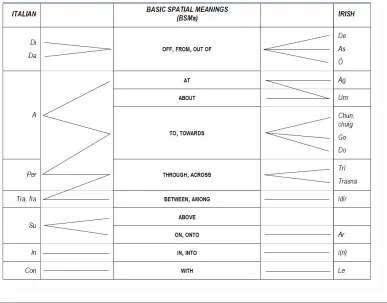
[image:34.612.114.501.371.674.2]It is important to emphasize that the spatial concepts we are taking as being basic and about to describe in the present chapter are not extracted from the corpora, but independently set, that is, their list is compiled on the basis of the basic spatial meanings (henceforth, BSMs) as are found in grammatical references and dictionaries. Figure 4.1 is a graphic representation of the relationships between each set of prepositions (Italian and Irish on the leftmost and rightmost columns, respectively) and their BSMs (glossed in English). In the next section (4.2), a fully-fledged cata-logue of examples will be provided.
Figure 4.1 can be compared to Taylor’s (1993) list of English prepositions on which he conducted his own study of meaning extensions. It will be observed that a number of Irish prepositions which were included in Tables 3.1–2 (chapter 3) are excluded from Figure 4.1; these include the following:
dála ‘like, as’
faoi ‘under, beneath’
fearacht ‘like, as’
gan ‘without’
roimh ‘before, in front of’
seachas ‘besides, other than’
timpeall ‘around’
thar ‘past’
The reason why they have been excluded is that no equivalents are to be found for them among Italian simple prepositions (“simple” as defined in 3.1.1 above), and therefore no comparison could be established for them.
4.1.2 BSMs: A brief characterization
What will follow is a tentative description of basic, i.e., spatial usages of the prepositions displayed in Figure 4.1. A preliminary caveat is necessary at this stage. All of the following examples provide an English translation, which – although necessary – is potentially misleading, in that it may obscure the fact that different languages conceptualize the same facts in different ways. For instance, Irish and English conceptualize DWELLING as a state of affairs which takes place IN a given location, while Italian conceptualizes the same concept as a state of affairs which takes place AT a given location. Accordingly, the prepositional phrase in the English
Before going into the examples proper, a brief description will follow of the BSMs that shall be analyzed, keeping in mind Dirven’s (1993: pp.73f.) classification of English prepositions (basic space prepositions, e.g. at, in, on; proximity preposi-tions, e.g. by, with; path prepositions, e.g. through; separation/source prepositions, e.g. from, off, out of), as well as Talmy’s (2000b: p.55) “Ground’s Conformations”:
i. OFF/FROM/OUT OF: denoting source relations. Prototypically, separation of tr from some lm (The mosquito was hit and fell off the wall) and lm as the physical origin of the tr’s movement (Mary comes from the States). Static relations are also expressed (My tools are out of place).
ii. AT: denoting a generic relation of proximity between tr and lm. According to Dirven (1993: p.75), spatial functions like this are poorly specified from the point of view of spatial relation. For instance, Mary is waiting at the airport
says nothing about the exact location of Mary (tr) with respect to the airport (lm), i.e., whether she is waiting outside or inside the building, or at the taxi rank, etc.
iii. ABOUT: akin in meaning to AT, ABOUT is typically general with regard to orientation – so that while sitting AT the piano is sitting at the keyboard, i.e., functionally oriented with respect to the piano, sitting ABOUT the piano may denote any possible location of tr with respect to the piano (in front of it, behind it, at its side). This lack of orientational information about the tr makes it possible for ABOUT to denote a tr located at different lm’s at different times (Carla is annoyed at John’s being always ABOUT4), thus virtually encircling lm.5 In Irish, um is marginally employed in this sense (as we shall see, it is most productively employed in non-spatial senses), whereas in Italian there is no simple prepositions conveying this meaning.
4 This example features what Jackendoff (1973) and Taylor (1993: pp.160, 173) would call a
preposition used intransitively, i.e., with no prepositional object (in other words, a PP without a nominal). Although we shall not be concerned with either the intransitive usage of prepositions in this study, we appeal to this theoretically useful notion in order to exemplify a marginal use of a BSM which is scarcely represented in English by transitive prepositions.
5 This characteristic makes ABOUT suitable for extension in the time domain, where its meaning is
iv. TO, TOWARDS:denoting goal, i.e., lm as either the location where the tr is as result of a movement which originated somewhere else, or the location where the tr is meant to be after the movement is completed (cf. I left for Rome, but I never got there vs. I went to Rome, *but I never got there: the former profiles lm as intended goal, the latter as reached/actual goal). In the ‘intended direction’ meaning, TO/TOWARDS may denote static relations (What is she
pointing at?, He was standing with his back towards me).
v. THROUGH, ACROSS: lm acts as a medium, and tr occupies several locations (lm0–lmn) in subsequent moments (t0–tn), with lm0–lmn all belonging to lm and
(prototypically) arranged in some linear path. In some languages (e.g., in English) a preposition expressing such BSM may also have denote a static relation, namely that of a tr being at the endpoint lmn of the aforementioned
path (The shop is just across the street). Furthermore, lm can be either a region proper, i.e., a spatial continuum (They are walking across the field), or a number of distinct entities (i.e., individuals in a group) seen as occupying a region, i.e., a multiplex lm (She is pushing her way through the crowd).
vi. BETWEEN, AMONG: in this BSM, the tr/lm relation typically involve two or more lm’s. When a preposition expressing this BSM has a pluralized nominal as its object (e.g., The hammock hangs between the trees), the different lm’s are considered to belong in the same category. The tr is profiled as located in a location lmm which is considered to be roughly equidistant from lm1, lm2, …,
lmn.
vii. ABOVE: denoting a tr which is vertically higher than lm, with no contact occurring between them. It will be noted in what follows (4.1.2.1.6), as Figure 4.1 graphically shows, that Irish has no simple preposition denoting this kind of relation.
Eng. on the sole of my shoe = It. sulla suola della mia scarpa = Ir. ar bhonn mo bhróige6).
ix. IN, INTO: in the relationship profiled by this BSM, a lm is evoked which has certain boundaries within which tr is located (static) or ends up being located after a movement (dynamic). Cf. Your toys are in the box vs. Put your toys in(to) the box.
x. WITH: in the spatial domain, this BSM acts as a function assigning to tr the value ‘being where lm is’ (John is with Mary, The hammer is with the other tools). Apart from this specific meaning (i.e., location sharing between tr and lm), its level of genericness is as high as AT’s is: in John is with Mary, for instance, we know that if we find Mary we are likely to find John as well, but we do not know if he is in front of, behind, or beside her; nor does this BSM per se specify the location (which might be noted lm?) where tr and lm both
are. Used with a dynamic meaning, WITH implies that tr and lm continue to share location for the entire duration of a certain movement (I will go to Rome with him, This dish comes with a portion of fries).
4.2 Prepositions expressing BSMs: Examples
4.2.1 Irish
4.2.1.1 OFF/FROM/OUT OF
(1) DE
a. ribe d’ fhéasóg an fhir
hair from beard DET man.GEN
‘a hair of the man’s beard’
b. cuid den airgead c. duine de na daoine
share off.DET money person from DET people
‘some of the money’ ‘one of the people’
d. Bain de dhuine eile é
take.IMP.2SG off person other OBJ:3SG.MSC
‘Take it off someone else’
6 The source for this rather illuminating example is Ó Donaill (1977: s.v. ar), the English and Italian
e. Tóg den chathaoir é
lift.IMP.2SG off.DET chair OBJ:3SG.MSC
‘Lift it off the chair’
f. Bain díot do chóta
take.IMP.2SG off.2SG.OBJ POSS:2SG coat
‘Take off your coat’ (a–f: Mac Congáil 2004: pp.69f.)
(2) AS
a. as áit b. as gloine
out of place out of place
‘out of place’ ‘out of place’
c. as a teach
out of POSS:3SG.FEM house
‘out of her house’
d. Is as Gaillimh é
COP from Galway SUBJ:3SG.MSC7
‘He is from Galway’
e. mile as Doire mile from Derry
‘a mile from Derry’
f. Tóg as seo é
take.IMP.2SG from here OBJ:3SG.MSC
‘Take it away from here’
(a–e: Mac Congáil 2004: p.67; f: NIG: p.136)
(3) Ó
a. ó Dhoire go Béal Feirste
from Derry to Belfast
‘from Derry to Belfast’
b. ó duine go duine c. ón áit seo
from person to person from.DET place this
‘from person to person’ ‘from this place’
7 In Irish the third-person subject of the copula is expressed by what are described as object pronouns,
d. an t-athair ónar thóg sé an nós sin DET father from.REL.PAST took SUBJ:3SG.MSC DET habit that
‘the father from whom he took that habit’
e. Ó Liam a fuair mé iad from Liam REL get.PAST SUBJ:1SG 3PL.OBJ
‘(It is) from Liam that I got them’
f. Caith uait é
cast.IMP.2SG from.OBJ:2G OBJ.3SG.MASC
‘Throw it away from you’
(a, e, f: NIG: pp.136, 135; b–d: Mac Congáil 2004: p.79)
4.2.1.2 AT (ABOUT)
(4) AG
a. ag baile b. ag an ngeata
at town at DET gate
‘at a town’ ‘at the gate’
c. Tá sí ag an teach
be SUBJ:3SG.FEM at DET house
‘She is at the house’
d. Bhí mé ag an gcóisir be.PAST SUBJ:1SG at DET party
‘I was at the party’ (a–d: Mac Congáil 2004: p.64)
(5) UM
a. do chóta a chur umat b. um Shionainn POSS:2SG coat to8 put.VN about.OBJ:2SG at Shannon
‘to put one’s coat on’ ‘by the banks of the Shannon’ (a: Mac Mathúna and Ó Corráin 2003: s.v.; b: Ó Dónaill 1977: s.v.)
8 A
4.2.1.3 TO, TOWARDS
(6) CHUN, CHUIG9
a. dul chun na Róimhe
go.VN to DET Rome
‘to go to Rome’
b. Chuaig sé chun na scoile go.PAST SUBJ:3SG.MSC to DET school.GEN
‘He went to school’
c. Chuaig sé chuig an teach go.PAST SUBJ:3SG.MSC to DET house
‘He went to the house’
(a: Mac Mathúna and Ó Corráin2003: s.v. chun; b–c: NIG: p.136)
(7) GO
a. ó cheann go ceann
from head to head
‘from end to end’
b. dul go Meiriceá
go.VN to America
‘to go to America’
c. ag tiomáint abhaile ón Daingean go at drive.VN home from.DET Dingle to Dún Dearg
Dún Dearg
‘driving home from Dingle to Dún Dearg’
(a–b: Mac Mathúna and Ó Corráin 2003: s.v.; b: Ó Dónaill 1977: s.v., c: Ní Dhuibhne 2000: p.1)
9 Although chun and chuig are two distinct prepositions – the former governing in the genitive case, the