Proceedings of NAACL-HLT 2018, pages 641–651
The Web as a Knowledge-base for Answering Complex Questions
Alon Talmor
Tel-Aviv University
Jonathan Berant
Tel-Aviv University
Abstract
Answering complex questions is a time-consuming activity for humans that requires reasoning and integration of information. Re-cent work on reading comprehension made headway in answering simple questions, but tackling complex questions is still an ongo-ing research challenge. Conversely, seman-tic parsers have been successful at handling compositionality, but only when the informa-tion resides in a target knowledge-base. In this paper, we present a novel framework for an-swering broad and complex questions, assum-ing answerassum-ing simple questions is possible us-ing a search engine and a readus-ing comprehen-sion model. We propose to decompose com-plex questions into a sequence of simple ques-tions, and compute the final answer from the sequence of answers. To illustrate the viabil-ity of our approach, we create a new dataset of complex questions, COMPLEXWEBQUES
-TIONS, and present a model that decomposes questions and interacts with the web to com-pute an answer. We empirically demonstrate that question decomposition improves perfor-mance from 20.8 precision@1 to 27.5 preci-sion@1 on this new dataset.
1 Introduction
Humans often want to answer complex questions that require reasoning over multiple pieces of ev-idence, e.g., “From what country is the winner of the Australian Open women’s singles 2008?”. Answering such questions in broad domains can be quite onerous for humans, because it requires searching and integrating information from multi-ple sources.
Recently, interest in question answering (QA) has surged in the context of reading comprehen-sion (RC), where an answer is sought for a ques-tion given one or more documents (Hermann et al., 2015;Joshi et al., 2017; Rajpurkar et al., 2016).
q:What city is the birthplace of the author of
‘Without end’, and hosted Euro 2012? Decompose:
q1:Author of ‘Without End’ ? {Ken Follett, Adam Zagajewski}
q2:Birthplace of Ken Follett {Cardiff}
q3:Birthplace of Adam Zagajewski {Lviv}
q4:What cities hosted Euro 2012? {Warsaw, Kiev, Lviv, ...}
Recompose:
a:({Cardiff} ∪ {Lviv})∩ {Warsaw, Kiev, Lviv, ...}={Lviv}
Figure 1: Given a complex questionsq, we decom-pose the question to a sequence of simple questions q1, q2, . . ., use a search engine and a QA model to
an-swer the simple questions, from which we compute the final answera.
Neural models trained over large datasets led to great progress in RC, nearing human-level perfor-mance (Wang et al.,2017). However, analysis of models revealed (Jia and Liang,2017;Chen et al., 2016) that they mostly excel at matching questions to local contexts, but struggle with questions that require reasoning. Moreover, RC assumes docu-ments with the information relevant for the answer are available – but when questions are complex, even retrieving the documents can be difficult.
Conversely, work on QA through semantic pars-ing has focused primarily on compositionality: questions are translated to compositional pro-grams that encode a sequence of actions for find-ing the answer in a knowledge-base (KB) (Zelle and Mooney, 1996; Zettlemoyer and Collins, 2005; Artzi and Zettlemoyer, 2013; Krishna-murthy and Mitchell, 2012; Kwiatkowski et al., 2013;Liang et al.,2011). However, this reliance on a manually-curated KB has limited the cover-age and applicability of semantic parsers.
In this paper we present a framework for QA that isbroad, i.e., it does not assume information is in a KB or in retrieved documents, and compo-sitional, i.e., to compute an answer we must per-form some computation or reasoning. Our thesis is that answering simple questions can be achieved
by combining a search engine with a RC model. Thus, answering complex questions can be ad-dressed by decomposing the question into a se-quence of simple questions, and computing the an-swer from the corresponding anan-swers. Figure 1 illustrates this idea. Our model decomposes the question in the figure into a sequence of simple questions, each is submitted to a search engine, and then an answer is extracted from the search result. Once all answers are gathered, a final an-swer can be computed using symbolic operations such as union and intersection.
To evaluate our framework we need a dataset of complex questions that calls for reasoning over multiple pieces of information. Because an adequate dataset is missing, we created COM -PLEXWEBQUESTIONS, a new dataset for
com-plex questions that builds on WEBQUESTION -SSP, a dataset that includes pairs of simple
ques-tions and their corresponding SPARQL query. We take SPARQL queries from WEBQUESTIONSSP
and automatically create more complex queries that include phenomena such as function composi-tion, conjunctions, superlatives and comparatives. Then, we use Amazon Mechanical Turk (AMT) to generate natural language questions, and obtain a dataset of 34,689 question-answer pairs (and also SPARQL queries that our model ignores). Data analysis shows that examples are diverse and that AMT workers perform substantial paraphrasing of the original machine-generated question.
We propose a model for answering complex questions through question decomposition. Our model uses a sequence-to-sequence architecture (Sutskever et al.,2014) to map utterances to short programs that indicate how to decompose the question and compose the retrieved answers. To obtain supervision for our model, we perform a noisy alignment from machine-generated ques-tions to natural language quesques-tions and automati-cally generate noisy supervision for training.1
We evaluate our model on COMPLEXWE -BQUESTIONSand find that question
decompo-sition substantially improves precision@1 from 20.8 to 27.5. We find that humans are able to reach 63.0 precision@1 under a limited time bud-get, leaving ample room for improvement in future work.
To summarize, our main contributions are:
1We differ training from question-answer pairs for future
work.
Conj{Lviv}
Comp{Cardiff, Lviv} birthplace of VAR SimpQA{KF, AZ}
author of ‘Without End’
SimpQA{Warsaw, Lviv, ...} what cities hosted Euro 2012
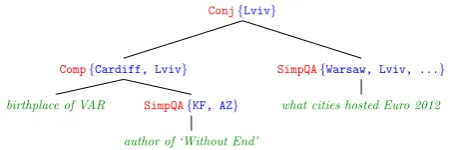
Figure 2: A computation tree for “What city is the birthplace of the author of ‘Without end’, and hosted Euro 2012?”. The leaves are strings, and inner nodes are functions (red) applied to their children to produce answers (blue).
1. A framework for answering complex ques-tions through question decomposition. 2. A sequence-to-sequence model for question
decomposition that substantially improves performance.
3. A dataset of 34,689 examples of complex and broad questions, along with answers, web snippets, and SPARQL queries.
Our dataset, COMPLEXWEBQUESTIONS, can
be downloaded from http://nlp.cs.tau.
ac.il/compwebq and our codebase can be
downloaded from https://github.com/
alontalmor/WebAsKB.
2 Problem Formulation
Our goal is to learn a model that given a ques-tion q and a black box QA model for answering simple questions, SIMPQA(·), produces a
com-putation tree t (defined below) that decomposes the question and computes the answer. The model is trained from a set of N question-computation tree pairs {qi, ti}N
i=1 or question-answer pairs {qi, ai}N
i=1.
A computation tree is a tree where leaves are labeled with strings, and inner nodes are labeled with functions. The arguments of a function are its children sub-trees. To compute an answer, or
denotation, from a tree, we recursively apply the function at the root to its children. More formally, given a tree rooted at nodet, labeled by the func-tion f, that has childrenc1(t), . . . , ck(t), the
de-notation JtK = f(Jc1(t)K, . . . ,Jck(t)K) is an
[image:2.595.305.533.64.139.2]in-teract with a KB, but rather compute directly over the breadth of the web through a search engine.
Figure2provides an example computation tree for our running example. Notice that words at the leaves are not necessarily in the original ques-tion, e.g.,“city”is paraphrased to“cities”. More broadly, our framework allows paraphrasing ques-tions in any way that is helpful for the function SIMPQA(·). Paraphrasing for better interaction with a QA model has been recently suggested by Buck et al.(2017) andNogueira and Cho(2016).
We defined the function SIMPQA(·) for an-swering simple questions, but in fact it comprises two components in this work. First, the question is submitted to a search engine that retrieves a list of web snippets. Next, a RC model extracts the answer from the snippets. While it is possible to train the RC model jointly with question decompo-sition, in this work we pre-train it separately, and later treat it as a black box.
The expressivity of our QA model is determined by the functions used, which we turn to next.
3 Formal Language
Functions in our formal language take arguments and return values that can be strings (when decom-posing or re-phrasing the question), sets of strings, or sets of numbers. Our set of functions includes:
1. SIMPQA(·): Model for answering simple questions, which takes a string argument and returns a set of strings or numbers as answer. 2. COMP(·,·): This function takes a string con-taining one unique variable VAR, and a set of answers. E.g., in Figure2 the first argu-ment is “birthplace of VAR”, and the sec-ond argument is “{KEN FOLLETT, ADAM
ZAGAJEWSKI}”. The function replaces the variable with each answer string represen-tation and returns their union. Formally, COMP(q,A) = ∪a∈ASIMPQA(q/a), where
q/a denotes the string produced when re-placing VAR in q with a. This is similar to function composition in CCG (Steedman, 2000), or a join operation in λ-DCS (Liang, 2013), where the string is a function applied to previously-computed values.
3. CONJ(·,·): takes two sets and returns their intersection. Other set operations can be de-fined analogously. As syntactic sugar, we al-low CONJ(·) to take strings as input, which means that we run SIMPQA(·)to obtain a set
and then perform intersection. The root node in Figure2illustrates an application of CONJ.
4. ADD(·,·): takes two singleton sets of num-bers and returns a set with their addition. Similar functions can be defined analogously. While we support mathematical operations, they were not required in our dataset.
Other logical operations In semantic parsing superlative and comparative questions like“What is the highest European mountain?”or“What Eu-ropean mountains are higher than Mont Blanc?”
are answered by joining the set of European moun-tains with their elevation. While we could add such functions to the formal language, answering such questions from the web is cumbersome: we would have to extract a list of entities and a numer-ical value for each. Instead, we handle such con-structions using SIMPQA directly, assuming they
are mentioned verbatim on some web document. Similarly, negation questions (“What countries are not in the OECD?”) are difficult to handle when working against a search engine only, as this is an open world setup and we do not hold a closed set of countries over which we can perform set subtraction.
In future work, we plan to interface with tables (Pasupat and Liang,2015) and KBs (Zhong et al., 2017). This will allow us to perform set operations over well-defined sets, and handle in a composi-tional manner superlatives and comparatives.
4 Dataset
Evaluating our framework requires a dataset of broad and complex questions that examine the im-portance of question decomposition. While many QA datasets have been developed recently (Yang et al.,2015;Rajpurkar et al.,2016;Hewlett et al., 2016;Nguyen et al.,2016;Onishi et al.,2016;Hill et al.,2015;Welbl et al.,2017), they lack a focus on the importance of question decomposition.
Most RC datasets contain simple questions that can be answered from a short input document. Re-cently, TRIVIAQA (Joshi et al.,2017) presented a
larger portion of complex questions, but still most do not require reasoning. Moreover, the focus of TRIVIAQA is on answer extraction from
Sec-1. Seed Question
2. SPARQL
3. Machine-generated
4. Natural language
What movies have robert pattinson starred in? ns:rebert_pattinson ns:film.actor.film ?c . ?c ns:film.performance.film ?x . ?x ns:film.film.produced_by ns:erwin_stoff
What movies have robert pattinson starred in and that was produced by Erwin Stoff?
Which Robert Pattinson film was produced by Erwin Stoff?
Figure 3: Overview of data collection process.
tion 6 we demonstrate that question decomposi-tion is useful for two different RC approaches.
4.1 Dataset collection
To generate complex questions we use the dataset WEBQUESTIONSSP (Yih et al., 2016), which
contains 4,737 questions paired with SPARQL queries for Freebase (Bollacker et al., 2008). Questions are broad but simple. Thus, we sample question-query pairs, automatically create more complex SPARQL queries, generate automatically questions that are understandable to AMT work-ers, and then have them paraphrase those into nat-ural language (similar toWang et al.(2015)). We compute answers by executing complex SPARQL queries against Freebase, and obtain broad and complex questions. Figure3provides an example for this procedure, and we elaborate next.
Generating SPARQL queries Given a
SPARQL query r, we create four types of more complex queries: conjunctions, superlatives, comparatives, and compositions. Table1gives the exact rules for generation. For conjunctions, su-perlatives, and comparatives, we identify queries in WEBQUESTIONSSP whose denotation is a set
A,|A| ≥ 2, and generate a new queryr0 whose denotation is a strict subsetA0,A0 ⊂ A,A0 6= φ. For conjunctions this is done by traversing the KB and looking for SPARQL triplets that can be added and will yield a valid set A0. For
comparatives and superlatives we find a numerical property common to all a ∈ A, and add a triplet and restrictor tor accordingly. For compositions, we find an entity e in r, and replace e with a variable y and add to r a triplet such that the denotation of that triplet is{e}.
Machine-generated (MG) questions To have
AMT workers paraphrase SPARQL queries into natural language, we need to present them in an understandable form. Therefore, we automatically generate a question they can paraphrase. When we generate new SPARQL queries, new
predi-cates are added to the query (Table1). We man-ually annotated 687 templates mapping KB pred-icates to text for different compositionality types (with 462 unique KB predicates), and use those templates to modify the original WebQuestionsSP question according to the meaning of the gener-ated SPARQL query. E.g., the template for ?x ns:book.author.works written objis“the
au-thor who wrote OBJ”. For brevity, we provide the details in the supplementary material.
Question Rephrasing We used AMT workers
to paraphrase MG questions into natural language (NL). Each question was paraphrased by one AMT worker and validated by 1-2 other workers. To generate diversity, workers got a bonus if the edit distance of a paraphrase was high compared to the MG question. A total of 200 workers were in-volved, and 34,689 examples were produced with an average cost of 0.11$ per question. Table 1 gives an example for each compositionality type.
A drawback of our method for generating data is that because queries are generated automatically the question distribution is artificial from a se-mantic perspective. Still, developing models that are capable of reasoning is an important direc-tion for natural language understanding and COM -PLEXWEBQUESTIONSprovides an opportunity to
develop and evaluate such models.
To summarize, each of our examples contains a question, an answer, a SPARQL query (that our models ignore), and all web snippets harvested by our model when attempting to answer the ques-tion. This renders COMPLEXWEBQUESTIONS
useful for both the RC and semantic parsing com-munities.
4.2 Dataset analysis
COMPLEXWEBQUESTIONS builds on the WE -BQUESTIONS (Berant et al.,2013). Questions in
WEBQUESTIONS are usually about properties of
entities (“What is the capital of France?”), of-ten with some filter for the semantic type of the answer (“Which director”, “What city”). WE -BQUESTIONSalso contains questions that refer to
events with multiple entities (“Who did Brad Pitt play in Troy?”). COMPLEXWEBQUESTIONS
Composit. Complex SPARQL queryr0 Example (natural language)
CONJ. r.?xpred1obj.or “What films star Taylor Lautner and have costume designs by Nina Proctor?”
r.?xpred1?c.?cpred2obj.
SUPER. r.?xpred1?n.ORDER BY DESC(?n)LIMIT1 “Which school that Sir Ernest Rutherford attended has the latest founding date?”
COMPAR. r.?xpred1?n.FILTER?n < V “Which of the countries bordering Mexico have an army size of less than 1050?”
[image:5.595.78.518.64.120.2]COMP. r[e/y].?ypred1obj. “Where is the end of the river that originates in Shannon Pot?”
Table 1: Rules for generating a complex queryr0from a queryr(’.’ in SPARQL corresponds to logical and). The queryrreturns the variable?x, and contains an entitye. We denote byr[e/y]the replacement of the entityewith a variable?y. pred1 and pred2are any KB predicates, obj is any KB entity,V is a numerical value, and?cis a
variable of a CVT type in Freebase which refers to events. The last column provides an example for a NL question for each type.
Figure 4: MG and NL questions similarity with nor-malized edit-distance, and the DICE coefficient (bars are stacked).
Paraphrasing To generate rich paraphrases, we gave a bonus to workers that substantially modi-fied MG questions. To check whether this worked, we measured surface similarity between MG and NL questions, and examined the similarity. Using normalized edit-distance and the DICE coefficient, we found that NL questions are different from MG questions and that the similarity distribution has wide support (Figure4).
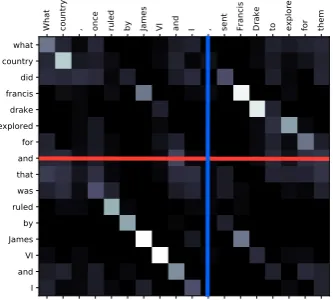
Figure 5: Heat map for similarity matrix between a MG and NL question. The red line indicates a known MG split point. The blue line is the approximated NL split point.
We created a heuristic for approximating the amount of word re-ordering performed by AMT workers. For every question, we constructed a ma-trixA, whereAij is the similarity between token
iin the MG question and tokenjin the NL ques-tion. Similarity is1 if lemmas match, or cosine similarity according to GloVe embeddings ( Pen-nington et al.,2014), when above a threshold, and 0 otherwise. The matrixA allows us to estimate whether parts of the MG question were re-ordered when paraphrased to NL (details in supplementary material). We find that in 44.7% of the conjunc-tion quesconjunc-tions and 13.2% of the composiconjunc-tion ques-tions, word re-ordering happened, illustrating that substantial changes to the MG question have been made. Figure5illustrates the matrixAfor a pair of questions with re-ordering.
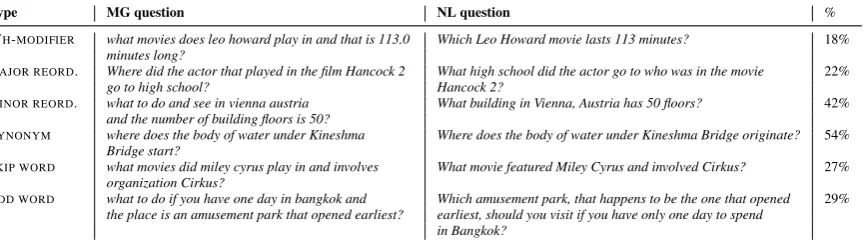
Qualitative analysis We randomly sampled 100 examples from the development set and manually identified prevalent phenomena in the data. We present these types in Table2along with their fre-quency. In 18% of the examples a conjunct in the MG question becomes a modifier of a wh-word in the NL question (WH-MODIFIER). In 22%
sub-stantial word re-ordering of the MG questions curred, and in 42% a minor word re-ordering oc-curred (“number of building floors is 50” para-phrased as“has 50 floors”). AMT workers used a synonym in 54% of the examples, they omitted words in 27% of the examples and they added new lexical material in 29%.
[image:5.595.103.258.221.317.2] [image:5.595.95.262.544.694.2]Type MG question NL question % WH-MODIFIER what movies does leo howard play in and that is 113.0 Which Leo Howard movie lasts 113 minutes? 18%
minutes long?
MAJOR REORD. Where did the actor that played in the film Hancock 2 What high school did the actor go to who was in the movie 22%
go to high school? Hancock 2?
MINOR REORD. what to do and see in vienna austria What building in Vienna, Austria has 50 floors? 42%
and the number of building floors is 50?
SYNONYM where does the body of water under Kineshma Where does the body of water under Kineshma Bridge originate? 54%
Bridge start?
SKIP WORD what movies did miley cyrus play in and involves What movie featured Miley Cyrus and involved Cirkus? 27%
organization Cirkus?
ADD WORD what to do if you have one day in bangkok and Which amusement park, that happens to be the one that opened 29%
[image:6.595.89.522.60.183.2]the place is an amusement park that opened earliest? earliest, should you visit if you have only one day to spend in Bangkok?
Table 2: Examples and frequency of prevalent phenomena in the NL questions for a manually analyzed subset (see text).
Moreover, words that did not appear in the MG question need to be added in 39% of the cases, and words need to be deleted in 28% of the examples.
5 Model and Learning
We would like to develop a model that translates questions into arbitrary computation trees with ar-bitrary text at the tree leaves. However, this re-quires training from denotations using methods such as maximum marginal likelihood or rein-forcement learning (Guu et al.,2017) that are dif-ficult to optimize. Moreover, such approaches in-volve issuing large amounts of queries to a search engine at training time, incurring high costs and slowing down training.
Instead, we develop a simple approach in this paper. We consider a subset of all possible compu-tation trees that allows us to automatically gener-ate noisy full supervision. In what follows, we de-scribe the subset of computation trees considered and their representation, a method for automati-cally generating noisy supervision, and a pointer network model for decoding.
Representation We represent computation trees as a sequence of tokens, and consider trees with at most one compositional operation. We denote a sequence of question tokensqi:j = (qi, . . . , qj),
and the decoded sequence byz. We consider the following token sequences (see Table3):
1. SimpQA: The function SIMPQA is applied
to the question q without paraphrasing. In prefix notation this is the tree SIMPQA(q). 2. Comp i j: This sequence of tokens
corre-sponds to the following computation tree: COMP(q1:i−1◦VAR◦qj+1:|q|,SIMPQA(qi:j)),
where◦is the concatenation operator. This is used for questions where a substring is an-swered by SIMPQA and the answers replace
a variable before computing a final answer. 3. Conj i j: This sequence of tokens
corresponds to the computation tree CONJ(SIMPQA(q0:i−1),SIMPQA(qj ◦
qi:|q|)). The idea is that conjunction can
be answered by splitting the question in a single point, where one token is copied to the second part as well (“film”in Table3). If nothing needs to be copied, thenj=−1. This representation supports one compositional operation, and a single copying operation is al-lowed without any re-phrasing. In future work, we plan to develop a more general representation, which will require training from denotations.
Supervision Training from denotations is diffi-cult as it involves querying a search engine fre-quently, which is expensive. Therefore, we take advantage of the the original SPARQL queries and MG questions to generate noisy programs for composition and conjunction questions. Note that these noisy programs are only used as supervision to avoid the costly process of manual annotation, but the model itself does not assume SPARQL queries in any way.
rule-Program Question Split
SimpQA “What building in Vienna, Austria has 50 floors”
-Comp5 9 “Where is the birthplace of the writer of Standup Shakespeare” “Where is the birthplace of VAR” “the writer of Standup Shakespeare” Conj5 1 “What film featured Taylor Swift and “What film featured Taylor Swift”
[image:7.595.117.483.61.113.2]was directed by Deborah Aquila” “film and was directed by Deborah Aquila”
Table 3: Examples for the types of computation trees that can be decoded by our model.
based algorithm are in the supplementary material. Thus, we obtain noisy supervision for all com-position and conjunction questions and can train a model that translates questionsq to representa-tionsz = z1 z2 z3, where z1 ∈ {Comp,Conj}
andz2, z3 are integer indices.
Pointer network The representationzpoints to indices in the input, and thus pointer networks (Vinyals et al., 2015) are a sensible choice. Be-cause we also need to decode the tokens COMP
and CONJ, we use “augmented pointer networks”,
(Zhong et al.,2017): For every questionq, an aug-mented questionqˆis created by appending the to-kens “COMP CONJ” to q. This allows us to
de-code the representationzwith one pointer network that at each decoding step points to one token in the augmented question. We encodeqˆwith a one-layer GRU (Cho et al.,2014), and decodezwith a one-layer GRU with attention as inJia and Liang (2016). The only difference is that we decode to-kens from the augmented question qˆrather than from a fixed vocabulary.
We train the model with token-level cross-entropy loss, minimizingPjlogpθ(zj|x, z1:j−1).
Parameters θ include the GRU encoder and de-coder, and embeddings for unknown tokens (that are not in pre-trained GloVe embeddings ( Pen-nington et al.,2014)).
The trained model decodes COMP and CONJ
representations, but sometimes using SIMPQA(q) without decomposition is better. To handle such cases we do the following: We assume that we al-ways have access to a score for every answer, pro-vided by the final invocation of SIMPQA (in CONJ
questions this score is the maximum of the scores given by SIMPQA for the two conjuncts), and use
the following rule to decide if to use the decoded representationzor SIMPQA(q). Given the scores for answers given by z and the scores given by SIMPQA(q), we return the single answer that has the highest score. The intuition is that the confi-dence provided by the scores of SIMPQA is
corre-lated with answer correctness. In future work we will train directly from denotations and will
han-dle all logical functions in a uniform manner.
6 Experiments
In this section, we aim to examine whether ques-tion decomposiques-tion can empirically improve per-formance of QA models over complex questions.
Experimental setup We used 80% of the exam-ples in COMPLEXWEBQUESTIONS for training,
10% for development, and 10% for test, training the pointer network on 24,708 composition and conjunction examples. The hidden state dimen-sion of the pointer network is 512, and we used Adagrad (Duchi et al., 2010) combined with L2
regularization and a dropout rate of 0.25. We initialize50-dimensional word embeddings using GloVe and learn embeddings for missing words.
Simple QA model As our SIMPQA function,
we download the web-based QA model ofTalmor et al. (2017). This model sends the question to Google’s search engine and extracts a distribution over answers from the top-100web snippets us-ing manually-engineered features. We re-train the model on our data with one new feature: for ev-ery questionq and candidate answer mention in a snippet, we run RASOR, a RC model bylee et al.
(2016), and add the output logit score as a feature. We found that combining the web-facing model of Talmor et al.(2017) and RASOR, resulted in
im-proved performance.
Evaluation For evaluation, we measure preci-sion@1 (p@1), i.e., whether the highest scoring answer returned string-matches one of the correct answers (while answers are sets, 70% of the ques-tions have a single answer, and the average size of the answer set is 2.3).
We evaluate the following models and oracles: 1. SIMPQA: running SIMPQA on the entire
question, i.e., without decomposition. 2. SPLITQA: Our main model that answers
complex questions by decomposition. 3. SPLITQAORACLE: An oracle model that
decom-System Dev. Test
SIMPQA 20.4 20.8
SPLITQA 29.0 27.5
SPLITQAORACLE 34.0 33.7
RCQA 18.7 18.6
SPLITRCQA 21.5 22.0
GOOGLEBOX 2.5
-HUMAN 63.0
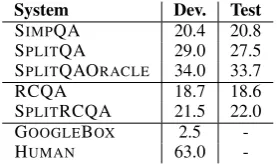
-Table 4: precision@1 results on the development set and test set for COMPLEXWEBQUESTIONS.
position or use SIMPQA in hindsight based
on what performs better.
4. RCQA: This is identical to SIMPQA, except
that we replace the RC model from Talmor et al.(2017) with the the RC model DOCQA
(Clark and Gardner, 2017), whose perfor-mance is comparable to state-of-the-art on TRIVIAQA.
5. SPLITRCQA: This is identical to SPLITQA,
except that we replace the RC model from Talmor et al.(2017) with DOCQA.
6. GOOGLEBOX: We sample 100random de-velopment set questions and check whether Google returns a box that contains one of the correct answers.
7. HUMAN: We sample 100 random develop-ment set questions and manually answer the questions with Google’s search engine, in-cluding all available information. We limit the amount of time allowed for answering to 4 minutes.
Table4presents the results on the development and test sets. SIMPQA, which does not
decom-pose questions obtained 20.8 p@1, while by per-forming question decomposition we substantially improve performance to 27.5 p@1. An upper bound with perfect knowledge on when to decom-pose is given by SPLITQAORACLEat 33.7 p@1.
RCQA obtained lower performance SIMPQA,
as it was trained on data from a different distri-bution. More importantly SPLITRCQA
outper-forms RCQA by 3.4 points, illustrating that this RC model also benefits from question decomposi-tion, despite the fact that it was not created with question decomposition in mind. This shows the importance of question decomposition for retriev-ing documents from which an RC model can ex-tract answers. GOOGLEBOX finds a correct
an-swer in 2.5% of the cases, showing that complex questions are challenging for search engines.
To conclude, we demonstrated that question
de-composition substantially improves performance on answering complex questions using two inde-pendent RC models.
Analysis We estimate human performance
(HUMAN) at 63.0 p@1. We find that answering
complex questions takes roughly 1.3 minutes on average. For questions we were unable to answer, we found that in 27% the answer was correct but exact string match with the gold answers failed; in 23.1% the time required to compute the answer was beyond our capabilities; for 15.4% we could not find an answer on the web; 11.5% were of ambiguous nature; 11.5% involved paraphrasing errors of AMT workers; and an additional 11.5% did not contain a correct gold answer.
SPLITQA decides if to decompose questions or
not based on the confidence of SIMPQA. In 61%
of the questions the model chooses to decompose the question, and in the rest it sends the question as-is to the search engine. If one of the strategies (decomposition vs. no decomposition) works, our model chooses that right one in 86% of the cases. Moreover, in 71% of these answerable questions, only one strategy yields a correct answer.
We evaluate the ability of the pointer network to mimic our labeling heuristic on the develop-ment set. We find that the model outputs the ex-act correct output sequence 60.9% of the time, and allowing errors of one word to the left and right (this often does not change the final output) accu-racy is at 77.1%. Token-level accuaccu-racy is 83.0% and allowing one-word errors 89.7%. This shows that SPLITQA learned to identify decomposition
points in the questions. We also observed that of-ten SPLITQA produced decomposition points that
are better than the heuristic, e.g., for“What is the place of birth for the lyricist of Roman Holiday”, SPLITQA produced “the lyricist of Roman
Hol-iday”, but the heuristic produced “the place of birth for the lyricist of Roman Holiday”. Addi-tional examples of SPLITQA question
decompo-sitions are provided in Table5.
ComplexQuestions To further examine the abil-ity of web-based QA models, we run an experi-ment against COMPLEXQUESTIONS (Bao et al., 2016), a small dataset of question-answer pairs de-signed for semantic parsing against Freebase.
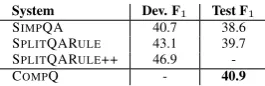
We ran SIMPQA on this dataset (Table6) and
obtained 38.6 F1 (the official metric), slightly
[image:8.595.112.251.62.145.2]op-Question Split-1 Split-2
“Find the actress who played Hailey Rogers, “the actress who played Hailey Rogers” “FindVAR, what label is she signed to” what label is she signed to”
“What are the colors of the sports team whose “the sports team whose arena stadium “What are the colors ofVAR” arena stadium is the AT&T Stadium” is the AT&T Stadium”
“What amusement park is located in Madrid “What amusement park is located in “park includes the stunt fall ride” Spain and includes the stunt fall ride” Madrid Spain and”
[image:9.595.97.497.61.137.2]“Which university whose mascot is “Which university whose mascot is “university Derek Fisher attend” The Trojan did Derek Fisher attend” The Trojan did”
Table 5: Examples for question decompositions from SPLITQA.
System Dev. F1 Test F1
SIMPQA 40.7 38.6
SPLITQARULE 43.1 39.7 SPLITQARULE++ 46.9
[image:9.595.114.247.179.222.2]-COMPQ - 40.9
Table 6: F1results for COMPLEXQUESTIONS.
erates directly against Freebase. 2 By analyzing
the training data, we found that we can decom-pose COMP questions with a rule that splits the
question when the words“when”or“during” ap-pear, e.g.,“Who was vice president when JFK was president?”.3We decomposed questions with this
rule and obtained 39.7 F1 (SPLITQARULE).
An-alyzing the development set errors, we found that occasionally SPLITQARULEreturns a correct
swer that fails to string-match with the gold an-swer. By manually fixing these cases, our devel-opment set F1 reaches 46.9 (SPLITQARULE++).
Note that COMPQ does not suffer from any string
matching issue, as it operates directly against the Freebase KB and thus is guaranteed to output the answer in the correct form. This short experiment shows that a web-based QA model can rival a se-mantic parser that works against a KB, and that simple question decomposition is beneficial and leads to results comparable to state-of-the-art.
7 Related work
This work is related to a body of work in seman-tic parsing and RC, in parseman-ticular to datasets that focus on complex questions such as TRIVIAQA
(Joshi et al.,2017), WIKIHOP(Welbl et al.,2017)
and RACE (Lai et al.,2017). Our distinction is in
proposing a framework for complex QA that fo-cuses on question decomposition.
Our work is related to Chen et al. (2017) and Watanabe et al. (2017), who combined retrieval and answer extraction on a large set of documents. We work against the entire web, and propose
ques-2By adding the output logit from RASOR, we improved
test F1from 32.6, as reported byTalmor et al.(2017), to 38.6.
3The data is too small to train our decomposition model.
tion decomposition for finding information. This work is also closely related to Dunn et al. (2017) andBuck et al.(2017): we start with ques-tions directly and do not assume documents are given.Buck et al.(2017) also learn to phrase ques-tions given a black box QA model, but while they focus on paraphrasing, we address decomposition. Another important related research direction is Iyyer et al.(2016), who answered complex ques-tions by decomposing them. However, they used crowdsourcing to obtain direct supervision for the gold decomposition, while we do not assume such supervision. Moreover, they work against web tables, while we interact with a search engine against the entire web.
8 Conclusion
In this paper we propose a new framework for answering complex questions that is based on question decomposition and interaction with the web. We develop a model under this framework and demonstrate it improves complex QA perfor-mance on two datasets and using two RC mod-els. We also release a new dataset, COMPLEXWE -BQUESTIONS, including questions, SPARQL
pro-grams, answers, and web snippets harvested by our model. We believe this dataset will serve the QA and semantic parsing communities, drive re-search on compositionality, and push the commu-nity to work on holistic solutions for QA.
In future work, we plan to train our model di-rectly from weak supervision, i.e., denotations, and to extract information not only from the web, but also from structured information sources such as web tables and KBs.
Acknowledgements
References
Y. Artzi and L. Zettlemoyer. 2013. Weakly supervised learning of semantic parsers for mapping instruc-tions to acinstruc-tions. Transactions of the Association for Computational Linguistics (TACL)1:49–62.
J. Bao, N. Duan, Z. Yan, M. Zhou, and T. Zhao. 2016. Constraint-based question answering with knowl-edge graph. In International Conference on Com-putational Linguistics (COLING).
J. Berant, A. Chou, R. Frostig, and P. Liang. 2013. Se-mantic parsing on Freebase from question-answer pairs. InEmpirical Methods in Natural Language Processing (EMNLP).
J. Berant and P. Liang. 2015. Imitation learning of agenda-based semantic parsers. Transactions of the Association for Computational Linguistics (TACL)
3:545–558.
K. Bollacker, C. Evans, P. Paritosh, T. Sturge, and J. Taylor. 2008. Freebase: a collaboratively created graph database for structuring human knowledge. In
International Conference on Management of Data (SIGMOD). pages 1247–1250.
C. Buck, J. Bulian, M. Ciaramita, A. Gesmundo, N. Houlsby, W. Gajewski, and W. Wang. 2017. Ask the right questions: Active question reformu-lation with reinforcement learning. arXiv preprint arXiv:1705.07830.
D. Chen, J. Bolton, and C. D. Manning. 2016. A thor-ough examination of the CNN / Daily Mail reading comprehension task. In Association for Computa-tional Linguistics (ACL).
D. Chen, A. Fisch, J. Weston, and A. Bordes. 2017. Reading Wikipedia to answer open-domain ques-tions. arXiv preprint arXiv:1704.00051.
K. Cho, B. van Merri¨enboer, D. Bahdanau, and Y. Ben-gio. 2014. On the properties of neural machine translation: Encoder-decoder approaches. arXiv preprint arXiv:1409.1259.
C. Clark and M. Gardner. 2017. Simple and effec-tive multi-paragraph reading comprehension. arXiv preprint arXiv:1710.10723.
J. Duchi, E. Hazan, and Y. Singer. 2010. Adaptive sub-gradient methods for online learning and stochastic optimization. In Conference on Learning Theory (COLT).
M. Dunn, , L. Sagun, M. Higgins, U. Guney, V. Cirik, and K. Cho. 2017. SearchQA: A new Q&A dataset augmented with context from a search engine. arXiv
.
K. Guu, P. Pasupat, E. Z. Liu, and P. Liang. 2017. From language to programs: Bridging reinforce-ment learning and maximum marginal likelihood. In
Association for Computational Linguistics (ACL).
K. M. Hermann, T. Koisk, E. Grefenstette, L. Espe-holt, W. Kay, M. Suleyman, and P. Blunsom. 2015. Teaching machines to read and comprehend. In Ad-vances in Neural Information Processing Systems (NIPS).
D. Hewlett, A. Lacoste, L. Jones, I. Polosukhin, A. Fandrianto, J. Han, M. Kelcey, and D. Berthelot. 2016. Wikireading: A novel large-scale language understanding task over Wikipedia. In Association for Computational Linguistics (ACL).
F. Hill, A. Bordes, S. Chopra, and J. Weston. 2015. The goldilocks principle: Reading children’s books with explicit memory representations. In International Conference on Learning Representations (ICLR).
M. Iyyer, W. Yih, and M. Chang. 2016. Answering complicated question intents expressed in decom-posed question sequences. CoRR0.
R. Jia and P. Liang. 2016. Data recombination for neu-ral semantic parsing. InAssociation for Computa-tional Linguistics (ACL).
R. Jia and P. Liang. 2017. Adversarial examples for evaluating reading comprehension systems. In Em-pirical Methods in Natural Language Processing (EMNLP).
M. Joshi, E. Choi, D. Weld, and L. Zettlemoyer. 2017. TriviaQA: A large scale distantly supervised chal-lenge dataset for reading comprehension. In Associ-ation for ComputAssoci-ational Linguistics (ACL).
J. Krishnamurthy and T. Mitchell. 2012. Weakly supervised training of semantic parsers. In Em-pirical Methods in Natural Language Processing and Computational Natural Language Learning (EMNLP/CoNLL). pages 754–765.
T. Kwiatkowski, E. Choi, Y. Artzi, and L. Zettlemoyer. 2013. Scaling semantic parsers with the-fly on-tology matching. InEmpirical Methods in Natural Language Processing (EMNLP).
G. Lai, Q. Xie, H. Liu, Y. Yang, and E. Hovy. 2017. Race: Large-scale reading comprehen-sion dataset from examinations. arXiv preprint arXiv:1704.04683.
K. lee, M. Lewis, and L. Zettlemoyer. 2016. Global neural CCG parsing with optimality guarantees. In
Empirical Methods in Natural Language Processing (EMNLP).
P. Liang. 2013. Lambda dependency-based composi-tional semantics. arXiv preprint arXiv:1309.4408.
P. Liang, M. I. Jordan, and D. Klein. 2011. Learn-ing dependency-based compositional semantics. In
T. Nguyen, M. Rosenberg, X. Song, J. Gao, S. Tiwary, R. Majumder, and L. Deng. 2016. MS MARCO: A human generated machine reading comprehension dataset. In Workshop on Cognitive Computing at NIPS.
R. Nogueira and K. Cho. 2016. End-to-end goal-driven web navigation. InAdvances in Neural Information Processing Systems (NIPS).
T. Onishi, H. Wang, M. Bansal, K. Gimpel, and D. McAllester. 2016. Who did what: A large-scale person-centered cloze dataset. In Empirical Meth-ods in Natural Language Processing (EMNLP). P. Pasupat and P. Liang. 2015. Compositional semantic
parsing on semi-structured tables. InAssociation for Computational Linguistics (ACL).
J. Pennington, R. Socher, and C. D. Manning. 2014. Glove: Global vectors for word representation. In
Empirical Methods in Natural Language Processing (EMNLP).
P. Rajpurkar, J. Zhang, K. Lopyrev, and P. Liang. 2016. Squad: 100,000+ questions for machine comprehen-sion of text. InEmpirical Methods in Natural Lan-guage Processing (EMNLP).
M. Steedman. 2000. The Syntactic Process. MIT Press.
I. Sutskever, O. Vinyals, and Q. V. Le. 2014. Sequence to sequence learning with neural networks. In Ad-vances in Neural Information Processing Systems (NIPS). pages 3104–3112.
A. Talmor, M. Geva, and J. Berant. 2017. Evaluating semantic parsing against a simple web-based ques-tion answering model. In*SEM.
O. Vinyals, M. Fortunato, and N. Jaitly. 2015. Pointer networks. InAdvances in Neural Information Pro-cessing Systems (NIPS). pages 2674–2682.
W. Wang, N. Yang, F. Wei, B. Chang, and M. Zhou. 2017. Gated self-matching networks for reading comprehension and question answering. In Associ-ation for ComputAssoci-ational Linguistics (ACL).
Y. Wang, J. Berant, and P. Liang. 2015. Building a semantic parser overnight. InAssociation for Com-putational Linguistics (ACL).
Y. Watanabe, B. Dhingra, and R. Salakhutdinov. 2017. Question answering from unstructured text by retrieval and comprehension. arXiv preprint arXiv:1703.08885.
J. Welbl, P. Stenetorp, and S. Riedel. 2017. Construct-ing datasets for multi-hop readConstruct-ing comprehension across documents. arXiv preprint arXiv:1710.06481
.
Y. Yang, W. Yih, and C. Meek. 2015. WikiQA: A chal-lenge dataset for open-domain question answering. InEmpirical Methods in Natural Language Process-ing (EMNLP). pages 2013–2018.
W. Yih, M. Richardson, C. Meek, M. Chang, and J. Suh. 2016. The value of semantic parse labeling for knowledge base question answering. In Associ-ation for ComputAssoci-ational Linguistics (ACL).
M. Zelle and R. J. Mooney. 1996. Learning to parse database queries using inductive logic program-ming. InAssociation for the Advancement of Arti-ficial Intelligence (AAAI). pages 1050–1055.
L. S. Zettlemoyer and M. Collins. 2005. Learning to map sentences to logical form: Structured classifica-tion with probabilistic categorial grammars. In Un-certainty in Artificial Intelligence (UAI). pages 658– 666.