CoMpetItIoN
aND proDUCtIVIty
DAVID BOYLE AND JOHN EVANS
1AbstRAct
The body of research linking competition and productivity has been growing in recent years and there appears to be a strong positive association. This chapter sets out the economic evidence in support of the thesis that strong competition supports productivity gains by encouraging innovation activity, more efficient business practices and technological diffusion. By way of example, the chapter discusses the Irish air travel and electricity sectors in-dept. In it’s conclusions, the chapter emphasises the problems in the non-traded sectors of the economy in terms of competition and productivity.
10.1 Introduction
The motivation for competition policy is often framed in terms of monopoly (or market) power. Anyone with even a passing interest in competition policy is aware of the ‘monopoly example’. Monopolies are ‘bad’ because they can charge the monopoly price (or equivalently, the monopoly margin over cost). The monopolist’s power, and therefore the harm it can cause to society, arises because the consumer’s only choice is to buy or not buy. By contrast, in a competitive market, each firm’s market power is weakened because consumers have other choices – the fact that the consumer can choose to buy from different firms disciplines each of them in such a way that the price they can charge approaches the cost of producing whatever good or service is at issue. This result is often referred to as the allocative efficiency property of competitive markets. It is not however the only, or perhaps even the most important efficiency property of competitive markets.
Competitive markets are also characterised as being both productively and dynamically efficient. Recent studies on gains from competition have been focussing increasingly on ‘productive efficiency’ and ‘dynamic efficiency’, which can be broadly defined in terms of productivity growth through innovations (Ahn, 00). In short, productive efficiency gains
come from productivity enhancing innovations which introduce new and better production methods, and successful innovations will eventually raise the level and growth rate of productivity in the long run. As with the previous example, harm to society tends to arise where competition is weak. Weakly competitive markets tend to be less productively or dynamically efficient, or in other words, productivity levels and growth rates tend to be less in weakly competitive markets.
The overall harm to society can be ascertained by considering briefly the determinants of economic growth. Economic growth is typically attributed to three factors: (i) capital accumulation; (ii) labour force growth; and (iii) multi-factor productivity. In other words, increasing factor inputs such as capital and labour, and enabling them to work together in more productive combinations, allow for the creation of greater wealth. To the extent that the degree of competition affects factor productivity, economic growth and therefore societal prosperity, now and into the future, is also affected. This line of reasoning yields a very powerful motivation for competition policy.
10.2 The relationship between productivity
and Competition
10.2.1 Some Intuition
The relationship between competition and productivity is in some respects not a straightforward one. Nonetheless, a rudimentary understanding of what is often termed the ‘competitive process’ provides a compelling intuition.
A useful starting point is to consider first the concept of ‘rivalry’ among firms. Rivalry refers to the interaction of firms in a market, i.e., the manner in which firms compete for custom based on price, quality and other product or service dimensions that the consumer values. Rivalry may be more or less vigorous and is determined by many factors. The simplest, but often deceptive characterisation of rivalry involves market structure. That is, markets with more firms tend to be more rivalrous. The concept of rivalry is however essentially a static one.
Concepts of the competitive process are more complete when dynamic effects are incorporated. Specifically, firms over time seek to (i) improve the way in which they produce goods or services, i.e., they seek out more efficient ways of operating and/or (ii) provide better or new goods and services. The first effect influences the productivity of the firm directly. Improving the manner in which a firm produces may involve employing labour and capital in more productive combinations, it may involve the adoption of new technologies or it may involve shifting the boundaries of the firm. The second effect influences productivity to the extent that the firm supplying new and innovative products operates at an intermediate stage of production, its ‘new or improved’ goods or services, to the extent that they are taken up, allow downstream firms to operate more productively.
Central to this dynamic notion of competition is the process of entry and exit. The threat of entry and the possibility of failure are strong drivers of competition. Weak rivalry, and the associated high profits and/or inefficient practices will over time induce entry by more efficient firms. Incumbents will either adapt or fail. When this process is effective, dynamic competition ensures greater productivity.
10.2.2 a More Formal Understanding
While this intuitive understanding of how competition can drive productivity is useful, formal studies of productivity tend to distinguish three different processes (Pilat, 99: 08-09): (i) innovation activity; (ii) efficiency and; (iii) technological diffusion. Each of these processes is influenced by competition.
occurs because a firm considering investing in R&D activity must consider the costs associated with making a risky R&D investment that may or may not be successful as well as the potential return from the R&D activity. In extremely competitive markets where the results of R&D, i.e., the new product or process, can be easily copied, the returns from R&D activity are reduced leading to reduced incentives to innovate in the first place. It is this line of reasoning which motivates the rationale for patents and licences.
Recent empirical studies undertaken by the OECD take an entirely different approach from the more conventional analysis of the relationship between competition and innovation which primarily focuses on the relationship between concentration levels and innovation. Recent studies search for a correlation between the level of anti-competitive product market regulation and innovation across entire national economies. Jaumotte and Pain (005) show that all else being equal, anti-competitive regulations (other than Intellectual Property Rights) have a significant negative correlation with both R&D intensity and patenting. The study analysed various policy levers and their effects on business R&D spending and found removing or reducing anti-competitive regulation was the second most effective lever for raising the level of R&D spending. In fact, the authors concluded that the low levels of such anti-competitive regulations in Australia, the UK and the US have helped to raise the intensity of R&D in each of those countries by ten per cent or more above the OECD average.
The ‘efficiency’ process refers to the reduction of productive inefficiency. Exposing inefficient firms to competition forces them to improve their methods of production. Competition provides the stimulus to adopt or invest in new technology or find more cost efficient ways of producing. Studies on the relationship between competition variables and inefficient behaviour conclude that in most countries efficiency in an industry declines beyond a certain level of concentration, suggesting that high levels of concentration are detrimental to efficiency (Caves et al., 99).
‘Technological diffusion’ as a source of productivity gains refers to the process whereby firms adopt new technologies or processes developed elsewhere and is distinct from the efficiency channel which typically involves more efficient use of existing technology. Diffusion of technology is also considered a key factor for improving productivity. The McKinsey Institute have carried out numerous studies on productivity and conclude that the degree to which firms implement modern technology is directly related to their exposure to competition. Firms
in markets sheltered from competition have little incentive to invest in new technology and improve efficiency, the result being lower productivity than under conditions of competition. An OECD study concluded technology diffusion often accounts for more than half of Total Factor Productivity (TFP) (OECD, 99).
10.2.3 Comment
10.3 two Illustrative examples
In this section we provide two examples where the considerations outlined in the previous section can be seen in practice. The importance of the transport and electricity sectors for an economy are widely recognised. The European Commission (00: ) described these sectors as “…. the arteries of the Internal Market, the lifeblood of competitiveness, when they under-perform, so does the rest of the economy. If they are efficient, all other sectors benefit.”
10.3.1 the Irish air-travel Industry
A cursory analysis of the air-travel industry in Ireland over the past two decades illustrates the effect that effective dynamic competition can have on productivity and how consumers and the economy more generally can benefit. In particular, the history of Aer Lingus is an interesting example of how a once primed national champion can become an effective competitor, not just on a domestic but also on an international stage.
Liberalisation of the Airline Sector
The process of liberalisation of the Irish travel sector was a long one but two distinct phases can be distinguished. The first phase commenced in 98 with the decision by regulatory authorities to allow Ryanair to challenge British Airways and Aer Lingus for the Dublin to London route. The second phase resulted from the European Commission decision to fully deregulate the airline industry in 997.
The first phase of liberalisation allowed, most notably, Ryanair to compete directly with the national carrier, Aer Lingus. At first Ryanair employed the traditional airline business model and, until restructuring in 990, made losses. The restructured Ryanair employed a new low cost business model that was closely based on that of the original low fares airline, Southwest Airlines in the U.S. The low cost model involved minimising costs and maximising efficiency through operating from uncongested secondary airports with a single aircraft-type fleet and getting maximum utilisation from each aircraft through fast turnarounds and high load-factors. The Ryanair business model was in stark contrast with that of Aer Lingus who operated the more traditional airline model. While throughout the 990s, consumers benefited from lower prices and greater choice, Aer Lingus, tried to compete, lost money, and were rescued by the government. In 99, Aer Lingus had debts of n million and were incurring losses of n million a week. Aid in the region of £75 million was approved by the European Commission
subject to conditions (Chari, 00).
Aer Lingus’ Turnaround
The removal of the restrictive barriers which were commonplace in the industry resulted in increased competition for Aer Lingus. Following the shock to international air travel caused by the events of September th, 00, many governments across Europe faced calls to financially
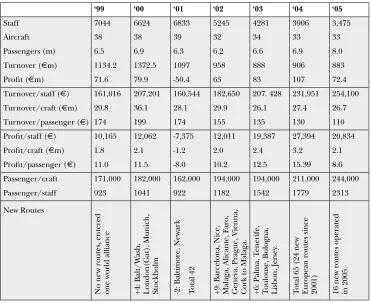
[image:6.482.57.428.189.492.2]support their national carriers. The decision of the European Commission not to allow airlines to receive state aids provoked fears we had seen the last of the ‘national champion’. Table 0. below provides some details on Aer Lingus’ perfomance between 999 and 005.
Table 10.1: Aer Lingus Performance 999 - 005
‘99 ‘00 ‘01 ‘02 ‘03 ‘04 ‘05
Staff 70 8 55 8 90 ,75
Aircraft 8 8 9
Passengers (m) .5 .9 . . . .9 8.0
Turnover (nm) . 7.5 097 958 888 90 88
Profit (nm) 7. 79.9 -50. 8 07 7.
Turnover/staff (n) ,0 07,0 0,5 8,50 07. 8 ,95 5,00
Turnover/craft (nm) 9.8 . 8. 9.9 . 7. .7
Turnover/passenger (n) 7 99 7 55 5 0 0
Profit/staff (n) 0,5 ,0 -7,75 ,0 9,87 7,9 0,8
Profit/craft (nm) .8 . -. .0 . . .
Profit/passenger (n) .0 .5 -8.0 0. .5 5.9 8.
Passenger/craft 7,000 8,000 ,000 9,000 9,000 ,000 ,000
Passenger/staff 9 0 9 8 5 779
New Routes N o ne w r ou te s, e nt er ed on e w or ld a lli an ce + : B al t/ W as h, L on do n( G at ), M un ic h, St oc kh ol m -: B al tim or e, N ew ar k To ta l +9 : B ar ce lo na , N ic e, M al ag a, A lic an te , F ar o, G en ev a, P ra gu e, V ie nn a, C or k to M al ag a. + : P al m a, T en er ife , To ul ou se , B ol og na , L is bo n, Je rs ey . To ta l 5 ( ne w E ur op ea n ro ut es s in ce 0 0 ) n ew r ou te s op er at ed in 00 5.
Vigorous competition has also driven Aer Lingus not just to use existing capital more intensively, but also to adopt new technologies. For example, Aer Lingus has installed new check in systems that make it possible for passengers to check in without queuing. Ryanair have now introduced an online self check in system.
Apart from the direct effects on productivity, competition in the air travel sector has clearly benefited consumers. The cost of air travel is down and consumers have a much broader range of destinations and carriers. The knock-on effects of increased competition in the air travel industry are visible across various sectors of the economy including the export and tourism markets, which contributes to our overall growth. Transport is an essential input for many sectors and industries; Ireland is now a convenient place to do business due to the cost and frequency of flights to and from Ireland.5 Passenger traffic through Dublin Airport is indicative.
Inward (outward) traffic has increased by per cent from .7 million passengers in 995 to 8.07 million passengers in 005.
10.3.2 the Irish electricity Sector
The impetus to liberalise the Irish electricity sector came from Europe. The principal objective behind the ongoing programme is to introduce greater competition into EU electricity markets by integrating national and regional energy markets into a single European market. Vertically and horizontally integrated companies, incorporating all the functions of the electricity supply chain (i.e., generation, transmission, distribution and supply) have historically controlled energy markets in Europe. As was the case in Ireland, these companies tended to be in public ownership and often had monopoly rights conferred on them by statute. The primary challenge facing the liberalisation programme lies in tackling these national and regional monopolies. The Irish experience of electricity market liberalisation has so far largely been a negative one, precisely because of the failure to tackle the former statutory monopolist.
Liberalisation of the Electricity Sector in Ireland
The launch of the EU electricity market liberalisation programme began with the adoption of the ‘First Electricity Directive’ in December 99, Directive 9/9/EC. The second piece of important community legislation aimed at liberalisation was the ‘Second Electricity Directive’, Directive 00/5/EC. Together, these pieces of EU legislation attempt to remove legal monopolies in the Member States by requiring a degree of vertical disintegration of the electricity supply chain, i.e., decomposition of generation, transmission, distribution and supply, along with market opening in generation and phased market opening in supply.
The rate of progress of liberalisation in Ireland has been slow. There has been market opening at the generation level but, despite significant initial interest from potential entrants, the ESB Group’s market share remains high at approximately 77 per cent with the remainder of the market largely being accounted for by Viridian.7 At the transmission level, there has been legal
unbundling of the transmission system assets, but ownership of the assets remains with the ESB Group. At the supply level, as with generation, entry has been limited with the former statutory monopolist supplying 7 per cent of the market in total.8
Generation and supply are two areas of the Irish market in which competition is possible.9
success of liberalisation can only really be assessed in light of the emergence of competition in the sector. The reality is that competition has not materialised and further, the prospect of it eventually appearing, at present, seems remote.
The Impact of Liberalisation
Unsurprisingly, one of the implications of weak competition in the electricity sector is inefficiency (or low productivity). Deloitte (005) in a review of the electricity sector in Ireland, find evidence of (i) higher than average non- fuel costs; and (ii) poor plant availability at the ESB. Together it is estimated that these two factors lead to approximately €00 million
per annum additional cost compared to a generation segment operating at the international benchmark (Deloite, 005: 0).
One of the main determinants of non-fuel costs are payroll and maintenance costs. Staffing levels and operation and maintenance costs of many ESB generation facilities compare favourably with benchmarks. However, staffing costs are notably above benchmarks. In general ESB PG staff costs are in the region of 0-0 per cent higher than benchmark generating stations in the UK (ibid). Very often in monopoly industries high profits are siphoned off in the form of higher wages for staff.
‘Plant availability’ refers to the average level of generating capacity available compared to the stock of generating capacity and it is considerably below benchmark levels. Deloitte (005) note that plant availability for 005 was 80 per cent compared to the benchmark of 90 per cent. Poor plant availability and low intensity capital usage is indicative of the low productivity levels at the ESB group. Deloitte (005) also note that rapidly rising demand has outstripped the growth in generation capacity leading to a situation where old and poorly performing generating plants are kept on the system leading to higher costs. In an effectively functioning competitive market, entry of more efficient firms with modern generating plants would have occurred.
Overall Irish electricity prices for industrial electricity users are per cent higher than the EU average, for small domestic users the prices are 5 per cent higher than the EU average, placing us with the third and second highest electricity prices, respectively, in Europe (Deloitte, 005: -8). Other countries in the EU have seen steady or falling energy prices whereas the National Competitiveness Councils (NCC) Annual Competitiveness Report 2005 notes that electricity costs for Irish firms escalated by almost per cent between July 000 and January 005 (NCC, 005: 5).
The 990’s saw sectors such as the technology sector and pharmaceuticals and chemicals become the frontrunners in boosting Irish productivity and growth. These industries are extremely reliant on a secure and competitively priced energy supply. Their position is now threatened. Introducing and actively promoting competition is crucial for continued economic growth.
10.3.3 Comment
However, in other respects the examples described are worlds apart. In the first, regulatory reform was effective in introducing competition. In the airline sector, new firms with new business models were allowed to enter and compete. This forced productivity improvements on the part of all operators with attendant benefits passed on to consumers in the form of greater choice and better value. Benefits were also realised outside the sector with export and tourism markets in particular flourishing.
In the electricity sector, largely because of the manner in which we chose to pursue the EU liberalisation programme, effective competition has not emerged. The consequence has been low productivity at the former statutory monopolist and steadily rising electricity prices. The high costs are being and will continue to be felt throughout the economy, by consumers and business alike.
10.4 policy environment
10.4.1 traded vs. Non-traded Sectors
The NCC’s Annual Competitiveness Report highlighted evidence of weaker productivity growth in sectors of the Irish economy less exposed to international competition (NCC, 005: 5). That portion of the economy not exposed, or only exposed in a very limited fashion, to international competition is often referred to as the non-traded sector.
Competition in the non-traded sector is determined domestically, not imported. The implication is that the non-traded sectors tend to be less competitive and, for the reasons outlined in Section 0., this has implications for productivity. For example, Forfás (005) compared hourly output per worker for thirteen countries with that of the US and the results highlighted that Irish productivity in the provision of utilities is substantially below that of the US and our European peers (NCC, 005: ).
As discussed in the context of the electricity example from Section 0., the implications of weak competition, and attendant low productivity, go beyond the sector or market in question. Goods and services produced in the non-traded sector are often inputs for other sectors of the economy, including those exposed to international competition. Poor performance in the non-traded sector, not only affects consumers to the extent that they are paying higher prices, but also competitiveness.
Various factors influence a firm’s decision to invest in a particular country, including taxation policy, level of education and most importantly input costs. Much of Ireland’s huge productivity growth in the 990’s can be attributed to foreign investment; spiralling input costs will deter firms setting up business in Ireland in the future. The electricity sector is part of the non-traded goods market and is an example of where weak competition is putting a strain on the traded sector.0
Policy makers and governments have a role in ensuring that non-traded sectors are as competitive as possible. This is achieved in two main ways. First, policies aimed at generating competition domestically should be pursued. Second, by pursuing policies aimed at opening up non-traded sectors to international competition.
10.4.2 Good vs. Bad regulation
Another area where policymakers can have significant influence is in the area of market regulation. There are two main considerations. First, regulation affects the cost of doing business directly, e.g., compliance costs. Second, regulation can affect the competitive dynamic in a market. For example, not only can regulation limit rivalry in a market, it can also significantly affect dynamic competition by stifling innovation or limiting entry and exit.
Regulation that supports competition rather than hinders it is desirable. Two principles are worth bringing out here. First, regulation should be kept to the necessary minimum and there should be a rolling back of regulation where competition can be established through structural reform. One weakness in the Irish policy approach to regulation so far has been the reluctance to use structural remedies in regulated markets to overcome efficiency and competition concerns. Successive governments have avoided structural reform making difficult and expensive conduct regulation unavoidable. Structural remedies reduce the regulatory burden and improve market performance. Decisions not to separate Cablelink from Telecom Eireann, not to restructure Telecom Eireann prior to privatisation, and not to restructure the ESB have undoubtedly contributed to higher prices for energy and poor broadband infrastructure.
Second, regulatory decision making should be both expert and transparent so as to reduce regulatory error and capture. Regulatory impact analysis can be a valuable tool in achieving this.
10.4.3 National Champions
Ireland has a legacy of providing state protection across a range of markets including energy, communications, and transport. Such regulation rarely if ever brings net benefits for the economy. It prevents entry and in the process reduces incentives for incumbents to reduce costs and improve efficiency. National champion-type policies are a form of state protection.
National champion advocates argue that applying the principles of competition policy in small economies can be harmful because firms are precluded from achieving the necessary scale to compete internationally. The implication of this argument is that industrial policy would be designed to encourage national champions, to which normal competition rules would then not apply. There are, however, several reasons why the trade-off between competition and other policy goals in industrial policy can be considered small, or even non-existent.
less incentive to encourage sensible investment at home or abroad. Second, the argument rests on the assumption that monopoly profits will in fact be available for investment. This assumption ignores the fact that monopolies are typically inefficient and that monopoly rents are often dissipated by rent seeking behaviour or through rent sharing with input suppliers such as labour. Third, the discipline earned by intense competition in the domestic market is the best stimulus to success abroad. Firms that have to compete domestically know how to cut costs, operate efficiently, please customers and win business.
10.4.4 Comment
Effective dynamic competition in the non-traded sectors of the economy is crucial, not just because productivity in the non-traded sectors is important in itself, but also because the products or services at issue are often necessary inputs for firms operating in the traded sector. As prices rise in the non-traded sectors so too does the cost of doing business in Ireland. For example, much of Ireland’s growth over the last ten years comes from pharmaceutical and chemical industries, as previously mentioned these industries are heavily reliant on competitively priced energy; having the second highest electricity prices in Europe does not strengthen our case when trying to attract or maintain foreign direct investment.
Regulation needs to be proportionate to the market failure present, expert and transparent. The air travel sector provides a prefect example of how the removal of anti-competitive regulation can boost productivity.
Unfettered competition in domestic markets allows the market, rather than history or the State, to select the most productive suppliers. Firms which are exposed to competition in domestic markets are much more likely to be able to compete successfully on international markets. Exposing Aer Lingus to competition in domestic markets forced efficiency and productivity improvements, and highlights how a once inefficient incumbent can be transformed into one of the most successful airlines in Europe.
10.5 Concluding Comment
The body of research on the link between competition and productivity has been growing in recent years and there appears to be a strong positive association. Strong competition tends to support productivity gains by encouraging innovative activity, more efficient business practices and technological diffusion. The relationship between competition policy and productivity is much less extensive. The likely reason for this is that on the one hand the relationship between competition and productivity is an indirect one and on the other, that the relationship between competition and competition policy is difficult to measure.
A broader interpretation of competition policy can go much further than the activities of competition authorities and can encompass the activities of policy makers throughout the economy. Three overlapping areas are of particular importance. First, regulatory policy should seek to encourage competition by ensuring that regulations are proportional to the market failure they address and by seeking to implement structural rather than expensive behavioural solutions where appropriate. Regulation can be a valuable policy instrument in sectors where competition is absent due to market failures that cannot be corrected by the market. However, regulation can also have adverse affects when it acts as a barrier to competition by inhibiting entry or stifling innovation. Problems such as regulatory capture, regulatory lag and regulatory creep place huge cost burdens on both business and tax payers.
Second, enterprise policy should seek to ensure that domestic markets are conducive to dynamic competition and not on the creation or protection of national champions. Competition in domestic markets or the non-traded sectors is essential as it allows the market, rather than history or the State, to select the most productive suppliers. Policy should reflect this and aim to promote market conditions that are conducive to competition. Competition policy aims to ensure that competition works well for consumers. This contrasts with protectionism, or protecting ‘infant industries’, or the creation of ‘national champions’, all of which are focused on producers rather than on what the consumer wants. The Department of Enterprise, Trade and Employment (00: ) acknowledges this in the course of its description of the transformation of the economy from the 90s-980s by saying: “notwithstanding the shift to foreign direct investment, the legacy of past protectionist policies was an industrial base that was uncompetitive in European and global markets”. Any enterprise policy choice that has the effect of protecting producers from competition runs the risk of repeating this mistake.
Third, market liberalisation programmes should be pursued vigorously and particularly in relation to the non-traded sectors of the economy. The non-traded portion of the economy is an important determinant of national productivity, but precisely because it is non-traded, competition tends to be weaker than in more exposed sectors. Because the outputs from our traded sectors are very often inputs for our traded sectors, inefficiency in the non-traded sector acts like a tax on production and tends to place a drag on national competitiveness. There must be willingness on behalf of Government to not only adopt but to vigorously implement European Commission directives and regulations on liberalisation and promoting competition.
In a recent report by the OECD on Australia, which has a mature and effective competition policy regime, the OECD estimated that effective competition policy in Australia added two and a half percentage points to GDP, which would equate in the Irish situation to gains in the order of €.5 billion. It added $7,000 to the average household income in Australia and
made the Australian economy more robust towards internal and external shocks. In Ireland, the gain per household would be in the order of €,500. Unlike Australia however, there is a
Notes
Other studies of the relationship between dynamic efficiency and competition include Spence (98), Vickers (995) and Evans and Schmalensee (00).
See, for example, McKinsey Institute (99) and McKinsey Institute (995). See also Lewis (00).
Council Regulation (EEC) No 08/9 of July 99 on access for Community air carriers to intra-Community air routes.
Source: Aer Lingus Annual Reports.
5 Ireland’s trade surplus has increased from approx €8 million in 990 to €88 million
in 005. Source: CSO. Source: CSO.
7 The ESB Group, in generation, consists of three main entities: ESB Power Generation (PG), Hibernian Wind and Synergen. Viridian Group is an Irish energy business that owns Northern Ireland Electricity (NIE), Energia and Huntstown Power Station.
8 ESB PES and ESB IE are wholly owned subsidiaries of the ESB Group. ESB IE is a supplier in the liberalised portion of the market.
9 The transmission and distribution markets are considered natural monopoly markets. 0 The Energy regulator has recently approved further price increases which vary from
9. per cent for domestic users to 9. per cent for small and medium enterprises and per cent for large industrial customers.
references
Ahn, S. (00), “Competition, Innovation and Productivity Growth, A Review of Theory and Evidence”, OECD Economics Department Working Papers, No. 7.
Caves, R.E. et al. (99), Industrial Efficiency in Six Nations, MIT Press, Cambridge, MA.
Chari, R.S. (00), “State Aids in the Airline Sector: A Comparative Analysis of Iberia and Aer Lingus,” TCD Policy Institute. Blue Paper .
Deloitte (005), Review of the Electricity Sector in Ireland: Final Report, Department of Communications, Marine and Natural Resources.
Department of Enterprise Trade and Employment (00), Review of Industrial Performance and Policy 2003, Department of Enterprise Trade and Employment.
European Commission (00), The Internal Market- Ten Years Without Frontiers, European Commission.
Evans, S. and Schmalensee, R. (00), “Some Economic Aspects of Antitrust Analysis in Dynamically Competitive Industries”, NBER Working Paper Series, No. 88.
IBEC/Amárach Consulting (005), National Survey of Energy Provision, IBEC/Amárach Consulting.
Jaumotte, F. and Pain, N. (005), “From Ideas to Development: The Determinants of R&D and Patenting”, OECD, ECO/WKP(005), Economics Department Working Paper, No. 57/9 (005).
McKinsey Institute (99), Manufacturing Productivity, McKinsey Global Institute, Washington D.C.
McKinsey Institute (995), Sweden’s Economic Performance, McKinsey Global Institute, Stockholm.
Lewis, W. (00), The Power of Productivity, McKinsey Institute. University of Chicago Press.
National Competitiveness Council (005), Annual Competitiveness Report 2005, Forfás.
OECD (99), Technology, Productivity and Job Creation, OECD Paris.
Pilat, D. (99), “Competition, Productivity and Efficiency”, OECD Economic Studies, No 7. 99/.
Small Firms Association (005), 5th Annual Business Survey, Small Firms Association.
Spence, M. (98), “Cost Reduction, Competition, and Industry Performance”, Econometrica, Vol.5, No..
Symeonides, G. (997), “Innovation, Firm Size and Market Structure: Schumpeterian, Hypotheses and Some New Themes”, OECD Economic Studies, No. 7, Vol. 99.