The meaning of the world is the separation of wish and fact.
KURT GÖDEL
Impossibility
The Limits of Science and
the Science of Limits
JOHN D. BARROW
Astronomy Centre
University of Sussex
Preface
The Preface is the most important part of the book. Even reviewers read a preface.
PHILIP GUEDALLA
Both scientists and philosophers are much concerned with impossibilities. Scientists like to show that things widely held to be impossible are in fact entire-ly possible; philosophers, by contrast, are more inclined to demonstrate that things widely regarded as perfectly feasible are in fact impossible. Yet, para-doxically, science is only possible because some things are impossible.
The incontrovertible evidence that Nature is governed by reliable 'laws' allows us to separate the possible from the impossible. Only those cultures for whom there existed a belief that there was a distinction between the possible and the impossible provided natural breeding grounds for scientific progress. But 'impossibility' is not only about science. In the pages that follow we shall look at some of the ways in which the impossible in art, literature, politics, theology, and logic has stimulated the human mind to take unexpected steps: revealing how the concept of the impossible sheds new light on the nature and content of the actual.
The idea of the impossible rings alarm bells in the minds of many. To some, any suggestion that there might be limits to the scope of human understanding of the Universe or to scientific progress is a dangerous meme that undermines confidence in the scientific enterprise. Equally uncritical, are those who enthu-siastically embrace any suggestion that science might be limited because they suspect the motives and fear the dangers of unbridled investigation of the unknown.
practi-tioners start to wonder whether the end is in sight—whether their theory might be able to explain everything within its encompass. But then something strange happens. The theory predicts that it cannot predict. It turns out to be not simply limited in scope, but self-limiting. This pattern is so strikingly recurrent that it suggests to us that we can recognize mature scientific theories by their self-limiting character. Such limits arise not merely because theories are inadequate, inaccurate, or inappropriate: they tell us something profound about the nature of knowledge and the implications of investigating the Universe from within.
Our study of the limits of science and the science of limits will take us from the consideration of practical limits of cost, computability, and complexity to the restrictions imposed on what we can know by our location in the middle of the Nature's spectra of size, age, and complexity. We shall speculate about our possible technological futures and locate our current abilities on the spectrum of possibilities for the manipulation of Nature in the realms of the large, the small, and the complex. But practicalities are not the only limits we face. There may be limits imposed by the nature of our humanity. The human brain was not evolved with science in mind. Scientific investigation, like our artistic senses, are by-products of a mixed bag of attributes that survived preferentially because they were better adapted to survive in the environments they faced in the far distant past. Perhaps those ambiguous origins will compromise our quest for an understanding of the Universe? Next, we shall start to pick at the edges of possible knowledge. We shall learn that many of the great cosmological questions about the beginning, the end, and the structure of our Universe are unanswerable. Despite the confident exposition of the modern view of the Universe by astronomers, these expositions are invariably simplified in ways that disguise the reasons why we cannot know whether or not the Universe is finite or infinite, open or closed, of finite age or eternal. Finally, we delve into the mysteries of the famous theorems of Godel concerning the limitations of mathematics. We know that there must exist statements of arithmetic whose truth we can never confirm or deny. What does this really mean? What is the fine print on this theorem? What are its implications for science? Does it mean that there are scientific questions that we can never answer? We shall see that the answers are unexpected and lead us to consider the possible meaning of incon-sistency in Nature, of the paradoxes of time travel, the nature of freewill and the workings of the mind. Finally, we shall explore some of the strange implications of trying to pass from the consideration of individual choices to collective choices. Whether it is the outcome of an election or the making up of one's mind in the face of the brain's competing options, we find a deep impossibility that may have ramifications throughout the domain of complex systems.
PREFACE IX
open-endedness that defies capture within the confines of a single logical sys-tem. Universes that are complex enough to give rise to consciousness impose limits on what can be known about them from within.
By the end of our journey, I hope the reader will have come to see that there is more to impossibility than first meets the eye. Its role in our understanding of things is far from negative. Indeed, I believe that we will gradually come to appreciate that the things that cannot be known, that cannot be done, and can-not be seen, define our Universe more clearly, more completely, and more sharply than those that can.
This book is dedicated to the memory of Roger Tayler, who sadly did not live to see it finished. His selfless service to his colleagues at Sussex and to the wider community of astronomers in Britain and around the world won him the respect, admiration, and friendship ,of scientists everywhere. He is greatly missed.
I would like to thank many people who helped me by their comments or advice, or who provided pictures and references, especially David Bailin, Per Bak, Margaret Boden, Michael Burt, Bernard Carr, John Casti, Greg Chaitin, John Conway, Norman Dombey, George Ellis, Mike Hardiman, Susan Harrison, Jim Hartle, Piet Hut, Janna Levin, Andrew Liddle, Andre Linde, Seth Lloyd, Harold Morowitz, David Pringle, Martin Rees, Nicholas Rescher, Mark Ridley, David Ruelle, John Maynard Smith, Lee Smolin, Debbie Sutcliffe, Karl Svozil, Frank Tipler, Joseph Traub, and Wes Williams. My wife Elizabeth helped in many practical ways, and accommodated innumerable new pieces of paper in the house with surprising good humour, whilst the subject of this book merely provoked our children, David, Roger, and Louise, to worry that there might indeed be fundamental limits on the use of the telephone.
Brighton
Contents
Chapter 1: The art of the impossible 1
The power of negative thinking 1
Of faces and games 3
Those for whom all things are possible 7 Paradox 12
Visual paradox 13 Linguistic paradox 19 Limits to certainty 21 A cosmic speed limit 24 Summary 26
Chapter 2: The hope of progress 27 Over the rainbow 27
The voyage to Polynesia via Telegraph Avenue 31 Progress and prejudice 37
The big idea of unlimited knowledge 41 Negativism 45
Some nineteenth-century ideas of the impossible 48 Summary 55
Chapter 3: Back to the future 57
What do we mean by the limits of science? 47 Possible futures 58
Higgledy-piggledyology 65 Selective and absolute limits 68 Will we be builders or surgeons? 70 The futures market 72
How many discoveries are there still to be made? 83 Summary 84
Xii CONTENTS
Counting on words 91
Modern art and the death of a culture 95
Complexity matching: climbing Mount Improbable 96 Intractability 100
The frontier spirit 107 The end of diversity 109
Does science always bring about its own demise? I l l Death and the death of science 113
The psychology of limits 114 Summary 116
Chapter 5: Technological limits 118
Is the Universe economically viable? 118 Why we are where we are 120
Some consequences of size 122 The forces of Nature 125 Manipulating the Universe 128 Criticality: the riddle of the sands 138 Demons: counting the cost 142 Two types of future 147
Is technological progress inevitable (or always desirable)?—a fable 150 Summary 153
Chapter 6: Cosmological limits 155
The last horizon 155
Inflation—still crazy after all these years 164 Chaotic inflation 169
Is the Universe open or closed? 170 Eternal inflation 171
The natural selection of universes 274 Topology 176
Did the Universe have a beginning? 178 Naked singularities: the final frontier 182 Dimensions 184
Symmetry-breaking 185 Summary 188
Chapter 7: Deep limits 190
Consistency 197
Time travel: is the Universe safe for historians? 199 Completeness 207
Impossible constructions 211 Metaphorical impossibilities 275 Summary 276
Chapter 8: Impossibility and us 218 Gödel's theorem and physics 218 Does Gödel stymie physics? 227 Gödel, logic, and the human mind 230 The problem of free will 232
The reaction game 236
Mathematics that comes alive 238
A stranger sort of impossibility 239 The Arrow Impossibility Theorem 242 Summary 246
Chapter 9: Impossibility: taking stock 248
Telling what is from what isn't 248
Notes 253
CHAPTER 1
The art of the impossible
If an elderly but distinguished scientist says that something is possible he is almost certainly right, but if he says that it is impossible he is very
probably wrong.
ARTHUR C.CLARKE
The power of negative thinking
That's what I like about Lord Young. While you all bring me problems, he brings me solutions.
MARGARET THATCHER
Bookshelves are stuffed with volumes that expound the successes of the mind and the silicon chip. We expect science to tell us what can be done and what is to be done. Governments look to scientists to improve the quality of life and safeguard us from earlier 'improvements'. Futurologists see no limit to human inquiry, while social scientists see no end to the raft of problems it spawns. The contemplation by our media of science's future path is dominated by our expectations of great interventions: cracking the human genetic code, curing all our bodily ills, manipulating the very atoms of the material universe, and, ultimately, fabricating an intelligence that exceeds our own. Human progress looks more and more like a race to manipulate the world around us on all scales, great and small.
It would be easy to write such a scientific success story. But we have another tale to tell: one that tells not of the known but of the unknown; of things impossible; of limits and barriers which cannot be crossed. Perhaps this sounds a little perverse. Surely there is little enough to say about the unknown without dragging in the unknowable? But the impossible is a powerful and persistent notion. Unnoticed, its influence upon our history has been deep and wide; its place in our picture of what the Universe is like at its deepest levels is undeniable. But its positive role has escaped the critics' attention. Our goal is to uncover some of the limits of science: to see how our minds' awareness of the impossible gives us a new perspective on reality.
grow older we will gradually discover that we know less than we thought. The poet W.H. Auden wrote of human development that
between the ages of twenty and forty we are engaged in the process of discovering who we are, which involves learning the difference between accidental limitations which it is our duty to outgrow and the necessary limitations of our nature beyond which we cannot trespass with impunity.'
Our collective knowledge of the nuts and bolts of the Universe matures in a similar way. Some knowledge is simply the accumulation of more facts, broader theories, and better measurements by more powerful machines. Its rate of growth is always limited by costs and practicalities that we steadily overcome by attrition, little by little. But there is another form of knowledge. It is the awareness that there are limits to one's theories even when they are right. While the modest investigator might always suspect that there are things that will remain beyond our reach, this is not quite what we have in mind. There is a path of discovery that unveils limits that are an inevitable by-product of the knowing process. Discovering what they are is a vital part of understanding the Universe. This means that the investigation of the limits of our knowledge is more than a delineation of the boundaries of the territory that science can hope to discover. It becomes a crucial feature in our understanding of the nature of this collective activity of discovery that we call science: a paradoxical revelation that we can know what we cannot know. This is one of the most striking consequences of human consciousness.
There is an intriguing pattern to many areas of deep human inquiry. Observations of the world are made; patterns are discerned and described by mathematical formulae. The formulae predict more and more of what is seen, and our confidence in their explanatory and predictive power grows. Over a long period of time the formulae seem to be infallible: everything they predict is seen. Users of the magic formulae begin to argue that they will allow us to understand everything. The end of some branch of human inquiry seems to be in sight. Books start to be written, prizes begin to be awarded, and of the giving of popular expositions there is no end. But then something unexpected happens. It's not that the formulae are contradicted by Nature. It's not that something is seen which takes the formulae by surprise. Something much more unusual happens. The formulae fall victim of a form of civil war: they predict that there are things which they cannot predict, observations which cannot be made, statements whose truth they can neither affirm nor deny. The theory proves to be limited, not merely in its sphere of applicability, but to be
self-limiting. Without ever revealing an internal inconsistency, or failing to account
OF FACES AND GAMES 3
this fate. Logical descriptions of complex worlds contain within themselves the seeds of their own limitation. A world that was simple enough to be fully known would be too simple to contain conscious observers who might know it.
Of faces and games
I ' m not young enough to know everything,
J.M. BARRIE2
Complete knowledge is a tempting pie in the sky. Although it appears in some commentator's minds as the obvious goal of science, it is a concept largely unknown within the writings of contemporary science. It is the hallmark of many varieties of pseudo-science, just as it pervades countless ancient myths and legends about the origin and nature of the world. These stories leave nothing out: they have an answer for everything. They aim to banish the insecurity of ignorance and provide a complete interlinked picture of the world in which human beings play a meaningful role. They remove the worrying idea of the unknown. If you are at the mercy of the wind and the rain it helps to personify those unpredictable elements as the character traits of a storm god. Even today, many spurious attempts to explain the world around us still bear this hallmark. Horoscopes seek to create a spurious determinism that links our personalities to the orientations of the stars. Uncertainties about tomorrow can be hidden behind vague generalities about the future course of events. It is strange how many inhabitants of modern democracies feel no qualms about living under an astral dictatorship that would plan their every thought and action.
This desire for complete seamless explanation infests most examples of crank science. When somebody mails me their explanation of the architecture of the Universe derived from the geometry of the Great Pyramid, or the cipher of the Kabbalah, it will usually display a number of features: it will be entirely a work of explanation; there will be no predictions, no tests of its correctness; and nothing lies beyond its encompass. It is not the beginning of any research programme. Beyond refutation, it is always the last word.
This desire to link all things together is a deep human inclination. It is not a modern fashion that arrived with the word processor. Its most famous ancient manifestation is to be found in the work of the ancient Pythagorean sect who mingled mathematics with mysticism.3 They thought that number was a
crisis so deep that these numbers had to be called 'irrational'. They appeared to lie beyond the complete arithmetic pattern of the Universe that the Pythagoreans had embroidered.
This unifying inclination of ours is a by-product of an important aspect of our intelligence. Indeed, it is one of the defining characteristics of our level of self-reflective intelligence. It allows us to organize knowledge into categories: to know vast numbers of thing by knowing rules and laws which apply in an infinite number of circumstances. We do not need to remember what the sum of every possible pair of numbers is: we need know only the principle of addition. The ability to seek and find common factors behind superficially dissimilar things is a prerequisite for memory and for learning from experience (rather than merely by experience). Some cultures have grown content with religious views of the world which are far less unified than others and have gods for every facet of life and Nature. In this sense, monotheistic faiths offer the most economical theological conception: by contrast, faiths with many disparate deities vying for influence seem less appealing.
All human experience is associated with some form of editing of the full account of reality ('we cannot bear too much reality'). Our senses prune the amount of information on offer. Our eyes are sensitive to a very narrow range of frequencies of light, our ears to a particular domain of sound levels and frequencies. If we gathered every last quantum of information about the world that impinged upon our senses they would be overwhelmed. Scarce genetic resources would be lopsidedly concentrated in information-gatherers at the expense of organs which could exploit a smaller quantity of information in order to escape from predators or to prey on sources of food. Complete environmental information would be like having a one-to-one scale map.4 For a
map to be useful it must encapsulate and summarize the most important aspects of the terrain: it must compress information into abbreviated forms. Brains must be able to perform these abbreviations. This also requires an environment that is simple enough and displays enough order, to make this encapsulation possible over some dimensions of time and space.
OF PACES AND GAMES 5
realm we might understand our penchant for religious and mystical explana-tions of experience as another application of this faculty for editing reality down to a few simple principles which make it seem under our control. All this gives rise to dichotomies. Our greatest scientific achievements spring from the most insightful and elegant reductions of the superficial complexities of Nature to reveal their underlying simplicities, while our greatest blunders often arise from the oversimplification of aspects of reality that subsequently prove to be far more complex than we realized.
Our penchant for completeness is closely associated with our liking for symmetry. We have a natural sensitivity for pattern and an appreciation of symmetry that quickly picks up subtle deviations from perfect symmetry. Our desire for a full and perfect description of the world owes much to this curious sensitivity. Where does it originate?
A powerful means of understanding why we possess many odd abilities is to recognize that our mental faculties evolved several million years ago in envi-ronments that were very different from those in which we now live. In that primitive environment certain sensitivities would tend to enhance the survival prospects of those that possessed them with respect to those who did not. Those attributes which made survival more probable would be the expression of some complex genetic cocktail with no predetermined purpose. Although one feature of an attribute might aid survival, there might be by-products of this attribute which showed up subsequently in all sorts of unexpected ways. Many of our aesthetic sensitivities have arisen in this indirect manner. Accordingly, we can identify good evolutionary reasons why we might be expected to have developed an acute appreciation for symmetry. If we look at the natural environment we see that lateral (left-right) symmetry is a very effective discriminator between living and non-living things in a crowded scene. You can tell when a living creature is looking at you. This sensitivity has a clear survival value. It enables you to recognize potential predators, mates, and meals. This biological source of our appreciation of symmetry is supported by the fact that our most acute sensitivity for symmetry is manifested in our appreciation of the human form, especially the face (Fig. 1). Symmetry of bodily form—especially that of the face—is our most common initial indicator of human beauty, and we go to enormous lengths to enhance it and protect it.5 In lower animals it is an
important indicator of mates. In humans it has had all manner of by-products which influence our aesthetic appreciation and underlie our acute sensitivity to patterns, symmetry, and form. Remarkably, no computer has yet managed to reproduce our many levels of visual sensitivity to patterns.7
Fig. 1.1 An average human face, displaying lateral symmetry.6
effect of the following classic deviation from the traditional anapaestic symmetry of the limerick form:
There was a young man of Milan Whose rhymes they never would scan; When asked why it was,
He said, 'It's because
I always try to cram as many words into the last line as ever I possibly can.'
A microcosm of our attitudes towards completeness can be found in the world of games. Simple games, like noughts and crosses, are entirely predictable. With a little thought you can devise a strategy that prevents you from ever losing, no matter who goes first and what moves your opponent makes. Draughts and chess (or Chinese chess) are games that are more satisfying because they lack this completely predictable completeness. The simplest game which could continue for ever is claimed to be Edward De Bono's L-Game.8 Each player has
THOSE FOR WHOM ALL THINGS ARE POSSIBLE 7
(a) (b)
Fig. 1.2 (a) The position of the pieces at the start of the L-Game devised by Edward de Bono. A player moves by first repositioning his or her L-shaped piece, and can then move one, or two, or neither of the spots to unoccupied squares. The aim is to prevent your opponent moving their L-shaped piece. (b) A winning position for the light-coloured L, with black to move. The black L cannot now be moved.
placing the L-piece, either one, two, or neither of the black spots maybe placed on the empty squares. The aim of the game is to prevent your opponent from moving his L-shape on the next move. The starting positions and a typical winning configuration are shown in Fig. 1.2.
Some games with deceptively simple rules, like John Horton Conway's Game of Life,9 possess so many developments of great complexity that it is impossible
to determine all the possible configurations that could arise. In fact, this game has been shown to share the same level of complexity as the whole of arithmetic. We might wonder whether our investigations of the natural world will eventually be completed in any sense. Perhaps all the laws of Nature might be found, even if all their outworkings might not be listable? Like the perennial noughts-and-crosses addict, would we then cease to be surprised by anything we found in the natural world? In later chapters we shall return many times to look at this question from a variety of different angles.
Those for whom all things are possible
With men this is impossible; but with God all things are possible.
ST MATTHEW10
possess in any measure at all. In the most extreme case the gods may possess limitless powers which enable them to do anything at all and to know
every-thing.
This deceptively simple idea is not without its problems. We can see that it is attractive for the adherents of a particular deity to believe in their god's limitless powers, if only to avoid subservience to the god next door. But looking a little deeper, we see that if their god's actions were limited in some way, then what-ever, or whowhat-ever, was doing the limiting would have a greater claim to be in control of events than the god. If your god has no jurisdiction over the wind, then the wind has a justifiable claim to be a superior deity. Eventually, someone will appeal to the superior power of the wind.
Although a deity of limited powers has a credibility problem, one of limitless power seems to have far deeper problems of principle. How can there exist a Being for whom nothing is impossible? For whom 2 + 2 = 5 ; whose existence can be terminated; who is not bound by the laws of logic? Surely some things must be impossible or chaos and contradiction beckons? If a deity has denning characteristics then there must exist opposites of those attributes which define impossible actions for him or her. Few traditional religions now grapple with these hard questions,11 yet they are questions that clearly trouble many scientists.
The late Heinz Pagels tells how this question was decisive in destroying his early belief in God:
When I was in high school I remember reflecting on what kind of being God could possibly be—I was curious... I also remember asking that if God was all-powerful, could he do things like change the laws of logic? If he could change the laws of logic, then he was a kind of lawless Being incomprehensible to the human mind. On the other hand if he couldn't change the laws of logic, he wasn't all-powerful. These alternatives left me dissatisfied... this 'teenage theology' left me with the feeling that either God was not subject to the laws of logic, in which case there was no point thinking rationally about God, or he was subject to the laws of logic, in which case he was not a very impressive God.12
Some are content with the notion of a 'miracle', an event which defies the rules by which Nature operates (or, at least, of our experience of them), but none elevate violations of the laws of logic or mathematics to the same evidential status.
THOSE FOR WHOM ALL THINGS ARE POSSIBLE 9
the laws of Nature, while others have tried to explain it by our inability to determine the future course of chaotically sensitive situations.13
If we look at a religious tradition like the Judaeo-Christian one, we find that God's ability to do the humanly 'impossible' is a defining characteristic. 'To believe only possibilities is not faith, but mere philosophy', as Thomas Browne argued back in the seventeenth century.14 This feature also serves to establish
one of the defining differences between God and mankind: human limits are what fix the great gulf between God and humanity. Thus, when magicians and shamans arise they seek confirmation of their status by demonstrating apparently miraculous powers and by their ability to perform acts which are impossible for the rest of us. They endorse a view of the Universe in which there is a hierarchy of beings whose status rises as the limitations on their actions grow fewer and weaker.
Our religious traditions reveal that restrictions on human thoughts and actions are often imposed by the gods. These are not limits which our mortal nature prevents us surpassing: they are like the motorway speed limit rather than the law of gravity. They are presented as taboos that we ignore at our peril. A huge range of human cultures have taboos, whether it be on naming gods, visiting certain places, or counting their populations.15 Just as earthly rulers
distinguish themselves from their subjects by the imposition of constraints upon their behaviour which are not of any obvious benefit to the rulers, except to impress their subjects, so it is imagined that the deity must follow similar practices. The habit of obedience is thought to be a valuable lesson for everyone to learn—a notion that any army sergeant-major will heartily endorse. Thus we see that the notion of impossibility has lodged itself effortlessly at the heart of our religious thinking in many different ways.
The forbidden fruit of the 'Tree of Knowledge of Good and Evil' in the book of Genesis16 is an interesting example because it entwines two notions that are
often separated: forbidden actions and forbidden knowledge. Eating from the Tree of Knowledge was forbidden in order to prevent awareness of some new form of knowledge. The term 'forbidden fruit' has since become a byword for any sort of taboo on human actions.
Good Privacy'17) which are beyond the means of any government's computer
system to break. Alternatively, one can adopt the (British) compromise position that knowledge is not special. Like any human activity or possession (guns, cars, etc.) it may need to be subject to some democratically imposed restrictions for the common good (just as you wouldn't like your credit card PIN number published each day in the papers).
Religious taboos are usually framed in order to maintain the exclusivity of the gods. Some things must be impossible for everyone else if omnipotence is to have any advantage for its possessor. In some Islamic cultures there was a reluctance to produce perfect patterned mosaics because this would trespass into the realm of perfection that is the sole preserve of Allah. Thus, whereas in some religions there are things which humans cannot know because of their finiteness and mortality, in others there are things which they know how to do but must not do, for fear of offending the exclusivity of the gods.
Alan Cromer has argued that the great monotheistic faiths like Islam and Judaism created environments in which science found it hard to develop primarily because they were focused upon deities for whom there was no sense of impossibility:
Belief in impossibility is the starting point for logic, deductive mathematics, and natural science. It can originate only in a mind that has freed itself from belief in its own omnipotence.18
By contrast, the presence of an omnipotent, interventionist being who is unrestricted by laws of Nature undermines faith in the consistency of Nature. A concept of impossibility seems to be a necessary prerequisite for a scientific understanding of the world. This is an interesting argument because it has also been claimed that monotheism provided an environment in which science could flourish because it gave credence to the idea of universal laws of Nature.19
The decrees of an omniscient deity gave rise to belief in laws imposed on things from outside which govern the workings of the world, in opposition to the idea that the things in the world behaved as they did because of their immanent properties. The distinction is significant. If every stone behaves in a manner dictated by its inward nature, or so as to produce harmony with other stones, then every stone should behave differently and there is little motivation to search for habitual behaviours shared by all moving stones. A feature of this position is that while it is consistent with the growth of abstract science and the concept of externally imposed laws of Nature, it does not ensure it. Although there is strong evidence from ancient China that the absence of a monotheistic view hindered the development of the mathematical sciences and led to a waning of faith in the underlying unity and rationality of Nature,20 it is not
THOSE FOR WHOM ALL THINGS ARE POSSIBLE 11
the Judaeo-Christian and Islamic cultures in the sense that it would not have developed in the absence of their monotheistic beliefs. It may well have been an unexpected by-product of a theistic world-view, but the aims and approaches to the world of these two cultures can be very different. Perhaps, as Oscar Wilde once remarked in a rare moment of seriousness, 'Religions die when they are proved true. Science is the record of dead religions.'21
We began this section by introducing the familiar idea of a god who is omniscient: someone who knows everything. This possibility does not imme-diately ring alarm bells in our brains; it is plausible that such a being could exist. Yet, when it is probed more closely one can show that omniscience of this sort creates a logical paradox and must, by the standards of human reason, therefore be judged impossible or be qualified in some way. To see this consider this test statement:
THIS STATEMENT IS NOT KNOWN TO BE TRUE BY ANYONE.
Now consider the plight of our hypothetical Omniscient Being ('Big O'). Suppose first that this statement is true and Big O does not know it. Then Big O would not be omniscient. So, instead, suppose our statement is false. This means that someone must know the statement to be true; hence it must be true. So regardless of whether we assume at the outset that this statement is true or false, we are forced to conclude that it must be true! And therefore, since the statement is true, nobody (including Big O) can know that it is true. This shows that there must always be true statements that no being can know to be true. Hence there cannot be an Omniscient Being who knows all truths. Nor, by the same argument, could we or our future successors, ever attain such a state of omniscience. All that can be known is all that can be known, not all that is true. As an aside, we note that the American political scientist, Stephen Brams, has carried out a fascinating analysis of many traditional theological questions relating to God's action in the world, for example the problem of suffering.22
Brams uses the methods of 'game theory', a branch of mathematics designed to ascertain whether there are optimal strategies for individuals who have different courses of action open to them. The word 'game' is used to describe any situation where two or more participants have a choice of strategies with associated costs and benefits. Brams sought to discover whether we could glean any evidence that the moral nature of the Universe reflects the optimal strategy of an omniscient being. The results were illuminating. Evil and suffering can be inevitable aspects of an optimal strategy to do good. It can turn out the deduction of an omniscient being's existence is logically undecidable if certain strategies are being adopted.
learning process. We learn by our mistakes. If we encounter inconsistencies we re-evaluate the situation as a whole and re-examine the assumptions we have made. It is far from clear to what extent machine intelligence will emulate us in this respect. At some stage in the evolutionary process we began to develop the faculty of imagination. This enabled us to learn about the impossible as well as the possible. Our ability to understand the world thereby increased significantly in scope and speed. Remarkably, we are able to conceive of things that are impossible. Indeed, most of us live our daily lives confident that all manner of impossible things are not merely possible, but actual. Most of us have more interest in the possible than the impossible (this attitude is sometimes called 'pragmatism'); but some people take a greater interest in the impossible. Nor are the latter simply idealists or fantasists. Whole genres of fantastic literature and art have sprung from the challenges posed by linguistic and visual impossibilities.
Paradox
A paradox is truth standing on its head to attract attention.
NICHOLAS FALLETTA23
The word 'paradox' is a synthesis two Greek words, para, beyond, and doxos, belief. It has come to have a variety of meanings: something which appears contradictory but which is, in fact, true; something which appears true but which is, in fact, contradictory; or a harmless chain of deductions from a self-evident starting point which leads to a contradiction. Philosophers love paradox.24 Indeed, Bertrand Russell once remarked that the mark of good
philosophy is to begin with a statement that is regarded as too obvious to be of interest and from it deduce a conclusion that no one will believe.
While some paradoxes maybe trivial, others reflect profound problems about our ways of thinking and challenge us to re-evaluate them or so seek out unsuspected inconsistencies in the beliefs that we held to be self-evidently true. Anatol Rapoport, an international authority on strategic analysis—an arena where paradoxical results often result from innocuous beginnings—draws attention to the stimulating role that the recognition of paradox has played in many areas of human thinking:
VISUAL PARADOX 13
the idea of convergent infinite series. Antinomies (internal contradictions in mathematical logic) eventually blossomed into Gödel's theorem. The paradoxical result of the Michelson-Morley experiment on the speed of light set the stage for the theory of relativity. The discovery of wave-particle duality of light forced a reexamination of deterministic causality, the very foundation of scientific philosophy, and led to quantum mechanics. The paradox of Maxwell's demon, which Leo Szilard first found a way to resolve in 1929, gave impetus more recently to the profound insight that the seemingly disparate concepts of information and entropy are intimately linked to each other.25
Visual paradox
You arrive at the truth by telling a pack of lies if you are writing fiction, as opposed to trying to arrive at a pack
of lies by telling the truth if you are a journalist.
MELVIN BURGESS26
The divergence of the artistic and scientific pictures of the world has been made most striking by the focus of twentieth-century artists upon abstract images and distortions of the everyday picture of the world. One of the most extraordinary consequences of human consciousness is the ability it gives us to imagine things which are physically impossible. By this device we can explore reality in a unique way, placing it in a context defined by impossible events. In this way we are able to create resonances of meaning and juxtapositions of ideas which are mind-stretching and stimulating. This we find appealing and novel. Some individuals devote their lives to this activity, creating and appreciating these alternative realities in a host of different media. The affinity that our minds possess for this activity is almost alarming. The sudden appearance of sophis-ticated computer simulations of alternative realities and the ready availability of computer games which are indistinguishable from direct human activities have revealed how seductive such experiences are to young people. They offer a huge range of vicarious experience without the need to leave the comfort of one's chair. Perhaps the appeal of these virtual adventures is telling us something about the untapped potential within the human mind which is so little used in the cosseted activities of everyday twentieth-century life. We have begun to use the computer interactively in education, but with little imagination so far. I suspect there is a great opportunity here to teach many subjects—especially science and mathematics—in an adventurous new way. Even a mundane computer-based activity, like word processing, has done more than make writing and editing more efficient: it has altered the way in which writers think. Writers used to write because they had something to say; now they write in order to discover if they have something to say.
modern artistic world. This takes several forms. The graphic style of Maurits Escher27 employs a form of precise drawing which seeks to deceive the viewer
into believing that he has entered a possible world which, on closer scrutiny, turns out to be inconsistent with the nature of space in which we live. Escher likes impossible objects which we could define as two-dimensional images of apparent three-dimensional objects which cannot exist as we have interpreted them: that is, they cannot be constructed in three-dimensional space.
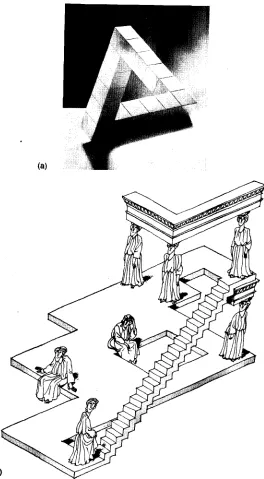
The three-dimensional interpretation of these images is a different matter. The eye is led to build up different local pictures which, ultimately, cannot be combined into a single consistent visual scenario. In modern times impossible objects were drawn first by Oscar Reutersvärd.28 In 1934 he drew the first known
example of an impossible tribar (Fig. 1.3a). Escher created the first impossible cube in 1958. The tribar was rediscovered in 1961 by Lionel and Roger Penrose, who introduced the never-ending staircase (Fig. l .3b)29 Escher employed these in
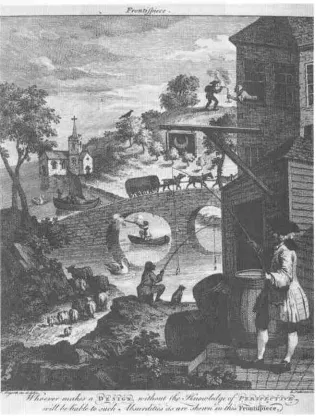
his famous drawings Waterfall (1961) and Ascending and descending (1961). There are a number of curious older examples of this genre which have been recognized retrospectively. Hogarth's engraving on copper False perspective (1754)30 is a beautiful example (Fig. 1.4). It was drawn by Hogarth to exaggerate
the mistakes of inept draughtsmen. He labels the picture, 'whoever makes a Design without the Knowledge of Perspective will be liable to such Absurdities as are shewn in this Frontispiece'.
In 1916, Marcel Duchamp created an advertisement for the paint manu-facturers Sapolin.31 The bed frame incorporates a tri- and four-bar structure
(Fig. 1.5). The original, entitled Apolinère enameled, is now in the Philadelphia Museum of Art.
The famous Italian architect and engraver Giovanni Piranesi (1720-78) produced a sinister collection of designs for a series of labyrinthine dungeons between 1745 and 1760. These fantastic creations depicted impossible networks of rooms and stairways. His working diagrams reveal that he deliberately set out to create impossible configurations.32
Breughel's The Magpie on the Gallows (1568) deliberately makes use of an impossible four-bar. Unintentional impossible objects can be found at very early times. The oldest known example dates from the eleventh century.33
VISUAL PARADOX 15
[image:23.406.74.338.31.510.2]Fig. 1.4 William Hogarth's copper engraving, False Perspective (1754).
VISUAL PARADOX 17
[image:25.404.49.362.30.258.2]Fig. 1.5 Marcel Duchamp's advertisement Apolinère enameled (1916/17). (Philidelphia Museum of Art: The Louise and Walter Arensberg Collection. © ADAGP, Paris and DACS, London 1998.)
Fig. 1.6 The Necker Cube, with all lines solid, is shown in the centre (ii). On either side, (i) and (iii), we show alternative visual interpretations of it in which the cube appears differently oriented. The eye makes rapid shifts between the two interpretations (i) and (iii). Solid lines are in the foreground; dotted lines in the background.
Château des Pyrénées of a gravity-defying castle in the air (Fig. 1.7).35 Perhaps
LINGUISTIC PARADOX 19
Much has been made of the way in which geometrically distorted pictures began to appear at a time when physicists first began to appreciate the physical relevance of geometries other than Euclid's. Pioneering cubists like Picasso always denied that scientific developments motivated them in any direct way.36
Escher, on the other hand, seemed to appreciate the studies that math-ematicians made of other geometries. Indeed, his work may even have stim-ulated some explorations of new tessellations of space.37
There is also a complementary literary style which trades on impossibility and paradox. The greatest early exponent of this was probably the Victorian surrealist Lewis Carroll. We see its more eclectic and fantastic manifestations in the short stories of Jorge Luis Borges, and others.38 The conjuring up of worlds
that don't quite fit remains a strangely attractive creative activity: the only way to be truly original.
The interesting feature of all these examples is the way in which they show our recognition of the impossible. The impossible is not necessarily something that lies outside our mental experience even if it falls outside our physical experience. We can create mental worlds which are quite different from the one we experience. Indeed, some people clearly relish these images of impossible worlds as much as any that could be made of this one.
Linguistic paradox
The supreme triumph of reason is to cast doubt upon its own validity.
MIGUEL DE UNAMUNO
Impossible figures are examples of visual paradoxes, or perhaps we should say inverted paradoxes. A paradox is usually something which, although seeming to be false, is in fact true. Impossible figures are things which, despite seeming true, are in reality false. We might have expected that our reaction to paradox would be one of confusion or aversion. Paradoxically, it is apparently quite the opposite. We enjoy paradox: it lies at the heart of many forms of humour, stories, pictures, and a host of well-appreciated quirks of human character.
Paradoxes spun for amusement have a habit of subsequently proving deeply profound. History is strewn with examples. Zeno's paradoxes have stimulated our understanding of the infinite.39 Zeno was Greek philosopher of the fifth
recognize that although an infinite number of instants of time will have elapsed before Achilles catches the tortoise, it is not necessarily true that an infinite number of instants of time must add up to make an infinitely long time.40
In modern science the term 'paradox' is usually reserved for a counter-intuitive finding that is believed to shed light upon something fundamental. Thus we have the 'twin paradox' of relativity,41 Schrödinger's 'cat paradox',42 the
'Einstein-Podolsky-Rosen (EPR) paradox',43 the 'Klein paradox; of quantum
field theory,44 and the paradox of'Wigner's Friend' in quantum measurement.45
These 'paradoxes' may be created by some incompleteness of our knowledge of what is going on, either at the level of the theory supposed to describe it, or in the specification of the state of affairs that is observed. Alternatively, they may appear paradoxical only because our expectations are simply wrong and derive from very limited experience of reality (as in the case of the 'twin paradox'). We can expect that further development of our understanding will either resolve the apparent paradox or reveal that there is in fact no paradox.
Linguistic and logical paradoxes are not like this at all. They are simple enough for everyone to appreciate. They affect the very tools that we use to think about everything and are therefore more deeply disturbing. Logic seems to be the final stop for human thinking. We can reduce science to mathematics and mathematics to logic, but there seems to be nothing to which we might reduce logic. The buck stops there.
Logical paradoxes have a long history. The most famous is repeated by St Paul in his Epistle to Titus when he remarks that 'all Cretans are liars, one of their own poets has said so.'46 This is the Epimenides (or 'Liar') Paradox.47 For
centuries such paradoxes appeared to be little more than isolated curiosities that could safely be ignored because they never seemed to arise in situations of practical importance. But during the twentieth century their importance has grown into something fundamental. They are consequences of logical structures which are complex enough to permit self-reference but arise when we are insufficiently careful to distinguish statements made in a particular language from those made in another language. Far from confining the linguistic paradoxes to the world of triviality, this distinction ends up by giving them a central role in formal proofs of the logical incompleteness of logical systems.
One of the most notable modern thinkers to be troubled by paradoxes was the philosopher Bertrand Russell, who wrote about his discovery, in June 1901, that logic contains a fundamental inconsistency. Subsequently, it became known as the'Russell Paradox'.
LIMITS TO CERTAINTY 21
to consider the classes that are not members of themselves; and these, it seemed, must form a class. I asked myself whether this class is a member of itself or not. If it is a member of itself, it must possess the defining properties of the class, which is to be not a member of itself. If it is not a member of itself, it must not possess the defining property of the class, and therefore must be a member of itself. Thus each alternative leads to its opposite and there is a contradiction.
The most memorable formulation that Russell gave to this difficulty of the set of all sets that are not members of themselves was to tell us of a town in which there is a barber who shaves all those who do not shave themselves. Who shaves the barber?48 What worried Russell so much about this paradox was its
infiltration of logic itself. If any logical contradiction exists it can be employed to deduce that anything is true. The entire edifice of human reasoning would fall. Russell was deeply pessimistic of the outcome:
Every morning I would sit down before a blank sheet of paper. Throughout the day, with a brief interval for lunch, I would stare at the blank sheet. Often when evening came it was still empty... it seemed quite likely that the whole of the rest of my life might be consumed in looking at that blank sheet of paper. What made it more annoying was that the contradictions were trivial, and that my time was spent in considering matters that seemed unworthy of serious attention.
Later, we shall discover that these seemingly innocuous linguistic paradoxes revealed the presence of profound problems for the whole of logic and mathe-matics, showing there to be a trade-off between our ability to determine whether statements are true or false and our ability to show that the system of reasoning we are employing is self-consistent. We can have one or the other, but not both. We shall find that there are limits to what mathematics can do for us: limits that are not merely consequences of human fallibility.
Limits to certainty
There is a theory which states that if anyone discovers exactly what the Universe is for and why it is here, it will instantly disappear and be replaced by something even
more bizarre and inexplicable. There is another theory which states that this has already happened.
DOUGLAS ADAMS49
experiments and theoretical investigations probed towards the frontiers of small sizes, large sizes, high speeds, very strong gravity fields, very high energies, and very low temperatures, they invariably encountered an unexpected limit on what could be done or what could be known about the state of the Universe. These were unexpected because they ran counter to what was predicted by simply extrapolating our experience of the laws of Nature from moderate laboratory conditions to unfamiliar environments. Two of these, the limits to measurement that the quantum nature of matter requires, and the cosmic speed limit imposed by relativity, are now foundation stones of our understanding of the physical world.
One of the most enthusiastically popularized areas of science in recent years has been quantum theory.50 This is somewhat surprising to insiders because
nothing new has happened in the subject. The theory was completed long ago. All the subsequent journalistic interest has been in its interpretation. Part of the mystique of quantum theory is that it combines amazing experimental success with a panoply of contrary-to-common-sense assertions about the world. Its domain is the small scale of atoms and their aggregates. Its potential to surprise arises because our familiar intuition about the behaviour of moving objects is gleaned from our experience of relatively large objects.
Quantum theory teaches us that all objects possess a wave-like aspect. This aspect is wave-like in the sense of a crime wave rather than a water wave. That is, it is a wave of information. If a neutron wave passes through your detector it tells you that a neutron is more likely to be detected there. The wavelengths of these matter waves are inversely proportional to their physical sizes. When an object has a quantum wavelength that is larger than its physical size it behaves in an overtly quantum fashion; when its wavelength is smaller than its size it behaves in the classical Newtonian fashion. Thus, typically, very large objects like you and me are said to behave 'classically', whereas small objects like elementary particles behave 'non-classically' or quantum-mechanically. Classical behaviour is just the extreme limit of quantum behaviour when the physical size of an object gets much bigger than its quantum wavelength.
LIMITS TO CERTAINTY 23
simultaneously with an accuracy better than some critical limit defined by a new constant of Nature, called Planck's constant. This constant, and the limiting accuracy it prescribes, is one of the defining characteristics of our Universe. It will place just the same limits on what physicists in the Andromeda Galaxy can do as it does for physicists on Earth.
The limit on our accuracy of measurement is known as Heisenberg's Uncertainty Principle. One heuristic way of understanding why there should be such a limit is to recognize that measurement requires an interaction of some sort with the state that is being measured: the smaller the thing being measured, the greater the impact of the measurement process. Eventually, that impact supersedes all information about the unperturbed state. The quantum picture of reality thus introduces a new form of impossibility into our picture of the world. This impossibility replaces a past belief in unrestricted experimental investigation of Nature which was based upon a misconception of what existed to be measured. There is a more accurate way to view the Heisenberg Uncertainty. It is not, as in our simple heuristic example, that there is a definite reality that we are unable to capture because measurement requires inter-vention. This suggests that we might be able to calculate what the effect of a particular intervention would be and allow for it in advance. Rather, the Uncertainty Principle is telling us that in the quantum realm, where dimensions are sufficiently small, certain complementary pairs of concepts, like position and velocity, or energy and time, can coexist only with a limited sharpness that Planck's constant dictates. The concepts referred to are classical concepts and there is a limit to their application. It is only because we had assumed (wrongly) that there was no limit in principle to our ability to measure all measurable quantities that we are shocked by Heisenberg's Uncertainty Principle and think of it as some sort of a limit on what we can do. Heisenberg teaches us that the scientist is not like a birdwatcher in a perfect hide. Observing the world necessarily couples us to it and influences its state in ways that are only partially predictable or knowable.
Heisenberg's Principle has had a widespread impact upon human thinking about certainty and knowledge.51 It is a prominent feature of many discussions
of the interface between science and religion because it provides a ready-made guarantee that there must always be a gap for a God-of-the-gaps argument to fill. In general, the tenor of this discussion welcomes rather than despairs of the ignorance that Heisenberg guarantees. There have occasionally been attempts to find mental consequences of Heisenberg uncertainty, but the general opinion is that the effects are too small on the scale of neurones to have any significant effect upon the human thinking process.52 Natural selection would certainly
in the chance of survival. Neuronal networking that evolved on a scale large enough to avoid significant quantum uncertainty would have been more adaptive than varieties on smaller scales susceptible to quantum uncertainties.
The fact that our world possesses quantum uncertainty at all is a consequence of the fact that Planck's constant is not equal to zero. We do not know why it takes the exact non-zero value that it does. If it were larger than it is, then larger objects would display strong wave-like attributes. The famous 'Mr Tompkins' stories by the late George Gamow attempted to explain some aspects of quantum reality by showing what the world might be like if Planck's constant were so large that everyday objects became overtly wave-like in character.53
The classical Newtonian laws that govern how bodies move prescribe rules of cause and effect. If a body is subjected to a certain force it will move with a definite acceleration. These laws enable the path taken by a body acted upon by forces to be calculated exactly if we know its starting state. In this way we can calculate the orbit of a planet around the Sun. Thus we see that laws of Nature involve the idea that certain motions are impossible; that is, if they occurred they would violate the laws of motion or some attendant principle like the conservation of energy. In quantum mechanics this picture changes in an extraordinary way. Quantum mechanics gives no exact predictions for the future location and speed of motion of an object given its starting state. It gives only probabilities that it will be observed to be at some location with some velocity. If the moving object is large (in the sense described above) then those probabilities will have a negligible spread and for all practical purposes (a probability almost exactly equal to 100 per cent certainty) the position and velocity of the object will be as predicted by Newton's laws. If, however, the object is small enough for its wave-like character to be significant, there may be an appreciable probability for it to be found in a state of motion that is impossible according to Newton's laws. Such states are frequently observed. They serve to distinguish the behaviour of the microscopic world from that of everyday experience. In quantum mechanics anything might be observed with some probability—although that probability might be vanishingly small.
A cosmic speed limit
The simplicities of natural laws arise through the complexities of the languages we use for their expression.
EUGENE WIGNER54
SUMMARY 25
moving at high speed. They were just a good low-speed approximation to a more general set of laws which governed motion at all possible speeds. But what do we mean by 'high' and 'low' speeds? Remarkably, Nature tells us in a way that involves no subjective judgements and no reference to our own motion. All speeds are to be judged relative to the speed of light in empty space. This speed, equal to 229,792,458 metres per second (about 186,000 miles per second) is a cosmic speed limit.55 No information can be transmitted by any means at a
speed exceeding this value. (Note that light travels more slowly through a medium than through empty space and it is possible to transmit information through a medium at a speed faster than the speed of light in that medium so long as it travels more slowly that the speed of light in empty space.56 Newton's
laws of motion predict no such speed limit (information is transmitted instan-taneously) and they lead to incorrect predictions about the world when applied to the motion of particles moving at speeds close to that of light. This is the regime of'high-speed', or relativistic, motion.
The fact that there is a limit to the speed at which information can be transmitted in Nature has all sorts of unusual consequences. It is responsible for our astronomical isolation. The enormous times needed to send or receive light or radio waves from other star systems in the Universe is a consequence of the finite speed of light. It is also responsible for our own existence in ways that may not be at first obvious. If the speed of light were not finite, then radiation of all sorts would be received instantaneously after it was emitted, no matter how far away its source. The result would be a reverberating cacophony. We would be dramatically influenced by signals from everywhere. Instead of local influences dominating over far distant ones, we would be affected instantaneously by changes occurring on the other side of the Universe. The impossibility of transferring information faster than the speed of light makes it possible to discriminate and organize any form of information.
Our world is governed by relativity because the speed of light is finite. We do not know why the speed of light takes the specific value that it does in our Universe. If it were much smaller, then more slowly moving objects would suffer the distortions of space and time that arise as the speed of light was approached; less energy would be available when matter was annihilated in nuclear reactions; light would interact more strongly with matter; and matter would be less stable.
After Einstein, we are faced with the recognition that faster-than-light information transmission or space travel is in general impossible but this impossibility is what makes the self-consistency of the laws of Nature possible.
Summary
I dreamt I died and went to heaven, and Saint Peter led me into the presence of God. And God said 'You won't remember me, but I took your Quantum Mechanics
Course in Berkeley in 1947.'
ROBERT SERBER57
We have begun to explore some of the ways in which the notion of impossibility lies at the root of many flowerings of the human imagination. We have taken some snapshots of different parts of our cultural development which have made important use of the concept of impossibility, both as a constraint on human actions and by way of contrast with the concept of a Being for whom nothing is an impossibility. Impossibility has played a stimulating role in art through the creation of impossible figures. In philosophy, paradoxes have been of persistent interest, leading to profound new considerations of the problems of the infinite and the nature of language, truth, and logic. Finally, we saw two examples of developments of our understanding of the physical Universe which showed us that there were unsuspected limits on what we can measure and how fast we can transmit information. The development of complex descriptions of the workings of the physical world seems to lead inevitably to theories that know their own limitations: that predict that they cannot predict.
CHAPTER 2
The hope of progress
You've got to ac-cent-tchu-ate the positive
Elim-my-nate the negative
Latch on to the affirmative
Don't mess with Mister In-between.
JOHNNY MERCER
Over the rainbow
The irony of life is that it is lived forward but understood backward.
SØREN KIERKEGAARD
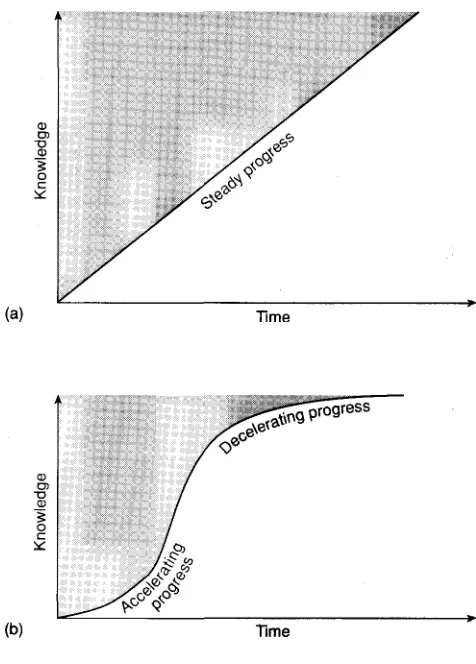
We can look back over a century of unprecedented progress in most areas of practical achievement. Machines, medicines, education, computer systems, transport,... the roster of achievements seems endless and relentless. Progress is undeniable, but what of the rate of progress. Is it accelerating or decelerating? Will our knowledge of Nature continue to grow? Or could it eventually slow to a trickle?
During the past thirty years, science has steadily mopped up lots of problems that were opened up by new technologies. New knowledge has invariably meant new gadgets and ways of transferring information which require ever-decreasing amounts of time and energy. But will new knowledge always have new practical consequences? Or will the frontiers of the doable lag further and further behind those of the conceivable?
Present theories of physics lead us to believe that there are surprisingly few fundamental laws of Nature. Nevertheless, there seems to be an endless array of different states and structures that those laws permit—just as there are a very small number of rules and pieces defining a game like chess, yet an endless number of different games that could be played out.1 Any unfound forces must
be extremely weak or severely constrained in their effects, perhaps confined to very short distances or to influencing the behaviour of very rare ephemeral entities. Physicists are fairly confident that they are not missing something in between the forces that they have already found.2 When it comes to the outcomes
structures come about and evolve in tandem with their environments. This trend could be just that—a trend—which runs its course, culminating in a full understanding of all the varieties of complexity that can exist. We might just be living in the Golden Age of complexity studies3 in the way that the 1970s and
1980s were a Golden Age for elementary particle physics. Experimental science is based upon discoveries, and you can only discover America once—as the Vikings would have told Señor Columbus.
Some scientists and philosophers have taken the view that science as a whole has experienced a Golden Age that will eventually draw to a close. Truly new discoveries will become harder and harder to make; minor variations will become tempting targets; deeper understanding will require greater and greater efforts of the imagination to achieve; and a wider grasp of the structure of systems of huge complexity will require more and more powerful computers. The seam of gold that is useful science may one day be mined out, leaving only a few nuggets to be uncovered here and there by ever-increasing effort. Of course, we may not realize that the mine is exhausted; no banner will appear in the sky to tell us that further fundamental advances will require a huge leap for Mankind, rather than a gradual shuffle. The demise of science may come not with a bang but a whimper. The financial cost of unearthing new knowledge may ultimately place too great a drain on scarce human resources. No potential benefit will outweigh the costs of investigation.
Even if this pessimistic scenario is not haunting our future, just contemplating it can help us focus on reality more clearly. The cost of scientific investigation has already become a political issue. How much of the GNP of a country should be spent on scientific investigation with little or no prospect of practical advantage or technical spin-off? How indirect can the benefits of science be and still be counted as benefits that derive from it? In this chapter we shall look at some provocative modern opinions about scientific progress before casting a look back at the prognostications of past prophets who wondered if progress was coming to an end at the turn of their own century. Not content with generalities, they often highlighted scientific problems that they thought would never be solved. Their worries were sometimes very similar to our own.
OVER THE RAINBOW 29
well-being—will be thrust increasingly to the limelight and voted abundant resources. Throughout human history, the threat and existence of war injected urgency and focus into special areas of science and mathematics. In the future that state of urgency may focus our attentions upon the by-products of our own past actions and the impact of untoward climatic and ecological trends in the natural world. Over very long periods of time the low-risk disaster becomes a certainty unless it is constantly guarded against.
Increasingly, it appears that 'advanced' societies—those that have extensive investment and reliance on science and technology—tend to create other internal problems, tensions, and expectations that are expensive to meet. Those that have the wherewithal to fund scientific research invariably have many other calls on their resources. Nor do these calls derive solely from the need to repair careless mistakes. Success can be costly as well. We continually find new medical treatments for conditions that were once untreatable. Yet, the costs of implementing them on a large scale could well prove ruinous to society. The costs of maintaining private and public medical care continue to grow as a result of the cost of more sophisticated treatments and the eradication of illness that were once fatal in late middle age. Every systematic medical success over progressive illness provides a new set of survivors whose encounter with the next affliction of older age will create a new social challenge.
One hope for sustained scientific progress may be the development of computer systems with new levels of miniaturization, speed, and complexity. Pure science projects that promote the development of these new technologies will play a starring role in the future. This computational dividend from exploratory fundamental science is something that we are already familiar with from past 'big science' projects. One of the greatest benefits of the early US space programme was not specimens of Moon rocks, but the rapid advance of large and reliable real-time computer systems. More recently, the Internet worldwide computer network is something that emerged from CERN, the European Centre for Particle and Nuclear Physics.
Telescope), and now biologists (on the Human Genome project). Others will surely follow. The science budgets of most countries have already had to come
to terms with scientific activities that were once inexpensive ventures requiring
little more than a few test tubes, books, chemicals, home-blown glassware, and low-tech equipment, but now need large computer systems, spectrometers, electron scanning microscopes, small accelerators, and other very expensive pieces of hardware, with formidable running costs, that require frequent up-grading to keep their users at the cutting edge of research worldwide.
The relentless desire for progress which has led to these never-ending demands for money and resources is something deep-rooted in our make-up. Perhaps it is not mysterious. We are the products of a long evolutionary history that has selected for those traits that survive best. An ability to change our environment and so fashion our own ecological niche has enabled us to outstrip other species and survive on every part of the Earth's surface. The harder the competition, the greater the pressure to gain a marginal advantage by the adoption of some innovation. Progressives will have been better adapted to survive in changing environments than conservatives. Progressive activity seems manic at times and creates all sorts of problems but, like growing old, it's not so bad when you look at the alternatives.
Today, most inhabitants of the Western democracies live luxuriously when compared with the lot of their distant ancestors. One might worry that as comfort increases so the incentive to innovate diminishes. Looking forward we might wonder whether the direction in which technological societies are moving—creating less work, longer lives, and greater leisure—might eventually remove incentive and desire to innovate in science and technology. Govern-ments try increasingly to create 'economic environGovern-ments' which stimulate and reward innovation in order to counter the growth of a dependency culture at the bottom of the scale and a lethargic culture at the top. How will things move in the long term? Creativity might find itself channelled into other areas, as individuals prove to have an unsuspected susceptibility for being sucked into virtual electronic realities and other high-tech amusements. Alternatively, apathy might become endemic. The challenge is not dissimilar to that in the face of being told that you are going to live for ever. Do you rush out to begin the first in a never-ending sequence of new careers, or do you lie back in the knowledge that there is world enough and time to do everything mañana.4
The social analyst Jose Ortega y Gasset saw this same division when he observed that
THE VOYAGE TO POLYNESIA VIA TELEGRAPH AVENUE 31
imposing on themselves any effort towards perfection, mere buoys that float on the waves.5
And we all know someone of each sort.
While this might be an acute evaluation of a twofold division between human personalities, one must be careful about what it is applied to. It is easy to talk of 'human society', or 'scientists', as though each were a single individual. They are nothing of the sort. Rather, they are whole populations of individuals displaying a wide range of different motivations and beliefs. Those motivations might well cluster around two opposite poles, but in any society there would still be a spectrum of different motivations and beliefs that would offer the prospect of quite different futures from any present mixture of the two.
The voyage to Polynesia via Telegraph Avenue
In Italy for thirty years under the Borgias, they had warfare, terror, murder, bloodshed. They produced Michelangelo, Leonardo da Vinci, and the Renaissance.
In Switzerland, they had brotherly love, five hundred years of democracy and peace, and what did they produce? The cuckoo clock.
ORSONWELLES6
The increasing cost of pushing back scientific frontiers might lead to a growth in the philosophical analysis of science and the discussion of unanswerable 'meaning-of-life' questions like 'how did the Universe begin?'. In this way, the hard core of science might be mined out, leaving only a superficial veneer of. questions about which one can have opinions but not testable answers. The view that science might bring about its own lugubrious