Proceedings of the 2019 Conference on Empirical Methods in Natural Language Processing and the 9th International Joint Conference on Natural Language Processing, pages 5994–5998,
5994
Abstract Text Summarization: A Low Resource Challenge
Shantipriya Parida Petr Motlicek Idiap Research Institute
Rue Marconi 19, 1920 Martigny, Switzerland
{shantipriya.parida,petr.motlicek}@idiap.ch
Abstract
Text summarization is considered as a chal-lenging task in the NLP community. The avail-ability of datasets for the task of multilingual text summarization is rare, and such datasets are difficult to construct. In this work, we build an abstract text summarizer for the Ger-man language text using the state-of-the-art “Transformer” model. We propose an itera-tive data augmentation approach which uses synthetic data along with the real summariza-tion data for the German language. To gener-ate synthetic data, the Common Crawl (Ger-man) dataset is exploited, which covers dif-ferent domains. The synthetic data is effec-tive for the low resource condition and is par-ticularly helpful for our multilingual scenario where availability of summarizing data is still a challenging issue. The data are also useful in deep learning scenarios where the neural mod-els require a large amount of training data for utilization of its capacity. The obtained sum-marization performance is measured in terms of ROUGE and BLEU score. We achieve an absolute improvement of +1.5 and +16.0 in ROUGE1 F1 (R1 F1) on the development and test sets, respectively, compared to the system which does not rely on data augmentation.
1 Introduction
Automatic text summarization is considered as a challenging task because while summarizing a piece of text, we read it entirely to develop our understanding to prepare highlighting its main points. Due to the lack of human knowledge and language processing abilities in computers, auto-matic text summarization is a major non-trivial task (Allahyari et al.,2017).
Two major approaches for automatic summa-rization are: extractive and abstractive. The ex-tractive summarization approach produces sum-maries by choosing a subset of sentences in the
original text. The abstract text summarization ap-proach aims to shorten the long text into a human-readable form that contains the most important fact from the original text (Allahyari et al.,2017;
Kry´sci´nski et al.,2018).
The deep learning-based neural attention model when applying to abstract text summarization per-forms well compared to standard learning-based approaches (Rush et al.,2015). Abstract text sum-marization using the attentional encoder-decoder recurrent neural network approach shows a state-of-the-art performance and sets a baseline model (Nallapati et al., 2016). Further improvements are introduced to the baseline model by using the pointer generator network and coverage mecha-nism using reinforcement learning based training procedure (See et al.,2017;Paulus et al., 2017). There is an inherent limitation to natural lan-guage processing tasks such as text summariza-tion for resource-poor and morphological complex languages owing to a shortage of quality linguis-tic data available (Kurniawan and Louvan,2018). The use of synthetic data along with the real data is one of the popular approaches followed in ma-chine translation domain for the low resource con-ditions to improve the translation quality (Bojar and Tamchyna,2011;Hoang et al.,2018; Chinea-Rıos et al., 2017). The iterative back-translation (e.g. training back-translation systems multiple times) were also found effective in machine trans-lation (Hoang et al., 2018). We explore similar approaches in our experiments for the text sum-marization task.
analysis and discussion. Section6provides con-clusion to the paper.
2 Method Description
Across all experiments performed in this paper, we have used the Transformer model as implemented in OpenNMT-py1(Vaswani et al.,2018;See et al.,
2017). The Transformer model is based on en-coder/decoder architecture. In context to summa-rize, it takes text as input and provides its sum-mary.
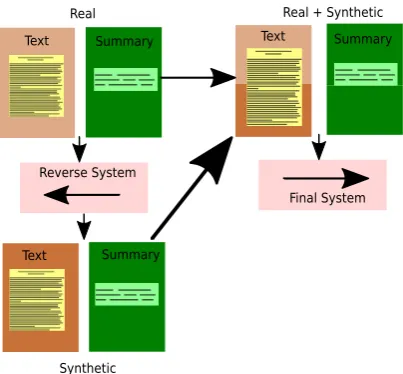
We use synthetic data as shown in Figure 1to increase the size of the training data.
Text Summary
Summary Text
Real
Synthetic
Real + Synthetic
Reverse System
[image:2.595.309.523.62.124.2]Final System Summary Text
Figure 1: Generation of synthetic data using a reverse system. To generate synthetic data, first, a system in the reverse direction (i.e. source as summary and target as text) is trained and then used to generate text for the given summary. Then both the real and synthetic data acts as input to the final system.
3 Dataset Description
We use German wiki data (spread across different domain) collected from the SwissText 20192(real data) and Common Crawl3data (synthetic data) in our experiment. The statistics of all the datasets are shown in Table1.
3.1 SwissText datasets used as real data
We divide the 100K SwissText dataset (down-loaded from SwissText 2019 website) into three subsets: train, dev, and test in 90:5:5 ratio (i.e. 90K for training, 5K for development and 5K for
1http://opennmt.net/OpenNMT-py/
Summarization.html
2
https://www.swisstext.org/
3http://commoncrawl.org/
Dataset #Text #Summ
[image:2.595.75.277.255.442.2]Train Real(SwissText) 90K 90K Train RealSynth(Swiss+CC) 190K 190K Train RealSynthRegen(Swiss+CC) 190K 190K Dev(SwissText) 5K 5K Test(SwissText) 5K 5K
Table 1: Statistics of the experimental data which in-clude the number of texts and their summaries.
the test data). The experiments performed over these datasets are described in Section 4.3 (de-noted as S1 experimental setup).
3.2 Common Crawl dataset used as synthetic data
The data crawled from the Internet (Common Crawl) used to prepare synthetic data to boost the training. The steps followed to create the synthetic dataset as follows:
Step 1: Build vocab:We create vocabulary using SwissText based on the occurrence of the most frequent (top N) German words.
Step 2: Sentence selection: The sentences from the Common Crawl data are selected with respect to the vocabulary based on the threshold we provide (e.g. a sentence has 10 words and the threshold is 10% (0.1)). For a sentence to be selected, at least 1 out of 10 words should be in the vocabulary.
Step 3: Filtering: Select random sentences (e.g. 100K) from the selected Common Crawl data in the previous step.
Step 4: Generate summary: The 100K data ob-tained from the previous step are used as a summary and required to generate corre-sponding text. We use the reverse trained model where we provide the summary as source and target as text. This results in the text as well as the corresponding summary as additional data to be utilized along with real data (SwissText).
Eventually, the 190K dataset is created (de-note as Train RealSynth) as a combination of 90K SwissText train data (real) and 100K synthetic data. This dataset is used in the experimental setup S2 (described in details in Section4.3).
4 Experimental Setup
Setting Dataset R1 F1 R2 F1 RL F1 BLEU
S1 Dev 43.9 28.5 46.3 12.6
Test 39.7 22.9 42.2 9.0
S2 Dev 45.4 29.8 47.4 14.0
Test 55.7 41.8 57.6 20.8
S3 Dev 44.3 28.5 46.4 13.1
[image:3.595.172.428.62.159.2]Test 40.0 23.0 42.3 9.4
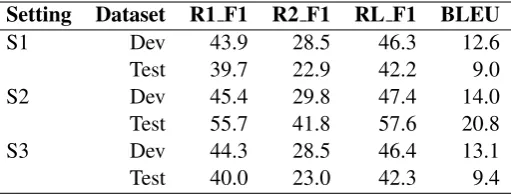
Table 2: Evaluation results of our models on development (dev) and testing (test) sets. The automatic evaluation scores in terms of Rouge (R1 F1, R2 F1, RL F1) and BLEU for the output summaries are shown in the table.
4.1 Prepossessing
The preprocess step involves preprocessing the dataset such that source and target are aligned and use the same dictionary. Additionally, we trun-cate the source length at 400 tokens and the tar-get length at 100 tokens to expedite training (See et al.,2017).
4.2 Model Parameters
The Transformer model is implemented in OpenNMT-py. To train the model, we use a sin-gle GPU. To fit the model to the GPU cluster, a batch size equal to 4,096 is selected for training. The validation batch size is set to 8. We use an initial learning rate of 2, drop out of 0.2 and 8,000 warm-up steps. Decoding uses a beam size of 10 and we did not set any minimum length of output summary.
4.3 Model Setup
We use 3 settings: (i) real data (we set this as the baseline in our experiment), (ii) real data and syn-thetic data, and (iii) real and regenerated synsyn-thetic data for the summarization task, described as fol-lows:
1. S1: Transformer model using Train Real data
In this setup, we use the “Train Real” data for training the Transformer model.
2. S2: Transformer Model using Train RealSynth data
In this setup, we use the “Train RealSynth” data for training the Transformer model. As the balance between real and synthetic data is an important factor, we maintain a 1:1 ratio (e.g. 1 (real) :1 (synthetic)) for our experi-ment (Sennrich et al.,2016).
3. S3: Transformer Model using Train RealSynthRegen data
We propose an iterative approach to im-prove the quality of synthetic summaries. In this setup, after training a system with (real+synthetic) data, it is used to regener-ate synthetic data for the final system. As a result, the input data to the final system is a combination of real and regenerated synthetic data as shown in Figure2.
4.4 Training Procedure
The copying mechanism is applied during train-ing. It allows the summarizer to fall back and copy the source text when encounters< unk >tokens by referencing to the softmax of the multiplication between attention scores of the output with the at-tention scores of the source (See et al.,2017). The systems are trained for 300K iterations.
5 Evaluation and Discussion
We evaluate the results for every 10,000 iterations on the dev and test set. The automatic evaluation results based on the dev and test set are shown in Table 2 with sample summaries in Table 3. To evaluate the proposed algorithms, we use ROUGE (Recall-Oriented Understudy for Gisting Evalu-ation) score, which is a popular metric for text summarization task, and has several variants like ROUGE-N, and ROUGE-L, which measure the overlap of n-grams between the system and refer-ence summary (LIN,2004). We use ROUGE 1 F1 (R1 F1), ROUGE 2 F1 (R2 F1), and ROUGE L F1 (RL F1) for scoring the generated summary. In addition, we also use the SacreBLEU4 evaluation metric (Post,2018).
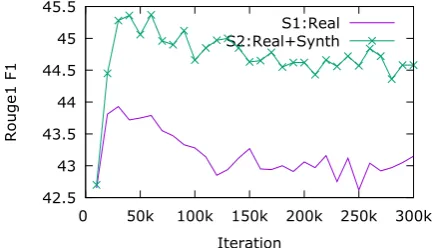
Figure 3 presents the learning curves for the models (S1 and S2) on the development set. It can be seen that there is a variance (e.g. word
Summary
Summary Text
Real
Synthetic
Real + Synthetic
Reverse System1
Summary Text
Summary Text
Synthetic
Summary Text
Final System Real + Synthetic
Text
[image:4.595.155.443.68.232.2]Reverse System2
Figure 2: Regeneration of synthetic data. After training a system with real+synthetic data (Reverse System2 above), used to create synthetic summarization data for the final system.
42.5 43 43.5 44 44.5 45 45.5
0 50k 100k 150k 200k 250k 300k
Rouge1 F1
Iteration S1:Real S2:Real+Synth
Figure 3: Learning curves in terms of Rouge1 F1 (R1 F1) Score on dev set.
selection, summary length) for model S2 gener-ated summary as compared with model S1. Dur-ing manual verification, we found that the sum-maries generated without a minimum length con-straint appear better compared to summaries with minimum length constraint. Although we do not explicitly specify a minimum length parameter for generating summaries for the models, the average length of words generated by model S2 (e.g. 41.42 words) is longer than the model S1 (e.g. 39.81 words). Some data (e.g. name, year) were found inconsistent during a comparison of the generated summary with respect to the reference. There is a variance in summaries generated by model S3 as compared to S2 and S1. In terms of Rouge score model S3 outperforms model S1 but perform worse than model S2 (see Table2).
6 Conclusion
In this paper, we highlighted the implementation of synthetic data for the abstract text
summariza-Ref Summary: “Das Feuerschiff Relandersgrund war ein finnisches Feuerschiff, das von 1888 bis 1914 im Schrenmeer bei Rauma positioniert war. Heute dient es als Restaurantschiff in Helsinki.”
Gloss: The lightship Relandersgrund was a Finnish lightship, which was built from 1888 to 1914 Schrenmeer was positioned at Rauma. Today serves it as a restaurant ship in Helsin
S1 Summary: :“Die “Rauma”. ist ein 1886—1888 Feuerschiffder norwegischen Reederei “Libauskij”, Das Schiff wurde in den 1930er Jahren gebaut und in den 2000er Jahren als Museumsschiff als”
Gloss:“The “Rauma ”. is a 1886-1888 Lightship of the Norwegian shipping company “Libauskij”,The ship was built in the 1930s and in the 2000s as a museum ship as
S2 Summary: :“Das Feuerschiff Relandersgrund war ein
Feuerschiff desdas von 1888 bis 1914 imEinsatz war.
Heute dient es als Restaurantschiff inKotka,”
Gloss: The lightship Relandersgrund was on Lightship of the 1888 to 1914 was in use. Today it serves as a restaurant ship in Kotka
S3 Summary: :“DasKotka.” isteinfinnischer Museumsschiff der im Zweiten Weltkrieg von der russischen Marine alsRestaurantschiff1” eingesetzt wurde. Im Mittelalter war das Schiff unter dem Namen “Vuolle” 1” fr die finnische Marine 1”
Gloss: The Kotka. “Is a Finnish one Museum ship of the World War II Russian Navy used as a restaurant ship 1 ” has been. In the Middle Ages, the ship was under the name “Vuolle” 1 “for the Finnish Navy 1
Table 3: Sample summaries on test set. The matching words of generating summaries with respect to refer-ences are shown in color blue.
[image:4.595.306.525.278.587.2] [image:4.595.74.291.289.413.2]Acknowledgments
The work is supported by an innovation project (under an InnoSuisse grant) oriented to improve the automatic speech recognition and natural lan-guage understanding technologies for German. Ti-tle: “SM2: Extracting Semantic Meaning from Spoken Material” funding application no. 29814.1 IP-ICT.
References
Mehdi Allahyari, Seyedamin Pouriyeh, Mehdi Assefi, Saeid Safaei, Elizabeth D Trippe, Juan B Gutier-rez, and Krys Kochut. 2017. Text summariza-tion techniques: a brief survey. arXiv preprint arXiv:1707.02268.
Ondrej Bojar and Aleˇs Tamchyna. 2011. Improving translation model by monolingual data. In Sixth Workshop on Statistical Machine Translation, page 330.
Mara Chinea-Rıos, Alvaro Peris, and Francisco Casacuberta. 2017. Adapting neural machine trans-lation with parallel synthetic data. WMT 2017, page 138.
Cong Duy Vu Hoang, Philipp Koehn, Gholamreza Haffari, and Trevor Cohn. 2018. Iterative back-translation for neural machine back-translation. ACL 2018, 23(32.5):18.
Yaser Keneshloo, Naren Ramakrishnan, and Chan-dan K Reddy. 2018. Deep transfer reinforcement learning for text summarization. arXiv preprint arXiv:1810.06667.
Wojciech Kry´sci´nski, Romain Paulus, Caiming Xiong, and Richard Socher. 2018. Improving abstraction in text summarization. InProceedings of the 2018 Conference on Empirical Methods in Natural Lan-guage Processing, pages 1808–1817.
Kemal Kurniawan and Samuel Louvan. 2018. Indo-sum: A new benchmark dataset for indonesian text summarization. In 2018 International Conference on Asian Language Processing (IALP), pages 215– 220. IEEE.
C-Y LIN. 2004. Rouge: A package for automatic evaluation of summaries. InProc. of Workshop on Text Summarization Branches Out, Post Conference Workshop of ACL 2004.
Ramesh Nallapati, Bowen Zhou, Cicero dos Santos, Caglar Gulcehre, and Bing Xiang. 2016. Ab-stractive text summarization using sequence-to-sequence rnns and beyond. In Proceedings of The 20th SIGNLL Conference on Computational Natu-ral Language Learning, pages 280–290.
Romain Paulus, Caiming Xiong, and Richard Socher. 2017. A deep reinforced model for abstractive sum-marization.arXiv preprint arXiv:1705.04304.
Matt Post. 2018. A call for clarity in reporting BLEU scores. InProceedings of the Third Conference on Machine Translation: Research Papers, pages 186– 191. Association for Computational Linguistics.
Alexander M Rush, Sumit Chopra, and Jason Weston. 2015. A neural attention model for abstractive sen-tence summarization. In Proceedings of the 2015 Conference on Empirical Methods in Natural Lan-guage Processing, pages 379–389.
Abigail See, Peter J Liu, and Christopher D Manning. 2017. Get to the point: Summarization with pointer-generator networks. InProceedings of the 55th An-nual Meeting of the Association for Computational Linguistics (Volume 1: Long Papers), pages 1073– 1083.
Rico Sennrich, Barry Haddow, and Alexandra Birch. 2016. Improving neural machine translation mod-els with monolingual data. In Proceedings of the 54th Annual Meeting of the Association for Compu-tational Linguistics (Volume 1: Long Papers), vol-ume 1, pages 86–96.