Open Domain Targeted Sentiment
Margaret Mitchell Jacqueline Aguilar Theresa Wilson Benjamin Van Durme
Human Language Technology Center of Excellence Johns Hopkins University
Baltimore, MD 21218, USA
{m.mitchell,jacqui.aguilar}@jhu.edu, [email protected], [email protected]
Abstract
We propose a novel approach to sentiment analysis for a low resource setting. The in-tuition behind this work is that sentiment expressed towards an entity, targeted senti-ment, may be viewed as a span of sentiment expressed across the entity. This represen-tation allows us to model sentiment detec-tion as a sequence tagging problem, jointly discovering people and organizations along with whether there is sentiment directed to-wards them. We compare performance in both Spanish and English on microblog data, using only a sentiment lexicon as an exter-nal resource. By leveraging linguistically-informed features within conditional random fields (CRFs) trained to minimize empiri-cal risk, our best models in Spanish signifi-cantly outperform a strong baseline, and reach around 90% accuracy on the combined task of named entity recognition and sentiment pre-diction. Our models in English, trained on a much smaller dataset, are not yet statistically significant against their baselines.
1 Introduction
Sentiment analysis is a multi-faceted problem. De-termining when a positive or negative sentiment is being expressed is a large part of the challenge, but identifying other attributes, such as the target of the sentiment, is also crucial if the ultimate goal is to pinpoint and extract opinions. Consider the exam-ples below, all of which contain a positive sentiment:
(1) So happy that Kentucky lost to Tennessee! (2) Kentucky versus Kansas I can hardly wait... (3) Kentucky is the best alley-oop throwing team
since Sherman Douglas’ Syracuse squads!!
The entities in these examples are college basket-ball teams, and the events referred to are games. In (1), although there is a positive sentiment, the tar-get of the sentiment is an event (Kentucky losing to Tennessee). However, from the positive sentiment toward this event, we can infer that the speaker has a negative sentiment toward Kentucky and a positive sentiment toward Tennessee. In (2), the positive sen-timent is toward a future event, but we are not given enough information to infer a sentiment toward the mentioned entities. In (3), Kentucky is the direct target of the positive sentiment. We can also in-fer a positive sentiment toward Douglas’s Syracuse teams, and even toward Douglas himself.
These examples illustrate the importance of the target when interpreting sentiment in context. If we are looking for sentiments toward Kentucky, for ex-ample, we would want to identify (1) as negative, (2) as neutral (no sentiment) and (3) as positive. How-ever, if we are looking for sentiment toward Ten-nessee, we would want to identify (1) as positive, and (2) and (3) as neutral.
The expression of these and other kinds of sen-timent can be understood as involving three items:
(1) An experiencer
(2) An attitude
(3) A target (optionally)
Research in sentiment analysis often focuses on (2), predicting overall sentiment polarity (Agarwal et al., 2011; Bora, 2012). Recent work has begun to com-bine (2) with (3), examining how to automatically predict the sentiment polarity expressed towards a target entity (Jiang et al., 2011; Chen et al., 2012) for a fixed set of targets. This topic-dependent sen-timent classification requires that the target entity be
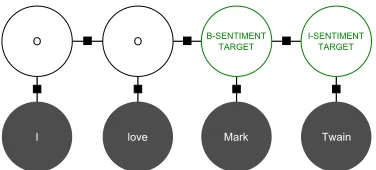
Figure 1:Sentiment expressed across an entity.
given, and returns statements expressing sentiment towards the given entity.
In this paper, we take a step towards open-domain,
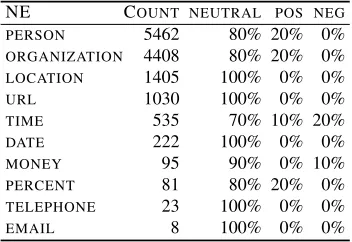
targeted sentiment analysisby investigating how to detect both the named entity and the sentiment pressed toward it. We observe that sentiment ex-pressed towards a target entity may be possible to learn in a graphical model along the span of the en-tity itself: Similar to how named enen-tity recognition (NER) learns labels along the span of each word in an entity name, sentiment may be expressed along the entity as well. A small example is shown in Fig-ure 1. We focus on people and organizations ( voli-tional named entities), which are the primary targets of sentiment in our microblog data (see Table 1).
Both NER and opinion expression extraction have achieved impressive results using conditional ran-dom fields (CRFs) (Lafferty et al., 2001) to define the conditional probability of entity categories (Mc-Callum and Li, 2003; Choi et al., 2006; Yang and Cardie, 2013). We develop such models to jointly predict the NE and the sentiment expressed towards it using minimum risk training (Stoyanov and Eis-ner, 2012). We learn our models on informal Span-ish and EnglSpan-ish language taken from the social net-work Twitter,1 where the language variety makes NLP particularly challenging (see Figure 2).
Our ultimate goal is to develop models that will be useful for low resource languages, where a sen-timent lexicon may be known or bootstrapped, but more sophisticated linguistic tools may not be read-ily available. We therefore do not rely on an external part-of-speech tagger or parser, which are often used for features in fine-grained sentiment analysis; such tools are not available in many languages, and if they are, are not usually adapted for noisy social media.
Instead, we use information from sentiment lex-icons and some simple hand-written features, and otherwise use only features of the word that can be
1www.twitter.com
@[user]le dijo erralo muy por lo bajo jaja un grande juancito grandes amigos mios
@[user]he told him it was very on the dl haha a great juancito great friends of mine
@[user]buenos d´ıas Profe!! Nos quedamos acciden-tados otra vez en la carretera vieja guarenas echando gasoil, estamos a la interperie
@[user]good morning, Prof!! We were wrecked again on the old guarenas highway while getting diesel, we’re out in the open
Sin ´animo de ofender a los Militares, que realmente se merecen ese aumento y m´as. Pero, d´onde queda la misma recompensa para M´edicos.
I do not intend to offend the military in the slightest, they truly deserve the raise and more. However, I’m wondering whether doctors will ever receive a similar compensation.
Figure 2: Messages on Twitter use a wide range of formality, style, and errors, which makes extracting in-formation particularly difficult. Examples from Spanish (screen names anonymized), with approximate transla-tions in English.
extracted without supervision. These include fea-tures based on unsupervised word tags (Brown clus-ters) and a method that automatically syllabifies a word based on the orthography of the language. All tools and code used for this research are released with this paper.2
2 Related Work
As the scale of social media has grown, using sources such as Twitter to mine public sentiment has become increasingly promising. Commer-cial systems include Sentiment1403 (products and brands) and tweetfeel4(suggests searching for pop-ular movies, celebrities and companies).
The majority of academic research has focused on supervised classification of message sentiment irre-spective of target (Barbosa and Feng, 2010; Pak and Paroubek, 2010; Bifet and Frank, 2010; Davidov et al., 2010; Kouloumpis et al., 2011; Agarwal et al., 2011). Large datasets are collected for this work by leveraging the sentiment inherent in emoticons (e.g., smilies and frownies) and/or select Twitter hashtags (e.g., #bestdayever, #fail), resulting in noisy
collec-2
www.m-mitchell.com/code
3
www.sentiment140.com
tions appropriate for initial exploration. Prior work includes: the use of a social network (Speriosu et al., 2011; Tan et al., 2011; Calais Guerra et al., 2011; Jiang et al., 2011; Li et al., 2012; Hu et al., 2013); user-adapted models based on collabo-rative online-learning (Li et al., 2010b); unsuper-vised, joint sentiment-topic modeling (Saif et al., 2012); tracking changing sentiment during debates (Diakopoulos and Shamma, 2010); and how ortho-graphic conventions such as word-lengthening can be used to adapt a Twitter-specific sentiment lexicon (Brody and Diakopoulos, 2011).
Efforts in targeted sentiment (Bermingham and Smeaton, 2010; Jin and Ho, 2009; Li et al., 2010a; Jiang et al., 2011; Tan et al., 2011; Wang et al., 2011; Li et al., 2012; Chen et al., 2012), have mostly focused on topic-dependent analysis. In these ap-proaches, messages are collected on a fixed set of topics/targets, such as products or sports teams, and sentiment is learned for the given set. In contrast, we aim to predict sentiment in tweets for any named person or organization. We refer to this task asopen domain targeted sentiment analysis.
Within topic-dependent sentiment analysis, sev-eral approaches have explored applying CRFs or HMMs to extract sentiment and target words from text (Jin and Ho, 2009; Li et al., 2010a). In these approaches, opinion expressions are extracted, and polarity is annotated across the opinion expression. However, as noted by many researchers in senti-ment, opinion orientation towards a specific target is often not equal to the orientation of a neighbor-ing opinion expression; and opinion expressions in one context may not be opinion expressions in an-other (Kim and Hovy, 2006), making open domain approaches particularly challenging.
The above work by Jiang et al. (2011) is most similar to our own. They do not use joint learning, but they do incorporate a number of parse-based fea-tures designed to capture relationships between sen-timent terms and topic references. In our work these relationships are captured by the CRF model, and we compare against their approach in Section 6.
Recent work by Yang and Cardie (2013) is sim-ilar in spirit to our own, where the identification of opinion holders, opinion targets, and opinion ex-pressions is modeled as a sequence tagging problem using a CRF. However, similar to previous work
ap-plying CRFs to extract sentiment, Yang and Cardie use syntactic relations to connect an opinion target to an opinion expression. In contrast, we model the expression of sentiment polarity across the senti-ment target itself, extracting both the sentisenti-ment tar-get and the sentiment expressed towards it within the same span of words. This allows us to use surround-ing context to determine sentiment polarity without identifying explicit opinion expressions or relying on a parser to help link expression to target.
Most work in targeted sentiment outside the mi-croblogging domain has been in relation to prod-uct review mining (e.g., Yi et al. (2003), Hu and Liu (2004), Popescu and Etzioni (2005), Qiu et al. (2011)). Rather than identify named entities (NEs), this work seeks to identify products and their fea-tures mentioned in reviews, and classify these for sentiment. Recent work by Qui et al. jointly learns targets and opinion words, and Jakob and Gurevych (2010) use CRFs to extract the targets of opinions, but do not attempt to classify the sentiment toward these targets. To the best of our knowledge, this is the first work to approach targeted sentiment in a low resource setting and to jointly predict NEs and tar-geted sentiment.
3 Data
Twitter Collection We use the Spanish/English Twitter dataset of Etter et al. (2013) to train and test our models. Approximately 30,000 Spanish tweets and 10,000 English were labeled for named entities in BIO encoding: The start of an NE is labeled B -{NE}and the rest of the NE is labeled I-{NE}. The
NE COUNT NEUTRAL POS NEG
PERSON 5462 80% 20% 0%
ORGANIZATION 4408 80% 20% 0%
LOCATION 1405 100% 0% 0%
URL 1030 100% 0% 0%
TIME 535 70% 10% 20%
DATE 222 100% 0% 0%
MONEY 95 90% 0% 10%
PERCENT 81 80% 20% 0%
TELEPHONE 23 100% 0% 0%
[image:3.612.339.515.521.642.2]EMAIL 8 100% 0% 0%
full set of NE categories are shown in Table 1. For example, the sequence “Mark Twain” would be la-beledB-PERSON,I-PERSON. We are interested in both
PERSON and ORGANIZATION entities, which make up the majority of named entities in this data, and we evaluate these using the more general entity category VOLITIONAL. Removing retweets, 7,105 Spanish tweets contained a total of 9,870 volitional entities and 2,350 English tweets contained a total of 3,577 volitional entities.
Sentiment Lexicons We use two sentiment lex-icon sources in each language. For English, we use the MPQA lexicon (Wilson et al., 2005), which identifies 12,296 manually and semi-automatically produced subjective terms along with their polarity. For the second lexicon, we use SentiWordNet 3.0 (Baccianella et al., 2010), which assigns positive and negative polarity scores to WordNet synsets. We use the majority polarity of all words with a subjectivity score above 0.5.
For Spanish, the first lexicon is obtained from Volkova et al. (2013), who automatically trans-lated strongly subjective terms from the MPQA lex-icon (Wilson et al., 2005) into Spanish. The re-sulting Spanish lexicon contains about 65K words. The second lexicon is available from Perez-Rosas et al. (2012). This contains approximately 1000 sentiment-bearing words collected leveraging man-ual resources and 2000 collected leveraging auto-matic resources.
Annotation To collect sentiment labels, we use crowdsourcing through Amazon’s Mechanical Turk.5 Annotators (“Turkers”) were shown six tweets at a time, each with a single highlighted named entity. Turkers were instructed to (1) se-lect the sentiment being expressed towards the en-tity (positive, negative, or no sentiment); and (2) rate their level of confidence in their selection. Fol-lowing best practices on collecting language data with Mechanical Turk (Callison-Burch and Dredze, 2010), two controls were placed among each set of six tweets to screen out unreliable judgments. An example prompt is shown in Figure 3.
Eachhtweet, NEipair was shown to three Turk-ers, and those with majority consensus on sentiment polarity were extracted. Tweets without sentiment
5www.mturk.com/mturk
ORGANIZATION PERSON
Named Entity
F
re
q
u
en
cy
in
T
w
ee
ts
0
500
1000
1500
2000
2500
Positive
[image:4.612.323.518.54.206.2]Negative Neutral
Figure 4:Targeted sentiment annotated for Spanish.
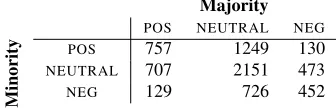
Majority
POS NEUTRAL NEG
Minority
POS 757 1249 130
NEUTRAL 707 2151 473
NEG 129 726 452
Table 2: Number of targeted sentiment instances where at least two of the three annotators (Majority) agreed. Common disagreements with a third annotator (Minority) were over whether no sentiment or positive sentiment was expressed, and whether no sentiment or negative sent-ment was expressed.
consensus on all NEs were removed. In Spanish, this yielded 6,658 uniquehtweet, NEipairs. In English, which is a smaller data set, this yielded 3,288 unique pairs. We split the data into folds for 10-fold cross-validation, developing on the data from one fold and reporting results for the remaining nine.
[image:4.612.344.512.238.292.2]Figure 3:Example Tweet shown to Turkers.
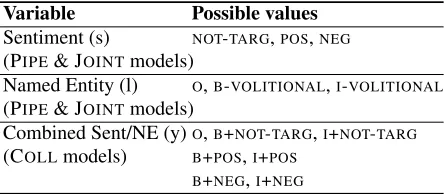
Variable Possible values
Sentiment (s) NOT-TARG,SENT-TARG (PIPE& JOINTmodels)
Named Entity (l) O,B-VOLITIONAL,I-VOLITIONAL (PIPE& JOINTmodels)
[image:5.612.75.297.302.399.2]Combined Sent/NE (y)O,B+NOT-TARG,I+NOT-TARG (COLLmodels) B+SENT-TARG,I+SENT-TARG
Table 3: Possible values for random variables, targeted subjectivity (is/is not sentiment target). COLL models collapse targeted subjectivity and NE label into one node.
Variable Possible values
Sentiment (s) NOT-TARG,POS,NEG (PIPE& JOINTmodels)
Named Entity (l) O,B-VOLITIONAL,I-VOLITIONAL (PIPE& JOINTmodels)
Combined Sent/NE (y)O,B+NOT-TARG,I+NOT-TARG (COLLmodels) B+POS,I+POS
B+NEG,I+NEG
Table 4: Possible values for random variables, targeted sentiment. The COLLmodels collapse both targeted sen-timent and NE label into one node.
4 Targeted Subjectivity and Sentiment Formally, we define the problem as follows: Given an observed messagew = (w1. . . wn), wherenis
the number of words in the message and wj(1 ≤
j ≤ n) is a word, we learn the probability of a label sequence l = (l1. . . ln), where li ∈ the set
of named entity values; and a sentiment sequence
s= (s1. . . sn), wheresi ∈the set of sentiment
val-ues. We additionally explore simpler linear-chain models that learn the probability of a single label sequencey= (y1. . . yn), whereyi ∈the set of
con-joined entity+sentiment values (Tables 3 and 4). Our basic model is a linear conditional random field, an undirected graph that represents the con-ditional distribution p(l,s|w).6 Sentiment towards
a named entity may be modeled in a CRF as a
se-6
For the COLLmodels, this is instead the conditional distri-butionp(y|w), where entity and sentiment labels are conjoined in one sequence assignmenty.
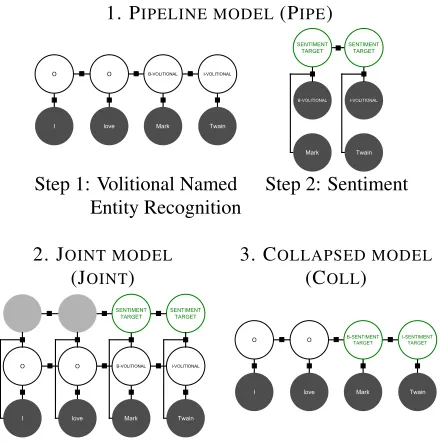
quence of random variables for sentiment s con-nected to named entitiesl. In all models, entity vari-ables are connected by a factor to their neighbors in sequence, and we include skip-chains (Finkel and Manning, 2010) connecting identical words where at least one is capitalized. Our model strategies in-clude: a pipeline that first learns volitional entities then sentiment directed towards them (PIPE); one that jointly learns volitional entities along with sen-timent directed towards them (JOINT); and one that learns volitional entities and targeted sentiment with combined labels (COLL) (Figure 5).
Using these models, we explore two primary tasks: (1) the task of detecting whether sentiment is targeted at an entity, which we refer to astargeted subjectivity; and (2) the task of detecting whether positive, negative, or neutral sentiment (no senti-ment) is targeted at an entity, which we refer to as
targeted sentiment. Moving from targeted subjectiv-ity prediction to targeted sentiment prediction is pos-sible by changing the sentiment target (SENT-TARG) variable into two variables, one for positive targeted sentiment (POS) and one for negative (NEG). Possi-ble values for targeted subjectivity are shown in Ta-ble 3, and possiTa-ble values for targeted sentiment are shown in Table 4.
In the pipeline models (PIPE), we first build a CRF where each word is connected by a factor to an entity labelli ∈ l. In a second model, every
ob-served volitional entity node is connected by a factor to a sentiment labelsi ∈s. An example is shown in
Figure 5 (1).
In the joint models (JOINT), eachsi ∈ s is
con-nected by a factor to the corresponding entity label in the sequence, li ∈ l. Sentiment in this model
In the collapsed models (COLL), we combine sen-timent and named entity into one label sequence (e.g., O,B+SENT-TARG,I+SENT-TARG). An example
is shown in Figure 5 (3). The JOINTand PIPE mod-els therefore predict named entity sequences, their category labels, and the sentiment expressed towards volitional named entities.7 The collapsed models predict volitional labels and targeted sentiment as combined categories. The COLL and PIPE models are considerably faster than JOINT models, where exact inference is intractable.
1. PIPELINE MODEL(PIPE)
Step 1: Volitional Named Step 2: Sentiment Entity Recognition
2. JOINT MODEL 3. COLLAPSED MODEL
[image:6.612.79.300.209.430.2](JOINT) (COLL)
Figure 5: Example CRFs for targeted subjectivity with observed variables (dark nodes), predicted variables (white nodes) and hidden variables (light grey nodes).
5 Training
Minimum-Risk CRF Training We use the ERMA system (Stoyanov et al., 2011) to learn our models.8 ERMA (Empirical Risk Minimization un-der Approximations) learns parameters to minimize loss on the training data. Predicting NE labels using a linear-chain CRF trained with empirical risk mini-mization has been shown to result in a statistically significant improvement over the common approach of maximum likelihood estimation (Stoyanov and Eisner, 2012). All models are trained to optimize
7We found that learning theVOLITIONALcategories
dur-ing traindur-ing rather than maintaindur-ing beliefs about separate named entities during inference (ORGANIZATION,PERSON) and then post-processing toVOLITIONALleads to slightly bet-ter accuracy.
8sites.google.com/site/ermasoftware
log likelihood using 20 iterations of stochastic gradient descent, and a maximum of 100 iterations of belief propagation to compute the marginals for each example.
Features Features of the models are shown in Ta-ble 5. For an observed word, features are extracted for the word itself as well as within a context win-dow of three words in either direction. Words seen only once are treated as out-of-vocabulary. Surface features and linguistic features are concatenated in groups of two and three to create further features. All algorithms and code that we have developed for feature extraction are available online.9
Because we aim to develop models that do not heavily rely on language-specific resources, we are interested in exploring unsupervised and lightly supervised methods for learning relevant features. Rather than use part-of-speech tags, we therefore use Brown cluster labels as unsupervised word tags (Brown et al., 1992; Koo et al., 2008). Brown clustering is a distributional similarity method that merges pairs of word clusters in the training data10 to create the smallest decrease in corpus likelihood, using a bigram language model on the clusters. For our task, we cut clusters at length 3 and length 5, and these serve as rough part-of-speech tags without the need to train additional models. For example, the wordhellois tagged as belonging to cluster 011 (length 3) and 01111 (length 5).
During development, we found that being able to syllabify the word (break the word into sylla-bles) was a positive indicator of people names, but a negative indicator of organization names. This observation can be approximated automatically us-ing constraints from the sonority sequencus-ing princi-ple (Hooper, 1976; Clements, 1990; Blevins, 1996; Morelli, 2003) on a language’s orthography. This is a phonotactic principle that states that syllables will tend to have a sonority peak, usually a vowel, in the center of the syllable, followed on either side by consonants with decreasing sonority. Although languages may violate this principle, the core idea that a vowel forms the nucleus of a syllable with
op-9www.m-mitchell.com/code 10
tional consonants before (the onset) and after (the coda) can be used to begin to automatically learn syllable structure.11 We learn this in an unsuper-vised way, using the most frequent (seen more than 1,000 times) word-initial non-vowel sequences from the Brown cluster data as allowable syllable onset consonants. Similarly, the most frequent word-final non-vowel sequences are learned as possible sylla-ble codas. For each word, we then attempt to seg-ment syllables using the learned onsets and codas around each vowel. If a word cannot be syllabified, it is often an initialism (e.g.,CND,lsat).
We follow the approach from the out-of-vocabulary assignment in the Berkeley parser (Petrov et al., 2006) to encode common surface patterns such as capitalization and lexical patterns such as verb endings as a single feature for words we have seen once or less. We also use the Jer-boa toolkit (Van Durme, 2012) to extract further language-independent features from the data, such as features for emoticons and binning for repeated characters (like !!!). In addition, we include features for whether the word is three or four letters, which is often used for acronyms and initialisms in several languages (including Spanish and English); whether the word is neighbored by a punctuation mark; word identity; word length; message length; and position in the sentence.
We utilize a speaker of each language to simply list word forms for sentiment features that may be indicative of sentiment, totaling less than two hours of annotation time. This set includes intensifiers (e.g., hella, freakin’ in English; e.g., muy, suma-mente in Spanish), positive/negative abbreviations (WTF,pso), positive/negative slang words, and pos-itive/negative prefix and suffixes (e.g., anti-in En-glish and Spanish,-itoin Spanish).
6 Experiments
We are interested in bothPERSON and ORGANIZA-TION entities, and evaluate these in the collapsed category VOLITIONAL. This suggests that the data may be pre-processed to label all volitional entities asVOLITIONALNEs, or the models may be learned with the traditional named entities in place, and
post-11
Further development is necessary to extend a similar idea to languages that do not ordinarily mark all vowels in their or-thography, such as Hebrew and Arabic.
SURFACE FEATURES
binned word length, message length, and sen-tence position; Jerboa features; word identity; word lengthening; punctuation characters, has digit; has dash; is lower case; is 3 or 4 letters; first letter capi-talized; more than one letter capitalized, etc. LINGUISTIC FEATURES
function words; can syllabify; curse words; laugh words; words forgood,bad,no,my; slang words; ab-breviations; intensifiers; subjective suffixes and pre-fixes (such as diminutive forms); common verb end-ings; common noun endings
BROWN CLUSTERING FEATURES
cluster at length 3; cluster at length 5 SENTIMENT FEATURES
is sentiment-bearing word; prior sentiment polarity
Table 5:Features used in model.
processed to identify those that are VOLITIONAL. We explored results using both methods, and found that training models on VOLITIONAL tags yielded the best performance overall; we report numbers for this approach below.
We compare against a baseline (BASE-NS) where we use our volitional entity labels and assign no sentiment directed towards the entity (the majority case). This is a strong baseline to isolate how our methods perform specifically for the task of identi-fying sentiment targeted at an entity.
We report on precision, recall, and sensitivity for the tasks of NER and targeted subjectivity/sentiment prediction in isolation; and we report on accuracy for the targeted subjectivity and targeted sentiment models. For sentiment, a true positive is an instance where the label has sentiment, and a true negative is an instance where the label has no sentiment (neu-tral). For NER, a true positive is an instance where the label is a B- or I- label; a true negative is an instance where the label is O. The three systems are evaluated against one another for NER, subjec-tivity (entity has/does not have sentiment expressed towards it), and sentiment (positive/negative/no sen-timent) using paired t-tests across folds, with a Bon-ferroni correction to setαto 0.02.
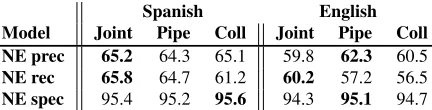
Spanish English
Model Joint Pipe Coll Joint Pipe Coll
NE prec 65.2 64.3 65.1 59.8 62.3 60.5
NE rec 65.8 64.7 61.2 60.2 57.2 56.5
[image:8.612.78.294.54.109.2]NE spec 95.4 95.2 95.6 94.3 95.1 94.7
Table 6:Average precision, recall, and specificity for vo-litional entity NER (in %).
mistakes include confusingB- labels withI- labels.
Subjectivity and Sentiment Table 7 shows results for the isolated task of predicting the presence of sentiment about a volitional entity. In Spanish, the pipeline models (PIPE) perform optimally for sub-jectivity recall (Subj rec), and significantly above the COLL models (p<.001). Precision and speci-ficity are comparable across models. In English as in Spanish, the collapsed model is particularly poor at subjectivity recall.
As discussed in Section 2, the subtask of predict-ing whether subjectivity is expressed towards an en-tity is comparable to the main task of Jiang et al. (2011), and so we compare our approach here. The Jiang et al. study is similar to the current study in that they aim to detect targeted sentiment, but it differs from the current study in that they focus exclusively on subjectivity towards five manually selected enti-ties: {Obama, Google, iPad, Lakers, Lady Gaga}. They also evaluate on artificially balanced evalu-ation data, and evaluate sentiment polarity (posi-tive/negative) separately from subjectivity (has/does not have sentiment).
Our dataset includes any entity labeled asPERSON or ORGANIZATION, and is not balanced (most tar-gets have no sentiment expressed towards them; see Table 1), thus we can only roughly compare against their approach. Lakers and Lady Gagaare rare in our collection (appearing less than 3 times), and so we updated the comparison set prior to evaluation to:
{Obama,Google,iPad,BBC,Tebow}. On this set, a baseline that always guesses no sentiment reaches an accuracy of 66.9%, compared to Jiang et al.’s 65.5% accuracy on a balanced set (not strictly compara-ble, but provided for reference). The JOINT mod-els reach an accuracy of 71.04% on this set, demon-strating this approach as potentially useful for topic-dependent targeted sentiment.
Table 8 shows results for the task of predicting the polarity of the sentiment expressed about an en-tity. In Spanish, the PIPEmodels significantly
out-Spanish English
Model Joint Pipe Coll Joint Pipe Coll
Subj prec 58.3 58.8 58.9 46.6 52.2 45.9
Subj rec 40.1 50.9 19.1 44.5 48.5 16.4
[image:8.612.315.544.54.109.2]Subj spec 79.6 77.5 77.8 77.6 80.8 74.0
Table 7:Average precision, recall, and specificity (in %) for subjectivity prediction (has/does not have sentiment) along the target entity.
Spanish English
Model Joint Pipe Coll Joint Pipe Coll
Sent prec 36.6 45.8 42.5 31.6 42.9 38.5
Sent rec 38.0 40.6 15.5 36.6 34.8 9.7
Sent spec 67.1 75.2 73.3 72.3 82.0 78.1
Table 8:Average precision, recall, and specificity (in %) for sentiment prediction (positive/negative/no sentiment) along the target entity.
perform the COLL models on sentiment recall, and the JOINT models on sentiment precision (p<.01). In English, PIPEsignificantly outperforms JOINTon precision (p<.001).
Targeted Subjectivity and Targeted Sentiment The JOINT and PIPE models work reasonably well for the isolated tasks of NER and subjectiv-ity/sentiment prediction. We now examine results fortargeted subjectivity– labeling an entity and pre-dicting whether there is sentiment directed towards it – in Table 9; andtargeted sentiment– labeling an entity and predicting what the sentiment directed to-wards it is – in Table 10.
We evaluate using two accuracy metrics:Acc-all, which measures the accuracy of the entire named en-tity span along with the sentiment span; and Acc-Bsent, which measures the accuracy of identifying the start of a named entity (B- labels) along with the sentiment expressed towards it. Acc-all primar-ily measures the correctness ofOlabels, while Acc-Bsent focuses on the beginning of named entities.
For the targeted subjectivity task, our JOINT mod-els perform optimally in Spanish, and significantly above their baselines. For the Acc-Bsent task, JOINT models perform best, significantly outperforming their baseline for subjectivity prediction. In English, where our data is half the size, we do not see a statis-tically significant difference between the predictive models and the no sentiment baselines.
[image:8.612.315.542.152.205.2]Model Joint Joint Base
Pipe Pipe
Base
Coll Coll
Base
Spa
Acc-all 89.5* 89.3 89.3** 89.1 89.5* 89.3
Acc-Bsent 32.1***29.5 30.9***28.3 30.1** 28.1
Eng
Acc-all 88.0 88.1 88.6 88.6 87.9 88.1
Acc-Bsent 30.4 30.8 30.7 30.3 28.1 29.2
[image:9.612.74.302.55.131.2]***p<.001 **p<.01 *p<.05
Table 9:Average accuracy on Targeted Subjectivity Pre-diction: Identifying volitional entities and whether they are a sentiment target. In the core task,Acc-Bsent, the best model in Spanish is JOINT, significantly outperform-ing the baseline. In English, the best model (PIPE) does not significantly improve over its baseline.
Model Joint Joint
Base
Pipe Pipe
Base
Coll Coll
Base
Spa
Acc-all 89.4 89.4 89.0 89.0 89.2 89.3
Acc-Bsent 29.7* 29.0 30.0 29.2 28.9 29.0
Eng
Acc-all 88.0 88.1 88.2 88.4 87.7 88.1
Acc-Bsent 30.4 30.6 30.5 30.8 27.9 29.8
*p<.05
Table 10: Average accuracy on Targeted Sentiment Pre-diction: Identifying volitional entities and the polarity of the sentiment expressed towards them. The Spanish JOINT models significantly improve over their baseline for the core task. In English, no models outperform their baseline.
the sentiment polarity above their no sentiment base-lines. We find this to be the most difficult task: It may be clear that sentiment is being expressed to-wards an entity, but it is not always clear what the polarity of that sentiment is. Error analysis is given below in this section. In the smaller English set, the models do not outperform the no sentiment baseline.
7 Discussion
Feature Analysis Examples of some of the top-weighted features in the Spanish models are shown in Table 11. In addition to lexical identity and Brown cluster, we find that positive indicators include pos-itive suffixes such as diminutive forms, whether the word can be syllabized (Section 5), and whether it is three or four letters.
Error Analysis Because it is relatively common for therenotto be sentiment targeted at a named en-tity, it is difficult to tease out the polarity in instances where there is targeted sentiment. Similarly, our pre-dictions are most reliable for detecting the absence of a named entity (Olabels).
Label confusions are shown in Table 12. Mistakes are often made by confusing B- labels (the start of
B-VOLITIONALFEATURES
Negative is a function word; jerboa tags; followed by a word
with 3 or 4 letters that cannot be syllabified
Positive ends in -a, -o, or -s; is capitalized; has one
non-initial capital letter; is 3 or 4 letters B-VOLITIONAL,POSFEATURES
Negative preceded by a curse word; followed by a word
with a positive suffix; immediately preceded by a word with a negative prefix
Positive not in a sentiment lexicon; preceded by a happy
emoticon; followed by an exclamation or a ‘my’ word; immediately preceded by a laugh; has two or more sentiment-bearing words in the sentence B-VOLITIONAL,NEGFEATURES
Negative is immediately followed by a question mark or
positive abbreviation word
Positive preceded by a ‘bad’ word or curse word; has four
or more sentiment lexicon items
B-VOLITIONAL,NOT-TARGFEATURES
Negative immediately followed by a ‘no’ word or word with
a negative prefix; is preceded by a question mark; is immediately preceded by a curse word or laugh; is followed by an exclamation mark
[image:9.612.314.553.63.361.2]Positive not followed by sentiment lexicon word
Table 11: Example strongly weighted features for a Spanish joint sentiment model. In addition to lexical identity, we find that curse words and positive and neg-ative prefixes are used to detect volitional entities and the sentiment directed towards them.
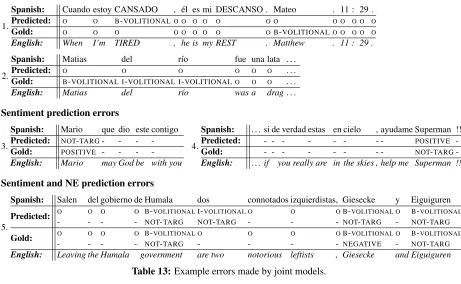
an entity) with I- labels (inside an entity); and by predicting sentiment polarity when the gold annota-tions say there is not sentiment targeted at the entity. Some example errors are shown in Figure 13. In (1), “CANSADO” (“TIRED”) was predicted to be volitional, while “Matthew” was not. In (2), “Ma-tias del r´ıo” was not predicted to be an entity, likely due to the fact that the capitalization patterns we see in this sentence are indicative of the start of a sen-tence rather than a proper name (similar to 1). In (3),
a.
Observed
B I O
Pr
edicted
B 423 21 186 I 36 236 135 O 197 90 7168
b.
Observed
POS NEG NEUT
POS 68 24 42
NEG 58 65 102 NEUT 115 61 468
[image:9.612.74.298.205.289.2] [image:9.612.317.517.571.634.2]NE prediction errors
1.
Spanish: Cuando estoy CANSADO , ´el es mi DESCANSO . Mateo . 11 : 29 .
Predicted: O O B-VOLITIONALO O O O O O O O O O O O
Gold: O O O O O O O O OB-VOLITIONALO O O O O
English: When I’m TIRED , he is my REST . Matthew . 11 : 29 .
2.
Spanish: Matias del r´ıo fue una lata . . .
Predicted: O O O O O O . . .
Gold: B-VOLITIONAL I-VOLITIONAL I-VOLITIONALO O O . . .
English: Matias del r´ıo was a drag. . .
Sentiment prediction errors
3.
Spanish: Mario que dio este contigo
Predicted: NOT-TARG- - -
-Gold: POSITIVE - - -
-English: Mario may God be with you
4.
Spanish: . . . si de verdad estas en cielo , ayudame Superman !!!
Predicted: - - - POSITIVE
-Gold: - - - NOT-TARG
-English: . . .if you really are in the skies , help me Superman !!!
Sentiment and NE prediction errors
5.
Spanish: Salen del gobierno de Humala dos connotados izquierdistas, Giesecke y Eiguiguren
Predicted: O O O O B-VOLITIONALI-VOLITIONAL O O OB-VOLITIONAL O B-VOLITIONAL
- - - - NOT-TARG NOT-TARG - - - NOT-TARG - NOT-TARG
Gold: O O O O B-VOLITIONAL O O O OB-VOLITIONAL O B-VOLITIONAL
- - - - NOT-TARG - - - - NEGATIVE - NOT-TARG
[image:10.612.77.538.70.354.2]English: Leaving the Humala government are two notorious leftists , Giesecke and Eiguiguren
Table 13:Example errors made by joint models.
sentiment may not be clear without spelling correc-tion: “dio” should be “dios”, meaning “God”; other-wise, “dio” is the word for “gave”. Humans can eas-ily fix the spelling error, which changes the overall reading of the expression. In (4), the positive polar-ity item “verdad” (“believe”) and the exclamation marks (!!!) were likely used as indicators of posi-tive sentiment; however, in this case the annotators marked the targeted sentiment as neutral. In (5), the “Humala” entity was predicted to be longer than it is (“Hamala dos” or“Hamala two”). It was also pre-dicted that both “Giesecke” and “Eiguiguren” had no sentiment expressed towards them; annotators disagreed, with the majority of those who annotated “Giesecke” marking negative sentiment, and the ma-jority of those who annotated “Eiguiguren” mark-ing no sentiment. This highlights some of the diffi-culty in predicting sentiment discussed in Section 3, where annotators will often disagree as to whether there is no sentiment or positive/negative sentiment. During development, we found that the collapsed model (COLL) performed best on small amounts of data. However, as we scaled up the amount of data we trained on, the PIPE and JOINT models signif-icantly improved, while the COLL models did not have significant performance gains.
8 Conclusion
We have introduced the task of open domain targeted sentiment: predicting sentiment directed towards an entity along with discovering the entity itself. Our approach is developed to find targeted sentiment to-wards both person and organization named entities by modeling sentiment as a span along the entity.
We find that by modeling targeted sentiment in this way, we can reliably detect entities and whether or not they are sentiment targets above a no senti-ment baseline. How best to determine thepolarity
of the sentiment expressed towards the entity, how-ever, is still an open issue. Our data suggests that it is usually not clear-cut whether sentiment is being expressed or not; the strong disagreement between annotators suggests that detecting sentiment polar-ity in microblogs is difficult even for humans.
References
A. Agarwal, B. Xie, I. Vovsha, O. Rambow, and R. Pas-sonneau. 2011. Sentiment analysis of twitter data. In Proceedings of the Workshop on Language in Social Media.
Stefano Baccianella, Andrea Esuli, and Fabrizio Sebas-tiani. 2010. Sentiwordnet 3.0: An enhanced lexical resource for sentiment analysis and opinion mining. In Proceedings of the Seventh International Conference on Language Resources and Evaluation (LREC’10). Luciano Barbosa and Junlan Feng. 2010. Robust
senti-ment detection on Twitter from biased and noisy data. InProceedings of Coling: Posters.
Adam Bermingham and Alan F Smeaton. 2010. Clas-sifying sentiment in microblogs: Is brevity an advan-tage? InProceedings of CIKM-2010.
Albert Bifet and Eibe Frank. 2010. Sentiment knowl-edge discovery in Twitter streaming data. In Proceed-ings of the International Conference on Discovery Sci-ence (DS-2010).
Juliette Blevins. 1996. The syllable in phonological the-ory. In John A. Goldswmith, editor, The Handbook of Phonological Theory. Blackwell Publishing, Black-well Reference Online.
N. N. Bora. 2012. Summarizing public opinions in tweets. InProceedings of CICLing-2012.
Samuel Brody and Nicholas Diakopoulos. 2011. Cooooooooooooooollllllllllllll!!!!!!!!!!!!!!: using word lengthening to detect sentiment in microblogs. InProceedings of EMNLP-2011.
P. F. Brown, V. J. Della Pietra, P. V. deSouza, J.C. Lai, and R.L. Mercer. 1992. Class-based n-gram mod-els of natural language. Computational Linguistics, 18(4):467–479.
Pedro Henrique Calais Guerra, Adriano Veloso, Wagner Meira Jr, and Virg´ılio Almeida. 2011. From bias to opinion: a transfer-learning approach to real-time sen-timent analysis. InProceedings of the KDD-2011. Chris Callison-Burch and Mark Dredze. 2010. Creating
speech and language data with amazon’s mechanical turk. InProceedings of the NAACL:HLT Workshop on Creating Speech and Language Data with Amazon’s Mechanical Turk.
Lu Chen, Wenbo Wang, Meenakshi Nagarajan, Shaojun Wang, and Amit P. Sheth. 2012. Extracting diverse sentiment expressions with target-dependent polarity from twitter. InProceedings of ICWSM-2012. Yejin Choi, Eric Breck, and Claire Cardie. 2006. Joint
extraction of entities and relations for opinion recog-nition.Proceedings of EMNLP 2006.
G. N. Clements. 1990. The role of the sonority cycle in core syllabification. In J. Kingston and M. Beckman,
editors,Papers in Laboratory Phonology, pages 283– 333. CUP, Cambridge.
Dmitry Davidov, Oren Tsur, and Ari Rappoport. 2010. Enhanced sentiment learning using Twitter hashtags and smileys. InProceedings of Coling: Posters. Nicholas A Diakopoulos and David A Shamma. 2010.
Characterizing debate performance via aggregated twitter sentiment. InProceedings of CHI-2010. David Etter, Francis Ferraro, Ryan Cotterell, Olivia
Buzek, and Benjamin Van Durme. 2013. Nerit: Named entity recognition for informal text. Techni-cal Report 11, Human Language Technology Center of Excellence, Johns Hopkins University, July. Jenny Rose Finkel and Christopher D. Manning. 2010.
Hierarchical joint learning: Improving joint parsing and named entity recognition with non-jointly labeled data. InProceedings of ACL-2010.
Joan B. Hooper. 1976. The syllable in phonological the-ory.Language, 48(3):525–540.
Minqing Hu and Bing Liu. 2004. Mining and summariz-ing customer reviews. InProceedings of KDD. Xia Hu, Lei Tang, Jiliang Tang, and Huan Liu. 2013.
Ex-ploiting social relations for sentiment analysis in mi-croblogging. In Proceedings of the 6th ACM Inter-national Conference on Web Search and Data Mining (WSDM-2013).
Niklas Jakob and Iryna Gurevych. 2010. Extracting opinion targets in a single-and cross-domain setting with conditional random fields. In Proceedings of EMNLP.
Long Jiang, Mo Yu, Xiaohua Liu, and Tiejun Zhao. 2011. Target-dependent twitter sentiment classification. In Proceedings of ACL-2011.
Wei Jin and Hung Hay Ho. 2009. A novel lexicalized hmm-based learning framework for web opinion min-ing.Proceedings of ICML 2009.
Soo-Min Kim and Eduard Hovy. 2006. Identifying and analyzing judgment opinions. Proceedings of NAACL 2006.
Terry Koo, Xavier Carreras, and Michael Collins. 2008. Simple semi-supervised dependency parsing. In Pro-ceedings of ACL/HLT.
Michal Kosinskia, David Stillwell, and Thore Graepel. 2013. Private trains and attributes are predictable from digital records of human behavior. Proc. of the Na-tional Academy of Sciences of the USA, 110(5). Efthymios Kouloumpis, Theresa Wilson, and Johanna
Moore. 2011. Twitter sentiment analysis: The good the bad and the OMG! In Proceedings of ICWSM-2011.
Fangtao Li, Chao Han, Minlie Huang, Xiaoyan Zhu, Ying-Ju Xia, Shu Zhang, and Hao Yu. 2010a. Structure-aware review mining and summarization. Proceedings of Coling 2010.
Guangxia Li, Steven CH Hoi, Kuiyu Chang, and Ramesh Jain. 2010b. Micro-blogging sentiment detection by collaborative online learning. In Proceedings of ICDM-2010.
Hao Li, Yu Chen, Heng Ji, Smaranda Muresan, and De-quan Zheng. 2012. Combining social cognitive theo-ries with linguistic features for multi-genre sentiment analysis. In Proceedings of the Pacific Asia Con-ference on Language, Information and Computation (PACLIC-2012).
Andrew McCallum and Wei Li. 2003. Early results for named entity recognition with conditional random fields, feature induction, and web-enhanced lexicons. InProceedings of CoNLL-2003.
Frida Morelli. 2003. The relative harmony of /s+stop/ onsets: Obstruent clusters and the sonority sequenc-ing principle. In C. Fery and R. van de Vijver, edi-tors,The syllable in optimality theory, pages 356–371. CUP, New York.
Alexander Pak and Patrick Paroubek. 2010. Twitter as a corpus for sentiment analysis and opinion mining. In Proceedings of LREC-2010.
James W. Pennebaker, Roger J. Booth, and Martha E. Francis. 2007. Linguistic inquiry and word count: Liwc2007, operator’s manual.
Veronica Perez-Rosas, Carmen Banea, and Rada Mihal-cea. 2012. Learning sentiment lexicons in span-ish. Proceedings of the Conference on Language Re-sources and Evaluations (LREC 2012).
Slav Petrov, Leon Barrett, Romain Thibaux, and Dan Klein. 2006. Learning accurate, compact, and interpretable tree annotation. In Proceedings of Coling:ACL-2006.
Ana-Maria Popescu and Oren Etzioni. 2005. Extracting product features and opinions from reviews. In Pro-ceedings of HLT:EMNLP-2005.
Guang Qiu, Bing Liu, Jiajun Bu, and Chun Chen. 2011. Opinion word expansion and target extraction through double propagation. Computational Linguis-tics, 37(1).
Hassan Saif, Yulan He, and Harith Alani. 2012. Allevi-ating data sparsity for twitter sentiment analysis. Pro-ceedings of the WWW Workshop on Making Sense of Microposts (# MSM2012).
Michael Speriosu, Nikita Sudan, Sid Upadhyay, and Ja-son Baldridge. 2011. Twitter polarity classification with label propagation over lexical links and the fol-lower graph. In Proceedings of the EMNLP-2011 Workshop on Unsupervised Learning in NLP.
Veselin Stoyanov and Jason Eisner. 2012. Minimum-risk training of approximate crf-based nlp systems. In Proceedings of NAACL:HLT-2012.
Veselin Stoyanov, Alexander Ropson, and Jason Eis-ner. 2011. Empirical risk minimization of graphi-cal model parameters given approximate inference, de-coding, and model structure. InAIStats.
Chenhao Tan, Lillian Lee, Jie Tang, Long Jiang, Ming Zhou, and Ping Li. 2011. User-level sentiment anal-ysis incorporating social networks. InProceedings of the KDD-2011.
Benjamin Van Durme. 2012. Jerboa: A toolkit for ran-domized and streaming algorithms. Technical report, Human Language Technology Center of Excellence, Johns Hopkins University.
Svitlana Volkova, Theresa Wilson, and David Yarowsky. 2013. Exploring sentiment in social media: Boot-strapping subjectivity clues from multilingual twitter streams. InAssociation for Computational Linguistics (ACL).
Xiaolong Wang, Furu Wei, Xiaohua Liu, Ming Zhou, and Ming Zhang. 2011. Topic sentiment analysis in Twit-ter: A graph-based hashtag sentiment classification ap-proach. InProceedings of CIKM-2011.
T. Wilson, J. Wiebe, and P. Hoffmann. 2005. Recogniz-ing contextual polarity in phrase-level sentiment anal-ysis. InProceedings of HLT-EMNLP.
Theresa Wilson, Janyce Wiebe, and Paul Hoffman. 2009. Recognizing contextual polarity: An exploration of features for phrase-level sentiment analysis. Compu-tational Linguistics, 35(3).
Bishan Yang and Claire Cardie. 2013. Joint inference for fine-grained opinion extraction. Proceedings of ACL 2013.