Decentralized Two-Level 0-1 Programming
through Distributed Genetic Algorithms
Keiichi Niwa
∗,
Tomohiro Hayashida
†,
Masatoshi Sakawa
‡,
Yishen Yang
§Abstract—In this paper, we consider decentralized two-level 0-1 programming problems in which there are one decision maker (the leader) at the upper level and two or more decision makers (the followers) at the lower level, and decision variables of each deci-sion maker are 0-1 variables. We assume that there is coordination among the followers while between the leader and the group of all the followers, there is no motivation to cooperate each other. We propose a modified computational method that solves problems related to computational methods for obtaining the Stackelberg solution. Specifically, in order to shorten the computational time of a computational method implementing a genetic algorithm (GA) proposed by us, a distributed genetic algorithm is introduced with respect to the upper level GA, which handles deci-sion variables for the leader. Parallelization of the lower level GA is also performed along with paral-lelization of the upper level GA. In order to verify the effectiveness of the proposed method, we propose a comparison with the existing method by performing numerical experiments to verify both the accuracy of the solution and the time required for the computa-tion.
Keywords: Decentralized two-level 0-1 programming problem, Stackelberg solution, Distributed genetic al-gorithm
1
Introduction
In the real world, we can often encounter situations that there are two or more decision makers at the organiza-tion with hierarchical structures and they make their de-cisions in turn or at the same time in order to optimize their objectives. For two-level programming problems, the decision maker (the leader) at the upper level first specifies a decision and then the decision maker (the
fol-∗Faculty of Economics, Hiroshima University of Economics,
5-37-1 Gion, Asaminami-ku, Hiroshima 731-0192, Japan Tel/Fax: +81-82-871-1048/1005 Email: [email protected]
†Graduate School of Engineering, Hiroshima University 1-4-1,
Kagamiyama, Higashi-Hiroshima, 739-8527, Japan, Tel/Fax: +81-82-424-5267/422-7195 Email: [email protected]
‡Graduate School of Engineering, Hiroshima University 1-4-1,
Kagamiyama, Higashi-Hiroshima, 739-8527, Japan, Tel/Fax: +81-82-424-7694/422-7195 Email: [email protected]
§Faculty of Economics, Hiroshima University of Economics,
5-37-1 Gion, Asaminami-ku, Hiroshima 731-0192, Japan, Tel/Fax: +81-82-871-1031/1005 Email: [email protected]
lower) at the lower level determines a decision so as to optimize an objective of the follower with full knowledge of the decision of the leader.
In this paper, we consider two-level programming prob-lems in which there are one decision maker (the leader) at the upper level and two or more decision makers (the fol-lowers) at the lower level of a hierarchical structure, and decision variables of the leader and the followers are 0-1 variables, and call such problems decentralized two-level 0-1 programming problems.
As an overview of research dealing with two-level pro-gramming problems that include discrete variables, Bard
et al. presented an algorithm based on the branch-and-bound approach in order to derive the Stackelberg solu-tion for level 0-1 programming problems [3] and two-level mixed integer programming problems [2]. Wen et al.[14] have presented a computation method for obtain-ing the Stackelberg solution to two-level programmobtain-ing problems which have 0-1 parameters for the decision vari-ables in the upper level and continuous parameters for the decision variables in the lower level.
This paper focuses on decentralized two-level 0-1 pro-gramming problems, and proposes an improved compu-tational method that addresses problems related to the computational method proposed by the authors for de-riving the Stackelberg solution. Specifically, in order to shorten the computational time of a computational method implementing a genetic algorithm (GA) proposed by the authors, a distributed genetic algorithm is intro-duced with respect to the upper level GA, which handles decision variables for the leader. Parallelization of the lower level GA is also performed along with paralleliza-tion of the upper level GA. In order to verify the effective-ness of the proposed method, we propose a comparison with the existing method by performing numerical exper-iments to verify both the accuracy of the solution and the time required for the computation.
2
Decentralized two-level zero-one
pro-gramming problem
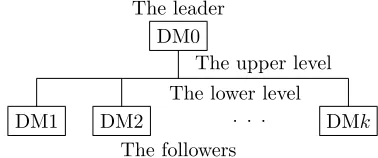
We consider two-level decision making situations where there are one leader at the upper level andkfollowers at the lower level, and decision variables of the leader and the followers are integer variables. Let DM0 denote the leader and DM1,. . ., DMkdenote the followers.
DM0
DM1 DM2 p p p DMk
The leader
The followers The lower level
[image:2.595.71.260.387.466.2]The upper level
Figure 1: Decentralized two-level structure
The decentralized two-level 0-1 programming problem is expressed as
maximize
x z0(x,y) =c0x+d01y1+· · ·+d0kyk
where (y1, . . . ,yk) solves
maximizey
1
z1(x,y) =c1x+d11y1+· · ·+d1kyk
· · · ·
maximizey
k
zk(x,y) =ckx+dk1y1+· · ·+dkkyk
subject to Ax+B1y1+· · ·+Bkyk5b
x∈ {0,1}n0
yj∈ {0,1}nj, j= 1, . . . , k,
(1) where ci, i = 0,1, . . . , k are n0-dimensional row
coeffi-cient vectors; dij, i = 0,1, . . . , k, j = 1, . . . , k are nj
-dimensional row coefficient vectors;Ais anm×n0
coef-ficient matrix;Bj,j = 1, . . . , karem×njcoefficient
ma-trices; andbis anm-dimensional column constant vector; xis ann0-dimensional column decision variable vector of
the leader (DM0);yj,j= 1, . . . , karenj-dimensional
col-umn decision variable vectors of thejth follower (DMj); for the sake of simplicity, y = (yT1, . . . ,yTk)
T, where T
denotes transposition;z0 is a objective function of DM0;
zj, j= 1, . . . , kare objective functions of DMj.
It is natural that decision makers have fuzzy goals for their objective functions when they take fuzziness of hu-man judgments into consideration. For each of the ob-jective functionszi,i= 0,1, . . .,kof the problem (1), we
assume that the decision makers have fuzzy goals such as “the objective functionzi should be substantially less
than or equal to some valuepi.”
LetS denote the feasible region of the problem (1), and then, the individual minimum of the objective function for DMi,i= 0,1, . . . , k is
zmini = min
x,y∈Scix+di1y1+· · ·+dikyk, (2)
and the individual maximum of the objective function for DMiis
zmaxi = max
x,y∈Scix+di1y1+· · ·+dikyk. (3)
The individual minimum and the individual maximum are helpful for DMi to identify a membership function prescribing the fuzzy goal for his/her objective function zi. Consulting the variation ratio of degree of
satisfac-tion in the interval between the individual minimum (2) and the individual maximum (3), DMi determines the membership function µi(zi), which is strictly monotone
increasing for zi. The domain of the membership
func-tion is the interval [zimin, zimax],i= 0,1, . . . , k, and DMi specifies the valuez0
i of the objective function such that
the degree of satisfaction is 0, µi(z0i) = 0, and the value
z1
i of the objective function such that the degree of
satis-faction is 1,µi(zi1) = 1. For the value undesired (smaller)
than z0
i, it is defined that µi(zi) = 0, and for the value
desired (larger) thanz1
i, it is defined thatµi(zi) = 1.
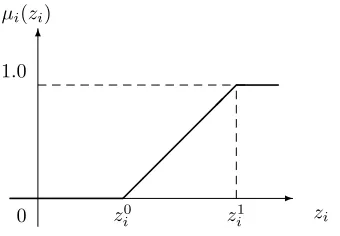
In this paper, for the sake of simplicity, we adopt a linear membership function which characterizes the fuzzy goal of DMi. The corresponding linear membership function µi(zi) is defined as:
µi(zi) =
0, ifzi< zi0
zi−zi0
z1
i −z
0
i
, ifz0
i 5zi< zi1
1, ifzi=zi1,
(4)
and it is depicted in Figure 2.
For the leader and the followers, suppose that DMi de-termines his/her linear membership function by choosing z0
i =zimin andz1i =zmaxi .
pro-6
-µi(zi)
1.0
0 z1
i
z0
[image:3.595.307.553.71.109.2]i zi
Figure 2: Linear membership function.
gramming problem:
maximize
x µ0(c0x+d01y1+· · ·+d0kyk)
wherey solves maximizey min
j=1,...,kµj(cjx+dj1y1+· · ·+djkyk)
subject to Ax+B1y1+· · ·+Bkyk5b,
x∈ {0,1}n0
yj∈ {0,1}nj, j= 1, . . . , k.
(5) In this formulation, the followers (DM1, ..., DMk) max-imize their aggregated degree of satisfaction minj=1,...,k
µj(cjx+dj1y1+· · ·+djkyk). This aggregated degree
of satisfaction is nothing else but the fuzzy decision pro-posed by Bellman, et al [4], which is often employed as a solution concept in fuzzy environments.
3
GA based computational method
We propose a computational method through GAs in or-der to obtain Stackelberg solutions to the decentralized two-level 0-1 programming problems. In this section, we describe fundamental elements of GAs, which are coding procedure, a decoding procedure and genetic operators, used in the proposed computational method.
3.1
Coding and decoding
Binary strings are usually adopted to express individu-als [7, 6] when solving 0-1 programming problems using GAs. However, under this representation it is possible that infeasible individuals that do not satisfy the con-straints may be generated, so there is a danger that the performance of the GAs may degrade. Thus, in this pa-per, in order to derive only feasible solutions, a double string [13] is used which is composed of the substring corresponding to the decision of the leader (DM0), x, and the substring corresponding to the decisions of the followers (DM1, . . . , DMk), y, as shown in Fig.3. The decisions of the leader (DM0) and the followers (DM1, . . . , DMk) are handled by performing genetic operators on each sub-individual. In this paper, the GA handling the decision of the leader (DM0) is called the upper level GA, and the GA handling the decisions of the followers (DM1, . . . , DMk) is called the lower level GA.
←Individual forx→ ←Individual fory→
ix(1) · · · ix(n0) iy(1) · · · iy(n1+· · ·+nk)
Six(1) · · · Six(n0) Siy(1) · · · Siy(n1+···+nk)
Figure 3: Double string
six(m) ∈ {0,1}, ix(m) ∈ {1, . . . , n0}, and for m ̸= m ′
it is assumed that ix(m) ̸= ix(m
′
). Similarly, siy(m) ∈
{0,1}, iy(m)∈ {1, . . . , n1+· · ·+nk}, and form̸=m
′
it is assumed thatiy(m)̸=iy(m
′
). Also, in the double string, regardingix(k),iy(k) andsix(k),siy(k)as the index of an
element in a solution vector and the value of the element respectively, a stringscan be transformed into a solution x= (x1, . . . , xn0) andyj = (yj1, . . . , yj nj), j = 1, . . . , k
as:
xi(m) =six(m), m= 1, . . . , n0,
y1i(m) =siy(m) for 15iy(m)5n1,
y2i(m) =siy(m) forn1+ 15iy(m)5n2,
· · · ·
yki(m) =siy(m) fornm−1+ 15iy(m)5nk.
In this paper, a decoding algorithm propoesd by the au-thors [11] is also applied to the upper level and lower level GA, generating only feasible solutions.
3.2
Reproduction
First, we describe the reproduction operator of the lower level GA. In the lower level GA, by using the value of y obtained by decoding individuals in the lower level GA, and the given values of the decision variables in the up-per level GA, x, a value of the aggregated fuzzy goal
minj=1,...,k µj(cjx+dj1y1+· · ·+djkyk) is evaluated,
and a evaluation value for each individual is thus ob-tained. Next, the fitness value for each individual is de-rived using linear scaling, and the individuals remaining in the next generation are determined by applying elitist expected value selection.
Next, we show the reproduction operator of the upper level GA. In the upper level GA, by using the value ofx obtained by decoding individuals in the upper level GA and the value of the rational reaction obtained by ap-plying the lower level GA, a value of fuzzy goal of the leader µ0(c0x+d01y1+· · ·+d0kyk) is evaluated, and
a evaluation value for each individual is obtained. Fur-thermore, the fitness value for each individual is calcu-lated by applying linear scaling and adopting a clustering method. The individuals remaining in the next genera-tion are determined by applying elitist expected value selection based on these fitness values.
3.3
Crossover and mutation
[image:3.595.80.250.72.190.2]possibil-ity that infeasible individuals may be generated because the indexes occurring in the offspring, ix(m), ix(m
′
), m ̸=m′ or iy(m), iy(m
′
), m ̸=m′, may have the same number. Recall that the same violation occurs in solv-ing travelsolv-ing salesman problems or schedulsolv-ing problems through GAs. Partially matched crossovers (PMX) have been devised to stop this violation. In this paper, a mod-ified version of PMX is used in order to handle the double strings proposed by Sakawaet al.[13]. Also, when deter-mining whether or not to apply the crossover operator, a probability pc is used. Its value is set in advance.
The mutation operator is thought to fulfill the role of a local random search in genetic algorithms. For double strings, the index string expresses the priority of the pa-rameters. For binary strings, since the value of the 0-1 parameters themselves are expressed, strings with differ-ing properties coexist in a sdiffer-ingle strdiffer-ing, and it is neces-sary to apply mutations to each string. In this paper, the mutation operator is applied to each string, and in-version is used for additional strings. For binary strings, bit-reverse is introduced. When applying the mutation operator to individuals, it is first determined whether or not the mutation operator will be applied to an individ-ual according to the mutation probabilitypm. In the case
that mutation is applied, it is then determined whether to apply inversion or bit-reverse according to the mutation selection constantMP um.
3.4
Application of the parallel genetic
algo-rithm
In this study, we aim for reductions in computational time, and consider parallelization of the upper level GA and the lower level GA implemented by the computa-tional method proposed by the authors [11].
In GAs, it is possible to perform parallel processing in the greater part of the operations included in the algo-rithm. In reproduction operations, however, because it is necessary to calculate evaluation values for each individ-ual in a population, and based on that value determine the fitness of each individual, direct application of allel processing is difficult. Research related to the par-allelization of GAs started with improvements to such barriers to the implementation of parallelization, and a variety of types of models have been proposed and their effectiveness noted by numerous researchers [5]. Today, GAs that implement parallel processing have come to be called parallel genetic algorithms.
Broadly classified, there are four types of parallel genetic algorithms:
1) Single-population master-slave GAs In these
models, the population is not divided, and repro-duction and crossover are performed globally, with only individual evaluation performed on multiple
processors.
2) Multiple-population GAs In these models, the
population is divided into multiple partial popula-tions, and the partial populations are assigned to multiple processors. Reproduction, crossover and mutation are then performed on the assigned proces-sors, and at some fixed period an operation called migration is performed to swap individuals among populations. These models are also known as dis-tributed GA.
3) Fine-grained GAs In these models, each processor
is assigned one or a very small number of individuals.
4) Hierarchical hybrids These models combine
multiple-population GAs or fine-grained GAs.
The computational method proposed by the authors in-cludes an upper level GA and a lower level GA, and par-allelization of each must be considered. We will describe the parallelization of upper level GAs. In this paper, we will employ multiple-population GAs. First, in our pro-posed method, the population of the upper level GA is divided into multiple subpopulations, and the subpopula-tions are assigned to multiple processors. Next, reproduc-tion operator, crossover operator and mutareproduc-tion operator are applied on the assigned processors, and migration is performed to swap individuals among subpopulations.
We will describe the parallelization of the lower level GA. A lower level GA is used to obtain the rational reaction y(x) to a given upper level GA individual x. For each individual xof the upper level GA therefore there is an independently operating lower level GA, and so it is pos-sible to divide the lower level GA operations and assign them across multiple processors.
It is possible to reduce calculation times and improve calculation precision by employing such a model.
3.5
Lower level GA avoidance procedures
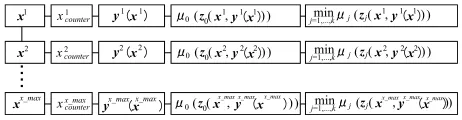
By introducing a lower level GA avoidance procedure it is possible to reduce the number of unneeded rational re-action calculations, and so calculation times are reduced. In this paper, we introduce storage regions as shown in Fig. 4.
x1 y
0 1
x
1
x y x
x y
0x
x
y x
z ( , )
2 2 2
x_max x_max x_max x_max x_max x_max
xx_max counter
x2
counter
x1
counter
Ǵ( )
0 z 0( , )x yx 1 1 1
Ǵ( )
0 z 0( , )x yx 2 2 2
Ǵ( )
x_max x_max x_max x y x
z ( , ) Ǵj( )j min
j=1,...,k
x yx
z ( , ) Ǵ( )2 2 2
j j min j=1,...,k
x yx
z ( , )1 1 1
Ǵj( )j min
[image:4.595.312.543.634.694.2]j=1,...,k
Figure 4: Storage for savingxandy(x)
used in the past for handling individuals of the upper level GA, and yi(xi), i= 1, . . . , x maxindicates the val-ues of the rational reactions associated withxi obtained
by the lower level GA. xi
counter ∈ {1,2, . . . , y max}, i =
1, . . . , x maxindicates the number of times that the lower level GA was used to find the rational reactionyi(xi) for
xi. x maxindicates the maximum number of the leader’s
(DM0) decisionsxsaved, andy maxindicates the max-imum number of times that the lower level GA can be repeatedly used to find the rational reaction yi(xi) for
xi. µ
0(z0(xi,yi)) is a value that is obtaiend by
substitut-ing storedxi,yi(xi) values into fuzzy goal of the leader.
Also, minj=1,...,kµj(zj(xi,yi)) is a value that is obtained
by substituting stored xi and yi(xi) values into aggre-gated fuzzy goal of the flollowers. By furthermore using an algorithm like the following, the number of applica-tions of the lower level GA is reduced, and unnecessary calculation times eliminated.
Storage of the rational reaction y(x) and lower
level GA avoidance procedures
Step 1 If there exists inxian upper level GA individual ¯
x, proceed to Step 2. If one does not exist, then check if the number ofxi has reachedx max, and if
so continue on to Step 3. If not, proceed to Step 4.
Step 2 If xi
counter has reached y max, then the saved
yi(xi) is returned to the upper level GA as the
ra-tional reaction and the algorithm terminates. If not reached, proceed to Step 4.
Step 3 Select the least of the values µ0(z0(xi,yi(xi)))
from the saved xi, and take that xi value as xk. After applying the lower level GA and thus obtaining the rational reaction y(¯x) for ¯x, if µ0(z0(xk,yk(xk)))5µ0(z0(¯x,y(¯x))), save ¯x,y(¯x),
µ0(z0(¯x,y(¯x))), minj=1,...,kµj(zj(¯x,y(¯x))) in the
storage region xk, and terminate the algorithm.
Step 4 After obtaining the rational reaction y(¯x) for ¯
x by applying the lower level GA, save ¯x, y(¯x), µ0(z0(¯x,y(¯x))), minj=1,...,kµj(zj(¯x,y(¯x))), and
ter-minate the algorithm.
3.6
The algorithm for the improved
compu-tational method
The following is a summary of the algorithm used in the computational method after improvement. Here, the number of processors used in the experiment is taken to be p.
Step 1 For each processorq, q= 1, . . . , p, apply the up-per level GA oup-perations on Step1 through Step7. Taking the generation of the upper level GA as tuq := 0, Nu initial individuals are randomly
gen-erated.
Step 2 For each individualxin the upper level GA, de-termine whether or not to apply the lower level GA, and find the number of lower level GA to applyNul.
For those individuals to which the lower level GA will be applied, apply the lower level GA operations in Step 2-1 through Step 2-3, and obtain the ratio-nal reactiony(x). For thoseNu−Nulindividuals to
which the lower level GA will not be applied, take the savedy(x) as the rational reaction, and proceed to Step 4.
Step 2-1 Settl := 0. Randomly generateNl lower
level GA individuals y, and take these as the initial population of the lower level GA . Pro-ceed to Step 2-2.
Step 2-2 Use xgiven as the upper level GA
indi-vidual and y generated by the lower level GA to calculate the value of the aggregated fuzzy goal minj=1,...,k µj(zj(x,y)), and after
apply-ing linear scalapply-ing use that value to generate an individual. Proceed to Step 2-3.
Step 2-3 If tl has exceeded the previously defined
a maximum number of generationMl, take the
individual with the best fitness value as the op-timal individual y(x), and proceed to Step 3. Otherwise, apply crossover operator and muta-tion operator to each lower level GA individual, lettl=tl+ 1, and proceed to Step 2-2.
Step 3 Calculate the value of fuzzy goal of the leader (DM0) µ0(z0(x,y(x))) and the value of the
aggre-gated fuzzy goal minj=1,...,kµj(zj(x,y(x))) using
the lower level rational reaction y(x) obtained by operation of the lower level GA, and the individual xof the upper level GA. Perform the procedures re-quired to save x and its rational reactions y(x) to the storage region, and proceed to Step 4.
Step 4 Calculate the value of fuzzy goal of the leader (DM0) µ0(z0(x,y(x))) for each upper level GA
in-dividualx, and after performing linear scaling apply the clustering method to measure the level of conver-gence of the individuals. Depending upon the degree of convergence, calculate the fitness value of each in-dividual. Proceed to Step 5.
Step 5 If tuq has exceeded the previously set a maxi-mum number of generation Mu, then terminate the
algorithm. In that case, the individual obtained up to that generation with the best fitness value is taken as the optimal individual (x,y). Otherwise, proceed to Step 6.
Step 6 Reproduction operator is performed using the
Step 7 If tuq mod mi (migration interval) = 0, after
performing synchronization between the processors, apply migration. Return to Step 2 withtuq :=tuq+ 1.
4
Conclusion
In this paper, we have focused on decentralized two-level 0-1 programming problems, and have proposed a modi-fied computational method that solves problems related to computational methods for obtaining the Stackelberg solution. Specifically, in order to shorten the computa-tional time of a computacomputa-tional method implementing a GA proposed by the authors, a distributed genetic algo-rithm has been introduced with respect to the upper level GA. Also, parallelization of the lower level GA has been performed along with parallelization of the upper level GA. In order to verify the effectiveness of the proposed method, it is intended to conduct numerical experiments into both the solution precision and computation time, and thus compare the proposed method with the existing method.
References
[1] G. Anandalingam, R. Mathieu, C.L. Pittard, and N. Sinha, “Artificial intelligence based approaches for solving hierarchical optimization problems,” in: Sharda, Golden, Wasil, Balci and Stewart (eds.), Im-pacts of Recent Computer Advances on Operations Research,North-Holland, pp. 289–301 (1989).
[2] J. Bard and J. Moore, “The mixed integer lin-ear bilevel programming problem,” Operations Re-search,Vol. 38, pp. 911–921 (1990).
[3] J. Bard and J. Moore, “An algorithm for the discrete bilevel programming problem,” Naval Research Lo-gistics,Vol. 39, pp. 419–435 (1992).
[4] R.E. Bellman and L.A. Zadeh, “Decision making in a fuzzy environment,”Management Science,Vol. 17, pp. 141-164 (1970).
[5] E. Cant´u-Paz: Efficient and Accurate Parallel Ge-netic Algorithms,Kluwer Academic Publishers, Nor-well, Massachussets (2000).
[6] D.E. Goldberg, Genetic Algorithms in Search, Op-timization, and Machine Learning,Addison Wesley, Massachusetts (1989).
[7] D.E. Goldberg and R. Lingle: “Alleles, loci, and the traveling salesman problem,”Proceedings of the First International Conference on Genetic Algo-rithms and Their Applications, Lawrence Erlbaum Associates, Hillsdale, NJ, pp. 154–159 (1985).
[8] J.H. Holland, Adaptation in Natural and Artificial Systems,University of Michigan Press (1975), MIT Press, Cambridge (1992).
[9] Z. Michalewicz, Genetic Algorithms + Data Struc-tures = Evolution Programs,Springer-Verlag, Third, revised and extended edition, Berlin, (1996).
[10] K. Niwa: “Revised computational methods for us-ing genetic algorithms for obtainus-ing Stackelberg so-lutions to two-level 0-1 programming problems,” Es-says and Studies in Commemoration of the 40th An-niversary of the Founding of Hiroshima University of Economics,Hiroshima University Economics, pp. 771–794, in Japanese (2007)
[11] K. Niwa, I. Nishizaki and M. Sakawa, “Decentrized two-level 0-1 programming through genetic al-gorithms with double strings,” in: L.C. Jain and R.K. Jain (eds.), In proceedings of Second Inter-national Conference on Knowledge-Based Intelligent Electronic Systems,vol. 2, pp. 278–283 (1998).
[12] K. Niwa, I. Nishizaki and M. Sakawa: “Two-Level 0-1 Programming Using Genetic Algorithms and a Sharing Scheme Based on Cluster Analysis,” Inter-national MultiConference of Engineers and Com-puter Scientists 2008 Proceedings, pp. 1931–1936 (2008).
[13] M. Sakawa, M. Tanaka: Genetic Algorithms, Asakura Publishing, in Japanese (1995).