Using the Web as an Implicit Training Set:
Application to Structural Ambiguity Resolution
Preslav Nakov and Marti Hearst EECS and SIMS
University of California at Berkeley Berkeley, CA 94720
[email protected], [email protected]
Abstract
Recent work has shown that very large corpora can act as training data for NLP algorithms even without explicit labels. In this paper we show how the use of sur-face features and paraphrases in queries against search engines can be used to infer labels for structural ambiguity resolution tasks. Using unsupervised algorithms, we achieve 84% precision on PP-attachment and 80% on noun compound coordination.
1 Introduction
Resolution of structural ambiguity problems such as noun compound bracketing, prepositional phrase (PP) attachment, and noun phrase coordination re-quires using information about lexical items and their cooccurrences. This in turn leads to the data sparseness problem, since algorithms that rely on making decisions based on individual lexical items must have statistics about every word that may be encountered. Past approaches have dealt with the data sparseness problem by attempting to generalize from semantic classes, either manually built or auto-matically derived.
More recently, Banko and Brill (2001) have ad-vocated for the creative use of very large text col-lections as an alternative to sophisticated algorithms and hand-built resources. They demonstrate the idea on a lexical disambiguation problem for which la-beled examples are available “for free”. The prob-lem is to choose which of 2-3 commonly confused
words (e.g., {principle, principal}) are appropriate for a given context. The labeled data comes “for free” by assuming that in most edited written text, the words are used correctly, so training can be done directly from the text. Banko and Brill (2001) show that even using a very simple algorithm, the results continue to improve log-linearly with more training data, even out to a billion words. A potential limita-tion of this approach is the queslimita-tion of how applica-ble it is for NLP proapplica-blems more generally – how can we treat a large corpus as a labeled collection for a wide range of NLP tasks?
In a related strand of work, Lapata and Keller (2004) show that computing n-gram statistics over very large corpora yields results that are competi-tive with if not better than the best supervised and knowledge-based approaches on a wide range of NLP tasks. For example, they show that for the problem of noun compound bracketing, the perfor-mance of an n-gram based model computed using search engine statistics was not significantly differ-ent from the best supervised algorithm whose pa-rameters were tuned and which used a taxonomy. They find however that these approaches generally fail to outperform supervised state-of-the-art models that are trained on smaller corpora, and so conclude that web-basedn-gram statistics should be the base-line to beat.
We feel the potential of these ideas is not yet fully realized. We are interested in finding ways to further exploit the availability of enormous web corpora as implicit training data. This is especially important for structural ambiguity problems in which the de-cisions must be made on the basis of the behavior
of individual lexical items. The trick is to figure out how to use information that is latent in the web as a corpus, and web search engines as query interfaces to that corpus.
In this paper we describe two techniques –
sur-face features and paraphrases – that push the ideas
of Banko and Brill (2001) and Lapata and Keller (2004) farther, enabling the use of statistics gathered from very large corpora in an unsupervised man-ner. In recent work (Nakov and Hearst, 2005) we showed that a variation of the techniques, when ap-plied to the problem of noun compound bracketing, produces higher accuracy than Lapata and Keller (2004) and the best supervised results. In this pa-per we adapt the techniques to the structural disam-biguation problems of prepositional phrase attach-ment and noun compound coordination.
2 Prepositional Phrase Attachment
A long-standing challenge for syntactic parsers is the attachment decision for prepositional phrases. In a configuration where a verb takes a noun comple-ment that is followed by a PP, the problem arises of whether the PP attaches to the noun or to the verb. Consider the following contrastive pair of sentences: (1) Peter spent millions of dollars. (noun) (2) Peter spent time with his family. (verb) In the first example, the PP millions of dollars at-taches to the noun millions, while in the second the PP with his family attaches to the verb spent.
Past work on PP-attachment has often cast these associations as the quadruple(v, n1, p, n2), wherev is the verb,n1is the head of the direct object,pis the preposition (the head of the PP) andn2 is the head of the NP inside the PP. For example, the quadruple for (2) is (spent, time, with, family).
2.1 Related Work
Early work on PP-attachment ambiguity resolu-tion relied on syntactic (e.g., “minimal attachment” and “right association”) and pragmatic considera-tions. Most recent work can be divided into su-pervised and unsusu-pervised approaches. Susu-pervised approaches tend to make use of semantic classes or thesauri in order to deal with data sparseness problems. Brill and Resnik (1994) used the su-pervised transformation-based learning method and
lexical and conceptual classes derived from Word-Net, achieving 82% precision on 500 randomly se-lected examples. Ratnaparkhi et al. (1994) cre-ated a benchmark dataset of 27,937 quadruples
(v, n1, p, n2), extracted from the Wall Street Jour-nal. They found the human performance on this task to be 88%1. Using this dataset, they trained a maximum entropy model and a binary hierarchy of word classes derived by mutual information, achiev-ing 81.6% precision. Collins and Brooks (1995) used a supervised back-off model to achieve 84.5% precision on the Ratnaparkhi test set. Stetina and Makoto (1997) use a supervised method with a deci-sion tree and WordNet classes to achieve 88.1% pre-cision on the same test set. Toutanova et al. (2004) use a supervised method that makes use of morpho-logical and syntactic analysis and WordNet synsets, yielding 87.5% accuracy.
In the unsupervised approaches, the attachment decision depends largely on co-occurrence statistics drawn from text collections. The pioneering work in this area was that of Hindle and Rooth (1993). Using a partially parsed corpus, they calculate and compare lexical associations over subsets of the tu-ple (v, n1, p), ignoringn2, and achieve 80% preci-sion at 80% recall.
More recently, Ratnaparkhi (1998) developed an unsupervised method that collects statistics from text annotated with part-of-speech tags and mor-phological base forms. An extraction heuristic is used to identify unambiguous attachment decisions, for example, the algorithm can assume a noun at-tachment if there is no verb within kwords to the left of the preposition in a given sentence, among other conditions. This extraction heuristic uncov-ered 910K unique tuples of the form (v, p, n2) and
(n, p, n2), although the results are very noisy, sug-gesting the correct attachment only about 69% of the time. The tuples are used as training data for clas-sifiers, the best of which achieves 81.9% precision on the Ratnaparkhi test set. Pantel and Lin (2000) describe an unsupervised method that uses a collo-cation database, a thesaurus, a dependency parser, and a large corpus (125M words), achieving 84.3% precision on the Ratnaparkhi test set. Using
sim-1When presented with a whole sentence, average humans
ple combinations of web-based n-grams, Lapata and Keller (2005) achieve lower results, in the low 70’s.
Using a different collection consisting of German PP-attachment decisions, Volk (2000) uses the web to obtain n-gram counts. He comparedPr(p|n1)to
Pr(p|v), wherePr(p|x) = #(x, p)/#(x). Herex
can be n1 or v. The bigram frequencies #(x, p) were obtained using the Altavista NEAR operator. The method was able to make a decision on 58% of the examples with a precision of 75% (baseline 63%). Volk (2001) then improved on these results by comparing Pr(p, n2|n1) to Pr(p, n2|v). Using inflected forms, he achieved P=75% and R=85%.
Calvo and Gelbukh (2003) experimented with a variation of this, using exact phrases instead of the NEAR operator. For example, to disambiguate Veo
al gato con un telescopio, they compared
frequen-cies for phrases such as “ver con telescopio” and “gato con telescopio”. They tested this idea on 181 randomly chosen Spanish disambiguation examples, labelling 89.5% recall with a precision of 91.97%.
2.2 Models and Features
2.2.1 n-gram Models
We computed two co-occurrence models;
(i)Pr(p|n1)vs.Pr(p|v)
(ii)Pr(p, n2|n1)vs.Pr(p, n2|v).
Each of these was computed two different ways: usingPr(probabilities) and#(frequencies). We es-timate then-gram counts using exact phrase queries (with inflections, derived from WordNet 2.0) using the MSN Search Engine. We also allow for deter-miners, where appropriate, e.g., between the prepo-sition and the noun when querying for#(p, n2). We add up the frequencies for all possible variations. Web frequencies were reliable enough and did not need smoothing for (i), but for (ii), smoothing using the technique described in Hindle and Rooth (1993) led to better recall. We also tried back-off from (ii) to (i), as well as back-off plus smoothing, but did not find improvements over smoothing alone. We found n-gram counts to be unreliable when pronouns ap-pear in the test set rather than nouns, and disabled them in these cases. Such examples can still be han-dled by paraphrases or surface features (see below).
2.2.2 Web-Derived Surface Features
Authors sometimes (consciously or not) disam-biguate the words they write by using surface-level markers to suggest the correct meaning. We have found that exploiting these markers, when they oc-cur, can prove to be very helpful for making dis-ambiguation decisions. The enormous size of web search engine indexes facilitates finding such mark-ers frequently enough to make them useful.
For example, John opened the door with a key is a difficult verb attachment example because doors, keys, and opening are all semantically related. To determine if this should be a verb or a noun attach-ment, we search for cues that indicate which of these terms tend to associate most closely. If we see paren-theses used as follows:
“open the door (with a key)”
this suggests a verb attachment, since the parenthe-ses signal that “with a key” acts as its own unit. Similarly, hyphens, colons, capitalization, and other punctuation can help signal disambiguation deci-sions. For Jean ate spaghetti with sauce, if we see
“eat: spaghetti with sauce”
this suggests a noun attachment.
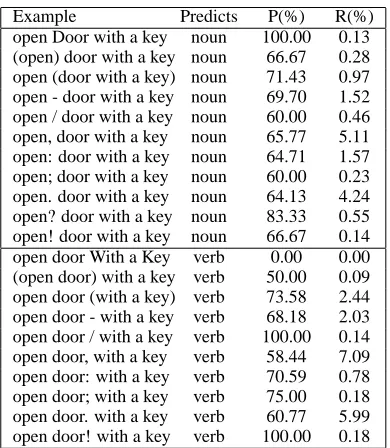
Table 1 illustrates a wide variety of surface fea-tures, along with the attachment decisions they are assumed to suggest (events of frequency 1 have been ignored). The surface features for PP-attachment have low recall: most of the examples have no sur-face features extracted.
We gather the statistics needed by issuing queries to web search engines. Unfortunately, search en-gines usually ignore punctuation characters, thus preventing querying directly for terms containing hyphens, brackets, etc. We collect these numbers indirectly by issuing queries with exact phrases and then post-processing the top 1,000 resulting sum-maries2, looking for the surface features of interest. We use Google for both the surface feature and para-phrase extractions (described below).
2.2.3 Paraphrases
The second way we extend the use of web counts is by paraphrasing the relation of interest and see-ing if it can be found in its alternative form, which
2We often obtain more than 1,000 summaries per example
suggests the correct attachment decision. We use the following patterns along with their associated at-tachment predictions:
(1) v n2 n1 (noun) (2) v p n2n1 (verb) (3) p n2*v n1 (verb) (4) n1p n2v (noun) (5) vpronounp n2 (verb) (6) ben1p n2 (noun)
The idea behind Pattern (1) is to determine if “n1 p n2” can be expressed as a noun com-pound; if this happens sufficiently often, we can predict a noun attachment. For example, meet/v demands/n1 from/p customers/n2 becomes meet/v
the customers/n2demands/n1.
Note that the pattern could wrongly target ditran-sitive verbs: e.g., it could turn gave/v an apple/n1
to/phim/n2into gave/vhim/n2an apple/n1. To pre-vent this, we do not allow a determiner beforen1, but we do require one beforen2. In addition, we disallow the pattern if the preposition is to and we require bothn1 andn2 to be nouns (as opposed to numbers, percents, pronouns, determiners etc.).
Pattern (2) predicts a verb attachment. It presup-poses that “p n2” is an indirect object of the verbv and tries to switch it with the direct objectn1, e.g.,
had/v a program/n1 in/p place/n2 would be trans-formed into had/vin/pplace/n2 a program/n1. We requiren1to be preceded by a determiner (to prevent “n2n1” forming a noun compound).
Pattern (3) looks for appositions, where the PP has moved in front of the verb, e.g., to/phim/n2I gave/v
an apple/n1. The symbol * indicates a wildcard po-sition where we allow up to three intervening words. Pattern (4) looks for appositions, where the PP has moved in front of the verb together withn1. It would transform shaken/v confidence/n1 in/p markets/n2 into confidence/n1 in/pmarkets/n2shaken/v.
Pattern (5) is motivated by the observation that if n1 is a pronoun, this suggests a verb attach-ment (Hindle and Rooth, 1993). (A separate feature checks ifn1 is a pronoun.) The pattern substitutes
n1 with a dative pronoun (we allow him and her), e.g., it will convert put/v a client/n1 at/p odds/n2 into put/vhim at/podds/n2.
Pattern (6) is motivated by the observation that the verb to be is typically used with a noun attachment. (A separate feature checks ifvis a form of the verb
to be.) The pattern substitutesvwith is and are, e.g. it will turn eat/vspaghetti/n1with/psauce/n2into is
spaghetti/n1with/psauce/n2.
These patterns all allow for determiners where ap-propriate, unless explicitly stated otherwise. For a given example, a prediction is made if at least one instance of the pattern has been found.
2.3 Evaluation
For the evaluation, we used the test part (3,097 ex-amples) of the benchmark dataset by Ratnaparkhi et al. (1994). We used all 3,097 test examples in order to make our results directly comparable.
Unfortunately, there are numerous errors in the test set3. There are 149 examples in which a bare determiner is labeled asn1 orn2rather than the ac-tual head noun. Supervised algorithms can compen-sate for this problem by learning from the training set that “the” can act as a noun in this collection, but unsupervised algorithms cannot.
In addition, there are also around 230 examples in which the nouns contain special symbols like: %, slash, &, ’, which are lost when querying against a search engine. This poses a problem for our algo-rithm but is not a problem with the test set itself.
The results are shown in Table 2. Following Rat-naparkhi (1998), we predict a noun attachment if the preposition is of (a very reliable heuristic). The table shows the performance for each feature in isolation (excluding examples whose preposition is of). The surface features are represented by a single score in Table 2: for a given example, we sum up separately the number of noun- and verb-attachment pattern matches, and assign the attachment with the larger number of matches.
We combine the bold rows of Table 2 in a majority vote (assigning noun attachment to all of instances), obtaining P=85.01%, R=91.77%. To get 100% re-call, we assign all undecided cases to verb (since the majority of the remaining non-of instances at-tach to the verb, yielding P=83.63%, R=100%. We show 0.95-level confidence intervals for the preci-sion, computed by a general method based on con-stant chi-square boundaries (Fleiss, 1981).
A test for statistical significance reveals that our results are as strong as those of the leading
unsuper-3Ratnaparkhi (1998) notes that the test set contains errors,
Example Predicts P(%) R(%) open Door with a key noun 100.00 0.13 (open) door with a key noun 66.67 0.28 open (door with a key) noun 71.43 0.97 open - door with a key noun 69.70 1.52 open / door with a key noun 60.00 0.46 open, door with a key noun 65.77 5.11 open: door with a key noun 64.71 1.57 open; door with a key noun 60.00 0.23 open. door with a key noun 64.13 4.24 open? door with a key noun 83.33 0.55 open! door with a key noun 66.67 0.14 open door With a Key verb 0.00 0.00 (open door) with a key verb 50.00 0.09 open door (with a key) verb 73.58 2.44 open door - with a key verb 68.18 2.03 open door / with a key verb 100.00 0.14 open door, with a key verb 58.44 7.09 open door: with a key verb 70.59 0.78 open door; with a key verb 75.00 0.18 open door. with a key verb 60.77 5.99 open door! with a key verb 100.00 0.18
Table 1: PP-attachment surface features. Preci-sion and recall shown are across all examples, not just the door example shown.
vised approach on this collection (Pantel and Lin, 2000). Unlike that work, we do not require a collo-cation database, a thesaurus, a dependency parser, nor a large domain-dependent text corpus, which makes our approach easier to implement and to ex-tend to other languages.
3 Coordination
Coordinating conjunctions (and, or, but, etc.) pose major challenges to parsers and their proper han-dling is essential for the understanding of the sen-tence. Consider the following “cooked” example:
The Department of Chronic Diseases and Health Promotion leads and strengthens global efforts to prevent and control chronic diseases or disabilities
and to promote health and quality of life.
Conjunctions can link two words, two con-stituents (e.g., NPs), two clauses or even two sen-tences. Thus, the first challenge is to identify the boundaries of the conjuncts of each coordination. The next problem comes from the interaction of the coordinations with other constituents that attach to its conjuncts (most often prepositional phrases). In the example above we need to decide between
[health and [quality of life]] and [[health and
qual-Model P(%) R(%)
Baseline (noun attach) 41.82 100.00
#(x, p) 58.91 83.97
Pr(p|x) 66.81 83.97
Pr(p|x)smoothed 66.81 83.97
#(x, p, n2) 65.78 81.02
Pr(p, n2|x) 68.34 81.62
Pr(p, n2|x)smoothed 68.46 83.97
(1) “v n2n1” 59.29 22.06
(2) “p n2v n1” 57.79 71.58
(3) “n1*p n2v” 65.78 20.73
(4) “v p n2n1” 81.05 8.75
(5) “vpronounp n2” 75.30 30.40
(6) “ben1p n2” 63.65 30.54
n1is pronoun 98.48 3.04
vis to be 79.23 9.53
[image:5.612.320.556.54.251.2]Surface features (summed) 73.13 9.26 Maj. vote, of→noun 85.01±1.21 91.77 Maj. vote, of→noun, N/A→verb 83.63±1.30 100.00
Table 2: PP-attachment results, in percentages.
ity] of life]. From a semantic point of view, we
need to determine whether the or in chronic
dis-eases or disabilities really means or or is used as an and (Agarwal and Boggess, 1992). Finally, we need
to choose between a non-elided and an elided read-ing: [[chronic diseases] or disabilities] vs. [chronic
[diseases or disabilities]].
Below we focus on a special case of the latter problem: noun compound (NC) coordination. Con-sider the NC car and truck production. Its real meaning is car production and truck production. However, due to the principle of economy of ex-pression, the first instance of production has been compressed out by means of ellipsis. By contrast, in president and chief executive, president is simply linked to chief executive. There is also an all-way co-ordination, where the conjunct is part of the whole, as in Securities and Exchange Commission.
More formally, we consider configurations of the kind n1 c n2 h, where n1 andn2 are nouns,c is a coordination (and or or) and h is the head noun4. The task is to decide whether there is an ellipsis or not, independently of the local context. Syntacti-cally, this can be expressed by the following brack-etings: [[n1c n2]h] versus [n1 c[n2 h]]. (Collins’ parser (Collins, 1997) always predicts a flat NP for such configurations.) In order to make the task more
4The configurations of the kindn h
realistic (from a parser’s perspective), we ignore the option of all-way coordination and try to predict the bracketing in Penn Treebank (Marcus et al., 1994) for configurations of this kind. The Penn Treebank brackets NCs with ellipsis as, e.g.,
(NP car/NN and/CC truck/NN production/NN).
and without ellipsis as
(NP (NP president/NN) and/CC (NP chief/NN exec-utive/NN))
The NPs with ellipsis are flat, while the others con-tain internal NPs. The all-way coordinations can ap-pear bracketed either way and make the task harder.
3.1 Related Work
Coordination ambiguity is under-explored, despite being one of the three major sources of structural ambiguity (together with prepositional phrase at-tachment and noun compound bracketing), and be-longing to the class of ambiguities for which the number of analyses is the number of binary trees over the corresponding nodes (Church and Patil, 1982), and despite the fact that conjunctions are among the most frequent words.
Rus et al. (2002) present a deterministic rule-based approach for bracketing in context of coor-dinated NCs of the kindn1 c n2 h, as a necessary step towards logical form derivation. Their algo-rithm uses POS tagging, syntactic parses, semantic senses of the nouns (manually annotated), lookups in a semantic network (WordNet) and the type of the coordination conjunction to make a 3-way classifi-cation: ellipsis, no ellipsis and all-way coordination. Using a back-off sequence of 3 different heuristics, they achieve 83.52% precision (baseline 61.52%) on a set of 298 examples. When 3 additional context-dependent heuristics and 224 additional examples with local contexts are added, the precision jumps to 87.42% (baseline 52.35%), with 71.05% recall.
Resnik (1999) disambiguates two kinds of pat-terns: n1 and n2 n3 and n1 n2 and n3 n4 (e.g., [food/n1 [handling/n2 and/c storage/n3]
procedures/n4]). While there are two options for the former (all-way coordinations are not allowed), there are 5 valid bracketings for the latter. Follow-ing Kurohashi and Nagao (1992), Resnik makes de-cisions based on similarity of form (i.e., number agreement: P=53%, R=90.6%), similarity of mean-ing (P=66%, R=71.2%) and conceptual association
Example Predicts P(%) R(%)
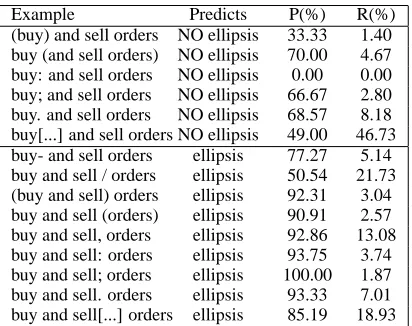
[image:6.612.332.538.53.216.2](buy) and sell orders NO ellipsis 33.33 1.40 buy (and sell orders) NO ellipsis 70.00 4.67 buy: and sell orders NO ellipsis 0.00 0.00 buy; and sell orders NO ellipsis 66.67 2.80 buy. and sell orders NO ellipsis 68.57 8.18 buy[...] and sell orders NO ellipsis 49.00 46.73 buy- and sell orders ellipsis 77.27 5.14 buy and sell / orders ellipsis 50.54 21.73 (buy and sell) orders ellipsis 92.31 3.04 buy and sell (orders) ellipsis 90.91 2.57 buy and sell, orders ellipsis 92.86 13.08 buy and sell: orders ellipsis 93.75 3.74 buy and sell; orders ellipsis 100.00 1.87 buy and sell. orders ellipsis 93.33 7.01 buy and sell[...] orders ellipsis 85.19 18.93
Table 3: Coordination surface features. Precision and recall shown are across all examples, not just the
buy and sell orders shown.
(P=75.0%, R=69.3%). Using a decision tree to com-bine the three information sources, he achieves 80% precision (baseline 66%) at 100% recall for the 3-noun coordinations. For the 4-3-noun coordinations the precision is 81.6% (baseline 44.9%), 85.4% re-call.
Chantree et al. (2005) cover a large set of ambi-guities, not limited to nouns. They allow the head word to be a noun, a verb or an adjective, and the modifier to be an adjective, a preposition, an ad-verb, etc. They extract distributional information from the British National Corpus and distributional similarities between words, similarly to (Resnik, 1999). In two different experiments they achieve P=88.2%, R=38.5% and P=80.8%, R=53.8% (base-line P=75%).
Goldberg (1999) resolves the attachment of
am-biguous coordinate phrases of the kind n1 p n2 c
n3, e.g., box/n1 of/p chocolates/n2 and/croses/n3. Using an adaptation of the algorithm proposed by Ratnaparkhi (1998) for PP-attachment, she achieves P=72% (baseline P=64%), R=100.00%.
Agarwal and Boggess (1992) focus on the
identi-fication of the conjuncts of coordinate conjunctions.
3.2 Models and Features
3.2.1 n-gram Models
We use the followingn-gram models: (i)#(n1, h)vs.#(n2, h)
(ii)#(n1, h)vs.#(n1, c, n2)
Model (i) compares how likely it is thatn1 mod-ifies h, as opposed to n2 modifying h. Model (ii) checks which association is stronger: between n1 andh, or betweenn1andn2. Regardless of whether the coordination is or or and, we query for both and we add up the corresponding counts.
3.2.2 Web-Derived Surface Features
The set of surface features is similar to the one we used for PP-attachment. These are brackets, slash, comma, colon, semicolon, dot, question mark, ex-clamation mark, and any character. There are two additional ellipsis-predicting features: a dash after
n1 and a slash aftern2, see Table 3.
3.2.3 Paraphrases
We use the following paraphrase patterns: (1) n2c n1h (ellipsis)
(2) n2h c n1 (NO ellipsis) (3) n1h c n2 h (ellipsis) (4) n2h c n1 h (ellipsis)
If matched frequently enough, each of these pat-terns predicts the coordination decision indicated in parentheses. If found only infrequently or not found at all, the opposite decision is made. Pattern (1) switches the places ofn1 andn2in the coordinated NC. For example, bar and pie graph can easily be-come pie and bar graph, which favors ellipsis. Pat-tern (2) movesn2 andh together to the left of the coordination conjunction, and placesn1to the right. If this happens frequently enough, there is no ellip-sis. Pattern (3) inserts the elided headhaftern1with the hope that if there is ellipsis, we will find the full phrase elsewhere in the data. Pattern (4) combines pattern (1) and pattern (3); it not only insertshafter
n1 but also switches the places ofn1andn2. As shown in Table 4, we included four of the heuristics by Rus et al. (2002). Heuristic 1 predicts no coordination whenn1 andn2 are the same, e.g.,
milk and milk products. Heuristics 2 and 3 perform a
lookup in WordNet and we did not use them. Heuris-tics 4, 5 and 6 exploit the local context, namely the
Model P(%) R(%)
Baseline: ellipsis 56.54 100.00
(n1, h)vs.(n2, h) 80.33 28.50
(n1, h)vs.(n1, c, n2) 61.14 45.09
(n2, c, n1, h) 88.33 14.02
(n2, h, c, n1) 76.60 21.96
(n1, h, c, n2, h) 75.00 6.54
(n2, h, c, n1, h) 78.67 17.52
Heuristic 1 75.00 0.93
Heuristic 4 64.29 6.54
Heuristic 5 61.54 12.15
Heuristic 6 87.09 7.24
Number agreement 72.22 46.26
Surface sum 82.80 21.73
Majority vote 83.82 80.84
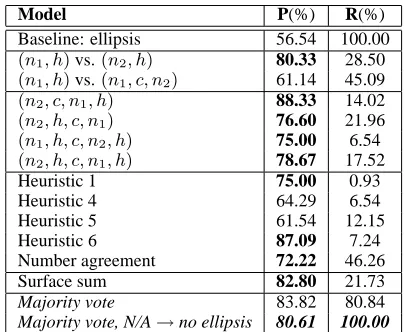
[image:7.612.332.535.53.219.2]Majority vote, N/A→no ellipsis 80.61 100.00
Table 4: Coordination results, in percentages.
adjectives modifyingn1 and/orn2. Heuristic 4 pre-dicts no ellipsis if both n1 andn2 are modified by adjectives. Heuristic 5 predicts ellipsis if the coor-dination is or and n1 is modified by an adjective, butn2 is not. Heuristic 6 predicts no ellipsis ifn1 is not modified by an adjective, butn2 is. We used versions of heuristics 4, 5 and 6 that check for deter-miners rather than adjectives.
Finally, we included the number agreement fea-ture (Resnik, 1993): (a) ifn1 andn2 match in num-ber, but n1 andh do not, predict ellipsis; (b) if n1 and n2 do not match in number, butn1 and h do, predict no ellipsis; (c) otherwise leave undecided.
3.3 Evaluation
We evaluated the algorithms on a collection of 428 examples extracted from the Penn Treebank. On ex-traction, determiners and non-noun modifiers were allowed, but the program was only presented with the quadruple (n1,c,n2,h). As Table 4 shows, our overall performance of 80.61 is on par with other ap-proaches, whose best scores fall into the low 80’s for precision. (Direct comparison is not possible, as the tasks and datasets all differ.)
As Table 4 shows, n-gram model (i) performs well, butn-gram model (ii) performs poorly, proba-bly because the(n1, c, n2)contains three words, as opposed to two for the alternative(n1, h), and thus a priori is less likely to be observed.
predicting NO ellipsis. We combine the bold rows of Table 4 in a majority vote, obtaining P=83.82%, R=80.84%. We assign all undecided cases to no el-lipsis, yielding P=80.61%, R=100%.
4 Conclusions and Future Work
We have shown that simple unsupervised algorithms that make use of bigrams, surface features and para-phrases extracted from a very large corpus are ef-fective for several structural ambiguity resolutions tasks, yielding results competitive with the best un-supervised results, and close to un-supervised results. The method does not require labeled training data, nor lexicons nor ontologies. We think this is a promising direction for a wide range of NLP tasks. In future work we intend to explore better-motivated evidence combination algorithms and to apply the approach to other NLP problems.
Acknowledgements. This research was supported by NSF DBI-0317510 and a gift from Genentech.
References
Rajeev Agarwal and Lois Boggess. 1992. A simple but useful approach to conjunct identification. In Proceedings of ACL.
Michele Banko and Eric Brill. 2001. Scaling to very very large corpora for natural language disambiguation. In Proceed-ings of ACL.
Eric Brill and Philip Resnik. 1994. A rule-based approach to prepositional phrase attachment disambiguation. In Pro-ceedings of COLING.
Hiram Calvo and Alexander Gelbukh. 2003. Improving prepo-sitional phrase attachment disambiguation using the web as corpus. In Progress in Pattern Recognition, Speech and Image Analysis: 8th Iberoamerican Congress on Pattern Recognition, CIARP 2003.
Francis Chantree, Adam Kilgarriff, Anne De Roeck, and Alis-tair Willis. 2005. Using a distributional thesaurus to resolve coordination ambiguities. In Technical Report 2005/02. The Open University, UK.
Kenneth Church and Ramesh Patil. 1982. Coping with syntac-tic ambiguity or how to put the block in the box on the table. Amer. J. of Computational Linguistics, 8(3-4):139–149.
Michael Collins and James Brooks. 1995. Prepositional phrase attachment through a backed-off model. In Proceedings of EMNLP, pages 27–38.
M. Collins. 1997. Three generative, lexicalised models for sta-tistical parsing. In Proceedings of ACL, pages 16–23.
Joseph Fleiss. 1981. Statistical Methods for Rates and Propor-tions (2nd Ed.). John Wiley & Sons, New York.
Miriam Goldberg. 1999. An unsupervised model for statis-tically determining coordinate phrase attachment. In Pro-ceedings of ACL.
Donald Hindle and Mats Rooth. 1993. Structural ambiguity and lexical relations. Computational Linguistics, 19(1):103– 120.
Sadao Kurohashi and Makoto Nagao. 1992. Dynamic pro-gramming method for analyzing conjunctive structures in japanese. In Proceedings of COLING, volume 1.
Mirella Lapata and Frank Keller. 2004. The Web as a base-line: Evaluating the performance of unsupervised Web-based models for a range of NLP tasks. In Proceedings of HLT-NAACL, pages 121–128, Boston.
Mirella Lapata and Frank Keller. 2005. Web-based models for natural language processing. ACM Transactions on Speech and Language Processing, 2:1–31.
Mitchell Marcus, Beatrice Santorini, and Mary Marcinkiewicz. 1994. Building a large annotated corpus of English: The Penn Treebank. Computational Linguistics, 19(2):313–330.
Preslav Nakov and Marti Hearst. 2005. Search engine statistics beyond the n-gram: Application to noun compound bracket-ing. In Proceedings of CoNLL 2005.
Patrick Pantel and Dekang Lin. 2000. An unsupervised ap-proach to prepositional phrase attachment using contextually similar words. In Proceedings of ACL.
Adwait Ratnaparkhi, Jeff Reynar, and Salim Roukos. 1994. A maximum entropy model for prepositional phrase attach-ment. In Proceedings of the ARPA Workshop on Human Lan-guage Technology., pages 250–255.
Adwait Ratnaparkhi. 1998. Statistical models for unsuper-vised prepositional phrase attachment. In Proceedings of COLING-ACL, volume 2, pages 1079–1085.
Philip Resnik. 1993. Selection and information: a class-based approach to lexical relationships. Ph.D. thesis, University of Pennsylvania, UMI Order No. GAX94-13894.
Philip Resnik. 1999. Semantic similarity in a taxonomy: An information-based measure and its application to problems of ambiguity in natural language. JAIR, 11:95–130.
Vasile Rus, Dan Moldovan, and Orest Bolohan. 2002. Brack-eting compound nouns for logic form derivation. In Su-san M. Haller and Gene Simmons, editors, FLAIRS Confer-ence. AAAI Press.
Jiri Stetina and Makoto. 1997. Corpus based PP attachment ambiguity resolution with a semantic dictionary. In Proceed-ings of WVLC, pages 66–80.
Kristina Toutanova, Christopher D. Manning, and Andrew Y. Ng. 2004. Learning random walk models for inducing word dependency distributions. In Proceedings of ICML.
Martin Volk. 2000. Scaling up. using the WWW to resolve PP attachment ambiguities. In Proceedings of Konvens-2000. Sprachkommunikation.