Proofs to: Submission to: Chemistry Eur. J. Professor Martin Schroder,
School of Chemistry, University of Nottingham, Nottingham NG7 2RD.
Analysis of High and Selective Uptake of CO
2in an
Oxamide-containing {Cu
2(OOCR)
4} Based Metal Organic Framework
Nada H. Alsmail, Mikhail Suyetin, Yong Yan, Rafel Cabot, Cristina P. Krap, Jian Lü, Timothy L. Easun, Elena Bichoutskaia, William Lewis, Alexander J. Blake and Martin Schröder*
School of Chemistry, University of Nottingham, Nottingham NG7 2RD, UK.
Abstract
The porous framework [Cu2(H2O)2L].4H2O.2DMA ((H4L = oxalylbis(azanediyl)diisophthalic
acid; DMA = N,N-dimethylacetamide), denoted NOTT-125, is formed by connection of
{Cu2(RCOO)4} paddlewheels with the isophthalate linkers in L4-. A single crystal structure
determination reveals that NOTT-125 crystallises in monoclinic cell with a = 27.9161(6) Å, b
= 18.6627(4) Å and c = 32.3643(8) Å, space group P2 (1)/c. The structure of this material
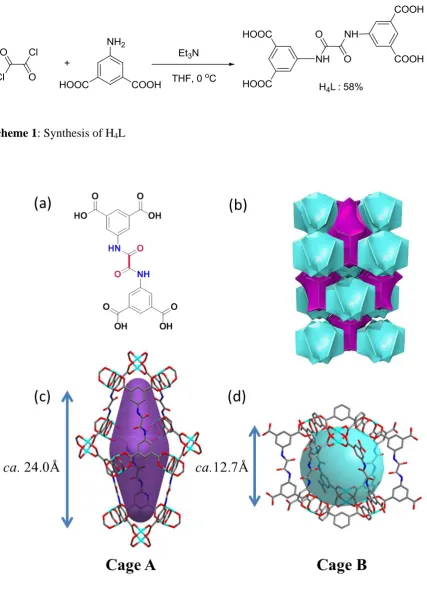
shows fof topology, which can be viewed as the packing of two types of cages (Cage A and
Cage B) in 3-dimensional space. Cage A is constructed by twelve {Cu2(OOCR)4}
paddlewheels and six linkers to form an ellipsoid-shaped cavity approximately 24.0 Å along
its long axis and 9.6 Å across the central diameter. Cage B consists of six {Cu2(OOCR)4}
units and twelve linkers with a spherical diameter of 12.7 Å taking into account the van der
Waals radii of the atoms. NOTT-125 incorporates oxamide functionality within the pore
walls, and this, combined with high porosity in the desolvated NOTT-125a, is responsible for
excellent CO2 uptake (40.1 wt% at 273 K and 1 bar) and selectivity for CO2 over CH4 or N2.
Grand canonical Monte Carlo (GCMC) simulations show excellent agreement with the
experimental gas isotherm data, and a computational study into the specific interactions and
binding energies of both CO2 and CH4 with the linkers in NOTT-125 reveals a set of strong
Introduction
Metal-organic frameworks (MOFs) show great promise for applications in gas storage
and separation because these crystalline, porous materials can demonstrate exceptionally high
internal surface areas and tunable functional pore environments.[1] Notably, CO2 storage in
MOFs[2] compares extremely favourably with other classes of porous materials such as
zeolites, activated carbon and silica.[3] Great efforts have been focused on enhancing the
binding affinity and selectivity of MOFs towards CO2, and several strategies have been
reported to enhance gas storage.[4] The shape, size and chemical environment of the pores
within a MOF play significant roles in gas storage capacity, specificity and separations.[1d,5]
The physical characteristics of pore volume and surface area have been shown to correlate
strongly with the high pressure (>20 bar) CO2 uptake in MOFs, with physisorption
dominating, while the strength of gas-framework interactions correlates strongly with the low
pressure (<1 bar) CO2 uptake of a framework.[6] The primary approaches to controlling the
chemical characteristics of the pores and hence the strength of the gas-framework interaction
are via modification of the ligands either by incorporating functional groups prior to the
formation of MOFs or by postsynthetic modification in which functional groups such as
-NH2, -OH or -CHO moieties are generated within the frameworks.[3c,6-10] Nitrogen-containing
groups or open metal sites accessible within the pores can improve CO2 affinity via
dipole-quadrupole interactions with the CO2 molecules.[11-14] We recently described the material
NOTT-122 incorporating triazole groups which displays a high adsorption capacity for CO2
and used a computational approach to investigate the specific interactions between CO2 and
the framework linker heteroatoms.[15] Similarly, Zaworotko et al. have reported MOFs[16]
containing amide functional groups in the linkers, whereby linking of three isophthalates
Our general approach has been based on the use highly symmetric polydentate
carboxylate ligands to construct porous coordination polymers which demonstrate excellent
gas uptake and selectivity.[19-21] We describe herein the synthesis and gas uptake properties of
NOTT-125, an amide-containing MOF primarily distinguished by the ‘double amide’
[-NHC(O)C(O)NH)-] oxamide motif within the bridging ligand L4- (H4L =
oxalylbis(azanediyl)diisophthalic acid) whereby two back-to-back amides comprise the
bridge between two isophthalate groups. This linker connects {Cu2(OOCR)4} paddlewheels
to form a MOF of fof topology [Fig. 1] in which the oxamide is incorporated and placed
within the pore walls. NOTT-125 exhibits a high surface area and excellent CO2 uptake
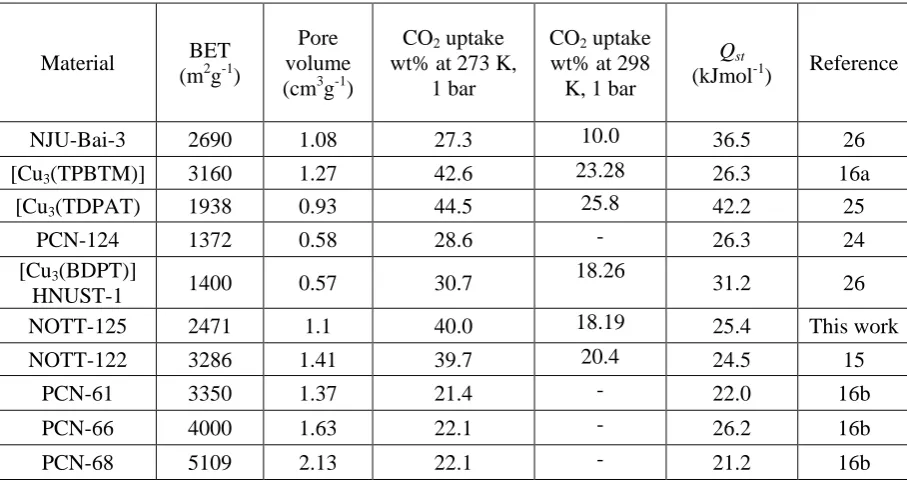
(40.1% at 1 bar, 273 K). To the best of our knowledge NOTT-125 displays the third highest
reported CO2 uptake in a MOF [Table 1] and shows significant selectivity for CO2vs both N2
and CH4. Importantly, grand canonical Monte Carlo (GCMC) simulations of the isotherms
show excellent agreement with the experimental data, and a computational study into the
specific interactions and binding energies of both CO2 and CH4 with the linkers reveals a set
of strong interactions between CO2 and the oxamide motif which are not possible with only a
single amide. This is the first time that we are aware of that the oxamide motif has been
employed within a MOF design.
Results and Discussion
H4L was synthesised in high yield by reaction of oxalyl chloride and
5-aminoisophthalic acid in tetrahydrofuran (THF) [Scheme 1]. The solvothermal reaction of
H4L and Cu(NO3)2.3H2O in N,N-dimethylacetamide (DMA):water (6:1) under acidic (HBF4)
conditions yielded blue crystals of [Cu2(H2O)2L].4H2O.2DMA in 70% yield. We find that
DMA is a better solvent than DMF in this reaction and leads to the formation of more
solvents and was characterised by single crystal diffraction, powder X-ray diffraction,
elemental analysis and thermogravimetric analysis. A single crystal structure determination
reveals that NOTT-125 crystallises in monoclinic cell with a = 27.9161(6) Å, b = 18.6627(4)
Å and c = 32.3643(8) Å, space group P2 (1)/c. The three-dimensional porous framework
hosts DMA and H2O solvent molecules. Two Cu(II) cations are bridged by four carboxylate
groups, distributed around the Cu-Cu axis, to form a {Cu2(OOCR)4} paddle-wheel node with
structure extended by the bridging L4- linkers to form a porous 3-D structure (Fig. S2). The
overall structure of NOTT-125 has fof topology[22] which can be viewed as the packing of
two types of cages (Cage A and Cage B) in 3-dimensional space [Fig. 1]. Cage A is
constructed by twelve {Cu2(OOCR)4} paddlewheels and six linkers to form an
ellipsoid-shaped cavity approximately 24.0 Å along its long axis and 9.6 Å across the central diameter.
Cage B consists of six {Cu2(OOCR)4} units and twelve linkers with a spherical diameter of
12.7 Å taking into account the van der Waals radii of the atoms. It is worth noting that the
structure is densely decorated with amide functionalities that are directly exposed in both
cages. There are two types of pore window between cages A and B. The smaller window is
an equilateral triangle whose vertices are occupied by {Cu2(COO)4} paddlewheels with a
distance of 9.3 Å between their centroids. The larger window takes the shape of an isosceles
triangle(13.9 × 13.9 × 9.3 Å) constructed by two linkers and one isophthalate unit.
The total accessible volume of NOTT-125 after removal of the guest and coordinated
water molecules is estimated to be 71% using the PLATON/VOID routine[23] and the
calculated density of the desolvated framework is 0.672 g/cm3. NOTT-125 shows thermal stability up to 280 oC by thermogravimetric analysis (TGA) [Fig. S3], and the phase purity of
the bulk sample was confirmed by powder X-ray diffraction (PXRD) [Fig. S4]. The fully
desolvated framework NOTT-125a was prepared by soaking the sample in acetone for five
indicates that the framework structure of NOTT-125a retains crystallinity and remains intact
on activation [Fig. S4]. All subsequent analyses described below were performed on the
activated NOTT-125a.
The permanent porosity of activated NOTT-125a was confirmed by gas adsorption
measurements. The N2 sorption isotherm for NOTT-125a at 77 K exhibits reversible type-I
adsorption behaviour characteristic of a microporous material [Fig. S5]. The
Brunauer-Emmett-Teller (BET) surface area was measured as 2447 m2 g-1 [Fig. S6] based upon the N2
sorption isotherm, and the calculated total pore volume of NOTT-125a is 1.1 cm3 g-1. The
pore size distribution (PSD) was calculated according to the N2 isotherm using non-local
density functional theory (NLDFT) implementing a hybrid kernel based on a zeolite–silica
model containing cylindrical pores. The PSD was found to lie in the range 10−13 Å [Fig. S7],
consistent with the single crystal structure determination.
The gravimetric CH4 sorption isotherms for NOTT-125a were recorded up to 1 bar at
273 and 298 K, both isotherms showing type-I behaviour with good reversibility and a
moderate total uptake of CH4 of 2.10 wt% (1.31 mmol g-1) and 1.34 wt% (0.837 mmol g-1),
respectively. By comparison, the related amide-containing PCN-124 framework described by
Zhou et al. shows CH4 uptake of 2.33 wt% at 273 K.[24] At 20 bar NOTT-125 shows a CH4
uptake of 20.4 wt % [192 cm3/cm3(STP), STP: standard temperature and pressure] at 273 K
and 15.1 wt % [142.1 cm3/cm3] at 298 K [Fig. 4]. The isosteric heat of CH4 adsorption was
found by virial analysis to be 14.5 kJ mol-1 at zero surface coverage [Fig. S10].
Combined with the large pore volume, the oxamide groups in the pore walls were
expected to enhance uptake of CO2 in the framework and indeed this is evident in the low
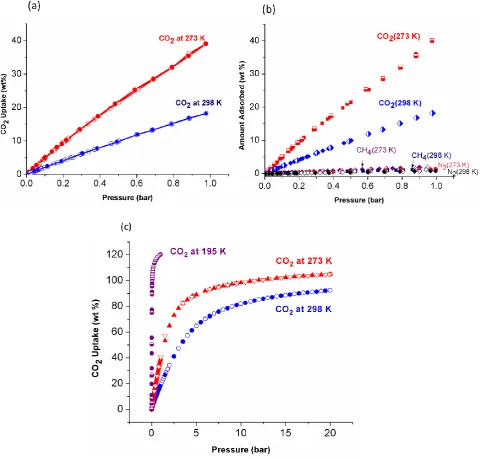
pressure (up to 1 bar) isotherms recorded at 273 and 298 K. Both isotherms are completely
reversible and show no hysteresis. At 273 K, the total uptake reaches 40.1 wt% (9.09 mmol g
-1
-1
) [Fig. 2]. The total CO2 uptake is approaching the highest reported values for MOFs such as
Cu-TDPAT[25] (44.5 wt%, 273 K, 1 bar) and Cu-TPBTM[16a] (42.6 wt%, 273 K, 1 bar) and a
comparison with a range of relevant MOFs is presented in Table 1. Significantly, in
comparison with the related amide-functionalised MOF Cu-NJU-Bai3,[26] NOTT-125a shows
higher CO2 uptake at 1 bar (NJU-Bai3: 27.32 wt%, 6.21 mmol g-1, 273 K) and also higher
uptake under the same conditions than the amide functionalised MOF PCN-124[24] (28.6 wt%,
6.5 mmol g-1, 273 K). NOTT-125a also shows a high CO2 uptake of 21.2 mmol g-1 at 298 K
and 20 bar [Fig. 3].
The excellent uptake of CO2 observed in the low pressure isotherms is consistent with
the presence of specific CO2-amide interactions. There are several potential interactions that
can be proposed including dipole-quadrupole interactions of the type described above[11-14]
and hydrogen-bond formation between the amide NH and the oxygens of CO2.[16] To better
understand these observations, the isosteric heat (Qst) of adsorption of CO2 was calculated by
fitting the CO2 sorption isotherms at 273 K and 298 K to a virial-type equation. The isosteric
heat is estimated to be 25.35 kJ mol-1 at zero surface coverage.
The marked difference in CH4 and CO2 adsorption isotherms encouraged us to
examine the capability of NOTT-125a for selective capture of CO2vs N2 and CO2vs CH4. To
evaluate the selective CO2 capture in NOTT-125a, CH4 and N2 sorption isotherms were
measured at 273 and 298 K [Fig. 2b] up to 1 bar. By determining the ratios of the Henry’s
law constants from single component isotherms,[27] the CO2/N2 adsorption selectivity factors
for NOTT-125a are 20.7:1 at 273 K and 16:1 at 298 K, further suggesting that the polar
amide functionalities have a positive effect on CO2 adsorption. Furthermore, NOTT-125a
also shows respectable CO2/CH4 selectivity of 9.2:1 at 273 K and 4.8:1 at 298 K.
Gravimetric H2 sorption measurements performed on NOTT-125a at 77 K and 87 K
H2 storage capacity of 2.30 % and 1.48 % respectively [Fig. 5]. The isosteric heats of
adsorption (Qst) for H2 were found to be 5.1 kJ mol-1 at zero surface coverage.
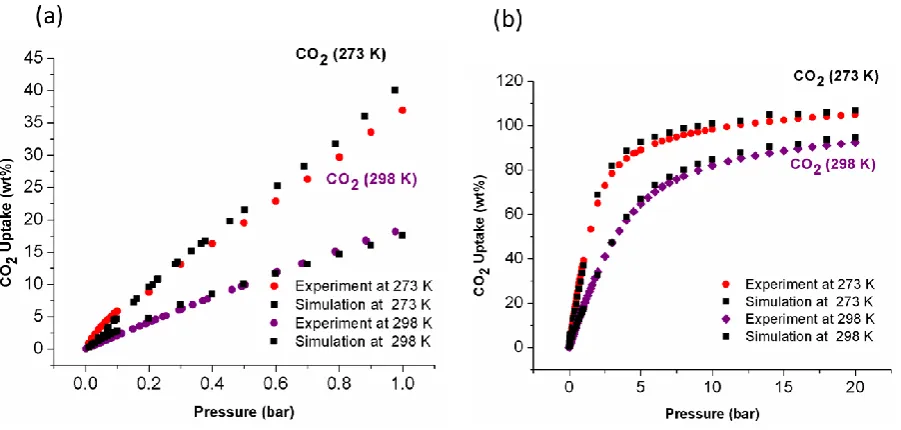
Grand canonical Monte Carlo (GCMC) calculations were performed to simulate the
adsorption of both CO2 and CH4 in NOTT-125a. Figures 3 and 4 show simulated isotherms
for CO2 and CH4 uptake in NOTT-125a, and these are in excellent agreement with the
experimentally measured isotherms. To understand further the relevant adsorption
mechanisms of the CH4 and CO2 molecules to the linkers of NOTT-125a at a molecular level,
second order Møller-Plesset perturbation theory (MP2) as implemented in the Q-Chem
quantum chemistry package[28] was employed. We analysed the strength of two preferential
adsorption sites in the linker: one formed by two amide -CONH- groups (highlighted blue in
Fig. 6) and the other being the phenyl ring (highlighted red in Fig. 6). We calculated the
binding energies (BE) between the guest molecule and the linker as well as their relative
positions corresponding to the strongest binding. For the interactions of CH4 and CO2 with
the oxamide part of the linker, the calculations were performed in two-stages in both cases.
For CH4, the geometry optimization was carried out using DFT calculations at the B3LYP/
6-31G** level of theory and the binding energies were subsequently calculated at the higher
B3LYP /6-311++G** level with BE = Eopt(complex) - Eopt(linker) - Eopt(guest molecule). For
CO2, the geometry optimization was first performed at the MP2/cc-pvdz level of theory and
the binding energies were subsequently calculated at the higher MP2/cc-pvqz level. Binding
energies were corrected for the basis set superposition error (BSSE), and the stable
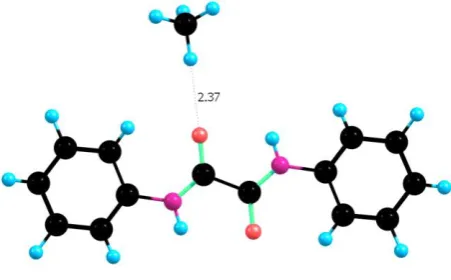
configuration identified for the CH4 molecule and linker is shown in Fig. 7. The distance
between H(CH4) and O(amide) is less than the sum of their van der Waals radii, with the
binding energy E = -5.57 kJ/mol characterized by a hydrogen bond-like interaction, C(CH4)-
We performed an extensive search for CO2 binding sites and several configurations
showing the strongest binding are summarised in Tables 2 and 3. The strongest binding of
CO2 to the linker was found to be in complexes A and B in which the guest CO2 molecule
interacts with the linker in a side on fashion and having binding energies of -19.7 kJ/mol and
-16.2 kJ/mol, respectively. In complex A the interaction is dominated by a strong hydrogen
bond (2.30 Å) formed between the electronegative oxygen of CO2 and hydrogen of the amide
group. This interaction is further enhanced by both the electrostatic attraction between the
carbon of CO2 and the electronegative oxygen of the linker, and a weak C-O···H-C(aromatic)
interaction which can be regarded as as a weak hydrogen bond.[29] All these interactions have
a significant cooperative effect on the overall binding of CO2 to this polyamide core.
Complex B corresponds to an in-plane T-shape orientation of CO2 and the C-O bond of one
of the amide groups of the linker. The electrostatic interaction between carbon of CO2 and
oxygen in the linker is somewhat stronger in this configuration compared to complex A.
Complex C (BE = -14.92 kJ/mol) is stabilised by two hydrogen bonds N-H
···
O1(CO2) andN-H
···
O2(CO2), thus having one donor and two acceptors. The N-H···
O1(CO2) angle of129.69o is fairly close to the ideal value of 120o, which may explain the relatively high value
of the binding energy. Similarly, a hydrogen bond-like interaction C-H
···
O1(CO2) (thecorresponding angle is 125.42o) and an electrostatic interaction between carbon of CO2 and
oxygen in the linker are also present.
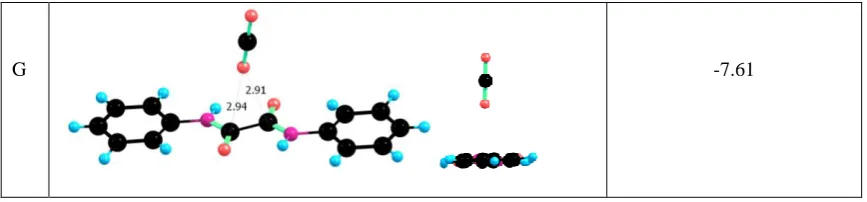
Complexes D-G correspond to the CO2 molecule being located above the oxamide
group. A relatively strong binding has been found when the CO2 molecule is located in a
‘bay’ formed by a phenyl ring and the amide group (complex D, BE = -13.04 kJ/mol).
Complex E (BE = -12.67 kJ/mol) highlights the importance of coulombic interactions
between carbon dioxide and the linker, in which the carbon of CO2 is located directly above
Complex F (BE = -10.25 kJ/mol) shows CO2 positioned above the N-C bond, between the
phenyl ring and an amide group. The least favourable binding site is found to be dimer G (BE
= -7.61 kJ/mol) where the CO2 molecule is located approximately mid-way between the
carbons of the C-C bond between the two amide groups, but even this binding energy is
stronger than that found for methane binding described above.
Finally, we compared the interactions of the CO2 molecule with the oxamide part of
the linker against those of CO2 and solely the phenyl group (blue in Fig. 6), which has been
replaced by a benzene ring. As this complex is somewhat smaller, more accurate calculations
were undertaken in which both geometry optimization and the BSSE-corrected binding
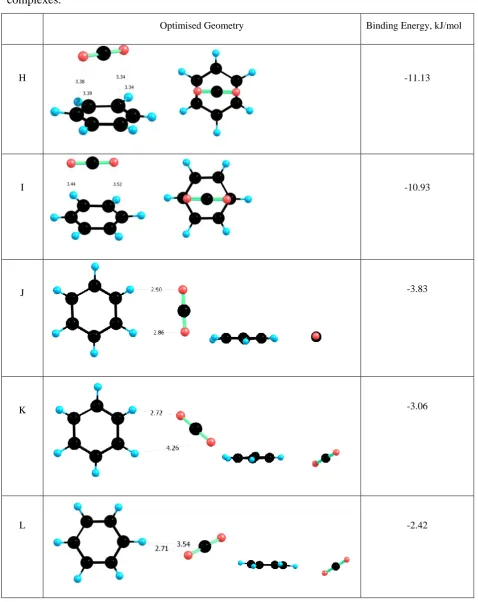
energies were obtained directly at the MP2/cc-pvqz level of theory. Five stable configurations
of the CO2 molecule and benzene ring are presented in Table 4. The strongest interaction
corresponds to the cases where the carbon atom of CO2 is located directly above the middle
of the benzene ring (complexes H and I). In the case of complex H (BE = -11.13 kJ/mol) the
oxygen atoms of CO2 are above the middle of two C-C bonds of the benzene ring, and the
distances between the oxygenatoms of CO2 and the nearest carbon atoms in the benzene ring
are in the range of 3.34 Å to 3.39 Å. In complex I (BE = -10.54 kJ/mol), the oxygen atoms of
CO2 are above the carbon atoms of the benzene ring and the corresponding separation is
slightly greater, being in the range of 3.44 Å to 3.52 Å. The predicted values of the binding
energies are in excellent agreement with previous calculations.[30] The remaining three
configurations (complexes J-L) are far less stable (BE in the range of -2 kJ/mol to -4 kJ/mol)
and these correspond to the orientations in which where CO2 interacts side-on with the
benzene ring.
Our calculations confirm that the oxamide part of the linker provides a variety of
strong binding sites for CO2 molecules with the values for the binding energy being
clear preferential binding region in NOTT-125a. These binding modes are clearly not
accessible in frameworks containing only single amides in their linkers. Additionally, in
contrast to the CO2−oxamide interactions, the binding identified between NOTT-125a and
CH4 is dependent on the presence of only one of the amide groups of the linker. The
selectivity of NOTT-125a for CO2 over CH4, therefore, seems likely to be strongly influenced
by the presence of this previously under-investigated oxamide motif.
Conclusions
In conclusion, we have successfully constructed a new highly porous fof type Cu(II)
paddlewheel porous material, the first reported example of a MOF containing the oxamide
functional group. Two types of cage exist within NOTT-125, both of which are bounded by
the oxamide functionality. The large pore volume and functionalised pores are responsible for
NOTT-125a exhibiting high CO2 gas storage capacity and selectivity of CO2 uptake over N2
and CH4. GCMC simulations of the gas uptake isotherms show excellent agreement with the
experimental data and our computational studies of the binding modes of CH4 and CO2 in
NOTT-125a has identified a variety of strong binding sites for CO2, which are only possible
with the oxamide functionality.
Experimental
Commercially available reagents were used as received without further purification.
Elemental analyses (C, H, and N) were performed on a CE-440 elemental analyzer at the
University of Nottingham. IR spectra were recorded in the range of 550−4000 cm−1 on a
Nicolet i5 FT-IR spectrophotometer using the attenuated total reflectance (ATR) mode. 1H
NMR spectra were recorded on a Bruker DPX-300 spectrometer. Thermal gravimetric
1 °C/min using a TA SDT-600 thermogravimetric analyzer. X-ray Powder Diffraction
(PXRD) measurements were carried out at room temperature on a PANalytical X’Pert PRO
diffractometer using Cu-Kα radiation (λ = 1.5418 Å) at 40 kV, 40 mA, at a scan speed of
0.02°/s and a step size of 0.005° in 2θ.
N2, H2 and CO2 Isotherms. N2, H2 and CO2 isotherms were determined using an IGA
gravimetric adsorption apparatus (Hiden) at the University of Nottingham in a clean ultra
high vacuum system with a diaphragm and turbo pumping system. Before measurements,
about 120 mg of solvent-exchanged sample was loaded into the sample basket within the
adsorption instrument and then degassed under dynamic vacuum at 100 °C for 16 h to obtain
the fully desolvated samples.
Synthesis of H4L: A solution of 5-aminoisophthalic acid (6.53 g, 34.2 mmol) in anhydrous
THF (50 mL) was cooled at 0˚C. A solution of oxalyl chloride (1.0 mL, 11.4 mmol) in
anhydrous THF (100 mL) was then added dropwise to the reaction mixture over a period of 1
h. and a precipitate formed almost immediately. Triethylamine (1.0 mL, 7.2 mmol) was
slowly added after 1 h. and the mixture was stirred overnight (~12 h) at room temperature.
The volume of solvent was partially reduced in the rotary evaporator and then 200 mL of 2M
HCl were added to the mixture. The precipitate was isolated by filtration and washed
extensively with water, recrystallised from methanol, filtered, washed with methanol and
diethyl ether, and dried under vacuum to afford a white powder (2.47 g, 58 % yield). 1H
NMR (300 MHz, DMSO-d6): δ (ppm) = 13.08 (s, 4H, COOH), 11.26 (s, 2H, NH), 8.72 (d, J
= 1.2 Hz, 4H, Ar-H), 8.26 (t, J = 1.2 Hz , 2H, Ar-H); 13C NMR (75 MHz, DMSO-d6): δ
(ppm) = 166.81, 159.24, 138.80, 132.30, 126.43, 125.68 ; ATR FT-IR: (cm-1) = 3227 (m),
2158 (w), 1974 (w), 1716(s), 1681(s), 1653(s), 1558 (m), 1540 (s), 1456 (m), 1387 (s), 1275
439.0403 (M+Na)+, 434.0838 (M+H4N)+, 415.0401 (M-H)-. Anal. Calcd (Found) for
C18H12N2O10: C, 51.93 (51.47); H, 2.98 (3.05); N, 6.73 (6.56).
Synthesis of NOTT-125, [Cu2(C18H12O10N2](H2O)2]•2DMA•4H2O. H4L (0.03 g, 0.081
mmol) and Cu(NO3)2•3H2O (0.06 g, 0.516 mmol) were added to a DMA:H2O solvent (9:2,
5.5 ml). HBF4 (50% in H2O, 0.2 mL) was added and the solution thoroughly mixed. The
solution was heated without stirring at 70 oC using an oil bath for 48 h and a large amount of
microcrystalline product precipitated. The blue crystalline product was separated by filtration,
washed with warm DMA and dried briefly in air. Yield: 0.15 g (60%). Anal. Calcd (Found)
for C26H38Cu2N4O18: C, 38.00 (39.10); H, 4.60 (4.82); N, 6.82 (6.85).
Crystallographic data have been deposited with the Cambridge Crystallographic Data Centre
as supplementary publications CCDC 965874 for NOTT-125. Supporting information
includes additional views of the crystal structures, TGA and PSD analysis, PXRD, technical
details for gas adsorption experiments and gas isotherms.
Acknowledgements
We thank the EPSRC and the University of Nottingham for support and funding. MS
gratefully acknowledges receipt of an ERC Advanced Grant, and EB for an ERC Starter
Grant. NHA thanks the Royal Commission for Jubail and Yanbu, Jubail University College,
Kingdom of Saudi Arabia for a PhD Fellowship, CPK thanks Conacyt, Mexico for funding,
References:
[1] (a) H. Furukawa, N. Ko, Y. B. Go, N. Aratani, S. B. Choi, E. Choi, A.Ö. Yazaydin, R. Q.
Snurr, M. O'Keeffe, J. Kim, O. M. Yaghi, Science2010,329, 424-428; (b) O. K. Farha, A. Ö.
Yazaydin, I. Eryazici, C. D. Malliakas, B. G. Hauser, M. G. Kanatzidis, S. T. Nguyen, R. Q.
Snurr, J. T. Hupp, Nat. Chem.2010, 11, 944-948; (c) J.-R. Li, J. Sculley, H.-C. Zhou, Chem.
Rev. 2012, 112, 869-932; (d) K. Koh, A. G. Wong-Foy, A. J. Matzger, J. Am. Chem. Soc.
2009, 131, 4184-4185; (e) S. Yang, X. Lin, A. J. Blake, G. S. Walker, P. Hubberstey, N. R.
Champness, M. Schröder, Nat. Chem. 2009, 1, 487-493; (f) X. Lin, J. Jia, X. B. Zhao, K. M.
Thomas, A. J. Blake, N. R. Champness, P. Hubberstey, M. Schröder, Angew. Chem., Int. Ed.
2006, 45, 7358-7364; (g) X. Lin, J. Jia, P. Hubberstey, M. Schröder, N. R. Champness,
CrystEngComm2007, 9, 438-448.
[2] (a) J. Liu, P. K. Thallapally, B. P. McGrail, D. R. Brown, J. Liu, Chem. Soc. Rev. 2012,
41, 2308−2322; (b) D. M. D'Alessandro, B. Smit, J. R. Long, Angew. Chem., Int. Ed. 2010,
49, 6058-6082; (c) A. R. Millward, O. M. Yaghi, J. Am. Chem. Soc.2005, 127, 17998-17999.
[3] (a) Z. Zhang, Y. Zhao, Q. Gong, Z. Li, J. Li, ChemComm.2013, 49, 653-661; (b) J-R. Li,
Y. Ma, M. C. McCarthy, J. Sculley, J. Yu, H-K. Jeong, B.Balbuena, H-C. Zhou, Coord.
Chem. Rev. 2011, 255, 1791-1823; (c) K. Sumida, D. L. Rogow, J. A. Mason, T. M.
McDonald, E. D. Bloch, Z. R. Herm, T.-H. Bae, J. R. Long, Chem. Rev.2012, 112, 724-781
[4] (a) W. Yang, A. J. Davies, X. Lin, M. Suyetin, R. Matsuda, A. J. Blake, C. Wilson, W.
Lewis, J. E. Parker, C. C. Tang, M. W. George, P. Hubberstey, S. Kitagawa, H. Sakamoto, E.
Bichoutskaia, N. R. Champness, S. Yang, M. Schröder, Chem. Sci.2012, 3, 2993-2999; (b) S.
Yang, X. Lin, W. Lewis, M. Suyetin, E. Bichoutskaia, J. Parker, C. C. Tang, D. R. Allan, P.
J. Rizkallah, P. Hubberstey, N. R. Champness, K. M. Thomas, A. J. Blake, M. Schröder, Nat.
David, D. Anderson, R. Newby, A. J. Blake, J. E. Parker, C. C. Tang, M. Schröder, Nat.
Chem. 2012, 4, 887-894.
[5] (a) D. M. D'Alessandro, B. Smit, J. R. Long, Angew. Chem. Int. Ed. 2010, 49, 6058-6082;
(b) A. R. Millward, O. M. Yaghi, J. Am. Chem. Soc. 2005, 127, 17998-17999; (c) L. J.
Murray, M. Dincă, J. R. Long, Chem. Soc. Rev.2009, 38, 1294-1314; (d) H. Furukawa, M. A.
Miller, O. M. Yaghi, J. Mater. Chem.2007, 17, 3197-3204.
[6] (a) X. Lin, N. R. Champness, M. Schröder, Top. Curr. Chem. 2010, 293, 35-76; (b) X.
Lin, J. Jia, P. Hubberstey, M. Schröder, N. R. Champness, CrystEngComm2007, 9, 438-448;
(c) L. J. Murray, M. Dincă, J. R. Long, Chem. Soc. Rev. 2009, 38, 1294-1314.
[7] Y. Zhao, H. Wu, T. J. Emge, Q. Gong, N. Nijem, Y. J. Chabal, L. Kong, D. C. Langreth,
H. Liu, H. Zeng, J. Li, Chem. Eur. J.2011, 17, 5101-5109.
[8] X. Si, C. Jiao, F. Li, J. Zhang, S. Wang, S.Liu, Z. Li, L. Sun, F. Xu, Z.Gabelica, C.Schick,
Energy Environ. Sci. 2011, 4, 4522-4527.
[9] C. Zlotea, D. Phanon, M. Mazaj, D. Heurtaux, V. Guillerm, C. Serre, P. Horcajada,
T.Devic, E.Magnier, F. Cuevas, G. Férey, P. L. Llewellyn, M. Latroche, Dalton Trans. 2011,
40, 4879-4881.
[10] A. Demessence, D. M. D’Alessandro, M. L. Foo, J. R. Long, J. Am. Chem. Soc. 2009,
131, 8784-8786.
[11] (a) R. Vaidhyanathan, S. S. Iremonger, K. W. Dawson, G. K. H. Shimizu, ChemComm.
2009, 5230-5232; (b) S. Couck, J. F. M. Denayer, G. V. Baron, T. Remy, J. Gascon, F.
Kapteijn, J. Am. Chem. Soc.2009, 131, 6326-6327.
[12] F. Debatin, A. Thomas, A. Kelling, N. Hedin, Z. Bacsik, I. Senkovska, S. Kaskel, M.
Junginger, H. Müller, U. Schilde, C. Jager, A. Friedrich, H.-J. Holdt, Angew. Chem., Int. Ed.
2010, 49, 1258-1262.
[14] B. Arstad, H. Fjellvåg, K. Kongshaug, O. Swang, R. Blom, Adsorption 2008, 14,
755-762.
[15] Y. Yan, M. Suyetin, E. Bichoutskaia, A. J. Blake, D. R. Allan, S. A. Barnett, M.
Schröder, Chem. Sci.2013, 4, 1731-1736.
[16] (a) B. Zheng, J. Bai, J. Duan, L. Wojtas, M. J. Zaworotko, J. Am. Chem. Soc. 2011, 133,
748-751; (b) a) D. Q. Yuan, D. Zhao, D. F. Sun, H-C. Zhou, Angew. Chem. Int. Ed. 2010, 49,
5357-5361
[17] B. Chen, S. Xiang, G. Qian, Acc. Chem. Res.2010, 43, 1115-1124.
[18] P. D. C. Dietzel, V. Besikiotis, R. Blom, J. Mater. Chem. 2009, 19, 7362-7370.
[19] M. Dincă, J. R. Long, Angew. Chem. Int. Ed. 2008, 47, 6766-6779.
[20] (a) X. Lin, I. Telepeni, A. J. Blake, A. Dailly, C. Brown, J. Simmons, M. Zoppi, G. S.
Walker, K. M. Thomas, T. J. Mays, P. Hubberstey, N. R. Champness, M. Schröder, J. Am.
Chem. Soc. 2009, 131, 2159-2171; (b) Y. Yan, X. Lin, S. Yang, A. J. Blake, A. Dailly, N. R.
Champness, P. Hubberstey, M. Schröder, Chem.Comm. 2009, 1025-1027; (c) Y. Yan, I.
Telepeni, S. Yang, X. Lin, W. Kockelmann, A. Dailly, A. J. Blake, W. Lewis, G. S. Walker,
D. R. Allan, S. A. Barnett, N. R. Champness, M. Schröder, J. Am. Chem. Soc. 2010, 132,
4092-4094; (d) Y. Yan, A. J. Blake, W. Lewis, S. A. Barnett, A. Dailly, N. R. Champness, M.
Schröder, Chem.–Eur. J.2011, 17, 11162-11170.
[21] Y.Yan, S. Yang, A. J. Blake, W. Lewis, E. Poirier, S. A. Barnett, N. R. Champness, M.
Schröder, ChemComm.2011, 47, 9995-9997.
[22] (a) M. O’Keeffe and O. Yaghi, Chem. Rev. 2012, 112, 675-702; (b) Z. Wang, B. Zheng,
H. Liu, X. Lin, X. Yu, P. Yi, R. Yun, Cryst. Growth Des. 2013, in press. DOI:
10.1021/cg401180r.
[24] J. Park, J.-R. Li, Y.-P. Chen, J. Yu, A. A. Yakovenko, Z. U. Wang, L.-B. Sun, P. B.
Balbuena, H.-C. Zhou, ChemComm.2012, 48, 9995-9997.
[25] (a) B. Li, Z. Zhang, Y. Li, K. Yao, Y. Zhu, Z. Deng, F. Yang, X. Zhou, G. Li, H. Wu, N.
Nijem, Y. J. Chabal, Z. Lai, Y. Han, Z. Shi, S. Feng, J. Li , Angew. Chem. Int. Ed. 2012, 51,
1412-1415. (b) R. Luebke, J. F. Eubank, A. J. Cairns, Y.Belmabkhout, L. Wojtas, M.
Eddaoudi, ChemComm.2012, 48, 1455-1457.
[26] (a) B. Zheng, H. Liu, Z. Wang, X. Yu, P. Yi, J. Bai, CrystEngComm 2013, 15,
3517-3520; (b) B. Zheng, Z. Yang, J. Bai, Y. Li, S. Li, ChemComm. 2012, 48, 7025-7027; (c) J.
Duan, Z. Yang, J. Bai, B. Zheng, Y. Li, S. Li, ChemComm. 2012, 48, 3058-3060; (d) Z. Lu,
H. Xing, R. Sun, J. Bai, B. Zheng, Y. Li, Cryst. Growth Des.2012, 12, 1081-1084.
[27] M. S. Sun, D. B. Shah, H. H. Xu, O. Talu, J. Phys. Chem. B1998, 102, 1466-1473.
[28] A. Gupta, S. Chempath, M. J. Sanborn, L. A. Clark, R. Q. Snurr, Mol. Simul.2003, 29,
29-46.
[29] (a) G.R. Desiraju, T. Steiner, The weak hydrogen bond: in structural chemistry and
biology. Oxford: Oxford University Press, 1999; (b) G.R. Desiraju, Acc. Chem. Res. 1991,
24, 290-296; (c) S. Varughese, S. M. Drapper, Cryst. Growth Des.2010, 10, 2298-2305.
[30] S.S. Han, D. Kim, D. H. Jung, S. Cho, S. –H. Choi,Y. J. Jung, J. Phys. Chem. C. 2012,
Figures,Tables and Schemes
Scheme 1: Synthesis of H4L
Figure 1: View of (a) chemical structure of H4L; (b) a natural tiling of NOTT-125; (c) Cage
Table 1: Surface area, CO2 uptake and Qst values for selected MOFs.
Material BET
(m2g-1)
Pore volume (cm3g-1)
CO2 uptake wt% at 273 K,
1 bar
CO2 uptake wt% at 298
K, 1 bar
Qst
(kJmol-1) Reference
NJU-Bai-3 2690 1.08 27.3 10.0 36.5 26
[Cu3(TPBTM)] 3160 1.27 42.6 23.28 26.3 16a
[Cu3(TDPAT) 1938 0.93 44.5 25.8 42.2 25
PCN-124 1372 0.58 28.6 - 26.3 24
[Cu3(BDPT)]
HNUST-1 1400 0.57 30.7
18.26
31.2 26
NOTT-125 2471 1.1 40.0 18.19 25.4 This work
NOTT-122 3286 1.41 39.7 20.4 24.5 15
PCN-61 3350 1.37 21.4 - 22.0 16b
PCN-66 4000 1.63 22.1 - 26.2 16b
Figure 2 a)CO2 sorption isotherms of NOTT-125a at 273 K and 298 K up to 1 bar; b) CO2,
CH4 and N2 sorption isotherms for NOTT-125a at 273 and 298 K up to 1 bar and c) CO2
Figure 3 a)Experimental and simulatedCO2 isotherms of NOTT-125a at 273 K and 298 K in
the pressure range 0-1 bar; b) Experimental and simulatedCO2 isotherms of NOTT-125a at
273 K and 298 K up to 20 bar.
Figure 4: a)Experimental and simulatedCH4 isotherms of NOTT-125a at 273 K and 298 K
in the pressure range 0- 1 bar; b) Experimental and simulatedCH4 isotherms of NOTT-125a
Figure 5: a)H2 isotherms of NOTT-125a at 77 K and 87 K up to 1 bar; b) N2 isotherms of
NOTT-125a at 273 K and 298 K up to 1 bar.
Figure 6: Two adsorption sites for CO2 on the NOTT-125a linker examined by the
[image:22.595.194.415.427.543.2]Table 2: The optimised MP2/cc-pvdz geometries and MP2/cc-pvqz binding energies of
C14H12N2O2 - CO2 complexes.
Optimised Geometry Binding Energy, kJ/mol
A -19.66
B -16.17
C -14.92
D -13.04
E -12.67
G -7.61
Table 3: The structural details of the optimised configurations of C14H12N2O2 - CO2
complexes corresponding to the strongest binding energies as predicted by the MP2/cc-pvqz
level of theory.
Complex Type of interaction Distance, Å Angle, degree
O=C=O angle, degree
A
H-Bond N-H···O(CO2)
2.30 H···O(CO2)
164.59 N-H···O(CO2)
177.80 Weak H-Bond
C-H···O(CO2)
2.67 H···O(CO2)
142.93 C-H···O(CO2)
CO···C(CO2)
2.78 O···C(CO2)
150.00 C-O··· O(CO2)
B
H-Bond N-H···O(CO2)
3.05 NH···O(CO2)
175.29 N-H···O(CO2)
177.88 Weak H-Bond
C-H···O(CO2)
2.74 H···O(CO2)
164.87 C-H···O(CO2)
C-O···C(CO2)
2.74 O···C(CO2)
173.79 C-O··· O(CO2)
C
H-Bond N-H···O1(CO2)
2.46 H···O1(CO2)
129.69 N-H···O1(CO2)
178.59 H-Bond
N-H···O2(CO2)
3.49 H···O2(CO2)
102.26 N-H···O2(CO2)
Weak H-Bond C-H···O1(CO2)
2.82 H···O1(CO2)
125.42 C-H···O1(CO2)
C-O···C(CO2)
2.91 O···C(CO2)
106.17 C-O···O(CO2)
D C-H···O(CO2)
2.8 H···O(CO2)
44.7 C-H···O(CO2)
178.82 C-O···C(CO2)
2.97 CO···C(CO2)
74.01 C-O···C(CO2)
E C-O···C(CO2)
2.93 O···C(CO2)
92.17
CO···C(CO2) 178.56
O-C···O(CO2)
2.90 C···O(CO2)
86.93 OC···O(CO2)
F C-N··· C(CO2)
3.02 N··· C(CO2)
98.82
C-N··· C(CO2) 179.75
N-H···O(CO2)
2.98 H···O_CO2
98.32 N-H···O_CO2
G O-C1···O(CO2)
2.94 C1···O(CO2)
95.57
O-C1···O(CO2) 179.87
O-C2···O(CO2)
2.91 C2···O(CO2)
Table 4: The optimised MP2/cc-pvqz geometries and binding energies of C6H6- CO2
complexes.
Optimised Geometry Binding Energy, kJ/mol
H
-11.13
I
-10.93
J
-3.83
K -3.06
L
Supporting Information
Analysis of High and Selective Uptake of CO2 in an Oxamide-containing {Cu2(OOCR)4}
Based Metal Organic Framework
Nada H. Alsmail, Mikhail Suyetin, Yong Yan, Rafel Cabot, Cristina P. Krap, Jian Lü,
Timothy L. Easun, Elena Bichoutskaia, William Lewis, Alexander J. Blake and Martin
Schröder*
1. Spectroscopy
4000 3500 3000 2500 2000 1500 1000 500
H4L
T
ra
n
smi
tta
n
ce
(a
.u
.)
Wavenumber (cm-1)
[image:28.595.134.457.120.399.2]NOTT-125 As-synthesised
Figure S1. ATR-IR spectra of H4L and of as-synthesised NOTT-125.
2. Single Crystal X-ray Structure Determination on NOTT-125
Table S1. Crystal data and structure refinement details for NOTT-125
Identification code NOTT-125
Empirical formula C26 H38 Cu2 N4 O18
Formula weight 821.68
Temperature 120.01(10) K
Wavelength 1.54184 A
Crystal system, space group
Monoclinic, P 1 21/c 1
Unit cell dimensions
a = 27.9161(6) A alpha = 90 deg. b = 18.6627(4) A beta = 112.655(3) deg.
c = 32.3643(8) A gamma = 90 deg.
Volume
15560.4(6) A3
Z, Calculated density 12, 1.052 Mg/m3
Absorption coefficient 1.501 mm-1
F(000) 5088
Crystal size 0.1212 x 0.1047 x 0.0902 mm
Theta range for data collection 3.56 to 60.00 deg
Limiting indices -31<=h<=23,-20<=k<=20,-36<=l<=36
Reflections collected / unique 91238 / 23087 [R(int) = 0.0519]
Completeness to theta = 60.00 99.9 %
Absorption correction Gaussian
Max. and min. transmission
0.867 and 0.779
Refinement method Full-matrix least-squares on F2
Data / restraints / parameters 23087 / 0 / 919
Goodness-of-fit on F2 1.013
Final R indices [I>2sigma(I)]
R1 = 0.0772, wR2 = 0.2127
R indices (all data) R1 = 0.0916, wR2 = 0.2219
2.608 and -1.465 e.Å-3
Largest diff. peak and hole
Figure S2. View of structure of NOTT-125.
3. TGA analysis
[image:30.595.142.454.408.641.2]4. PXRD patterns
10 20 30 40
Simulation As-synthesised NOTT-125 Activated NOTT-125 In te ni st y
[image:31.595.144.453.113.376.2]2Theta (degree)
Figure S4. The PXRD patterns for NOTT-125. The activated sample was obtained by heating the acetone-exchanged sample at 100 oC under dynamic vacuum for 12 h.
5. BET surface area and pore size distribution
0.0 0.2 0.4 0.6 0.8 1.0
100 200 300 400 500 600 700 800 N2 a d s o rb ti o n ( cm
3 g -1 , ST
P
)
P/Po
Adsorption Dessorption
[image:31.595.172.431.492.717.2]0.07 0.08 0.09 0.10 0.11 0.12 0.13 0.08 0.09 0.10 0.11 0.12 0.13 0.14 0.15 0.16 0.17
Area = 2.447E+03 m²/g Slope = 1.434E+00 Y - Intercept = -1.049E-0 Correlation Coefficient = 0.999840 C = -1.356E+02
[image:32.595.170.414.93.292.2]1 /(W (Po /P)-1 )) P/Po
Figure S6. The BET plot derived from N2 uptake in NOTT-125ain the range (P/P0 = 0.07 – 0.13).
10 20 30
0.0 0.1 0.2 0.3 0.4 0.5 0.6 d v (cm
3 A -1 g -1 )
Pore width ()
[image:32.595.155.437.383.608.2]6. Heats of adsorption for CO2 in NOTT-125
The CO2 adsorption isotherms at 273 and 298 K were fitted to the virial equation (eq 3, virial method I):3
(1)
where P is the pressure, n is total amount adsorbed and A0, A1, A2 etc. are virial coefficients. The Henry’s Law constant is given by KH = exp(A0). The enthalpy of adsorption at zero coverage was determined from the relationship:
(2)
0.0010 0.0015 0.0020 0.0025 0.0030 0.0035 0.0040 0.0045 -16.98 -16.96 -16.94 -16.92 -16.90 -16.88 -16.86
CO2 298 K Linear Fit of B
ln
(n
/P)
n (mol/g)
Equation y = a + b* Adj. R-Squar 0.99605
Value Standard Erro B Intercept -16.8405 0.00143 B Slope -33.8027 0.59043
0.0010 0.0015 0.0020 0.0025 0.0030 0.0035 0.0040 0.0045 -17.00 -16.98 -16.96 -16.94 -16.92 -16.90 -16.88 -16.86 ln (n /P) n (mol/g) CO2 273 K
Linear Fit of B
Equation y = a + b* Adj. R-Squar 0.9985
[image:33.595.125.431.228.718.2]Value Standard Erro B Intercept -16.8306 0.00105 B Slope -40.5131 0.43507
Figure S9. Heat of adsorption of CO2 in NOTT-125a.
[image:34.595.155.443.431.639.2]7. CO2/N2 and CO2/CH4 Selectivities in NOTT-125a
The Henry’s Law selectivity for gas component i over j at a specific temperature was calculated based on Eq. 3
Sij = KHi/KHj (3)
The Henry’s Law constants for N2 and CH4 adsorption at 298 and 273 K were calculated directly from the adsorption isotherms.
0 20000 40000 60000 80000 100000 -0.05 0.00 0.05 0.10 0.15 0.20 0.25 0.30
N2 298 K
Henry's Law fitting
n
(mo
l g
-1 )
P (Pa)
Equation y = a + b* Adj. R-Squar 0.9999
Value Standard Erro mmol/g Intercept -0.02798 2.40902E-4 mmol/g Slope 3.09449E- 5.94643E-9
0 20000 40000 60000 80000 100000 -0.1 0.0 0.1 0.2 0.3 0.4 0.5
N2 273 K
Henry's Law fitting
n
(mo
l g
-1 )
P (Pa)
Equation y = a + b* Adj. R-Squar 0.99922
Value Standard Err
mmol/g Intercept -0.02216 0.00113
[image:35.595.168.404.242.693.2]mmol/g Slope 5.00521E- 2.74664E-8
0 20000 40000 60000 80000 100000 0.0 0.1 0.2 0.3 0.4 0.5 0.6 0.7 0.8
CH4 298 K Henry's Law fitting
n
(mo
l g
-1 )
P (Pa)
Equation y = a + b* Adj. R-Square 0.99986
Value Standard Error
mmol/g Intercept 0.0081 8.38021E-4
mmol/g Slope 1.69423E- 2.05945E-8
0 20000 40000 60000 80000 100000
0.0 0.1 0.2 0.3 0.4 0.5 0.6 0.7 0.8
CH4 273 K Henry's Law fitting
n
(mo
l g
-1 )
P(Pa)
Equation y = a + b* Adj. R-Square 0.99986
Value Standard Error
mmol/g Intercept 0.0081 8.38021E-4
[image:36.595.170.415.89.549.2]mmol/g Slope 1.32423E-6 2.05945E-8
8. H2 sorption isotherms and heats of H2 adsorption for NOTT-125a
0.0 0.2 0.4 0.6 0.8 1.0
0 50 100 150 200 250 300
H2 (87 K)
H2 (77 K)
H2 U p ta ke ( cm
3 g -1 )
[image:37.595.163.425.117.315.2]Pressure (bar)
Figure S13. H2 sorption isotherms for NOTT-125a at 77 and 87 K. wt% = 100(weight of adsorbed H2/weight of host material).
A virial-type expression4(eq4, virial method II) was used to fit the combined isotherm data at 77 and 87 K:
m i n j j j iiN b N
a T N P 0 0 / 1 ) ln( )
ln( (4)
Here, P is the pressure expressed in mbar, N is the amount adsorbed in mol/g, T is the temperature in K, ai and bj are Virial coefficients (temperature independent empirical parameters), and m and n
represent the number of coefficients. The equation was fitted using the R statistical software package.5 The values of the virial coefficients a0 through amwere then used to calculate the isosteric heat of
adsorption using the following equation:
m i i i st R a NQ
0
(5)
Figure S14. Heats of adsorption for H2 in NOTT-125a.
9. Grand Canonical Monte Carlo simulations
using the OPLS-AA force field.8 For oxygen and copper atoms present in NOTT-125a the modelling atomic parameters were taken from reference 9 where they were adjusted for a correct description of the interaction between guest CO2 molecules and the host MOF. The fugacity coefficients were calculated from the Peng-Robinson equation of state.10 Both the framework and guest molecules were assumed to be rigid. The Lennard-Jones potential was used to describe the Van der Waals interactions with a cut-off distance of 15.0 Å. For CH4 uptake, atom parameters of NOTT-125a structure were described by the DREIDING force field.11 The partial charges on atoms of NOTT-125a were computed using the CHELPG approach and the B3LYP/6-31G* level of density functional theory, as implemented in the Q-Chem quantum chemistry package.12
References:
1. G. M. Sheldrick, SHELXS97. Acta Crystallogr., Sect. A 2008, 64, 112–122. 2. A. L. Spek, Acta Crystallogr., Sect. D, 2009, 65, 148–155.
3. I. P. O’Koye, M. Benham, K. M. Thomas, Langmuir 1997, 13, 4054–4059. 4. J. Jagiello, T. J. Bandosz, J. A. Schwarz, Langmuir 1996, 12, 2837–2842.
5. Download, instructions, and further details on the use and capabilities of this software package are available online at http://www.r-project.org.
6. A. Gupta, S. Chempath, M. J. Sanborn, L. A. Clark, R. Q. Snurr, Mol. Simul. 2003, 29, 29–46. 7. J. J. Potoff, J. I. Siepmann, AIChE Journal , 2002, 47, 1676−1682.
8. W. L. Jorgensen, D. S. Maxwell and J. Tirado-Rives, J Am. Chem. Soc. 1996, 118, 11225-11236 9. Q. Yang and C. Zhong, J.Phys. Chem. B, 2006, 110, 2, 17776–17783.
10. D.-Y. Peng, D. B. Robinson, Ind. Eng. Chem. Fundamen. 1976, 15, 59–64.
11. S. L. Mayo, B. D. Olafson, W. A. Goddard III, J.Phys. Chem. 1990, 94, 8897−8909.