CITATION:Joseph Hedgecock , P.J. Standen , Charlotte Beer , David Brown , David S. Stewart , (2014) "Evaluating the role of a humanoid robot to support learning in children with profound and multiple disabilities", Journal of Assistive Technologies, Vol. 8 Iss: 3, pp.111 - 123
DOI http://dx.doi.org/10.1108/JAT-02-2014-0006
Evaluating the role of a humanoid robot to support learning in children with profound and multiple disabilities.
Author Details (please list these in the order they should appear in the published article)
Author 1 Name: Joseph Hedgecock Role: Medical Student
Department: Faculty of Medicine & Health Sciences University/Institution: University of Nottingham Town/City: Nottingham
Country: United Kingdom
Author 2 Name: PJ Standen
Role:Professor of Health Psychology and Learning Disabilities Department: Faculty of Medicine & Health Sciences
University/Institution: University of Nottingham Town/City: Nottingham
State (US only):
Country: United Kingdom
Author 3 Name: Charlotte Beer Role: Research and Teaching Fellow Department: Division of Psychiatry
University/Institution: Institute of Mental Health, University of Nottingham Town/City: Nottingham
State (US only):
Country: United Kingdom
Author 4 Name: David Brown
Department: School of Science and Technology University/Institution: Nottingham Trent University Town/City: Nottingham
State (US only):
Country: United Kingdom
Author 5 Name: David S Stewart Role: Headteacher
Department:
University/Institution: Oak Field School and Sports College Town/City: Nottingham
State (US only):
Country: United Kingdom
NOTE: affiliations should appear as the following: Department (if applicable); Institution; City; State (US only); Country.
No further information or detail should be included
Corresponding author: [PJ Standen]]
Corresponding Author’s Email: [email protected]
Please check this box if you do not wish your email address to be published
Acknowledgments (if applicable):
This research was completed as part of a BMedSci project at the University of Nottingham and received no external funding
Biographical Details (if applicable):
[Author 1 bio]
[Author 3 bio]
[Author 4 bio]
Structured Abstract:
Purpose To identify i) ways teachers might employ a robot to achieve learning objectives with pupils with intellectual disabilities and ii) potential outcome measures.
Design/methodology/approach
A series of five case studies where teacher-pupil dyads were observed during five planned video recorded sessions with a humanoid robot. Engagement was rated in a classroom setting and during the last session with the robot. Video recordings were analysed for duration of engagement, teacher assistance and number of goals achieved.
Results
Teachers identified a wide range of learning objectives ranging from an appreciation of cause and effect to improving the pupil’s sense of direction. The robot’s role could be to reward behaviour, provide cues or provide an active element to learning. Rated engagement was significantly higher with the robot than in the classroom.
Research implications
A robot with a range of functions that allowed it to be engaging and motivating for the wide range of pupils in special education would be expensive and require teachers to learn how to use it. The findings identify ways to provide evidence that this expenditure of time and money is worthwhile.
Originality/value
There is almost no research teachers can refer to on using robots to support learning in children with intellectual disabilities. This paper is therefore of value for researchers who wish to investigate using robots to educate children with intellectual disabilities, as it can provide vital information to aid study design.
Keywords:
Robots, education, engagement, learning objectives, children, intellectual disabilities, case studies, video analysis
Article Classification:
For internal production use only
Running Heads:
Introduction
Intellectual disability (ID) affects around 1.2 million people in the UK, including 286,000 children (Emerson et al., 2012). WHO (Europe) define Intellectual disability as “reduced ability to understand new or complex information and to learn and apply new skills (impaired intelligence). This results in a reduced ability to cope independently (impaired social functioning), and begins before adulthood, with a lasting effect on development.”
(http://www.euro.who.int/en/health- topics/noncommunicable-diseases/mental-health/news/news/2010/15/childrens-right-to-family-life/definition-intellectual-disability. ID thus reduces academic achievement both directly, through reduced understanding of information, and indirectly, through impaired social interactions with staff and other students (Milsom and Glanville, 2010). As a result, different teaching strategies are often required for children with ID. One method which is often employed to enable or assist in learning or training, is the use of assistive technology. This term is used by Abbott et al (2013) to cover an increasingly diverse range of digital technologies, which assist or enable learning. Some of these are hardware-based (such as keyguards, mouse alternatives or voice output devices), others are
software-based (such as onscreen keyboards, writing frames and predictive word processing) Most educational applications of assistive technology are as “enablers”, allowing pupils to access content they would otherwise be unable to, and lead to improved educational and social outcomes (Chantry and Dunford, 2010). However a lack of research within the field is a widely acknowledged problem (Chantry and Dunford, 2010, Okolo and Bouck, 2007, Watson et al., 2010, Wise, 2012) especially on applications for more profoundly disabled children. Probably as a result of an increase in the survival of premature babies due to medical advances made in recent years (Moore et al, 2012), there are increasing numbers of people described as having profound and multiple intellectual disabilities (PMID). These people often have the most complex needs, due to a combination of extremely delayed intellectual and social functioning, no verbal communication and the presence of associated medical conditions usually neurological, sensory or physical impairments (Bellamy, Croot, Bush, Berry, & Smith, 2010).
Robots have been used to promote learning in science, engineering, and technology in typically developing children (Barker and Ansorge, 2007) by for example encouraging 9 to 11 year olds to build robots from a kit and learn to programme them. They have also been introduced to facilitate social interaction in children: Fridin, Azery and Angel (2011) use the term Socially Assistive Robotics (SAR). This has proved a useful approach for children with autism (e.g. Werry and Dautenhahn, 1999, Salter et al., 2008, Dautenhahn and Billard, 2002) who find social interaction challenging. Using robots as interacting partners, Robins et al., (2005) found that they promoted imitative, free-form play among pairs of children with autism and facilitated triadic interactions between
et al, 2014 describe successful preliminary work in which, after playing a video game with a
humanoid robot , children with autism improved on their baseline level of collaborative behaviours when partnered with a human adult. According to Thill et al, (2012) the rapid progress in
technology will mean that robots have a large potential to assist children with autistic spectrum disorder by teaching them basic social skills such as turn-taking and imitation which help them communicate and interact with others,
Although focussing on promoting social skills, these studies with children with autism highlighted qualities of robots that made them suitable not only for that group of children but would support their use with children with intellectual disabilities. First of all, the robot is more predictable than most human social partners or teachers. According to Robins et al (2005), unlike interactions with human beings, “interactions with robots can provide a simplified, safe, predictable and reliable environment where the complexity of interaction can be controlled and gradually increased” (p 108).The appeal for Werry and Dautenhahn (1999) of employing robots in this role was that they anticipated they would provide the necessary stimulation to reinforce the child’s responses by reacting in specific, non-threatening ways. The importance of a predictable response was
highlighted in a study by Feil-Seifer and Matarić (2008)who found that children with autism socially interacted more with robots that directly responded to their actions than they did to robots that behaved randomly or were completely unresponsive. Secondly, robots can be engaging. Robins et al (2005) found from behavioural observations that “children with autism directed significantly more eye gaze and attention towards therobot, supporting the hypothesis that the robot represents a salient object suitable for encouraging interaction” (p107).
This latter quality was echoed in an exploratory study (Ibrani, Allen, Brown, Sherkat, & Stewart, 2011) of children with a wide range of intellectual disabilities working with a mobile robotic platform. All pupils were observed to show high levels of motivation and engagement. Klein et al. (2011) showed that working with a robot increased “playfulness”, and therefore engagement, in two out of the three young children with developmental disabilities in their study. They describe how engaging children in this way could encourage the development of functional skills. According to Iovannone et al. (2003) engagement is “the single best predictor” of learning for children with intellectual disabilities. Discussing children with complex needs, Carpenter (2011) writes that “Sustainable learning can occur only when there is meaningful engagement. The process of engagement is a journey which connects a child and their environment (including people, ideas, materials and concepts) to enable learning and achievement” (p35).
The engaging, predictable and safe nature of robots, which has been highlighted by previous studies, suggests that robots could be a useful tool for teachers in special education especially when working with children with profound and multiple disabilities . However, an aesthetically engaging robot with a range of functions large enough to engage such a diverse group of pupils could be prohibitively expensive for schools, and the time required to design and plan sessions with the robot could limit the use of the robots by teachers. In order to justify the expenditure of so much time and money, evidence of the efficacy of robots would be required. In practice, it is difficult to design well
Aims
1. To give teachers the opportunity to identify pupils for whom they think the robot would be useful, and explore how a robot may be used to achieve specific learning objectives through a series of case studies.
2. To explore potential outcome measures for evaluating the use of the robot.
Methods
Design
A series of single case studies where teacher-pupil dyads were observed during five planned video recorded sessions with a robot. Engagement was rated in a classroom setting and during the last session with the robot.
Participants
Five teachers from a mixed community day school in Nottingham with around 150 pupils with severe, profound or complex learning and/or physical disabilities nominated a pupil to work with. There were no exclusion criteria for the pupils other than parents not consenting. The characteristics of the teachers are shown in Table 1 and those of the pupils in Table 2.
Table 1 to go here
Table 2 shows the characteristics of the six pupils who were involved with the study. One teacher nominated two pupils (PF and KW). PF helped with pilot work but did not proceed with the series of five sessions. Attainment levels are given in the form of either National Curriculum levels (NC) or Performance Scales (P levels). P levels are a performance measure for children with SEN, who do not meet the criteria for the lowest national curriculum level (Department for Education, 2012). P levels range from 1 to 8 with 1 being the lowest level of attainment. Pupils in the study are described in terms of their P levels for English in four categories of skills (Speaking, Listening, Reading and Writing) and for Maths in three categories (Using and applying, Number and Shape, space and measure).
Table 2 to go here
Intervention
The robot used in this project was a NAO NextGen (Model H25, Version4) humanoid robot, which is commercially available from robotics manufacturer Aldebaran Robotics. NAO is capable of a wide range of behaviours, including walking, standing up and sitting down, dancing, and recognising speech, sounds and objects as well as producing speech from text and playing sound files. These behaviours could all be programmed into the robot using the programme “Choregraphe” http://www.aldebaran.com/en/robotics-solutions/robot-software/development , a user-friendly graphical interface that allows users without technical expertise to control NAO and create
available for download from the internet. Pupils were able to interact with the robot using a method suitable to their needs: this included a smartphone, visual flashcards, pressing switches, clapping their hands and using their voice.
While there has been much consideration of measuring engagement in education (eg Fredricks and McColsky, 2012) no psychometrically robust measures exist for children with intellectual disabilities. We therefore measured engagement using the scale developed by the Special Schools and
Academies Trust (2011) as part of a classroom tool for teachers of children with complex disabilities. This was not originally designed as an outcome measure but to encourage teachers to focus on the child’s engagement as a learner and create personalised learning pathways by answering questions such as: ‘How can I change the learning activity to stimulate Robert’s curiosity?’; ‘What can I change about this experience to encourage Shannon to persist?’. As part of this tool, teachers are asked to rate pupils in seven areas (awareness, curiosity, investigation, discovery, anticipation, initiation and persistence). The pupil is given a rating between 0 (no focus) and 4 (fully sustained) for each factor, giving a total score out of 28, with a higher score indicating greater engagement.
Video recordings of sessions were analysed to measure four variables: duration of pupil engagement, duration of assistance from staff, and the frequency of whether or not a goal was achieved.
Procedure
Teachers were recruited from those that attended a demonstration of the robot at the school given by the research team. In individual meetings with the lead author they identified a pupil who they thought would benefit from working with the robot. Once parental consent had been obtained, discussions were held with the teachers to devise an appropriate learning objective for the pupil to achieve in the sessions and discuss how this may be achieved. Information from these discussions was then use to individually design the sessions for each pupil, focussing on their interests and learning style, to help them achieve their learning objective.
Five sessions were conducted with each teacher-pupil dyad. Sessions were digitally video recorded. They were intended to be no longer than thirty minutes in length, although the exact duration varied depending on the pupil’s attention span. Sessions were scheduled at regular intervals over three weeks at times convenient to the teachers. Sessions were carried out in a room with just the pupil, researcher and a member of staff present. The video camera was placed on a tripod, in an
inconspicuous position, as “camera consciousness” could affect how participants act, which would decrease the reliability of the data (Shrum, Duque, & Brown, 2005).
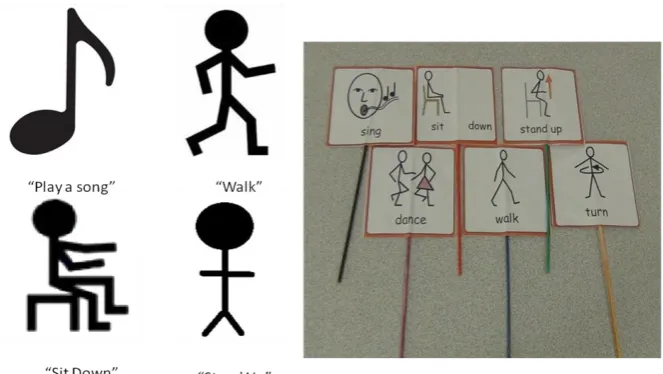
The camera did not appear to be a distraction. KW showed a high degree of interest in the robot; however PF seemed to be slightly apprehensive of the robot, although the member of teaching staff suggested she did show some positive signs. Following the pilot sessions, two changes were made to the flashcards: the symbols were changed to “Widgit Symbols”
[image:8.595.132.464.297.484.2]http://www.widgit.com/symbols/index.htm (see Figure 1) which the pupils use in class, as they were confused by some of the new symbols and the cards were mounted on coloured sticks to make them easier for the pupils to present to the robot. A “dance” card and a “turn” card were also produced to allow the pupil more control over the robot’s walking.
Figure 1 – The symbols used on flashcards in the pilot study (left) and within the case-studies sessions (right). The symbols were printed onto both sides of the flashcard, so that the pupil could see the symbol when presenting the card to the robot.
Initial plans for the sessions were finalised with the teachers. However, depending on how sessions proceeded, plans could be refined. This is because the study aimed to identify successful teaching methods, and this refinement was an important part of deciding what was and was not successful. Lessons learnt could then be applied to future studies. The initial session plans, and the changes made to them, are described in the Results section.
Video recordings of each session were analysed by the lead author using OBSWIN
(http://www.antam.co.uk/obswin.htm) for the duration of engagement, duration of assistance provided and the frequency of achieving a goal or failing to achieve a goal. Due to the inherent variability of the pupils, each pupil had individual criteria for the presence/absence of each variable. For example, to measure engagement, it was felt eye gaze alone was not accurate enough, as discerning the direction of the gaze could be difficult for pupils who had limited visual fields. In order to determine what constitutes the presence/absence of a variable, videos of the sessions were watched before the analysis began, and exact criteria defined for each. Three sessions from 3 different pupils were reanalysed to assess repeat reliability. For duration variables (engagement and teacher assistance), Cohen’s kappa was calculated using OBSWIN, to calculate agreement on
presence/absence of behaviour on a second by second basis. Percentage agreement was calculated for discrete variables ( goal achieved and goal not achieved (Wood, 2007).
All six calculations of Cohen’s Kappa ranged from 0.56-0.68, which puts reliability at moderate-substantial (Landis & Koch, 1977). Percentage agreements scores for goals achieved and goals not achieved ranged between 83.3% and 100%, a level of agreement described as “Good” by
Krippendorff (2012).
Results
1. What learning objectives did teachers select and how did they use the robot to achieve
them?
Table 3 shows the learning objectives that teachers wished to achieve with each pupil working with the robot together with how they planned to use the robot to help achieve it.
Table 3 to go here
Teachers identified a wide range of learning objectives, addressing a range of different levels of understanding, from gaining an appreciation of cause and effect (a relatively simple concept) to improving the pupil’s sense of direction by learning the concepts of “forwards”, “backwards”, “left” and “right” (more difficult abstract concepts). The main objective to be achieved over the five sessions, could be broken down into smaller goals for each session. For example, when trying to help KW build sequences of up to four events, steps towards achieving this were: to learn the meaning of the symbols, to recognise that there must be an order to some actions (e.g. the robot cannot dance when sitting down) and then to put together sequences of up to 4 events. In parallel, the robot’s role also varied. In some cases it provided the reward on a simple operant conditioning paradigm for example, the robot danced when the pupil (TN) made the required response. However, in other cases the robot formed a more active part of the learning process. For example when attempting to improve the pupil’s (TH) sense of direction, the robot was a necessary part of the activity, providing a concrete demonstration of an abstract concept rather than a simple reward. Similarly, when the teacher tried to encourage ST to vocalise, the robot had an active role in “conversing” with ST rather being a simple reward.
2. What results did the outcome measures yield?
The engagement scale score was used to measure whether there was a difference between the pupil’s engagement in class (without the robot) and in session 5 (with the robot). The scores are given in Table 4.
Table 4 to go here
The scale produced considerable variation in scores between pupils and between the two settings in which teachers completed it. The individual scores indicate that all pupils were rated higher when working with the robot although the increase was not so marked for ST and TH. For one pupil their rating with the robot was over six times higher than it was in a classroom situation. However, for two of the pupils (ST and TH) there was not much difference between the ratings they obtained in both situations. The Wilcoxon Signed rank test showed that for the group as a whole, ratings were significantly (z=2.023, p=0.043) higher when working with the robot.
Video Analysis Results
As the sessions varied in length, each of the duration measures (engagement and assistance) derived from observation of the video recordings was presented as a percentage of the session spent in that activity. Number of goals achieved was presented as a ratio of goals failedwith a higher score representing a greater proportion of goal achievement. Figure 2 shows the percentage of each session each pupil was observed as being engaged. The percentage duration for the first session (median = 74.85) was compared with the final session (median = 85.70) using the Wilcoxon signed rank test but no significant difference was found. However, examining the individual results indicates that for three of the pupils (SH, ST and TH) engagement increased over time.
Figure 2 – Percentage engagement for individual pupils by session
Figure 3 Percentage of session assisted by teacher for individual pupils by session
significant difference between session 1 (median = 1.46) and session 5 (median = 1.84). As with teacher assistance, the explanation may be that the teachers were increasing the difficulty of the sessions as pupils improved. This may account for the lack of change in the goal ratio as the pupil was regularly faced with new and more challenging goals.
Figure 4 Goal ratio for individual pupils by session
Discussion
As so little work has been carried out on the role of robots in special education, this study aimed to discover how teachers might use a humanoid robot to achieve specific learning objectives and additionally how we might measure success in using it for example in terms of engagement and achievement which the literature identifies as desired outcomes.
Teachers had no shortage of ideas on learning objectives that the robot could help achieve.
Unsurprisingly this included using the robot as a reward or to provide cues. While this might appear to be an expensive way of providing a reward, it was justified by one teacher who commented that, for children with considerable physical disabilities, even maintaining their position requires
could be seen as a first step towards this and encouraging ST to vocalise could then develop into more communicative uses of her voice.
One of the reasons robots were introduced in the school was in the hope that they would improve pupil engagement given the importance of this quality in learning in pupils with intellectual
disabilities. It was therefore important to look for a measure that would reflect this. As no psychometrically robust measurement of engagement was available for this group, the study
employed a scale that produced a numerical score but that was not originally designed to be used as an outcome measure. Teachers found it easy to complete, it had face validity and could be
completed for all of the pupils who took part even though they varied considerably in their abilities and ways of expressing themselves. Engagement was also measured in each session using
observations from the video recordings. This way of assessing engagement could feasibly be used to validate ratings from the Engagement scale as part of a programme to establish its psychometric properties. Repeat reliability is also an aspect that needs addressing as any method of assessing engagement in these pupils needs to recognise that pupils’ arousal and therefore their engagement, is likely to vary from day to day, and at different times of day (e.g. when they became tired, hungry or are feeling unwell).
Using this scale produced considerable variation between pupils and between the two settings in which teachers completed it. However, in addition to the untested nature of the Engagement Scale, there are other factors which need to be taken into account when considering its role in evaluating the use of robots with pupils with special needs. The primary limitation is that it is almost impossible to ensure that the scale is completed by a rater blind to the experimental condition. In the current study it was quite obvious to the teachers who completed the ratings which setting they were rating and the higher ratings with the robot could have been influenced by the teachers’ enthusiasm about its employment. The fact that not all pupils received a considerably higher rating with the robot indicates that teacher bias was not all that influential on the final results. The second problem was that other factors varied between the two settings in addition to the presence or absence of the robot. Although classroom settings for these pupils did not involve large groups of fellow pupils, inevitably there were more people present in the classroom setting than when working with the robot. There was also the researcher and a camera present when working with the robot. In future studies, it may be possible to eliminate many of these variables by having control sessions, where the environment would be made as similar as possible to the sessions working with the robot (e.g. the same room, the same equipment, video recorded with the same camera, the same people, at the same time of day).
Observations from the video recordings provide not only another measure of engagement but also goal achievement and teacher assistance. This measure of engagement did not vary over repeated sessions indicating that, at least for the duration of the study, the robot was not losing its
achievement remained stable. Similarly, as goals became more challenging, teachers had to maintain the same level of assistance rather than stepping back to allow the pupils to interact with the robot independently. Therefore, these measures may be of greater use in future studies where pupils are performing the same tasks in each session. In these cases, as the pupil learnt, it would be expected they would achieve the goal more frequently and with less assistance.
In conclusion, the study has shown that teachers identified a wide range of teaching objectives with which the robot could assist. Given the chance to plan the sessions, they also had no difficulty in suggesting ways the robot could be used to achieve these objectives. Both the Engagement Scale and video analysis produced variation between students. However, if rater bias can be avoided with the Engagement Scale, this methodology needs to be employed with a greater range of pupils to discover more ways of using the robot as well as to determine the discriminative ability of the outcome measures used.
References
Abbott, C., Brown, D., Evett, L. and Standen, P.J. (2013), “Emerging issues and current trends in assistive technology use 2007-2010: practising, assisting and enabling learning for all”, Disability and Rehabilitation: Assistive Technology, pp. 1-10.
Barker, B.S. and Ansorge, J. (2007), “Robotics as means to increase achievement scores in an informal learning environment”, Journal of Research on Technology in Education, Vol.39, p.229.
Bellamy, G., Croot, L., Bush, A., Berry, H. and Smith, A. (2010), “A study to define: profound and multiple learning disabilities (PMLD)”, Journal of Intellectual Disabilities, Vol.14 No.3, pp. 221-235.
Carpenter, B. (2011), “Overview of the research project: steps and impact”, Paper presented at the Complex Learning Difficulties and Disabilities Dissemination Conference, 24 March, London,
available at http://complexld.ssatrust.org.uk/uploads/SEN54%20complex%20needs.pdf(accessed 27 May 2014)
Chantry, J. and Dunford, C. (2010), “How do computer assistive technologies enhance participation in childhood occupations for children with multiple and complex disabilities? A review of the current literature”, British Journal of Occupational Therapy, Vol. 73, pp. 351-365.
Dautenhahn, K. and Billard, A. (2002), “Games Children with Autism Can Play With Robota, a Humanoid Robotic Doll”, in Proc. 1st Cambridge Workshop on Universal Access and Assistive
Technoloy [CWUAAT] (incorporating 4th Cambridge Workshop on Rehabilitation Robotics), Trinity
Hall, University of Cambridge, 25th-27th March, 2002. In Keats, S; Clarkson, PJ; Langdon, PM and Robinson, P (eds). Universal Access and Assistive Technology, Springer-Verlag (London).
Department for Education (2012) “About the P Scales” available at
http://www.education.gov.uk/schools/teachingandlearning/assessment/a00203453/about-the-p-scales (accessed 29 January 2014).
Feil-Seifer, D. and Matarić, M.(2008), “Toward socially assistive robotics for augmenting interventions for children with autism spectrum disorders”, International Symposium on Experimental Robotics, Vol. 54, pp. 201–21.
Fredricks, J.A. and McColsky, W. (2012), “The Measurement of Student Engagement: A Comparative Analysis of Various Methods and Student Self-report Instruments”. Christenson, S.L. et al Handbook
of Research on Student engagement, pp. 763-782.
Fridin M., Azery S. and Angel H., (2011), “Acceptance, Interaction, and Authority of Educational Robots: An ethnography study of child-robot interaction”, IEEE Transactions on Robotics, IEEE Workshop on Advanced Robotics and its Social Impacts, California, USA
Ibrani, L., Allen, T., Brown, D., Sherkat, N. and Stewart, D. (2011), “Supporting Students with
Learning and Physical Disabilities using a Mobile Robot Platform”, paper presented at the Interactive Technologies and Games (ITAG) Conference. October Nottingham, UK, available at
http://isrg.org.uk/wp-content/uploads/2013/02/ITAG-2011-Conference-Proceedings.zip (accessed 25 May 2014).
Iovannone, R., Dunlap, G., Huber, H. and Kincaid, D. (2003), “Effective Educational Practices for Students With Autism Spectrum Disorders”, Focus on Autism and Other Developmental Disabilities,
Vol. 18, pp. 150-165.
Klein, T., Gelderblom, G.J., De Witte, L. and Vanstipelen, S.(2011) “Evaluation of short term effects of the IROMEC robotic toy for children with developmental disabilities”, paper presented at
Rehabilitation Robotics (ICORR), 2011 IEEE International Conference June 29-July 1 2011 , available at http://www.ncbi.nlm.nih.gov/pubmed/22275609 (accessed 25 May 2014).
Krippendorff, K. (2012), Content Analysis: An Introduction to Its Methodology, SAGE Publications.
Landis, J. R. and Koch, G.G. (1977), “The Measurement of Observer Agreement for Categorical Data”,
Biometrics, Vol. 33 No.1, pp. 159-174
Milsom, A. and Glanville, J.L. (2010), “Factors Mediating the Relationship Between Social Skills and Academic Grades in a Sample of Students Diagnosed With Learning Disabilities or Emotional Disturbance”, Remedial and Special Education, vol. 31, pp. 241-251.
Moore.T., Hennessy, E.M., Myles, J., Johnson, S.J., Draper, E.S., Costeloe, K.L. and Marlow, N. (2012), “Neurological and developmental outcome in extremely preterm children born in England in 1995 and 2006: the EPICure studies”, BMJ, Vol.345, pp. e7961
Okolo, C.M. and Bouck, E.C. (2007), “Research about Assistive Technology: 2000-2006. What have we learned?”, Journal of Special Education Technology, Vol. 22, pp. 19-33.
Robins, B., Dautenhahn, K. (2006), “The role of the experimenter in HRI research—a case study evaluation of children with autism interacting with a robotic toy”, Proc of the 15th IEEE international symposium on robot and human interactive communication. IEEE Press, Piscataway, pp 646–651
Salter, T., Werry, I. and Michaud, F. (2008), “Going into the wild in child–robot interaction studies: issues in social robotic development”, Intelligent Service Robotics, Vol. 1, pp. 93-108.
Shrum, W., Duque, R., and Brown, T. (2005), “Digital video as research practice: Methodology for the millennium”, Journal of Research Practice, Vol. 1 no. 1, Article-M4.
Special Schools and Academies Trust. (2011), “The Complex Learning Difficulties and Disabilities Research Project: Developing Meaningful Pathways to Personalised Learning. Executive Summary”, available at http://www.ssatuk.co.uk (accessed 28 May 2014).
Standen, P J., Brown, D., Horan, M. and Proctor, T. (2002), “How tutors assist adults with learning disabilities to use virtual environments”, Disability and Rehabilitation, Vol. 24 Nos. 11-12, pp. 570-577.
Thill, S., Pop, C.A., Belpaeme, T., Ziemke, T. and Vanderborght, B. (2012), “Robot-assisted therapy for Autism Spectrum Disorders with(Partially) Autonomous Control: Challenges and Outlook”, Journal of Behavioural Robotics, Vol. 3, No.4, pp. 209-217.
Wainer, J., Dautenhahn, K., Robins, B. and Amirabdollahian, F. (2014), “A pilot study with a novel setup for collaborative play of the humanoid robot KASPAR with children with autism”, International Journal of Social Robotics,Vol. 6 No. 1, pp. 45-65.
Watson, AH., Ito, M., Smith, R.O. and Andersen, L.T. (2010), “Effect of Assistive Technology in a Public School Setting”, The American Journal of Occupational Therapy, Vol. 64, pp. 18-29.
Werry, I. and Dautenhahn, K. (1999) “Applying Mobile Robot Technology to the Rehabilitation of Autistic Children”, paper presented at the Symposium on Intelligent Robotics Systems, 1999 Coimbra, Portugal.
Wise, P.H. (2012), “Emerging Technologies and Their Impact on Disability”, The Future of Children,
Vol. 22, pp. 169-191.
Wood, J. M. (2007). “Understanding and Computing Cohen’s Kappa: A Tutorial”, WebPsychEmpiricist