DRAFT, July 22, [email protected]
Standard Test Method for the Determination of the Common Hazardous Air Pollutants (HAPs) in Solventborne Air-Dry Coatings by GasChromatograpy
1. Scope
1.1.This test method is for the determination of the weight percent of the hazardous air pollutants (HAPs) commonly found in solventborne air-dry coatings. These include methyl isobutyl ketone (MIBK), toluene, commercial xylene, cumene, and naphthalene.
1.2.Volatile compounds that are present at the 0.01 weight percent level or greater can be determined.
1.3.This standard does not purport to address all of the safety concerns, if any, associated with its use. It is the responsibility of the user of this standard to establish appropriate safety and health practices and determine the applicability of regulatory limitations prior to use.
2. Referenced Documents
2.1.ASTM Standards:
D 1475 Test Method for Density of Liquid Coatings, Inks, and Related Products2 D 2369 Test Method for Volatile Content of Coatings2
D 3792 Test Method for Water Content of Coatings by Direct Injection Into a Gas Chromatograph2
D 3925 Practice for Sampling Liquid Paints and Related Pigmented Coatings2
D 3960 Practice for Determining Volatile Organic Compound (VOC) Content of Paints and Related Coatings2
D 4017 Test Method for Water in Paints and Paint Materials by Karl Fischer Method2 D 6133 Test Method for Acetone p-Chlorobenzotrifluoride Methyl Acetate or t-Butyl
Acetate Content of Solventborne and Waterborne Paints, Coatings, Resins, and Raw Materials by Direct Injection into A Gas Chromatograph2
D 6438 Test Method for Acetone, Methyl Acetate, and Parachlorobenzotrifluoride Content of Paints, and Coatings by Solid Phase Microextraction-Gas Chromatography2
E 177 Practice for Use of the Terms Precision and Bias in ASTM Test Methods3 E 691 Practice for Conducting an Interlaboratory Study to Determine the Precision of
a Test Method3
2Annual Book of ASTM Standards, Vol 06.01. 3Annual Book of ASTM Standards, Vol 14.02.
3. Terminology 3.1.To be added
4. Summary of Test Method
4.1.A known weight of coating is dispersed in tetrahydrofuran (THF) or acetone, internally standardized, and analyzed by capillary gas chromatography to give a speciated composition of the volatile organic compounds in the coating. The HAPs present in the coating are identified and measured relative to the internal standard.
4.2. GC/FID or GC/MS using solid phase microextraction (SPME) of the coating may be used to facilitate identification of the volatile compounds present in a coating (Note 1).
NOTE 1—The analyst should consult MSDS and product data sheets for possible
information regarding solvents which may be present in a particular coating. SPME/GC may be used to ascertain that decomposition volatiles are not measured.
5. Significance and Use 5.1.To be added 6. Apparatus
6.1.SPME Sampling Apparatus and Fibers,4 manual SPME holders fitted with a 70
µm Carbowax™/Divinylbenzene (CW/DVB) StableFlex fiber assembly.
6.2.Gas Chromatograph, FID Detection with Electronic Data Acquisition System— Any capillary gas chromatograph equipped with a flame ionization detector and temperature programming capability may be used. Electronic flow control, which gives a constant carrier gas flow, is highly recommended.
6.3.Standard FID Instrument Conditions :
Detector Flame ionization
Column Primary column: 30 m by
0.25 mm 5 % phenyl/95 % methyl
siloxane (PMPS) (Note 2) , 1.0 µm film thickness.
Carrier Gas Helium
Flow Rate 1.0 mL per min, constant flow
Split Ratio Variable
Temperatures, °C
Inlet 260°
Detector 270°
Initial 50° for 4 min
Rate 20° per min to 250°, hold 5 min
NOTE 2 —The column designated as PMPS is commercially available from several
vendors by the following designations: DB-5, SPB-5, HP-5, AT-5, CP Sil 8CB, RTx-5, BP-5.
7. Reagents and Materials
7.1.Purity of Reagents—Reagent grade chemicals shall be used in all tests. Unless otherwise indicated, all reagents shall conform to the available specifications of the Committee on Analytical Reagents of the American Chemical Society. Other grades may be used, provided it is first ascertained that the reagent is of sufficiently high purity to permit its use without lessening the accuracy of the determination.
7.2.Carrier Gas, helium of 99.995 % or higher purity. 7.3.Terahydrofuran (THF), HPLC grade.
7.4.Acetone, 99 + mole %.
7.5.Ethylene glycol diethyl ether (EGDE), 99 + mole %.
7.6.Methyl isobutyl ketone (MIBK), toluene, ethylbenzene, m- or p-xylene, o-xylene, cumene, naphthalene, 99 + mole %.
7.7.Commercial xylene, commercial Aromatic 100 and commerial Aromatic 150.
7.8.Fluorocarbon-faced septum vials, 20 mL and 40 mL capacity. 8. Column and Fiber Conditioning
8.1.The capillary column should be conditioned according to the manufacturer's recommendation. The column may then be used indefinitely without further conditioning.
8.2.The SPME fiber should be conditioned and used according to the manufacturer's recommendation.
8.3.The SPME fiber should be inserted into a 260°C injection port for 30 s prior to each sampling event.
9. Preparation of Standards
9.1.Prepare a stock mixture of the compounds listed in 7.5 and 7.6 by weighing one or two grams of each into an appropriate vial. The weight of each component should be approximately the same and determined to 0.1 mg. Mix the contents. 9.2.Transfer approximately 150 µL of the stock mixture to a septum-capped vial
containing 10-12 mL of THF or acetone and mix the contents. This solution will contain each of the known analytes and the internal standard (EGDE) at a concentration of approximately 2 mg/mL.
9.3.Chromatograph the solution in 9.2 by injecting 1 µL using the PMPS column and
the chromatographic conditions given in 6.3. Calculate the relative response factors for each of the analytes relative to the EGDE internal standard using the relationship:
RF = AIAA * * MAMI where:
RF = relative response factor,
AA = area of analyte,
MI = weight of internal standard (from 9.1),
AI = area of internal standard, and
MA = weight of analyte (from 9.1).
9.4.Prepare a solution of the following in THF or acetone (approximate concentration in mg/mL): MIBK (2), toluene (2), EGDE (2), commercial xylene (3), and commercial Aromatic 100 (5).
9.5.Prepare a solution of the following in THF or acetone (approximate concentration in mg/mL): MIBK (2), toluene (2), EGDE (2), commercial xylene (3), and commercial Aromatic 150 (5).
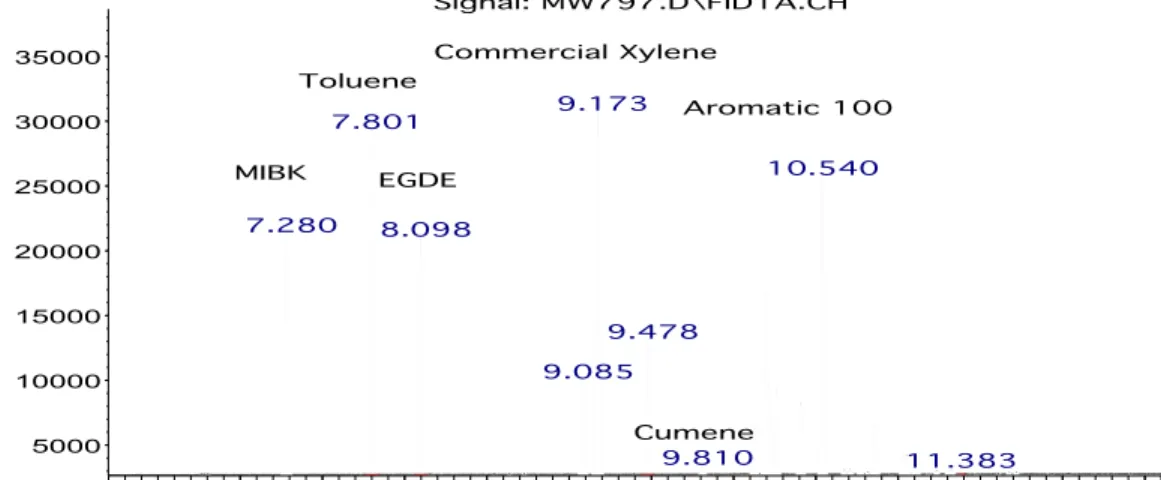
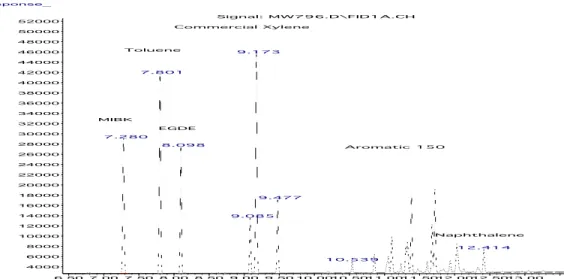
9.6.Chromatograph each of the solutions in 9.4 and 9.5 by injecting 1µL of the solution. The chromatograms should be obtained at heating rates of 20, 10, 5, and 2.5 degrees, respectively. Sample chromatograms that were obtained at a heating rate of 20 degrees per minute are given in Figures 1 and 2 below.
6.50 7.00 7.50 8.00 8.50 9.00 9.50 10.00 10.50 11.00 11.50 12.00 5000
10000 15000 20000 25000 30000 35000
Time Response_
Signal: MW797.D\FID1A.CH
7.280 7.801
8.098
9.085 9.173
9.478
9.810
10.540
11.383
EGDE Toluene
MIBK
Aromatic 100 Commercial Xylene
Cumene
Figure 1. Chromatogram of standard HAP mixture containing MIBK, toluene, EGDE(internal standard), commercial xylene, and Aromatic 100. Heating rate = 200C/minute.
6.50 7.00 7.50 8.00 8.50 9.00 9.50 10.0010.5011.0011.5012.0012.5013.00 4000 6000 8000 10000 12000 14000 16000 18000 20000 22000 24000 26000 28000 30000 32000 34000 36000 38000 40000 42000 44000 46000 48000 50000 52000 Time Response_ Signal: MW796.D\FID1A.CH 7.280 7.801 8.098 9.085 9.173 9.477 10.539 12.414 Naphthalene EGDE Toluene MIBK Commercial Xylene Aromatic 150
Figure 2. Chromatogram of standard HAP mixture containing MIBK, toluene, EGDE(internal standard), commercial xylene, and Aromatic 150. Heating rate = 200C/minute.
10.Coating Analysis
10.1. Add approximately 15-20 mL of THF or acetone to a 40 mL vial containing 3-5g ceramic beads (Coor’s Mini Media “M”, 2.0mm) and close with a fluorocarbon-faced septum cap. Using a disposable 1 mL syringe, add approximately 0.5mL of the well-mixed coating through the septum cap and weigh to 0.1 mg (Note 3). Using a dedicated 100 or 200µL syringe, add
approximately 50µL of EGDE internal standard and weigh to 0.1mg. Mix the
contents vigorously by shaking for 1 minute. Let the vial stand to permit pigments, if any, to settle.
NOTE 3—The coating should be drawn into the syringe without an attached syringe
needle. Excess coating is wiped from the syringe and the needle is then attached for transfer to the vial. The mass of the coating may be determined by either the difference in the weight of the filled and empty syringe or by the difference in the weight of the vial before and after adding paint.
10.2. Chromatograph the solution in 10.1 by injecting 1µL into the PMPS
capillary column using the standard conditions described in 6.3. Adjust the split ratio to give well-defined chromatographic peaks. If necessary, the solution may be diluted with additional THF or acetone. Identify the HAP compounds present. The peak area of the internal standard (EGDE) should be approximately equal to the peak area of the HAP present in the highest concentration. This may be accomplished by adjusting the amount of sample used, the amount of internal standard used, or both. Calculate the weight fraction of each HAP in the coating using the relationship:
%X =
( )
( )
AA( )
MI(
100)
AI
( )
RF(
MC)
where:
X = one of several possible HAPs in the coating,
RF = relative response factor of HAP X,
AA = peak area of HAP X,
MI = weight of internal standard
AI = peak area of internal standard, and
MC = weight of coating.
11.Chromatographic Resolution
11.1. Using a 5 % phenyl/95 % PDMS column and the chromatographic conditions of 6.3, certain compounds co-elute. These include, and are not limited to: PM acetate/ethylbenzene and 2-butoxyethanol(EB)/o-xylene. If co-elution is suspected, separation may be obtained by changing the chromatographic heating rate. See figures 3, 4, 5, and 6 for the effect of heating rate on commercial xylene containing PM acetate and 2-butoxyethanol.
8.40 8.60 8.80 9.00 9.20 9.40 9.60 9.80 10.00 20000
40000 60000 80000 100000 120000 140000 160000
Time Response_
Signal: MW639.D\FID1A.CH
8.966 9.084
9.173
9.477
o-Xylene and EB m&p-Xylene
Ethylbenzene PMOAc
Commercial Xylene + PMOAc + EB, Rate = 20
Figure 3. Commercial xylene with added PM acetate(PMOAc) and butoxyyethanol (EB) at a chromatographic heating rate of 200C/minute. EB and o-xylene co-elute. . Chromatography relatively fast.
10.60 10.80 11.00 11.20 11.40 11.60 11.80 12.00 12.20 12.40 5000
10000 15000 20000 25000 30000 35000 40000 45000 50000 55000 60000 65000
Time Response_
Signal: MW642.D\FID1A.CH
11.091 11.211
11.374
11.905
11.960
EB o-Xylene Ethylbenzene
PM Acetate
m&p-Xylene
Commercial Xylene + PMOAc + EB, Rate =10
Figure 4. Commercial xylene with added PM acetate(PMOAc) and butoxyyethanol (EB) at a chromatographic heating rate of 100C/minute. EB and o-xylene separated.
13.00 13.50 14.00 14.50 15.00 15.50 16.00 20000
40000 60000 80000 100000 120000 140000 160000 180000 200000 220000 240000 260000
Time Response_
Signal: MW640.D\FID1A.CH
14.068
14.395
15.301 15.519
Commercial Xylene + PMOAc + EB, Rate = 5
EB o-Xylene m&p-Xylene
Ethylbenzene + PMOAc
Figure 5 Commercial xylene with added PM acetate(PMOAc) and butoxyyethanol (EB) at a chromatographic heating rate of 50C/minute. EB and o-xylene separated. Ethylbenzene and PMOAc co-elute.
17.00 17.50 18.00 18.50 19.00 19.50 20.00 3000
4000 5000 6000 7000 8000 9000 10000 11000 12000 13000 14000 15000 16000 17000 18000 19000
Time Response_
Signal: MW641.D\FID1A.CH
17.548
17.700 18.041
19.600
20.092
EB o-Xylene
PM Acetate Ethylbenzene
m&p-Xylene
Commercial Xylene + PMOAc + EB, Rate = 2.5
Figure 6. Commercial xylene with added PM acetate(PMOAc) and butoxyyethanol (EB) at a chromatographic heating rate of 2.50C/minute. All components separated. Chromatography is relatively slow.
11.2. Commercial xylene contains ethylbenzene, m-xylene, p-xylene and o-xylene. The meta and para isomers are not resolved on a PMPS capillary column. The three peaks for commercial xylene have a relatively constant area ratio consisting of 15-18% ethylbenzene, 62-65% m&p-xylene and 19-22% o-xylene. When this ratio is significantly different, co-elution with another substance is probably occurring and the chromatography should be carried out at a different heating rate to effect separation. Additionally, if the chromatographic peak symmetry appears distorted, this may indicate co-elution with another substance and a different chromatographic heating rate should be used to obtain separation. 11.3. Cumene is introduced into coating materials when the aromatic
hydrocarbon mixture Aromatic 100 is added to a coating. This solvent mixture is the source of cumene in coatings. Cumene is normally not added to coatings as a pure material. The cumene content of Aromatic 100 is typically 1 to 2%. The average cumene content was found to be 1.4% in six samples of Aromatic 100 that were analyzed by GC. When measured as a percent of the 1,2,4-trimethylbenzene content (the major component in Aromatic 100) the value is 3 to 5%. Since cumene in a coating is a small component of a complex hydrocarbon mixture, its concentration in a coating will always be small, generally much less than 1%. Cumene is rarely, if ever, added to a coating as a pure solvent thus coatings containing cumene will exhibit the chromatographic peaks of Aromatic 100 (Figure 1).
11.4. Naphthalene is normally not added to coatings as a pure material. When naphthalene is present in a coating its source is almost always the solvent Aromatic 150, a complex mixture of predominantly C10 aromatic hydrocarbons. The naphthalene content of Aromatic 150 is typically 3 to 8%. The average naphthalene content was found to be 5.9% in five samples of Aromatic 150 that
2). The major components of Aromatic 150 are 1,2-dimethyl-4-ethylbenzene (10-15%, ret time = 15.5min) and 1,2,4,5-tetramethylbenzene (10-(10-15%, ret time = 16.2 min) at a heating rate of 100C per minute on the PMPS capillary column described in 6.3.
12.Solid Phase Microextraction Procedure
12.1. Since a solution/dispersion of coating in THF or acetone is injected into a relatively hot GC injection port, peaks representing decomposition products may be observed and should not be considered as VOCs. Solid phase microextraction allows sampling of most VOCs at low temperature and may be used to determine if GC peaks observed in the direct GC analysis (Section 10) are actual VOCs or decomposition products. If desired, the SPME procedure may be used prior to direct analysis to determine which VOCs are present in the coating. If GC/MS is available, the SPME procedure is especially useful for identification of VOCs, HAPs and exempt compounds present in a coating sample.
12.2. Place approximately 2 to 3 g of liquid coating into a 40 mL fluorocarbon-faced septum vial. Close the vial with a fluorocarbon-fluorocarbon-faced septum cap and heat to 35 to 40°C in an oven or other suitable heat source (oil bath, water bath, heated metal block). Do not let the contents contact the inside face of the septum cap. Insert the SPME fiber through the septum cap and sample the headspace for 3 to 4 min using a conditioned CW/DVB SPME fiber. Desorb the fiber for 10 s onto the capillary column and obtain the gas chromatogram using the standard chromatographic conditions described in 6.3. Identify the volatile components present in the liquid paint using retention time values corresponding to those of authentic compounds. The peaks found by this SPME procedure should correspond to the peaks found by the direct procedure. If peaks found in the direct procedure are not found by the SPME procedure, decomposition may be taking place in the direct method.
13.Reporting Results
13.1. Prepare a table (as indicated below) which contains information on each of the HAPs found.
HAP Found GC Retention Time (heating
rate)
Weight % Found
14.Alternate Identification Methods
14.1. The use of GC/MS for volatile compound identification is highly desirable. A convenient procedure is to sample the headspace of the coating using an SPME fiber. The fiber may be thermally desorbed onto any standard
capillary column and the compounds identified mass spectrally. This technique is especially valuable for identifying oxygenates, aromatics and other non-hydrocarbon compounds.
15.Precision and Bias 15.1. To be added