
Dhanalekshmi Gopinathan and Krishna Asawa
Department of Computer Science, Jaypee Institute of Information Technology, Noida, Uttar Pradesh, India
CBSL
−
A Compressed Binary String
Labeling Scheme for Dynamic Update
of XML Documents
The growing volume of XML documents over the Web has increased the need for an efficient mechanism to facilitate query processing. Many labeling schemes have been introduced to optimize data retrieval and query processing on XML database documents. As it is known, labels hold information about XML tree nodes such as their position, their relationship with other nodes and their order, which helps in query pro-cessing. Most of the existing labeling schemes support query processing over static XML documents. How-ever, they need to re-label during dynamic update. In this paper a compressed binary string labeling scheme is proposed which supports dynamic update of XML documents without re-labeling existing nodes. Ana-lytical results show that the proposed labeling scheme takes less label size in comparison with other labeling schemes. Also, an experiment has been conducted to evaluate the label generation time as well as update processing.
ACM CCS (2012) Classification: Information systems
→ World Wide Web → Web data description lan-guages → Markup languages → Extensible Markup Language (XML)
Information systems → Data management systems → Query languages → XML query languages
Keywords: compressed binary string, dynamic XML update, label size, XML tree, label generation time, update performance, lexicographic order
1. Introduction
The expressive and extensible nature of XML has become a key feature for its successful adop-tion as an interchange format between different applications and Web services over the Internet.
Moreover, the growing volume of XML docu-ments over the Web, in turn, increases the need for an efficient technique to store and accelerate query processing. XML data comprises nested collections of elements enclosed between start and end tags which describe the semantics of the element.
In general, XML documents are modeled as an ordered tree structure. Hence, the main chal-lenge in XML data management is to provide a storage structure that preserves the tree struc-ture intact. There are various labeling schemes proposed in the literature to provide persistent storage for XML documents by keeping the tree structure. Many of the labeling schemes can efficiently process different queries if the XML documents are static. To include structur-al modifications of XML data without affecting existing labels is still a hot topic.
In this paper we present a new labeling scheme which follows a lexicographic order of strings. The key contributions of this paper are:
(i) It supports dynamic updating of XML doc-uments. This scheme need not re-label any existing nodes and need not re-calculate any values when inserting an order-sensi-tive node into the XML tree.
elabo-rated in detail. Section 4 discusses the formal algorithm used in this scheme. In Section 5 an analytical study for the computation of label size is elucidated. Finally, experiment, results and conclusion are discussed in Sections 6 and 7, respectively.
2. Related Work
Existing labeling schemes are mainly classified into two major categories known as interval based (range based) labeling scheme [1], [2] and prefix based labeling scheme [3], [4], [5].
Range based labeling scheme generates labels
by assigning two values (begin, end) which de-note the start and end positions of the element in the document. These schemes can efficiently determine ancestor-descendant relationships. Additionally, the level information is required to find the parent-child relationship between the nodes. However, the major limitation of these labeling schemes is that they cannot determine the sibling relationship by only looking at the labels. To determine the sibling relationship be-tween two nodes, first it is required to search the parent of one node; further, it has to be checked whether the other node is the child of this same parent. This is obviously a time-consuming and expensive process. The second limitation is that they do not support dynamic update. During up-date, it may be necessary to re-label all the ex-isting or some of the exex-isting labels, which is an expensive operation. This partially limitation is latter resolved by keeping a larger interval size. However, doing this may cause a lot of values unused, which in turn increases the storage size. Moreover, if the insertion operation exceeds the interval size, then a re-labelling may require as-signing new values to the inserted nodes and already existing labels.
In the prefix based labeling scheme, each node is labeled by concatenating the prefix of the parent label with its self-label. This labeling scheme efficiently determines all the structur-al relationships between the nodes by merely looking at the labels. In [4] the authors pro-posed DeweyID which is an integer based pre-fix scheme. Each node is labeled with an inte-ger concatenated with its parent's label. It is a static labeling scheme which requires re-label-ing when new nodes are inserted.
An extension of this approach is proposed in [6] to support the dynamic updating of documents without relabeling. In [3], Cohen proposed the binary strings labeling scheme characterized by labeling the root with an empty string. The chil-dren nodes in the first level are labeled as 0, 10, 110 and so on. For any node u, the children are labeled as L(u).0, L(u).10, L(u).110 and so on, where L(u) is label of node u. In [7], O'Neil proposed the ORDPATH labeling scheme based on Dewey order using odd numbers for initial labeling; this scheme reserves even and nega-tive numbers for later insertions. However, if the size of the reserved code overflows, it has to re-label existing nodes. In [8], Duong and Zhang proposed the LSDX labeling scheme where each label is a combination of letters and digits, and the label of the root node is assigned to 0a, where the integer 0 represents the level or depth of the node while the alphabet represents the self-label of the node. Even though LSDX is designed to meet the dynamic nature of XML data, it is not a persistent labeling scheme. There are situations where collisions can occur during updation. Ko and Lee [9] proposed IBSL (Improved Binary String Labeling). Each label in this scheme uses binary bit strings, while the scheme avoids re-labeling during updations. However, space overhead and label size are not efficient. In Dynamic XDAS [10], the labels are generated based on masking technique; the au-thors use modified approach form [9] to incor-porate dynamic updating of XML data.
3. Proposed Approach
The proposed Compressed Binary String La-beling (CBSL) is inspired by the improved prefix based labeling scheme [9]. It uses string encoding to compress the number of symbols in the binary string to label the XML data. The ad-vantage of using the compressed binary string is that it uses less symbols to label each node in the XML tree. It uses lexicographic order to compare its labels. The next section explains the compressed binary string encoding used by the proposed approach.
3.1. Compressed Binary String Encoding The proposed Compressed Binary String La-beling uses binary strings generated as 10, 110,
in Figure 1 is used to illustrate the labeling of each node using the CBSL label.
3.2. Initial Labeling of CBSL
The initial labeling of CBSL starts with label-ing the root as NULL. The first level of children is labeled as "10", "20", "30", …, "90" and so forth. According to this approach, the first nine children are labeled with two symbols such as "10", "20", "30", and so forth; the next ninety children are labeled "100", "110", "990" with three symbols and so on.
Initial labeling in this scheme follows the lexi-cographic order, hence it is a unique label. The structural relationships such as parent-child (P-C), ancestor-descendant (A-D) and sibling relationships are computed by using the rules discussed below:
(i) Parent-child relationship (P-C): If the la-bel of Node1 is equal to the prefix label of
Node2, then Node1 is the parent of Node2. (ii) Ancestor-descendant relationship (A-D):
If the label of Node1 is a prefix string of the prefix label of Node2, then Node1 is an ancestor of Node2.
(iii) Sibling relationship: If the prefix of Node1 and the prefix of Node2 are the same, then
Node1 and Node2 are sibling nodes. These structural relationships play an important role in query processing. The next section elab-orates how CBSL handles the dynamic updates. 1110, and so forth. This labeling compression is
defined in Definition 1.
Definition 1. (Compressed Binary String La-bel). The first binary string, BS(1) = 10, is
en-coded as "10", which means that only one "1" is followed by a "0". The second binary string, BS
(2) = 110 is encoded as "20", meaning that two "1"s are followed by a "0". Further, the third binary string, BS(3) = 1110 is encoded as "30",
meaning that three "1" are followed by a zero. Finally, for any k, BS(k) = 1k0 means that k "1"s
are followed by a "0".
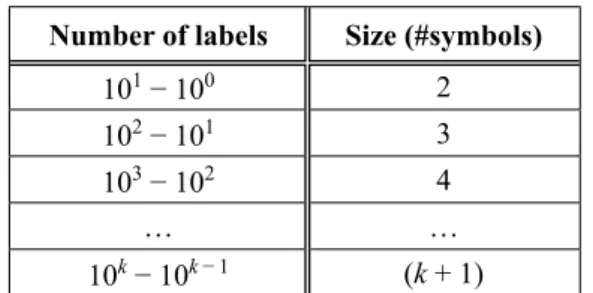
Table 1 shows the number of labels with its size. Here the size refers to the number of symbols used to label each node in the XML document. Thus, 101 − 100 denotes (10 − 1) = 9 labels, 102 − 101 = (100 − 10) = 90 labels and so on.
Definition 2. (Lexicographical order <). If two consecutive binary strings Nleft and Nright are equal (Nleft = Nright), all bits in Nleft and Nright should be exactly the same. Nleft is lexicograph-ically smaller than Nright (Nleft < Nright), if one of the following conditions hold:
a) Nleft [k] = 0 and Nright [k] =1 during bit-by-bit comparison of binary strings from left to right, at any position, say k or,
b) Nright has Nleft as its prefix.
For example, consider two binary strings "110" and "1110": "110" is lexicographically smaller than "1110" as per condition a) in Definition 2. For two binary strings "10" and "100", string "10" is lexicographically smaller than string "100" as per condition b) in Definition 2.
The next section explains the proposed label-ing scheme in detail. The example tree shown
Table 1. Number of labels with its size regarding the number of symbols.
Number of labels Size (#symbols)
101 − 100 2
102 − 101 3
103 − 102 4
… …
10k − 10k − 1 (k + 1)
rated in detail. Section 4 discusses the formal algorithm used in this scheme. In Section 5 an analytical study for the computation of label size is elucidated. Finally, experiment, results and conclusion are discussed in Sections 6 and 7, respectively.
2. Related Work
Existing labeling schemes are mainly classified into two major categories known as interval based (range based) labeling scheme [1], [2] and prefix based labeling scheme [3], [4], [5].
Range based labeling scheme generates labels
by assigning two values (begin, end) which de-note the start and end positions of the element in the document. These schemes can efficiently determine ancestor-descendant relationships. Additionally, the level information is required to find the parent-child relationship between the nodes. However, the major limitation of these labeling schemes is that they cannot determine the sibling relationship by only looking at the labels. To determine the sibling relationship be-tween two nodes, first it is required to search the parent of one node; further, it has to be checked whether the other node is the child of this same parent. This is obviously a time-consuming and expensive process. The second limitation is that they do not support dynamic update. During up-date, it may be necessary to re-label all the ex-isting or some of the exex-isting labels, which is an expensive operation. This partially limitation is latter resolved by keeping a larger interval size. However, doing this may cause a lot of values unused, which in turn increases the storage size. Moreover, if the insertion operation exceeds the interval size, then a re-labelling may require as-signing new values to the inserted nodes and already existing labels.
In the prefix based labeling scheme, each node is labeled by concatenating the prefix of the parent label with its self-label. This labeling scheme efficiently determines all the structur-al relationships between the nodes by merely looking at the labels. In [4] the authors pro-posed DeweyID which is an integer based pre-fix scheme. Each node is labeled with an inte-ger concatenated with its parent's label. It is a static labeling scheme which requires re-label-ing when new nodes are inserted.
An extension of this approach is proposed in [6] to support the dynamic updating of documents without relabeling. In [3], Cohen proposed the binary strings labeling scheme characterized by labeling the root with an empty string. The chil-dren nodes in the first level are labeled as 0, 10, 110 and so on. For any node u, the children are labeled as L(u).0, L(u).10, L(u).110 and so on, where L(u) is label of node u. In [7], O'Neil proposed the ORDPATH labeling scheme based on Dewey order using odd numbers for initial labeling; this scheme reserves even and nega-tive numbers for later insertions. However, if the size of the reserved code overflows, it has to re-label existing nodes. In [8], Duong and Zhang proposed the LSDX labeling scheme where each label is a combination of letters and digits, and the label of the root node is assigned to 0a, where the integer 0 represents the level or depth of the node while the alphabet represents the self-label of the node. Even though LSDX is designed to meet the dynamic nature of XML data, it is not a persistent labeling scheme. There are situations where collisions can occur during updation. Ko and Lee [9] proposed IBSL (Improved Binary String Labeling). Each label in this scheme uses binary bit strings, while the scheme avoids re-labeling during updations. However, space overhead and label size are not efficient. In Dynamic XDAS [10], the labels are generated based on masking technique; the au-thors use modified approach form [9] to incor-porate dynamic updating of XML data.
3. Proposed Approach
The proposed Compressed Binary String La-beling (CBSL) is inspired by the improved prefix based labeling scheme [9]. It uses string encoding to compress the number of symbols in the binary string to label the XML data. The ad-vantage of using the compressed binary string is that it uses less symbols to label each node in the XML tree. It uses lexicographic order to compare its labels. The next section explains the compressed binary string encoding used by the proposed approach.
3.1. Compressed Binary String Encoding The proposed Compressed Binary String La-beling uses binary strings generated as 10, 110,
in Figure 1 is used to illustrate the labeling of each node using the CBSL label.
3.2. Initial Labeling of CBSL
The initial labeling of CBSL starts with label-ing the root as NULL. The first level of children is labeled as "10", "20", "30", …, "90" and so forth. According to this approach, the first nine children are labeled with two symbols such as "10", "20", "30", and so forth; the next ninety children are labeled "100", "110", "990" with three symbols and so on.
Initial labeling in this scheme follows the lexi-cographic order, hence it is a unique label. The structural relationships such as parent-child (P-C), ancestor-descendant (A-D) and sibling relationships are computed by using the rules discussed below:
(i) Parent-child relationship (P-C): If the la-bel of Node1 is equal to the prefix label of
Node2, then Node1 is the parent of Node2. (ii) Ancestor-descendant relationship (A-D):
If the label of Node1 is a prefix string of the prefix label of Node2, then Node1 is an ancestor of Node2.
(iii) Sibling relationship: If the prefix of Node1 and the prefix of Node2 are the same, then
Node1 and Node2 are sibling nodes. These structural relationships play an important role in query processing. The next section elab-orates how CBSL handles the dynamic updates. 1110, and so forth. This labeling compression is
defined in Definition 1.
Definition 1. (Compressed Binary String La-bel). The first binary string, BS(1) = 10, is
en-coded as "10", which means that only one "1" is followed by a "0". The second binary string, BS
(2) = 110 is encoded as "20", meaning that two "1"s are followed by a "0". Further, the third binary string, BS(3) = 1110 is encoded as "30",
meaning that three "1" are followed by a zero. Finally, for any k, BS(k) = 1k0 means that k "1"s
are followed by a "0".
Table 1 shows the number of labels with its size. Here the size refers to the number of symbols used to label each node in the XML document. Thus, 101 − 100 denotes (10 − 1) = 9 labels, 102 − 101 = (100 − 10) = 90 labels and so on.
Definition 2. (Lexicographical order <). If two consecutive binary strings Nleft and Nright are equal (Nleft = Nright), all bits in Nleft and Nright should be exactly the same. Nleft is lexicograph-ically smaller than Nright (Nleft < Nright), if one of the following conditions hold:
a) Nleft [k] = 0 and Nright [k] =1 during bit-by-bit comparison of binary strings from left to right, at any position, say k or,
b) Nright has Nleft as its prefix.
For example, consider two binary strings "110" and "1110": "110" is lexicographically smaller than "1110" as per condition a) in Definition 2. For two binary strings "10" and "100", string "10" is lexicographically smaller than string "100" as per condition b) in Definition 2.
The next section explains the proposed label-ing scheme in detail. The example tree shown
Table 1. Number of labels with its size regarding the number of symbols.
Number of labels Size (#symbols)
101 − 100 2
102 − 101 3
103 − 102 4
… …
10k − 10k − 1 (k + 1)
3.3. Dynamic Insertions using CBSL
CBSL supports updating XML data dynamical-ly without collision. Inserting a node for vari-ous conditions is being elaborated in the form of cases as given below.
Case 1: Inserting a node before the leftmost child:
If the leftmost child has a label with distinc-tive character "#" (hash), the new node will be assigned a label by changing the last bit "1" in the left label to "01". For instance, if a new node is inserted before the leftmost child "100.10#01", the self-label of the leftmost child is "#01", therefore the new node will get the la-bel "100.10#001", as the last bit of the left node label is changed to 01 as shown in Figure 3.
If the leftmost child doesn't contain the distinc-tive character "#", then the new node will get a label by concatenating a string "#01" with the leftmost child's label, as depicted in Figure 4.
Case 2: Inserting a node after the rightmost child:
If the rightmost child contains a distinctive character "#" in its label, the new node will be assigned a label by concatenating a bit "1" to the right label. For instance, a new node insert-ed after the rightmost child "20#11" will get a label "20#111", as depicted in Figure 5.
Next, if the rightmost child doesn't contain dis-tinctive character "#", then the new node will get a label by concatenating a string "#11" with the rightmost child's label, as depicted in Figure 6.
Case 3: Inserting a node between two adjacent siblings:
The two conditions considered here are:
(i) the length of the left child's label is less than or equal to the length of the right child's label, and
(ii) the length of the left child's label is greater than the length of the right child's label. In the first condition, the new node will get a label by suffixing the string "#01" to the right child's label if the distinctive character (#) is not already present in the right node's label, as shown in Figure 7. Furthermore, if a distinctive character is present, the new node will get the label by changing the last bit to "01", as shown in Figure 8.
In the second condition, where the length of the left node's label is greater than the length of the right node's one, the new node will get a label by suffixing the string "1" to the left node's la-bel, as depicted in Figure 8.
In the following, the formal labeling algorithm is elaborated in detail.
3.4. Labeling Algorithm
Algorithm 1 elaborates the initial labeling as part of the proposed labeling scheme, while Algorithm 2 defines how dynamic update are handled by the scheme.
3.4.1. Initial Labeling
Algorithm 1 gives the details of CBSL labels for each node in the XML tree initially. A depth-first traversal is performed to assign a label to each node. The algorithm implements Definition 1 of the binary encoding. Here "." is used as the delimiter between the prefix and the self-label part of a label.
(a)
(b)
(c)
Figure 2. (a), (b) and (c) present the relationships described in rules (i), (ii) and (iii).
Figure 3. Inserting a node before the leftmost child (Case 1): label contains #.
Figure 4. Inserting a node before the leftmost child (Case 1): label contains no #.
Figure 5. Inserting a node after the rightmost child (Case 2): label contains #.
Figure 6. Inserting a node after the rightmost child (Case 2): label contains no #.
(a)
(b)
Figure 7. Inserting a node between two nodes: condition (i).
3.3. Dynamic Insertions using CBSL
CBSL supports updating XML data dynamical-ly without collision. Inserting a node for vari-ous conditions is being elaborated in the form of cases as given below.
Case 1: Inserting a node before the leftmost child:
If the leftmost child has a label with distinc-tive character "#" (hash), the new node will be assigned a label by changing the last bit "1" in the left label to "01". For instance, if a new node is inserted before the leftmost child "100.10#01", the self-label of the leftmost child is "#01", therefore the new node will get the la-bel "100.10#001", as the last bit of the left node label is changed to 01 as shown in Figure 3.
If the leftmost child doesn't contain the distinc-tive character "#", then the new node will get a label by concatenating a string "#01" with the leftmost child's label, as depicted in Figure 4.
Case 2: Inserting a node after the rightmost child:
If the rightmost child contains a distinctive character "#" in its label, the new node will be assigned a label by concatenating a bit "1" to the right label. For instance, a new node insert-ed after the rightmost child "20#11" will get a label "20#111", as depicted in Figure 5.
Next, if the rightmost child doesn't contain dis-tinctive character "#", then the new node will get a label by concatenating a string "#11" with the rightmost child's label, as depicted in Figure 6.
Case 3: Inserting a node between two adjacent siblings:
The two conditions considered here are:
(i) the length of the left child's label is less than or equal to the length of the right child's label, and
(ii) the length of the left child's label is greater than the length of the right child's label. In the first condition, the new node will get a label by suffixing the string "#01" to the right child's label if the distinctive character (#) is not already present in the right node's label, as shown in Figure 7. Furthermore, if a distinctive character is present, the new node will get the label by changing the last bit to "01", as shown in Figure 8.
In the second condition, where the length of the left node's label is greater than the length of the right node's one, the new node will get a label by suffixing the string "1" to the left node's la-bel, as depicted in Figure 8.
In the following, the formal labeling algorithm is elaborated in detail.
3.4. Labeling Algorithm
Algorithm 1 elaborates the initial labeling as part of the proposed labeling scheme, while Algorithm 2 defines how dynamic update are handled by the scheme.
3.4.1. Initial Labeling
Algorithm 1 gives the details of CBSL labels for each node in the XML tree initially. A depth-first traversal is performed to assign a label to each node. The algorithm implements Definition 1 of the binary encoding. Here "." is used as the delimiter between the prefix and the self-label part of a label.
(a)
(b)
(c)
Figure 2. (a), (b) and (c) present the relationships described in rules (i), (ii) and (iii).
Figure 3. Inserting a node before the leftmost child (Case 1): label contains #.
Figure 4. Inserting a node before the leftmost child (Case 1): label contains no #.
Figure 5. Inserting a node after the rightmost child (Case 2): label contains #.
Figure 6. Inserting a node after the rightmost child (Case 2): label contains no #.
(a)
(b)
Figure 7. Inserting a node between two nodes: condition (i).
The method nextBstring() generates the next binary string for the node visited, while the method countOnes() counts the number of "1"s in the generated binary string. Dynamic inser-tions in the proposed scheme are performed as discussed in Subsection 3.3. Dynamic update follow the lexicographic order.
Lemma 1. Inserting a node Nnew between the two lexicographically ordered strings Nleft and Nright using the CBSL approach follows the lex-icographic order, i.e. Nleft < Nnew < Nright.
Proof. The above statement is proved by
con-sidering two cases. The first one is when the length of the left sibling node is less than or equal to the right sibling node, while the sec-ond is when the length of the left sibling node is greater than the right sibling node.
Case a: If length (Nleft) ≤ length (Nright), the
Nnew is assigned a label as shown in steps (b1) of Algorithm 2 which checks two cases:
(i) both labels without a distinctive character "#", and
(ii) labels with a distinctive character "#". In the proposed labeling, according to Definition 1, the valueOf((length(Nleft) − 1) denotes the number of "1"s in the binary string representa-tion of label Nleft, while valueOf((length(Nright) − 1) indicates the number of "1"s in the label
Nright. Note that, as per the initial labeling, valueOf((length(Nright) − 1) cannot be less than valueOf((length(Nleft) − 1).
(a1) Labels without distinctive character "#" and length(Nleft) <= length(Nright).
Here valueOf (length (Nleft) − 1) < valueOf(length(Nright) − 1) means that the number of 1's in Nright is larger than Nleft,
i.e. Nleft is the prefix of Nright. Then, as per condition b in Definition 3.2, Nright is lex-icographically larger than Nleft. Thus, Nleft < Nnew, because Nnew is obtained by con-catenating "#01" to Nright.
(a2) Length(Nleft) < length(Nright) with dis-tinctive character "#".
In this case, Nnew is assigned a value by changing the last bit "1" of Nright to "01". Since 0 < 1 lexicographically, then, as per the condition a in Definition 3.2, Nnew <
Nright.
Based on (a1) and (a2), Nleft < Nnew < Nright lexico-graphically when length(Nleft) ≤ length(Nright). Next, to prove the second part, Nnew < Nright, we must also consider two cases.
Case b: If length(Nleft) > length(Nright), Nnew is
assigned a label as shown in step (b2) of Algo-rithm 2., i.e., Nnew = Nleft + "1".
(b1) From Algorithm 2, Nnew is assigned a la-bel by concatenating a "1" to Nleft, thus making Nleft a prefix of Nnew. Now, as per condition b in Definition 2, Nleft < Nnew lexicographically.
(b2) Since length (Nleft) > length(Nright) and
Nleft is lexicographically smaller than
Nright, it must satisfy the condition in Defi-nition 2. It means that there exists some position, say k, where Nleft [k] is "0" and
Nright [k] is "1". Note that "0" is lexico-graphically smaller than "1". Therefore, concatenating "1" to Nleft for assigning a value for Nnew still makes it smaller than
Nright lexicographically, i.e. Nnew < Nright. Based on (b1) and (b2), Nleft < Nnew < Nright when length (Nleft) > length(Nright). Therefore, from case (a) and case (b), Nleft < Nnew < Nright.
4. Label Size Analysis
In this section, the term size denotes the number of symbols present in a label. As the first part of the size analysis, for a given fan-out (F) value, the maximum number of symbols required to label each string is computed.
Lemma 2. To self-label sibling nodes, for each label string in CBSL, will take at most log10 (F) + 1 character symbols.
Proof. In this approach,
(i) 2-symbol character strings can represent the first nine label values, i.e. (101 − 100) values,
(ii) 3-symbol characters string can represent 90 label values, i.e. (102 − 101) values, (iii) 4-symbol character strings can represent
900 label values, i.e. (103 − 102).
Thus for any k, to represent (10k − 10k − 1) labels
requires k + 1 symbols. Let
(
) (
)
(
)
(
)
1 0 2 1 1
1 1
10 10 10 10 10 10
10 10 .
k k
k
i i
i
F −
−
=
= − + − + + −
=
∑
−
By mathematical induction,
(
1)
( )
1 10 10 10 .
k
i i k
i
F − k
=
=
∑
− = ⋅Hence, the maximum number of character sym-bols for each label string K = log10 (F) + 1. Example: for F = 80, F = 90 and F = 8379, the symbols required to self-label are
(i) F = 90, K = log10 (90) + 1 = 1.97 + 1 = 3 symbols.
(ii) F = 800, K = log10 (800) + 1 = 2.90 + 1 = 4 symbols.
(iii) F = 8375, K = log10 (8375) + 1 = 3.92 + 1 = 5 symbols.
Next, the computation of total sibling size re-quired for fan-out F nodes is
(
)
(
)
(
)
2 2
0, 2 9 10 0 9 10 1
l l
i i
i x x F i l
− −
= = =
⋅ ⋅ + − ⋅ ⋅ +
∑
∑
Algorithm 2. Insertion (Nleft , Nright).
Input: Nleft, selflabel of the left sibling, and Nright, selflabel of the right sibling
Output: Nnew, selflabel of the New node
//Case a: Inserting a node before Nleft
begin
(a1) Nleft without special character "#"
Nnew = 01# + Nleft
(a2) Nleft with special character "#"
Nnew = 0 + Nleft
end
//Case b: Inserting a node between two adjacent siblings begin
(b1) if (lenght(Nleft ) <= lenght(Nright )) then
if (!(Nleft .contains("#") and !(Nright .contains("#")) then
Nnew = Nleft + #01
else
if Nright .contains("#")then
Nnew = Nright with last bit 1 changed to 01
end end end
(b2) if (lenght(Nleft ) > lenght(Nright )) then
Nnew = Nleft + 1
end end
//Case c: Inserting a node after right sibling Nright
begin
(c1) Nright with special character ("#")
Nnew = Nright + 1
(c2) Nright without special character ("#")
Nnew = Nright + 11
end
Algorithm 1. Initial labeling.
Input: XML Document D
Output: Label for each node n in D
begin
if (nis root) then
Label(n) = null else
prefix (n) = Label (P) end
if (n is firstChild(P)) then
selflabel(n) = 10 else
templabel = countOnes (nextBstring()) Label(n) = templabel + 0
end
The method nextBstring() generates the next binary string for the node visited, while the method countOnes() counts the number of "1"s in the generated binary string. Dynamic inser-tions in the proposed scheme are performed as discussed in Subsection 3.3. Dynamic update follow the lexicographic order.
Lemma 1. Inserting a node Nnew between the two lexicographically ordered strings Nleft and Nright using the CBSL approach follows the lex-icographic order, i.e. Nleft < Nnew < Nright.
Proof. The above statement is proved by
con-sidering two cases. The first one is when the length of the left sibling node is less than or equal to the right sibling node, while the sec-ond is when the length of the left sibling node is greater than the right sibling node.
Case a: If length (Nleft) ≤ length (Nright), the
Nnew is assigned a label as shown in steps (b1) of Algorithm 2 which checks two cases:
(i) both labels without a distinctive character "#", and
(ii) labels with a distinctive character "#". In the proposed labeling, according to Definition 1, the valueOf((length(Nleft) − 1) denotes the number of "1"s in the binary string representa-tion of label Nleft, while valueOf((length(Nright) − 1) indicates the number of "1"s in the label
Nright. Note that, as per the initial labeling, valueOf((length(Nright) − 1) cannot be less than valueOf((length(Nleft) − 1).
(a1) Labels without distinctive character "#" and length(Nleft) <= length(Nright).
Here valueOf (length (Nleft) − 1) < valueOf(length(Nright) − 1) means that the number of 1's in Nright is larger than Nleft,
i.e. Nleft is the prefix of Nright. Then, as per condition b in Definition 3.2, Nright is lex-icographically larger than Nleft. Thus, Nleft < Nnew, because Nnew is obtained by con-catenating "#01" to Nright.
(a2) Length(Nleft) < length(Nright) with dis-tinctive character "#".
In this case, Nnew is assigned a value by changing the last bit "1" of Nright to "01". Since 0 < 1 lexicographically, then, as per the condition a in Definition 3.2, Nnew <
Nright.
Based on (a1) and (a2), Nleft < Nnew < Nright lexico-graphically when length(Nleft) ≤ length(Nright). Next, to prove the second part, Nnew < Nright, we must also consider two cases.
Case b: If length(Nleft) > length(Nright), Nnew is
assigned a label as shown in step (b2) of Algo-rithm 2., i.e., Nnew = Nleft + "1".
(b1) From Algorithm 2, Nnew is assigned a la-bel by concatenating a "1" to Nleft, thus making Nleft a prefix of Nnew. Now, as per condition b in Definition 2, Nleft < Nnew lexicographically.
(b2) Since length (Nleft) > length(Nright) and
Nleft is lexicographically smaller than
Nright, it must satisfy the condition in Defi-nition 2. It means that there exists some position, say k, where Nleft [k] is "0" and
Nright [k] is "1". Note that "0" is lexico-graphically smaller than "1". Therefore, concatenating "1" to Nleft for assigning a value for Nnew still makes it smaller than
Nright lexicographically, i.e. Nnew < Nright. Based on (b1) and (b2), Nleft < Nnew < Nright when length (Nleft) > length(Nright). Therefore, from case (a) and case (b), Nleft < Nnew < Nright.
4. Label Size Analysis
In this section, the term size denotes the number of symbols present in a label. As the first part of the size analysis, for a given fan-out (F) value, the maximum number of symbols required to label each string is computed.
Lemma 2. To self-label sibling nodes, for each label string in CBSL, will take at most log10 (F) + 1 character symbols.
Proof. In this approach,
(i) 2-symbol character strings can represent the first nine label values, i.e. (101 − 100) values,
(ii) 3-symbol characters string can represent 90 label values, i.e. (102 − 101) values, (iii) 4-symbol character strings can represent
900 label values, i.e. (103 − 102).
Thus for any k, to represent (10k − 10k − 1) labels
requires k + 1 symbols. Let
(
) (
)
(
)
(
)
1 0 2 1 1
1 1
10 10 10 10 10 10
10 10 .
k k
k
i i
i
F −
−
=
= − + − + + −
=
∑
−
By mathematical induction,
(
1)
( )
1 10 10 10 .
k
i i k
i
F − k
=
=
∑
− = ⋅Hence, the maximum number of character sym-bols for each label string K = log10 (F) + 1. Example: for F = 80, F = 90 and F = 8379, the symbols required to self-label are
(i) F = 90, K = log10 (90) + 1 = 1.97 + 1 = 3 symbols.
(ii) F = 800, K = log10 (800) + 1 = 2.90 + 1 = 4 symbols.
(iii) F = 8375, K = log10 (8375) + 1 = 3.92 + 1 = 5 symbols.
Next, the computation of total sibling size re-quired for fan-out F nodes is
(
)
(
)
(
)
2 2
0, 2 9 10 0 9 10 1
l l
i i
i x x F i l
− −
= = =
⋅ ⋅ + − ⋅ ⋅ +
∑
∑
Algorithm 2. Insertion (Nleft , Nright).
Input: Nleft, selflabel of the left sibling, and Nright, selflabel of the right sibling
Output: Nnew, selflabel of the New node
//Case a: Inserting a node before Nleft
begin
(a1) Nleft without special character "#"
Nnew = 01# + Nleft
(a2) Nleft with special character "#"
Nnew = 0 + Nleft
end
//Case b: Inserting a node between two adjacent siblings begin
(b1) if (lenght(Nleft ) <= lenght(Nright )) then
if (!(Nleft .contains("#") and !(Nright .contains("#")) then
Nnew = Nleft + #01
else
if Nright .contains("#")then
Nnew = Nright with last bit 1 changed to 01
end end end
(b2) if (lenght(Nleft ) > lenght(Nright )) then
Nnew = Nleft + 1
end end
//Case c: Inserting a node after right sibling Nright
begin
(c1) Nright with special character ("#")
Nnew = Nright + 1
(c2) Nright without special character ("#")
Nnew = Nright + 11
end
Algorithm 1. Initial labeling.
Input: XML Document D
Output: Label for each node n in D
begin
if (nis root) then
Label(n) = null else
prefix (n) = Label (P) end
if (n is firstChild(P)) then
selflabel(n) = 10 else
templabel = countOnes (nextBstring()) Label(n) = templabel + 0
end
Lemma 3. The total sibling self-label size for a fan-out of F nodes in the CBSL will be
(
)
(
)
(
)
2 2
0, 2 9 10 0 9 10 1
l l
i i
i x x F i l
− − = = = ⋅ ⋅ + − ⋅ ⋅ +
∑
∑
symbols. Here, l denotes the length (F).
Proof. The CBSL scheme starts its labeling with
the root node as null, hence for the first level of nodes the prefix part will be null. The children at the first level will have only the self-label. Hence, the label starts with 2-character strings such as 10, 20, 30 and so on.
The first step is to compute the size requirement of sibling labels up to l − 2.
(i) The size requirement of sibling labels is up to l − 2, where l is the string length (F). For this, as per the CBSL scheme, labeling falls within the range (101 − 100), (102 − 101), (103 − 102) with a 2-character string, 3-character string, 4-character string and so on.
Hence,
a) i = 0 denotes (101 − 100) · 10i = 9 · 100 = 9 sibling labels.
b) i = 1 denotes (101 − 100) · 10i = 9 · 101 = 90 sibling labels.
c) i = 2 denotes (101 − 100) · 10i = 9 · 102 = 900 sibling labels, and so on.
Now, x denotes the number of symbols used to label these nodes. As per this scheme, "x" starts with 2 and is incremented by 1 for every "i" value up to l − 2.
Hence, to label sibling nodes, we need
(
)
2
0, 2 9 10
l
i
i x x
−
=
∑
= ⋅ ⋅ symbols.(ii) The size requirement of sibling labels falls in the range l − 1.
Some cases may have the number of nodes less than (10l − 1 − 10l − 2). In such case, to capture
the exact number of remaining nodes, the num-ber of nodes which has already been labeled is subtracted from the fan-out value F. Hence, the remaining number of nodes is computed as F −
(
)
2
0 9 10
l i i x − = ⋅ ⋅
∑
, and the symbols required to label these nodes are obtained by multiplying (l + 1), where l denotes the string length of fan-out F.Therefore, from cases (i) and (ii) it is shown that the total sibling label size is ob-tained by using formula
(
)
(
)
(
)
2 2
0, 2 9 10 0 9 10 1
l l
i i
i x x F i l
− − = = = ⋅ ⋅ + − ⋅ ⋅ +
∑
∑
Consider an example for fan-out value F = 8875. Here, the string length (F) = 4. The first term of the summation series mentioned in Lemma 3 computes the number of symbols required to label the nodes as
a) i = 0, 9 · 10i = 9 · 100 = 9 label values. Symbols required are 9 · x =9 · 2 = 18. b) i = 1, 9 · 10i = 9 · 101 = 90 label values.
Symbols required are 90 · x = 90 · 3 = 270. c) i = 2, 9 · 10i = 9 · 102 = 900 label values.
Symbols required are 900 · x = 900 · 4 = 3600.
Now, when i = 3, which exceeds (l − 2) = 4, the second term of the formula is used to get the exact remaining number of nodes as 8875 − (9 + 90 + 900) = 7876 label values. Hence, 7876 * 5 = 39380 will give the total number of sym-bols required to label these nodes. Therefore, the total number of symbols required to label a sibling size of 8875 is computed as (18 + 270 + 3600 + 39380) = 43268 symbols. Besides, from Property 2 below, the average size of a single label will be 43268/8875 = 4.87.
Property 1. From Lemma 3, the total sibling label size for a fan-out F is computed as
(
)
(
)
(
)
2 2
0, 2 9 10 0 9 10 1 .
l l
i i
i x x F i l
− − = = = ⋅ ⋅ + − ⋅ ⋅ +
∑
∑
Hence, storage requirement for CBSL will be
(
)
(
)
( )
2 2
0, 2 9 10 0 9 10 1 8
l l
i i
i x x F i l
− − = = = ⋅ ⋅ + − ⋅ ⋅ + ⋅
∑
∑
bits. The 8 bits denote the required storage space for 1 symbol.
Property 2. From Lemma 3, the total sibling self-label size for a fan-out F in CBSL is
(
)
(
)
(
)
2 2
0, 2 9 10 0 9 10 1 .
l l
i i
i x x F i l
− − = = = ⋅ ⋅ + − ⋅ ⋅ +
∑
∑
Hence the average size for a single self-label is
(
)
(
)
(
)
2 2
0, 2 0
1 l 9 10 l 9 10 1 .
i i
i x x F i l
F − − = = = ⋅ ⋅ ⋅ + − ⋅ ⋅ +
∑
∑
Property 3. Considering the prefix, the maxi-mum size required to store the complete label (prefix + self-label) is
(
)
(
)
(
)
2 2
0, 2 9 10 0 9 10 1 ,
l l
i i
i x i
D − x F − l
= = =
⋅ ⋅ ⋅ + − ⋅ ⋅ +
∑
∑
where D denotes the maximum depth of the XML tree.
Property 4. The maximum size required by CBSL for all the nodes in the XML tree with
N nodes is
(
)
(
)
( )
2 2
0, 2 9 10 0 9 10 1 .
l l
i i
i x i
N D − x F − l
= = =
⋅ ⋅ ⋅ ⋅ + − ⋅ ⋅ +
∑
∑
5. Performance Analysis of Label
Size Requirements
In this section, a performance analysis study is conducted to analyze the size required by dif-ferent labeling schemes such as Dewey, bina-ry, IBSL, binary string and our CBSL scheme. "N", "F" and "D" indicate the number of nodes, maximum fan-out, and max-depth of nodes in an XML document respectively. In conducting this study we consider the benchmark datasets [11], [12] whose characteristics are shown in Table 2.
In Dewey ID [4], all the self-labels use a maxi-mum size of log2 (F), while the maximum size required to store the complete label including prefix and self-label is "D · log2 (F)". Fur-thermore, the maximum size required to store all the nodes in the XML tree is computed
N · D · log2 (F). The binary string scheme [3] takes label sizes of 1, 2, 3, ..., F for the first sib-ling, second sibling and so on. Hence, the total sibling size taken in this scheme is 1 + 2 + ... +
F which is equal to F2/2 + F/2. And, the aver-age size of the single sibling label is F/2 + 1/2. Therefore, the maximum size required to store all the nodes in the XML tree is N · D · (F/2 + 1/2).
In IBSL [13] the total sibling size for the self-label is computed as F · log2 (F − 1) + 2 · F − log(F −1) + 1, and the average size for a single self-label is log(F − 1) + 2 − (log(F − 1))/F
+ 1/F. Therefore, the maximum size required to store all the nodes in the XML tree is N · D
· [log(F −1) + 2 − (log(F −1)/F) + 1/F]. In the IBSL_2010 [9] the total sibling label, the aver-age size for a single self-label, and the maxi-mum size required to store all nodes in an XML tree are computed in the same way in Binary [3]. Table 3 shows the label size analysis for different schemes.
A comparative study of label size computation in various labeling schemes mentioned in Ta-ble 3 is performed and the results obtained are depicted in Table 4. It summarizes comparative results obtained on the total sibling size, aver-age size for a single label and maximum size required to store all nodes in an XML tree by different schemes on datasets shown in Table 3. From the table it is clear that our proposed
Table 2. Characteristics of data sets used.
DataSet Topic MaxFan-out(F) MaxDepth(D) #Nodes
D1 SigmodRecord 6 3 41
D2 NASA 26 6 4834
D3 Shakespeare Play 48 5 6636
D4 Club 13 3 340
D5 Actor 26 4 1110
D6 Department 25 3 2636
D7 Xmark 25500 12 16663000
D8 DBLP 328858 6 3332130
Lemma 3. The total sibling self-label size for a fan-out of F nodes in the CBSL will be
(
)
(
)
(
)
2 2
0, 2 9 10 0 9 10 1
l l
i i
i x x F i l
− − = = = ⋅ ⋅ + − ⋅ ⋅ +
∑
∑
symbols. Here, l denotes the length (F).
Proof. The CBSL scheme starts its labeling with
the root node as null, hence for the first level of nodes the prefix part will be null. The children at the first level will have only the self-label. Hence, the label starts with 2-character strings such as 10, 20, 30 and so on.
The first step is to compute the size requirement of sibling labels up to l − 2.
(i) The size requirement of sibling labels is up to l − 2, where l is the string length (F). For this, as per the CBSL scheme, labeling falls within the range (101 − 100), (102 − 101), (103 − 102) with a 2-character string, 3-character string, 4-character string and so on.
Hence,
a) i = 0 denotes (101 − 100) · 10i = 9 · 100 = 9 sibling labels.
b) i = 1 denotes (101 − 100) · 10i = 9 · 101 = 90 sibling labels.
c) i = 2 denotes (101 − 100) · 10i = 9 · 102 = 900 sibling labels, and so on.
Now, x denotes the number of symbols used to label these nodes. As per this scheme, "x" starts with 2 and is incremented by 1 for every "i" value up to l − 2.
Hence, to label sibling nodes, we need
(
)
2
0, 2 9 10
l
i
i x x
−
=
∑
= ⋅ ⋅ symbols.(ii) The size requirement of sibling labels falls in the range l − 1.
Some cases may have the number of nodes less than (10l − 1 − 10l − 2). In such case, to capture
the exact number of remaining nodes, the num-ber of nodes which has already been labeled is subtracted from the fan-out value F. Hence, the remaining number of nodes is computed as F −
(
)
2
0 9 10
l i i x − = ⋅ ⋅
∑
, and the symbols required to label these nodes are obtained by multiplying (l + 1), where l denotes the string length of fan-out F.Therefore, from cases (i) and (ii) it is shown that the total sibling label size is ob-tained by using formula
(
)
(
)
(
)
2 2
0, 2 9 10 0 9 10 1
l l
i i
i x x F i l
− − = = = ⋅ ⋅ + − ⋅ ⋅ +
∑
∑
Consider an example for fan-out value F = 8875. Here, the string length (F) = 4. The first term of the summation series mentioned in Lemma 3 computes the number of symbols required to label the nodes as
a) i = 0, 9 · 10i = 9 · 100 = 9 label values. Symbols required are 9 · x =9 · 2 = 18. b) i = 1, 9 · 10i = 9 · 101 = 90 label values.
Symbols required are 90 · x = 90 · 3 = 270. c) i = 2, 9 · 10i = 9 · 102 = 900 label values.
Symbols required are 900 · x = 900 · 4 = 3600.
Now, when i = 3, which exceeds (l − 2) = 4, the second term of the formula is used to get the exact remaining number of nodes as 8875 − (9 + 90 + 900) = 7876 label values. Hence, 7876 * 5 = 39380 will give the total number of sym-bols required to label these nodes. Therefore, the total number of symbols required to label a sibling size of 8875 is computed as (18 + 270 + 3600 + 39380) = 43268 symbols. Besides, from Property 2 below, the average size of a single label will be 43268/8875 = 4.87.
Property 1. From Lemma 3, the total sibling label size for a fan-out F is computed as
(
)
(
)
(
)
2 2
0, 2 9 10 0 9 10 1 .
l l
i i
i x x F i l
− − = = = ⋅ ⋅ + − ⋅ ⋅ +
∑
∑
Hence, storage requirement for CBSL will be
(
)
(
)
( )
2 2
0, 2 9 10 0 9 10 1 8
l l
i i
i x x F i l
− − = = = ⋅ ⋅ + − ⋅ ⋅ + ⋅
∑
∑
bits. The 8 bits denote the required storage space for 1 symbol.
Property 2. From Lemma 3, the total sibling self-label size for a fan-out F in CBSL is
(
)
(
)
(
)
2 2
0, 2 9 10 0 9 10 1 .
l l
i i
i x x F i l
− − = = = ⋅ ⋅ + − ⋅ ⋅ +
∑
∑
Hence the average size for a single self-label is
(
)
(
)
(
)
2 2
0, 2 0
1 l 9 10 l 9 10 1 .
i i
i x x F i l
F − − = = = ⋅ ⋅ ⋅ + − ⋅ ⋅ +
∑
∑
Property 3. Considering the prefix, the maxi-mum size required to store the complete label (prefix + self-label) is
(
)
(
)
(
)
2 2
0, 2 9 10 0 9 10 1 ,
l l
i i
i x i
D − x F − l
= = =
⋅ ⋅ ⋅ + − ⋅ ⋅ +
∑
∑
where D denotes the maximum depth of the XML tree.
Property 4. The maximum size required by CBSL for all the nodes in the XML tree with
N nodes is
(
)
(
)
( )
2 2
0, 2 9 10 0 9 10 1 .
l l
i i
i x i
N D − x F − l
= = =
⋅ ⋅ ⋅ ⋅ + − ⋅ ⋅ +
∑
∑
5. Performance Analysis of Label
Size Requirements
In this section, a performance analysis study is conducted to analyze the size required by dif-ferent labeling schemes such as Dewey, bina-ry, IBSL, binary string and our CBSL scheme. "N", "F" and "D" indicate the number of nodes, maximum fan-out, and max-depth of nodes in an XML document respectively. In conducting this study we consider the benchmark datasets [11], [12] whose characteristics are shown in Table 2.
In Dewey ID [4], all the self-labels use a maxi-mum size of log2 (F), while the maximum size required to store the complete label including prefix and self-label is "D · log2 (F)". Fur-thermore, the maximum size required to store all the nodes in the XML tree is computed
N · D · log2 (F). The binary string scheme [3] takes label sizes of 1, 2, 3, ..., F for the first sib-ling, second sibling and so on. Hence, the total sibling size taken in this scheme is 1 + 2 + ... +
F which is equal to F2/2 + F/2. And, the aver-age size of the single sibling label is F/2 + 1/2. Therefore, the maximum size required to store all the nodes in the XML tree is N · D · (F/2 + 1/2).
In IBSL [13] the total sibling size for the self-label is computed as F · log2 (F − 1) + 2 · F − log(F −1) + 1, and the average size for a single self-label is log(F − 1) + 2 − (log(F − 1))/F
+ 1/F. Therefore, the maximum size required to store all the nodes in the XML tree is N · D
· [log(F −1) + 2 − (log(F −1)/F) + 1/F]. In the IBSL_2010 [9] the total sibling label, the aver-age size for a single self-label, and the maxi-mum size required to store all nodes in an XML tree are computed in the same way in Binary [3]. Table 3 shows the label size analysis for different schemes.
A comparative study of label size computation in various labeling schemes mentioned in Ta-ble 3 is performed and the results obtained are depicted in Table 4. It summarizes comparative results obtained on the total sibling size, aver-age size for a single label and maximum size required to store all nodes in an XML tree by different schemes on datasets shown in Table 3. From the table it is clear that our proposed
Table 2. Characteristics of data sets used.
DataSet Topic MaxFan-out(F) MaxDepth(D) #Nodes
D1 SigmodRecord 6 3 41
D2 NASA 26 6 4834
D3 Shakespeare Play 48 5 6636
D4 Club 13 3 340
D5 Actor 26 4 1110
D6 Department 25 3 2636
D7 Xmark 25500 12 16663000
D8 DBLP 328858 6 3332130
Table 2.
Characteristics of the data set.
Labeling Scheme
Total Sibling Label Size
Average size for
a single self-label
Maximal Size r
equir
ed to stor
e all nodes in an
XML tr ee Dewey log 2 F N
· D · log
2
F
Binary
F
2 +
F
/2
F
/2 + 1/2
N
·
D
· (
F
/2 + 1/2)
IBSL
– Li, Ling (2005)
F
· log
2
(F − 1) + 2 ·
F
− log
(
F
− 1) + 1
log
(
F
− 1) + 2 − (log
( F − 1))/ F + 1/ F N · D · [log ( F
− 1) + 2 − (log
(
F
− 1)/
F
) + 1/
F
]
IBSL
– Ko, Lee (2010)
F
2 /2
F/2 + 1/2
N
·
D
· (
F
/2 + 1/2)
CBSL (proposed scheme)
(
)
(
)
( ) 22 0, 2 0 9 10 9 10 1 ll ii ix i x F l −− = = = ⋅⋅ + − ⋅⋅ + ∑∑(
)
(
)
( ) 22 0, 2 0, 2 9 10 9 10 1 ll ii ix ix x F l F −− = = = = ⋅⋅ + − ⋅⋅ + ∑ ∑(
)
(
)
( ) 22 0, 2 0, 2 9 10 9 10 1 ll ii ix ix ND x F l F −− = = = = ⋅ ⋅ ⋅⋅ + − ⋅⋅ + ∑ ∑ Table 4.Label size analysis of dif
ferent labeling schemes.
Total sibling label size
Average size for
a single self label
Maximal size r
equir
ed to stor
e all nodes in XML
tr
ee
Data set
Binary
IBLS
–
Li, Ling (2005)
IBLS – Ko, Lee (2010) CBSL DeweyID Binary IBLS –
Li, Ling (2005)
IBLS
–
Ko, Lee (2010)
CBLS DeweyID Binary IBLS – Li, Ling (2005) IBLS –
Ko, Lee (2010)
Table 2.
Characteristics of the data set.
Labeling Scheme
Total Sibling Label Size
Average size for
a single self-label
Maximal Size r
equir
ed to stor
e all nodes in an
XML tr ee Dewey log 2 F N
· D · log
2
F
Binary
F
2 +
F
/2
F
/2 + 1/2
N
·
D
· (
F
/2 + 1/2)
IBSL
– Li, Ling (2005)
F
· log
2
(F − 1) + 2 ·
F
− log
(
F
− 1) + 1
log
(
F
− 1) + 2 − (log
( F − 1))/ F + 1/ F N · D · [log ( F
− 1) + 2 − (log
(
F
− 1)/
F
) + 1/
F
]
IBSL
– Ko, Lee (2010)
F
2 /2
F/2 + 1/2
N
·
D
· (
F
/2 + 1/2)
CBSL (proposed scheme)
(
)
(
)
( ) 22 0, 2 0 9 10 9 10 1 ll ii ix i x F l −− = = = ⋅⋅ + − ⋅⋅ + ∑∑(
)
(
)
( ) 22 0, 2 0, 2 9 10 9 10 1 ll ii ix ix x F l F −− = = = = ⋅⋅ + − ⋅⋅ + ∑ ∑(
)
(
)
( ) 22 0, 2 0, 2 9 10 9 10 1 ll ii ix ix ND x F l F −− = = = = ⋅ ⋅ ⋅⋅ + − ⋅⋅ + ∑ ∑ Table 4.Label size analysis of dif
ferent labeling schemes.
Total sibling label size
Average size for
a single self label
Maximal size r
equir
ed to stor
e all nodes in XML
tr
ee
Data set
Binary
IBLS
–
Li, Ling (2005)
IBLS – Ko, Lee (2010) CBSL DeweyID Binary IBLS –
Li, Ling (2005)
IBLS
–
Ko, Lee (2010)
CBLS DeweyID Binary IBLS – Li, Ling (2005) IBLS –
Ko, Lee (2010)
scheme CBSL takes less number of symbols in comparison with the others.
Figure 9 shows the total sibling size taken by CBSL, compared with binary and IBSL schemes. CBSL takes less number of symbols to label XML data sets in comparison with oth-er schemes. For example, the dataset (D3) with a maximum fan-out 48 took 1176 symbols by the Binary [3] and IBSL [9] and IBSL [13] took 354 symbols, whereas CBSL took only 144 symbols to label the same dataset.
The percentage of improvement of CBSL on total sibling label size over binary, and IBSL is shown in Table 5. It can be seen that CBSL achieves a maximum improvement, i.e. 100%, for XMark, DBLP, and Treebank while a min-imum improvement, 43%, for SigmodRecord when compared to the binary labeling scheme.
Besides, CBSL achieves the overall average improvement of 91% over binary labeling scheme.
The average size of a single label is shown in Table 6 while the improvement percentage on the average size of the single label is shown in Table 7.
The percentage of improvement of CBSL on average size for a single label over Dewey ID, Binary, and ISBSL schemes is shown in Ta-ble 8, where it can be seen that the proposed scheme outperforms all the other ones.
For IBSL [13], the minimum improvement of CBSL achieved for SigmodRecord is 0.51, while the maximum improvement is 0.9 for XMark data set.
Next, the maximum label size required to la-bel all nodes in the XML tree for the differ-ent datasets is computed and compared with the existing schemes Binary, IBSL – Li, Ling (2005), IBSL – Ko, Lee (2010) and CBSL. The percentage of improvement on maximum label size of CBSL over other schemes on different datasets is shown in Table 8. CBSL achieves a minimum improvement of 23% on maximal la-bel size compared to Dewey ID, and IBSL for the SigmodRecord. Besides, it achieves a maxi-mum improvement of 100% on XMark, DBLP, and Treebank datasets. Additionally, the overall average improvement of the proposed CBSL over other schemes is 90%.
6. Experiments and Results
Two sets of experiments are conducted to eval-uate the performance of the proposed labelling scheme. The first set evaluates the time taken to generate the labels, while the second evaluates the update performance of CBLS.
6.1. Label Generation Time
This section explains the time taken to label each node in the XML document by the pro-posed labeling scheme CBSL. The results are compared with the existing IBSL – Li, Ling (2005), IBSL – Ko, Lee (2010), Dewey ID for the datasets DBLP, XMark, Mondial, and Auc-tion. It is observed that CBSL needs less time to generate the label in comparison with IBSL
and Dewey, and provides an 88% improvement over IBSL on labeling the DBLP dataset, 63% improvement on the XMark dataset, and 24% improvement on the Mondial dataset. For the Auction dataset almost all the schemes give ap-proximately the same result.
6.2. Performance Evaluation of Update Processing
Update performance is evaluated using the dataset Shakespeare play Hamlet.xml. As part of the evaluation, the time needed to insert Table 6. Average size for a single label.
DataSet Dewey ID Binary IBSL – Li, Ling (2005) IBSL – Ko, Lee (2010) Proposed CBSL
D1 3.5 3.5 4.1 3.5 2
D2 13.5 13.5 6.5 13.5 4.15
D3 24.5 24.5 7.46 24.5 3
D4 7 7 5.39 7 3
D5 13.5 13.5 6.5 13.5 3
D6 13 13 6.44 13 3
D7 12750.5 12750.5 16.64 12750.5 5.36
D8 164429.5 164429.5 20.33 164429.5 6.23
D9 28192.5 28192.5 17.78 28192.5 5.71
Table 7. Improvement of CBSL on average label size of single label.
DataSet Dewey Binary IBSL – Li, Ling (2005) IBSL – Ko, Lee (2010)
SigmodRecord 0.43 0.43 0.51 0.43
NASA 0.85 0.85 0.69 0.85
Shakespeare Play 0.92 0.92 0.73 0.92
Club 0.71 0.71 0.63 0.71
Actor 0.85 0.85 0.69 0.85
Department 0.85 0.85 0.69 0.85
Xmark 1 1 0.88 1
DBLP 1 1 0.9 1
Treebank 1 1 0.89 1
Table 8. Improvement of CBSL on maximum label size.
DataSet Dewey Binary IBSL – Li, Ling (2005) IBSL – Ko, Lee (2010)
SigmodRecord 0.23 0.43 0.23 0.43
NASA 1 1 1 1
Shakespeare Play 1 1 1 1
Club 0.93 0.97 0.93 0.97
Actor 0.99 1 0.99 1
Department 0.99 1 0.99 1
Xmark 1 1 1 1
DBLP 1 1 1 1
Treebank 1 1 1 1
Figure 9. Total sibling label size for the datasets.
Table 5. Improvement of CBSL on total sibling label size.
Dataset Binary Ling (2005)IBSL – Li, IBSL – Ko, Lee (2010)
SigmodRecord 0.43 0.51 0.43
NASA 0.97 0.93 0.97
Shakespeare
Play 0.99 0.97 0.99
Club 0.87 0.83 0.87
Actor 0.97 0.93 0.97
Department 0.96 0.93 0.96
XMark 1 1 1
DBLP 1 1 1
Treebank 1 1 1


![Figure 11. Label generation time in [ms].](https://thumb-us.123doks.com/thumbv2/123dok_us/8037596.2128302/15.1785.518.1281.846.1230/figure-label-generation-time-in-ms.webp)
