A New Ensemble Semi-supervised Self-labeled Algorithm
Ioannis Livieris
Department of Computer & Informatics Engineering
Technological Educational Institute of Western Greece, Greece, GR 263-34 E-mail: [email protected]
Keywords:semi-supervised methods, self-labeled, ensemble methods, classification, voting
Received:March 13, 2018
As an alternative to traditional classification methods, semi-supervised learning algorithms have become a hot topic of significant research, exploiting the knowledge hidden in the unlabeled data for building pow-erful and effective classifiers. In this work, a new ensemble-based semi-supervised algorithm is proposed which is based on a maximum-probability voting scheme. The reported numerical results illustrate the efficacy of the proposed algorithm outperforming classical semi-supervised algorithms in term of classifi-cation accuracy, leading to more efficient and robust predictive models.
Povzetek: Razvit je nov delno nadzorovani uˇcni algoritem s pomoˇcjo ansamblov in glasovalno shemo na osnovi najveˇcje verjetnosti.
1
Introduction
The development of a powerful and accurate classifier is considered as one of the most significant and challeng-ing tasks in machine learnchalleng-ing and data minchalleng-ing [3]. Nev-ertheless, it is generally recognized that the key to recog-nition problems does not lie wholly in any particular solu-tion since no single model exists for all pattern recognisolu-tion problems [28, 15].
During the last decades, in the area of machine learn-ing the development of an ensemble of classifiers has been proposed as a new direction for improving the classifica-tion accuracy. The basic idea of ensemble learning is the combination of a set of diverse prediction models, each of which solves the same original task, in order to obtain a bet-ter composite global model with more accurate and reliable estimates or decisions than can be obtained from using a single model [9, 28]. Therefore, several prediction models have been proposed based on ensembles techniques which have been successfully utilized to tackle difficult real-world problems [31, 14, 32, 30, 23, 27, 11]. Traditional ensemble methods usually combine the individual predictions of su-pervised algorithms which utilize only labeled data as train-ing set. However, in most real-world classification prob-lems, the acquisition of sufficient labeled samples is cum-bersome and expensive and frequently requires the efforts of domain experts. On the other hand, unlabeled data are fairly easy to obtain and require less effort of experienced human annotators.
Semi-supervised learning algorithms constitute the ap-propriate and effective machine learning methodology for extracting useful knowledge from both labeled and unlabeled data. In contrast to traditional classification approaches, semi-supervised algorithms utilize a large amount of unlabeled samples to either modify or
repriitize the hypothesis obtained from labeled samples in or-der to build an efficient and accurate classifier. The gen-eral assumption of these algorithms is to leverage the large amount of unlabeled data in order to reduce data sparsity in the labeled training data and boost the classifier per-formance, particularly focusing on the setting where the amount of available labeled data is limited. Hence, these methods have received considerable attention due to their potential for reducing the effort of labeling data while still preserving competitive and sometimes better classification performance (see [18, 6, 7, 38, 17, 16, 21, 20, 22, 44, 45, 46, 43] and the references therein). The main issue in semi-supervised learning is how to exploit the information hidden in the unlabeled data. In the literature, several ap-proaches have been proposed each with different philoso-phy related to the link between the distribution of labeled and unlabeled data [46, 4, 36].
of this method do not require explicit feature splits or the it-erative mutual-teaching procedure imposed by co-training, as they are commonly based on disagreement-based classi-fiers [44, 12, 36, 46, 45]
By taking these into consideration, ensemble methods and semi-supervised methods constitute two significant classes of methods. The former attempt to achieve strong classification performance by combining individual classi-fiers while the later attempt to enhance the performance of a classifier by exploiting the information in the unlabeled data. Although both methodologies have been efficiently applied to a variety of real-world problems during the last decade, they were almost developed separately. In this con-text, Zhou [43] advocated that ensemble learning and semi-supervised learning are indeed beneficial to each other and stronger learning machines can be generated by leverag-ing unlabeled data with the combination of diverse classi-fiers. More specifically, ensemble learning could be useful to semi-supervised learning since an ensemble of classifiers could be more accurate than an individual classifier. Ad-ditionally, semi-supervised learning could assist ensemble learning since unlabeled data can enhance the diversity of the base learner which constitute the ensemble and increase the ensemble’s classification accuracy.
In this work, a new ensemble semi-supervised self-labeled learning algorithm is proposed. The proposed al-gorithm combines the individual predictions of three of the most representative SSL algorithms: Self-training, Co-training and Tri-Co-training via a maximum-probability voting scheme. The efficiency of the proposed algorithm is eval-uated on various standard benchmark datasets and the re-ported experimental results illustrate its efficacy in terms of classification accuracy, leading to more efficient and ro-bust prediction models.
The remainder of this paper is organized as follows: Sec-tion 3 presents some elementary semi-supervised learning definitions and Section 4 presents a detailed description of the proposed algorithm. Section 5 presents the experimen-tal results of the comparison of the proposed algorithm with the most popular semi-supervised classification methods on standard benchmark datasets. Finally, Section 6 discusses the conclusions and some research topics for future work.
2
Related work
Semi-Supervised Learning (SSL) and Ensemble Learning (EL) constitute machine learning techniques which were independently developed to improve the performance of existing learning methods, though from different perspec-tives and methodologies. SSL provides approaches to im-prove model generalization performance by exploiting un-labeled data; while EL explores the possibility of
achiev-ing the same objective by aggregatachiev-ing a group of learn-ers. Zhou [43] presented an extensive analysis of how semi-supervised learning and ensemble learning can be ef-ficiently fuse for the development of efficient prediction models. A number of rewarding studies which fuse and ex-ploit their advantages have been carried out in recent years; some useful outcomes of them are briefly presented below. Zhou and Goldman [42] have adopted the idea of en-semble learning and majority voting and proposed a new SSL algorithm which is based on the multi-learning ap-proach. More specifically, this algorithm utilizes multiple algorithms for producing the necessary information and en-dorses a voted majority process for the final decision, in-stead of asking for more than one views of the correspond-ing data.
Along this line, Li and Zhou [17] proposed another al-gorithm, in which a number of Random trees are trained on bootstrap data from the dataset, named Co-Forest. The main idea of this algorithm is the assignment of a few un-labeled examples to each Random tree during the training process. Eventually, the final decision is composed by a simple majority voting. Notice that the utilization of Ran-dom Tree classifier for ranRan-dom samples of the collected la-beled data is the main reason why the behavior Co-Forest is efficient and robust although the number of the available labeled examples is reduced. Xu et al. [40] applied this method for the predictions of protein subcellular localiza-tion providing some promising results.
Sun and Zhang [34] attempted to combine the ad-vantages of multiple-view learning and ensemble learn-ing for semi-supervised learnlearn-ing. They proposed a novel multiple-view multiple-learner framework for semi-supervised learning which adopted a co-training based learning paradigm in enlarging labeled data from a much larger set of unlabeled data. Their motivation is based on the fact that the use of multiple views is promising to pro-mote performance compared with single-view learning be-cause information is more effectively exploited; while at the same time, as an ensemble of classifiers is learned from each view, predictions with higher accuracies can be ob-tained than solely adopting one classifier from the same view. The experiments conduced on several datasets pre-sented some encouraging results, illustrating the efficacy of the proposed method.
datasets.
In more recent works, Livieris et al. [21] proposed a new ensemble-based semi-supervised method for the prognosis of students’ performance in the final examinations. They incorporated a ensemble of classifiers as base learner in the semi-supervised framework. Based on their numerical ex-periments, the authors concluded that ensemble methods and semi-supervised methodologies could efficiently com-bined to develop efficient prediction models. Motivated by the previous work, Livieris et al. [22] presented a new ensemble-based semi-supervised learning algorithm for the classification of chest X-rays of tuberculosis, presenting some encouraging results.
3
A review on semi-supervised
self-labeled classification
In this section, we present a formal definition of the semi-supervised classification problem and briefly describe the most relevant self-labeled approaches proposed in the lit-erature. Letxp = (xp1, xp2, . . . , xpD, y)be an example,
wherexpbelongs to a classyand aD-dimensional space in
whichxpi is thei-th attribute of thep-th sample. Suppose
Lis a labeled set ofNLinstancesxpwithyknown andU
is an unlabeled set ofNUinstancexqwithyunknown.
No-tice that the setL∪Uconsists the training set. Moreover, there exists a test setT ofNT unseen instances whereyis
unknown, which has not been utilized in the training stage. Notice that the aim of the semi-supervised classification is to obtain an accurate and robust learning hypothesis with the use of the training set.
Self-labeled techniques constitute a significant family of classification methods which progressively classify unla-beled data based on the most confident predictions and utilize them to modify the hypothesis learned from la-beled samples. Therefore, the methods of this class ac-cept that their own predictions tend to be correct, with-out making any specific assumptions abwith-out the input data. In the literature, a variety of self-labeled methods has been proposed each with different philosophy and method-ology on exploiting the information hidden in the unla-beled data. In this work, we focus our attention to Self-training, Co-training and Tri-training which constitute the most efficient and commonly used self-labeled methods [21, 20, 22, 35, 37, 36].
3.1
Self-Training
Self-training [41] is generally considered as the simplest and one of the most efficient SSL algorithms. This algo-rithm is a wrapper based SSL approach which constitutes
an iterative procedure of self-labeling unlabeled data. Ac-cording to Ng and Cardie [25] “self-training is a single-view weakly supervised algorithm” which is based on its own predictions on unlabeled data to teach itself. Firstly, an arbitrary classifier is initially trained with a small amount of labeled data, constituting its training set which is itera-tively augmented using its own most confident predictions of the unlabeled data. More analytically, each unlabeled instance which has achieved a probability over a specific thresholdConLev is considered sufficiently reliable to be added to the labeled training set and subsequently the clas-sifier is retrained.
Clearly, the success of Self-training is heavily depended on the newly-labeled data based on its own predictions, hence its weakness is that erroneous initial predictions will probably lead the classifier to generate incorrectly labeled data [46]. A high-level description of Self-training algorithm is presented in Algorithm 1.
Algorithm 1:Self-training
Input: L−Set of labeled instances. U−Set of unlabeled instances.
ConLev−Confidence level. C−Base learner.
Output: Trained classifier.
1 :repeat
2 : TrainConL.
3 : ApplyConU.
4 : Select instances with a predicted probability more thanConLev
per iteration (xMCP).
5 : RemovexMCPfromUand add toL.
6 :untilsome stopping criterion is met orUis empty.
3.2
Co-training
Essentially, Co-training is a “two-view weakly super-vised algorithm” since it uses the self-training approach on each view [25]. Blum and Mitchell [4] have extensively studied the efficacy of Co-training and they concluded that if the two views are conditionally independent, then the use of unlabeled data can significantly improve the predictive accuracy of a weak classifier. Nevertheless, the assumption about the existence of sufficient and redundant views is a luxury hardly met in most real world scenarios. Algorithm 2 presents a high-level description of Co-training algorithm.
Algorithm 2:Co-training
Input: L−Set of labeled instances. U−Set of unlabeled instances. Ci−Base learner (i= 1,2).
Output: Trained classifier.
1: Create a poolU0ofuexamples by randomly choosing fromU.
2: repeat
3: TrainC1onL(V1).
4: TrainC2onL(V2).
5: for eachclassifierCido (i= 1,2)
6: Cichoosespsamples (P) that it most confidently labels as
positive andn instances (N) that it most confidently labels
as negative fromU.
7: RemovePandNfromU0.
8: AddPandNtoL.
9: end for
10: RefillU0with examples fromUto keepU0at constant size ofu
examples.
11: untilsome stopping criterion is met orUis empty.
Remark:V1andV2are two feature conditionally independent views of instances.
3.3
Tri-Training
Tri-Training[44] consists of an improved version of Co-Training which overcomes the requirements for multiple sufficient an redundant feature sets. This algorithm consti-tutes a bagging ensemble of three classifiers, trained on the data subsets generated through bootstrap sampling from the original labeled training set. In case two of the three clas-sifiers agree on the categorization of an unlabeled instance, then this is considered to be labeled and augment the third classifier with the newly labeled example. The efficiency of the training process is based on the strategy the “majority teach minority” which avoids the use of a complicated time consuming approach to explicit measure the predictive con-fidence, serving as an implicit confidence measurement,
In contrast to several SSL algorithms, Tri-training does not require different supervised algorithms as base learners which leads to greater applicability in many real world classification problems [12, 46, 19]. A high-level description of Tri-training is presented in Algorithm 3.
Algorithm 3:Tri-training algorithm
Input: L−Set of labeled instances. U−Set of unlabeled instances. Ci−Base learner (i= 1,2,3).
Output: Trained classifier.
1: fori= 1,2,3do
2: Si=BootstrapSample(L).
3: TrainCionSi.
4: end for
5: repeat
6: fori= 1,2,3do
7: Li=∅.
8: foru∈Udo
9: ifCj(u) =Ck(u)then (j, k6=i)
10: Li=Li∪(u, Cj(u)).
11: end if
12: end for
13: end for
14: fori= 1,2,3do
15: TrainCionSi.
17: end for
18: untilsome stopping criterion is met orUis empty.
4
An ensemble semi-supervised
self-labeled algorithm
In this section, the proposed ensemble SSL algorithm is presented which is based on the hybridization of ensem-ble learning with semi-supervised learning. Generally, the development of an ensemble of classifiers consists of two main steps:selectionandcombination.
By taking these into consideration, the development of an ensemble of classifiers is considered to be consti-tuted by the SSL algorithms: Self-training, Co-training and Tri-training. These algorithms are self-labeled algorithms which exploit the hidden information in unlabeled data with complete different methodologies since Self-training and Tri-training are single-view methods while Co-training is a multi-view method.
A high-level description of the proposed Ensemble Semi-supervised Self-labeled Learning (EnSSL) algorithm is presented in Algorithm 4 which consists of two phases:
Trainingphase andTestingphase.
In the Training phase, the SSL algorithms which constitute the ensemble are trained independently, using the same labeled Land unlabeledU datasets (steps 1-3). Clearly, the total computation time of this phase is the sum of computation times associated with each component SSL algorithm. In the Testing phase, initially the trained SSL algorithms are applied on each instance in the testing set (step 6). Subsequently, the individual predictions of the three SSL algorithms are combined via a maximum probability-based voting scheme. More specifically, the SSL algorithm which exhibits the most confident predic-tion over an unlabeled example of the test set is selected (step 8). In case the confidence of the prediction of the selected classifier meets a predefined threshold (ThresLev) then the classifier labels the example otherwise the pre-diction is not considered reliable enough (step 9). In this case, the output of the ensemble is defined as the combined predictions of three SSL learning algorithms via a simple majority voting, namely the ensemble output is the one made by more than half of them (step 11). This strategy has the advantage of exploiting the diversity of the errors of the learned models by using different classifiers and it does not require training on large quantities of representative recognition results from the individual learning algorithms.
Algorithm 4:EnSSL
Input: L−Set of labeled training instances. U−Set of unlabeled training instances. T−Set of test instances.
ThresLev−Threshold level.
Output: The labels of instances in the testing set.
/* Phase I: Training phase */
1: Train Self-train(L, U).
2: Train Co-train(L, U).
3: Train Tri-train(L, U).
/* Phase II: Testing phase */
5: foreachxfromTdo
6: Apply Self-train, Co-train, Tri-train classifiers onx.
7: Find the classifierC∗with the highest confidence prediction on x.
8: if(Confidence ofC∗≥ThresLev)then
9: C∗predicts the labelyofx.
10: else
11: Use majority vote to predict the labelyofx.
12: end if
13: end for
5
Experimental results
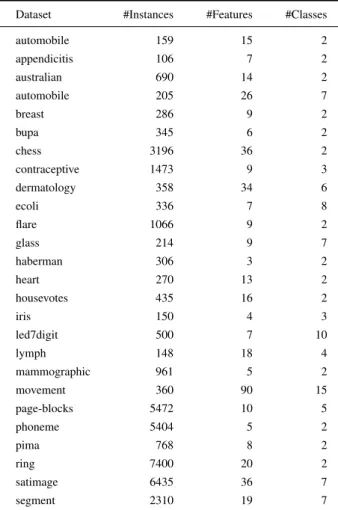
In this section, the classification performance of the pro-posed algorithm is compared with that of Self-training, Co-training and Tri-Co-training on 40 benchmark datasets from KEEL repository [2] in terms of classification accuracy.
Each self-labeled algorithm was evaluated deploying as base learners:
– C4.5 decision tree algorithm [26].
– RIPPER (JRip) [5] as the representative of the classi-fication rules.
– kNN algorithm [1] as instance-based learner.
These algorithms probably constitute three of the most ef-fective and most popular data mining algorithms for classi-fication problems [39]. In order to study the influence of the amount of labeled data, four different ratios of the training data were used: 10%, 20%, 30% and 40%. Moreover, we compared the classification performance of the proposed algorithm for each utilized base learner against the corre-sponding supervised learner.
The implementation code was written in JAVA, using WEKA Machine Learning Toolkit [13]. The configuration parameters of all the SSL methods and base learners used in the experiments are presented in Tables 1 and 2, respec-tively. It is worth noticing that the base learners were uti-lized with their the default parameter settings included in the WEKA software in order to minimize the effect of any expert bias by not attempting to tune any of the algorithms to the specific datasets.
SSL Algorithm Parameters
Self-training Maximum number of iterations= 40.
c= 95%.
Co-training Maximum number of iterations= 40.
Initial unlabeled pool= 75.
Tri-training No parameters specified.
EnSSL ThresLev= 95%.
Table 1: Parameter specification for all SSL algorithms em-ployed in the experimentation.
Base learner Parameters
C4.5 Confidence factor used for pruning= 0.25.
Minimum number of instances per leaf= 2. Number of folds used for reduced-error pruning= 3.
Pruning is performed after tree building.
JRip Number of optimization runs= 2.
Number of folds used for reduced-error pruning= 3.
Minimum total weight of the instances in a rule= 2.0.
Pruning is performed after tree building.
kNN Number of neighbors= 3.
Euclidean distance.
Table 2: Parameter specification for all base learners em-ployed in the experimentation.
Dataset #Instances #Features #Classes
automobile 159 15 2
appendicitis 106 7 2
australian 690 14 2
automobile 205 26 7
breast 286 9 2
bupa 345 6 2
chess 3196 36 2
contraceptive 1473 9 3
dermatology 358 34 6
ecoli 336 7 8
flare 1066 9 2
glass 214 9 7
haberman 306 3 2
heart 270 13 2
housevotes 435 16 2
iris 150 4 3
led7digit 500 7 10
lymph 148 18 4
mammographic 961 5 2
movement 360 90 15
page-blocks 5472 10 5
phoneme 5404 5 2
pima 768 8 2
ring 7400 20 2
satimage 6435 36 7
segment 2310 19 7
(continued).
Dataset #Instances #Features #Classes
sonar 208 60 2
spambase 4597 57 2
spectheart 267 44 2
texture 5500 40 11
thyroid 7200 21 3
tic-tac-toe 958 9 2
titanic 2201 3 2
twonorm 7400 20 2
vehicle 846 18 4
vowel 990 13 11
wisconsin 683 9 2
wine 178 13 3
yeast 1484 8 10
zoo 101 17 7
Table 3: Brief description of datasets.
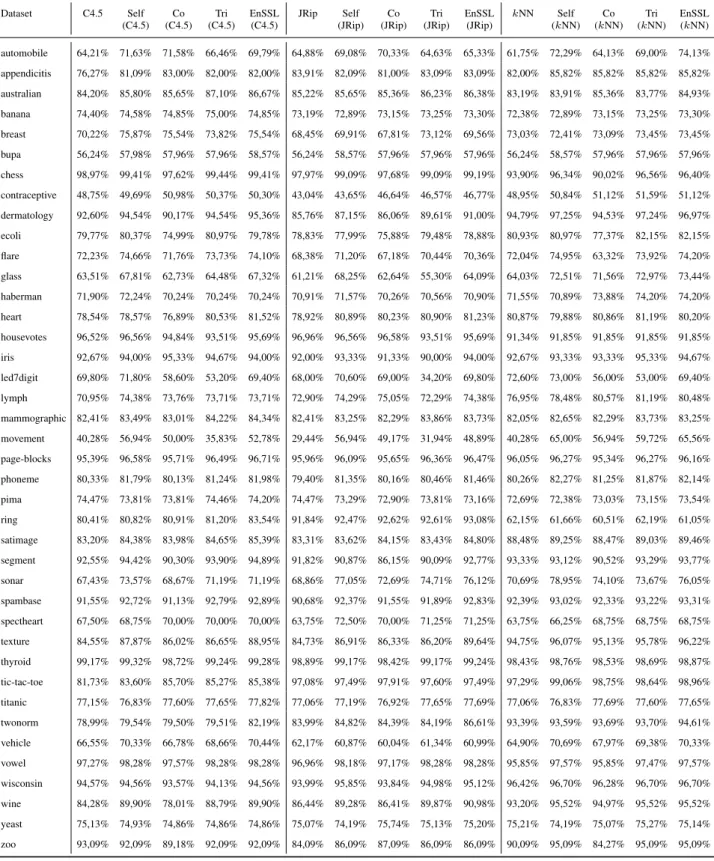
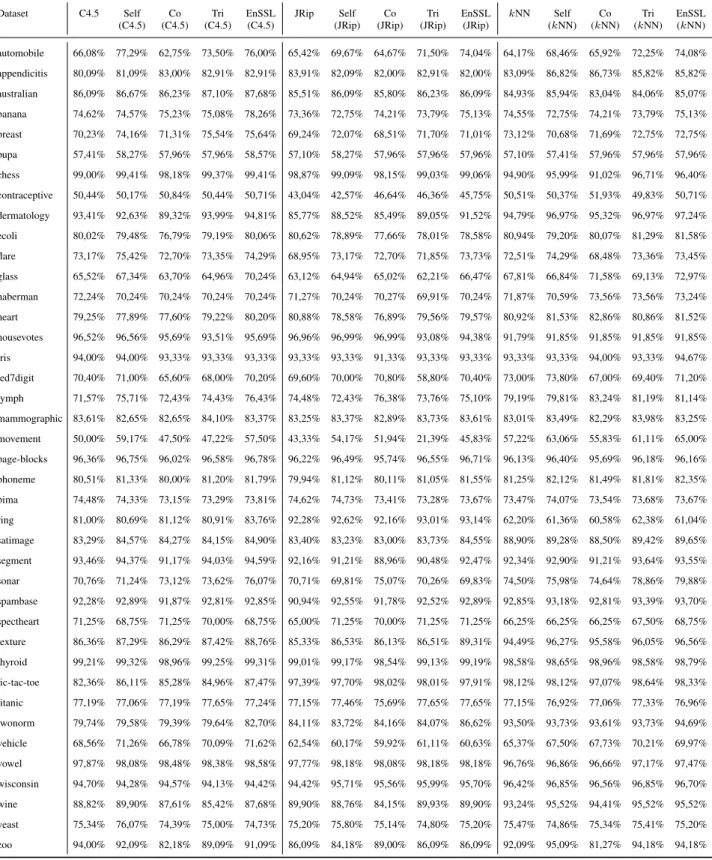
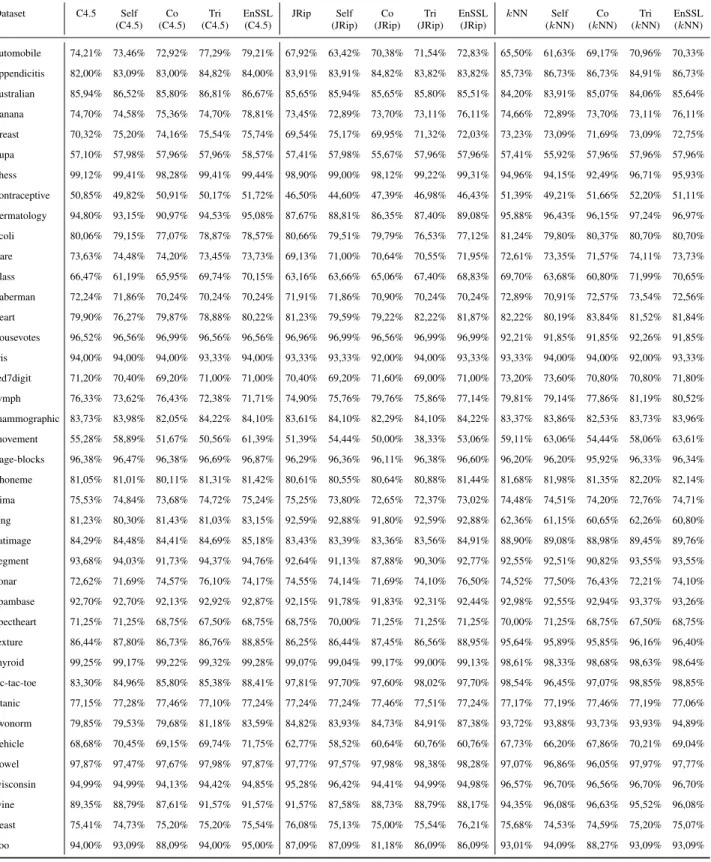
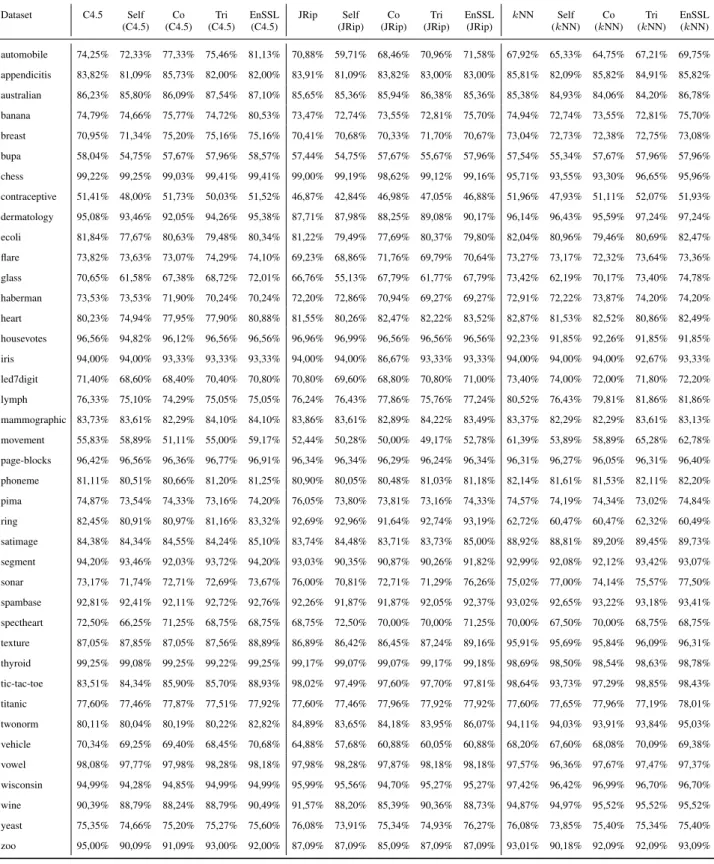
Tables 4-7 present the experimental results using 10%, 20%, 30% and 40% labeled ratio, respectively regarding all base learners.
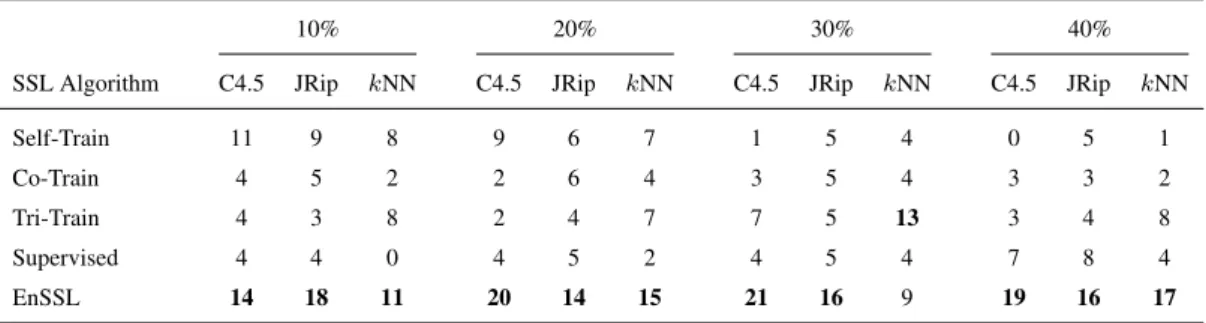
Table 8 presents the number of wins of each one of the tested algorithms according to the supervised classifier used as base learner and utilized the ratio of labeled data in the training, while the best scores are highlighted in bold. It should be mentioned that draw cases between algorithms have not been encountered. Clearly, the presented results illustrated that EnSSL is the most effective method in all cases except the one usingkNN as base learner with a la-beled ratio of 30%. In this case, Tri-training performs bet-ter in 13 datasets, followed by EnSSL (9 wins). It is worth noticing that
– Depending upon the the ratio of labeled instances in the training set, EnSSL illustrates the highest classifi-cation accuracy in 46.2% of the datasets for 10% la-beled ratio, 40% of the datasets for lala-beled ratio 20%, 44.4% of the datasets for labeled ratio 30% and 44.4% of the datasets for 40% labeled ratio. Obviously, En-SSL exhibits better classification accuracy for 10% and 40% labeled ratio.
Dataset C4.5 Self (C4.5)
Co (C4.5)
Tri (C4.5)
EnSSL (C4.5)
JRip Self (JRip)
Co (JRip)
Tri (JRip)
EnSSL (JRip)
kNN Self (kNN)
Co (kNN)
Tri (kNN)
EnSSL (kNN) automobile 64,21% 71,63% 71,58% 66,46% 69,79% 64,88% 69,08% 70,33% 64,63% 65,33% 61,75% 72,29% 64,13% 69,00% 74,13%
appendicitis 76,27% 81,09% 83,00% 82,00% 82,00% 83,91% 82,09% 81,00% 83,09% 83,09% 82,00% 85,82% 85,82% 85,82% 85,82%
australian 84,20% 85,80% 85,65% 87,10% 86,67% 85,22% 85,65% 85,36% 86,23% 86,38% 83,19% 83,91% 85,36% 83,77% 84,93%
banana 74,40% 74,58% 74,85% 75,00% 74,85% 73,19% 72,89% 73,15% 73,25% 73,30% 72,38% 72,89% 73,15% 73,25% 73,30%
breast 70,22% 75,87% 75,54% 73,82% 75,54% 68,45% 69,91% 67,81% 73,12% 69,56% 73,03% 72,41% 73,09% 73,45% 73,45%
bupa 56,24% 57,98% 57,96% 57,96% 58,57% 56,24% 58,57% 57,96% 57,96% 57,96% 56,24% 58,57% 57,96% 57,96% 57,96%
chess 98,97% 99,41% 97,62% 99,44% 99,41% 97,97% 99,09% 97,68% 99,09% 99,19% 93,90% 96,34% 90,02% 96,56% 96,40%
contraceptive 48,75% 49,69% 50,98% 50,37% 50,30% 43,04% 43,65% 46,64% 46,57% 46,77% 48,95% 50,84% 51,12% 51,59% 51,12%
dermatology 92,60% 94,54% 90,17% 94,54% 95,36% 85,76% 87,15% 86,06% 89,61% 91,00% 94,79% 97,25% 94,53% 97,24% 96,97%
ecoli 79,77% 80,37% 74,99% 80,97% 79,78% 78,83% 77,99% 75,88% 79,48% 78,88% 80,93% 80,97% 77,37% 82,15% 82,15%
flare 72,23% 74,66% 71,76% 73,73% 74,10% 68,38% 71,20% 67,18% 70,44% 70,36% 72,04% 74,95% 63,32% 73,92% 74,20%
glass 63,51% 67,81% 62,73% 64,48% 67,32% 61,21% 68,25% 62,64% 55,30% 64,09% 64,03% 72,51% 71,56% 72,97% 73,44%
haberman 71,90% 72,24% 70,24% 70,24% 70,24% 70,91% 71,57% 70,26% 70,56% 70,90% 71,55% 70,89% 73,88% 74,20% 74,20%
heart 78,54% 78,57% 76,89% 80,53% 81,52% 78,92% 80,89% 80,23% 80,90% 81,23% 80,87% 79,88% 80,86% 81,19% 80,20%
housevotes 96,52% 96,56% 94,84% 93,51% 95,69% 96,96% 96,56% 96,58% 93,51% 95,69% 91,34% 91,85% 91,85% 91,85% 91,85%
iris 92,67% 94,00% 95,33% 94,67% 94,00% 92,00% 93,33% 91,33% 90,00% 94,00% 92,67% 93,33% 93,33% 95,33% 94,67%
led7digit 69,80% 71,80% 58,60% 53,20% 69,40% 68,00% 70,60% 69,00% 34,20% 69,80% 72,60% 73,00% 56,00% 53,00% 69,40%
lymph 70,95% 74,38% 73,76% 73,71% 73,71% 72,90% 74,29% 75,05% 72,29% 74,38% 76,95% 78,48% 80,57% 81,19% 80,48%
mammographic 82,41% 83,49% 83,01% 84,22% 84,34% 82,41% 83,25% 82,29% 83,86% 83,73% 82,05% 82,65% 82,29% 83,73% 83,25%
movement 40,28% 56,94% 50,00% 35,83% 52,78% 29,44% 56,94% 49,17% 31,94% 48,89% 40,28% 65,00% 56,94% 59,72% 65,56%
page-blocks 95,39% 96,58% 95,71% 96,49% 96,71% 95,96% 96,09% 95,65% 96,36% 96,47% 96,05% 96,27% 95,34% 96,27% 96,16%
phoneme 80,33% 81,79% 80,13% 81,24% 81,98% 79,40% 81,35% 80,16% 80,46% 81,46% 80,26% 82,27% 81,25% 81,87% 82,14%
pima 74,47% 73,81% 73,81% 74,46% 74,20% 74,47% 73,29% 72,90% 73,81% 73,16% 72,69% 72,38% 73,03% 73,15% 73,54%
ring 80,41% 80,82% 80,91% 81,20% 83,54% 91,84% 92,47% 92,62% 92,61% 93,08% 62,15% 61,66% 60,51% 62,19% 61,05%
satimage 83,20% 84,38% 83,98% 84,65% 85,39% 83,31% 83,62% 84,15% 83,43% 84,80% 88,48% 89,25% 88,47% 89,03% 89,46%
segment 92,55% 94,42% 90,30% 93,90% 94,89% 91,82% 90,87% 86,15% 90,09% 92,77% 93,33% 93,12% 90,52% 93,29% 93,77%
sonar 67,43% 73,57% 68,67% 71,19% 71,19% 68,86% 77,05% 72,69% 74,71% 76,12% 70,69% 78,95% 74,10% 73,67% 76,05%
spambase 91,55% 92,72% 91,13% 92,79% 92,89% 90,68% 92,37% 91,55% 91,89% 92,83% 92,39% 93,02% 92,33% 93,22% 93,31%
spectheart 67,50% 68,75% 70,00% 70,00% 70,00% 63,75% 72,50% 70,00% 71,25% 71,25% 63,75% 66,25% 68,75% 68,75% 68,75%
texture 84,55% 87,87% 86,02% 86,65% 88,95% 84,73% 86,91% 86,33% 86,20% 89,64% 94,75% 96,07% 95,13% 95,78% 96,22%
thyroid 99,17% 99,32% 98,72% 99,24% 99,28% 98,89% 99,17% 98,42% 99,17% 99,24% 98,43% 98,76% 98,53% 98,69% 98,87%
tic-tac-toe 81,73% 83,60% 85,70% 85,27% 85,38% 97,08% 97,49% 97,91% 97,60% 97,49% 97,29% 99,06% 98,75% 98,64% 98,96%
titanic 77,15% 76,83% 77,60% 77,65% 77,82% 77,06% 77,19% 76,92% 77,65% 77,69% 77,06% 76,83% 77,69% 77,60% 77,65%
twonorm 78,99% 79,54% 79,50% 79,51% 82,19% 83,99% 84,82% 84,39% 84,19% 86,61% 93,39% 93,59% 93,69% 93,70% 94,61%
vehicle 66,55% 70,33% 66,78% 68,66% 70,44% 62,17% 60,87% 60,04% 61,34% 60,99% 64,90% 70,69% 67,97% 69,38% 70,33%
vowel 97,27% 98,28% 97,57% 98,28% 98,28% 96,96% 98,18% 97,17% 98,28% 98,28% 95,85% 97,57% 95,85% 97,47% 97,57%
wisconsin 94,57% 94,56% 93,57% 94,13% 94,56% 93,99% 95,85% 93,84% 94,98% 95,12% 96,42% 96,70% 96,28% 96,70% 96,70%
wine 84,28% 89,90% 78,01% 88,79% 89,90% 86,44% 89,28% 86,41% 89,87% 90,98% 93,20% 95,52% 94,97% 95,52% 95,52%
yeast 75,13% 74,93% 74,86% 74,86% 74,86% 75,07% 74,19% 75,74% 75,13% 75,20% 75,21% 74,19% 75,07% 75,27% 75,14%
zoo 93,09% 92,09% 89,18% 92,09% 92,09% 84,09% 86,09% 87,09% 86,09% 86,09% 90,09% 95,09% 84,27% 95,09% 95,09%
Dataset C4.5 Self (C4.5)
Co (C4.5)
Tri (C4.5)
EnSSL (C4.5)
JRip Self (JRip)
Co (JRip)
Tri (JRip)
EnSSL (JRip)
kNN Self (kNN)
Co (kNN)
Tri (kNN)
EnSSL (kNN) automobile 66,08% 77,29% 62,75% 73,50% 76,00% 65,42% 69,67% 64,67% 71,50% 74,04% 64,17% 68,46% 65,92% 72,25% 74,08%
appendicitis 80,09% 81,09% 83,00% 82,91% 82,91% 83,91% 82,09% 82,00% 82,91% 82,00% 83,09% 86,82% 86,73% 85,82% 85,82%
australian 86,09% 86,67% 86,23% 87,10% 87,68% 85,51% 86,09% 85,80% 86,23% 86,09% 84,93% 85,94% 83,04% 84,06% 85,07%
banana 74,62% 74,57% 75,23% 75,08% 78,26% 73,36% 72,75% 74,21% 73,79% 75,13% 74,55% 72,75% 74,21% 73,79% 75,13%
breast 70,23% 74,16% 71,31% 75,54% 75,64% 69,24% 72,07% 68,51% 71,70% 71,01% 73,12% 70,68% 71,69% 72,75% 72,75%
bupa 57,41% 58,27% 57,96% 57,96% 58,57% 57,10% 58,27% 57,96% 57,96% 57,96% 57,10% 57,41% 57,96% 57,96% 57,96%
chess 99,00% 99,41% 98,18% 99,37% 99,41% 98,87% 99,09% 98,15% 99,03% 99,06% 94,90% 95,99% 91,02% 96,71% 96,40%
contraceptive 50,44% 50,17% 50,84% 50,44% 50,71% 43,04% 42,57% 46,64% 46,36% 45,75% 50,51% 50,37% 51,93% 49,83% 50,71%
dermatology 93,41% 92,63% 89,32% 93,99% 94,81% 85,77% 88,52% 85,49% 89,05% 91,52% 94,79% 96,97% 95,32% 96,97% 97,24%
ecoli 80,02% 79,48% 76,79% 79,19% 80,06% 80,62% 78,89% 77,66% 78,01% 78,58% 80,94% 79,20% 80,07% 81,29% 81,58%
flare 73,17% 75,42% 72,70% 73,35% 74,29% 68,95% 73,17% 72,70% 71,85% 73,73% 72,51% 74,29% 68,48% 73,36% 73,45%
glass 65,52% 67,34% 63,70% 64,96% 70,24% 63,12% 64,94% 65,02% 62,21% 66,47% 67,81% 66,84% 71,58% 69,13% 72,97%
haberman 72,24% 70,24% 70,24% 70,24% 70,24% 71,27% 70,24% 70,27% 69,91% 70,24% 71,87% 70,59% 73,56% 73,56% 73,24%
heart 79,25% 77,89% 77,60% 79,22% 80,20% 80,88% 78,58% 76,89% 79,56% 79,57% 80,92% 81,53% 82,86% 80,86% 81,52%
housevotes 96,52% 96,56% 95,69% 93,51% 95,69% 96,96% 96,99% 96,99% 93,08% 94,38% 91,79% 91,85% 91,85% 91,85% 91,85%
iris 94,00% 94,00% 93,33% 93,33% 93,33% 93,33% 93,33% 91,33% 93,33% 93,33% 93,33% 93,33% 94,00% 93,33% 94,67%
led7digit 70,40% 71,00% 65,60% 68,00% 70,20% 69,60% 70,00% 70,80% 58,80% 70,40% 73,00% 73,80% 67,00% 69,40% 71,20%
lymph 71,57% 75,71% 72,43% 74,43% 76,43% 74,48% 72,43% 76,38% 73,76% 75,10% 79,19% 79,81% 83,24% 81,19% 81,14%
mammographic 83,61% 82,65% 82,65% 84,10% 83,37% 83,25% 83,37% 82,89% 83,73% 83,61% 83,01% 83,49% 82,29% 83,98% 83,25%
movement 50,00% 59,17% 47,50% 47,22% 57,50% 43,33% 54,17% 51,94% 21,39% 45,83% 57,22% 63,06% 55,83% 61,11% 65,00%
page-blocks 96,36% 96,75% 96,02% 96,58% 96,78% 96,22% 96,49% 95,74% 96,55% 96,71% 96,13% 96,40% 95,69% 96,18% 96,16%
phoneme 80,51% 81,33% 80,00% 81,20% 81,79% 79,94% 81,12% 80,11% 81,05% 81,55% 81,25% 82,12% 81,49% 81,81% 82,35%
pima 74,48% 74,33% 73,15% 73,29% 73,81% 74,62% 74,73% 73,41% 73,28% 73,67% 73,47% 74,07% 73,54% 73,68% 73,67%
ring 81,00% 80,69% 81,12% 80,91% 83,76% 92,28% 92,62% 92,16% 93,01% 93,14% 62,20% 61,36% 60,58% 62,38% 61,04%
satimage 83,29% 84,57% 84,27% 84,15% 84,90% 83,40% 83,23% 83,00% 83,73% 84,55% 88,90% 89,28% 88,50% 89,42% 89,65%
segment 93,46% 94,37% 91,17% 94,03% 94,59% 92,16% 91,21% 88,96% 90,48% 92,47% 92,34% 92,90% 91,21% 93,64% 93,55%
sonar 70,76% 71,24% 73,12% 73,62% 76,07% 70,71% 69,81% 75,07% 70,26% 69,83% 74,50% 75,98% 74,64% 78,86% 79,88%
spambase 92,28% 92,89% 91,87% 92,81% 92,85% 90,94% 92,55% 91,78% 92,52% 92,89% 92,85% 93,18% 92,81% 93,39% 93,70%
spectheart 71,25% 68,75% 71,25% 70,00% 68,75% 65,00% 71,25% 70,00% 71,25% 71,25% 66,25% 66,25% 66,25% 67,50% 68,75%
texture 86,36% 87,29% 86,29% 87,42% 88,76% 85,33% 86,53% 86,13% 86,51% 89,31% 94,49% 96,27% 95,58% 96,05% 96,56%
thyroid 99,21% 99,32% 98,96% 99,25% 99,31% 99,01% 99,17% 98,54% 99,13% 99,19% 98,58% 98,65% 98,96% 98,58% 98,79%
tic-tac-toe 82,36% 86,11% 85,28% 84,96% 87,47% 97,39% 97,70% 98,02% 98,01% 97,91% 98,12% 98,12% 97,07% 98,64% 98,33%
titanic 77,19% 77,06% 77,19% 77,65% 77,24% 77,15% 77,46% 75,69% 77,65% 77,65% 77,15% 76,92% 77,06% 77,33% 76,96%
twonorm 79,74% 79,58% 79,39% 79,64% 82,70% 84,11% 83,72% 84,16% 84,07% 86,62% 93,50% 93,73% 93,61% 93,73% 94,69%
vehicle 68,56% 71,26% 66,78% 70,09% 71,62% 62,54% 60,17% 59,92% 61,11% 60,63% 65,37% 67,50% 67,73% 70,21% 69,97%
vowel 97,87% 98,08% 98,48% 98,38% 98,58% 97,77% 98,18% 98,08% 98,18% 98,18% 96,76% 96,86% 96,66% 97,17% 97,47%
wisconsin 94,70% 94,28% 94,57% 94,13% 94,42% 94,42% 95,71% 95,56% 95,99% 95,70% 96,42% 96,85% 96,56% 96,85% 96,70%
wine 88,82% 89,90% 87,61% 85,42% 87,68% 89,90% 88,76% 84,15% 89,93% 89,90% 93,24% 95,52% 94,41% 95,52% 95,52%
yeast 75,34% 76,07% 74,39% 75,00% 74,73% 75,20% 75,80% 75,14% 74,80% 75,20% 75,47% 74,86% 75,34% 75,41% 75,20%
zoo 94,00% 92,09% 82,18% 89,09% 91,09% 86,09% 84,18% 89,00% 86,09% 86,09% 92,09% 95,09% 81,27% 94,18% 94,18%
Dataset C4.5 Self (C4.5)
Co (C4.5)
Tri (C4.5)
EnSSL (C4.5)
JRip Self (JRip)
Co (JRip)
Tri (JRip)
EnSSL (JRip)
kNN Self (kNN)
Co (kNN)
Tri (kNN)
EnSSL (kNN) automobile 74,21% 73,46% 72,92% 77,29% 79,21% 67,92% 63,42% 70,38% 71,54% 72,83% 65,50% 61,63% 69,17% 70,96% 70,33%
appendicitis 82,00% 83,09% 83,00% 84,82% 84,00% 83,91% 83,91% 84,82% 83,82% 83,82% 85,73% 86,73% 86,73% 84,91% 86,73%
australian 85,94% 86,52% 85,80% 86,81% 86,67% 85,65% 85,94% 85,65% 85,80% 85,51% 84,20% 83,91% 85,07% 84,06% 85,64%
banana 74,70% 74,58% 75,36% 74,70% 78,81% 73,45% 72,89% 73,70% 73,11% 76,11% 74,66% 72,89% 73,70% 73,11% 76,11%
breast 70,32% 75,20% 74,16% 75,54% 75,74% 69,54% 75,17% 69,95% 71,32% 72,03% 73,23% 73,09% 71,69% 73,09% 72,75%
bupa 57,10% 57,98% 57,96% 57,96% 58,57% 57,41% 57,98% 55,67% 57,96% 57,96% 57,41% 55,92% 57,96% 57,96% 57,96%
chess 99,12% 99,41% 98,28% 99,41% 99,44% 98,90% 99,00% 98,12% 99,22% 99,31% 94,96% 94,15% 92,49% 96,71% 95,93%
contraceptive 50,85% 49,82% 50,91% 50,17% 51,72% 46,50% 44,60% 47,39% 46,98% 46,43% 51,39% 49,21% 51,66% 52,20% 51,11%
dermatology 94,80% 93,15% 90,97% 94,53% 95,08% 87,67% 88,81% 86,35% 87,40% 89,08% 95,88% 96,43% 96,15% 97,24% 96,97%
ecoli 80,06% 79,15% 77,07% 78,87% 78,57% 80,66% 79,51% 79,79% 76,53% 77,12% 81,24% 79,80% 80,37% 80,70% 80,70%
flare 73,63% 74,48% 74,20% 73,45% 73,73% 69,13% 71,00% 70,64% 70,55% 71,95% 72,61% 73,35% 71,57% 74,11% 73,73%
glass 66,47% 61,19% 65,95% 69,74% 70,15% 63,16% 63,66% 65,06% 67,40% 68,83% 69,70% 63,68% 60,80% 71,99% 70,65%
haberman 72,24% 71,86% 70,24% 70,24% 70,24% 71,91% 71,86% 70,90% 70,24% 70,24% 72,89% 70,91% 72,57% 73,54% 72,56%
heart 79,90% 76,27% 79,87% 78,88% 80,22% 81,23% 79,59% 79,22% 82,22% 81,87% 82,22% 80,19% 83,84% 81,52% 81,84%
housevotes 96,52% 96,56% 96,99% 96,56% 96,56% 96,96% 96,99% 96,56% 96,99% 96,99% 92,21% 91,85% 91,85% 92,26% 91,85%
iris 94,00% 94,00% 94,00% 93,33% 94,00% 93,33% 93,33% 92,00% 94,00% 93,33% 93,33% 94,00% 94,00% 92,00% 93,33%
led7digit 71,20% 70,40% 69,20% 71,00% 71,00% 70,40% 69,20% 71,60% 69,00% 71,00% 73,20% 73,60% 70,80% 70,80% 71,80%
lymph 76,33% 73,62% 76,43% 72,38% 71,71% 74,90% 75,76% 79,76% 75,86% 77,14% 79,81% 79,14% 77,86% 81,19% 80,52%
mammographic 83,73% 83,98% 82,05% 84,22% 84,10% 83,61% 84,10% 82,29% 84,10% 84,22% 83,37% 83,86% 82,53% 83,73% 83,96%
movement 55,28% 58,89% 51,67% 50,56% 61,39% 51,39% 54,44% 50,00% 38,33% 53,06% 59,11% 63,06% 54,44% 58,06% 63,61%
page-blocks 96,38% 96,47% 96,38% 96,69% 96,87% 96,29% 96,36% 96,11% 96,38% 96,60% 96,20% 96,20% 95,92% 96,33% 96,34%
phoneme 81,05% 81,01% 80,11% 81,31% 81,42% 80,61% 80,55% 80,64% 80,88% 81,44% 81,68% 81,98% 81,35% 82,20% 82,14%
pima 75,53% 74,84% 73,68% 74,72% 75,24% 75,25% 73,80% 72,65% 72,37% 73,02% 74,48% 74,51% 74,20% 72,76% 74,71%
ring 81,23% 80,30% 81,43% 81,03% 83,15% 92,59% 92,88% 91,80% 92,59% 92,88% 62,36% 61,15% 60,65% 62,26% 60,80%
satimage 84,29% 84,48% 84,41% 84,69% 85,18% 83,43% 83,39% 83,36% 83,56% 84,91% 88,90% 89,08% 88,98% 89,45% 89,76%
segment 93,68% 94,03% 91,73% 94,37% 94,76% 92,64% 91,13% 87,88% 90,30% 92,77% 92,55% 92,51% 90,82% 93,55% 93,55%
sonar 72,62% 71,69% 74,57% 76,10% 74,17% 74,55% 74,14% 71,69% 74,10% 76,50% 74,52% 77,50% 76,43% 72,21% 74,10%
spambase 92,70% 92,70% 92,13% 92,92% 92,87% 92,15% 91,78% 91,83% 92,31% 92,44% 92,98% 92,55% 92,94% 93,37% 93,26%
spectheart 71,25% 71,25% 68,75% 67,50% 68,75% 68,75% 70,00% 71,25% 71,25% 71,25% 70,00% 71,25% 68,75% 67,50% 68,75%
texture 86,44% 87,80% 86,73% 86,76% 88,85% 86,25% 86,44% 87,45% 86,56% 88,95% 95,64% 95,89% 95,85% 96,16% 96,40%
thyroid 99,25% 99,17% 99,22% 99,32% 99,28% 99,07% 99,04% 99,17% 99,00% 99,13% 98,61% 98,33% 98,68% 98,63% 98,64%
tic-tac-toe 83,30% 84,96% 85,80% 85,38% 88,41% 97,81% 97,70% 97,60% 98,02% 97,70% 98,54% 96,45% 97,07% 98,85% 98,85%
titanic 77,15% 77,28% 77,46% 77,10% 77,24% 77,24% 77,24% 77,46% 77,51% 77,24% 77,17% 77,19% 77,46% 77,19% 77,06%
twonorm 79,85% 79,53% 79,68% 81,18% 83,59% 84,82% 83,93% 84,73% 84,91% 87,38% 93,72% 93,88% 93,73% 93,93% 94,89%
vehicle 68,68% 70,45% 69,15% 69,74% 71,75% 62,77% 58,52% 60,64% 60,76% 60,76% 67,73% 66,20% 67,86% 70,21% 69,04%
vowel 97,87% 97,47% 97,67% 97,98% 97,87% 97,77% 97,57% 97,98% 98,38% 98,28% 97,07% 96,86% 96,05% 97,97% 97,77%
wisconsin 94,99% 94,99% 94,13% 94,42% 94,85% 95,28% 96,42% 94,41% 94,99% 94,98% 96,57% 96,70% 96,56% 96,70% 96,70%
wine 89,35% 88,79% 87,61% 91,57% 91,57% 91,57% 87,58% 88,73% 88,79% 88,17% 94,35% 96,08% 96,63% 95,52% 96,08%
yeast 75,41% 74,73% 75,20% 75,20% 75,54% 76,08% 75,13% 75,00% 75,54% 76,21% 75,68% 74,53% 74,59% 75,20% 75,07%
zoo 94,00% 93,09% 88,09% 94,00% 95,00% 87,09% 87,09% 81,18% 86,09% 86,09% 93,01% 94,09% 88,27% 93,09% 93,09%
Dataset C4.5 Self (C4.5)
Co (C4.5)
Tri (C4.5)
EnSSL (C4.5)
JRip Self (JRip)
Co (JRip)
Tri (JRip)
EnSSL (JRip)
kNN Self (kNN)
Co (kNN)
Tri (kNN)
EnSSL (kNN) automobile 74,25% 72,33% 77,33% 75,46% 81,13% 70,88% 59,71% 68,46% 70,96% 71,58% 67,92% 65,33% 64,75% 67,21% 69,75%
appendicitis 83,82% 81,09% 85,73% 82,00% 82,00% 83,91% 81,09% 83,82% 83,00% 83,00% 85,81% 82,09% 85,82% 84,91% 85,82%
australian 86,23% 85,80% 86,09% 87,54% 87,10% 85,65% 85,36% 85,94% 86,38% 85,36% 85,38% 84,93% 84,06% 84,20% 86,78%
banana 74,79% 74,66% 75,77% 74,72% 80,53% 73,47% 72,74% 73,55% 72,81% 75,70% 74,94% 72,74% 73,55% 72,81% 75,70%
breast 70,95% 71,34% 75,20% 75,16% 75,16% 70,41% 70,68% 70,33% 71,70% 70,67% 73,04% 72,73% 72,38% 72,75% 73,08%
bupa 58,04% 54,75% 57,67% 57,96% 58,57% 57,44% 54,75% 57,67% 55,67% 57,96% 57,54% 55,34% 57,67% 57,96% 57,96%
chess 99,22% 99,25% 99,03% 99,41% 99,41% 99,00% 99,19% 98,62% 99,12% 99,16% 95,71% 93,55% 93,30% 96,65% 95,96%
contraceptive 51,41% 48,00% 51,73% 50,03% 51,52% 46,87% 42,84% 46,98% 47,05% 46,88% 51,96% 47,93% 51,11% 52,07% 51,93%
dermatology 95,08% 93,46% 92,05% 94,26% 95,38% 87,71% 87,98% 88,25% 89,08% 90,17% 96,14% 96,43% 95,59% 97,24% 97,24%
ecoli 81,84% 77,67% 80,63% 79,48% 80,34% 81,22% 79,49% 77,69% 80,37% 79,80% 82,04% 80,96% 79,46% 80,69% 82,47%
flare 73,82% 73,63% 73,07% 74,29% 74,10% 69,23% 68,86% 71,76% 69,79% 70,64% 73,27% 73,17% 72,32% 73,64% 73,36%
glass 70,65% 61,58% 67,38% 68,72% 72,01% 66,76% 55,13% 67,79% 61,77% 67,79% 73,42% 62,19% 70,17% 73,40% 74,78%
haberman 73,53% 73,53% 71,90% 70,24% 70,24% 72,20% 72,86% 70,94% 69,27% 69,27% 72,91% 72,22% 73,87% 74,20% 74,20%
heart 80,23% 74,94% 77,95% 77,90% 80,88% 81,55% 80,26% 82,47% 82,22% 83,52% 82,87% 81,53% 82,52% 80,86% 82,49%
housevotes 96,56% 94,82% 96,12% 96,56% 96,56% 96,96% 96,99% 96,56% 96,56% 96,56% 92,23% 91,85% 92,26% 91,85% 91,85%
iris 94,00% 94,00% 93,33% 93,33% 93,33% 94,00% 94,00% 86,67% 93,33% 93,33% 94,00% 94,00% 94,00% 92,67% 93,33%
led7digit 71,40% 68,60% 68,40% 70,40% 70,80% 70,80% 69,60% 68,80% 70,80% 71,00% 73,40% 74,00% 72,00% 71,80% 72,20%
lymph 76,33% 75,10% 74,29% 75,05% 75,05% 76,24% 76,43% 77,86% 75,76% 77,24% 80,52% 76,43% 79,81% 81,86% 81,86%
mammographic 83,73% 83,61% 82,29% 84,10% 84,10% 83,86% 83,61% 82,89% 84,22% 83,49% 83,37% 82,29% 82,29% 83,61% 83,13%
movement 55,83% 58,89% 51,11% 55,00% 59,17% 52,44% 50,28% 50,00% 49,17% 52,78% 61,39% 53,89% 58,89% 65,28% 62,78%
page-blocks 96,42% 96,56% 96,36% 96,77% 96,91% 96,34% 96,34% 96,29% 96,24% 96,34% 96,31% 96,27% 96,05% 96,31% 96,40%
phoneme 81,11% 80,51% 80,66% 81,20% 81,25% 80,90% 80,05% 80,48% 81,03% 81,18% 82,14% 81,61% 81,53% 82,11% 82,20%
pima 74,87% 73,54% 74,33% 73,16% 74,20% 76,05% 73,80% 73,81% 73,16% 74,33% 74,57% 74,19% 74,34% 73,02% 74,84%
ring 82,45% 80,91% 80,97% 81,16% 83,32% 92,69% 92,96% 91,64% 92,74% 93,19% 62,72% 60,47% 60,47% 62,32% 60,49%
satimage 84,38% 84,34% 84,55% 84,24% 85,10% 83,74% 84,48% 83,71% 83,73% 85,00% 88,92% 88,81% 89,20% 89,45% 89,73%
segment 94,20% 93,46% 92,03% 93,72% 94,20% 93,03% 90,35% 90,87% 90,26% 91,82% 92,99% 92,08% 92,12% 93,42% 93,07%
sonar 73,17% 71,74% 72,71% 72,69% 73,67% 76,00% 70,81% 72,71% 71,29% 76,26% 75,02% 77,00% 74,14% 75,57% 77,50%
spambase 92,81% 92,41% 92,11% 92,72% 92,76% 92,26% 91,87% 91,87% 92,05% 92,37% 93,02% 92,65% 93,22% 93,18% 93,41%
spectheart 72,50% 66,25% 71,25% 68,75% 68,75% 68,75% 72,50% 70,00% 70,00% 71,25% 70,00% 67,50% 70,00% 68,75% 68,75%
texture 87,05% 87,85% 87,05% 87,56% 88,89% 86,89% 86,42% 86,45% 87,24% 89,16% 95,91% 95,69% 95,84% 96,09% 96,31%
thyroid 99,25% 99,08% 99,25% 99,22% 99,25% 99,17% 99,07% 99,07% 99,17% 99,18% 98,69% 98,50% 98,54% 98,63% 98,78%
tic-tac-toe 83,51% 84,34% 85,90% 85,70% 88,93% 98,02% 97,49% 97,60% 97,70% 97,81% 98,64% 93,73% 97,29% 98,85% 98,43%
titanic 77,60% 77,46% 77,87% 77,51% 77,92% 77,60% 77,46% 77,96% 77,92% 77,92% 77,60% 77,65% 77,96% 77,19% 78,01%
twonorm 80,11% 80,04% 80,19% 80,22% 82,82% 84,89% 83,65% 84,18% 83,95% 86,07% 94,11% 94,03% 93,91% 93,84% 95,03%
vehicle 70,34% 69,25% 69,40% 68,45% 70,68% 64,88% 57,68% 60,88% 60,05% 60,88% 68,20% 67,60% 68,08% 70,09% 69,38%
vowel 98,08% 97,77% 97,98% 98,28% 98,18% 97,98% 98,28% 97,87% 98,18% 98,18% 97,57% 96,36% 97,67% 97,47% 97,37%
wisconsin 94,99% 94,28% 94,85% 94,99% 94,99% 95,99% 95,56% 94,70% 95,27% 95,27% 97,42% 96,42% 96,99% 96,70% 96,70%
wine 90,39% 88,79% 88,24% 88,79% 90,49% 91,57% 88,20% 85,39% 90,36% 88,73% 94,87% 94,97% 95,52% 95,52% 95,52%
yeast 75,35% 74,66% 75,20% 75,27% 75,60% 76,08% 73,91% 75,34% 74,93% 76,27% 76,08% 73,85% 75,40% 75,34% 75,40%
zoo 95,00% 90,09% 91,09% 93,00% 92,00% 87,09% 87,09% 85,09% 87,09% 87,09% 93,01% 90,18% 92,09% 92,09% 93,09%
10% 20% 30% 40%
SSL Algorithm C4.5 JRip kNN C4.5 JRip kNN C4.5 JRip kNN C4.5 JRip kNN
Self-Train 11 9 8 9 6 7 1 5 4 0 5 1
Co-Train 4 5 2 2 6 4 3 5 4 3 3 2
Tri-Train 4 3 8 2 4 7 7 5 13 3 4 8
Supervised 4 4 0 4 5 2 4 5 4 7 8 4
EnSSL 14 18 11 20 14 15 21 16 9 19 16 17
Table 8: Total wins of each SSL algorithm.
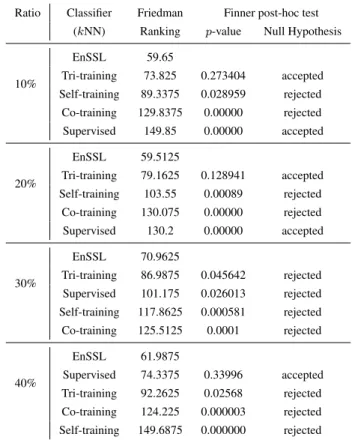
The statistical comparison of multiple algorithms over multiple data sets is fundamental in machine learning and usually it is typically carried out by means of a nonparametric statistical test. Therefore, the Friedman Aligned-Ranks (FAR) test [8] is utilized in order to conduct a complete performance comparison between all algorithms for all the different labeled ratios. Its application will allow us to highlight the existence of significant differences between the proposed algorithm and the classical SSL algorithms and evaluate the rejection of the hypothesis that all the classifiers perform equally well for a given level. Notice that FAR test is considered to be one of the most well-known tools for multiple statistical comparison tests when comparing more than two methods [10]. Furthermore, the Finner test is applied as a post hoc procedure to find out which algorithms present significant differences.
Ratio Classifier Friedman Finner post-hoc test (C4.5) Ranking p-value Null Hypothesis
10%
EnSSL 58.4375
Self-training 76.625 0.049750 rejected
Tri-training 94.7875 0.037739 rejected Co-training 128.225 0.025321 rejected
Supervised 144.425 0.012741 rejected
20%
EnSSL 56.6
Self-training 83.8 0.045583 rejected
Tri-training 103.85 0.037739 rejected Supervised 115.4875 0.025321 rejected
Co-training 142.7625 0.012741 rejected
30%
EnSSL 57.575
Tri-training 93.5375 0.044582 rejected
Supervised 108.85 0.037739 rejected Self-training 109.2625 0.025321 rejected Co-training 133.275 0.012741 rejected
(continued).
Ratio Classifier Friedman Finner post-hoc test
(C4.5) Ranking p-value Null Hypothesis
40%
EnSSL 58.475
Supervised 77.45 0.142611 accepted
Tri-training 106.9625 0.000239 rejected Co-training 116.2 0.000016 rejected
Self-training 143.4125 0.000000 rejected
Table 9: FAR test and Finner post hoc test (C4.5).
Tables 9, 10 and 11 present the information of the statis-tical analysis performed by nonparametric multiple com-parison procedures for each base learner. The best(lowest) ranking obtained in each FAR test determines the control algorithm for the post hoc test. Moreover, the adjustedp -value with Finner’s test (Finner APV) is presented based on the control algorithm, atα= 0.05level of significance. Clearly, the proposed algorithm exhibits the best overall performance, outperforming the rest SSL algorithms, since it reports the highest probability-based ranking, presenting statistically better results, relative to all labeled ratio.
6
Conclusions & future research
In this work, a new ensemble semi-supervised algorithm is proposed based on a voting methodology. The proposed al-gorithm combines the individual predictions of three SSL algorithms: Co-training, Self-training and Tri-training via a maximum-probability voting scheme. The numerical ex-periments and the presented statistical analysis indicate that the proposed algorithm EnSSL outperforms its component SSL algorithms, confirming its efficacy.
Ratio Classifier Friedman Finner post-hoc test
(JRip) Ranking p-value Null Hypothesis
10%
EnSSL 62.2625
Self-training 81.5375 0.136404 accepted
Tri-training 100.2625 0.004429 rejected Co-training 121.0125 0.136404 rejected Supervised 137.425 0.000000 rejected
20%
EnSSL 69.25
Self-training 95.225 0.044749 rejected Tri-training 102.35 0.014031 rejected
Supervised 116.7 0.000492 rejected Co-training 118.975 0.000488 rejected
30%
EnSSL 66.225
Supervised 99.9625 0.009140 rejected Tri-training 104.175 0.004484 rejected
Self-training 109.25 0.001771 rejected Co-training 122.8875 0.000048 rejected
40%
EnSSL 64.925
Supervised 76.1 0.387887 accepted
Tri-training 107.875 0.001206 rejected Co-training 121.175 0.000028 rejected
Self-training 132.425 0.000001 rejected
Table 10: FAR test and Finner post hoc test (JRip).
data can be processed in significantly less computational time. Since the experimental results are quite encourag-ing, a next step could be the evaluation of the proposed algorithm in specific scientific fields applying real world datasets, such as the educational, health care, etc.
References
[1] David W. Aha. Lazy Learning.
Dor-drecht: Kluwer Academic Publishers, 1997. https://doi.org/10.1007/978-94-017-2053-3
[2] Jesús Alcalá-Fdez, Alberto Fernández, Julián Lu-engo, Joaquín Derrac, Salvador García, Luciano Sánchez, and Francisco Herrera. Keel data-mining software tool: data set repository, integration of algo-rithms and experimental analysis framework. Jour-nal of Multiple-Valued Logic & Soft Computing, 17, 2011. https://doi.org/10.1109/nwesp.2011.6088224
[3] Ethem Alpaydin. Introduction to Machine Learn-ing. MIT Press, Cambridge, 2nd edition, 2010. https://doi.org/10.1017/s0269888906220745
[4] Avrim Blum and Tom Mitchell. Combining labeled and unlabeled data with co-training.
Ratio Classifier Friedman Finner post-hoc test
(kNN) Ranking p-value Null Hypothesis
10%
EnSSL 59.65
Tri-training 73.825 0.273404 accepted
Self-training 89.3375 0.028959 rejected Co-training 129.8375 0.00000 rejected Supervised 149.85 0.00000 accepted
20%
EnSSL 59.5125
Tri-training 79.1625 0.128941 accepted Self-training 103.55 0.00089 rejected
Co-training 130.075 0.00000 rejected Supervised 130.2 0.00000 accepted
30%
EnSSL 70.9625
Tri-training 86.9875 0.045642 rejected Supervised 101.175 0.026013 rejected
Self-training 117.8625 0.000581 rejected Co-training 125.5125 0.0001 rejected
40%
EnSSL 61.9875
Supervised 74.3375 0.33996 accepted
Tri-training 92.2625 0.02568 rejected Co-training 124.225 0.000003 rejected
Self-training 149.6875 0.000000 rejected
Table 11: FAR test and Finner post hoc test (kNN).
In 11th annual conference on Computational learning theory, pages 92–100. ACM, 1998. https://doi.org/10.1109/icdm.2001.989574
[5] William W. Cohen. Fast effective rule induction. In International Conference on Machine Learning, pages 115–123, 1995. https://doi.org/10.1016/b978-1-55860-377-6.50023-2
[6] Bozidara Cvetkovic, Boštjan Kaluza, Mitja Luštrek, and Matjaz Gams. Semi-supervised learning for adaptation of human activity recognition classifier to the user. InProceddings of International Joint Con-ference on Artificial Intelligence, pages 24–29, 2011.
[7] Asif Ekbal and Sivaji Bandyopadhyay. Named entity recognition using appropriate unlabeled data, post-processing and voting.Informatica, 34(1), 2010.
[8] Helmut Finner. On a monotonicity problem in step-down multiple test procedures. Journal of the Amer-ican Statistical Association, 88(423):920–923, 1993. https://doi.org/10.2307/2290782
[10] Salvador García, Alberto Fernández, Julián Lu-engo, and Francisco Herrera. Advanced nonpara-metric tests for multiple comparisons in the de-sign of experiments in computational intelligence and data mining: Experimental analysis of power.
Information Sciences, 180(10):2044–2064, 2010. https://doi.org/10.1016/j.ins.2009.12.010
[11] Hristijan Gjoreski, Boštjan Kaluža, Matjaž Gams, Radoje Mili´c, and Mitja Luštrek. Context-based en-semble method for human energy expenditure esti-mation. Applied Soft Computing, 37:960–970, 2015. https://doi.org/10.1016/j.asoc.2015.05.001
[12] Tao Guo and Guiyang Li. Improved tri-training with unlabeled data.Software Engineering and Knowledge Engineering: Theory and Practice, pages 139–147, 2012. https://doi.org/10.1007/978-3-642-25349-2 19
[13] Mark Hall, Eibe Frank, Geoffrey Holmes, Bern-hard Pfahringer, Peter Reutemann, and Ian H. Wit-ten. The WEKA data mining software: An update.
SIGKDD Explorations Newsletters, 11:10–18, 2009. https://doi.org/10.1145/1656274.1656278
[14] Kyaw Kyaw Htike. Hidden-layer ensemble fusion of MLP neural networks for pedestrian detection. Infor-matica, 41(1), 2017.
[15] Ludmila I. Kuncheva. Combining Pattern Clas-sifiers: Methods and Algorithms. McGraw Hill, John Wiley & Sons, Inc., second edition, 2014. https://doi.org/10.1002/9781118914564
[16] Jurica Levati´c, Sašo Džeroski, Fran Supek, and Tomislav Šmuc. Semi-supervised learning for quanti-tative structure-activity modeling.Informatica, 37(2), 2013.
[17] Ming Li and Zhi-Hua Zhou. Improve computer-aided diagnosis with machine learning techniques using undiagnosed samples. IEEE Transac-tions on Systems, Man, and Cybernetics-Part A: Systems and Humans, 37(6):1088–1098, 2007. https://doi.org/10.1109/tsmca.2007.904745
[18] Chang Liu and Pong C. Yuen. A boosted co-training algorithm for human action recogni-tion. IEEE transactions on circuits and sys-tems for video technology, 21(9):1203–1213, 2011. https://doi.org/10.1109/tcsvt.2011.2130270
[19] Ioannis E. Livieris, Ioannis Dimopoulos, Thedore Kotsilieris, and Panagiotis Pintelas. Predicting length of stay in hospitalized patients using ssl algorithms. In ACM 8th International Conference on Software
Development and Technologies for Enhancing Acces-sibility and Fighting Infoexclusion, pages 1–8, 2018. https://doi.org/10.1145/3218585.3218588
[20] Ioannis E. Livieris, Konstantina Drakopoulou, Vas-silis Tampakas, Tassos Mikropoulos, and Panagio-tis Pintelas. Predicting secondary school students’ performance utilizing a semi-supervised learning ap-proach.Journal of Educational Computing Research, 2018. https://doi.org/10.1177/0735633117752614
[21] Ioannis E. Livieris, Konstantina Drakopoulou, Vas-silis Tampakas, Tassos Mikropoulos, and Panagiotis Pintelas. Research on e-Learning and ICT in Edu-cation, chapter An ensemble-based semi-supervised approach for predicting students’ performance, page 25-42. Springer, 2018. https://doi.org/10.1007/978-3-319-95059-4 2
[22] Ioannis E. Livieris, Andreas Kanavos, Vassilis Tampakas, and Panagiotis Pintelas. An ensem-ble SSL algorithm for efficient chest x-ray image classification. Journal of Imaging, 4(7), 2018. https://doi.org/10.3390/jimaging4070095
[23] Ioannis E. Livieris, Tassos Mikropoulos, and Panagi-otis Pintelas. A decision support system for predicting students’ performance. Themes in Science and Tech-nology Education, 9:43–57, 2016.
[24] Christopher J. Merz. Using correspondence analysis to combine classifiers.Machine Learning, 36:33–58, 1999. https://doi.org/10.1023/A:1007559205422
[25] Vincent Ng and Claire Cardie. Weakly su-pervised natural language learning without redun-dant views. In Proceedings of the 2003 Confer-ence of the North American Chapter of the As-sociation for Computational Linguistics on Hu-man Language Technology-Volume 1, pages 94–101. Association for Computational Linguistics, 2003. https://doi.org/10.3115/1073445.1073468
[26] J. Ross Quinlan. C4.5: Programs for machine learning. Morgan Kaufmann, San Francisco, 1993. https://doi.org/10.1007/BF00993309
[27] Matteo Re and Giorgio Valentini. Advances in Machine Learning and Data Mining for As-tronomy, chapter Ensemble methods: A re-view, pages 563–594. Chapman & Hall, 2012. https://doi.org/10.1201/b11822-34
[29] Moumita Roy, Susmita Ghosh, Ashish Ghosh. A novel approach for change detection of remotely sensed images using semi-supervised multiple classi-fier system. Information Sciences, 269:35–47, 2014. https://doi.org/10.1016/j.ins.2014.01.037
[30] S.K. Satapathy, A.K. Jagadev, and S. Dehuri. An empirical analysis of different machine learning tech-niques for classification of EEG signal to detect epileptic seizure.Informatica, 41(1), 2017.
[31] Sandeep Kumar Satapathy, Alok Kumar Jagadev, and Satchidananda Dehuri. Weighted majority voting based ensemble of classifiers using different machine learning techniques for classification of EEG signal to detect epileptic seizure.Informatica, 41(1):99, 2017.
[32] Gasper Slapniˇcar, Mitja Luštrek, and Matej Marinko. Continuous blood pressure estimation from PPG sig-nal.Informatica, 42(1), 2018.
[33] Shiliang Sun and Feng Jin. Robust co-training.
International Journal of Pattern Recognition and Artificial Intelligence, 25(07):1113–1126, 2011. https://doi.org/10.1142/s0218001411008981
[34] Shiliang Sun and Qingjiu Zhang. Multiple-view multiple-learner semi-supervised learn-ing. Neural processing letters, 34(3):229, 2011. https://doi.org/10.1007/s11063-011-9195-8
[35] Isaac Triguero, Salvador García, and Francisco Herrera. SEG-SSC: A framework based on synthetic examples generation for self-labeled semi-supervised classification. IEEE Trans-actions on Cybernetics, 45:622–634, 2014. https://doi.org/10.1109/tcyb.2014.2332003
[36] Isaac Triguero, Salvador García, and Francisco Her-rera. Self-labeled techniques for semi-supervised learning: taxonomy, software and empirical study.
Knowledge and Information Systems, 42(2):245–284, 2015. https://doi.org/10.1007/s10115-013-0706-y
[37] Isaac Triguero, José A. Sáez, Julián Luengo, Salvador García, and Francisco Herrera. On the characterization of noise filters for self-training semi-supervised in nearest neighbor classification. Neurocomputing, 132:30–41, 2014. https://doi.org/10.1016/j.neucom.2013.05.055
[38] Julius Venskus, Povilas Treigys, Jolita Bernataviˇcien˙e, Viktor Medvedev, Miroslav Voz-nak, Mindaugas Kurmis, and Violeta Bulbenkien˙e. Integration of a self-organizing map and a virtual
pheromone for real-time abnormal movement detec-tion in marine traffic. Informatica, 28(2):359–374, 2017.
[39] Xindong Wu, Vipin Kumar, J. Ross Quinlan, Joy-deep Ghosh, Qiang Yang, Hiroshi Motoda, Geoffrey J. McLachlan, Angus Ng, Bing Liu, and Philip S. Yu, Zhi-Hua Zhou, Michael Steinbach, David J. Hand, and Dan Steinberg Top 10 algorithms in data min-ing.Knowledge and information systems, 14(1):1–37, 2008. https://doi.org/10.1201/9781420089653
[40] Qian Xu, Derek Hao Hu, Hong Xue, Weichuan Yu, and Qiang Yang. Semi-supervised protein subcellular localization. BMC bioinformatics, 10(1):S47, 2009. https://doi.org/10.1186/1471-2105-10-s1-s47
[41] David Yarowsky. Unsupervised word sense disam-biguation rivaling supervised methods. In Proceed-ings of the 33rd annual meeting of the association for computational linguistics, pages 189–196, 1995. https://doi.org/10.3115/981658.981684
[42] Yan Zhou and Sally Goldman. Democratic co-learning. In 16th IEEE International Conference on Tools with Artificial Intelli-gence (ICTAI), pages 594–602. IEEE, 2004. https://doi.org/10.1109/ictai.2004.48
[43] Zhi-Hua Zhou. When semi-supervised learning meets ensemble learning. In Frontiers of Electrical and Electronic Engineering in China, volume 6, pages 6– 16. Springer, 2011. https://doi.org/10.1007/s11460-011-0126-2
[44] Zhi-Hua Zhou and Ming Li. Tri-training: Exploiting unlabeled data using three classi-fiers. IEEE Transactions on Knowledge and Data Engineering, 17(11):1529–1541, 2005. https://doi.org/10.1109/tkde.2005.186
[45] Xiaojin Zhu. Semi-supervised learning. In Encyclo-pedia of Machine Learning, pages 892–897. Springer, 2011.