VOLUME 18 ISSUE 1 (2020), Page 66 – 77
EFFECTS OF SUSTAINABLE CONSTRUCTION SITE PRACTICES ON ENVIRONMENTAL PERFORMANCE OF CONSTRUCTION
PROJECTS IN NIGERIA
Hilary Omatule Onubi1, Nor’Aini Yusof2 & Ahmad Sanusi Hassan3
1,2,3
School of Housing, Building and Planning UNIVERSITI SAINS MALAYSIA
Abstract
There are growing calls for construction site activities to be carried out in a sustainable manner. The reason for these calls is not far-fetched in view of the enormous impact such construction activities have on the natural environment. The objective of this study is to examine the effects of green construction site practices on environmental performance of construction projects in Nigeria. The effects of three green construction site practices namely waste management, materials management and energy management on environmental performance were analysed. 168 questionnaires were administered to site managers and project managers from “class A” contractors. The data were analysed using partial least squares-structural equation modelling. The results indicate that waste management has an insignificant impact on environmental performance, while materials management and energy management have positive effects on environmental performance. The results imply that not all sustainable construction site practices lead towards the attainment of environmental performance. The study has both theoretical and practical implication that helps policy makers and contractors to better understand the relationships that exists between these variables of sustainable construction site practices as well as environmental performance. This is essential in order to come out with a better plan for their projects and formulation of appropriate policies.
INTRODUCTION
Green construction site practices is an avenue for constructing buildings and civil structures using approaches of construction that guarantees a reduction in the negative effects construction activities have on the environment (Ali & Al Nsairat, 2009). Activities carried out at various stages of the construction process consume considerable amount of resources which results in resource depletion and also produce substances and greenhouse gases which are injurious to the environment and humans (Zhang, Sandanayake, Setunge, Li, & Fang, 2017). The quest for economic advancement and the continuous upward surge in human population has increased the demand for housing and other infrastructure which has worsen problems of environmental pollution, climate change, and resource depletion (Xiao, Dong, Geng, & Brander, 2018). Environmental problems such as flooding, soil erosion and emission of poisonous gasses have been on the increase in Nigeria in recent years. These have been attributed to construction activities.
There are tendencies to emphasis on the need for construction site activities to be carried out in a more environmentally sustainable manner recently. This is connected with the tremendous negative impact construction site activities have on the life of humans and the stability of the natural environment. Extensive utilization of construction materials and other resource, massive generation of construction wastes, and enormous utilization of energy in the construction process have hindered the attainment of sustainability in the construction industry. Entrenching sustainability in the construction of buildings and other infrastructures contributes immensely with regards to the impact humans on the environment, and on the quality of life (Lu & Zhang, 2016).
Chen, Ong, and Hsu (2016) reports that various researches have concluded that there is a variance with regards to environmental performance when green construction practices are been adopted on site. They reported that some projects recorded a positive, negative or a neutral performance as a result of engaging in environmentally friendly site practices. In a study conducted by Adriana and Ioana-Maria (2013), they observed some discrepancies when trying to ascertain the relationship between adoption of sustainability practices and projects environmental performance. It was observed that in some successful construction projects, their success could not necessarily be attributed to sustainable practices, and also there were some instances where adoption of sustainability practice didn’t lead to project environmental performance.
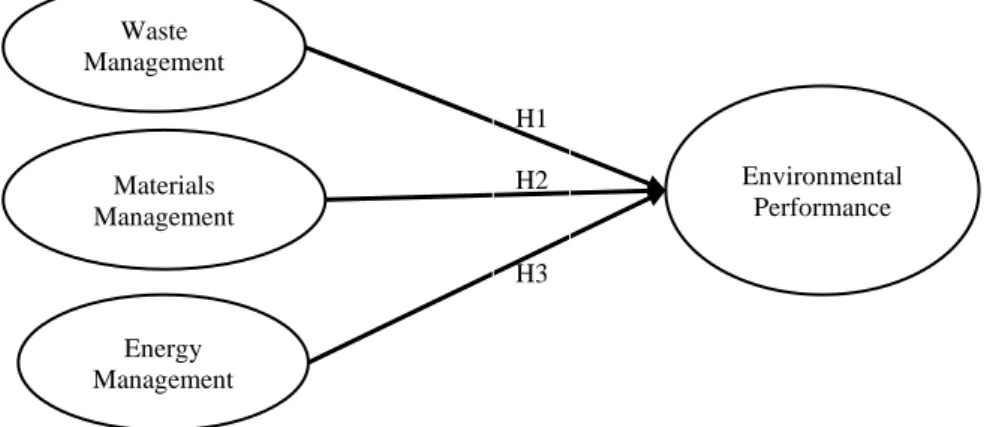
Effective waste management as well as the other green construction site practices are expected to impact positively on the environmental performance of construction projects (Silvius & Schipper, 2016). Based on the various arguments and opinions in the review of literatures, the following hypotheses are developed;
Hypothesis 1 Waste management has a positive effect on environmental performance of construction projects
Hypothesis 2 Construction materials management has a positive effect on environmental performance of construction projects. Hypothesis 3 Energy management has a positive effect on environmental
performance of construction projects.
These hypotheses are illustrated in figure 1.
Figure 1 Conceptual Framework Waste
Management
Materials Management
Energy Management
Environmental Performance H1
H2
RESEARCH METHOD
Instrument Development
This study was designed in a quantitative manner and a structured questionnaire was used for data collection. The items or questions contained in the questionnaire where adapted from the data collection instruments used in previously conducted studies related to this study. The items used in measuring waste management (5 items) where adapted from (Ajayi et al., 2016; Bhardwaj, 2016), materials management (4 items) which where adapted from (Sandanayake, Zhang, Setunge, Li, & Fang, 2016; Sinha, Gupta, & Kutnar, 2013), items for energy management (4 items) where adapted from (Collins, Parrish, & Gibson Jr, 2017) ,while the items for environmental performance (4 items) where adopted from (Yusof, Awang, & Iranmanesh, 2017). The questions posed in the research where answered with options on a 5-point Likert scale for the independent variables (waste management, materials management and Energy management) with 1 referring to very low extent and 5 referring to very high extent, while the dependent variable (environmental performance) was measured on a 7-point Likert scale with 1 referring to strongly disagree and 7 referring to strongly agree. It is also worthy to note that an extra single item (a global item) was collected for each of the latent variable for the redundancy analysis. This is a requirement since the constructs are all formatively measured. The choice of different scale of measurement between the dependent and independent variables was to reduce the incidence of single source bias since both sets of data will be collected from same respondents (Jakobsen & Jensen, 2015). A pilot survey was conducted before data collection to ascertain whether the items adapted as contained in the questionnaire where valid and reliable. Interviewed for this purpose where experts in the Nigerian construction industry and those in the academia. They were asked to review and comment on the appropriateness or otherwise of the questionnaire items. In addition to the reviews and comments by the various experts, 43 completed questionnaires were collected from the to-be respondents (construction site and project managers of Class A contractors in Nigeria), the composite reliability where calculated for each of the indicators. From the results obtained from the interviews with experts, and the analysis of data gathered during the pilot survey, a few items were removed, some wordings in parts of the questions where reworded and some sentences where reversed in the final draft of the questionnaire. The constructs examined in this research are all formative. The questionnaire was prepared in English, which is the official language in Nigeria.
Method of Data Collection
contractors with projects spread across the six geopolitical zones of Nigeria. Data was collected from 63 contractors who undertook 168 construction projects spread across the length and breadth of the country. The questionnaires were self-administered so as to have a high response rate. A total of 206 questionnaires were administered out of which 173 were returned. Of the 173 returned, only 168 where filled properly and considered for this study. The sample size for the study was determined based on the recommendations by Kock and Hadaya (2018). They recommended two approaches for determining the minimum samples size when using PLS-SEM as a response to the inaccuracies observed in the “10-times rule”. These two methods are the “inverse square root” method and the “gamma exponential” method. The inverse square root method advocates for a minimum sample size of 160 samples while the gamma exponential method has 146 since the value of the path coefficients where not known prior to conducting the study. Therefore, the 168 valid reponses collected for this study is adequate.
Data Analysis Approach
The partial least squares structural equation modelling (PLS-SEM) was used to test the various relationships in this study. In the analysis of data for this study, WarpPLS version 6.0 was used. In specific terms, the reasoning behind the choice of WarpPLS software as against other Structural Equation Modelling (SEM) softwares is predicated on the fact that it possesses a wide variety of attributes, most of which are absent in other SEM softwares (Kock, 2017). For instance, the WarpPLS software is the first of its kind, and the only SEM software to comprehensively take into account non-linear functions linking pairs of latent variables in SEM models and calculate multivariate coefficients of interactions accordingly (Kock, 2017).
DATA ANALYSIS, RESULTS AND DISCUSSION
Respondents Profile
In this study, 18% of the respondents had Ordinary National Diploma (OND) as their highest academic qualification, 27% where Higher National Diploma (HND) holders, 44% had bachelor’s degree, 21% had postgraduate diploma (PGD), 49% had Masters degree (MSc) and 9% possessed a doctorate degree (Ph.D.). This indicates that the respondents are well educated and possessed the requisite knowledge to respond to the questions as contained in the questionnaire. Also, in terms of working experience, 19% had 0-5years working experience, 31%(6-10years), 48% (11-15), 42%(16-20years), 28% (over 20years). Most of the respondents where site managers who were 48.2% of the total study population, followed by project managers who constituted 47% of the respondents, senior managers and general managers where 3rd and 4th respectively in the number of respondents in this study with percentages of 14.9% and 8.9% in that other. Most of the contracting organizations considered for this study had over 200 employees which is 31% of the entire respondents, followed by 100-200 employees (29.2%), 10-99 employees (26.8%) and 0-9 employees (6%).
Assessment of the Measurement Model
Three formative constructs where studied in this research namely waste management, materials management, and energy management denoted by WM, MM and EM respectively. Also, the dependent variable (environmental performance) denoted by EP was also measured as formative. To evaluate the quality of the formative model, convergent validity, indicator collinearity, and statistical significance and relevance of the indicator weights will be evaluated. Convergent validity for formative models is determined using redundancy analysis as propounded by Chin (1998). From table 2, the formative construct for waste management produced a path coefficient of 0.721, material management had a path coefficient of 0.812, energy management yielded a path confident of 0.801, while environmental performance had a path coefficient of 0.765. all the values obtained for path coefficients where above the 0.70 threshold recommended by Klassen and Whybark (1999). This implies that the convergent validity of various latent variables is sufficient.
Finally, the significance and relevance of the outer weights would be analysed. From the results obtained, all the weights for the various indicators are significant except for MM1, EM1 and EP4. Since these three indicator weights are not significant, we check its outer loading as recommended by Hair, Hult, Ringle, and Sarstedt (2017). They recommended that the outer loading must be greater than 0.5 if the weights are not significant for the indicator to be retained. In this model, the outer loadings for MM1, EM1 and EP4 are 0.532, 0.973 and 0.731 respectively. Therefore, the indicators are retained.
Table 2 Assessment of Results of the Measurement Model
Construct Items Convergent Validity Weights VIF P-value
Waste Management (WM)
WM1
0.721
0.357 1.499 <0.001
WM2 0.269 1.511 <0.001
WM3 0.220 2.597 <0.001
WM4 0.219 1.464 0.047
WM5 0.066 1.490 <0.001
Material Management (MM)
MM1
0.812
0179 1.145 0.057
MM2 0.271 1.225 <0.001
MM3 0.052 1.463 <0.001
MM4 0.383 1.766 <0.001
Energy Management (EM)
EM1
0.801
0.197 1.294 0.437
EM2 0.170 1.745 0.007
EM3 0.054 1.280 0.003
EM4 0.310 1.199 0.010
Environmental Performance (EP)
EP1
0.765
0.243 1.109 <0.001
EP2 0.083 1.058 <0.001
PP3 0.146 1.156 <0.001
EP4 0.302 1.207 0.063
Assessment of the Structural Model
In assessing the structural model in PLS-SEM, six steps need to be taken (Ramayah, Cheah, Chuah, Ting, & Memon, 2018). These six steps according to Hair et al. (2017) are assessment of structural model for collinearity issues, assessment of the significance and relevance of the structural model relationships, assessment of the level of R2 , assessment of the effect size (f2),and assessment of predictive relevance Q2. Each of the formulated hypothesis represents a relationship link between one of the independent variables and the dependent variable in the structural model. Also, each of the links between the variables (dependent and independent) has a path coefficient and an associated p-value (level of significance) calculated.
behavioural studies (Hair Jr, Sarstedt, Hopkins, & G. Kuppelwieser, 2014). Stone Geisser’s Q2 values, indicative of the model’s explanatory power and predictive validity, were calculated for the endogenous latent variable (Hair, Ringle, & Sarstedt, 2011). The Q2 obtained for endogenous latent variable in this study is 0.214. The validity of a construct can be established when the value of its linked Q2 coefficient is more than zero. This is the case with the endogenous variable in this study, which signifies a model wide predictive validity.
Table 3 Result of Hypothesis Testing
Hypothesis Relationship Path Coefficient P-value Effect Size Decision
H1 WM → EP 0.005 0.472 0.002 Not supported
H2 MM → EP 0.266 < 0.001 0.102 Supported
H3 EM → EP 0.524 < 0.001 0.305 Supported
The R2 obtained for this study was 0.41. The R2 value obtained is
relatively high and acceptable for this research area. It therefore means that the percentage variance in EP is appropriately explained by the model.
Figure 2 Results of Hypothesis Testing
This study investigated the effects of selected green construction site practices on the environmental performance of construction projects. The results obtained indicates that energy management has significant positive effect on environmental performance. Also, construction materials management has a significant effect on the environmental performance on construction projects. However, the results show that waste management practices have no significant effect on environmental performance. It can be noticed that of the three green site practices assessed in this research, not all has significant effect on environmental performance. The findings in this study are consistent with the findings of Chen et al. (2016) where they observed some projects attained high environmental performance as a result of adopting certain green practices on site while some other projects experience negative and neutral environmental performance outcomes.
The attainment of a nonsignificant effect of waste management on environmental performance may be attributed to the likelihood that these practices have been institutionalized by the contracting firms. The contractors in this research are large contractors who handle very big projects, and also have large project turnover. As such, it could be said that was responsible for the insignificant effect of waste management. The effect of three out of so many other green practices on environmental performance where analysed in this study, the overall effect of green practices on environmental performance could be significant if the entire green practices are analysed since there is usually an overlap in these practices.
CONCLUSION
The research was conducted in Nigeria and three green site practices where analysed for their effect on environmental performance. The result indicates that energy management and material management had significant effects on environmental performance, while waste management did not. This is consistent with the findings of some studies. It can be concluded that, it is not in all scenarios that all green practices will lead to environmental performance. This can be attributed to peculiarities of different projects since all projects are of different characteristics. This can also be said to be because of the different skill sets of the workforce in the different contracting organizations. Some of the workers may be more experienced in undertaking certain green practices while others are not. It can be concluded that the environmental performance of projects executed using various sustainable site practices may be contingent on the characteristics of the projects.
and other regulatory bodies in the country, it assists them in policy formulation. It also assists them in appraising how far the various policy frameworks with regards to sustainable construction site practices have impacted on the broader goals of environmental performance.
LIMITATIONS OF THE STUDY AND RECOMMENDATION FOR FUTURE RESEARCH
This research is limited to only projects undertaken by “class A” contractors in Nigeria and did not take note of factors related to project characteristics such as project complexity, ownership structure of the project, form of contract and so on which could influence the environmental performance of construction projects when certain sustainable practices are been adopted. Also, projects undertaken by other categories of contractors where not captured in this study. Furthermore, only 3 sustainable construction practices where assessed in this research.
It is suggested that further studies should be conducted on projects executed by other categories of contractors, taking into cognizance various project characteristics. Other forms of sustainable construction site practices can also be studied in future researches and their effects on other dimensions of project performance such as: economic performance, and health and safety performance can also be examined. Similar studies should also be replicated in other countries in the developing world to compare the results with what was obtained in Nigeria.
REFERENCES
Adriana, T.-T., & Ioana-Maria, D. (2013). Project Success by Integrating Sustainability in Project Management. Sustainability Integration for Effective Project Management, 106.
Ajayi, S. O., Oyedele, L. O., Akinade, O. O., Bilal, M., Owolabi, H. A., Alaka, H. A., & Kadiri, K. O. (2016). Reducing waste to landfill: A need for cultural change in the UK construction industry. Journal of Building Engineering, 5, 185-193.
Ali, H. H., & Al Nsairat, S. F. (2009). Developing a green building assessment tool for developing countries–Case of Jordan. Building and Environment, 44(5), 1053-1064.
Allu, E. L., & Ebohon, O. J. (2015). Assessing the Knowledge and Awareness Level of Built Environment Professionals in Nigeria. International Journal of Contemporary Applied Sciences, 2(5), 77-95.
Bhardwaj, B. R. (2016). Role of green policy on sustainable supply chain management: A model for implementing corporate social responsibility (CSR). Benchmarking: An International Journal, 23(2), 456-468.
Chen, P.-H., Ong, C.-F., & Hsu, S.-C. (2016). Understanding the relationships between environmental management practices and financial performances of multinational construction firms. Journal of Cleaner Production, 139, 750-760.
Chin, W. W. (1998). The partial least squares approach to structural equation modeling.
Collins, W., Parrish, K., & Gibson Jr, G. E. (2017). Development of a project scope definition and assessment tool for small industrial construction projects. Journal of management in engineering, 33(4), 04017015.
Hair , J. F., Hult, G. T. M., Ringle, C., & Sarstedt, M. (2017). A primer on partial least squares structural equation modeling (PLS-SEM): Sage Publications.
Hair, J. F., Ringle, C. M., & Sarstedt, M. (2011). PLS-SEM: Indeed a silver bullet.
Journal of Marketing theory and Practice, 19(2), 139-152.
Hair Jr, J., Sarstedt, M., Hopkins, L., & G. Kuppelwieser, V. (2014). Partial least squares structural equation modeling (PLS-SEM) An emerging tool in business research.
European Business Review, 26(2), 106-121.
Jakobsen, M., & Jensen, R. (2015). Common method bias in public management studies.
International Public Management Journal, 18(1), 3-30.
Klassen, R. D., & Whybark, D. C. (1999). The impact of environmental technologies on manufacturing performance. Academy of Management journal, 42(6), 599-615. Kock, N. (2011). Using WarpPLS in e-collaboration studies: Descriptive statistics,
settings, and key analysis results. International Journal of e-Collaboration (IJeC), 7(2), 1-18.
Kock, N. (2014). Advanced mediating effects tests, multi-group analyses, and measurement model assessments in PLS-based SEM. International Journal of e-Collaboration (IJeC), 10(1), 1-13.
Kock, N. (2015). One-tailed or two-tailed P values in PLS-SEM? International Journal of e-Collaboration (IJeC), 11(2), 1-7.
Kock, N. (2017). WarpPLS user manual: Version 6.0. ScriptWarp Systems: Laredo, TX, USA.
Kock, N., & Hadaya, P. (2018). Minimum sample size estimation in PLS‐SEM: The inverse square root and gamma‐exponential methods. Information Systems Journal, 28(1), 227-261.
Lu, Y., & Zhang, X. (2016). Corporate sustainability for architecture engineering and construction (AEC) organizations: Framework, transition and implication strategies. Ecological indicators, 61, 911-922.
Ramayah, T., Cheah, J., Chuah, F., Ting, H., & Memon, M. A. (2018). Partial Least Squares Structural Equation Modelling (PLS-SEM) using SmartPLS 3.0: An Updated and Practical Guide to Statistical Analysis (2nd Edition ed.): Pearson Malaysia Sdn Bhd.
Rasoolimanesh, S. M., Jaafar, M., Kock, N., & Ahmad, A. G. (2017). The effects of community factors on residents’ perceptions toward World Heritage Site inscription and sustainable tourism development. Journal of Sustainable Tourism, 25(2), 198-216.
Rönkkö, M., & Evermann, J. (2013). A critical examination of common beliefs about partial least squares path modeling. Organizational Research Methods, 16(3), 425-448.
Silvius, A. G., & Schipper, R. (2016). Exploring the relationship between sustainability and project success-conceptual model and expected relationships. SciKA-Association for Promotion and Dissemination of Scientific Knowledge, 4(3), 5-22. Sinha, A., Gupta, R., & Kutnar, A. (2013). Sustainable Development and Green
Buildings. Wood Industry/Drvna Industrija, 64(1).
Xiao, S., Dong, H., Geng, Y., & Brander, M. (2018). An overview of China’s recyclable waste recycling and recommendations for integrated solutions. Resources, Conservation and Recycling, 134, 112-120.
Yusof, N. A., Awang, H., & Iranmanesh, M. (2017). Determinants and outcomes of environmental practices in Malaysian construction projects. Journal of Cleaner Production, 156, 345-354.