ARTICLE
The infant mortality rate (IMR) in South Africa (SA) has lagged behind the best international standards.1 In the past decade the ability to deliver neonatal intensive care in SA has de-creased.2-4 There is a paucity of information on the availability of equipment and the long-term outcome of infants who are not accommodated in a neonatal intensive care unit (NICU).5 We do know that outcome of survivors is good in the limited number of neonates who have access to neonatal care.6-8 Because of financial constraints, there has been a steady loss of neonatal intensive care facilities for public sector patients in a time of increasing urbanisation.9,10 There is an increasing demand for tertiary care, which is driven by better facilities in the primary health care arena and increased patient expectations.11 This raises questions about the rationale of allocating intensive care to selected neonates only. Intensive care may be allocated so as to give the best chance of survival if a good outcome is likely, or it can be allocated to benefit as many babies as is physically possible, as is the case in the SA public health sector. This does not relieve the government of its responsibility to maintain and upgrade health care facilities.12 At the 1991 Priorities in Perinatal Care Conference in South Africa a policy was formulated not to treat babies weighing less than 1 000 g in government hospital NICUs. These recommendations were made before surfactant therapy became available. After its introduction, the survival rates of babies admitted to a NICU with birth weights between 855 g
and 1 000 g rose and are currently the same as those of babies weighing more than 1 000 g.
Most premature and small-for-dates neonates in SA are born to the poorer socio-economic group,13 who are dependent on the public health services for their care.
Aim
The aim of this study was to describe the patient population in the Tygerberg Hospital (TBH) NICU during two time periods, 1992 - 1996 (1992 cohort) and 1999 - 2000 (1999 cohort), and to describe the outcome of the babies treated.
Patients and methods
All infants admitted to the NICU during the two time periods who either had a gestational age less than 33 weeks or a birth weight less than 1 501 g were prospectively evaluated. All demographic data, as well as outcome measures such as death, time spent on the ventilator and the development of bronchopulmonary dysplasia, were documented. The two time periods were compared to evaluate any changes in outcomes. The TBH NICU has 12 beds, and the medical staff consists of a full-time neonatologist, two rotating registrars and one rotating junior doctor. The NICU is mainly a ventilation facility
C H Pieper, MB ChB, MMed (Paed), MSc Med Sc, MD
Neonatal Service, University of Cape Town, and School of Child and Adolescent Health,Groote Schuur Hospital, Cape Town
P B Hesseling, MB ChB, MMed (Paed), FCP (Paed) SA, MD
Department of Paediatrics and Child Health, Tygerberg Hospital and Medical Faculty, Stellenbosch University, Tygerberg, W Cape
The changing face of neonatal
intensive care in South Africa
S
A
Jo
ea
lth
S
A
Jo
ur
nal
of Child
H
ea
lth
S
A
Jo
ur
nal
of Child
H
ea
lth
In 1991 a cut-off weight of 1 000 g and/or 28 weeks’ gestation for neonatal intensive care unit (NICU) admission was decided on by attending neonatologists at a Priorities in Perinatal Care Conference. These recommendations were not based on published evidence. At the time there were few data on the outcome of babies born in the public sector who received NICU.
Aim. The aim of this study was to describe the demographic data (mother and baby) and outcomes of babies admitted to a tertiary NICU.
Methods. During 1992 - 1996 (1992 cohort) and 1999 - 2000 (1999 cohort) two cohorts of babies treated in the NICU at Tygerberg Hospital, Western Cape, South Africa, were studied. Demographic data were collected prospectively on all admissions with a birth weight of less than 1 501 g and a gestational age of less than 32 weeks. Outcome data were survival, days of ventilation and NICU stay.
Results. There were 455 babies in the 1992 cohort and 272 in the 1999 cohort. The mothers’ mean income was R892 per month and was higher in the 1999 cohort.The 1999 cohort comprised significantly smaller babies, at a mean birth weight of 1 119 g v. 1 198 g. The mean gestational age in the 1999 cohort was lower (29.2 v. 30.3 weeks), but so was the mortality rate (21.6% v. 26.1%). The main differences between the survivors and non-survivors were in their birth weight and gestational age and the mean income of their mothers. The mean number of ventilation days needed by these infants was low at 8.5 days, with an average stay in the NICU of 13 days.
Discussion. Babies admitted to an NICU have a good chance of survival at a low mean number of ventilation and NICU days. The increase in survival in the 1999 cohort, in spite of low income, is in keeping with international trends and underlines the good short-term outcome of these small babies.
ARTICLE
and few patients are admitted unless they need ventilation. High care is provided in a separate ward. Surfactant and nitric oxide are available. Standard volume-cycled ventilators and oscillators are available. After weaning onto either head-box oxygen or continuous positive-pressure (CPAP) ventilation, the babies are discharged to the high-care ward. Our policy for routine care has been recorded by Smith et al.14
The TBH NICU has between 600 and 800 admissions a year with a mortality rate of 18% for babies born at TBH. For babies weighing less than 1 500 g, or younger than 32 weeks’ gestation, the mortality rate was 26% in 1992 - 1996. One quarter (26%) of NICU admissions are referred from rural areas and 15% from the metropolitan antenatal clinics. The remaining 59% are born at TBH.
Admission criteria for the NICU
Inborn babies whose mothers have received antenatal care will routinely receive NICU care if they weigh over 999 g and/or have a gestational age of at least 28 weeks, if a bed is available. Unbooked babies have to weigh over 1 200 g or have a gestational age of at least 30 weeks. Babies of mothers with a poor obstetric history are often admitted even if they do not fulfil the above admission criteria.
Results
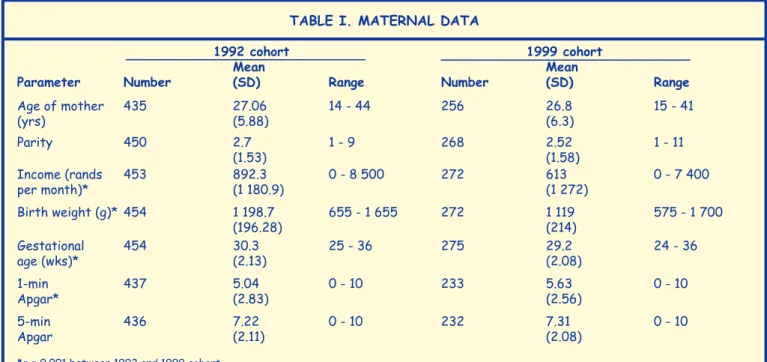
Data on 727 babies were analysed, 455 in the 1992 cohort and 272 in the 1999 cohort. The demographic data on the mothers and babies are presented in Table I.
The mean income of all mothers in the 1992 cohort of R892 per month was just more than the official minimum wage of R800 for domestic employees. The mean income of those who had an income was R1 098. The mean income in the 1999 cohort was R787 per month, which is less than the official minimum wage of R800 for domestic employees, and the mean income of those who had an income was R1 386.
The babies in the 1999 cohort had a mean weight of 1 169 g. The mean gestational age was significantly lower in the 1999 cohort (29.2 v. 30.3 weeks) than in the 1992 cohort. The data on the deliveries of these babies are presented in Table II.
Eighty-seven babies belonged to sets of twins and 4 to sets of triplets. The mortality rate in normally delivered babies was 24.7%, but 33.3% of forceps-delivered babies and 32.1% of breech deliveries died, as illustrated in Table III. Significantly fewer babies with premature rupture of membranes and fewer females were admitted in the 1999 cohort.
Of the babies 605 had been delivered at Tygerberg Hospital, 33 in the district services and 89 in the rural areas. There were 549 (24.4%) survivors and 178 deaths before discharge from hospital. In the 1992 cohort the mortality rate was 26.1% and in the 1999 cohort it was 21.6%.
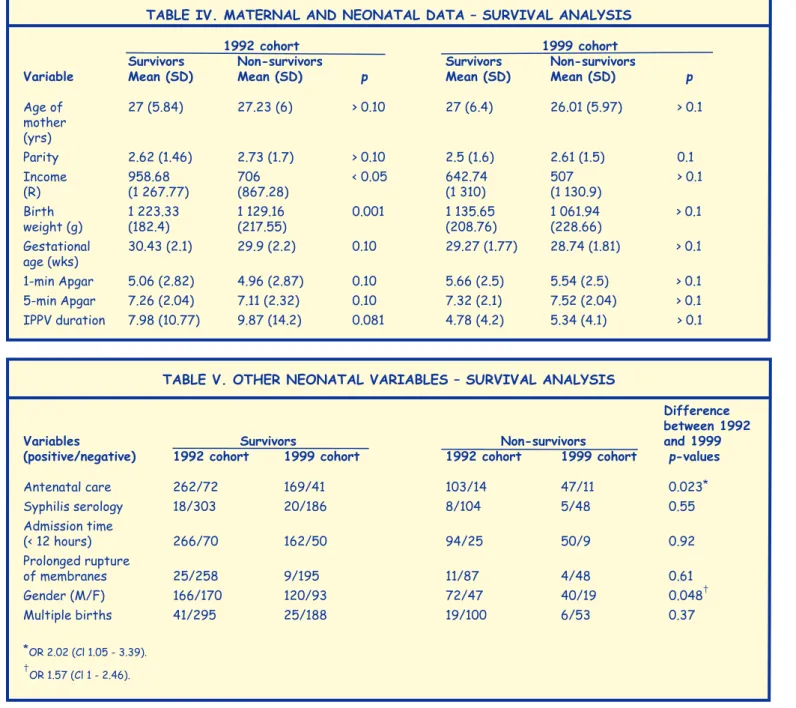
The babies required a mean of 8.5 days of ventilation. Survival in relation to maternal and neonatal data is presented in Table IV.
There was no difference in survival related to either age or parity, but mothers of survivors had a higher income. The mean income of all mothers was very low. Neonatal mortality was similar in the mothers who had less than 3 babies and those who were grand multiparas.
Mean gestational ages and Apgar scores did not differ significantly between the survivors and non-survivors. There was, however, a significant difference in birth weight between survivors and non-survivors. Even though the absolute difference was small and insignificant at 94 g, the effect of this possibly combined with the half-week increase in gestational age made all the difference. There was no difference in duration of ventilation between the two groups (Table IV).
There were no differences in booking status, the incidence of positive serology for syphilis or duration of admission between the two groups (Table V). More boys than girls were admitted, and more boys died. Babies who died did not use more resources than survivors.
TAble I. MATeRNAl DATA
1992 cohort 1999 cohort
Mean Mean
Parameter Number (SD) Range Number (SD) Range
Age of mother 435 27.06 14 - 44 256 26.8 15 - 41
(yrs) (5.88) (6.3)
Parity 450 2.7 1 - 9 268 2.52 1 - 11
(1.53) (1.58)
Income (rands 453 892.3 0 - 8 500 272 613 0 - 7 400
per month)* (1 180.9) (1 272)
Birth weight (g)* 454 1 198.7 655 - 1 655 272 1 119 575 - 1 700
(196.28) (214)
Gestational 454 30.3 25 - 36 275 29.2 24 - 36
age (wks)* (2.13) (2.08)
1-min 437 5.04 0 - 10 233 5.63 0 - 10
Apgar* (2.83) (2.56)
5-min 436 7.22 0 - 10 232 7.31 0 - 10
Apgar (2.11) (2.08)
Discussion
This study suggested that in making the decision which neonates should be admitted to neonatal intensive care units in the public sector, discrimination based solely on birth weight and gestational age may be flawed. If scarce resources are to be allocated to the baby with the best prognosis, factors such as gender,15,16 booking status17and income of the parents18 should to be taken into account in addition to birth weight19,20and gestational age.21 These may not be comfortable decisions, but involve more than just admitting a baby weighing 1 000 g and refusing another weighing 998 g. Discrimination based on income discriminates against the poorest of people and cannot be justified ethically. The survival in the 1999 cohort was similar
to the 1992 one in spite of smaller babies in the latter. These findings could be used to motivate for more NICU beds from the Department of Health.
The significance of the lower income for mothers in the 1999 cohort would be influenced by how reliable the information provided by mothers was, but is a cause for concern. The effect of mothers’ income on the outcome of their babies can only be estimated. The reason for the lowering in income might be the change in the NICU population, with an increased influx of migrant labourers from the Eastern Cape.22
These findings emphasise the increased requirements for medical care of the lower socio-economic group, which is served by the public sector in SA. These babies might be nutritionally impaired, or other factors may play a role.
The role of HIV was not investigated, as the prevalence was very low during the time the study was done. Being exposed to HIV does not seem to have a detrimental effect in the short-term outcome of premature neonates, unless they are born with sepsis.
In the public sector,
discrimination based
solely on birth weight
and gestational age
may be flawed.
S
A
Jo
ur
H
ea
lth
S
A
Jo
ur
nal
of Child
H
ea
lth
S
A
Jo
ur
nal
of Child
H
ea
lth
60 SAJCH JULY 2007 VOL. 1 NO. 2
TAble III. SURvIvAl ACCoRDINg To TyPe of DelIveRy
1992 cohort 1999 cohort
Type of Non- Deaths Non- Deaths
delivery Survivors survivors (%) Survivors survivors* (%)
Caesarean 187 64 25.4 96 29 23.2
Vaginal 130 43 24.8 96 21 17.9
normal
Forceps 2 1 33 0 0 0
Breech 17 11 39.2 21 7 25
*Incomplete data on 2 male infants.
TAble II. DelIveRy DATA
1992 cohort 1999 cohort
Total Total
Parameter number Positive Negative number Positive Negative
Antenatal care 449 365 84 268 216 52
(p = 0.080)
Syphilis serology 433 26 407 259 25 234
(p = 0.17)
Admission time 455 360 95 271 212 59
(< 12 h) after
birth (p = 0.32)
Prolonged 396 36 360 256 13 243
rupture of
membranes
(p = 0.0008)
Gender (M:F)* 455 238 217 272 160 112
(p = 0.08)
Multiple births 455 60 395 272 31 241
ARTICLE
The fact that this NICU ‘penalises’ babies for not having received any antenatal care affects the predictive strength of this variable. If the mother does not receive antenatal care, the baby’s birth weight and the gestational age have to be higher for it to be admitted. The group that did not receive antenatal care therefore comprised more mature babies.
Prolonged rupture of membranes also significantly influences outcome.23-25 This underlines the need for improved antenatal care and the need for mothers to be informed on all the possible problems that need urgent attention in preterm labour. It is of interest that factors traditionally associated with a bad outcome, such as teenage mothers,26-28 congenital syphilis,29 low Apgar scores30,31 and multiple births32 do not show any relevance to outcome in this study. The difference in outcome in the 1999 cohort compared with the 1992 cohort could be explained by improved care such as availability of surfactant in 1999.
Neonatal intensive care in the public sector is restricted. The risk factors identified in this study should be evaluated further in larger studies and used to formulate ethically acceptable
selection criteria. The improvement of the socio-economic status of our population would address major risk factors such as inadequate maternal income.
References
1. Bellamy C. The State of the World’s Children 1997. UNICEF. New York: Oxford University Press, 1997: 79.
2. Jones JS. New unused ICU at George. S Afr Med J 1998; 88: 477. 3. Smith J, Pieper CH, Kirsten GF. Born too soon, too small, to die – a plea
for fair innings. S Afr Med J 1999; 89: 1148-1153. 4. Benatar SR. South Africa. Lancet 1997; 349: 1537-1545.
5. Cooper PA. Very-low-birth-weight infants in South Africa. S Afr Med J 1999; 89: 1160-1161 (Editorial).
6. Kirsten GF. The long term neurodevelopmental outcome of infants born to mothers with severe pre-eclampsia and absent end diastolic umbilical artery flow velocity waveforms. MD dissertation, Stellenbosch University, 1996, p. 292.
7. Van Zyl JI, Kirsten GF, editors. The long term neurodevelopmental outcome of infants <1250g electively not admitted to the neonatal intensive care unit. Proceedings of the 18th Conference on Priorities in Perinatal Care in South Africa; 1999 March 9-11; Buffelspoort, South Africa. CD, Dept. of Obstetrics and Gynecology, University of Pretoria.
TAble v. oTheR NeoNATAl vARIAbleS – SURvIvAl ANAlySIS
Difference between 1992
variables Survivors Non-survivors and 1999
(positive/negative) 1992 cohort 1999 cohort 1992 cohort 1999 cohort p-values
Antenatal care 262/72 169/41 103/14 47/11 0.023*
Syphilis serology 18/303 20/186 8/104 5/48 0.55
Admission time
(< 12 hours) 266/70 162/50 94/25 50/9 0.92
Prolonged rupture
of membranes 25/258 9/195 11/87 4/48 0.61
Gender (M/F) 166/170 120/93 72/47 40/19 0.048†
Multiple births 41/295 25/188 19/100 6/53 0.37
*OR 2.02 (Cl 1.05 - 3.39).
†OR 1.57 (Cl 1 - 2.46).
TAble Iv. MATeRNAl AND NeoNATAl DATA – SURvIvAl ANAlySIS
1992 cohort 1999 cohort
Survivors Non-survivors Survivors Non-survivors
variable Mean (SD) Mean (SD) p Mean (SD) Mean (SD) p
Age of 27 (5.84) 27.23 (6) > 0.10 27 (6.4) 26.01 (5.97) > 0.1
mother (yrs)
Parity 2.62 (1.46) 2.73 (1.7) > 0.10 2.5 (1.6) 2.61 (1.5) 0.1
Income 958.68 706 < 0.05 642.74 507 > 0.1
(R) (1 267.77) (867.28) (1 310) (1 130.9)
Birth 1 223.33 1 129.16 0.001 1 135.65 1 061.94 > 0.1
weight (g) (182.4) (217.55) (208.76) (228.66)
Gestational 30.43 (2.1) 29.9 (2.2) 0.10 29.27 (1.77) 28.74 (1.81) > 0.1
age (wks)
1-min Apgar 5.06 (2.82) 4.96 (2.87) 0.10 5.66 (2.5) 5.54 (2.5) > 0.1
5-min Apgar 7.26 (2.04) 7.11 (2.32) 0.10 7.32 (2.1) 7.52 (2.04) > 0.1
8. Cooper PA, Sander DL. Outcome of very low birth weight infants at 12 to 18 months of age in Soweto, South Africa. Pediatrics 1997; 99: 537-552.
9. De Villiers S. Children in South Africa – Their Right to Health. Cape Town: Child Health Policy Institute, University of Cape Town, 1999: 20. 10. Cooper PA, Rothberg AD, Davies VA, Herman AAB. Needs for
special-care beds for the newborn in the Witwatersrand area. S Afr Med J 1987; 71: 645-646.
11. Bowen FW, Gwiazdowski S. Principles of disease management in neonatology. Pediatr Clin North Am 1998; 45: 651-672.
12. De Villiers S. Children in South Africa – Their Right to Health. Cape Town: Child Health Policy Institute, University of Cape Town, 1999: 18. 13. Bonduelle M, Iliff P. Case control study of perinatal mortality in GHU.
Proceedings of the 14th conference on Priorities in Perinatal Care in South Africa; 1995 March 7-10; Golden Gate, South Africa. CD, Dept. of Obstetrics and Gynecology, University of Pretoria.
14. Smith J, Kling S, Gie RP, Van Zyl J, Kirsten GF, Nel ED, Schneider JW. Bronchopulmonary dysplasia in infants with respiratory distress syndrome in a developing country: a prospective single center-based study. Eur J Pediatr 1996; 155: 672-677.
15. SADS 1998 – Child health. Table III. http//www.dih.gov.facts/1889/ ado.html (accessed 14 November 2002).
16. Copper RL, Goldenberg RL, Creasy RK, et al. A multicenter study of preterm birth weight and gestational age-specific neonatal mortality. Am J Obstet Gynecol 1993; 168: 78-84.
17. Vintzileos AM, Annath CV, Smulian JC, Scorza WE, Knuppel RA. The impact of prenatal care on neonatal deaths in the presence and absence of antenatal high risk conditions. Am J Obstet Gynecol 2002; 186: 1011-1016.
18. Mare R. Socioeconomic effects on child mortality. Am J Public Health 1982; 72: 539-547.
19. Thompson CM, Buccimazza SS, Webster J, Malan AF, Molteno CD. Infants of less than 1250 grams birth weight at Groote Schuur Hospital: outcome at 1 and 2 years of age. Pediatrics 1993; 91: 961-968.
20. Cloherty JP, Stark AR, eds. Manual of Neonatal Care. 4th ed. Philadelphia: Lippincott Williams & Wilkins, 1998: 38-39.
21. Stein H, Ellis U. The low birthweight African baby. Arch Dis Child 1974; 49: 156-159.
22. Cohen GR, Curet LB, Levine RJ, et al. Ethnicity, nutrition, and birth outcomes in nulliparous women. Am J Obstet Gynecol 2001; 185: 660-667.
23. Egarter C, Leitich H, Karas H, Wieser F, Husslein P, Kaider A, Schlempner M. Antibiotic treatment in preterm premature rupture of membranes and neonatal morbidity: a meta-analysis. Am J Obstet Gynecol 1996; 174: 589-597.
24. Seaward PG, Hannah ME, Myhr TL, et al.International Multicentre Term Prelabor Rupture of Membranes Study: evaluation of predictors of clinical chorioamnionitis and postpartum fever in patients with prelabor rupture of membranes at term. Am J Obstet Gynecol1997; 177: 1024-1029.
25. Andolsek KM, Kelton GM. Risk assessment. Prim Care 2000; 27: 71-103. 26. American Academy of Pediatrics Committee on Adolescence. Care of
adolescent parents and their children. Pediatrics 2001; 107: 429-434. 27. American Academy of Pediatrics Committee on Adolescence.
Adolescent pregnancy: current trends and issues. Pediatrics 1999; 103: 516-520.
28. Rip MR, Hunter JM. The community perinatal health care system of urban Cape Town, South Africa. Soc Sci Med 1990; 30: 111-118.
29. Gray RH, Wabwire-Mangen F, Kigozi G, et al. Randomized trial of presumptive sexually transmitted disease therapy during pregnancy in Rakai, Uganda. Am J Obstet Gynecol 2001; 185: 1209-1217.
30. Lagrew DC jr, Adashek JA. Lowering the caesarean section rate in a private hospital: comparison of individual physicians’ rates, risk factors, and outcomes. Am J Obstet Gynecol 1998; 178: 1207-1214. 31. Hegyi T, Carbone T, Anwar M, et al. The Apgar score and its components
in the preterm infant.Pediatrics 1998; 101: 77-81.
32. Joseph KS, Marcoux S, Ohlsson A, Liu S, Allen AC, Kramer MS, Wen SW. Changes in stillbirth and infant mortality associated with increases in pre-term birth among twins. Pediatrics 2001; 108: 1055-1061.