PERSPECTIV
A
Promising Immuno-Oncology Treatments Beyond the 2018
Nobel Prize
Tratamentos Promissores de Imuno-Oncologia Para Além
do Prémio Nobel 2018
* Co-primeiros autores.
1. Serviço de Oncologia Médica. Centro Hospitalar e Universitário do Algarve. Faro. Portugal.
2. Departamento de Epidemiologia. Escola Nacional de Saúde Pública. Universidade NOVA de Lisboa. Lisboa. Portugal. 3. Melanoma Institute Australia. Sydney. Australia.
4. Centro de Estudos de Doenças Crónicas/ Chronic Diseases Research Center – CEDOC. Epidemiology of Chronic Diseases Unit – EpiDoC. NOVA Medical School. Universidade NOVA de Lisboa. Lisboa. Portugal.
5. Serviço de Reumatologia. Hospital Curry Cabral. Centro Hospitalar e Universitário de Lisboa Central. Lisboa. Portugal. 6. Medical Oncology Institut Jules Bordet. Université Libre de Bruxelles. Brussels. Belgium.
Autor correspondente: Luís Castelo-Branco. [email protected]
Recebido: 10 de março de 2019 - Aceite: 20 de março de 2019| Copyright © Ordem dos Médicos 2019
Luís CASTELO-BRANCO*1,2, Inês Pires SILVA*3, Helena CANHÃO2,4,5, Ahmad AWADA6
Acta Med Port 2019 Apr;32(4):251-257 ▪ https://doi.org/10.20344/amp.12040
IMMUNE-CHECKPOINT INHIBITORS: CLINICAL EVI-DENCE AND LIMITATIONS
The Nobel Prize of Medicine in 2018 awarded jointly by James P. Allison and Tasuku Honjo was an important landmark recognizing recent clinical advances in immune-oncology. Targeting the immune system to fight cancer is not a new concept, but there were few significant clinical advances until very recently.
Tasuku Honjo et al first reported programmed cell death protein 1 (PD-1) in 1992, a protein expressed on the sur-face of T-cells that acts as a brake in T-cells cytotoxicity.1 So
blocking PD-1 could facilitate T-cells activity against cancer. In 1996 James P. Allison et al discovered that the cy-totoxic T-lymphocyte-associated antigen 4 (CTLA-4) is a regulator of T-cells activity, transmitting signals that inhibits its activation and proliferation,2 thus, blocking CTLA4 could
improve T-cells activity against cancer.
These concepts were further explored with immune checkpoint inhibitors (ICI) anti-PD-1 and anti-CTLA-4, against cancer. Compared with classic chemotherapy, checkpoint inhibitors might take more time to be effective, but those who benefit are normally long-term responders (Fig. 1). The toxicity profile is globally more favorable com-pared with chemotherapy, with immune related adverse events being the major toxicity of concern but that is usually manageable with immune-modulators such as steroids and/ or treatment interruption.
Immune checkpoint inhibitors changed the panorama of metastatic melanoma dramatically, from a terrible prognosis and no efficacious treatment to 34% to 58% long term sur-vivals.3,4
Further studies confirmed the benefit of checkpoint in-hibitors across different types of cancers such as in lung, bladder, kidney, Merkel cell carcinoma, head and neck,
lym-phomas among others. Results are not so impressive like in metastatic melanoma, but it is still very positive to change the gold standard of treatment of those diseases in some settings.
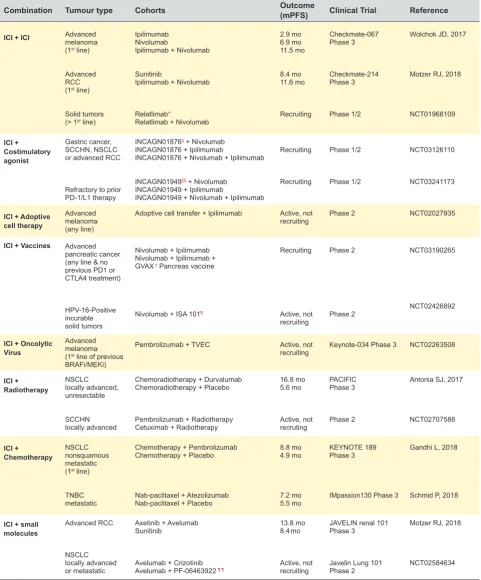
Moreover, the combination between different checkpoint inhibitors could improve clinical outcomes. In checkmate 067 clinical trial, in advanced melanoma patients, the over-all survival rate at three years was 58% for nivolumab (an-ti-PD-1) plus ipilimumab (anti-CTLA-4) group, 52% in the nivolumab group and 34% in the ipilimumab group.3 In
ad-vanced renal cell carcinoma, the overall survival and objec-tive response rates were significantly higher with nivolumab plus ipilimumab vs sunitinib, which was the previous stand-ard of care in this setting5 (Table 1).
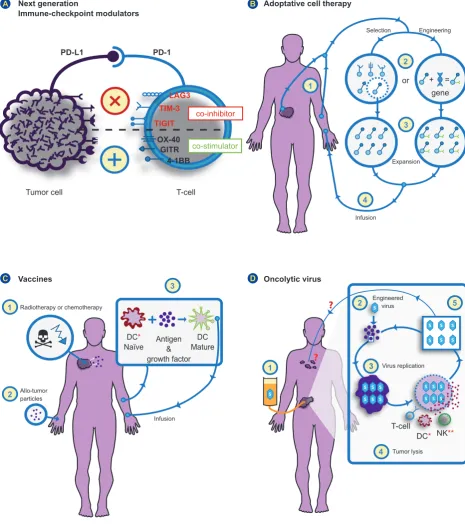
Despite the achieved clinical results so far, the majority of patients treated do not benefit from immune checkpoint inhibitors, and there is still lack of evidence on predictors of (non) benefit. Therefore, it is very important to find more strategies to improve immune-oncology results, combining treatments with checkpoint inhibitors or developing other novel immune-oncology strategies (Fig. 2).
NOVEL IMMUNE-ONCOLOGY STRATEGIES
“Next-generation” immune checkpoints and co-stimu-latory monoclonal antibodies
Three signals are needed for T-cell activation. The first signal happens when antigen-presenting cells (APCs) pre-sent the antigen through MHC to T cell receptor (TCR) on T cells. The second signal occurs with the interaction be-tween co-stimulatory receptors on T cells and their respec-tive signals on APCs. Finally, the third signal comes from cytokines. Co-inhibitory (immune checkpoints) and co-stim-ulatory receptors are key for signal two, and their balance will determine T-cell activation.6
Keywords: Immunotherapy; Medical Oncology; Neoplasms/drug therapy; Neoplasms/immunology; Programmed Cell Death 1 Receptor
PERSPECTIV
A
The co-inhibitory receptors, CTLA-4 and PD-1, have been described to be responsible for maintaining overall immune self-tolerance, while “next-generation” immune checkpoints, including T-cell immunoglobulin and mucin-domain containling-3 (Tim-3), lymphocyte activation gene-3 (Lag-gene-3) and T-cell immunoreceptor with Ig and ITIM do-mains (TIGIT), have more specific roles in tolerance. These three co-inhibitory receptors are highly expressed on the dysfunctional and exhausted T cells and NK cells.7,8
Preclin-ical data have shown tumor activity of monoclonal anti-bodies against these receptors,9-11 and now these drugs are
currently being studied in clinical trials for hematologic and solid tumors, either alone (NCT03489369; NCT03489343; NCT01968109), or in combination with anti-CTLA-4 and/or anti-PD-1 therapy (Table 1).
Co-stimulatory receptors, including 4-1BB, glucocorti-coid-induced TNFR-related protein (GITR) and OX40 pro-mote T cells survival, activation and proliferation. Studies performed in different pre-clinical models using agonistic monoclonal antibodies targeting these receptors in combi-nation with anti-PD-1 have shown non-consistent results.12,13
While more work needs to be done in this field to better un-derstand the mechanism of action of these antibodies, the
first clinical trials using these agents, alone or in combina-tion with anti-CTLA-4 and/or anti-PD-1, in cancer patients are ongoing and their results are awaited (NCT01239134; NCT03126110; NCT03241173).
Adoptive cell therapy
Adoptive cell therapy (ACT) uses tumor-infiltrating lym-phocytes (TILs) extracted from fresh tumor samples, or pe-ripheral blood lymphocytes (leukapheresis). After extracting these lymphocytes, there is a selection of the ones express-ing T cell receptor (TCR) targetexpress-ing a specific tumor antigen, or they can be genetically engineered to express the de-sired TCR. These lymphocytes are expanded and activated ex vivo, and then infused into the patients, after lymphode-pletion to eliminate regulatory T cells.14,15
In a National Cancer Institute (NCI) clinical trial, meta-static melanoma patients were previously subjected to total body irradiation (TBI - 2 Gy or 12Gy) and to a non-mye-loablative regimen with fludarabine and cyclophosphamide, while the cells were expanded with the T-cell stimulating an-ti-CD3 monoclonal antibody (OKT3) and IL-2. In this study, objective responses were observed in 49% to 72% depend-ing on the conditiondepend-ing regimen prior to the cells’ infusion.
Figure 1 – Survival: curve with immune checkpoint inhibitors
1 – Later response with ICI - Chemotherapy has a rapid cytotoxicity and tumor reduction effect. ICI monotherapy requires some weeks to months to start having effect; 2 – Median is a bad outcome: Median OS or PFS are current outcomes used in oncology clinical trials, but due to the delay but long term effect with ICI, it is important to find other outcomes which better capture the magnitude of benefit with ICIs; 3 – Long term responders: Those who benefit from ICIs are normally long term responders, having a chronic disease or perhaps being cured
* Ilustrative time. Time changes with different types of cancer.
Survival
(%)
Time (months)
Combination or sequence plus predictors of response
Combination or sequence of treatment
Checkpoint inhibitors monotherapy
Chemotherapy 10%
0 6 12 18 24 30 36*
50% 100%
1
2
PERSPECTIV
A
Even though these results are promising, this was a single arm trial with no randomized comparison.16 Moreover, there
are some obstacles to this technique that need to be ad-dressed in order to increase its efficacy, including the
im-munosuppressive tumor microenvironment and the lack of automation in the ACT production process, as it is a highly personalized treatment, is labor-intensive and requires laboratory expertise.15 This strategy is now being tested in Table 1 – Selection of clinical trials with Immune checkpoint inhibitors combinations
Combination Tumour type Cohorts Outcome(mPFS) Clinical Trial Reference
ICI + ICI Advancedmelanoma
(1st line)
Advanced
RCC
(1st line)
Solid tumors (> 1st line)
Ipilimumab Nivolumab
Ipilimumab + Nivolumab
Sunitinib
Ipilimumab + Nivolumab
Relatlimab*
Relatlimab + Nivolumab
2.9 mo 6.9 mo 11.5 mo 8.4 mo 11.6 mo Recruiting Checkmate-067 Phase 3 Checkmate-214 Phase 3 Phase 1/2
Wolchok JD, 2017
Motzer RJ, 2018
NCT01968109 ICI + Costimulatory agonist Gastric cancer, SCCHN, NSCLC or advanced RCC
Refractory to prior PD-1/L1 therapy
INCAGN01876§ + Nivolumab
INCAGN01876 + Ipilimumab
INCAGN01876 + Nivolumab + Ipilimumab
INCAGN01949§§ + Nivolumab
INCAGN01949 + Ipilimumab
INCAGN01949 + Nivolumab + Ipilimumab
Recruiting Recruiting Phase 1/2 Phase 1/2 NCT03126110 NCT03241173
ICI + Adoptive cell therapy
Advanced melanoma (any line)
Adoptive cell transfer + Ipilimumab Active, not
recruiting Phase 2 NCT02027935
ICI + Vaccines Advanced
pancreatic cancer (any line & no previous PD1 or CTLA4 treatment)
HPV-16-Positive incurable solid tumors
Nivolumab + Ipilimumab Nivolumab + Ipilimumab + GVAX ‡ Pancreas vaccine
Nivolumab + ISA 101¶
Recruiting Active, not recruiting Phase 2 Phase 2 NCT03190265 NCT02426892
ICI + Oncolytic Virus
Advanced melanoma (1st line of previous
BRAFi/MEKi)
Pembrolizumab + TVEC Active, not
recruiting Keynote-034 Phase 3 NCT02263508
ICI + Radiotherapy NSCLC locally advanced, unresectable SCCHN locally advanced
Chemoradiotherapy + Durvalumab Chemoradiotherapy + Placebo
Pembrolizumab + Radiotherapy Cetuximab + Radiotherapy
16.8 mo 5.6 mo Active, not recruting PACIFIC Phase 3 Phase 2
Antonia SJ, 2017
NCT02707588 ICI + Chemotherapy NSCLC nonsquamous metastatic (1st line)
TNBC metastatic
Chemotherapy + Pembrolizumab Chemotherapy + Placebo
Nab-paclitaxel + Atezolizumab Nab-paclitaxel + Placebo
8.8 mo 4.9 mo 7.2 mo 5.5 mo KEYNOTE 189 Phase 3
IMpassion130 Phase 3
Gandhi L, 2018
Schmid P, 2018
ICI + small molecules
Advanced RCC
NSCLC locally advanced or metastatic
Axetinib + Avelumab Sunitinib
Avelumab + Crizotinib Avelumab + PF-06463922 ¶ ¶
13.8 mo 8.4 mo
Active, not recruiting
JAVELIN renal 101 Phase 3
Javelin Lung 101 Phase 2
Motzer RJ, 2018
NCT02584634
mPFS: median progression free survival in months; ICI: immune checkpoint inhibitors; mo: months; SCCHN: squamous cell carcinoma of head and neck; NSCLC: non small cell lung cancer; RCC: renal cell carcinoma; TNBC: triple negative breast cancer; TVEC: talimogene Laherparepvec (oncolytic herpes virus);
PERSPECTIV
A
Figure 2 – Novel immune-oncology strategies
(A) ‘Next-generation’ immune checkpoint modulators: After positive results with anti-pd1 or anti pd-l1 drugs, blocking other checkpoint inhibitors (eg. LAG-3, TIM-3, TIGIT), or activate co-stimulators (eg.OX-40, 4-1BB, GITR) are promising immune-oncology strategies on clinical research.
(B) Adoptive cell therapy. 1 – Extraction of tumor-infiltrating lymphocytes (TILs) or lymphocytes from peripheral blood; 2 – Selection of TILs targeting a specific tumor antigen, or engineering of lymphocytes to express a desired antigen receptor - Chimeric antigen receptor T cells (CAR T cells); 3 – Expansion of T cells; 4 – Infusion of T-Cells for a specific immune-reaction against cancer.
(C) Vaccines: 1 – Cytotoxic treatments (e.g. chemotherapy or radiotherapy) can induce tumor lysis and antigens release to be recognized by immune-system; 2 – Some tumor particles (proteins or glucosides), when injected on a tumor-naive patient, might induce immunization against those tumors, and combination with immune-stimulator agents could improve such benefit; 3 – Dendritic cells are collected, exposed ex-vivo to tumor antigens and growth factors to become mature and further infused to induce immunization against cancer. (D) Oncolytic virus: 1 – Local administration of oncolytic virus on tumor site; 2 – Selective infection of tumor cells by oncolytic virus (e.g. T-VEC in melanoma); 3 – Replication of virus inside tumor cells; 4 – Tumor lysis and antigen release. Immune system (innate and adaptative) could more easily recognize tumor antigens; 5 – Oncolytic virus could infect more local tumor cells, but the benefit on distant lesions it is still unknown and remains a challenge.
DC*: dendritic cells; NK**: natural killers
Next generation
Immune-checkpoint modulators
Vaccines
Adoptative cell therapy
Oncolytic virus A
C
B
D
Tumor cell
PD-L1 PD-1
LAG3 TIM-3 TIGIT
OX-40 GITR
4-1BB
T-cell
or
gene + = Selection
Infusion
T-cell
DC* NK** Engineered
virus
Virus replication
Tumor lysis DC*
Naïve Antigen & MatureDC growth factor
Engineering
co-inhibitor
co-stimulator
1
2
3
4
1
2
3
3
4
5 2
1
Radiotherapy or chemotherapy
Allo-tumor particles
Infusion
PERSPECTIV
A
combination with ipilimumab in a phase II trial for advanced melanoma patients (Table 1).
Adoptive transfer of T cells engineered with TCRs or chimeric antigen receptors (CARs) is a strategy to improve the efficacy of the anti-tumor response. The TCR therapy consists of the isolation of normal circulating T-cells from the patient’s blood and genetically modified via transfection. CARs, which consist of the combination of an antibody and a TCR, are antigen specific and their activation is not de-pendent on MHC expression on tumor cells. CAR-T cells therapy has been particularly successful in hematologic cancers, including the CTL019 for young adult B-ALL
pa-tients17 (Grupp, 2016) and the CT019 for refractory
aggres-sive NHL.18 Vaccines
The goal of cancer vaccination is to induce an efficient antigen presentation generating an anti-tumor response, based on CD4+ and CD8+ T lymphocytes against tumor-specific antigens, that is sufficiently robust to be able to produce long-lasting clinical responses. Different strategies have been studied including: (1) non-targeted vaccines, us-ing non-specific strategies to induce an immunogenic tumor cell death, including radiotherapy, some chemotherapies or administration of tumor specific antigens to induce im-munization against tumor; (2) ex vivo generated dendritic cells (DCs), including activation, expansion and reinfusion of DCs into the patient; (3) in vivo DC targeting.19
Sipuleucel-T is the only cancer vaccine approved by the FDA. This vaccine consists of autologous peripheral blood mononuclear cells (PBMC) obtained by leukapheresis and cultured with the fusion protein that combines recombinant PAP with recombinant granulocyte-macrophage colony-stimulating factor (GM-CSF). In a phase III trial (Impact trial), 512 men with metastatic castration-resistant prostate cancer were randomly assigned to receive either the vac-cine Sipuleucel-T or placebo. This trial showed a relative reduction of 22% in the risk of death in the Sipuleucel-T group as compared with the placebo group (hazard ratio, 0.78; 95% confidence interval [CI], 0.61 to 0.98; p = 0.03). 20
Different types of vaccines are now being tested in combi-nation with anti-CTLA-4 and/or anti-PD-1 for different tumor types (Table 1).
Oncolytic virus
Oncolytic viruses, like vaccines, stimulate antigen pres-entation and generate an anti-tumor response. Oncolytic viruses infect/invade, replicate within and kill tumor cells, inducing antigen release and promoting a pro-inflammatory environment. The only FDA approved oncolytic virus is the T-VEC (talimogenelaherparepvec), consisting of attenuated herpes simplex virus (HSV) associated with GM-CSF. T-VEC was studied in a phase III trial (2:1) with 436 unresect-able stage IIIA/B/C melanoma patients. The T-VEC or the GM-CSF alone were injected into the tumor, with an overall objective response of 26.4% and 5.7% for the arms of the T-VEC and GM-CSF, respectively.21 Even though the results
seem compelling, in order to fully understand the effect of T-VEC, as well as other intralesional agents, it would be important to study the effect of these intralesional agents on the non-injectable lesions. T-VEC is now being studied alone or in different combinations, including immune check-points, radiotherapy and chemotherapy (NCT03086642; NCT02263508; NCT03554044). An important challenge ahead with oncolytic virus is to have a very selective infec-tion on tumor cells, without their recogniinfec-tion/destrucinfec-tion by the immune-system, thus optimizing the clinical benefit also on distant metastasis, without major side-effects.
Bifunctional agents
This new immunotherapy strategy refers to bispecific an-tibodies that bind to two different antigens with high affinity. Bispecific T-cell engagers (BiTE’s) are a particular type of bispecific antibodies that bind to CD3+ cells and to a tumor specific antigen. The first BiTE to be approved by the FDA was Blinatumomab for B-cell acute lymphoblastic leukemia (B-ALL). Blinatumomab binds to CD3, expressed by T cells, and to CD19, expressed by B cells. In a phase II trial, blina-tumomab showed impressive clinical activity, inducing 43% complete responses in refractory B-ALL patients22. Some
of the advantages of BiTE’s include the cytotoxic capacity and the ability to bind to tumor cells expressing low antigen levels.23
COMBINATION OF CHECKPOINT INHIBITORS WITH CLASSIC TREATMENTS
There are different combinations between checkpoint inhibitors and other treatment strategies being tested (Ta-ble 1), and that includes combination with ‘older’ oncology treatments such as chemotherapy, radiotherapy or small molecules.
Checkpoint inhibitors plus radiotherapy
Different doses of ionizing radiation can have an im-munosuppressive or immune-stimulator effect.24
There-fore, finding optimal schemes combining radiotherapy with checkpoint inhibitors is crucial to optimize this synergic ben-efit. Different clinical studies showed an increased response rate for patients receiving combination of radiotherapy with ICI, with no significant increase in toxicity25-27 and there is a
growing number of clinical trials addressing combination or sequence between radiotherapy and immunotherapy. The best combination or sequence of treatment, radiotherapy doses and fraction schedules across different tumor types, are still important challenges to be addressed.
Checkpoint inhibitors with chemotherapy
Chemotherapy is still the gold-standard in many oncol-ogy settings, and there is a strong interest to combine it with ICI. Chemotherapy can have a myelosuppressive ef-fect or stimulate the immune system by different mecha-nisms,28 depending on doses, type of chemotherapy, type
PERSPECTIV
A
benefit. In non-squamous, non-small-cell lung cancer, the addition of pembrolizumab to standard chemotherapy im-proved OS and PFS comparing with chemotherapy alone.29
Also, in metastatic triple negative breast cancer, atezoli-zumab plus nab-paclitaxel increased the median PFS and mainly OS in PD-L1 positive immune cells infiltrating the tumor compared with nab-paclitaxel plus placebo.30 There
are many ongoing clinical trials combining chemotherapy with checkpoint inhibitors and more positive results can be expected in a near future.
Checkpoint inhibitors with small molecules
Some small molecules, such as tyrosine kinase inhibi-tors (TKIs) can block important intracellular signaling path-ways for tumor growth and survival. These drugs have been widely used across different tumor types, such as leukemia, lung, renal, breast cancers, among others. With these drugs a tumor response can be expected, but due to drug resist-ance clones there is also a high rate of relapse. There is a strong rationale to combine TKIs with ICI, having the benefit of faster TKIs response and potentially long term responses with ICIs. In advanced renal cell carcinoma, axitinib plus avelumab (TKI+ICI) significantly improved PFS versus the standard of care sunitinib,31 thus becoming a possible
first-line treatment for this setting. There are many ongoing dif-ferent trials combining TKIs plus ICIs in difdif-ferent tumor set-tings and results are awaited (Table 1).
FUTURE PERSPECTIVES
Despite positive results achieved with immune
check-point inhibitors, decreasing the number of non-responders and improving clinical results is still an important challenge ahead.
Finding reliable predictors of response is an important goal for the near future, and that can be very helpful to se-lect those who might benefit and to identify those who will not respond to the available drugs.
Novel immune-oncology strategies and combination with other treatment strategies are showing promising re-sults, and there is a strong rationale to expect more positive results in a near future.
Moreover, the identification of new mechanisms of re-sistance to ICI and new therapeutic targets makes it im-perative to help this significant proportion of patients that do not benefit from available immunotherapy strategies. Finally, a more personalized research, with the identi-fication of more subgroups of disease (e.g., MSI positive solid tumors) can be helpful to select specific treatment strategies towards a tendentially more personalized im-mune-oncology medicine.
ACKNOWLEDGEMENTS
The authors would like to thank Rui Matos for producing the figures that illustrate the article.
CONFLICTS OF INTEREST
All authors report no conflict of interest.
FUNDING SOURCES
The authors received no financial support for this article
REFERENCES
1. Ishida YA, Agata Y, Shibahara K, Honjo T. Induced expression of PD-1, a novel member of the immunoglobulin gene superfamily, upon programmed cell death. EMBO J. 1992;11:3887-95.
2. Leach DR, Krummel MF, Allison JP. Enhancement of Antitumor Immunity by CTLA-4 Blockade. Science. 1996; 271:1734-6.
3. Wolchok JD, Chiarion-Sileni V, Gonzalez R, Rutkowski P, Grob JJ, Cowey CL, et al. Overall survival with combined nivolumab and ipilimumab in advanced melanoma. N Engl J Med. 2017;377:1345-56. 4. Schachter J, Ribas A, Long GV, Arance A, Grob JJ, Mortier L, et al.
Pembrolizumab versus ipilimumab for advanced melanoma: final overall survival results of a multicentre, randomised, open-label phase 3 study (KEYNOTE-006). Lancet. 2017;390:1853-62.
5. Motzer RJ, Tannir NM, McDermott DF, Arén Frontera O, Melichar B, Choueiri TK, et al. Nivolumab plus ipilimumab versus sunitinib in advanced renal-cell carcinoma. N Engl J Med. 2018;378:1277-90. 6. Marshall HT, Djamgoz MB. Immuno-oncology: emerging targets and
combination therapies. Front Oncol. 2018;8:315.
7. Wherry EJ, Kurachi M. Molecular and cellular insights into T cell exhaustion. Nat Rev Immunol. 2015;15:486-99.
8. da Silva IP, Gallois A, Jimenez-Baranda S, Khan S, Anderson AC, Kuchroo VK, et al. Reversal of NK-cell exhaustion in advanced melanoma by Tim-3 blockade. Cancer Immunol Res. 2014;2:410-22. 9. Matsuzaki J, Gnjatic S, Mhawech-Fauceglia P, Beck A, Miller A, Tsuji T,
et al. Tumor-infiltrating NY-ESO-1-specific CD8+ T cells are negatively regulated by LAG-3 and PD-1 in human ovarian cancer. Proc Natl Acad Sci U S A. 2010;107:7875-80.
10. Ngiow SF, Von Scheidt B, Akiba H, Yagita H, Teng MW, Smyth MJ. Anti-TIM3 antibody promotes T cell IFN-gamma-mediated antitumor immunity and suppresses established tumors. Cancer Res. 2011;71:3540-51. 11. Johnston RJ, Comps-Agrar L, Hackney J, Yu X, Huseni M, Yang Y, et
al. The immunoreceptor TIGIT regulates antitumor and antiviral CD8+T cell effector function. Cancer Cell. 2014;26:923-37.
12. Bartkowiak T, Curran MA. 4-1BB agonists: multi-potent potentiators of tumor immunity. Front Oncol. 2015;5:117.
13. McKee SJ, Doff BL, Soon MS, Mattarollo SR. Therapeutic efficacy of 4-1BB costimulation Is abrogated by PD-1 blockade in a model of spontaneous B-cell lymphoma. Cancer Immunol Res. 2017;5:191-7. 14. Baruch EN, Berg AL, Besser MJ, Schachter J, Markel G. Adoptive T
cell therapy: an overview of obstacles and opportunities. Cancer. 2017;123:2154-62.
15. Rosenberg SA, Restifo NP, Yang JC, Morgan RA, Dudley ME. Adoptive cell transfer: a clinical path to effective cancer immunotherapy. Nat Rev Cancer. 2008;8:299-308.
16. Dudley ME, Yang JC, Sherry R, Hughes MS, Royal R, Kammula U, et al. Adoptive cell therapy for patients with metastatic melanoma: evaluation of intensive myeloablative chemoradiation preparative regimens. J Clin Oncol. 2008;26:5233-9.
17. Grupp SA, Laetsch TW, Buechner J, acrescentar mais três autores, et al. Analysis of a global registration trial of the efficacy and safety of CTL019 in pediatric and young adults with relapsed/refractory acute lymphoblastic leukemia (ALL). Blood. 2016;128:221.
18. Neelapu SS, Locke FL, Bartlett NL, Lekakis LJ, Miklos DB, Jacobson CA, et al. Axicabtagene ciloleucel CAR T-cell therapy in refractory large B-cell lymphoma. N Engl J Med. 2017;377:2531-544.
19. Palucka K, Banchereau J. Dendritic-cell-based therapeutic cancer vaccines. Immunity. 2013;39:38-48.
20. Kantoff PW, Higano CS, Shore ND, Berger ER, Small EJ, Penson DF, et al. Sipuleucel-T immunotherapy for castration-resistant prostate cancer. N Engl J Med. 2010;363:411-22.
PERSPECTIV
A
or refractory B-precursor acute lymphoblastic leukaemia: a multicentre, single-arm, phase 2 study. Lancet Oncol. 2015;16:57-66.
23. Kobold S, Pantelyushin S, Rataj F, Vom Berg J. Rationale for combining bispecific T cell activating antibodies with checkpoint blockade for cancer therapy. Front Oncol. 2018;8:285.
24. Rodríguez-Ruiz ME, Vanpouille-Box C, Melero I, Formenti SC, Demaria S. Immunological mechanisms responsible for radiation-induced abscopal effect. Trends Immunol. 2018;39:644-55.
25. Thangamathesvaran L, Shah R, Verma R, Mahmoud O. Immune checkpoint inhibitors and radiotherapy-concept and review of current literature. Ann Transl Med. 2018;6:155.
26. Antonia SJ, Villegas A, Daniel D, Vicente D, Murakami S, Hui R, et al. Durvalumab after chemoradiotherapy in stage III non–small-cell lung cancer. N Engl J Med. 2017;377:1919-29.
27. Koller KM, Mackley HB, Liu J, Wagner H, Talamo G, Schell TD, et al. Improved survival and complete response rates in patients with advanced
melanoma treated with concurrent ipilimumab and radiotherapy versus ipilimumab alone. Cancer Biol Ther. 2017;18:36-42.
28. Yan Y, Kumar AB, Finnes H, Markovic SN, Park S, Dronca RS, et al. Combining immune checkpoint inhibitors with conventional cancer therapy. Front Immunol. 2018;9:1739.
29. Gandhi L, Rodríguez-Abreu D, Gadgeel S, Esteban E, Felip E, De Angelis F. Pembrolizumab plus chemotherapy in metastatic non–small-cell lung cancer. N Engl J Med. 2018;378:2078-92.
30. Schmid P, Adams S, Rugo HS, Schneeweiss A, Barrios CH, Iwata H, et al. Atezolizumab and nab-paclitaxel in advanced triple-negative breast cancer. N Engl J Med. 2018;379:2108-21.