International Journal Advances in Social Science and Humanities
Available online at: www.ijassh.com
RESEARCH ARTICLE
Gichuhi SM & Mberia Hellen K |April. 2014|Vol.2|Issue4|01-07 1
The Effect of Gendered Roles in the Bible on the Participation of Women
in Church Leadership: A Case Study of Ruchu Catholic Parish in Kenya
Gichuhi SM*, Mberia Hellen K
Social Sciences and Humanities Department, School for Human Resource Development, Jomo Kenyatta University of Agriculture and Technology, Nairobi, Kenya.
*Corresponding Author: Email: [email protected]
Abstract
The aim of the study was to investigate the effects of gendered communication styles in the Bible on women’s participation in church leadership. One of the specific objectives was to examine the effect of gendered roles in the Bible and their effect on women’s participation in church leadership. The study examined the gendered roles as they appear in four sampled books in the New Testament of The New International Version of the Bible. The New Testament was chosen since it lays the basis for church governments as we have them today. The study was carried out in Ruchu Parish in Murang’a Catholic Diocese in Kenya. The choice of the Catholic Church was informed by the fact that the church has definite and elaborate leadership hierarchy, from the global level to the units in the church. It is also one of the first churches to be established after the death of Christ. Ruchu Parish was selected because it has a long history of the presence of the church since it was established by European missionaries in 1901. Descriptive research design was employed for the study with the use of content analysis and the questionnaire to collect data. Content analysis was used to systematically analyse the gendered communication, which in this case were the gendered roles in the Bible. The questionnaire was used to collect data on the effects of gendered roles in the church on women’s participation in church leadership. The results were then analysed using the Statistical Package for Social Sciences (SPSS). It was then presented in form of charts and tables for discussion.
Keywords:Gendered communication, Gendered roles, Women, Church, Leadership.
Introduction
Participation of women in leadership has been a major concern for governments and policy makers globally especially after the 1995 the forth United Nations Conference on Women that was held in Beijing, China. Among other deliberations, the conference came up with what came to be commonly known as The Beijing Declaration and Platform for Action. In this document, the governments present committed themselves to the advancement of the rights of women for the welfare of humanity [15]. Governments came up with policies to ensure the empowerment of women in all areas, including leadership. An example can be seen in Kenya where the people voted in a new constitution in 2010. Section 27(3) of the document states that both men and women are entitled to equal treatment in all spheres. It also puts in place the one third gender rule which is meant to ensure that elective and appointment positions are not dominated by members of one gender. It also sets aside special seats for women in the National Assembly, Senate and county
construction of roles in terms of gender as a key factor contributing to the oppression of women within the church and beyond. One of the areas in which the gender roles are clearly defined is at home. This is because the home is seen as the basic institution which forms the basic building blocks for the church and the entire society. Consequently, its leadership structure is clearly defined in the Bible. One of the key authorities on this is Apostle Paul. In his address to Ephesians, he places the husband as the head of the wife and to an extension the whole family, just in the same way that Christ is the head of the church [9]. This then means that there can be no democratic family where the wife and the husband are equal partners at home. This model of leadership is criticised by [16] who sees the relationship between husbands and wives as the basis of oppression. This is because it violates the principles of individual freedom. What makes the roles at home have a bearing on the broader leadership of women in the church is the conditioning process. Conditioning here means that men are used to lead in their respective homes and the same is expected in the church. It is in line with the observations by Millet (1995 as quoted by [4] which make her conclude that patriarchy is maintained by a process of conditioning which starts with childhood socialisation within the family and is later reinforced by institutions such as the family, the school and the church. In fact, Apostle Paul emphasises to Timothy that men to be appointed deacons in the church should be able to rule over their families [9].Women on the other hand are not used to lead in their homes since the husbands are the heads. Consequently, they are not expected to do the same even in the church. This is shown from the instructions that Paul gives to his son Timothy. He directs that the son should not allow women to have authority over men. They should in fact listen in silence. This kind of instructions confirm that [16] is justified to assert that that the way that women are excluded from the public sphere is grounded on the domestic sphere which is as a result of patriarchal beliefs and practices.
There are also the general roles assigned to women in the society. The biblical woman was expected to provide food for the family. [1] notes that the industrious woman was highly glorified in the Old Testament. This study does not view this as a glorification of women but an assignment of subordinate roles to enable the men take the more the roles that the society in the biblical times regarded as more noble and divine. In fact, [1] notes that the Bible presents a patriarchal
society where the woman is confined at home where she has no formal authority. This idea is also replicated in the church where it is agreed that the place of women is at home where she should take care of her husband and children and leave the realms of public leadership to men. There is also an examination of the spiritual roles both in the old and new testaments. The Old Testament shows that most of the prophets, judges and priests were men. In fact, none of the Major Prophets was a woman. The same is continued in the New Testament where the twelve disciples of Jesus, who later became apostles, were all men. Authorities in the Catholic Church trace the church government to the twelve apostles. An example is [2] who writes that though Jesus had many women, including his own mother who he could have appointed as disciples, he never did so. It is from the apostles that the Catholic Church got its first pope who was Apostle Peter. From here, the church derives its priestly offices, from the global level where there is a pope to the local church. From the arguments fronted by authorities within the church and amplified by [2] it is clear that the church is not ready to ordain women as priests. This translates to low participation of women within the church hierarchy since the model of a male dominated leadership has already been presented.
The fact that there has been a male dominated leadership in the church does not mean that all people in the church are comfortable with the status quo. Voices of disquiet have emerged especially from feminist theologians. They see no reason for the presentation of male dominated narratives and images which elevate men over women and deny the latter the opportunities to lead. An example is Ruethler (1983 as quoted by [10] who argues:
dominance in the church. The study thus seeks to investigate these roles and their effect on the participation of women in church leadership. This is done with the aim of opening a room for discussion within the academic circles and the church on how the adverse effects of the roles on the participation of women in church leadership can be reversed.
Theoretical Framework: The Social
Construction Theory
This study employed the Social construction theory. This is a perspective which holds that a great deal of human life exists as it does due to social and interpersonal influences Gergen, 1985 as quoted by [15]. The social constructionists do not deny the role of biological attributes such as genes in determining people’s behaviour. However, to them, the world around an individual plays a greater role in the individual’s behaviour. [15] explains that since social constructionists view an individual an integral part of the cultural, political and historical evolutions, then, all aspects of humanity, save for the developmental ones, are created, maintained and destroyed by the society. In agreement with this, [13] explores how the society forms social constructs, which are meanings that go beyond the physical environment. She rejects the notion that gender and sex are related. To her, gender is a social construct which results from what she refers to as “building blocks”. The blocks in this case are stratus which many societies classify as masculine and feminine genders. A part of the social constructions is gender since it defines what the society expects of men and women. This includes the roles where women are expected to perform feminine roles while the men take up the masculine ones. The gendered practices of everyday life reproduce a society's view of how women and men should act. Gendered social arrangements are justified by religion and cultural productions and backed by law, but the most powerful means of sustaining the moral hegemony of the dominant gender ideology is that the process is made invisible; any possible alternatives are virtually unthinkable (Foucault 1972; Gramsci 1971: 10 as quoted by [13].This theory applies to the issue under study because the church in this context is regarded as an institution which has a certain form of culture. This society has defined how men and women should behave in the church, society and home. This is detailed in the books of Ephesians 5 and I Corinthians 7. Looking at these scriptures, women are expected to be submissive while men are meant to be assertive in leadership. This affects how women are viewed in the church since
a socially constructed society tries as much as possible not to break the social rules. What makes the Bible portrayals powerful and effective are two factors. Firstly, the Christians believe that there are consequences (punishments) for disobeying God’s law as stipulated in the Bible. Secondly, Just as [10] observes, the portrayals in the Bible are consistent with the African cultures, which puts women at a disadvantaged position. For instance, [7] note that the Kikuyu and Christian examples form a part of patrilineal descent. These are good bases of excluding women from leadership in the church. This observation by [7] is very important since the area under study is predominantly inhabited by the kikuy us the largest ethnic group in Kenya according to the 2009 National Population and Housing Census.
Methodology
Research Design
The study employed a descriptive research design. The use of the design was appropriate for the study since it has been found to yield accurate results since the variables are observed in their natural setting. This contrasts to experiments which though they give analysable data, adversely influence the behaviour of the variables [12].
Instruments
Content Analysis Schedule
Content analysis was used to measure gendered roles in the Bible. The findings were recorded in a content analysis schedule. The use of this instrument is grounded on scholarly works by [18] who write that it helps in “studying mass communication in a systematic, objective and quantitative manner for the purpose of measuring the variables.” This is supported by [7] who advocate the use its use in media research since it is useful in examining how news and other media content reflect social and cultural issues. It applied in this study since the Bible is treated as a printed media in this study and the gendered roles it produces is a cultural issue.
Questionnaire
assistants collected and analysed all the 190 questionnaires. There was also a pace for “Any other” to capture those responses that had not been captured in the questionnaire.
Sampling Procedure
Content analysis was used to investigate gendered roles use in the Bible on every first book every category in the New Testament of the Bible. The categories of the books were borrowed from the classifications commonly used by Bible scholars and documented by [9] and [14]. These are: the gospels, acts of apostles, epistles and the apocalypse. The sampled books were therefore Matthew, Acts, Romans and Revelation, making a total sample of four books.The sample size for the questionnaire was arrived at by following the formula given by [5]. The authority recommends that for a population of 15, 000 people, a sample size of 577 respondents is required. The sample for a population of 4950 in Ruchu Catholic Parish was thus calculated as follows: Sample (S) = (577 × 4950) ÷ 15, 000= 190.1 (rounded off to190). Data Collection Procedure
Data on the gendered roles in the Bible was obtained by use of content analysis which six categories used in table were followed. As for the data from the questionnaire, the researcher sought permission from the parish priest before proceeding to collect data from the faithful in the parish. The faithful who had been selected form the study were approached by the researcher and his assistants in their respective churches. The purpose of the study was explained to them. They were also guided on how to place their responses in the questionnaire. They were given a period of
two weeks after which the researcher and his assistants collected the questionnaires from each church in the parish.
Results and Discussion
The study sought to establish two things. The first one was whether there are gendered roles in the Bible. The second was whether the gendered roles as found in the Bible have an effect on the participation of women in church leadership. Further, if the gendered roles had an effect on the participation of women, there was a need to evaluate whether the effect was positive or negative.
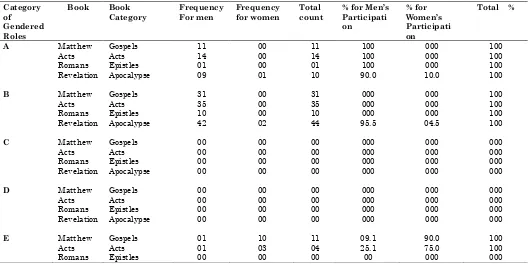
Examination of Gendered Roles in the Bible To examine the gendered roles in the Bible the researcher identified six categories of roles and how they are assigned to both men and women in the four books sampled for the study. The categories of roles are listed below in the order in which they appear in the table below.
(a) Political leaders (A)
(b) Spiritual leaders (B)
(c) Homemakers (C)
(d) Farmers (D)
(e) Servants (Maids and caretakers) (E)
(f) Supporters of spouses in leadership (F)
Table 1: Gendered roles in the Bible Category
of Gendered Roles
Book Book
Category Frequency For men Frequency for women Total count % for Participati Men’s on
% for Women’s Participati on
Total %
A Matthew Gospels 11 00 11 100 000 100
Acts Acts 14 00 14 100 000 100
Romans Epistles 01 00 01 100 000 100
Revelation Apocalypse 09 01 10 90.0 10.0 100
B Matthew Gospels 31 00 31 000 000 100
Acts Acts 35 00 35 000 000 100
Romans Epistles 10 00 10 000 000 100
Revelation Apocalypse 42 02 44 95.5 04.5 100
C Matthew Gospels 00 00 00 000 000 000
Acts Acts 00 00 00 000 000 000
Romans Epistles 00 00 00 000 000 000
Revelation Apocalypse 00 00 00 000 000 000
D Matthew Gospels 00 00 00 000 000 000
Acts Acts 00 00 00 000 000 000
Romans Epistles 00 00 00 000 000 000
Revelation Apocalypse 00 00 00 000 000 000
E Matthew Gospels 01 10 11 09.1 90.0 100
Acts Acts 01 03 04 25.1 75.0 100
Revelation Apocalypse 01 00 01 100 000 100
F Matthew Gospels 00 00 00 000 000 000
Acts Acts 00 01 01 000 100 100
Romans Epistles 00 13 13 000 100 100
Revelation Apocalypse 08 01 10 01.1 08.9 100
Toatal 4 87 25 115 75.7 24.3 100
The table above shows gendered roles in the Bible. Categories A and B are associated with the highest levels of leadership: political and spiritual leadership. In these categories, men have 153 out of the total 156 incidents recorded, accounting for 98.1%. Women on the other hand have 3 incidents in the same categories, accounting for 1.9% in the same categories. No incidents are recorded for men and women in categories C and D. Categories, E and F, are associated with low cadres of leadership. In these categories, men have 11 out of 39 incidents, accounting for 28.2%. Women on their part have 28 incidents in the same categories, accounting for 71.2%.
The Effect of Gendered Roles in the Bible on the Participation of women in the Church The next step was to investigate whether the gendered roles have an effect of women in church leadership. This was done by asking the respondents whether they thought the gendered roles in the Bible had an effect on the participation of women in church leadership. The summary of the responses is given in the fig 1 below.
Fig 1 summarises the responses of the audience to the question: “Do the roles that you have specified
have an effect on women’s access to leadership in your church?”
Fig 1: Responses to the question: Do the gendered roles practised in your church have an effect on the participation of women in church leadership?
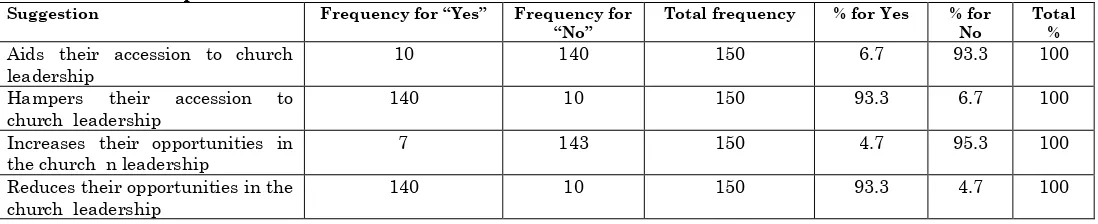
Out of the 190 respondents, 40 of them (21.1%) reported that they did not while the rest 150 (79.1) reported in the affirmative. After establishing that the gendered roles affect the participation of women in church leadership, the study sought to investigate their specific effect of the gendered roles. The respondents were asked to tick against some given suggestions and the summary is given in the table below.
Table 2: Summary of responses on the effects of gendered roles on the participation of women in church leadership
Suggestion Frequency for “Yes” Frequency for
“No” Total frequency % for Yes % for No Total %
Aids their accession to church
leadership 10 140 150 6.7 93.3 100
Hampers their accession to church leadership
140 10 150 93.3 6.7 100
Increases their opportunities in
the church n leadership 7 143 150 4.7 95.3 100
Reduces their opportunities in the
church leadership 140 10 150 93.3 4.7 100
The table above summarises the responses on the effects of gendered roles on the participation of women in church leadership. 17 responses out of the total 600 responses (28.3%) reported that the gendered roles aids women’s accession to church leadership and increases their opportunities in church leadership. On the other hand, 280 responses out 600 reported that the same attitudes hampers women’s accession to church leadership and reduces their opportunities in the same.
Implications of the Study
duty to produce literature that counters the stereotypes roles that are presented in the Bible and the church. These should be products that paint women as effective leaders both within the church and beyond. The study in fact suggests that the products should be fashioned in such a way that women play the central roes alongside men. Thirdly, the study of gendered roles and other forms of gendered communication is of great interest to communication scholars since it shows the results of such communication on any section of a society even beyond the church. This is important since understanding how the gendered roles and other forms of gendered communication are constructed is essential in learning how they can be deconstructed.
Conclusion
The study sought to investigate the effect of gendered roles in the Bible on the participation of women in church leadership. These gendered roles are a part of gendered communication styles that are employed both in the Bible and the church. The study indeed established that there are gendered roles in the Bible. Content analysis of the sampled books showed that the duties allocated to women were the ones that denied them political and spiritual leadership. Instead, the roles confined them to their homes so that men would have the convenience of taking leadership at higher positions. It further revealed
that the roles adversely influenced the participation of women in church leadership. It was clear that the roles in the Bible are used to deny women leadership as the church establishment quotes the text as the key authority on how authority should be distributed in the church. The study thus recommended that the church should open more doors for the participation of women in leadership at the top hierarchies. It also calls upon the communication scholars to pore into ways in which the gendered roles and other forms of gendered communication can be deconstructed and then reconstructed. A key area would be whether new models of communication can create new roles and other social constructions in the church and beyond. There is also a need to establish whether the new channels of communication such as the social media platforms can be used to create new perceptions about women and leadership in the church.
Acknowledgements
The authors would like to thank the International Bible Society for allowing them to quote from The New International Version. Scriptures taken from the Holy Bible, New International Version ®. Copyright© 1984 by International Bible Society. Used by permission of the International Bible Society. All rights reserved.
References
1. Barker A (1993) The Jewish Woman in the Contemporary Society. London: Macmillan Press Limited.
2. Bogle J (2009) Women Priests-No Chance! Catholic Education Resource Centre. www.catholiceducation.org/articles. Retrieved on 12th August, 2012.
3. Bridges LM (2011) Women in Church Leadership. www.rande.org/BRIDGES. Accessedon 22nd August, 2012.
4. Bryson V (1992) Feminist Political Theory. Hampshire: Macmillan Press Limited.
5. Gill Research LLC (2004) Sample Size – How large does my sample need to be? www.gill research.com/pdfs gr/samplesize.pdf. Retrieved on 23rd August, 2013.
6. Government of Kenya (2010) The Constitution of Kenya. Nairobi: Government Printer.
7. Hadsen A et al (1998). Mass Communication Research Methods. London: Palgrave Macmillan.
8. Hay J, Sticher S (1984) African Women South of the Sahara. New York: Longman Group Limited.
9. International Bible Society (1984) New International Version. Nairobi: International Bible Society.
10. King U (1993) Women and Spirituality: Voices of Protest and Promise. Pennsylvania: Pennsylvania University Press.
11. Kuloba WR (2011) The berated politicians: other ways of reading Miriam, Michal, Jezebel and Athaliah in the Old Testament in relation to political and gender quandary in Sub-Saharan Africa, Kenya and Uganda as case studies: PhD thesis. The Department of Theology and Religious Studies, School of Critical Studies, University of Glasgow. http://theses.gla.ac.uk/2936/. Accessed on 13th January, 2013
13. Lorber J (1994) “Night to his Day”: The Social Construction of Gender. Excerpts from: Paradoxes of Gender (Chapter 1). Yale: Yale University Press.
14. McCain D (1996) Notes on New Testament: Introduction. Bukuru: African Christian Textbooks.
15. Owen IR (1995) Social constructionism and the Theory, Practice and Research of Psychotherapy: A Phenomenological Psychology Manifesto. www.intentionalitymodel.info.pdf/SOCCONST.pdf . Retrieved on 12th April, 2012.
16. Philips A (1987) Feminism and Equality. New York: New York University Press.
17. United Nations (1995) Beijing Declaration and Platform for Action: The Fourth World