© 2019 by the Serbian Biological Society 517
Antioxidant and antimicrobial activities of
Penicillium
sp. lectins
Ram S. Singh* and Amandeep K. Walia
Carbohydrate and Protein Biotechnology Laboratory, Department of Biotechnology, Punjabi University, Patiala 147 002, Punjab, India
*Corresponding author: [email protected]
Received: May 29, 2019; Revised: May 31, 2019; Accepted: June 3, 2019; Published online: June 5, 2019
Abstract: Lectins are a diverse group of proteins of non-immune origin that interact specifically with glycans. Owing to their specificity, they can mediate various cellular and molecular recognition processes. To explore information on biological activities of lectins from Penicillium duclauxii, P. proteolyticum and P. griseoroseum, they were investigated for their antioxidant and antimicrobial activities. Penicillium sp. lectins exhibited moderate antioxidant activity. P. duclauxii, P. proteolyticum and P. griseoroseum lectins inhibited DPPH with an IC50 value of 71.42, 75.04 and 82.11 µg/mL, respectively.
P. duclauxii, P. proteolyticum and P. griseoroseum lectins inhibited the hydrogen peroxide radical with IC50 values of 198.57, 209.76 and 215.31 µg/mL, respectively. P. duclauxii and P. proteolyticum lectins exhibited potent antibacterial activity against Gram-negative bacteria. P. griseoroseum lectin inhibited only Gram-positive bacteria. Penicillium sp. lectins did not exhibit antifungal activity. The biological potential of Penicillium sp. lectins will help to understand their biomedical applications. This is the first report on the antioxidant and antimicrobial activities of purified lectins from Penicillium sp.
Keywords: Penicillium; lectin; antioxidant; antibacterial; antifungal
How to cite this article: Singh RS, Walia AK. Antioxidant and antimicrobial activities of Penicillium sp. Lectins. Arch Biol Sci. 2019;71(3):517-24. INTRODUCTION
Lectins are multivalent glycoproteins that possess two or more carbohydrate binding sites. They are of non-immune origin [1] and bind reversibly and specifically to free or membrane bound carbohydrate moieties [1]. Lectins are widely distributed in nature and found in all life forms including plants [2], animals [3], algae [4,5], cyanobacteria [6,7], yeasts [8], mushrooms [9] and microfungi [10]. Amongst the microfungi, lectins from Penicillium sp. [11,12], Fusarium sp. [13] and As-pergillus sp. [14,15] have been widely reported. Lectins from diverse sources are involved in cell-cell/host-pathogen interactions and trigger many of reactions [16-18]. They possess the ability to induce agglutina-tion of cells and have been explored for their biomedi-cal potential [19]. They manifest diverse biologibiomedi-cal activities such as mitogenic [20-22], antiproliferative [23,24], immunomodulatory [25,26], antitumor [27], antimicrobial [28,29], antioxidant [30,31], etc.
Antioxidants are molecules that donate electrons/ hydrogen to radicals and quench free radical
reac-tions based on their reduction potential or other traits. During normal or pathological cell metabolism, free radicals are generated that have one or more unpaired electrons (superoxide, hydroxyl, peroxyl), and the compounds that have the potential to scavenge free radicals can play a role in curing diseased cells and improving pathological conditions. Thus, they play a significant role in defense mechanisms of organisms against various pathologies related to free radical at-tack [32]. There has been an increase in research into new compounds with antioxidant activity in natural products. Many plant lectins have been reported to possess an antioxidant potential [23,27,28]. However, there is only one report on the antioxidant potential of lectins from microfungi [33].
influence recognized targets [35]. There are only a few reports on the antimicrobial action of lectins from microfungi. The antimicrobial activities of lectins from Fusarium sp. [36], Aspergillus sp. [37,38] and
Penicillium sp. [39] have been reported. New lectins have been reported from Penicillium sp. [11,12,39], however, scant information is available in the litera-ture regarding their biological potential. In previous studies, lectins from Penicillium sp. were purified, characterized and evaluated for their mitogenicity [40,41]. The aim of the current study was to explore the antioxidative and antimicrobial activities of these purified Penicillium sp. lectins.
MATERIALS AND METHODS Ethical statement
Animal care was taken according to the guidelines of the Committee for the Purpose of Control and Supervision of Experiments on Animals (CPCSEA) of the Government of India. Experimental work was approved by the Institutional Ethics Committee for Animals (Permit No. 107/99/CPCSEA/201429).
Procurement and maintenance of test organisms used for antimicrobial activity
Cultures used for the antibacterial assay were Gram-positive bacteria (Bacillus cereus MTCC 1306 and
Staphylococcus aureus MTCC 6908) and Gram-neg-ative bacteria (Pseudomonas aeruginosa MTCC 1034 and Escherichia coli MTCC 64). Test organisms used for the antifungal assay were Saccharomyces cerevi-siae MTCC 170, Candida albicans MTCC 183, As-pergillus flavus MTCC 277 and Fusarium oxysporum
MTCC 284. All cultures were procured from MTCC, IMTECH Chandigarh, India, and maintained on pre-scribed media. Bacterial cultures were maintained on nutrient agar slants containing (expressed as percent-age (%) of contents): 0.1 beef extract, 0.2 yeast ex-tract, 0.5 peptone, 0.5 NaCl and 3.0 agar. Yeast cul-tures (S. cerevisiae and C. albicans) were maintained on yeast extract peptone dextrose (YEPD) agar slopes containing (in %): 0.3 yeast extract, 1.0 peptone, 2.0 dextrose and 3.0 agar. A. flavus was maintained on Czapek yeast agar (CYA) slants containing (in %): 0.1
K2HPO4, 0.5 yeast extract, 3.0 sucrose, 0.3 NaNO3, 0.05 KCl, 0.05 MgSO47H2O, 0.001 FeSO47H2O and 3.0 agar. F. oxysporum was maintained on potato dextrose agar (PDA) slants containing (in %): potato extract 20.0, dextrose 2.0, agar 3.0 and pH adjusted to 5.6.
Extraction and purification of Penicillium sp. lectins
Fungal cultures of P. duclauxii MTCC 7997, P. pro-teolyticum MTCC 10300 and P. griseoroseum MTCC 9624 were obtained from MTCC housed at IMTECH, Chandigarh, India. All the cultures were maintained and cultivated on their respective medium under growth conditions specified by MTCC, as described earlier [12]. Fungal mycelia were harvested by filtra-tion from broth cultures and intracellular Penicillium
sp. lectins were extracted in 0.1 M phosphate buffered saline (PBS), pH 7.2. as described [14]. Penicillium
sp. lectins were purified by ion chromatography on a DEAE Sepharose column (GE Healthcare, USA) and gel exclusion chromatography on a Sephadex G-100 column following the reported methodology [40,41].
Hemagglutination assay and protein quantification
Rabbit erythrocytes were used for the hemagglutina-tion assay with Penicillium lectins as described [14]. Hemagglutination titer was used to express lectin ac-tivity, which is defined as the reciprocal of the highest dilution that exhibits visible erythrocyte hemaggluti-nation. Protein quantification of Penicillium sp. lectins was performed by the Lowry method [42]. Purified lectins were then evaluated for their antioxidant po-tential and antimicrobial activity.
DPPH (2,2-diphenyl-1picrylhydrazyl) radical scavenging assay
DPPH (3.9 mL). The reaction mixture (4 mL) was shaken vigorously and then incubated for 30 min in the dark at room temperature. Absorbance of the re-sultant solution was read spectrophotometrically at 517 nm against the blank (methanol plus lectin so-lution). The control solution contained all reagents except the test sample. Owing to the strong reducing power and weak metal chelating ability, ascorbic acid at different concentrations (1, 5, 10, 25, 50, 75, 100 µg/ mL) served as a standard. The DPPH radical scaveng-ing activity of lectins was determined by convertscaveng-ing the absorbance into the percentage antioxidant activ-ity using the following equation:
Percent inhibition (%) =
where AbsA is the absorbance of the control reaction and AbsB is the absorbance of the lectin solution.
The concentration of the test sample required to inhibit 50% of the DPPH free radical is defined by the IC50 (half maximal inhibitory concentration) value. Higher free radical (antioxidant) activity is indicated by lower IC50 values of the reaction mixture.
Hydrogen peroxide radical scavenging assay
The ability of Penicillium sp. lectin solution to scav-enge hydrogen peroxide radicals was determined as described [44]. A 43-mM H2O2 solution was prepared in phosphate buffer (0.1 M, pH 7.4). Purified Penicil-lium sp. lectin solutions (3.4 mL) in phosphate buffer at different concentrations (50, 70, 100, 125, 150, 175, 200, 225, 250 µg/mL) were added to the H2O2 solution (0.6 mL, 43 mM). After 10 min, the absorbance of the H2O2 was read spectrophotometrically at 230 nm against the blank (phosphate buffer without H2O2). Ascorbic acid at different concentrations (50, 70, 100, 125, 150, 175, 200, 225, 250 µg/mL) was used as the standard for comparison. The hydrogen peroxide rad-ical scavenging activity of lectins was then determined using the following equation:
Percent of H2O2 radical scavenging
activity (%) =
where AbsA is the absorbance of the control reaction and AbsB is the absorbance of the lectin solution. The
half maximal inhibitory concentration (IC50) was de-termined as described above.
Antimicrobial assay
The antimicrobial activity of purified Penicillium sp. lectins was assessed against various bacterial and fun-gal cultures by the disk diffusion method [45].
Antibacterial assay
The bacterial cell suspension was prepared by inocu-lating the test culture strains from nutrient agar slants into nutrient broth medium and grown for 24 h by shaking (150 rpm) at 37°C. The overnight-grown bac-terial cultures were adjusted with sterile PBS (pH 7.4) to yield a 0.5 McFarland suspension. The prepared bacterial inoculum (100 µL) was then spread on Mul-ler-Hinton agar plates by the three-dimension swab technique. Sterile filter paper disks (6.0 mm diameter, Whatman, U.K.) were placed on the inoculated agar plates and each disk was impregnated with purified
Penicillium sp. lectin (50 µg). Inoculated agar plates were then incubated at 37°C for 24 h. Reference anti-biotics, ciprofloxacin (10 µg) and gentamicin (50 µg), served as a positive control. The degree of susceptibil-ity of the test organism was determined by examining the zone of inhibition around the sample disk. Bacte-rial growth encircled around the disks indicated the non-inhibitory action of lectin, whereas crescents of inhibition around disks depicted antibacterial activity.
Antifungal assay
Yeast cultures were grown in YEPD broth for 48 h at 30°C. Fungal cultures of A. flavus and F. oxysporum
were grown on CYA and PDA, respectively, for 5 days at 25°C. The fungal suspensions (107 spores/mL) and
yeast cells (107 cells/mL) were prepared, and spreading
Minimum inhibitory concentration (MIC) determination for antibacterial activity
Purified Penicillium sp. lectins were serially diluted with sterile water to different concentrations (5-50 µg) for the determination of MIC. Bacterial cultures (100 µL) were spread over Muller-Hinton agar plates. Different lectin concentrations were impregnated over sterile fil-ter paper disks placed on agar plates. The disk diffusion method was performed to determine the inhibition of microorganisms. The MIC was taken to be the lowest concentration that inhibited bacterial growth.
Statistical analysis
All the experiments were repeated three times and the results are expressed as the mean±standard deviation of triplicate values.
RESULTS
Lectins from P. duclauxii, P. proteolyticum and P. grise-oroseum were purified to the following specific activi-ties: 131.1, 168.42 and 124.27 titer/mg, respectively, as described previously [40,41]. All lectins were used for determination of the antioxidant potential, and antifungal and antibacterial activities.
DPPH free radical scavenging by Penicillium
sp. lectins
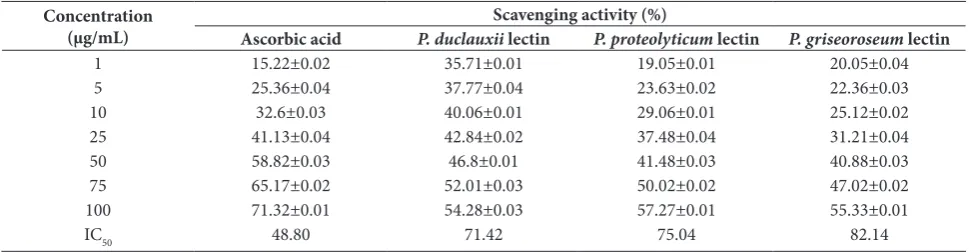
To evaluate the antioxidant activity, the DPPH free radical scavenging assay is considered the most accu-rate screening method. The percentage inhibition of DPPH by purified Penicillium sp. lectins and ascorbic acid (standard) was determined (Table 1). Penicillium
sp. lectins possess a moderate antioxidant capacity. The highest scavenging action was shown by P. duclauxii lec-tin. IC50 values of 71.42 µg/mL, 75.04 µg/mL and 82.14 µg/mL were shown by P. duclauxii, P. proteolyticum and
P. griseoroseum lectins, respectively, whereas ascorbic acid had an IC50 value of 48.80 µg/mL.
Hydrogen peroxide scavenging by Penicillium sp. lectins
The percentage inhibition of hydrogen peroxide by purified Penicillium sp. lectins and the standard,
ascorbic acid, were also determined (Table 2). The IC50 values of P. duclauxii, P. proteolyticum and P. gri-seoroseum lectins for hydrogen peroxide were found at concentrations of 198.57 µg/mL, 209.76 µg/mL and 215.31 µg/mL, respectively. Ascorbic acid was used as the standard as it is a very strong antioxidant, and 50% scavenging of hydrogen peroxide radicals was achieved at a concentration of 150 µg/mL (IC50).
Antimicrobial activity of Penicillium sp. lectins
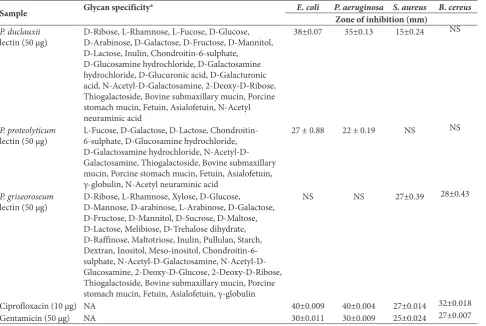
The purified Penicillium sp. lectins were screened for antimicrobial activities by the disk diffusion method. The zone of inhibition by Penicillium sp. lectins was determined by measuring the diameters of the inhibi-tory zones (Table 3). P. duclauxii lectin exhibited an enhanced inhibitory effect over Gram-negative bacte-ria as compared to Gram-positive bactebacte-ria. A high an-tibacterial activity of P. duclauxii lectin was observed against E. coli and P. aeruginosa, with maximum zones of inhibition of 38±0.07 mm and 35±0.13 mm, respec-tively. P. proteolyticum lectin showed inhibitory zones of 27±0.88 mm and 22±0.19 mm against E. coli and P. aeruginosa, respectively. P. duclauxii lectin expressed low antibacterial activity against S. aureus (15±0.24 mm), whereas P. proteolyticum lectin was non-inhibi-tory against it. Growth of B. cereus remained unaffect-ed with both lectins. However, P. griseoroseum lectin strongly inhibited Gram-positive bacteria, including
S. aureus (27±0.39) and B. cereus (28±.43), but was non-inhibitory towards Gram-negative bacteria.
The growth of yeast (C. albicans, S. cerevisiae) and fungi (A. niger, F. oxysporum) was not affected in the assay. The MIC of purified Penicillium sp. lec-tins against bacterial strains was determined (Table 4). In the case of P. duclauxii lectin, the MIC was lowest for E. coli (7.5 µg) and highest for S. aureus (45 µg), whereas, P griseoroseum lectin had an MIC of 17.5 µg towards B. cereus.
DISCUSSION
the organism’s defense against pathologies related to high ROS levels [32]. DPPH is a widely used assay for determining antioxidant activity [47]. P. duclauxii, P. proteolyticum and P. griseoroseum lectins exhibited concentration-dependent antioxidant activities. In-teraction between lectin molecule (antioxidant) and DPPH radical can lead to a decrease in absorbance of DPPH radicals owing to scavenging of the radical by hydrogen donation [33]. Penicillium sp. extract was reported to express a DPPH free radical scavenging activity of about 50% at a concentration of 300 µg/mL [48]. Concentration-dependent free radical scaveng-ing of DPPH is expressed by some endophytic fungal lectins [33].
P. duclauxii, P. proteolyticum and P. griseoroseum
lectins exhibit antioxidant activities. The highest hydrogen peroxide scavenging activity was shown by P. duclauxii lectin. Hydrogen peroxide is a non-radical derivative of oxygen and can inactivate some enzymes. It is a weak oxidizing agent and can oxidize essential thiol (-SH) groups. It can react with differ-ent molecules in living organism after differ-entry into cells
[49]. A concentration-dependent hydrogen peroxide scavenging activity was also displayed by lectins from endophytic fungi [33]. Cratylia mollis (pCramoll) and recombinant Cramoll 1 (rCramoll 1) lectins exhib-ited concentration-dependent attenuation of H2O2 -induced oxidative stress [49]. Thus, antioxidants have gained interest owing to their role in preventing oxidative-stress related diseases caused by free radical attack on key biological components, such as nucleic acids and lipids [30].
Microorganisms usually possess carbohydrates on their cell surface that are either covalently bound (glycosylated teichoic acids to peptidoglycan) or non-covalently bound (capsular polysaccharides) and act as potential lectin-reactive site [35]. Owing to the abil-ity of lectins to form complexes with microbial glyco-conjugates, they can play a key role in the recognition of microbes and thus exert antimicrobial activity.
P. duclauxii and P. proteolyticum lectins inhibited Gram-negative bacteria, whereas P. griseoroseum
lectin inhibited Gram-positive bacteria. P.
proteo-Table 1. DPPH radical scavenging by the standard (ascorbic acid) and purified Penicillium sp. lectins.
Concentration
(µg/mL) Ascorbic acid P. duclauxiiScavenging activity (%) lectin P. proteolyticum lectin P. griseoroseum lectin
1 15.22±0.02 35.71±0.01 19.05±0.01 20.05±0.04
5 25.36±0.04 37.77±0.04 23.63±0.02 22.36±0.03
10 32.6±0.03 40.06±0.01 29.06±0.01 25.12±0.02
25 41.13±0.04 42.84±0.02 37.48±0.04 31.21±0.04
50 58.82±0.03 46.8±0.01 41.48±0.03 40.88±0.03
75 65.17±0.02 52.01±0.03 50.02±0.02 47.02±0.02
100 71.32±0.01 54.28±0.03 57.27±0.01 55.33±0.01
IC50 48.80 71.42 75.04 82.14
Table 2. Hydrogen peroxide radical scavenging by the standard (ascorbic acid) and purified Penicillium sp. lectins. Concentration
(µg/mL) Ascorbic acid P. duclauxii Scavenging activity (%)lectin P. proteolyticum lectin P. griseoroseum lectin
50 32.22±0.01 9.2±0.04 8.16±0.04 10.16±0.04
70 35.51±0.03 11.11±0.01 19.05±0.02 17.05±0.03
100 38.53±0.02 14.28±0.04 28.89±0.01 22.99±0.02
125 44.62±0.04 26.34±0.02 31.41±0.03 27.21±0.04
150 51.49±0.03 39.04±0.03 34.33±0.02 32.43±0.02
175 55.31±0.01 43.8±0.04 41.21±0.01 40.11±0.04
200 60.79±0.04 51.74±0.02 45.71±0.04 48.66±0.01
225 63.47±0.02 58.09±0.03 54.55±0.02 51.37±0.02
250 67.77±0.04 64.76±0.04 60.03±0.04 59.22±0.04
lyticum and P. griseoroseum lectins exhibited strong selective antibacterial activity. Interactions of lectin with lipopolysaccharides present in the cell wall of Gram-negative bacteria could be responsible for its antibacterial action [50]. Lectins could also interact with N-acetyl-D-glucosamine, N-acetylmuramic acid and tetrapeptides linked to N-acetylmuramic acid and present in the cell wall of Gram-positive bacteria [50].
P. duclauxii [40] and P. proteolyticum [41] lectins are nonspecific towards N-acetyl-D-glucosamine. Thus,
their non-inhibitory action towards Gram-positive bacteria (which possess high levels of N-acetyl-D-glucosamine in their cell wall) further corroborates this. However, P. griseoroseum lectin exhibits specific-ity towards N-acetyl-D-glucosamine [12] and inhibits Gram-positive bacteria, which substantiates lectin-glycan interaction leading to bacterial inhibition. In the case of S. aureus, P. duclauxii lectin might form a channel on the cell membrane resulting in an out-flow of cellular contents, thus leading to cell death.
Table 3. Antimicrobial activities of purified Penicillium sp. lectins.
Sample Glycan specificity* E. coli P. aeruginosa S. aureus B. cereusZone of inhibition (mm)
P. duclauxii
lectin (50 µg) D-Ribose, L-Rhamnose, L-Fucose, D-Glucose, D-Arabinose, D-Galactose, D-Fructose, D-Mannitol, D-Lactose, Inulin, Chondroitin-6-sulphate,
D-Glucosamine hydrochloride, D-Galactosamine hydrochloride, D-Glucuronic acid, D-Galacturonic acid, N-Acetyl-D-Galactosamine, 2-Deoxy-D-Ribose, Thiogalactoside, Bovine submaxillary mucin, Porcine stomach mucin, Fetuin, Asialofetuin, N-Acetyl neuraminic acid
38±0.07 35±0.13 15±0.24 NS
P. proteolyticum
lectin (50 µg) L-Fucose, D-Galactose, D-Lactose, Chondroitin-6-sulphate, D-Glucosamine hydrochloride, D-Galactosamine hydrochloride, N-Acetyl-D-Galactosamine, Thiogalactoside, Bovine submaxillary mucin, Porcine stomach mucin, Fetuin, Asialofetuin, γ-globulin, N-Acetyl neuraminic acid
27 ± 0.88 22 ± 0.19 NS NS
P. griseoroseum
lectin (50 µg) D-Ribose, L-Rhamnose, Xylose, D-Glucose, D-Mannose, D-arabinose, L-Arabinose, D-Galactose, D-Fructose, D-Mannitol, D-Sucrose, D-Maltose, D-Lactose, Melibiose, D-Trehalose dihydrate, D-Raffinose, Maltotriose, Inulin, Pullulan, Starch, Dextran, Inositol, Meso-inositol, Chondroitin-6-sulphate, Galactosamine, N-Acetyl-D-Glucosamine, 2-Deoxy-D-Glucose, 2-Deoxy-D-Ribose, Thiogalactoside, Bovine submaxillary mucin, Porcine stomach mucin, Fetuin, Asialofetuin, γ-globulin
NS NS 27±0.39 28±0.43
Ciprofloxacin (10 µg) NA 40±0.009 40±0.004 27±0.014 32±0.018
Gentamicin (50 µg) NA 30±0.011 30±0.009 25±0.024 27±0.007
*Glycan specificity of lectins from Penicillium sp. [12] NA: Not applicable
NS: Zone of inhibition not shown by lectins
Table 4. Minimum inhibitory concentrations of purified Penicillium sp. lectins.
Test organism Minimum inhibitory concentration (µg)
P. duclauxii lectin P. proteolyticum lectin P. griseoroseum lectin
Escherichia coli 7.5 15 NS
Pseudomonas aeruginosa 10 20 NS
Staphylococcus aureus 45 NS 22.5
Bacillus cereus NS NS 17.5
The thicker murein layer in the case of Bacillus ce-reus probably acts as a barrier in P. duclauxii and P. proteolyticum lectins and thus does not exhibit any inhibitory action.
Crude lectin extracts from P. corylophilum, P. purpurogenum and P. expansum exhibited both anti-fungal and antibacterial activities [39]. A. panamensis
[38] and A. gorakhpurensis [37] purified lectins also displayed a considerable antibacterial potential. En-dophytic fungal lectins from A. flavus, F. moniliforme
and F. oxysporum exhibit nonselective antibacterial activity towards K. pneumonia, P. mirabilis, S. marc-escens and S. aureus [51].
Although many microbial lectins have been char-acterized, only a few showed antifungal effects [52,53]. Lectins having specificity towards chitin can inhibit fungal growth as the fungal cell wall is composed of chitin (polymer of β-(1, 4)-N-acetyl-D-glucosamine) [50]. However, purified P. duclauxii [40] and P. pro-teolyticum [41] lectins are nonspecific towards N-acetyl-D-glucosamine and thus does not exhibit any antifungal activity.
Owing to the potential antioxidant and antibacte-rial actions of Penicillium sp.lectins, these compounds could have prospective biomedical applications and may be used further for microbiology studies.
Funding: Punjabi University, Patiala, India is acknowledged for funding the experiments.
Acknowledgments: Laboratory facilities provided by Depart-ment of Biotechnology, Punjabi University, Patiala, India are duly acknowledged.
Author contributions: RSS is the main author who conceived the idea, designed the research, provided guidance for research work and interpreted the results. AKW performed all of the ex-perimental work and wrote the manuscript.
Conflict of interest disclosure: The authors have no conflict of interest.
REFERENCES
1. Sharon N, Lis H. History of lectins: From hemagglutinins to biological recognition molecules. Glycobiology. 2004;14:53-62. 2. Van Damme EJ. History of plant lectin research. Methods
Mol Biol. 2014;1200:3-13.
3. Singh RS, Tiwary AK, Kennedy JF. Lectins: sources, activi-ties and applications. Crit Rev Biotechnol. 1999;19:145-78. 4. Singh RS, Thakur SR, Bansal P. Algal lectins as promising
biomolecules for biomedical research. Crit Rev Microbiol. 2015;41:77-88.
5. Singh RS, Walia AK. Lectins from red algae and their bio-medical potential. J Appl Phycol. 2018;30:1833-58. 6. Singh RS, Walia AK, Khattar JS, Singh DP, Kennedy JF.
Cya-nobacterial lectins characteristics and their role as antiviral agents. Int J Biol Macromol. 2017;102:475-96.
7. Singh RS, Walia AK, Pratibha, Khattar JS, Singh DP. New cell surface lectins with complex carbohydrate specificity from cyanobacteria. Ind J Exp Biol. 2017;55:514-22.
8. Singh RS, Bhari R, Kaur HP. Characteristics of yeast lec-tins and their role in cell-cell interactions. Biotechnol Adv. 2011;29:726-31.
9. Singh RS, Bhari R, Kaur HP. Mushroom lectins: current status and future perspectives. Crit Rev Biotechnol. 2010;30:99-126. 10. Singh RS, Bhari R, Kaur HP. Current trends of lectins from
microfungi. Crit Rev Biotechnol. 2011;31:193-210.
11. Singh RS, Sharma S, Kaur G, Bhari R. Screening of
Penicil-lium species for occurrence of lectins and their characteriza-tion. J Basic Microbiol. 2009;49:471-6.
12. Singh RS, Walia AK. New mycelial lectins from peni-cillin with complex carbohydrate specificity. Biologia. 2016;71:388-95.
13. Singh RS, Thakur S. New rabbit erythrocyte specific mycelial
lectins from Fusarium sp. with complex saccharide
specific-ity. J Appl Biol Biotechnol. 2019;7:7-13.
14. Singh RS, Tiwary AK, Bhari R. Screening of Aspergillus
spe-cies for occurrence of lectins and their characterization. J Basic Microbiol. 2008;48:112-7.
15. Singh RS, Kaur HP, Singh J. New lectins from Aspergilli and their carbohydrate specificity. Biologia. 69;2014:15-23. 16. Singh RS, Walia AK. Characteristics of lichen lectins and
their role in symbiosis. Symbiosis. 2014;62:123-34. 17. Singh RS, Walia AK, Kanwar JR, Kennedy JF.
Amoebia-sis vaccine development: a snapshot on E. histolytica with
emphasis on perspectives of Gal/GalNAc lectin. Int J Biol Macromol. 2016;91:258-68.
18. Singh RS, Walia AK, Kanwar JR. Protozoa lectins and their role in host-pathogen interactions. Biotechnol Adv. 2016;34:1018-29.
19. Singh RS, Walia AK, Kennedy JF. Structural aspects and biomedical applications of microfungal lectins. Int J Biol Macromol. 2019;134:1097-107.
20. Singh RS, Bhari R, Singh J, Tiwary AK. Purification and characterization of a new mucin-binding mycelial lectin
from Aspergillus nidulans with potent mitogenic activity.
World J Microbiol Biotechnol. 2011;27:547-54.
21. Singh RS, Bhari R, Kaur R. Purification, characterization, and mitogenic potential of a mucin-specific mycelial
lec-tin from Aspergillus sparsus. Appl Biochem Biotechnol.
2015;175:1938-47.
22. Singh RS, Walia AK. Microbial lectins and their prospective mitogenic potential. Crit Rev Microbiol. 2014;40:329-47.
23. Pan WL, Ng TB. A dimeric Phaseolus coccineus lectin with
24. Singh RS, Kaur HP, Kanwar J. Mushroom lectins as promising anticancer substances. Curr Protein Pept Sci. 2016;17:797-807.
25. Singh RS, Kaur HP, Kennedy JF. Modulation of immunocyte functions by a mucin-specific lectin from Aspergillus gorakh-purensis. Int J Biol Macromol. 2017;101:172-8.
26. Singh RS, Kaur HP, Rana V, Kennedy JF. Immunomodula-tory and therapeutic potential of a mucin-specific mycelial
lectin from Aspergillus panamensis. Int J Biol Macromol.
2017;96:241-8.
27. Lacerda RR, de Nascimento ES, de Lacerda JT, Pinto LD, Rizzi C, Bezerra MM, Pinto IR, Filho SM, Pinto VP, Filho GC, Gadelha CA, Gadelha TS. Lectin from seeds of a Bra-zilian lima bean variety (Phaseolus lunatus L. var. cascavel) presents antioxidant, antitumour and gastroprotective activi-ties. Int J Biol Macromol. 2017;95:1072-81.
28. Saha RK, Tuhin SHM, Jahan N, Roy A, Roy P. Antibacterial and antioxidant activities of a food lectin isolated from the
seeds of Lablab purpureus. Am J Ethnomed. 2014;1:8-17.
29. Chandrasekaran G, Lee YC, Park H, Wu Y, Shin HJ. Antibac-terial and antifungal activities of lectin extracted from fruit-ing bodies of the Korean cauliflower medicinal mushroom,
Sparassis latifolia (Agaricomycetes). Int J Med Mushrooms. 2016;18:291-9.
30. Bera AK, Rana T, Das S, Bhattacharya D, Pan D, Bandyo-padhyay S, Das SK. Mitigation of arsenic-mediated renal oxidative stress in rat by Pleurotus florida lectin. Hum Exp Toxicol. 2011;30:940-51.
31. Wu M, Tong C, Wu Y, Liu S, Li W. A novel thyroglobulin-binding lectin from the brown alga Hizikia fusiformis and its antioxidant activities. Food Chem. 2016;201:7-13.
32. Pisoschi AM, Negulescu GP. Methods for total antioxidant activity determination: a review. Biochem Anal Biochem. 2011;1:1-10.
33. Sadananda TS, Govindappa M, Ramachandra YL. In vitro
antioxidant activity of lectin from different endophytic fungi of Viscum album L. Brit J Pharm Res. 2014;4:626-43. 34. Coelho LCBB, Silva PMDS, Oliveira WF, de Moura MC,
Pontual EV, Gomes FS, Paiva PMG, Napoleão TH, Correia MTS. Lectins as antimicrobial agents. J Appl Microbiol. 2018;125:1238-52.
35. Procópio TF, Moura MC, Albuquerque LP, Gomes FS, San-tos NDL, Coelho LCBB, Pontual EV, Paiva PMG, Napoleão TH. Antibacterial lectins: action mechanisms, defensive roles, and biotechnological potential. In: Collins E, editor. Antibacterials: synthesis, properties and biological activities. New York: Nova Sci Pub; 2017. p. 69-90.
36. Singh RS, Thakur S. Antimicrobial activity and carbohydrate specificity of new mycelial lectins from Fusarium sp. Biolo-gia. 2014;69:1295-302.
37. Singh RS, Kaur HP, Singh J. Purification and
characteriza-tion of a mucin specific mycelial lectin from Aspergillus
gorakhpurensis: application for mitogenic and antimicrobial activity. PLoS ONE. 2014;9:e109265.
38. Singh RS, Kaur HP, Singh J. Purification and
characteriza-tion of a mycelial mucin specific lectin from Aspergillus
panamensis with potent mitogenic and antibacterial activity. Process Biochem. 2015;50:2251-8.
39. Singh RS, Jain P, Kaur HP. Characterization and antimicro-bial activity of lectins from Penicillium sp. Indian J Exp Biol. 2013;51:984-91.
40. Singh RS, Walia AK, Kennedy JF. Purification and charac-terization of a mitogenic lectin from Penicillium duclauxii. Int J Biol Macromol. 2018;116:426-33.
41. Singh RS, Walia AK, Kennedy JF. Purification and
charac-terization of a heterodimeric mycelial lectin from
Penicil-lium proteolyticum with potent mitogenic activity. Int J Biol Macromol. 2019;128:124-31.
42. Lowry OH, Rosebrough NJ, Farr A, Randall RJ. Pro-tein estimation with Folin phenol reagent. J Biol Chem. 1951;193:265-75.
43. Oyaizu M. Studies on products of browning reactions: anti-oxidative activities of products of browning reaction pre-pared from glucosamine. Jap J Nutri. 1986;44:307-15. 44. Ferreira EB, Fernandes LC, Galende SB, Cortez DAG,
Bazotte RB. Hypoglycemic effect of the hydroalcoholic
extract of leaves of Averrhoa carambola L. (Oxalidaceae).
Brazil J Pharmacog. 2008;18:339-43.
45. Chumkhunthod P, Rodtong S, Lambert SJ, Fordham-Skelton AP, Rizkallah PJ, Wilkinson MC, Reynolds CD. Purification and characterization of an N-acetyl-D-galactosamine
spe-cific lectin from the edible mushroom Schizophyllum
com-mune. Biochim Biophys Acta. 2006;1760:326-32.
46. Campanella L, Martini E, Rita E, Tomassetti M. Antioxidant capacity of dry vegetal extracts checked by voltammetric method. J Food Agric Environ. 2006;4:135-44.
47. Yadav M, Yadav A, Yadav JP. In vitro antioxidant activity and total phenolic content of endophytic fungi isolated from Euge-nia jambolana Lam. Asian Pac J Trop Med. 2014;7:256-61.
48. Gunasekaran S, Sathiavelu M, Arunachalam S. In vitro
anti-oxidant and antibacterial activity of endophytic fungi isolated
from Mussaenda luteola. J Appl Pharma Sci. 2017;7:234-8.
49. Da Silva LCN, Alves NMP, De Castro MCAB, Higino TMM, Da Cunha CRA, Pereira VRA, Da Paz NVN, Coelho LCBB, Correia MTDS, De Figueiredo RCBQ. PCramoll and rCramoll as new preventive agents against the oxida-tive dysfunction induced by hydrogen peroxide. Oxid Med Cell Longev. 2015;2015:520872.
50. Karnchanatat A. Antimicrobial activity of lectins from plants. In: Bobbarala V, editor. Antimicrobial agents. Lon-don: InTech; 2019. p. 145-78.
51. Sadananda TS, Govindappa M, Ramachandra YL. Antibac-terial activity of Viscum album endophytic fungal lectin. Int J Biol Pharma Res. 2013;4:1033-42.
52. Amano K, Katayama H, Saito A, Ando A, Nagata Y. Aleuria
aurantia lectin exhibits antifungal activity against Mucor rac-emosus. Biosci Biotechnol Biochem. 2012; 76:967-70. 53. Albore´s S, Mora P, Bustamante MJ, Cerdeiras MP, Fraguas
LF. Purification and applications of a lectin from the
mush-room Gymnopilus spectabilis. Appl Microbiol Biotechnol.