Research Article
a
January
2018
Computer Science and Software Engineering
ISSN: 2277-128X (Volume-8, Issue-1)
A Novel Approach for Congestion Avoidance Using EIRED
Algorithm in MANET
Abreet Pal Singh
Research Scholar at Chandigarh Group of Colleges, Gharuan, Mohali, Punjab, India
Rajdavinder Singh Boparai
Assistant Professor at Chandigarh Group of Colleges, Gharuan, Mohali, Punjab, India
Abstract: A Mobile Ad-hoc Network (MANET) is a set of remote versatile hubs shaping an element self-sufficient system. Hubs speak with one another without the mediation of concentrated access focuses or base stations.
In MANET various issues have been encountered that degrades the performance of the network. These problem are congestion occurs in the network sue to peer to peer communication. Sometime a single node received large amount data than that a node can transmit further to destination. This issue get extend to data loss due to congestion occurred on a node. Optimum path assures guaranteed delivery of data from source to destination. In this paper a novel approach that is based early detection of congestion at each node has been used for congestion avoidance in the proposed work. Priority and probability has been assigned for all the nodes so that data can be transmitted in effective manner. On the basis of various parameters it has been analyzed that proposed approach provides better congestion avoidance as compare to existing approaches.
Keywords: MANET, IRED, CLRP, AODV, DSR, DSDV.
I. INTRODUCTION 1.1 MANET’S:
A Mobile Ad-hoc Network (MANET) is a set of remote versatile hubs shaping an element self-sufficient system. Hubs speak with one another without the mediation of concentrated access focuses or base stations. Because of the restricted transmission scope of remote system interfaces, numerous bounces are expected to trade information between hubs in the system. Portable Ad hoc Network is the quick becoming innovation from the previous 20 years. The addition in their notoriety is a result of the simplicity of arrangement, foundation less and their element nature. MANET made another set of requests to be actualized and to give effective better end to end correspondence.
1.2 Classification of Routing Protocols:
Routing protocols define a set of rules which governs the journey of message packets from source to destination in a network. In MANET, there are different types of routing protocols each of them is applied according to the network circumstances
Proactive Routing Protocols: Proactive routing protocols are also called as table driven routing protocols. In this every node maintain routing table which contains information about the network topology even without requiring it. This feature although useful for datagram traffic, incurs substantial signaling traffic and power consumption. The routing tables are updated periodically whenever the network topology changes. Proactive protocols are not suitable for large networks as they need to maintain node entries for each and every node in the routing table of every node. These protocols maintain different number of routing tables varying from protocol to protocol. There are various well known proactive routing protocols. Example: DSDV, OLSR, WRP etc. [8]. Reactive Routing Protocols: Reactive routing protocol is also known as on demand routing protocol. In this
protocol route is discovered whenever it is needed Nodes initiate route discovery on demand basis. Source node sees its route cache for the available route from source to destination if the route is not available then it initiates route discovery process. The on- demand routing protocols have two major components Ex: DSR, DSDV, AODV.
1.3 Security Goals
ISSN(E): 2277-128X, ISSN(P): 2277-6451, pp. 95-101 versatile promotion -hoc system is extremely difficult. The objectives to assess if versatile ad-hoc system is secure or not are as per the following:
Availability: Accessibility implies the benefits are open to approved gatherings at fitting times. Accessibility applies both to information and to administrations. It guarantees the survivability of system administration regardless of refusal of administration assault.
Confidentiality: It guarantees that computer related resources are gotten to just by approved gatherings. That is, just the individuals who thought to have admittance to something will really get that get to. To keep up secrecy of some private data, we have to keep them mystery from all elements that do not have benefit to get to them. Secrecy is frequently called mystery or protection [6].
Integrity: Trustworthiness implies that benefits can be altered just by approved gatherings or just in approved way. Change incorporates composing, evolving status, erasing and making. Trustworthiness guarantees that a message being exchanged is never defiled.
Authentication: Confirmation empowers a hub to guarantee the personality of associate hub it is corresponding with. Validation is basically certification that members in correspondence are confirmed and not impersonators. Validness is guaranteed in light of the fact that just the true blue sender can create a message that will unscramble legitimately with the shared key [7].
Authorization: This property relegates diverse access rights to diverse sorts of clients. For instance a system administration can be performed by system overseer just.
1.4 Congestion in MANET
Congestion is a circumstance in communication organizes in which an excess of packets are exhibit in a piece of the subnet. Congestion may happens when the load on the system (number of packets send to the system) is more prominent than the limit of the system (number of packets a system can handle). Congestion prompts packet losses and data transfer capacity corruption and waste time and vitality on congestion recuperation .In Internet when congestion happens it is regularly focused on a single switch, because of the imparted medium of the MANET congestion won't over-burden the versatile hubs yet has an impact on the whole scope area. When the routing protocols in MANET are definitely not conscious about the congestion, it brings about the accompanying issues.
Long delay: This holds up the methodology of locating the congestion. At the point when the congestion is more thorough, it is better to choose a substitute new way. Anyway the predominating on demand routing protocol defers the route seeking procedure.
High overhead: More handling and correspondence attempts are needed for another route
Disclosure: In the event that the multipath directing is used, it needs extra exertion for maintaining the multi-ways paying little mind to the presence of alternate route.
Many packet losses: The congestion control method endeavors to minimize the excess load in the system by either reducing the sending rate at the sender side or by dropping the packets at the intermediate nodes or by executing both the procedure. This causes increased packet loss rate or least throughput.
1.5 Congestion Control Tehniques in MANETs
1.5.1 CBRRT (Congestion Based Route Recovery Technique) [5]: In this technique, each node estimates the parameters such as queue length, data rate, and medium access control (MAC) contention. The upper and lower limit of these parameters is compared and node is marked with the congestion status such as normal, medium or high level. When data is to be transmitted from the source to destination, the intermediate nodes along the path verify its congestion status. If the congestion status of any one node is high or congestion status of more than one node is medium, a warning message will be sent to the source. The source then selects the alternate congestion free path for data transmission. Congestion status of node can be categorized into 3 states: Normal (N), High (H) and Low (L). In this paper, three parameters are defined to control the congestion that is: Average queue length (Lq), Incoming Data Rate (Rin) and MAC Contention (TMAC). This technique minimizes the packet drop and delay while increasing the packet delivery ratio.
ISSN(E): 2277-128X, ISSN(P): 2277-6451, pp. 95-101
1.5.3 LSRP (Link State Routing Protocol) [8]: In LSRP, whenever congested node sent congestion control packet which received by source node, it executes the congestion control algorithm. At first, the source node stops the forwarding of packets over the active paths. The source node sets a timer for the duration at which this new rate will be activated. During this period, if the source node does not receive any congested packet, if the link qualities of any of the active paths deteriorate, eventually the source node starts to load at the lowest possible rate over that path. In this case, the source attempts to switch the congested path with the backup path if possible. Consider residual energy and battery power in paths selection and the energy balance in data transmission to maximize the lifetime of networks. LSRP protocol which is effectively reduces the degradation of packet loss and faulty nodes. Although this approach produces routes with more hops, it allows minimizing the congestion on the link.
1.5.4 CARP (Congestion Adaptive Routing Protocol) [9]: Congestion Adaptive Routing is a congestion adaptive unicast on-demand routing protocol for MANETs. It tries to prevent congestion from occurring in the first place. Here every node that appears on the route warns its previous node when likely to be congested. So, CRP uses the additional paths called as bypass for bypassing the congestion creating traffic to the first non-congested node appearing on primary route. It reduces packet delay. But, at the same time CRP tries to minimize bypass to reduce protocol overhead. Hence, the traffic is split over bypass and so it reacts adaptively to network congestion. It consists of six components: congestion monitoring, primary route discovery, bypass discovery, traffic splitting and congestion adaptability, multipath minimization and failure recovery. Hence, power consumption is efficient, congestion is resolved beforehand and at the same time there is small packet loss rate.
II. REVIEW OF LITERATURE
Shivashankar et al [1] “Designing Energy Routing Protocol with Power Consumption Optimization in MANET” As technology rapidly increases, diverse sensing and mobility capabilities have become readily available to devices and, consequently, mobile ad hoc networks (MANETs) are being deployed to perform a number of important tasks. This protocol must be able to handle high mobility of the nodes that often cause changes in the network topology. This paper evaluates three ad hoc networks routing protocols (EPAR, MTPR, ands) in different network scales, taking into consideration the power consumption. Indeed, our proposed scheme reduces for more than 20% the total energy consumption and decreases the mean delay, especially for high load networks, while achieving a good packet delivery ratio.
Dong-Li Zhang et al. [2]“Research and improvement of DSR protocol in Ad Hoc Network”,DSR convention is one of
the agents of Ad hoc system with on-interest steering conventions, whose working methodology is primarily isolated into two sections: identify and keep up routings. Wormhole assault is an extraordinary approach to assault steering conventions of Ad hoc system. As per the examination of DSR convention and states of wormhole assault, the methodology and calculation of wormhole assault to DSR conventions have been scrutinized. Inevitably, ways are displayed to enhance DSR conventions.
Zhiyong Shi et al.[3] “Study on application of DSR protocol to mobile communication system”,as a rule, the base
station (BS) is settled in the versatile correspondence framework, be that as it may, which will be changed in some particular circumstances. To guarantee the better correspondence, both BSS and versatile stations (Mss) of portable correspondence system ought to have the capacity to move in the system, in particular whole versatility, which doesn't influence the correspondence of Mss. Notwithstanding, the course between Bss altered doesn't adjust to the circumstances in which all Bss can move starting with one spot then onto the next. What's more, the handover instrument of the system is the delicate handover mode with MS's support. Through a case and recreation, it is demonstrated that the portable correspondence system has the whole versatility in the wake of receiving the DSR convention, while the prerequisite of the correspondence can be fulfilled in such system.
Varshney , T. et al.[4] “Performance improvement of MANET under DSR protocol using swarm optimization”, Portable Ad hoc Network (MANET) is an independent, baseless, orchestrating toward oneself and recovering toward oneself arrangement of versatile hubs joined by remote connections. This enhances the execution of a steering convention in light of the fact that in greater part of the poor performing systems, the acting up hubs is the significant reason. To discover an ideal way between a set of hubs, DSR convention has been conveyed (utilizing the Ns2 test system) emulated by the application of Genetic Algorithm in recognizing the self-centered hubs.
Jhuria, M. et al. [5] “Improve Performance DSR Protocol by Application of Mobile Agent”, The Mobile Ad-Hoc
ISSN(E): 2277-128X, ISSN(P): 2277-6451, pp. 95-101
III. METHDOLOGY
MANET is the area of networking that has been used for communication between different nodes using intermediate nodes without interference of external devices. In the process of communication under MANET nodes has been used to transmit data from source node to destination using intermediate nodes available in the network. In the process of data transmission various types of routing protocols have been used that are table driven routing protocols and on-demand routing protocols. In the purposed work routing protocols that have been used that are on-demand routing protocols. In the process of on demand routing protocols sender nodes broadcast a request message and intermediate nodes that are one hop neighbor receives request and generate a path to destination and reply back to source node on the basis of route request and route reply path has been elected that have minimum number of intermediate nodes available in the path.
This figure represents the flow of purposed work that steps that must have to be carried out for generation of MANET network and to transmit information from source to destination in reliable manner. In the purposed work MANET has been initialized by definingdifferentparameters for initialization of network.
IV. RESULTS
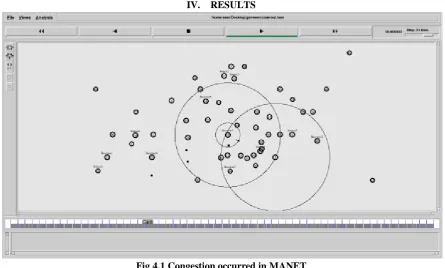
Fig 4.1 Congestion occurred in MANET
ISSN(E): 2277-128X, ISSN(P): 2277-6451, pp. 95-101
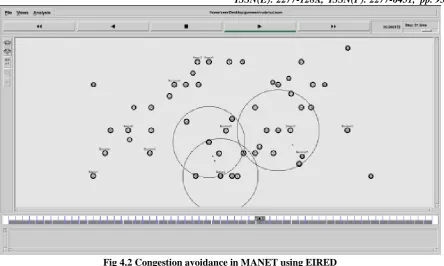
Fig 4.2 Congestion avoidance in MANET using EIRED
This figure represents reliable communication between nodes based on EIRED algorithm. This approach use minimum, maximum and average threshold value on the basis of queue size allocated in the network so that minimum congestion can be occurred over the network.
Fig 4.3 Packet delivery ratio
This figure represents packet delivery ratio in MAET using purposed approach and previous approach that is IRED approach. Packet delivery ratio has been measured for efficiency evaluation of purposed model. In this ratio between total numbers of packet properly delivered has been measure to total number of packets transmitted.
ISSN(E): 2277-128X, ISSN(P): 2277-6451, pp. 95-101 This figure represents throughput in MAET using purposed approach and previous approach that is IRED approach. Throughput has been measured for effective efficiency to transmit number of bits by the network. It is computed by ratio between total number of bits successfully transmit to per unit of time.
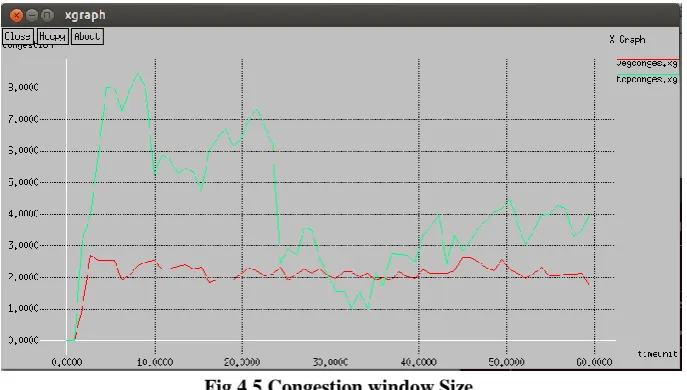
Fig 4.5 Congestion window Size
This figure represents congestion in MAET using purposed approach and previous approach that is IRED approach. Congestion is measured to check overall performance of the network. In the purposed work congestion window that occurred in the network has been measured.
V. CONCLUSION& FUTURE SCOPE
Mobile ad-hoc network is branch of networking that deals with communication between nodes without interference of any external device. In MANET various node have been used for communication from source to destination. Source node broadcast a request message over the network for data transmission. Intermediate nodes receives request and discover a route for data transmission and reply to source with all route information
In this research a new approach has been purposed for selection of optimal path on the basis of weight age to avoid congestion in the network. This approach use queue length and weight age factor to computes best route or changes to be made in the route if queue length has been approximate near to full then route has been neglected and new route on the basis of weight age have to be followed. In the process of congestion control enhanced IRED algorithm has been purposed that utilize minimum and maximum threshold and weight age priority to different paths for data transmission in the purposed work. On the basis of this approach congestion in MANET has been avoided so that delay can be decreased and throughput of the system can be increased. By analyzing various parameters for performance evaluation we can conclude that purposed approach provide better results.
REFRENCES
[1] Shivashankar “Designing Energy Routing Protocol With Power Consumption Optimization in MANET”, IEEE Conf. on MANET 2014, pp. 192-197.
[2] Dong-Li Zhang, Wen-cheng Jiao, Zheng Jian-Ling “Research and improvement of DSR protocol in Ad Hoc Network”, Industrial and Information Systems (IIS), vol.1, pp. 242-244, IEEE, 2010.
[3] Zhiyong Shi, Shenquan Zhu, Zhenyu Zhang “Study on application of DSR protocol to mobile communication system”, Mobile Technology, Applications and Systems, pp. 1-5, IEEE, 2005.
[4] Varshney, “Performance improvement of MANET under DSR protocol using swarm optimization”, Issues and Challenges in Intelligent Computing Techniques (ICICT), pp. 58-63, IEEE, 2014.
[5] Jhuria, M., Singh, S. “Improve Performance DSR Protocol by Application of Mobile Agent”, Communication Systems and Network Technologies (CSNT), pp. 336-340, IEEE, 2014.
[6] Ahmad, S, Awan, I., Waqqas, A.; Ahmad, B. “Performance Analysis of DSR & Extended DSR Protocols”, Modeling & Simulation, pp. 191-196, IEEE, 2008.
[7] Shen Ming-yu, Li Cang-yuan, “Research and Analysis on Secure DSR Routing Protocol Based on Strand Space”, Electrical and Control Engineering (ICECE), pp. 2917 – 2920, IEEE, 2010.
ISSN(E): 2277-128X, ISSN(P): 2277-6451, pp. 95-101 [9] Yu-Liang Chang, ChingChi Hsu, "Connection-Oriented Routing in Ad Hoc Networks Based on Dynamic Group Infrastructure," it Proc. of the Fifth IEEE Symposium on Computers and Communications (ISCC 2000), pp. 587-593, July 04 - 06, 2000 Antibes, France
[10] Ming-Hong Jiang, Rong-Hong Jan, "Ancient Multiple Paths Routing Protocol for Ad-hoc Net- works," The 15th International Conference on Information Networking (ICOIN'01), January 31 - February02, 2001 Beppu City, Oita, Japan, pp. 544-549.
[11] A. Nasipuri, R. Castaneda and S. Das, “Performance of multipath routing for on-demand protocols in mobile ad-hoc networks”, ACM/Kluwer Mobile Networks and Applications, vol. 6, no. 4, pp. 339-349,2001.