TOXIC ELEMENTS IN THE SEWAGE SLUDGE – SOIL – PLANT
CHAIN
Attila Tomócsik
[a]*, Viktória Orosz
[a], Tibor Aranyos
[a], Marianna Makádi
[a]and
György Füleky
[b]Paper was presented at the 4th International Symposium on Trace Elements in the Food Chain, Friends or Foes, 15-17 November, 2012, Visegrád, Hungary
Keywords: sewage sludge compost, agriculture, toxic element, sandy soil
According to statistical data the amount of sewage sludge does not increase as it was prognosed some years ago. Although this is a positive effect, we have to solve the problem of recycling of the sewage sludge. The appropriate chemical composition of municipal sewage sludge compost is suitable for nutrient supply in the agriculture. The small-plot experiment with sewage sludge compost was started in the spring of 2003. Three doses of compost (9, 18, 27 t ha-1) and a control treatment were used in the experiment. The small-plot experiment was re-treated in the fall of 2006 and 2009. In the composting process bentonite, rhyolite and wheat straw were used as additives for improving the quality of the compost. Our purpose was to stabilize or increase the fertility of sandy soil and contribute to the reduction of environmental pollution. In the plot experiment there were three test plants: triticale, maize and pea. These three plants were sawn in crop rotation. We examined the concentration of nickel (Ni) and zinc (Zn) in two soil layers, 0-30 and 30-60 cm in 2008-2009 years. We could not observe toxic effects on the test plants. The aim of the experiment was to investigate whether the application of sewage sludge compost cause hazardous accumulation of toxic elements in the soil and plants.
* Corresponding Authors Fax: (+36)-42-496-009
E-Mail: [email protected]
[a] Research Institutes of University of Debrecen, H-4400 Nyíregyháza, Westsik Vilmos u. 4-6.
[b] Szent István University, Department of Soil Science and Agricultural Chemistry, H-2103 Gödöllő, Páter Károly u. 1.
Introduction
Sewage sludge is an organic waste which usually contains high levels of nitrogen and phosphorous as well as significant concentrations of micronutrients 1,2. The use of sewage sludge in soil has very beneficial effects on the quantity and availability of nutrients, on the restoration of structural stability of the soil and on resistance against soil erosion 3,4.
Composting offers an effective method for treating sewage sludge by stabilizing organic matter, reducing odour, and killing human pathogens and weed seeds by the heat generated 5,6. The products can be used as soil conditioner to improve soil physical properties by increasing soil organic matter content. In this way the water holding capacity and aggregate stability are increased, but soil bulk density is reduced7. Sewage sludge compost also represents a source of nitrogen (N), phosphorus (P), potassium (K) and trace elements such as zinc (Zn), copper (Cu) and molybdenum (Mn) for plant growth8.
However, the presence of toxic elements in composts is the main cause of adverse effects on animal and human health, transmitted through the food chain from soil, groundwater and plants9.
The sewage sludge contains toxic elements within an organic matrix. This may lead to the increased solubility of some of the metals (due to the formation of soluble organic complexes) or to their immobilization and subsequent reduced possibility of being assimilated by the plant10. Consequently, exact analyzing the contents of toxic elements in composts is very important for the routine monitoring and risk assessment and regulation of environmental protection.
In the present study, we aimed to measure toxic element, such us nickel (Ni) and potential toxic element, like zinc (Zn). During the experiment we would like to follow the movement of toxic elements in the food chain.
Experiments
Experimental design
The small-plot experiment was established in spring, 2003 at the Research Institute of CAAES of University of Debrecen, at the town of Nyíregyháza, located in the NE part of Hungary. It was re-treated in 2006, when the field experiment was re-arranged and the size of plots was enlarged.
(e.g. sewage sludge). The compost was applied at 9, 18, 27 t ha-1 doses, ploughed into the 0-30 cm soil layer before sowing. The effect of the applied compost on triticale (x
Triticosecale Wittmack), maize (Zea mays) and pea. (Pisum
sativum L.) was studied.
Toxic elements of plant samples were measured after harvesting. In the case of triticale and maize the toxic elements content of grain was measured. The toxic element content of pea plants were measured in its three parts (root, straw + pods and grain). Composite soil samples were mixed from 5 subsamples in each plot from 0-30 and 30-60 cm soil layers after harvesting of all test plants.
The applied compost
In the Table 1 can be seen the important parameters of the applied compost
Table 1. Main characteristics of the applied compost
Parameter Value
pH (H2O 1:10) 7.2 Dry matter content [m/m% raw matter] 54 Organic matter content [m/m % dry matter] 26 Total N-content [m/m% dry matter] 1.68 Total P2O5-content [m/m% dry matter] 0.7 Total K2O-content [m/m% dry matter] 0.4
As (mg kg-1) 5.26
Cd (mg kg-1) 0
Co (mg kg-1) 0
Cr (mg kg-1) 21.96
Cu (mg kg-1) 149.7
Hg (mg kg-1) 1.42
Ni (mg kg-1)] 12.09
Pb (mg kg-1) 23.33
Se (mg kg-1) 2.51
In the composted sewage sludge there were nitrogen (N), phosphorus (P) and potassium (K), which are useful for enhancing the available nutrients content of soil. The toxic elements content of compost was low therefore it is good for agricultural utilization. In the applied compost amount of nickel was under the limit value determined by the Agricultural Ministry Order of 36/2006 (V.18.).
Chemical and statistical analysis
The Zn and Ni content of soil and plant samples were measured according to the MSZ –08-0012/16-87. Briefly, the samples were digested with cc. HNO3 :H2O2 and after filtering, the heavy metal contents of solutions were measured by using an ICP-OES emission spectrometer.
Statistical significance (P<0.05) of the differences was determined by one-way ANOVA and Tukey’s multiple range test. Statistical analysis was performed with SPSS
Results and Discussion
Toxic elements in the soil
The utilization of sewage sludge in agriculture may cause to get a certain amount of toxic elements into the soil. This could result in the contamination of soil and plants by toxic elements. In our data reveal the fate of Zn and Ni in the sewage sludge-soil-plant chain.
The heavy metal content in soils comes from two sources: first, from the natural heavy metal content of soil and on the other hand, as a result of soil pollution. The measurable concentration of the micronutrients in the soil usually increases when the amount of heavy metals entering into the soil is higher than their leached or utilized quantity11.
In the Table 2 the Ni and Zn concentrations of soil of the three test plants measured in 2008 are shown. The Ni and Zn content of the soil were below the 40 and 200 mg kg-1 limit in all treatments in this year. Concentration of Zn was increased after the treatments in the upper 0-30 cm soil layer, but this increase was not statistically significant. The measured Zn concentrations were around 30 mg kg-1. In Canada12 various crop responses were measured to a mixed municipal solid waste compost and the fate of certain metals associated with compost were examined. Plant and soil samples were collected after the compost application to analyse for content of Arsenic (As), Cupper (Cu), Zn, Mercury (Hg) and Lead (Pb). The research results showed that the compost slightly increased the heavy metal concentrations of the soil. The amount of Ni did not increase in the top soil under triticale.
Similar results were found when sea weeds compost was applied (leaves of beached Posidonia oceanica were used), which had high concentrations of heavy metals. Except of Ni, they measured higher heavy metal concentrations in soil samples amended with compost than in the control ones. The low concentration of Ni in soluble and exchangeable form explains its low mobility and biological activity 13.
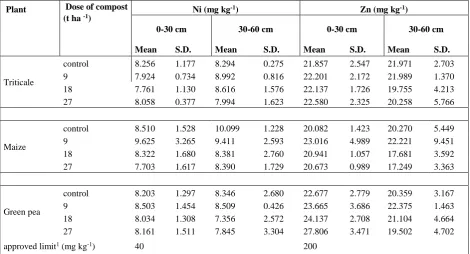
Toxic elements content of soil samples measured in 2009 can be seen in Table 3. Ni concentrations of soil samples were similar in both soil layers (7.35 – 10.09 mg kg-1) in 2009 and neither was above the 40 mg kg-1 threshold limit. The compost treatment did not increase its concentration. Low increase of Zn concentration in all treatments was found in the top soil samples collected from green pea’s plots. On the contrary a researcher14 observed significantly higher levels of Zn, manganese (Mn) and Cu in soil amended with compost at a rate of 19 t ha-1 but their applied compost had high heavy metal content (Zn: 566 mg kg-1, Mn: 176 mg kg -1 and Cu: 226 mg kg -1).
Concentrations of measured elements were under the limit value (Ni: 40 and Zn: 200 mg kg-1).
Toxic elements in the test plants
Pea (Pisum sativum L.)
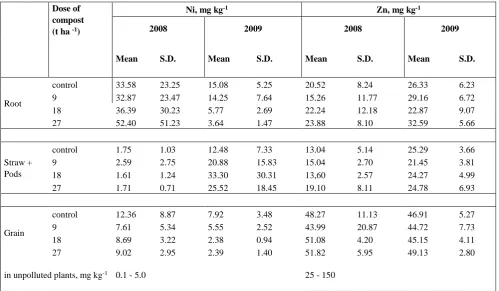
significant. The amount of Zn was higher in the grain yield compared to other two parts of the plants in the year 2008 and 2009. Due to the 18 and the 27 t ha-1 treatment the Zn concentration increased in different parts of the plants. In
2009 the amount of Zn increased only in the 9 and 27 t ha-1 treatments compared to the control plots, while the Zn concentrations measured in the 18 t ha-1 treatments were similar to the control ones.
Table 2. Nickel and zinc content in two layers of soil under test plants in the sewage sludge compost experiment in 2008
Plant
Dose of compost
(t ha -1) Ni (mg kg
-1) Zn (mg kg-1)
0-30 cm 30-60 cm 0-30 cm 30-60 cm
Mean S.D. Mean S.D. Mean S.D. Mean S.D.
Triticale
control 4.724 6.364 9.116 1.648 33.84 2.64 29.22 1.13 9 4.230 5.649 9.274 1.494 35.26 1.79 28.40 1.54 18 4.280 5.588 8.295 0.246 36.76 4.29 28.45 1.39 27 4.058 5.065 10.768 3.353 35.48 4.97 29.36 1.81
Maize
control 0.065 0.055 9.860 1.120 32.53 2.29 28.46 1.11 9 3.878 5.236 9.380 1.176 33.04 2.17 29.17 0.32 18 4.118 5.110 9.393 0.405 34.98 2.33 29.42 2.51 27 3.908 4.917 9.394 0.973 35.96 1.35 29.24 1.81
Green pea
control 0.123 0.037 10.478 1.100 32.15 7.48 26.88 1.28 9 3.828 4.808 10.010 1.174 36.46 10.37 31.64 6.85 18 3.746 4.974 9.862 2.059 33.94 3.57 27.84 2.85 27 4.894 6.488 9.584 1.741 33.40 1.78 27.80 1.98 approved limit1 (mg kg-1) 40 200
1 (50/2001. Government regulation). There was not significant difference among treatments, according to the Tukey’s test (p>0.05)
Table 3. Nickel and zinc content in two layers of soil under test plants in the sewage sludge compost experiment in 2009
Plant Dose of compost
(t ha -1) Ni (mg kg
-1) Zn (mg kg-1)
0-30 cm 30-60 cm 0-30 cm 30-60 cm
Mean S.D. Mean S.D. Mean S.D. Mean S.D.
Triticale
control 8.256 1.177 8.294 0.275 21.857 2.547 21.971 2.703 9 7.924 0.734 8.992 0.816 22.201 2.172 21.989 1.370 18 7.761 1.130 8.616 1.576 22.137 1.726 19.755 4.213 27 8.058 0.377 7.994 1.623 22.580 2.325 20.258 5.766
Maize
control 8.510 1.528 10.099 1.228 20.082 1.423 20.270 5.449 9 9.625 3.265 9.411 2.593 23.016 4.989 22.221 9.451 18 8.322 1.680 8.381 2.760 20.941 1.057 17.681 3.592 27 7.703 1.617 8.390 1.729 20.673 0.989 17.249 3.363
Green pea
control 8.203 1.297 8.346 2.680 22.677 2.779 20.359 3.167 9 8.503 1.454 8.509 0.426 23.665 3.686 22.375 1.463 18 8.034 1.308 7.356 2.572 24.137 2.708 21.104 4.664 27 8.161 1.511 7.845 3.304 27.806 3.471 19.502 4.702 approved limit1 (mg kg-1) 40 200
Zn content in maize in unpolluted plants: 25-150 mg kg-1
0,0 10,0 20,0 30,0 40,0
control 9 18 27
Dose of compost (t ha-1)
mg
kg
-1
2008 2009
Ni content in maize in unpolluted plants: 0.1-5 mg kg-1
-3,0 0,0 3,0 6,0 9,0 12,0
control 9 18 27
Dose of compost (t ha-1)
mg
kg
-1
Table 4. Nickel and zinc concentrations in different parts of pea in the sewage sludge compost experiment
Dose of compost (t ha -1)
Ni, mg kg-1 Zn, mg kg-1
2008 2009 2008 2009
Mean S.D. Mean S.D. Mean S.D. Mean S.D.
Root
control 33.58 23.25 15.08 5.25 20.52 8.24 26.33 6.23 9 32.87 23.47 14.25 7.64 15.26 11.77 29.16 6.72 18 36.39 30.23 5.77 2.69 22.24 12.18 22.87 9.07 27 52.40 51.23 3.64 1.47 23.88 8.10 32.59 5.66
Straw + Pods
control 1.75 1.03 12.48 7.33 13.04 5.14 25.29 3.66 9 2.59 2.75 20.88 15.83 15.04 2.70 21.45 3.81 18 1.61 1.24 33.30 30.31 13,60 2.57 24.27 4.99 27 1.71 0.71 25.52 18.45 19.10 8.11 24.78 6.93
Grain
control 12.36 8.87 7.92 3.48 48.27 11.13 46.91 5.27 9 7.61 5.34 5.55 2.52 43.99 20.87 44.72 7.73 18 8.69 3.22 2.38 0.94 51.08 4.20 45.15 4.11 27 9.02 2.95 2.39 1.40 51.82 5.95 49.13 2.80
in unpolluted plants, mg kg-1 0.1 - 5.0 25 - 150
There was not significant difference among treatments, according to the Tukey’s test (p>0.05)
Maize (Zea mays)
In Figure 1 presents Zn content in maize in the sewage sludge compost experiment. Zn concentration was under 30 mg kg-1 in the test plant. The quantity of Zn measured in maize was higher in the 9 t ha-1 dose of compost treated plots in 2008.
In 2008 we did not find significant differences between the three treatments, as it is showed in Figure 2. Other researchers found significantly increased Ni concentration in the roots of the lettuce plants after compost application. The Ni concentration was particularly higher in the leaves of the control sample13. Quantity of Ni in the maize crop was lower than detection limit in 2009.
Triticale (x Triticosecale Wittmack)
Figure 3 shows Zn content of triticale crop in the sewage sludge compost experiment in 2008 and 2009. We can see that amount of Zn was increased in the treatments in 2008. Measurements by Chaney15 demonstrated that in plant tissue, the concentration of Zn was the highest in the compost treatment which reflect the high Zn concentrations in the compost material.
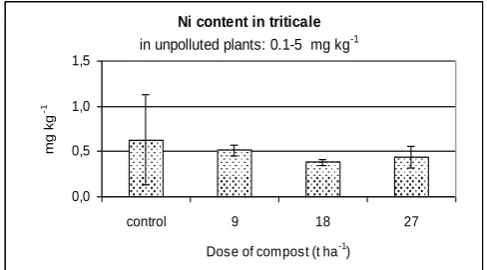
In the year 2009 the amount of Zn increased only in the 9 t ha-1 treatment in comparison with the control plot, while the measured Zn concentrations of the other two treatments were similar to the concentrations of control samples. Figure 4 presents the Ni concentration in triticale in the sewage
Zn content in triticale in unpolluted plants: 25-150 mg kg-1
0,0 10,0 20,0 30,0 40,0
control 9 18 27
Dose of compost (t ha-1)
mg
kg
-1
2008 2009
Ni content in triticale in unpolluted plants: 0.1-5 mg kg-1
0,0 0,5 1,0 1,5
control 9 18 27
Dose of compost (t ha-1)
mg
kg
-1
Figure 3. Zinc (Zn) content of triticale seed in the sewage sludge compost experiment
Figure 4. Nickel (Ni) content in triticale seed in the sewage sludge compost treatment in 2008
Similar to the Ni content of the corn, Ni content of triticale samples could not be measured in 2009.
Conclusion
Our results proved that the repeated use of composted sewage sludge for crop production did not cause any danger for agriculture and feed/food safety. We have not found toxic elements accumulation in the measured layers of the soil. The green pea accumulated Ni primarily in its root , which is important from food safety aspect, because it is not edible part of the plant. The other two test plants (triticale and maize) contain similar quantity of Zn in the grain while green pea concentrated this element in its grain with a higher quantity. The content of Zn and Ni were the lowest in the grain of maize.
Both measured elements were in the soil and plants, but these Zn and Ni did not accumulate hazardous in soil-plant chain. In conclusion it can be stated that the good quality and the circumspect application of the sewage sludge compost could guarantee its safe utilization.
References
1Epstein, E., Taylor, J.M., Chaney, R.L., J. Environ. Qual. 1976, 5 (4), 422–426.
2Sopper, W.E., Municipal Sludge Use in Land Reclamation. Lewis Publishers, Boca Raton. 1993.
3Sort, X., Alcaniz, J.M. Land Degrad. Dev. 1996, 7, 69–76.
4Debosz, K., Petersen, S.O., Kure, L.K., Ambus, P. Appl. Soil Ecol.
2002, 19, 237–248.
5Riffaldi, R., Minzi, R. L., Pera, A. & de Bertoldi, M. Waste Mgmt
Res. 1986, 4, 387-396.
6Bevacqua, R. F., Mellano, V. J. California Agric. 1993, 47(3), 22-24.
7Smith, S. R. Journal of Horticultural. Sci. 1992, 67, 703-716. 8Tester, C. F. Soil Sci.1990, 148, 452-458.
9Senesi, G.S., Baldassarre, G., Senesi, N., Radina, B.,
Chemosphere. 1999, 39, 343–377.
10Garcia, C., Hern~indez, T. & Costa, F. Environmental
Management.1991, 15, 433-439.
11Simon L. Talajszennyeződés, talajtisztítás. 1999, 3-27.
12Zhang, M.; Heaney, D.; Solberg, E.; Heriquez, B. Compost
Science & Utilization. 2000, 8, 3, 224-235.
13Paola Castaldi; Giovanni Garau; Pietro Melis. Fresenius
Environmental Bulletin. 2004, 13, 11b, 1322-1328.
14Mylavarapu, R. S. and Zinati, G. M. Scientia Horticulture.2009, 120, 426-430.
15Chaney, R.L. Land Treatment of Hazardous Wastes. Noyes Data
Corp.1983, 152–240.