ISSN-L: 2501 - 1235 Available on-line at: www.oapub.org/edu
doi: 10.5281/zenodo.1314729 Volume 4 │ Issue 8 │ 2018
PHYSICAL EDUCATION CURRICULUM AND THE LEVEL OF
PHYSICAL ACTIVITY OF BASIC SCHOOL CHILDREN IN GHANA
Agartha Ohemengi
Millicent Asante
Department of Nutrition and Food Science, School of Biological Sciences,
University of Ghana, Legon, Accra, Ghana
Abstract:
Purpose: This study sought to investigate the relationship between current physical education curriculum of basic schools and the level of physical activity of children in the Ga East Municipality of Ghana. Method: A total of 201 children from selected schools (4 with physical education curriculum [PE] and 4 without physical education curriculum [NPE]) were included in the study. A semi-structured questionnaire was used to collect information on socio-demographic characteristics and physical activity. Pearson’s Chi square test was used to evaluate the relationship between physical education curriculum and physical activity levels of school children. Results: Few of the children met the WHO recommendation for physical activity for the target age-group. The two groups did not differ with respect to the duration of physical activity of the children. Children attending public schools were four times more likely to engage in physical activities for at least 180 minutes per week compared to those in private schools. Conclusion: Current physical education curriculum was not related to the level of physical activity and nutritional status of basic school children in this study. PE lessons need to be restructured so as to meet the physical activity needs of children in basic schools.
Keywords: school children, physical education, physical activity, nutritional status, Ghana
1. Introduction
Physical activity is defined as any bodily movement produced by skeletal muscles that require energy expenditure (WHO, 2013). Physical activity produces overall physical, psychological, and social benefits for both children and adults. Physical Education is a
course that is taught in schools to enable children to get a period to engage in physical activity. Obesity rate is increasing among adolescents globally and physical education is one strategy that can help reduce it (Viuda-Serrano et al, 2011). A review of the literature has also shown that interventions that are school based have the ability to improve physical activity levels of children in low- and middle income countries (Verstraeten et al., 2012). Consequently, some of the reasons for which Ghana’s Ministry of Education offers Physical Education in schools are: to improve the general health of the individual and general community, leading to lower absenteeism from school and work; create the love for sports and games; and impart a healthy and positive attitude of mind that helps academic work in school (Ministry of Education, 2010). Despite these expected benefits, physical education has slipped in priority for some years in Ghana (Doe, 2006). Thus, although children are being trained in academic disciplines, there is less emphasis on lifestyle changes that will impact on their health. In a study conducted by Steiner et al (2012) in the Ga East Municipality in the Greater Accra Region of Ghana, overweight and obese school children had inadequate dietary and physical activity behaviours. There is scanty information on whether the introduction of physical education curriculum is leading to improved level of physical activity of the school-going child in Ghana.
The main aim of the study was therefore to evaluate the relationship if any, between the currently existing Ghana Education Service physical education curriculum in basic schools and the physical activity level and nutritional status of school children aged 9-15 years in the Ga-East Municipality of Ghana. Additionally, we sought to identify some challenges that are related to the teaching of physical education in basic schools.
2. Methods
The cross-sectional study involved school children (aged 9-15 years) of basic schools in the Ga-East Municipality in the Greater Accra Region of Ghana. A sample size 196 was calculated using the formula given by Moore and McCabe (1993). This was rounded to 200 to account for uncompleted data. The list of basic schools located in the Ga-East Municipality was obtained from Ghana Ministry of Education and the schools were grouped into two; private and public schools. Each group was further classified based on the presence or otherwise of physical education as a curriculum. This provided four lists and two schools were randomly selected from each list. Thus there were four schools with the physical education curriculum (PE) consisting of two private and two public schools, and four schools that did not have physical education curriculum (NPE), also consisting of two private and two public schools.
and knowledge on physical education); and anthropometry (weight and height). Weight was measured in kilograms with an analogue weighing scale (AOV International Company) and height was measured in metres with a stadiometer (Charder Electronic Company Limited).
Data were coded and entered into the Statistical Package for Social Sciences (SPSS) v.16 software for cleaning and analysis. The weight (kg) and height (m) of the children were used to calculate the BMI (BMI= weight/height²). Using their BMI values, participants were classified into underweight, normal, and overweight/obese using the WHO cut-offs for BMI-for-age: Overweight: > +1SD, Obesity : > +2SD, and underweight < -2SD (WHO, 2014). Independent t-tests (for continuous variables) and the Pearson’s Chi-square test (for proportions) were used to compare types, frequencies, and duration of physical activities between the groups (PE and non-PE).
3. Results
A total of 201 school children within the ages of 9-15 years participated in the study. Of this, 103 were attending schools that had Physical Education as part of their curriculum (PE), and 98 were from schools that did not have Physical Education as part of their curriculum (NPE). The mean age of the participants was 12.4±1.8 years with no significant difference between PE and NPE schools (Table 1). There were also no differences between the groups (PE and NPE) in the socio-demographic characteristics of the participants, although a substantial proportion (35%) of the children could not provide the educational levels of their mothers.
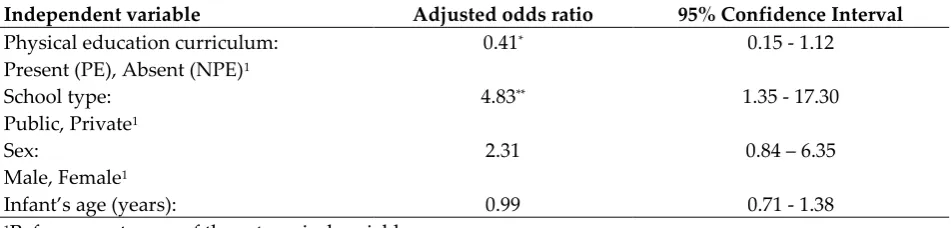
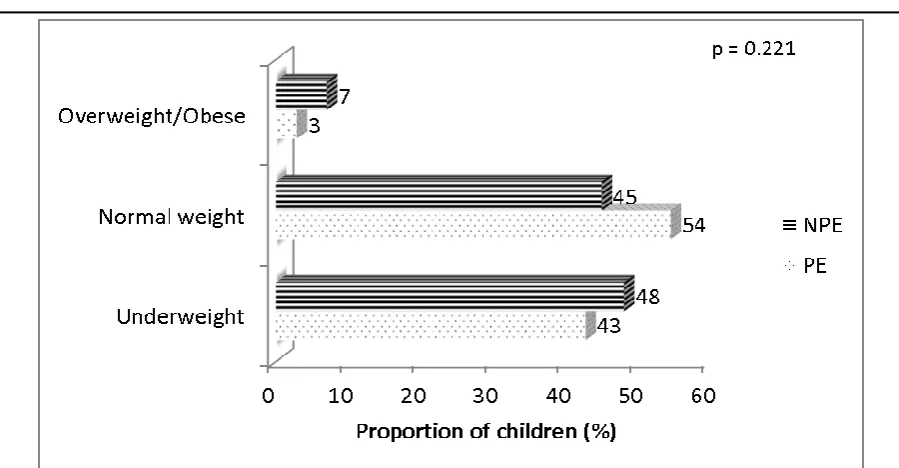
likely to engage in physical activities for at least 180 minutes per week compared to those who were in private schools, Table 3). There were no differences between children attending PE schools and those in non-PE schools in their anthropometric indices (Figure 3). Almost half of the study participants (45.3%) were classified as underweight, based on their BMI, and 5% of the children were overweight or obese.
Less than half of the children defined physical activity as ‘any activity that builds the body’, and majority observed that physical education as ‘time to play or have fun’. However, almost a third of the study children did not know the definition of physical activity nor its benefits. About half of the children indicated that physical activities keep one healthy. Developing one’s talent or career was also identified by the children as a main benefit of activities that are engaged in during physical education or during break time. Getting tired or hurt and lack of facilities were the two main challenges of physical education that were identified by the children.
A total of eight (8) heads of the participating schools were interviewed and more than half of them were males (62.5%). The mean age of the school heads was 50.6 ± 10.1 years and there was no difference between the two groups. Most head teachers recognised ‘exercising the body’ as the definition of physical activity, while physical education was defined as an ‘education related to healthy living’. The guidelines for the teaching of PE were mostly from the PE syllabus from the Ghana Education Service (2007). The heads of the schools that do not offer PE indicated lack of trained PE teachers as the reason for not offering the curriculum. Some of the identified challenges encountered in the teaching of PE in the basic schools were inadequate sports facilities (such as football, handballs, and jerseys), playing grounds, and changing rooms. Participants also indicated that the time allocated for PE was not enough. The head teachers also complained that some teachers do not want to teach PE because they are not motivated in any way and that there are no changing rooms for them to change into after the PE lessons. They recommended that for PE to be improved in schools, children should be encouraged to participate. In addition, they identified factors as possible stimulants for improving physical education in basic schools: provision of facilities, revision of the syllabus, and frequent organization of refresher workshops for teachers by the Ghana Education Service.
4. Discussion
(Guthold et al., 2010). Because of the many benefits for health of physical activity, recent analysis has suggested that reaching the recommended minimum level of physical activity leads to a reduction in all-cause mortality of 19 per cent – and this rises to 24 per cent if an hour a day is spent in physical activity (Cooper and Hancock, 2011), compared with no activity. A study conducted in the same locality as this study by Steiner et al, (2012) observed that majority of the school children interviewed (81.5%) said they engaged in some form of physical activity on daily basis. However, only a little over a third of them engaged in physical activity for at least one hour in a day. This implies that even the schools which have the physical education curriculum are not doing so for the required period of time. This is contrary to the recommendations of the Ghana Health Service that compulsory physical education should be added in the school curriculum for at least 120 minutes a week (Ghana Ministry of Health, 2010). One main reason given by the study children was that, PE was not done as often as had been allocated on the time table because the period was sometimes used to teach other subjects. Other given reasons included tiredness and lack of interest. For the non-PE schools, they did not meet the recommendation due to the fact that they did not offer PE in their schools and their break time was not enough for them to have adequate physical activity.
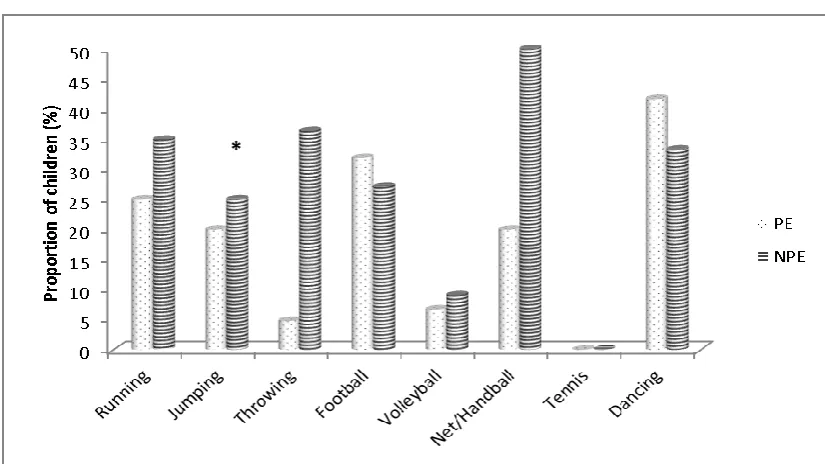
According to WHO (2010), spending more than 60 minutes on physical activity yields additional health benefits such as developing their musculoskeletal tissues, healthy cardiovascular system, and neuromuscular awareness. Physical activity that lasts for less than 60 minutes is moderately intense activity, activities that last 90 minutes is endurance performance and those that last more than 60 minutes is intense exercise (Coyle 2004). Based on this classification, most of the study children engaged in moderately intense physical activity. Moderate activities such as walking and dancing, and vigorous activities such as football and running are beneficial for the health of the children. From the study, the children engaged in vigorous activities such as football, but for short periods of time. This implies that the children may not obtain the full benefits of engaging in such activities According to a study by Trinh et al, (2013), a sustained increase in physical activity, especially the moderate vigorous component, can reduce BMI and therefore help overweight or obese children to attain healthy body weight.
of significant difference in the physical activity levels between the PE and Non-PE school children was that the PE schools spent less time than what is recommended for PE lessons, sometimes being taught other subjects during the allocated PE period. Although the Non-PE schools did not have physical education as part of their time table, the study showed that the children engaged in activities during break time, thus making them as active as the children attending schools that have the curriculum.
Our study indicated that children attending public schools were more likely to have a longer period of physical activity compared to their counterparts in the private schools. This is contrary to findings from a study conducted in South India that showed that although physical activity was generally low among school children, a higher proportion of children in private schools had adequate physical activity (42% v 18.3%, p < 0.0001) compared to the public school counterparts (Dhanpal et al, 2014). It should however, be noted that the above mentioned study defined adequate physical activity as performing more than 20 minutes of aerobic activity for more than three times per week, whilst the current study used the WHO recommendation of at least 60 minutes of activity for at least three times a week (WHO, 2010). It is generally expected that private schools will have better facilities for physical activities, and observations have been made in the past that public schools paid little attention to physical education (Doe, 2005). However, our study shows that not enough time is allocated to actual engagement in physical activities, even if the physical facilities ae available. Thus, the adoption of the physical education may not necessarily result in improved activity levels of school children, unless steps are put in place to ensure efficient implementation. There is the need to maximize the time that is allocated to PE by actually involving the children in physical activities.
The findings of the current study are limited by the lack of information on the dietary habits of the participants within the same period. As a result, comprehensive discussion of nutritional status data was limited.
5. Conclusion
References
1. Baruki, SBS, de Lima Rosado, LEFP, Rosado, GP, Ribiero, RCL. (2006). Association between nutritional status and physical activity in Municipal school in Corumbá – MS. Rev Bras Med Esporte 12(2): 80e – 84e
2. Cooper, K. and Hancock, C. (2011), The Benefits of Physical Activity for Health and Well-being, Matrix Public Health Solutions Inc., London. Page 4
3. Coyle, E.F. (2004). Fluid and Fuel Intake during Exercise. Journal of Sports Sciences.22:39-55
4. Diouf, A., Thiam, M., Idohou-Dossou, N., Diongue, O., Megne, N., Diallo, K., Sembene, M. and Wade, S. (2016). Physical Activity Level and Sedentary Behaviours Among Public School Children in Dakar (Senegal) Measured by PAQ-C Accelerometer: Preliminary Results. International Journal of Environmental Research and Public Health. 13(10):998; DOI: 10.3390/ijerph13100998, 11 pages
5. Doe, JW. (2005). Ghana: Education, Physical activity and development. Retrieved
on December 17, 2013 from
http://www.ghanaweb.com/GhanaHomePage/Newsarchive/Ghana_Education_p hysical_activity_and_development_94811_2005-11-23 Article 94811
6. Ghana Education Service. (2007). Teaching Syllabus for Physical Education
retrieved from
http://www.ibe.unesco.org/curricula/ghana/gh_pr_pe_2007_eng_pdf. on 28th April, 2014 at 11:00am.
7. Guthold, R., Cowan, M. J., Autenrieth, C. S., Kann, L. and Riley, L. M. (2010). Physical Activity and Sedentary Behaviour among School Children a 34-Country Comparison. Journal of Pediatrics. 157(1):43-49.
8. Ministry of Education. (2010). Teaching Syllabus for physical Education: Senior High School 1-3. Curriculum Research and Development Division, Ghana Education Service, Accra. Pg. ii.
9. Moore, D.S. and McCabe, G.P. (1993). Introduction to te Practice of Statistics 2nd ed. W.H. Freeman and Company, New York. Pg. 605.
10.Steiner-Asiedu, M., Addo, P., Bediako-Amoah, B., Fiadjoe, F. Y. M., Anderson, A. K. (2012). Lifestyle and Nutrition Profile of the overweight and Obese School Children in the Ga-East District of Ghana, Asian Journal of Medical Sciences. 4 (3): 99-104
11.Trinh, A., Campbel, M., Ukoumunne, O. C., Gener, B. and Wake, M. (2013). Physical Activity and 3-Year BMI Change in Overnight and Obese Children. Journal of American Academy of Pediatrics. 470-477.
Intervention in Low and Middle Income Countries: a Systematic Review. American Journal of Clinical Nutrition. 96(2):415-438
13.Viuda-Serrano, A., Gonzalez M. C. and Perez-Gonzalez, B. (2011). Obesity Prevention through Physical Activity in School Age Children and Adolescents
retrieved from
https://stillmed.olympic.org/media/Document%20Library/OlympicOrg/IOC/Wh at-We-Do/Promote-Olympism/Sport-And-Active-Society/Conferences/2010/EN-2-CamiloJoseCelaUniversityStudy-preventionofobesity-final.pdf on 28th April, 2014 at 3:59pm.
14.WHO (2010). Global recommendations on physical activity for health. ISBN 978
924 159 9979. Downloaded on July 20, 2017 from
http://apps.who.int/iris/bitstream/handle/10665/44399/9789241599979_eng.pdf;jse ssionid=EDD8E104D2CFBBBF52395E5678232457?sequence=1
Appendix
Table 1: Background Characteristics of Study Participants1
PE (n = 103) NPE (n = 98) p-value
Child’s age (years) 12.3 ± 1.6 12.5 ± 1.8 0.499
Sex (% males) 51 (49.5) 45 (45.9) 0.610
Type of school Public Private 53 50 (51.5) (48.5) 48 50 (49.0) (51.0) 0.726
Educational level of child’s mother Below Secondary
Secondary and above Don’t know 33 31 39 (32.0) (30.1) (37.9) 43 24 31 (43.9) (24.5) (31.6) 0.223
Household ownership of assets2
Low High 36 67 (35.0) (65.0) 35 63 (35.7) (64.3) 0.910
1Values are presented as means ± standard deviation or number (%). P-values are based on Independent
t-test or Pearson’s Chi square test
2A summary indicator of the possession of assets by study households based on car, fridge/freezer,
cooker, television, video deck/VCD, air conditioner, and satellite dish/Multi TV. Values ranged from 0 to 7 and a categorical variable was generated from the scores as follows: low (0 to 3) and high (4 to 7).
Table 2: Factors associated with Engaging in Physical Activities for at least 180 minutes per week, based on the final model of the multiple logistic regression
Independent variable Adjusted odds ratio 95% Confidence Interval
Physical education curriculum: Present (PE), Absent (NPE)1
0.41* 0.15 - 1.12
School type: Public, Private1
4.83** 1.35 - 17.30
Sex:
Male, Female1
2.31 0.84 – 6.35
Infant’s age (years): 0.99 0.71 - 1.38
Figure 1: Types of physical activity undertaken by study children on a weekly basis. *p= 0.022
Figure 2: Proportion of study children who participated in physical activities at least three times per week. *p= 0.011
Creative Commons licensing terms