K
EEPING
D
EFENDER
W
ORKLOADS
M
ANAGEABLE
Bureau of Justice Assistance
Monograph
Monograph
K
EEPING
D
EFENDER
U.S. Department of Justice
Office of Justice Programs
810 Seventh Street NW.
Washington, DC 20531
John Ashcroft
Attorney General
Office of Justice Programs
World Wide Web Home Page
www.ojp.usdoj.gov
Bureau of Justice Assistance
World Wide Web Home Page
www.ojp.usdoj.gov/BJA
For grant and funding information contact
U.S. Department of Justice Response Center
1–800–421–6770
This document was prepared by The Spangenberg Group for the Bureau of Justice Assistance, Office of Justice Programs, U.S. Department of Justice. The opinions, findings, and conclusions or recommendations expressed in this document are those of the authors and do not neces-sarily represent the official position or policies of the U.S. Department of Justice.
The Bureau of Justice Assistance is a component of the Office of Justice Programs, which also includes the Bureau of Justice Statistics, the National Institute of Justice, the Office of Juvenile Justice and Delinquency Prevention, and the Office for Victims of Crime.
K
EEPING
D
EFENDER
W
ORKLOADS
M
ANAGEABLE
January 2001
NCJ 185632
Foreword
Adequately supporting indigent defenders is critical to preserving the con-stitutional rights of individuals accused of crimes. To function properly, the criminal justice system needs all of its components, including defense, oper-ating effectively.
One important way we can bolster indigent defense in this country is edu-cating criminal justice practitioners, elected officials, and the public about the challenges facing the indigent defense community. This series will help accomplish that goal by addressing key issues that attorneys and managers in indigent defense systems struggle with in their day-to-day work.
The subject of this report, finding ways to better manage defender work-loads, is at the heart of ensuring that the administration of justice is fair and equitable. Every day, defender offices and assigned counsel are forced to manage too many clients with inadequate resources. Too often, the quality of service suffers, jeopardizing one of our most important constitutional rights: the right to effective counsel.
It is our hope that the information and recommendations provided here serve as a valuable resource for all of us working to improve the justice system.
I. Introduction. . . 1
II. Caseload v. Workload . . . 3
Importance of Uniform Definition of Case . . . 4
Ethical Considerations: When To Say Enough? . . . 4
III. Caseload Standards . . . 7
National Standards . . . 8
Case-Weighting Studies . . . 8
State Standards . . . 10
Statutory Caseload Provisions . . . 13
Contractual Standards . . . 14
Caseload Standards for Private Attorneys . . . 14
Performance Standards . . . 15
IV. Withdrawal From Cases . . . 17
Systemic Litigation . . . 21
Malpractice Claims in State Court and Federal Immunity . . . 22
V. Strategies for Keeping Workloads Manageable . . . 25
VI. Notes . . . 27
In 1991, Rick Tessier, a young public defender working in New Orleans, was appointed to represent Leonard Peart. At the time, Tessier was handling 70 active felonies. Peart was charged with armed rob-bery, aggravated rape, aggravated burglary, attempted armed robbery, and first-degree murder. Tessier’s clients typically were incarcerated between 30 and 70 days before he met with them. In the first 7 months of 1991, Tessier represented 418 defendants. His office had minimal investigative support and no funds for expert witnesses.
Tessier filed a motion to have the trial court declare, before disposition of Peart’s case, that Tessier was un-able to provide Peart with effective assistance of counsel, given his pend-ing workload and lack of investiga-tive and expert resources. Tessier’s motion resulted in a sharply worded admonition by the Louisiana Supreme Court that the state legislature must take action to remedy indigent de-fense in Louisiana. The situation was so bad that the court threatened to “employ the more intrusive and
specific measures it has thus far avoided to ensure that indigent defen-dants received reasonably effective
assistance of counsel.”1
While refusing to make a blanket pretrial finding that Tessier provided ineffective assistance to his clients, the court instructed the trial court to which Tessier was assigned to hold individual hearings for all defendants making such a pretrial assertion. Fur-thermore, the trial court was ordered to apply a rebuttable presumption that such defendants were not receiv-ing assistance of counsel effective enough to meet constitutionally re-quired standards.
Tessier’s experience conjures stereotypical images of young, over-worked lawyers juggling too many files, too many courtrooms, and too many clients at the expense of the indigent defendants they represent. Although in many instances this public image is a far cry from the truth, excessive workload is one of the most pressing issues facing indi-gent defense programs in the United States.
I. Introduction
About the Authors
This report was researched and written by the staff of The Spangenberg Group, a nationally recognized criminal justice research and consulting firm working to improve the delivery of indigent defense services. Located in West Newton, Massachusetts, The Spangenberg Group has provided research and technical assistance for justice organizations in every state in the nation.
Historically, public defenders have had little control over the number of cases they receive. Most public de-fender offices began by representing a small percentage of criminal defen-dants. Today, in some jurisdictions, public defender offices are appointed as many as 80 percent of all criminal cases. As populations and caseloads have increased, many public defender offices have been unable to obtain corollary increases in staff. Every day, defenders try to manage too many clients. Too often, the quality of ser-vice suffers. At some point, even the most well-intentioned advocates are overwhelmed, jeopardizing their clients’ constitutional right to effective counsel. The problem is not limited to pub-lic defenders. Individual attorneys who contract to accept an unlimited
number of cases in a given period often become overwhelmed as well. Excessive workloads even affect court-appointed attorneys. Rules of professional responsibility make it clear that every lawyer must main-tain a reasonable workload. In prac-tice, meeting this standard has been more difficult for lawyers who repre-sent indigent criminal defendants than for those who represent paying clients.
In the past decade, defender orga-nizations, state legislatures, state courts, and other entities have devel-oped approaches to managing the workloads of attorneys who repre-sent indigent defendants. This mono-graph discusses these approaches and presents strategies for keeping caseloads manageable.
II. Caseload v. Workload
Many practitioners still tend to think of their caseload only in terms of the number of clients they are assigned to represent. Yet, this cap-tures only a portion of their full workload. With the advent of sen-tencing guidelines and the expanded use of mandatory minimum sen-tences, the complexity of criminal defense practice has increased dra-matically. There are fewer and fewer “easy” cases, and with the growth of public defender programs many attorneys find themselves spending more and more time on administra-tive matters. Thus, the amount of time an attorney must spend to competently represent a client is not accurately reflected by the number of clients alone.
Likewise, given the different amounts of time required for differ-ent kinds of cases, measuring case-load in terms of the number of clients is not an accurate means of comparing the amount of work done by attorneys handling different types of cases.
In addition to zealous advocacy in court, effective defense work requires client contact, investigation, legal research, social work, confer-ences with prosecutors, and case preparation. In the chapter “Coping With Excessive Workload” of the American Bar Association’s (ABA) Ethical Problems Facing the Criminal Defense Lawyer: Practical Answers
to Tough Questions,authors Edward
C. Monahan and James Clark set out the dimensions of competence and quality for criminal defense lawyers as defined by the ABA in several substantive areas: • Legal knowledge and skill. • Timeliness of representation. • Thoroughness and preparation. • Client relationship and
interviewing.
• Communicating with the accused. • Advising the accused.
• Investigation.
• Trial court representation. • Sentencing.
• Appellate representation main-taining competence and ensuring quality.
Each of these facets of effective representation is compromised when caseloads are too high. Defenders’ job responsibilities extend beyond representing clients. They consult with colleagues about their own and others’ cases. They keep abreast of recently decided cases and new laws and rules by attending training ses-sions and through routine professional development reading. All defenders must perform administrative tasks,
and many have supervisory responsi-bilities, often of both support staff and lawyers. In addition, public defender managers have commitments to par-ticipate in community and policy meetings. All of these responsibilities detract from the time a lawyer can spend on individual case work but are essential to the functioning of an effective defender office. In short, a defenders overall workload comprises a defenders active caseload com-bined with these duties.
Many defenders who face exces-sive caseloads make decisions anal-ogous to those made by physicians in a M.A.S.H. unit. They perform triage. Defendants facing serious felony charges receive primary attention, whereas defendants facing misdemeanor, juvenile delinquency, or lower-level felony charges receive much less. Too often in these cases, early investigation and regular client
communication fall by the wayside.2
Importance of Uniform
Definition of a Case
In developing workload or caseload standards for a given jurisdiction, it is critical to use a common definition of what constitutes a case. The National Center for State Courts and the Con-ference of State Court
Administra-tors, in State Court Model Statistical
Dictionary, 1989, instruct court
administrators to “[c]ount each defendant and all charges involved in
a single incident as a single case.”3In
developing its standards, the National Advisory Commission (NAC) defined a case as “a single charge or set of
charges concerning a defendant (or other client) in one court in one pro-ceeding.” Whereas it is important for the indigent defense system (includ-ing public defenders, court-appointed attorneys, and contract defenders) in a given jurisdiction to count cases using a uniform definition, it is opti-mal when the courts and prosecution in the jurisdiction also use the same definition. This affords the greatest opportunity to develop and approve budget requests for the adjudication component of the criminal justice system accordingly on a systematic and balanced basis.
Ethical Considerations:
When To Say Enough?
The first rule in ABA’s Model Rules of Professional Conduct (as amend-ed through August 1998) requires a lawyer to provide competent
repre-sentation to a client.4Model Rule 1.3
requires that a lawyer “act with rea-sonable diligence and promptness.” Model Rule 1.4 covers attorney-client communication, mandating that a lawyer keep a client reason-ably informed about the situation and promptly reply to reasonable requests for information. Model Rule 1.7(b) prohibits attorneys from rep-resenting clients “if the representa-tion of that client may be materially limited by the lawyer’s responsibili-ties to another client.” Many public defenders fail to acknowledge the conflict of interest that arises when excessive caseloads force them to choose which of their clients will receive the defense to which they are entitled.
C
ASELOAD V. W
ORKLOADIn State v.Smith,considered by
many defense practitioners to be the most important opinion on public defender workload, the Arizona Supreme Court found that Mohave County’s contract system violated indigent defendants’ rights to due process and counsel as guaranteed by the Arizona and United States
Constitutions.5
The court, placing blame for the system with the participating attor-neys and the county, reasoned that the attorneys are usually in a better position to recognize when a con-tract will likely result in inadequate representation than is the county board of supervisors. The court quot-ed the Arizona Rules of Professional Responsibility, which forbids attorneys from accepting employment that can-not be adequately performed, and cited ABA standards on delay and punctuality (Standard 4–1.2) and workload (Standard 5–4.3).
ABA Standards for Criminal
Jus-tice, Providing Defense Services(3d
ed., 1992) and The Defense Function
(3d ed., 1993), establish quality rep-resentation as the benchmark for criminal defense lawyers. Standard 4–1.2, “The Function of Defense Counsel,” states that the basic duty of defense counsel is to “render effective, quality representation.” Standard 5–1.1 reinforces this princi-ple: “The objective in providing counsel should be to assure that quality representation is afforded.”
The fact that overburdened attor-neys are reluctant to stand up and
say enough is enough makes the problem even more difficult to address. Reasons for this reluctance include ego, fear of rocking the boat in the local criminal system, and fear of reprobation from the appropriate disciplinary committee of the gov-erning bar if an attorney suggests that he or she is unable to provide effective representation.
This fear is particularly acute for attorneys such as public defenders and court-appointed attorneys who serve at the will of a particular judge. ABA cautions against the potential conflict caused by such an arrange-ment in Standard 5–1.3(a) of the
Standards for Criminal Justice,which
states:
The selection of lawyers for spe-cific cases should not be made by the judiciary or elected offi-cials, but should be arranged for by the administrators of the defender, assigned counsel, and contract-for-service programs. Moreover, it is the primary respon-sibility of the judiciary to ensure that court proceedings are fair and equi-table. If a judge with responsibility for appointing counsel in his or her courtroom recognizes that over-whelming caseloads may jeopardize a defendant’s right to competent representation of counsel, it is the judge’s responsibility to identify and rectify the situation.
In their guide to coping with exces-sive caseloads, Monahan and Clark explain how attorneys should—in
fact, must—deal with these situations:
A lawyer who has so much work, so many cases, so many other clients that she is material-ly limited in her ability to effec-tively represent another client has an impermissible personal conflict of interest and cannot assume responsibility for an additional client.
Rules clearly establish that a lawyer cannot ethically accept another case or other work when she has so much work that accepting another case will preclude her from competently representing the new client or performing any other ethical requirements, for example, com-municating fully and promptly with the client, or investigating the case and adequately
Ethical guidelines set the ultimate standard for determining when an attorney carries an excessive case-load. However, numerical standards also play an important role in putting concerns about excessive caseload in context. Some standards establish a limited number of cases that a defender should not exceed in any given year. Others are aspirational, encouraging indigent defense lawyers to accept reasonable caseloads in accordance with professional respon-sibility requirements.
Caseload standards take different forms, including statute, court rule, contractual terms, court opinion, and published guidelines by national organizations. The latter—national standards promulgated by organiza-tions including ABA, the National Legal Aid and Defender Association (NLADA), and NAC—typically form one starting point for states and localities that develop their own standards. The second starting point is a case-weighting study, in which caseload/workload standards are developed to reflect the actual cases handled in a particular jurisdiction.
Programs that have developed successful caseload or workload pro-grams share a common set of char-acteristics, including
• A sound management information system based on reliable and empirical data.
• A statistical reporting procedure that has been accepted by the funding sources.
• A sound managerial/administra-tive system.
• The ability to tie caseload stan-dards to budget requests. • A mechanism (e.g., a statute or
court rule) that kicks in once caseloads reach an excessive level to prevent defenders from being assigned to additional cases.
• The ability to mobilize strong local support.
Note that a caseload standard is just a beginning. Without adequate support staff, training, and supervi-sion, a standard will not do much to alleviate case overload. Some juris-dictions, such as Florida and Indiana, have used unit staffing formulas in conjunction with attorney workload standards. In such a system, ratios of adequate support staff to attorneys are developed. For example, for every four felony attorneys there should be one paralegal, one investi-gator, and one secretary. The bottom line is that caseload or workload stan-dards should be viewed as one part of an overall program to ensure that defender offices have adequate staff and resources to properly represent clients.
them. Washington state law requires counties and municipalities to estab-lish caseload standards and encour-ages counties and municipalities to use the Washington Defender Associ-ation’s standards as guidelines.
In the absence of guidelines creat-ed for a particular jurisdiction, NAC standards are an effective tool to help public defenders plan and dis-cuss resource needs with policymak-ers and budget committees. How-ever, NAC standards are limited to describing resource needs strictly according to the raw number of cases for which an attorney is responsible. They do not take into consideration administrative or supervisory work, waiting or travel time, or professional development activities. Furthermore, they do not differentiate the amount of time required to work on various types of cases within a case category. For example, all felonies, whether straightforward burglary charges or complicated child sex abuse charges, are given equal weight by NAC standards.
Case-Weighting Studies
Several public defender offices have developed their own caseload standards, using either the Delphi method or the time record-based case-weighting method. Of the two methods, the latter is most reliable.
The Delphi and
Case-Weighting Methods
Under the Delphi method, a sam-ple of attorneys is given a series of
National Standards
The only national body that has attempted to quantify a maximum annual public defender caseload is NAC, which published its standards
in 1973.7
The commission, made up of elected officials, law enforcement officers, corrections officials, com-munity leaders, prosecutors, judges, and defense attorneys, was appoint-ed by the administrator of the fappoint-ederal Law Enforcement Assistance Admin-istration. In NAC’s report, Standard 13.12 on courts states:
The caseload of a public defen-der attorney should not exceed the following: felonies per attor-ney per year: not more than 150; misdemeanors (excluding traffic) per attorney per year: not more than 400; juvenile court cases per attorney per year: not more than 200; Mental Health Act cases per attorney per year: not more than 200; and appeals per attorney per
year: not more than 25.8
NAC caseload standards have served as a benchmark for other entities. Commentary to Standard
5–5.3 of ABA’s Standards Relating
to the Administration of Criminal
Justicereferences the public
defend-er caseload standards developed by NAC, noting they “have proven resilient over time and provide a
rough measure of caseloads.”9
Additionally, some state organiza-tions, such as the Washington De-fender Association, have adopted NAC standards or standards similar to
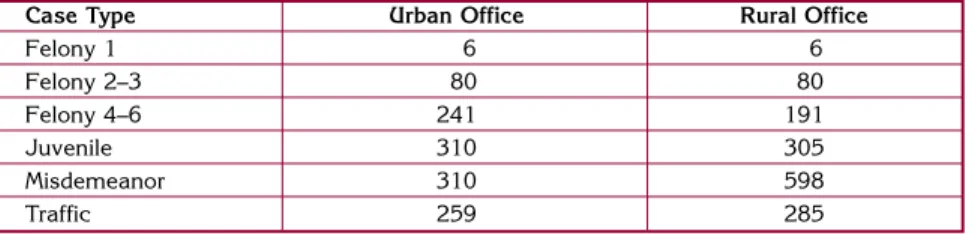
Case Type Urban Office Rural Office Felony 1 6 6 Felony 2–3 80 80 Felony 4–6 241 191 Juvenile 310 305 Misdemeanor 310 598 Traffic 259 285
scenarios designed to reflect typical cases and clients to be found in any public defender’s workload. The attorneys are asked to estimate the time involved in handling the various scenarios. This results in case weights based on “strong educated guesses” about the relative time required to complete various tasks.
The case-weighting method uses detailed time records kept by public defender attorneys over a period, typically ranging from 7 to 13 weeks. The time records provide a means by which caseload (the number of cases a lawyer handles) can be translated to workload (the amount of effort, measured in units of time, for the lawyer to complete work on the caseload). In the broad-est context, weights can be given to the total annual caseload of an office to compare with the next year’s anticipated volume of cases. Assum-ing that records are kept of attorney time expended in each case, the translation of projected caseload into projected workload can be accom-plished with some precision.
C
ASELOADS
TANDARDSTable 1: Colorado Case-Weighting Standards
Colorado Case-Weighting Study
In 1996, The Spangenberg Group completed a case-weighting study for the Colorado state public
defend-er.10Since then, the Colorado public
defender has used the study’s weighted caseload formula to deter-mine staffing needs in regional trial offices. It justifies its budget requests with the formula, which sets out dif-ferent annual caseload standards for trial attorneys working in urban and
rural offices.11The standards are
shown in table 1.
The Colorado legislature has ac-cepted the formula for purposes of both budgeting and analyzing the fis-cal impact of proposed legislation. As a result, the Colorado public defender office reports that its attor-ney staffing levels have been ade-quately funded in recent years. It believes that a critical element in the acceptance of the study was obtain-ing legislative input in the initial stages of the study’s design. This involvement, together with the empirical nature of the study, give
credibility to the case-weighting study’s formula for staffing needs.
State Standards
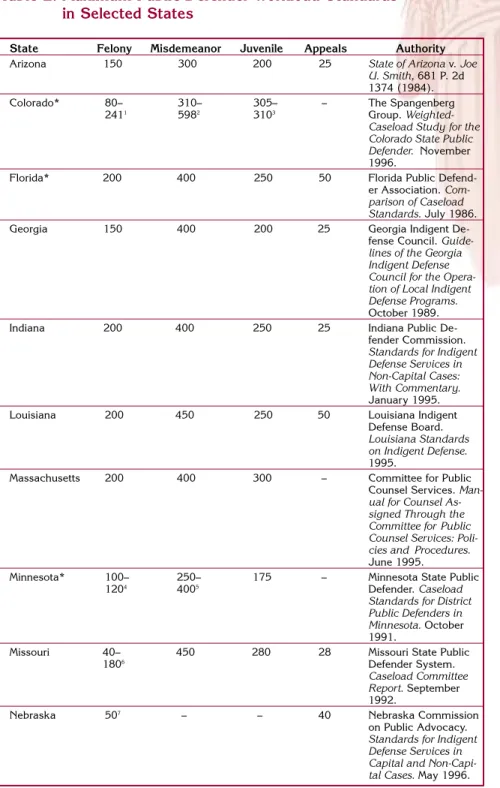
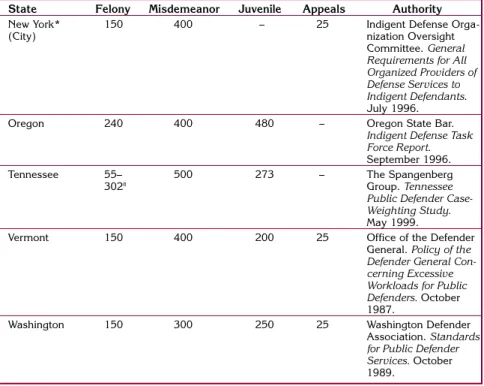
Using a combination of NAC stan-dards and case-weighting studies as the starting point, several states have implemented workload guide-lines for public defenders. Table 2 shows the standards used in 15 states. In reviewing the table, note that making comparisons between various indigent defense systems is an imperfect science, because of the many variables affecting indigent
defense services in each state.12
Nat-urally, criminal practices and proce-dures vary from state to state and often between jurisdictions within a single state. Despite this caveat, table 2 illustrates how different states use workload standards. These workload standards represent the maximum annual number of cases a single attorney should carry if that attorney handles only that type of case. For example, most states with misdemeanor caseload standards suggest that public defenders handle no more than 400 misdemeanor cases in a single year, if misdemeanors are the only type of case the attorney handles.
Additionally, many of these states have further restrictions. To cite one example, the Indiana Public Defend-er Commission’s workload standards were designed for use by indigent defense practitioners who have ac-cess to adequate support staff, in recognition of the important role support staff play in providing
quality indigent defense.13The
Indi-ana standards in table 2 represent the caseload standards for offices that maintain an adequate level of support staff consistent with the guidelines listed below.
The ratio of support staff to attorneys should be as follows: • Paralegal - Felony, 1:4 - Misdemeanor, 1:5 - Juvenile, 1:4 - Mental Health, 1:2 • Investigator - Felony, 1:4 - Misdemeanor, 1:6 - Juvenile, 1:6 • Law Clerk Appeal, 1:2 • Secretary
- Felony, 1:4 - Misdemeanor, 1:6 - Juvenile, 1:5
For county public defender offices that do not maintain the required ratios of support staff to attorney, annual caseloads are reduced accordingly (to a maximum of 100–150 felonies, 300 misde-meanors, 200 juvenile cases, or 20 appeals per attorney per year).
Also, Indiana’s experience shows how successful statewide indigent defense commissions can be in pro-mulgating standards and guidelines designed to improve and ensure uni-formity of practice statewide. These commissions (currently, 31 states have a commission of some kind)
Table 2: Maximum Public Defender Workload Standards
in Selected States
State Felony Misdemeanor Juvenile Appeals Authority
Arizona 150 300 200 25 State of Arizonav. Joe U. Smith,681 P. 2d 1374 (1984). Colorado* 80– 310– 305– – The Spangenberg
2411 5982 3103 Group.
Weighted-Caseload Study for the Colorado State Public Defender. November 1996.
Florida* 200 400 250 50 Florida Public Defend-er Association. Com-parison of Caseload Standards.July 1986. Georgia 150 400 200 25 Georgia Indigent De-
fense Council. Guide-lines of the Georgia Indigent Defense Council for the Opera-tion of Local Indigent Defense Programs. October 1989. Indiana 200 400 250 25 Indiana Public De-
fender Commission. Standards for Indigent Defense Services in Non-Capital Cases: With Commentary. January 1995. Louisiana 200 450 250 50 Louisiana Indigent
Defense Board. Louisiana Standards on Indigent Defense. 1995.
Massachusetts 200 400 300 – Committee for Public Counsel Services. Man-ual for Counsel As-signed Through the Committee for Public Counsel Services: Poli-cies and Procedures. June 1995.
Minnesota* 100– 250– 175 – Minnesota State Public 1204 4005 Defender. Caseload
Standards for District Public Defenders in Minnesota.October 1991.
Missouri 40– 450 280 28 Missouri State Public 1806 Defender System.
Caseload Committee Report.September 1992.
Nebraska 507 – – 40 Nebraska Commission
on Public Advocacy. Standards for Indigent Defense Services in Capital and
Table 2: Maximum Public Defender Workload Standards
in Selected States (continued)
State Felony Misdemeanor Juvenile Appeals Authority
New York* 150 400 – 25 Indigent Defense Orga-(City) nization Oversight
Committee. General Requirements for All Organized Providers of Defense Services to Indigent Defendants. July 1996. Oregon 240 400 480 – Oregon State Bar.
Indigent Defense Task Force Report. September 1996. Tennessee 55– 500 273 – The Spangenberg
3028 Group. Tennessee
Public Defender Case-Weighting Study. May 1999.
Vermont 150 400 200 25 Office of the Defender General. Policy of the Defender General Con-cerning Excessive Workloads for Public Defenders.October 1987.
Washington 150 300 250 25 Washington Defender Association.Standards for Public Defender Services.October 1989.
*Jurisdictions in which caseload standards have been developed through case-weighting studies.
1 Colorado's felony caseload standards establish thresholds based on the severity of the charge
and whether defenders are in urban or rural offices. For Felony 2 and 3 cases, the standard is 80 cases per year. For Felony 4, 5, and 6 cases, the standard in rural areas is 191 cases and in urban areas is 241 cases.
2 Colorado’s misdemeanor caseload standards establish thresholds based on the severity of the
charge and whether defenders are in urban or rural offices. The standards for misdemeanors in urban areas are 259 traffic and 310 nontraffic cases per year. The standards for misdemeanors in rural jurisdictions are 285 traffic and 598 nontraffic cases per year.
3 Colorado’s juvenile delinquency caseload standards establish thresholds based on whether
defenders are in urban or rural offices. For juvenile delinquency cases in urban areas, the standard is 310 cases per year. In rural jurisdictions, the standard is 305 cases.
4 Minnesota’s caseload standards establish a range of cases a public defender may handle
accord-ing to local practices throughout the state. Additionally, Minnesota has established a caseload standard (3 cases per year) specifically for homicide cases.
5 Minnesota’s misdemeanor caseload standards establish a threshold based on the severity of the
charge. For gross misdemeanors, a public defender should not handle more than 250 to 300 cases per year, depending on local practices. For all other misdemeanors, the standard is 400 cases per year.
6 Missouri’s caseload standards establish thresholds based on the severity of the felony charge.
For Felony A and B cases, the standard is 40 cases per year. For Felony C and D cases, the stan-dard is 180 cases.
7 The Nebraska Commission on Public Advocacy has established a felony caseload standard for
only the most serious category of felonies. The standard represents the number of violent crime cases (rape, manslaughter, 2-degree murder, sexual assault) that a single attorney could handle during a year if those cases were the only type of cases handled during the year.
8 Tennessee’s felony caseload standards establish thresholds based on the severity of the charge.
C
ASELOADS
TANDARDSprovide oversight and troubleshoot to avoid serious problems in the
deliv-ery of indigent defense services.14In
Indiana, the commission’s noncapital standards were adopted in 1995. By 2000, 42 of the state’s 92 counties were in compliance with its noncapi-tal standards.
Statutory Caseload
Provisions
Several jurisdictions have public defender workload limitations written into statutory provisions. Most do not set specific numeric limitations but include language requiring public defenders to accept caseloads that allow them to provide effective rep-resentation, or representation that comports with codes of professional responsibility. At least two states’ statutory provisions contain specific annual caseload caps based on case-weighting studies conducted for the statewide public defender organizations.
New Hampshire requires the statewide public defender program to adopt a plan for the allocation of cases between public defender staff
attorneys and assigned counsel.15
The purpose of the plan is twofold. First, it establishes caseload limits for defender attorneys in accordance with professional standards under the code of professional responsibil-ity. Second, it provides for appoint-ment of assigned counsel when public defender attorneys reach maximum caseload limits. Pursuant to the statutory requirement, a case-load plan loosely modeled after NAC
standards is incorporated into the contract between the public defender and the state. Unlike NAC standards, the New Hampshire plan gives some consideration to factors such as trav-el time and average case processing time.
The New Hampshire public defender does not rely on the case-load plan alone. In fact, greater emphasis is placed on an informal, weighted caseload plan developed over the years that guides the public defender program’s internal case assignment process. Case weights, or units, have been developed based on summaries of time reported by public defenders on how long they devote to individual cases.
Washington state mandates each county or city to adopt standards for the delivery of public defense ser-vices, whether those services are provided by contract, assigned
counsel, or a public defender office.16
Among other things, the standards are to include caseload limits, and the standards endorsed by the Wash-ington Defender Association “may serve as guidelines to contracting authorities.”
Wisconsin’s statute sets out specif-ic annual caseload standards for assistant state public defenders that are used to help make budget
decisions.17The standards take into
account the results of a case-weighting study conducted by The Spangenberg Group for the Wisconsin state public defender in 1990, and they are occasionally adjusted by the state
legislature, with the input of the state public defender, to reflect changes in practice. Wisconsin’s statute also acts as a safety valve when caseloads reach the standards set out in the statute by allowing the public defender to seek legislative approval to assign overload cases to the private bar.
Contractual Standards
Like public defenders, contract attorneys can run into excessive workload situations, particularly when they have entered into low-bid, flat-fee contracts to handle all of the cases in a given jurisdiction
for a set price. In State v.Joe U.
Smith,the Arizona Supreme Court
struck down Mohave County’s contract defense system, which solicited sealed bids from private
bar members for several years.18In
the underlying case, the defendant was represented by a lawyer who contracted with Mohave County to represent indigent defendants on a part-time basis. (The lawyer also had a civil practice). The court found that the contract lawyer handled 149 felonies, 160 misde-meanors, 21 juvenile cases, and 33 other types of cases in 11 months.
The Arizona Supreme Court opinion established a widely cited standard for assessing the constitu-tionality of a low-bid contract system.
The decision cites the NLADA
Guide-lines for Negotiating and Awarding
Indigent Defense Contractsand ABA’s
Standards for Criminal Justiceand
concludes that Mohave County’s
system did not conform with the stan-dards and guidelines for four reasons: (1) it did not take into account the time the attorney was expected to spend in representing his or her share of indigent defendants; (2) it did not provide for support costs for the attorney, such as investigators, para-legals, and law clerks; (3) it did not take into account the complexity of each case; and (4) it did not take into account the competency of the attorney.
In Nebraska, a statutory provision governs indigent defense contrac-tors’ caseloads. Neb. Rev. Stat. § 23–3406 (1999) states that any contract negotiated between an attorney and a county for the provi-sion of indigent defense services may specify a maximum allowable caseload for each full- or part-time attorney working under the contract. Although no specific numbers are prescribed, caseloads “shall allow each lawyer to give every client the time and effort necessary to provide effective representation.” In addi-tion, the statute states that such contracts must require contracting attorneys to adhere to minimum standards set forth by ABA and the Nebraska Canons of Ethics for Attorneys.
Caseload Standards for
Private Attorneys
At least two states’ standards rec-ognize that private attorneys who accept court appointments are sus-ceptible to excessive caseloads, particularly when compensation in
C
ASELOADS
TANDARDScourt-appointed cases is inadequate. In Indiana, where many of the state’s 92 counties use some sort of court-appointment system, state standards regarding appointment of private counsel in capital cases address this potential problem.
In the late 1980s, the Indiana Commission on Public Defense draft-ed standards regarding representa-tion in death penalty cases. The standards were ultimately adopted by the Indiana Supreme Court in Indiana Criminal Rule 24 and went into effect in January 1990. Under Rule 24, for the first time in the his-tory of indigent defense in Indiana, state funds became available for counties that complied with the requirements of the rule in providing representation to indigent defendants charged with crimes where the state asked that the death penalty be imposed. Rule 24 includes qualifica-tion standards for both lead counsel and co-counsel, maximum caseload standards (outside of the capital case) for counsel, requirements for sufficient support staff, and compen-sation, as of January 1, 2001, of
$90 per hour.19Any county that is
able to meet these standards is reim-bursed by the state for one-half the cost of representation.
Rule 24(B)(3) of the Indiana Rules of Criminal Procedure specifically addresses “Workload of Appointed Counsel” in capital cases, stating:
(a) Attorneys accepting appoint-ments pursuant to this rule shall provide each client with quality
representation in accordance with constitutional and profes-sional standards. Appointed counsel shall not accept work-loads which, by reason of their excessive size, interfere with the rendering of quality representa-tion or lead to the breach of pro-fessional obligations.
(b) A judge shall not make an appointment of counsel in a capital case without assessing the impact of the appointment on the attorney’s workload. Additionally, Rule 24(J)(2) focuses on the workload of appointed appel-late counsel:
In the appointment of appellate counsel, the judge shall assess the nature and volume of the workload of appointed appellate counsel to assure that counsel can direct sufficient attention to the appeal of the capital case. In the event the appointed appel-late counsel is under contract to perform other defense or appel-late services for the court of appointment, no new cases for appeal shall be assigned to such counsel until the appellant’s brief in the death penalty case is filed.
Performance Standards
Performance standards are another important tool for attorneys facing a work-overload crisis. When a juris-diction adopts performance stan-dards for attorneys who represent
indigent defendants, defense attor-neys can use the standards to ex-plain to the court—through informal discussions with judges or, if neces-sary, litigation—that appointment to additional cases will make it impossible to properly represent their current clients. Performance standards describe minimum requirements for competent repre-sentation by public defenders and private court-appointed counsel. Such standards, which are in place in several states, are designed to
ensure that, among other things, attorneys maintain contact with the client, conduct a factual investiga-tion, examine the complaint for legal sufficiency, file appropriate motions,
and conduct discovery.20NLADA’s
Performance Guidelines for Criminal
Defense Representation (1995) is an
excellent resource for defense coun-sel and a good starting point for a jurisdiction seeking to tailor perfor-mance guidelines to local practice and procedure.
IV. Withdrawal From Cases
What should an attorney do when facing a caseload that she believes will jeopardize her ability to provide effective representation? A request by an attorney to a court to with-draw from assigned cases and/or temporarily refrain from taking new cases typically comes as a last resort, after the attorney has en-dured a mounting case-overload sit-uation. Often, in the case of a public defender office, the chief public defender will have made unsuccess-ful attempts to secure supplemental funds needed to hire additional attor-neys who can absorb the overload. The situation typically screams “Cri-sis!” in the indigent defense system. A successful motion to temporarily cut off appointments to an individual attorney or to a public defender office can trigger ripple effects through the entire local criminal jus-tice system.
In November 1991, the Knox County public defender in Ten-nessee moved the four general ses-sion court judges to suspend further case appointments to the public defender office. Excessive case-loads, as high as five times the national standards, formed the basis for the motion. The public defender argued that continued appointments would create a conflict of interest between present and future clients. To temporarily relieve the situation, the general session judges granted an order that halted all further
appointments of cases to the public defender for 60 days. A similar motion filed in criminal court result-ed in suspension of misdemeanor appointments to the public defender office so that the attorneys could work down their caseloads to more manageable levels.
In such a situation, cases normal-ly assigned to the public defender would typically be assigned to the private criminal defense bar, who would take additional case appoint-ments until the public defender’s caseload reached a manageable level. At the time, other factors were at play that affected indigent defense statewide, not just in Knox County. One primary factor was that Tennessee’s Indigent Defense Fund was running out of money, just 4 months into the fiscal year. The fund is used to pay for the operation of public defender offices, compensate attorneys in court-appointed cases, and pay for associated expert fees in those cases.
To make up this shortfall, the state proposed to reduce the rate of reimbursement for court-appointed cases to 25 percent of the total claim. Rather than the $20 hourly rate for out-of-court work and $30 hourly rate for in-court representa-tion, attorneys’ fees would be reduced to $5 and $7.50 an hour. This proposal was unacceptable to appointed attorneys, who had
complained about the inadequacy of the $20/$30 rates that had been in place since 1965. The proposal was not implemented.
For attorneys practicing in Knox County, news about the reduced fees came in the wake of a new plan, announced by the General Sessions Court, to distribute cases to private counsel during the temporary sus-pension of case appointments to the public defender. The court issued notice to every bar member in the county advising them that they would be expected to accept an appointment to a criminal case. The mandate applied to all lawyers, regardless of whether they were cur-rently practicing or familiar with criminal defense.
At about the time the temporary freeze on new appointments to the Knox County public defender office was set to expire, the Indigent Defense Fund was almost entirely depleted. The Shelby County (Memphis) public defender office announced that it would stop taking new appointments and begin layoffs because of the state’s inability to provide funding to the office. When the Shelby County public defender sought an order for continued fund-ing for his office in federal court, the judge indicated that he did not have the authority to order the state to provide funding. However, he noted that he did have the authority to pre-vent the state from contributing directly to unconstitutional condi-tions in the local jail, which was under a consent decree that included
a maximum population cap. If the public defender stopped accepting cases, it would trigger a backlog in the criminal justice system, including the jail.
The crisis in Tennessee was finally remedied by moving funds from other program areas to keep the Shelby County public defender office operating, and court-appointed lawyers were paid the full $20/$30
rate.21The 60-day halt in
appoint-ments to the Knox County public defender office gave the office the breathing room it needed to make it through the fiscal year.
In the next legislative session, the Tennessee legislature appropriated funds to increase public defender staff at offices throughout the state. The Knox County public defender office almost doubled in size. As years passed, it became clear that additional staff were needed. The legislature requested that the state comptroller oversee case-weighting studies for judges, prosecutors, and public defenders to determine the level of staff needed.
In 1999, The Spangenberg Group conducted a weighted-caseload study for public defenders in Ten-nessee that found an additional 59 attorneys were needed statewide. Weighted-caseload studies were con-ducted for judges and prosecutors at the same time by the National Cen-ter for State Courts and the Ameri-can Prosecutors Research Institute. It is expected that any state-funded increases in the numbers of judges,
Withdrawal From Cases
prosecutors, or public defenders will be made according to the recom-mendations in these studies. How-ever, because of fiscal restrictions, Tennessee has not yet funded addi-tional public defenders, prosecutors, or judges.
These funding limitations prompt-ed Knox County Public Defender Mark Stephens to work with county officials to avoid a repeat of 1991. State law now gives localities the option to adopt an ordinance requir-ing that 75 cents be appropriated for the local public defender’s office for every dollar of county money appropriated for the local district attorney’s office. Knox County adopted such an ordinance. Further-more, state law allows revenue from a local litigation tax assessed on criminal defendants convicted in general sessions court to fund indi-gent defense in Knox County. These local measures currently fund almost one-third (7 of 22) of the attorneys in the Knox County public defender office.
In the early 1990s, Dade County, Florida, was in a crisis similar to that faced by Knox County. In Octo-ber 1992, the Dade County public defender office, arguing that crush-ing caseloads had rendered its lawyers unable to represent criminal defendants competently, filed peti-tions with four juvenile court judges to withdraw from 500 juvenile cases and to request that further juvenile case appointments be suspended. Dade County Public Defender
Bennett Brummer called the situa-tion “a reflecsitua-tion of a failure of state government. I have a constitutional and ethical responsibility to provide effective legal representation. I’ve been very reluctant to withdraw from cases. But it gets to the point where you can’t justify being a self-respecting professional and pretend you’re providing legal representation
under those circumstances.”22
At the time of the public defend-er’s request to withdraw, Florida, like many states, was experiencing revenue shortfalls. Brummer had requested an increase in funding from the state legislature to hire additional lawyers but ended up with a budget smaller than that appropri-ated for his office the previous year. Meanwhile, caseloads were on the rise. Individual defenders had an average of 98 open juvenile cases, and the office was assigned to roughly 100 additional cases each week. At that rate, attorneys were on their way to handling 400 juve-nile cases apiece in 1992, double NAC standards.
Although workloads were up for attorneys handling all types of cases, Brummer reportedly with-drew from juvenile cases because they are cheaper than adult cases for court-appointed counsel to han-dle and because the overload situa-tion was especially severe in the office’s juvenile division. Brummer was granted leave to withdraw, but that amounted to a temporary reprieve. It would not prevent a repeat occurrence.
In Florida, 20 elected public de-fenders provide representation to indigent defendants at the trial level throughout the state’s judicial cir-cuits. Appellate cases are handled on a regional basis by 5 of the 20 offices. All funds for these programs are provided by the state, but the counties are responsible for repre-senting indigent defendants in pro-ceedings in which the state public defender withdraws because of a conflict of interest and where an excessive workload precludes ade-quate state public defender repre-sentation. The Dade County public defender’s request to withdraw from cases in 1992 was not an isolated incident. Because of their profession-al standards, 6 of Florida’s 20 elect-ed public defenders have found it necessary to withdraw from cases or to seek county funds to supplement
their inadequate state budgets.23
Because state funds have not filled the needs for additional public de-fender staff, public dede-fenders have sought local assistance. After Brum-mer withdrew from cases in 1992, the county provided an influx of special assistant public defenders, which it continues to do. In FY 2000, the county funded 82 of the 183 attor-neys in Dade County’s public
defend-er office.24These so-called special
assistant public defenders work as staff in the public defender office and handle cases that otherwise would be assigned to appointed counsel be-cause of excessive workload. The average cost per case to the county for cases handled by special assistant
public defenders is much lower than the average cost per case for
court-appointed attorneys.25
In 2004, the state will assume the responsibility of funding conflict and overload counsel. Five public de-fender offices currently receive county funds to hire special assistant public defenders to handle what would be overload cases. For these five offices, including the Dade County public defender, the top leg-islative priority is to obtain adequate state funds for the positions before transfer of financial responsibility for overload cases to the state.
Public defenders in Georgia have also been forced to take action in regard to overwhelming caseloads. In 1990, after 4 years as a public defender in Fulton County (Atlanta), Georgia, Lynne Borsuk became uncomfortable with her expanding caseload and its effect on her
clients.26After consulting with the
Georgia Association of Criminal Defense Lawyers, Borsuk appeared in court and requested that the judge not appoint her to any more cases. She filed a motion stating her case-load was so overwhelming that it violated her clients’ right to effective counsel and the canon of ethics of the State Bar of Georgia. Borsuk explained her action to a reporter: “I recognized I was no longer doing my clients a service by keeping quiet. It was a sham. We were pre-tending that we were providing
Withdrawal From Cases
Borsuk’s stand led to the forma-tion of the Atlanta Bar Associaforma-tion Blue Ribbon Commission to study the problem of case overload in the Fulton County public defender office. After reviewing the bar’s find-ings, the Fulton County Commission appropriated additional funds to the
public defender office.28Borsuk,
however, paid a price for her initia-tive. She was demoted from han-dling felony cases to juvenile court and resigned shortly thereafter.
Borsuk’s experience raises an important issue: Whose responsibili-ty is it to have an attorney withdraw from a case—the individual defender or the chief public defender? If an assistant defender is not getting workload relief and works for a chief public defender who does not want to create friction in the local crimi-nal justice system, there are few appealing options. She can resign and leave colleagues with an even greater workload. She can go over the boss’s head to the court and ask to withdraw. Or she can attempt to build a coalition of bar, defender, and other criminal justice system players to look at the issue, which could take weeks or longer to orchestrate. Because these alterna-tives may not be palatable or feasi-ble for a young defender, the chief defender should monitor the work-load and take steps to ease it when it becomes excessive.
Of course, individual defenders should not stand idly by when a workload situation becomes unten-able. Recall the example of Rick
Tessier, the young defender in New Orleans who filed a motion for relief when he felt he could no longer pro-vide constitutionally required stan-dards of representation for his clients. The Louisiana Supreme Court upheld the promise it made in
State v.Peartto take action if none
was forthcoming from the legisla-ture. In 1994, after its landmark
decision in Peartand a statewide
study of Louisiana’s indigent de-fense system conducted by The Spangenberg Group, the Louisiana Supreme Court promulgated a rule creating the Louisiana Indigent De-fense Assistance Board (LIDAB) (formerly called the Louisiana Indi-gent Defender Board). LIDAB was given $7.5 million in state funds and charged to supplement the budgets of local indigent defender boards, defray the costs of court-ordered defense experts and tests through-out the local boards, and more ade-quately fund counsel representing indigent defendants charged with capital crimes.
In December 1997, the governor and legislature assumed responsi-bility for LIDAB to avoid conflicts of interest arising from the judiciary’s stewardship of the program. In the 1999 legislative session, LIDAB acquired the additional responsi-bility of ensuring that counsel is appointed in state postconviction death penalty cases.
Systemic Litigation
Sometimes defenders’ excessive workloads become so intractable in a
jurisdiction that seeking relief through traditional channels—promulgating performance standards, document-ing case overload and presentdocument-ing the evidence to criminal justice system officials, seeking supplemental appro-priations, requesting to withdraw from cases, and seeking to temporarily de-cline additional appointments—fails to make progress. At this point, bring-ing a lawsuit chargbring-ing systemic defi-ciencies may be the only alternative.
In the 1990s, attorneys in Connecti-cut’s statewide, state-funded public defender system were chronically overworked, carrying caseloads far in excess of NAC standards. In 1993 and 1994, Connecticut public defend-ers each handled an average of 1,045 cases in “geographic area” courts, where misdemeanors and lesser felonies are tried. The average caseload for an attorney
represent-ing juveniles was 716 cases a year.29
The situation was corrected through settlement of a class action lawsuit,
Rivera v.Rowland,alleging
viola-tions of the 6th and 14th Amend-ments to the Constitution, violations of the Connecticut constitution and various state statutes, and failure to provide the state public defender
system with adequate funding.30The
lawsuit was filed by the American Civil Liberties Union against the Governor of Connecticut, the state’s public defender services commis-sioners, and others.
Such a lawsuit can produce good results but it can take years to re-solve, leaving indigent defendants in the hands of overburdened public
defenders. Rivera v.Rowland,for
example, spent 5 years in the court system.
Malpractice Claims in State
Court and Federal Immunity
Attorneys with excessive case-loads are under an ethical obligation to remedy the situation. Failure to do so may result in disciplinary action under professional codes of conduct. Additionally, attorneys may be held liable for legal malpractice. A legal malpractice suit requires proof of four elements: (1) existence of an attorney-client relationship, (2) the attorney’s duty to act according to particular standards of care, (3) fail-ure to meet that standard, and (4) damage to the client as a result of
that failure.31
In a recent Illinois case, Johnson v.
Halloran,a former client who was
convicted of aggravated criminal sexual assault sued his public de-fender for malpractice. The public defender sought to dismiss the plain-tiff’s claims on the basis of sovereign duty, arguing that as state employ-ees, public defenders are immune from malpractice claims. The Illinois Appellate Court disagreed, finding that a public defender’s duties and obligations, by virtue of his or her status as a licensed attorney, are the same as those of any other lawyer. That status, the court found, is independent of the lawyer’s state
employment.32
Although the public defender in
Johnson v.Hallorandid not claim
Withdrawal From Cases
negligence led to a denial of the defendants’ Sixth Amendment right
to effective counsel.34The court
rejected this argument, finding that a public defender does not act under color of state law for purposes of
claims under section 1983.35The
court stressed that the professional relationship and obligation of a pub-lic defender are the same as those of any private attorney and his client and that the form of payment to counsel does not constitute state action. However, some states grant immunity to public defenders by statute.
holding, along with others before it, should encourage public defenders and other attorneys representing indigent defendants to more aggres-sively request relief from further assignments when they face exces-sive caseloads.
Public defenders enjoy limited immunity from actions brought under section 1983 of the Civil
Rights Act.33In Polk County v.
Dodson,the plaintiffs, who were
criminal defendants in the underly-ing action, claimed that a section 1983 action would be proper when their court-appointed counsel’s
Workloads Manageable
Of all the approaches public defenders, contract defenders, and private attorneys who handle court-appointed cases have taken to keep their workloads reasonable, none is a foolproof approach to this persis-tent problem. And, it is important to note that a defender program can-not provide quality representation solely by developing a numerical set of caseload standards. Caseload standards are only one component of an effective indigent defense sys-tem. Public defender offices and individual attorneys providing repre-sentation must also have fair and adequate compensation; adequate support staff such as investigators, social workers, paralegals, and sec-retaries; a complete law library; opportunities for continuing legal education; sufficient funds for ex-perts and other costs of litigation; and specialty units for unique cases such as death penalty and juvenile transfer cases or for clients with mental health problems.
However, leaders of a local crimi-nal defense bar, particularly chief defenders, can pursue the following common strategies to prevent case-loads from reaching overwhelming levels:
• Develop working relationships with local criminal justice system play-ers such as judges, prosecutors,
funders, and pretrial service pro-grams. Hold regular meetings to discuss common issues and work together on common projects such as task forces or committees. • Maintain a constant dialogue
among judges, public defenders, and prosecutors about the need for balanced funding and re-sources. Get to know leaders of the private bar and the criminal defense bar. Establish ties with local schools, churches, and community groups that provide pertinent services such as health care, employment training, and counseling. Potential supporters of the public defender must understand the complexities of providing effective indigent defense representation and the vital need to uphold this constitu-tional right.
• Develop a case definition that your office uses uniformly. Dis-cuss the possible development of a uniform case definition to be used by all criminal justice sys-tem participants in the jurisdic-tion. In the event that caseloads grow beyond capacity, this uni-form definition can be used to conduct an “apples to apples” comparison with other compo-nents of the justice system.
K
EEPINGD
EFENDERW
ORKLOADSM
ANAGEABLE• Develop a user-friendly system for recording case statistics and producing regular reports on indi-vidual attorney workload, overall office workload, and fluctuations in the mix of types of cases assigned to the office. Use these reports for funding requests and for internal supervision. Make use of information systems that sim-plify case tracking and report pro-duction, and make sure staff are trained to use the systems. • Create caseload standards for
the office, and share them with funders, judges, and other players in the system. Caseload standards can be developed in
various ways, ranging from a case-weighting study to adoption of NAC standards.
• Develop a way to enforce or en-courage compliance with work-load standards, as Indiana has done.
• Document your office’s excessive caseloads and inadequate staff and resources. Begin by trying to discuss and resolve the problem informally with judges and fund-ers. Make it clear that you want to avoid having to withdraw from cases but that you will do so if no other solutions can be found.
1. State v.Peart,621 So. 2d 780, 791 (La. 1993).
2. Ibid.
3. State Court Model Statistical Dictio-nary, 1989: 19 (definition used by The Spangenberg Group in its weighted-caseload studies).
4. Model Rule 1.1 states a “lawyer shall provide competent representation to a client.”
5. 681 P. 2d 1374 (Arizona 1984).
6. Monahan, Edward C., and Clark, James, 1995, “Coping With Excessive Workload,” Ethical Problems Facing the Criminal Defense Lawyer: Practical Answers to Tough Questions, Chicago, IL: American Bar Association, 331.
7. There are no nationally recognized caseload standards for prosecutors. Research is under way by the Ameri-can Prosecutors Research Institute to determine whether such a set of stan-dards can be produced. The project is funded through a grant from the Bureau of Justice Assistance and should be finalized in 2001.
8. National Advisory Commission on Criminal Justice Standards and Goals, Task Force on Courts, 1973, Courts. Washington, DC: National Advisory Commission, 186.
9. American Bar Association Stan-dards for Criminal Justice, Providing Defense Services, 3rd ed. Chicago, IL:
American Bar Association: Washing-ton, DC, 1992: 72.
10. The Spangenberg Group has con-ducted statewide weighted-caseload studies for public defender programs in Colorado, Minnesota, Tennessee, and Wisconsin. Another weighted-caseload study was conducted for the New York Legal Aid Society Criminal Defense Division in New York City.
11. Colorado’s felony and misde-meanor caseload standards establish thresholds based on the severity of the charge and whether defenders are in urban or rural offices. Colorado’s juve-nile delinquency caseload standards establish thresholds on the basis of whether defenders are in urban or rural offices.
12. Among the most important vari-ables to consider in state-by-state indi-gent defense comparisons are the following: whether the system is fund-ed entirely with state funds, entirely with county funds, or a mixture of both; whether the system is organized at the county, regional, or state level; whether the state has the death penal-ty; whether the system has a central-ized organization responsible for statewide data collection, oversight, and/or policymaking; the types and percentages of cases handled by vari-ous providers in the state; the rate of pay for court-appointed counsel in the state; the state population; and the way in which programs define, and
therefore count, cases (different pro-grams define cases by charge, indict-ment, defendant, assignindict-ment, and disposition).
13. Indiana’s 92 counties have the pri-mary responsibility for funding the indigent defense programs within their jurisdictions. Each county may choose between a county public defender, a contract defender program, or an assigned counsel system. The Indiana Public Defender Commission (IPDC) allocates state funds to offset county indigent defense expenditures in coun-ties that comply with IPDC’s standards for indigent defense services in capital and noncapital cases. Counties that enforce these standards are reim-bursed by IPDC for 40 percent of the cost of representing indigent defen-dants in noncapital felony cases, 50 percent of the cost of attorneys’ fees, and expert, investigative, and support services in capital cases. Currently, 42 of Indiana’s 92 counties, including Marion County (Indianapolis), the state’s largest county, are in compli-ance with IPDC standards and receive funds from the commission.
14. In some states, a commission on indigent defense sets policy to ensure uniformity of practice statewide, and a state public defender implements the policy. In other states, either a com-mission but no state public defender or no commission but a state public defender develops and implements policy.
15. New Hampshire Revised Statute Ann. § 604–B:6 (1999).
16. Washington Revised Code Ann. § 10.101.030 (1999).
17. Wisconsin Statute Ann. § 977.08(5)(bn) (1999).
18. 681 P. 2d 1374 (Arizona 1984).
19. Until January 1, 2001, compensa-tion for court-appointed counsel under Rule 24 was set at $70 per hour.
20. Two of the best state examples are the Massachusetts Committee for Pub-lic Counsel Services’ Manual for Coun-sel Assigned Through the Committee for Public Counsel Services: Policies and Procedures (June 1995) and the Louisiana Indigent Defense Board’s
Louisiana Standards on Indigent Defense,Chapter 6 (1995). Perfor-mance standards can also be found for indigent defense systems in California, Colorado, Florida, Georgia, Indiana, Massachusetts, Michigan, Missouri, Nebraska, New Mexico, New York City, New York, North Dakota, Oregon, and Washington.
21. The state gave the public defender $700,000 from its award from the federal Drug Control and System Improvement Formula Grant program.
22. Viglucci, Andres, The Miami Her-ald,October 25, 1992, p. 1B.
23. Brummer, Bennet H., 10–3 St. Thomas Law Review/ 607, 616 See, e.g., In reA.S., no. 92–1607FJ13 (Fla. Cir. Ct. filed October 16, 1992),
In re Certification of Conflict in Motions To Withdraw filed by public defender of 10th Judicial Circuit, 636 So. 2d 19
(Fla. 1994), and In reOrder on Prose-cution of Crim. App. by the 10th Judi-cial Circuit Public Defender, 561 So. 2d 1130 (Fla. 1990).
24. While housed at the public defend-er office and trained and supdefend-ervised by the public defender, the county-funded special assistant public defenders do not receive the same fringe benefits received by state-employed assistant public defenders.
25. In 1995, the estimated average fee for a noncapital case handled by a court-appointed attorney in Dade County was $1,400 and for juvenile and misdemeanor cases was $500. The average cost/per/case handled by special assistant public defenders was estimated between $50 and $100.
26. Shumate, Richard,1991–92, I Will Not Accept Any More Cases,Barrister
11 (Winter).
27. See note 26.
28. The county appropriated an addi-tional $470,000 in 1991 and made fur-ther steady increases to the public defender office in the following years.
29. Touchy, Lynne, “CCLU Files Suit Against State,” Hartford Courant,
January 6, 1995.
30. Riverav. Rowland,Superior Court, Judicial District of
Hartford-New Britain, CT (1999) (No. CV95–545629).
31. Klein, Richard, 1988, “Legal Mal-practice, Professional Discipline, and Representation of the Indigent Defen-dant,” Temple Law Review 61. (4) 1191, n. 121.
32. Johnsonv. Halloran,2000 WL 21047 (Ill. App. 1 Dist.) (No. 1–98–2365).
33. 42 U.S.C. § 1983 (1982) states: “Every person who, under color of any statute, ordinance, regulation, custom or usage, or any state or territory, sub-jects, or causes to be subjected, any citizen of the United States or other person within the jurisdiction thereof to the deprivation of any rights, privi-leges, or immunities secured by the Constitution and laws, shall be liable to the party injured in an action at law, suit in equity, or other proper proceed-ing for redress.”
34. 454 U.S. 312 (1981).
35. However, in Towerv. Glower,467 U.S. 914 (1984), the Court clarified there is no immunity from liability under section 1983 for public defend-ers who allegedly conspire with other state officials to deprive a former defendant of his/her constitutional rights. See Klein, supranote 31 at 1197.
VII. For More Information
To receive more information about indigent defense contract systems, contact the following organizations:
The Spangenberg Group
1001 Water Town Street West Newton, MA 02465 617–969–3820
Fax: 617–965–3966
E-mail: [email protected] World Wide Web:
www.spangenberggroup.com For additional information on BJA grants and programs, contact:
Bureau of Justice Assistance
810 Seventh Street NW., Fourth Floor
Washington, DC 20531 202–514–6278 Fax: 202–305–1367 World Wide Web: www.ojp.usdoj.gov/BJA
Bureau of Justice Assistance Clearinghouse
P.O. Box 6000
Rockville, MD 20849–6000 1–800–688–4252
World Wide Web: www.ncjrs.org
Clearinghouse staff are available Monday through Friday, 8:30 a.m. to 7 p.m. eastern time. Ask to be placed on the BJA mailing list.
U.S. Department of Justice Response Center
1–800–421–6770 or 202–307–1480
Response Center staff are avail-able Monday through Friday, 9 a.m. to 5 p.m. eastern time.
To learn more about indigent defense workloads discussed in this report, contact the following organizations:
American Bar Association Criminal Justice Section
1800 M Street NW. Washington, DC 20036 202–331–2260
World Wide Web: www.abanet.org
National Legal Aid & Defender Association
1625 K Street NW., Suite 800 Washington, DC 20006–1604 202–452–0620