How to Get the Human Resources
Information Systems You Need
Secrets to Strategic Alignment
of Human Resources Automation
by
Denise
Pringle,
Human
Resources
Consultant
TABLE OF CONTENTS
1.
Strategic Focus –
It’s Not About You
… ... 3
1.1.
What’s the Problem You’re Trying to Solve? ... 3
1.2.
Stakeholders - Who will care? ... 4
1.2.1.
Talent Management ... 4
1.2.2.
Rewards Strategies ... 5
1.2.3.
On-Boarding ... 6
1.2.4.
Employee Tracking: End-to-End Employment Cycle ... 6
1.2.5.
Other ... 7
2.
System Options ... 7
2.1.
ERP ... 8
2.2.
Stand Alone Systems ... 8
2.3.
BPM ... 8
2.4.
Hybrid Solutions ... 9
3.
Call for Action – Building Your Case ... 9
4.
ADDITIONAL INFORMATION... 10
4.1.
ROI Examples ... 10
4.1.1.
Measuring Lost Productivity ... 10
4.1.2.
Case Study Example... 11
4.2.
Considering a BPM Solution ... 13
4.2.1.
Example: Starting with BPM for Recruitment and Selection (Talent Management) ... 13
About the authors ... 17
The question of whether or not it makes good sense to automate tasks
and processes in Human Resources was answered decades ago. Even
though the functional name has evolved – be it Personnel, Human
Resources, Organizational Effectiveness, or Human Capital
Management ‐ the mountains of required paperwork, monitoring
activities, and administrative tasks traditionally associated with this
function were and are obvious, logical choices for automation.
Since that is the case, why are there still so many professional journals,
websites, classes, outside consultants and HR organizations still
debating this question? Proposed Human Resources Information
Systems (HRIS) solutions in the past have often become blurred and bogged down with ill‐defined strategic
focus, numerous technology choices, varied cost models and ill‐planned implementations.
The good and bad news is that there is no one‐size‐fits‐all answer. Let’s first look at where most HR
departments start off on the wrong foot when requesting HRIS funding.
1.
Strategic Focus –
It’s Not About You
…
Many HRIS proposals are doomed to failure from the start because their driving justifications are typically
based on how implementation will make processes so much easier and time‐saving for HR, thereby freeing
HR professionals to focus on other, more pro‐active work within the organization. From an HR perspective,
this makes perfect sense. But from the desks of the CEO, CFO, and CIO however, the proposals offer no
defined value to the business, and perhaps fulfill preconceived notions about HR’s lack of tangible value.
The result? The request for HRIS funding is relegated to the bottom of the pile. What went wrong?
The answer lies in understanding the pressing needs most companies and IT departments must prioritize
within any organization – sales, manufacturing, R & D, and other internal departments that directly impact
the bottom line are also clamoring for IT attention and dollars. Think of your household budget –
prioritizing costs for food and shelter will always surpass those for other less essential line items. Such is
the case for HR. The challenge, therefore, is to demonstrate how automation brings value to the entire
business, not only to HR. In other words, it’s not about you.
1.1.
What’s the Problem You’re Trying to Solve?
Another proposal approach that’s doomed to failure is assuming that by simply automating, existing tasks
and processes will make everything go faster and smoother. But in reality, if manual or semi‐automated
processes are bad to begin with, automation alone will not improve them.
So, the first question to ask before submitting any kind of
proposal is “what the problem is you’re trying to solve?” When
was the last time you reviewed existing processes? When was
the last time you mapped them from beginning to end to
ensure the right stakeholders were identified and unnecessary
“if … processes
are
bad
to
begin
with,
automation
review eliminated? And, when was the last time you confirmed that the processes you have today address
a defined problem still important to the organization? Is it possible that you have processes that address a
problem no longer relevant to the organization?
I once worked in an organization where a single employment requisition went back and forth TWICE and
sometimes THREE TIMES to the same people in different phases of the approval cycle. It wasn’t until we
made a flow chart of the approval path was it realized that the lengthy, multi‐person review had long lost
its relevance. When we defined the problem the employment requisition was originally designed to solve,
we also realized that the approval structure no longer even existed for that organization! It was a process
embedded in tradition and history rather than addressing a legitimate business problem currently facing
the company.
1.2.
Stakeholders - Who will care?
A subset to defining the problem is determining who will and who
should be directly impacted by implementation of an HRIS. For
example, if only HR will be impacted, the less likely an HRIS
implementation will contribute to resolution of pressing business
problems and, quite rightly, the less likely it will be approved.
Let’s look at what I call the “low hanging fruit” in HR – business issues that a robust HRIS will help to
address.
1.2.1.
Talent Management
Often defined only in terms of a stand‐alone hiring system residing in HR, talent management is probably
the most pressing business issue facing companies today – even in a downturn economy. The obvious
rationale is that labor costs are typically the single highest expenditure in any organization, so it’s critical
that the money is spent wisely ensuring the company’s future.
A common misconception is the belief that the many lay‐offs of the last several years have resulted in a
surplus of talent. In fact, the opposite is the case, especially in the long term. Most recently, the US Bureau
of Labor Statistics reported that 3.7 million jobs have gone unfilled, unchanged from the previous several
months.1 With technology continuing to evolve, service industries continuing to grow, and domestic
entities facing rapidly expanding global competition, the challenge of identifying, hiring, expertly deploying,
developing and keeping the right talent has never been more important to a company’s future than it is
now.
Stand‐alone recruitment software has been available for years, but most aren’t leveraged across the
organization for key stakeholders to utilize. Stakeholders not only include hiring managers, but may also
include Finance and other line organizations wanting to access potential talent for the organization.
1
United Status Department of Labor, Bureau of Labor Statistics, January 10, 2013.
“if
only
HR
will
be
impacted,
the
less
likely
an
HRIS
implementation
Unfortunately, many recruitment systems are set up to only react to candidate interest, rather than
proactively connecting with multiple external sites for true interactive capabilities.
Given that prospective candidates are now accessed from multiple sources, and very often through various
types of social media (e.g. Facebook, LinkedIn, professional blogs, and others), the capability for
recruitment software to be truly interactive with external sites is critical for timely, effective talent mining.
While recruitment software that includes resume review, cross‐
functional access, and distribution is a far better solution than
the manual systems of years ago, the latest generation of
Talent Management software goes beyond external hires. It
enables workforce analysis using an assessment of current
employees. Executives and hiring managers should be able to
understand the organizational capabilities that reside in their
employees, both in their own departments as well as across the
company in order to plan effectively for the future. Using this
information, identifying the development needs of current
employees in addition to identifying what talent is necessary to
hire becomes much more effective and much easier to accomplish.
1.2.2.
Rewards Strategies
Years ago, compensation typically consisted of HR and Finance offering competing merit budget proposals
based on external salary survey data and company affordability. The CEO would then approve a merit
budget based on a fixed percentage of total salaries from which raises would be given using a matrix chart
linking specific performance ratings to proscribed increases. Given very little discretion, managers often
abdicated their roles to provide critical employee feedback by granting employees similar increases
regardless of current performance, current salary, level of contribution, or future potential.
With this lack of strategic direction, it’s no surprise that many companies chose to outsource their
compensation function for third parties to administer. Note the emphasis I’ve placed on the tem
“administer,” vs. creating effective reward strategies.
A more effective business approach would utilize an HRIS system which links the key talent identified in
Point 1.2.1 above, to a strategy deployed to retain and reward key employees. HR professionals, working in
collaboration with line executives to identify and incentivize excellent performance and key contributions,
could then easily tap into software systems with access to key salary data, both external and internal to the
organization.
This strategic approach to address the challenges facing key stakeholders across the organization
represents a key value‐add partnership between line executives and HR vs. the old compensation
administration approach from years ago.
“Given that
prospective
candidates
are
accessed
from
multiple
sources
and
very
often
from
social
media…
interactive
recruitment
software
is
critical
for
timely,
1.2.3.
On-Boarding
In my first HR job, one of my responsibilities was to conduct New Hire Orientation at a very large disc drive
company in Silicon Valley. Orientations initially started as a 4‐hour meeting for all new hires, and ultimately
evolved into a 2‐day meeting that included all key company executives making presentations on a weekly
basis to the latest batch of new hires. I smile when I recall that, back then, the length of the New Hire
Orientation was a measure of how people‐oriented the
companies were. Of course, such a time‐and‐resource
intensive approach would never be seriously considered
today.
Business‐minded HR professionals understand that the
evolution of New Hire Orientation to “On‐Boarding” is not
simply an evolution of terminology. While certainly employees
must sign up for benefits, understand company history and
culture, and complete necessary legal paperwork in order to get hired and paid, the real business goal of
on‐boarding is to get employees as informed and as productive as quickly as possible.
Such a challenge would be well met with robust HR software. Basic productivity begins long before the
new employee’s first day. Ensuring the appropriate workspace is designated and ready, telephone,
computer and Internet access is set up and ready to go, office supplies stocked could be simply
accomplished through workflow checklists distributed to appropriate departments as soon as employees
are hired.
Getting new employees informed and productive includes ensuring they have access to customized
information geared to each employee’s role in the company. Engineering documents, financial reports,
company‐specific acronyms, service manuals, key organization charts, product specifications, and
marketing collateral are all examples of information that new employees, depending on their roles in the
organization, require to start being productive. HR software integrated with a company intranet that
provides password‐protected employee desktop access to this information, on a customized basis, would
easily speed up the time required for a new employee to become productive.
1.2.4.
Employee Tracking: End-to-End Employment Cycle
Certainly one of the more time consuming and wasteful processes that exist in any company is duplication
and reentry of key data. This most often occurs because of two situations: One is the multiple physical
entries of employee information because the original data is unavailable or not set up to be distributed to
multiple stakeholders.
The other situation, which can be even more frustrating and time consuming, is research and data
gathering of information already available in a siloed software system somewhere else in the company.
[Note: This is not limited to employee data. For example, searching for customer data, or even being
unaware that someone IS a customer, costs time, money, and company good will when such information is
unavailable across the organization.]
“the
real
business
goal
of
on
‐
boarding
is
to
get
employees
as
informed
and
as
productive
Traditional HR internal databases track benefit information, new hire data, and perhaps salary and job
history. Managers outside of Human Resources are often unable to access key employee experience or
capabilities after an employee has been hired and built a history of training and skills after the initial
resume, thus potentially limiting employee growth opportunities and preventing the company from
benefitting from those skills.
Managers have often resorted to keeping hard copies of training records, educational reimbursement
forms, absenteeism requests, performance reviews, salary actions, etc. in their desk drawers just to
manage and assess key employee information. Of course, these manual “records” typically don’t follow an
employee moving to another department or manager, thus the process is repeated with each new manager
or move.
Another simple example of data duplication and wasteful research from siloed employee data could occur
when an external regulatory auditor requests training documentation for specific employees. If the internal
HRIS database tracked employee training and enabled its accessibility cross functionally, it would result in
easier regulatory certifications or quick identification of gaps prior to an external audit.
Having an internal company‐wide HR database that allows cross‐functional access to data in other existing
databases (on an as‐needed basis), as well as the ability to add pertinent employee data would enable an
organization to track, develop, inform, assess, deploy and retain its human assets for its business success.
1.2.5.
Other
This list of business applications for an HRIS is not intended to be a complete or fully qualitative inventory
of processes and challenges faced by an HR organization that would be well served by automation. There
are certainly many others.
Instead the goal is to provide examples of how certain existing
responsibilities and/or processes, generally managed by HR, have
significant business impact with cross‐functional stake‐holders
throughout a company. Understanding this impact and
collaborating with these stakeholders will allow HR the ability to
contribute more effectively to the company on a broader basis
and to play a major role in a company’s success.
2.
System Options
Throughout this discussion, references were made to various types of HRIS software that’s currently
available on the market. Selecting the system that best fits your organization will depend on a variety of
factors, but generally speaking, systems may be categorized as follows:
Enterprise Resource Planning (ERP)
Stand‐Alone Systems (Home grown or purchased)
Business Process Management (BPM) solutions
“collaborating
with…stakeholders
will
allow
HR…to
contribute
more
effectively
to
the
company
Each has its advantages and limitations, but your selection will be based primarily on two questions:
1. What is the problem you’re trying to solve?
2. What are the advantages and barriers to available options?
The first question, of course, is the most important, and will drive an HRIS solution unique to the needs of
your organization. However, let’s briefly discuss each option.
2.1.
ERP
Complex software systems built to manage internal and external information across an entire organization.
This often includes sales, service manufacturing, finance, logistics, HR and other departments. ERP systems
work inside the company but are also built to manage connections to external stakeholders such as
vendors, key customers, distributors, etc. Given its broad, integrated capabilities, ERP systems are
understandably the most expensive option of the three listed and generally require a team of cross‐
functional professionals dedicated to its selection, customization, implementation, and maintenance. Total
costs can run into the millions of dollars with implementation often taking many months.
2.2.
Stand Alone Systems
Stand Alone Systems (either home grown or purchased) that generally address a single task and are not
necessarily linked with others have been available for many years and have grown measurably in
sophistication. One example is powerful recruitment software which scans resumes and optically searches
for key words that are customized on demand. Another is employee attendance software which provides
online workflow management approval and tracking for employee time off. Depending on the skill residing
in a company, these systems could be “home grown” or purchased from third parties. While considerably
less expensive to buy and much faster to implement than an ERP system, Stand‐Alone Systems are
generally unable to be leveraged or linked across an organization and require sophisticated technical
assistance to modify or customize to your organizational needs.
2.3.
BPM
Flexible BPM software enables customized business processes to
be automated and linked across an organization. Depending on
the level of in‐house skills, purchase and implementation of BPM
software to link HR processes across the organization is typically
much less costly than an ERP system, although likely more
expensive than many Stand‐Alone Systems. BPM solutions today
include “open source” offerings, which can make this option
financially attractive.
“BPM
software
enables
customized
business
processes
to
be
automated
and
linked
across
an
2.4.
Hybrid Solutions
You are clearly not restricted to selecting only one type of system for your HRIS. Depending on your
answers to the questions posed at the beginning of this section, you may determine that a hybrid solution
works best for you.
For example, your organization may already have an ERP currently in place but implementing another
module or developing customized changes may be time‐consuming and cost‐prohibitive. Or, you may
currently have a robust stand‐alone system that you would like to leverage across the organization, but
modifying that system either may not be possible or cost effective utilizing its own technology.
A hybrid solution could be to use BPM to link your current system across the organization or to add an HRIS
module, which would then link, or plug into your current model. This could be very cost effective and offers
a quicker ramp‐up solution which builds on what your organization may already have in place. (Note: A
further discussion of how a BPM solution may work for you may be found in Additional Information, in
Section 4.2 of this paper.)
3.
Call for Action – Building Your Case
If your HR organization has reached the conclusion to either acquire HRIS technology or update an existing
HRIS system, consider carefully your organization’s needs with a thorough assessment of your
organizational priorities, the skills available inside your company to work with the new technology, the
financial investment the company can afford, and how to best build a strong business case for how HRIS
will benefit the organization. Developing a strategic case proposal based on this information will be crucial
for its success.
Ensure the case is based on realistic ROI data vs. relying too much
on external anecdotal evidence. It also may be beneficial to
include key stakeholder support as part of your proposal, as may
partnering with another department with a stake in the HRIS
information provided.
Last, consider the most appropriate technology that best addresses the problem you’re trying to solve
rather than being distracted by bells and whistles that may not be realistically relevant to your
organization’s needs. You may determine that a lower cost initial solution may provide the organization
with less risky option to demonstrate proof of concept before proceeding further. The most important
priority is to understand and communicate how HR is addressing the business problems facing your
organization.
“Developing
a
strategic
case
proposal
based
on…[ROI
data]
will
be
4.
ADDITIONAL INFORMATION
4.1.
ROI Examples
In the discussion above, considerable emphasis was placed on basing an HRIS funding proposal on the ROI
(Return on Investment) from which the entire organization would benefit. For example, using Talent
Management from the “Low Hanging Fruit” list above, I’ll demonstrate how an ROI calculation could be
developed. (Note that for a ROI calculation to be meaningful to your proposal, it will be critical that you
assess for your own unique organization how processes are mapped, how services are delivered, and the
priorities the company has.)
For most hiring managers, the goal of acquiring talent is to identify the most qualified applicants and hire
them in the most timely and cost effective manner. Depending on the economic health of the organization
and the critical need for the hire, timeliness and cost effectiveness will often alternate as the highest
priority in this process.
While no company has unlimited resources to spend “whatever it takes” to hire the right talent, traditional
calculation methods do not adequately address the true costs to the organization when the right talent
isn’t hired quickly or given the tools to shorten ramp up time once the hire is made.
Historically, calculating cost per hire has been to simply add up all of the external expenses associated with
the hiring process and divide that number by the total number of hires over a specific time period. The
result would determine how much was spent, on average, for each hire. The typical response to these
calculations has been to understandably focus on keeping these costs down.
However, these figures are much less important than the resources and the time necessary to attract
exceptional employees or to acquire employees with unique skills. These figures don’t address the impact
on the organization of not having these employees in place. When these implications are understood and
quantified, we can then begin to understand the true ROI and thus begin to justify the expense of the right
HRIS.
The following is an example of a metric to assess the true costs to the organization of hiring or not hiring
the best talent in as timely a manner as possible.
4.1.1.
Measuring Lost Productivity
Take the annual sales of your company and divide it by its number of employees. This will yield the total
annual revenue per employee – a common metric that measures organizational productivity.
Divide that number by 260 (total annual workdays), which will yield the daily revenue per employee.
Add the costs related to the hiring process discussed above (advertising, travel, fees, sign‐on bonuses,
vistas, etc.)
4.1.2.
Case Study Example
Smart Solutions has annual revenue of $50,000,000, and has 250 employees. The company currently uses
manual processes or Excel spread sheets for Applicant Tracking. For the 35 employees it hired in 2012, it
took an average of 4 months from the time a position opened to the time the new employee began
employment. The HR Department has been under significant pressure to keep its costs down, but under
even more pressure to fill open positions much more quickly. Smart Solutions calculated that for 35 hires,
its annual outside costs included:
Advertising: $25,000
Agency Fees: $100,000
Travel: $25,000
Relocation: $75,000
Total: $225,000
Cost per hire = $225,000/35 = $6,428.57
While total costs weren’t insignificant, the calculation for lost productivity yielded a surprising result.
R / E
=
A
where
R = Annual revenue
E = Total number of employees
A = Annual revenue per employee
A
/
260
=
D
where D = Daily revenue per employee
D
*
T
=
H
where
T = Average number of days to new employee’s start date
Using the formula above to calculate the lost productivity for each open position:
As you can see, the total cost for lost productivity is staggering.
Figure 1. Cost of filing 35 new positions with an average time of 4 months from position opening to hire
$0 $500 000 $1 000 000 $1 500 000 $2 000 000 $2 500 000 $3 000 000 $3 500 000
Agency Fees Advertising Travel Relocation Total Lost Productivity
R
/
E
=
A
where
R = $50,000,000 (Annual revenue)
E = 250 (Total number of employees)
A = $50,000,000 / 250 = $200,000 (Annual revenue per employee)
A
/
260
=
D
where D = $200,000/260 = $769.23 (Daily revenue per employee)
D
*
T
=
H
where T = 120 (Average number of days from position opening to start date)
H = $769.23 * 120 = $92,307.60 (Lost productivity for time one requisition remains open)
Total annual lost employee productivity for 35 open positions:
This figure doesn’t include the potential missed opportunities of the timing of a product release, missed
market share, a scientific discovery, or other significant impact a new employee may have on an
organization.
The ability to reduce the time to hire would have significant impact on Smart Solutions. The ROI in this case
would include this data.
4.2.
Considering a BPM Solution
Business Process Management (BPM) is the current leading edge of the automation movement. How can it
apply, practically, to HR?
A good BPM suite enables customized business processes to be automated and linked across an
organization. Implementation of a BPM to link HR processes across the company can offer a significant
advantage to an organization that has already invested in an ERP and/or other stand‐alone systems.
The selection of a BPMS requires careful scrutiny of current processes, in‐house technical capability, and
existing Human Resource Information Systems. Like other HRIS solutions, BPM solutions can be complex
and proprietary, but open source offerings have significantly lowered the barrier to entry. In addition, it can
be highly effective to choose a BPM solution that can be implemented by stating small, with a single
process that can produce measurable results. When success can be demonstrated with one process, the
case to extend BPM to address other processes to extend BPM integration to further support HRIS
becomes stronger.
4.2.1.
Example: Starting with BPM for Recruitment and Selection (Talent Management)
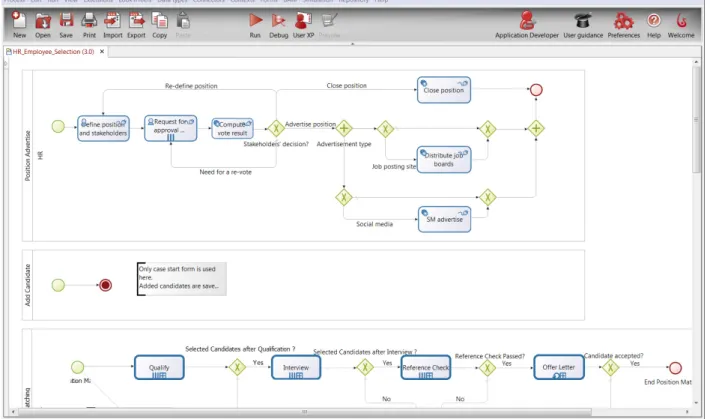
As seen in the hypothetical Recruitment and Selection process case study above, reducing the time from
when a position is opened to the time the new hire begins can produce some measureable cost savings to
the company (as well as improve the day‐to‐day efficiency of the HR organization). An automated BPM
process for Recruitment and Selection will include steps or tasks to:
1. Define the position, including duties and salary. This task can include a connector to existing software
systems with access to key salary data, both external and internal to the organization.
2. Analyze the current employee workforce to assess the skillset of current employees. The information
needed for this analysis resides in the HR organization; the database or system it resides in can be
connected to the process to be implemented with a BPM solution. This makes the data available to
the stakeholders (hiring managers, others) seeking talent for their organization according to pre‐
defined business rules that define authorization for access (for example, to hide personal data).
3. Post a position and advertise it externally on multiple external sources, and search external sources
for resumes, automatically. Standard, widely used recruitment software includes resume review,
cross‐functional access, and distribution; this can be connected to the process. In addition, the media
used for talent‐job searching has changed radically over the last years and it is likely to continue to
frequently to be interactive with new and expanding external sites is critical for keeping up with
effective recruitment.
4. Machine‐scan review AND human review of resumes at the right times in the overall process by HR,
hiring managers, supervisors, and other stakeholders increases the chances that a specific skillset will
be caught by the right review at the right time. A process automated with BPM can route material
for review based on information that is defined in advance, or on a case‐by‐case basis.
5. Good organization and management of candidate interviews makes the overall interview process
more efficient. An automated HR‐driven BPM process can notify interviewers and initiate interview
scheduling on internal calendars. It can also support the mechanism necessary to structure
interviews so candidates can be objectively compared. An automated task in the process can access
the set of structured interview questions prepared and maintained by HR for objective ratings, and
the end user forms presented by the BPM application inside the company intranet can provide a way
to input information and keep these interview records.
6. The selection and hiring of a candidate requires a many levels of approvals at many points in the
process, for defining, opening, and ultimately filing a position ‐ some mandatory, others optional.
Different approval rules may apply, depending on the position profile (for example, the pay grade or
responsibilities). The BPM Selection and Recruitment process can be implemented to enable the
right people to easily validate, reject, provide feedback, and add critical documentation at the right
time during the process.
A good criterion for selecting a BPM suite to automate a process like this one should be that it is possible to
relatively quickly model the process currently used by HR even without deep technical IT knowledge.
Connection of the model to existing HRIS does of course require IT, and building the user interface forms is
a highly collaborative effort. Implementing BPM should not require intensive, long‐term, dedicated IT
support, however.
Figure 3. Example of end user form, as presented in web browser
Once the process has been tested, the data collected to show a reduction in the time required between
processes, with perhaps an ultimate goal of full employee life cycle management to enable an organization
to track, develop, inform, assess, deploy reward and retain its human assets.
Figure 4. Example of HR selection process dashboard report, presented in a web browser
About the authors
Denise Pringle has extensive global Human Resources’ experience encompassing strategic business support,
OD, talent acquisition, and training. Ms. Pringle has led HR organizations in high tech and life science
companies, and has been an adjunct faculty member at San Jose State University. She frequently speaks at
professional organizations and runs her own HR consulting practice. Ms. Pringle received her B.A. from San
Jose State University and completed Babson College’s Strategic Leadership Program for HR Executives.
Denise has worked on several HRIS implementations and shares her perspectives.
Mickey Farrance has extensive experience with process and process improvement in engineering and
aerospace at NASA, Lockheed‐Martin, and General Electric and has been working with BPM at BonitaSoft
since its creation in 2009.