Graduate Degree Program Assessment Progress Report
For Calendar Year: 2010
(Date submitted to college committee:) March 31, 2011 (Date posted on college assessment website:)
By: Drs. Babiceanu and Mohan
Overall Rating:
1. Summary of Assessment Activities in CY 2010
The Systems Engineering Department (SYEN) currently offers two graduate programs: the Graduate Certificate in Systems Engineering (GCSE), started in 2006, and the Master of Science in Systems Engineering (MSSE), started in 2008. The GCSE program consists of 18 credit hours of course work, out of which 12 credit hours are coming from the program’s four core courses. The MSSE program consists of 31 credit hours, out of which 12 credit hours are coming from the same four core courses as in the GCSE program. Besides the increased number of credit hours required for the completion of the MSSE program, another difference comes from the specialization that the MSSE students are expected to get from the program in one of the following five areas: computers, electrical, telecom, mechanical, and systems engineering.
Based on the below rationale, the assessment activities for the two programs are performed at the same time, and in the same manner.
• The two programs are designed to provide the students with systems engineering knowledge beyond what they acquired from the baccalaureate degree.
• The two programs share their four core systems engineering courses, with the students coming from both programs taking their core course requirements at the same time. • GCSE students can enroll directly in the MSSE, with their entire GCSE course credit
being transferred, once they successfully completed the GCSE requirements, and subject to the MSSE program admission requirements.
The assessment activities for the SYEN graduate programs in CY 2010 considered the degree of achievement of the program outcomes through the two core courses, listed below:
• SYEN 7312: Systems Architecture and Design • SYEN 7313: Systems Management and Evaluation
The MSSE program outcomes also include other criteria besides the basic CGSE program outcomes, so the assessment was performed for two specialization courses, as well. Out of the five specialization of the MSSE program, for the CY 2010 assessment, the systems engineering specialization was chosen. In the subsequent years, other specializations will be chosen, such as
computer engineering, electrical engineering, mechanical engineering, or telecommunications engineering.
• SYEN 7315: Complex Engineered Systems
• SYEN 7399: ST: Agent-Based Modeling and Simulation
2. MSSE Program Goals
The MSSE program is designed such that the following objectives are achieved:
• MSSE is intended to provide professionals and engineers advanced knowledge of systems engineering principles and methodologies as well as impart specialization beyond the Bachelors degree in one of the five areas – computers, electrical, mechanical, telecommunications, and systems engineering.
• The graduates of the program are able to effectively design real-world systems, and apply their knowledge to the development, deployment, reliable operation, maintenance, refinement, and retirement of systems within a given set of cost and time constraints. • The graduates should also be able to engage in the pursuit of knowledge, including other
advanced degrees, beyond the master’s level.
2. MSSE Program Objectives
Upon completing the Master’s degree program, the graduates will be able to: 1. Analyze and design engineering systems.
2. Apply systems design principles to develop functional and physical architectures that are environmentally safe and cost effective.
3. Understand the advances, emerging trends and their applicability to the industry in one or more of the disciplines such as systems engineering, computer engineering, electrical engineering, mechanical engineering, or telecommunications engineering.
4. Apply modeling and simulation techniques to advance the knowledge in one or more of the disciplines mentioned in objective 3.
3. Assessment Methodology
The degree of achievement of the MSSE program objectives listed above is evaluated using the methodology depicted in the MSSE Assessment Plan. The achievement of the GCSE program objectives includes only the four systems engineering core courses, thus can be done at the same time with the assessment of the MSSE program objectives.
3.1 Program Outcomes Assessment Methodology Examples: PO 1: Analyze and design engineering systems.
Assessed course: SYEN 7315: Complex Engineered Systems
Assessment methodology: Students achieve the abilities listed of PO 1 (analyze engineering systems, design engineering systems) as a result of their work on the homework assignments, course project and the two exams. Each homework assignment contributes to the achievement of two of the abilities, as presented in Table 1. Both examinations contribute towards the achievement of the two abilities. In addition, depending on the project topic selected by each of the students, the course project contributes, once again, to the achievement of the two abilities.
MSSE Program Outcome Systems Engineering
Core Courses Systems Engineering Specialization Courses Systems Engineering Specialization Course Project 1. Analyze and design
engineering systems
SYEN 7311: Systems Design and Analysis (Fall 2010)
SYEN 7315: Complex Engineered Systems (Summer 2010) 2. Apply systems principles
to develop functional and physical architectures that are environmentally safe and cost effective
SYEN 7312: Systems Architecture and Design
(Spring 2010) 3. Understand the advances,
emerging trends and their applicability to the industry in one or more of the
specializations
SYEN 7313: Systems Management and Evaluation (Fall 2010) 4. Apply modeling and
simulation techniques to advance the knowledge in one or more of the specializations
SYEN 7314: Multi-criteria Decision and Risk Analysis (Spring 2010)
SYEN 7399:
Agent-Based Modeling and Simulation
Table 1: Achievement of the PO 1 abilities through student graded work.
Homework 1: Introduction to Complex Engineered Systems Homework 2: Agent-Based Modeling and Simulation
Homework 3: Fuzzy-Neuro Approach to Agent Applications Homework 4: Evolutionary Computation
Assessment results: using the above methodology and considering quantitative measures for all four abilities listed under PO 2, an overall measure of achievement of PO 2 is derived. The assessment results are presented in Table 2, below, on 100-point and 5.00-point scales.
Table 2: PO 1 assessment results.
PO 2: Apply systems design principles to develop functional and physical architectures that are environmentally safe and cost effective.
Designated course: SYEN 7312: Systems Architecture and Design
Assessment methodology: Students achieve the abilities listed of PO 2 (develop functional architectures, develop physical architectures, concern for the environment, cost effectiveness design) as a result of their work on the homework assignments, course project and the two exams. Each homework assignment contributes to the achievement of at least one of the four abilities, as presented in Table 3. First examination contributes towards the achievement of the first two abilities, while the second examination contributes to the achievement of the last two abilities. In addition, depending on the project topic selected by each of the students, the course project contributes, once again, to the achievement of all the four abilities.
Table 3: Achievement of the PO 2 abilities through student graded work.
Analyze engineering systems Design engineering systems
Homework 3, 4 Homework 1, 2
Exam 1, 2 Exam 1, 2
Course Project Course Project
PO 1 component abilities All graded work 100-point
scale
5.00-point scale
Analyze engineering systems 86.61 4.33
Design engineering systems 89.41 4.47
Overall PO 1 88.01 4.40
Develop functional architectures
Develop physical architectures
Concern for the environment
Cost effectiveness design Homework 1, 2, 3 Homework 1, 2, 3 Homework 4, 5 Homework 6
Exam 1 Exam 1 Exam 2 Exam 2
Homework 1: Systems Architecture Fundamentals Homework 2: Architecture Development Process Homework 3: Graphical Modeling Techniques Homework 4: Design for Reliability
Homework 5: Design for Maintainability Homework 6: Design for Affordability
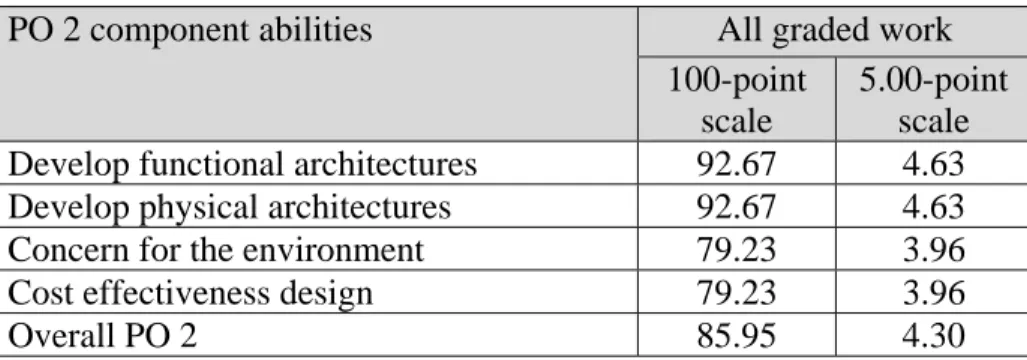
Assessment results: using the above methodology and considering quantitative measures for all four abilities listed under PO 2, an overall measure of achievement of PO 2 is derived. The assessment results are presented in Table 4, below, on 100-point and 5.00-point scales.
Table 4: PO 2 assessment results.
PO 3: Understand the advances, emerging trends and their applicability to the industry in the systems engineering discipline.
Designated course: SYEN 7313: Systems Management and Evaluation
Assessment methodology: Students achieve the abilities listed of PO 3 (understand the advances in systems engineering, understand the emerging trends in systems engineering, applicability to the industry in the systems engineering domain) as a result of their work on the homework assignments, course project and the two exams. Each homework assignment contributes to the achievement of at least one of the three abilities, as presented in Table 5. First examination contributes towards the achievement of the first two abilities, while the second examination contributes to the achievement of the last ability. In addition, depending on the project topic selected by each of the students, the course project contributes, once again, to the achievement of all the three abilities.
Table 5: Achievement of the PO 3 abilities through student graded work. PO 2 component abilities All graded work
100-point scale
5.00-point scale Develop functional architectures 92.67 4.63 Develop physical architectures 92.67 4.63
Concern for the environment 79.23 3.96
Cost effectiveness design 79.23 3.96
Overall PO 2 85.95 4.30
Understand the advances in systems engineering
Understand the emerging trends in systems engineering
Applicability to the industry in the systems engineering
domain
Homework 1, 2 Homework 1, 2 Homework 3, 4, 5, 6
Exam 1 Exam 1 Exam 2
Homework 1: Systems Engineering Management Homework 2: Project Initiation and Selection Homework 3: Planning the Project
Homework 4: Budgeting the Project Homework 5: Scheduling the Project
Homework 6: Allocating Resources to the Project
Assessment results: using the above methodology and considering quantitative measures for all four abilities listed under PO 3, an overall measure of achievement of PO 3 is derived. The assessment results are presented in Table 6, below, on 100-point and 5.00-point scales.
Table 6: PO 3 assessment results.
PO 4: Apply modeling and simulation techniques to advance the knowledge in the systems engineering discipline.
Assessed course: SYEN 7399: Agent-Based Modeling and Simulation
Assessment methodology: Being a project-based course, students achieve the abilities listed under PO 4 (apply modeling techniques to advance the knowledge in the systems engineering discipline, and apply simulation techniques to advance the knowledge in the systems engineering discipline) as a result of their work on their individual course project. The course project contributes to the achievement of both the abilities of PO 4, as presented in Table 7.
Table 7: Achievement of the PO 4 abilities through student graded work.
Assessment results: using the above methodology and considering quantitative measures for all four abilities listed under PO 3, an overall measure of achievement of PO 3 is derived. The assessment results are presented in Table 8, below, on 100-point and 5.00-point scales.
PO 3 component abilities All graded work
100-point scale
5.00-point scale Understand the advances in systems engineering 83.85 4.19 Understand the emerging trends in systems engineering 83.85 4.19 Applicability to the industry in the systems engineering domain 75.15 3.75
Overall PO 3 80.95 4.04
Apply modeling techniques to advance the knowledge in the systems engineering
discipline
Apply simulation techniques to advance the knowledge in the systems engineering
discipline
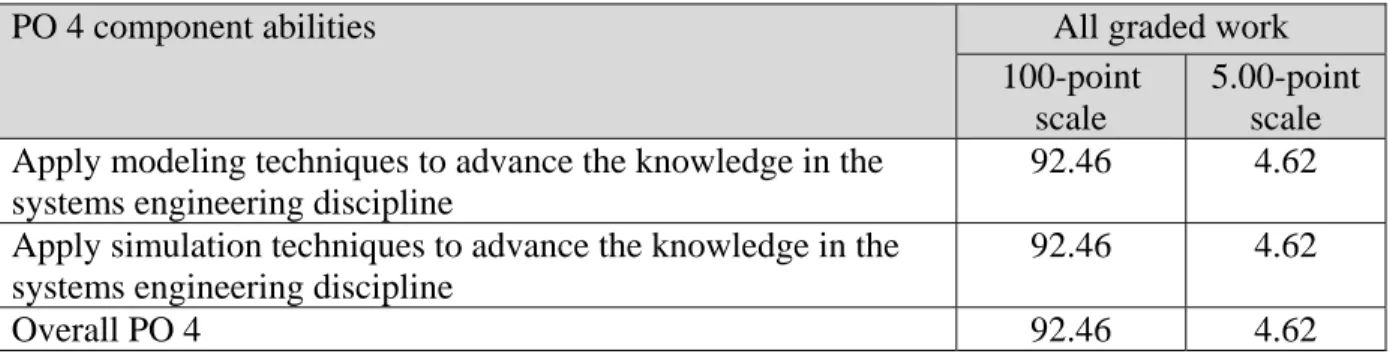
Table 8: PO 4 assessment results.
PO 4 component abilities All graded work
100-point scale
5.00-point scale Apply modeling techniques to advance the knowledge in the
systems engineering discipline
92.46 4.62 Apply simulation techniques to advance the knowledge in the
systems engineering discipline
92.46 4.62