Lessons Learned from
Evaluation
M. J. Spilsbury, C. Perch, S. Norgbey, G. Rauniyar and
C.Battaglino
Special Study Paper Number 2
A Platform for Sharing Knowledge
United Nations Environment Programme
Lessons Learned from Evaluation:
A Platform for Sharing Knowledge
M. J. Spilsbury, C. Perch, S. Norgbey, G. Rauniyar and C.Battaglino
Special Study Paper Number 2
Evaluation and Oversight Unit
United Nations Environment Programme
Nairobi
Contents
Background... 3
Methods - Developing a Framework of Lessons from Evaluation using a
Problem Tree approach ... 4
Discussion ...11
Conclusions ...12
Abstract
Lessons presented in evaluation reports are often of highly variable quality and limited utility. They are “often platitudes borne of a felt need to demonstrate engagement in the ‘knowledge society’ or simply to satisfy the specified evaluation requirements”. Even where high quality lessons are developed, they are seldom communicated effectively to their intended audiences. In order to enhance the quality of lessons, improve their
utilisation, and aid their dissemination and communication, a Framework of Lessons from Evaluation is presented in this paper. Theframework consists of common problems, issues and or constraints to which evaluation lessons relate using ‘Mind- mapping’ software and ‘problem tree’ techniques. Evaluation lessons were systematically classified within the resulting Framework of Lessons.The proposedframework of evaluation lessons is best used within the context of interactive ‘face-to-face’ communication with project / programme managers to ensure that evaluation lessons truly become ‘lessons learned’.
Introduction
The United Nations Environment Programme’s (UNEP) Evaluation and Oversight Unit (EOU) maintains a database of lessons derived from evaluations conducted over the past several years. However, ‘lessons’ presented in evaluation reports are often of highly variable quality and limited utility. They are “often platitudes borne of a felt need to demonstrate engagement in the ‘knowledge society’ or simply to satisfy the specified evaluation requirements”1. In addition, even when high quality lessons are developed, they are seldom communicated effectively to their intended audience. ‘Lessons learned’ should more accurately be regarded as ‘lessons to be learned’. In common with many organisations, lessons derived from evaluations have had limited success as a feedback mechanism for programme/project design and implementation within UNEP.
In order to enhance the quality of lessons, improve their utilisation, and to aid their dissemination and communication to both internal and external audiences, EOU decided to develop a Framework of Lessons from Evaluation.
Background
There is considerable published academic and informal (grey) literature on ‘lessons learned’ and most of these aim to convey knowledge gained through experience, in some specific field of study or action, as means to enhance future performance. Few studies provide a definition of the lessons they present or explore the concept of ‘lessons learned’. Where definitions are provided they tend to focus on the attributes of the ‘lesson’ and say much less about the process by which it may, eventually, be used. In
1
this sense, they are ‘lessons learned from experience’, as opposed to ‘lessons applied’. One definition used by the American, European, and Japanese Space agencies is: “A lesson learned is knowledge or understanding gained by experience. The experience may bepositive, as in a successful test or mission, ornegative, as in a mishap or failure…A lesson mustbe significant in that it has a real or assumedimpact on operations; valid in that is factually andtechnically correct; and applicable in that it identifies a specific design, process, or decision thatreduces or eliminates the potential for failures and mishaps, or reinforces a positive result (Secchi, 1999 in Weber 2001).” Whilst the evaluation community (OECD-DAC) defines lessons learned as “Generalizations based on evaluation experiences with projects, programs, or policies that abstract from the specific circumstances to broader situations. Frequently, lessons highlight strengths or weaknesses in preparation, design, and implementation that affect performance, outcome, and impact.”
The attention paid by evaluators to ‘lessons learned’ has increased over the past decade. Patton (2001) observes that evaluation has moved from merely generating findings about specific programs to generating knowledge:
“Both judgment-oriented and improvement-oriented evaluations involve the instrumental use of results. Instrumental use occurs when a decision or action follows, at least in part, from the evaluation. Conceptual use of findings, on the other hand, contrasts with instrumental use in that no decision or action is expected; rather, it involves the use of evaluations to influence thinking and deepen understanding by increasing knowledge. This knowledge can be as specific as clarifying a program’s model, testing theory, distinguishing types of interventions, figuring out how to measure outcomes, generating lessons learned, and/or elaborating policy options. In other cases, conceptual use is more vague, such that the findings may reduce uncertainty, offer illumination, enlighten funders and staff about what participants really experience, enhance communications, and facilitate sharing of perceptions.”
Instrumental use of evaluation is often associated with evaluation ‘recommendations’. Evidence that confirms use of evaluation recommendations can readily be collated, especially if recommendations identify, as they should, a specific actor, action, a performance target and a means of verification. However, conceptual use of evaluation findings, by its very nature, is often difficult to discern. Lessons may be utilized, but evidence of such use or influence (i.e. ‘learning’) is usually lacking. Most evaluation professionals would probably acknowledge that their lessons are underutilised. Why is this so?
Two broad problems underlie this observation:
1.) Lessons are poorly formulated (low quality); and;
2.) Processes to promote dissemination and uptake of lessons are weak.
Many so-called lessons lack the essential attributes implied by the definitions above. A high quality lesson should; succinctly specify the context from which it is derived, establish its relevance beyond that context (where it will be applied and by whom) and suggest some prescription or action. Although lessons are derived from a specific
situation, they are intended to have wider relevance. However, lessons are often regarded as one-off findings that lack supporting information from other sources. Lessons that are supported by ‘triangulated’ evidence command greater credibility among their potential users; “the more rigorous the supporting evidence, and the greater the triangulation of supporting sources, the more confidence one has in the significance and meaningfulness of a lesson learned” (Patton op. cit). This implies a need for preparation guidelines and ‘quality’ control / review processes to enhance the formulation of lessons.
Clearly, producing high-quality lessons is necessary but not sufficient to maximize their potential utility. Relying on passive dissemination approaches, e.g. by simple
dissemination of evaluation reports, is a common but not very effective method of promoting their uptake. As a result, many lessons are destined to be archived in
underutilised databases or to languish, unheeded, in evaluation reports. Greater emphasis on enhancing the credibility and building the ‘ownership’ of lessons is required. A variety of complementary communication and ‘outreach’ processes are needed to enhance the uptake of lessons by their intended users.
These problems and issues provided the motivation for the recent work on ‘lessons learned’ undertaken by UNEP’s Evaluation and Oversight Unit. In order to enhance the quality of lessons, improve their utilisation, and to aid the dissemination and
communication to both internal and external audiences, EOU decided to develop a
Framework of Lessons from Evaluation.
The articulation of lessons is standard requirement for all UNEP evaluations; however, several studies (e.g. UNEP’s Annual Evaluation Report) have revealed that the lessons of the past have not necessarily been taken into consideration. This implies a certain waste of effort or resources and highlights the difficulties in using evaluations as a means to improve the performance of the organisation. While recognising that the evaluation unit does not have a ‘monopoly on knowledge’ compared to other divisions of the
organisation, it does have the advantage of the ‘bigger picture’ gained through systematic collection of evaluative information across the organisation. The evaluation function has an important role to play as a central knowledge provider and can help inform new thinking with knowledge from past experiences as the organisation evolves. Capturing and using lessons derived from evaluations can provide a range of benefits within a programme or project. Lessons can:
§ Allow other practitioners to learn from previous experience and avoid “re-inventing the wheel”
§ Help stakeholders at different levels understand the relevance of other activities and achievements, thus improving collaboration and co-ordination
§ Inform decision-makers to help avoid common mistakes and help promote a more enabling environment
Lessons in EOU’s database are classified according to common themes e.g. ‘biodiversity and biosafety’, ‘capacity building’ ‘chemicals’ and ‘environmental law’. Currently, lessons from UNEP evaluations are disseminated through rather traditional means; distribution of evaluation reports (which contain lessons) in hard-copy; presentations and workshops; electronic access through EOU’s web-site to evaluation reports and the dedicated ‘lessons learned’ database. It can be argued that the true value-added of our “lessons” is their consideration and integration into programme planning and project development. Specifically, be it at the project, programme, institutional or policy level, the true measure of EOU’s long-term impact will be determined by how knowledge derived from evaluations can bring about positive change.
Methods - Developing a Framework of Lessons from Evaluation using a
Problem Tree approach
The method applied in this study consisted of three main stages. Firstly, evaluation professionals reviewed thecontents of the UNEP EOU lessons database; applying a working definition of ‘what constitutes a lesson’ and eliminating low quality ‘lessons’. Secondly, a framework of common problems, issues and or constraints to which evaluation lessons relate was developed using ‘Mind- mapping’ software and ‘problem tree’ techniques. The remaining evaluation lessons were systematically classified within the resulting Framework of Lessons from Evaluation.
Review of Lessons Learned
Professional evaluators in UNEP EOU embarked on this initiative by developing ‘minimum quality criteria’ for evaluation lessons. These are consistent with the definitions for lessons discussed above. A quality lesson must:
− concisely capture the context from which it is derived
− be applicable in a different context (generic), have a clear ‘application domain’ and identify target users.
− should suggest a prescription and should guide action
Approximately two hundred and sixty lessons from evaluation studies produced between 1999 and 2006 were reviewed against the above criteria. Nearly 50% of all lessons analysed failed to satisfy these criteria. Many so-called lessons were re-classified as evaluative findings or conclusions, because their authors (usually independent evaluation consultants) had frequently failed to articulate clear prescriptions or ‘application
domains’. Lessons that failed these criteria were excluded from the study and deleted from the EOU lessons database. Those that remained were given a unique lesson identification number.
The large number of deletions from the lessons database prompted EOU to more clearly specify the requirements for drafting lessons in our standard evaluation guidelines and to use these same criteria in the quality control and feedback rubric applied to all draft EOU evaluation reports of our project / programme evaluations.
Development of a Framework of Lessons from Evaluation and classification of UNEP’s lessons
The next step in the study was to develop a conceptual framework for classifying lessons from project and programme reviews. A ‘problem tree’ approach to the development of the lessons framework was adopted. At the outset, the process of developing a problem tree starts with a statement about the main problem to be investigated, i.e. the core or central problem. In this case, and since the bulk of UNEP’s lessons are derived from evaluations of UNEP projects or sub-programmes the central problem was defined as:
“UNEP projects and programmes have sub-optimal impact” 2.
This central problem addresses the ultimate purpose of lessons learned as defined by OECD-DAC, and, of course, could be readily applied in the context of UNEP’s mission and mandate. Problem tree analysis proceeds by further identifying the causes of the central problem and establishes a hierarchy of such causes, from those most immediate to the central problem, down to the fundamental causes.
This process was undertaken through group discussion and debate among UNEP’s evaluation professionals. The process of developing the conceptual framework was initiated by a simple card clustering exercise. Approximately thirty lessons, that had previously satisfied the minimum criteria, were divided among the EOU staff who were asked to capture the essence of each lesson, on a single blank postcard, as a simple
2
It is equally possible to develop an ‘objective’ tree in which case the central objective, to which all UNEP’s lessons pertain, could be stated as “UNEP’s projects and programmes achieve maximum impact”.
problem statement. The lessons were summarised as single word or sentence in terms of the main cause of the problem identified in the lesson. These lessons were then organised into related clusters through group discussions that lead to a consensus. The clusters were then structured into hierarchies of causality using a similar process of discussion and debate. After the initial card clustering exercise the group became familiar with the process and dispensed with the cards, preferring to capture the remaining lessons (approximately 100) in the problem tree framework using computer-based ‘Mind-Map’3 software. The framework was further developed, over a period of weeks, using group discussion and debate about the causes and effects of the problems identified in UNEP’s evaluation lessons. Each lesson became the focus of a discussion on causality. As a result, each lesson remaining in the EOU database was incorporated and then referenced in the lessons framework using its unique identification number. Thus the ‘classification’ of lessons within the framework was an integral part of the framework’s development.
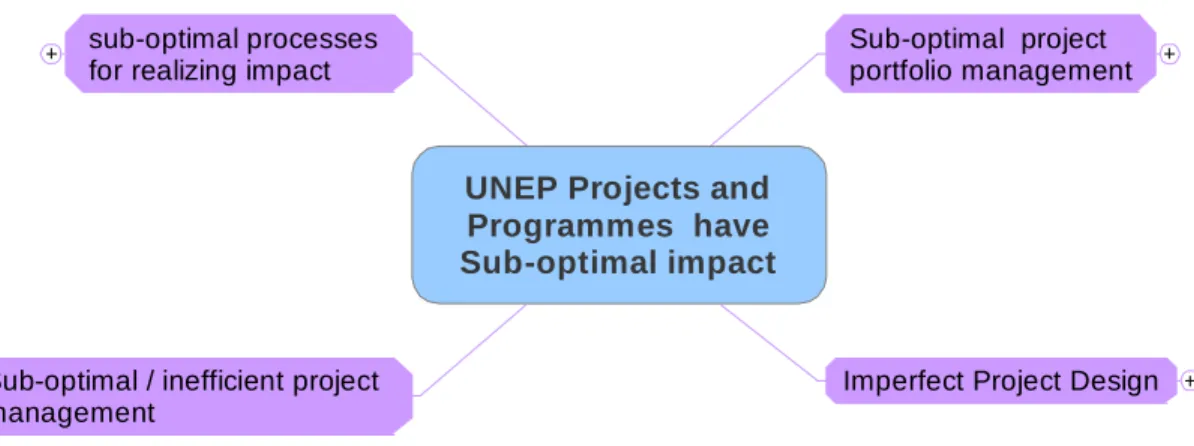
Figure 1. UNEP’s Framework of Lessons Learned showing the central problem and the first level, or ‘cornerstones’, of causal problems.
UNEP Projects and Programmes have Sub-optimal impact
Sub-optimal project portfolio management
Imperfect Project Design Sub-optimal / inefficient project
management
sub-optimal processes for realizing impact
Each ‘cornerstone’ cluster is further subdivided into causal problems (see Figure 2).
3
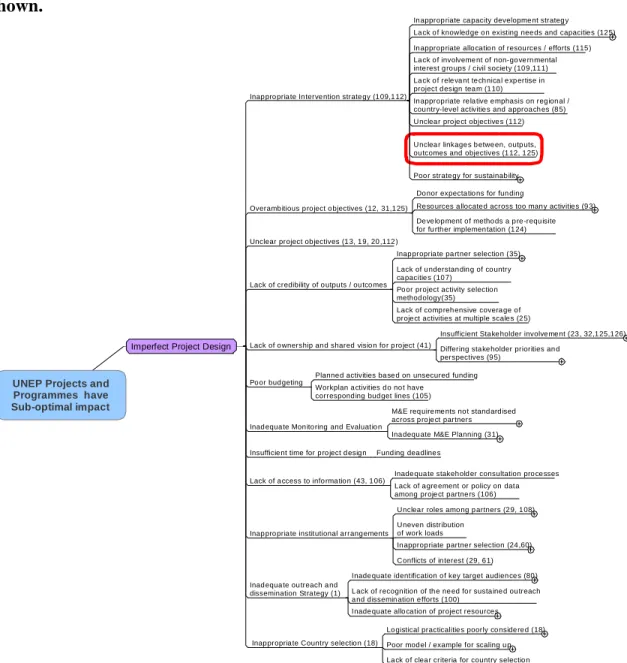
Figure 2. The ‘Imperfect Project Design’ ‘cornerstone’ and two causal levels below, with their lesson identification numbers. More distal levels of the framework are not shown.
UNEP Projects and Programmes have Sub-optimal impact
Imperfect Project Design
Inap pro pria te In terve ntion strate gy (1 09,1 12)
In approp riate ca pacity developme nt strateg y La ck o f knowled ge o n existing nee ds and capacitie s (12 5) In approp riate allo ca tio n of resou rces / efforts (115 ) La ck o f involveme nt of non-go ve rn mental inte rest g ro ups / civil society (10 9,11 1) La ck o f rele va nt te ch nica l e xp ertise in project d esign tea m (1 10)
In approp riate re la tive e mphasis on reg ion al / cou ntry-level activitie s and approa ch es (8 5) Unclea r pro je ct objective s (11 2) Unclea r linkage s b etwe en, outp uts, ou tcomes and objectives (1 12, 1 25) Poo r strate gy for sustainab ility
Overamb itious p ro ject o bjectives (12, 31,1 25)
Do nor expecta tio ns for fun ding
Re so urces a llocate d across too man y activitie s (9 3) De ve lop ment o f metho ds a p re -requ isite for fu rth er implemen tation (1 24) Unclear project ob jectives (1 3, 1 9, 20 ,112 )
Lack of credibility of o utpu ts / ou tco mes
Inap propria te pa rtner selectio n (35) Lack of u nderstan din g of co untry ca pacitie s (10 7)
Po or project activity selectio n method ology(35)
Lack of comp reh ensive covera ge o f proje ct activities at multiple scale s (2 5) Lack of o wnership an d shared visio n fo r p ro ject (41 )
Insufficient Sta ke holder involve me nt (23 , 32,1 25,1 26) Differing sta ke holder priorities an d
perspectives (9 5) Po or bud geting Planne d activities ba se d on unsecured fund ing
Workplan a ctivities d o no t have correspond ing bud get lines (105 )
Inad equa te Mon ito ring and Evaluatio n
M&E req uire me nts no t stand ard ised across p ro je ct partners Ina dequ ate M&E Planning (3 1) Insufficie nt time for p ro ject d esig n Fund ing dea dline s
Lack of a ccess to info rma tio n (43, 1 06) Inade qua te stakeh old er consultation pro ce sses Lack of a gre ement or policy on data among proje ct partne rs (106 )
Inap pro pria te institutional arrang ements
Unclea r roles amo ng p artners (2 9, 1 08) Uneven distribution
of work loads
In approp riate partne r selection (24 ,60) Conflicts of in terest (29, 6 1) Inad equa te ou treach a nd
dissemination Stra tegy (1)
Inade quate identification o f key target audien ce s (80 ) L ack of recogn ition of th e ne ed fo r susta ine d ou treach a nd d issemin ation e fforts (100)
Inade quate allo ca tion of project resource s
Inap propria te Country selectio n (18)
Lo gistical practicalitie s poorly co nside re d (18) Poor mod el / example for scaling u p La ck o f clea r criteria for country selectio n
In the example shown in Figure 2, the problem ‘Inappropriate intervention strategy’ currently has nine causes associated with it. One of these causes is listed as ‘Unclear linkages between outputs, outcomes and objectives’. This cause is associated with Lesson numbers 112 and 125 in the UNEP EOU database of lessons learned. Lesson 112, for example states:
“It is critical that the internal logic of the project be very clearly spelled out in the project document and that the strategic linkages between outcomes and objectives are made very clear. Those implementing or supervising a project are frequently completely different people from those who developed the project. The Project Document needs to be a self-explanatory, stand-alone document.”4
4
Lesson from the Mid-Term Evaluation of the UNEP UNDP GEF Project “Botswana, Kenya and Mali: Management of Indigenous Vegetation for the Rehabilitation of Degraded Lands in Arid Zones of Africa”GF/2740-03-4618
Figure 3. Graphic showing the overall structure of UNEP’s Framework Lessons Learned from Evaluation.
(See middle of brochure)
As more lessons from evaluations are generated, more causes for the problem
‘Inappropriate intervention strategy’ in the ‘project design’ cluster may be identified or new instances of previously identified problems may occur. In the former case, a new ‘branch’ of the problem tree would be created and in the latter case the new lesson would be referenced alongside other lessons by adding the lesson reference number. The framework will be further developed so that there are software ‘hyperlinks’ between the framework and the full lesson text contained with the lessons database.
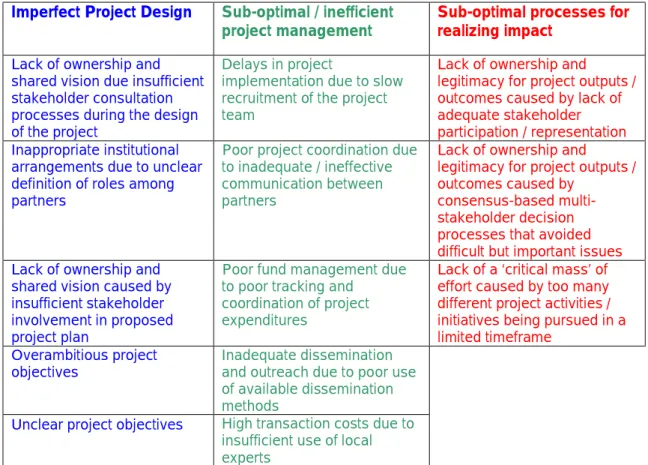
The framework of lessons allows quick identification of issues that frequently feature in lessons across all UNEP evaluations. Such information is usually disaggregated in large databases or in disparate reports. Table 1 highlights issues for which lessons were frequently formulated within three main ‘problem clusters’ in the evaluation lessons framework. This is an important and useful application for the lessons framework.
Table 1 highlights issues, classified in three of the main ‘problem clusters’ of UNEP’s evaluation lessons framework, which were frequently identified in evaluation lessons.
Imperfect Project Design Sub-optimal / inefficient
project management Sub-optimal processes for realizing impact
Lack of ownership and shared vision due insufficient stakeholder consultation processes during the design of the project
Delays in project
implementation due to slow recruitment of the project team
Lack of ownership and legitimacy for project outputs / outcomes caused by lack of adequate stakeholder participation / representation
Inappropriate institutional arrangements due to unclear definition of roles among partners
Poor project coordination due to inadequate / ineffective communication between partners
Lack of ownership and legitimacy for project outputs / outcomes caused by
consensus-based multi-stakeholder decision processes that avoided difficult but important issues
Lack of ownership and shared vision caused by insufficient stakeholder involvement in proposed project plan
Poor fund management due to poor tracking and
coordination of project expenditures
Lack of a ‘critical mass’ of effort caused by too many different project activities / initiatives being pursued in a limited timeframe
Overambitious project
objectives Inadequate dissemination and outreach due to poor use of available dissemination methods
Unclear project objectives High transaction costs due to insufficient use of local experts
Discussion
The framework provides a means to cluster related lessons in a readily understandable, succinct and highly visual format. The format is intended to provide a user-friendly interface to the existing UNEP EOU database of lessons learned and, primarily, to provide a platform for discussing such lessons with their potential users. As new lessons are generated, EOU intends to discuss and categorise them collaboratively with key project staff. This will provide an opportunity to discuss the lesson in terms of underlying problems and encourage such staff to examine and assimilate the knowledge captured in related lessons as they identify solutions that will enhance the overall intended impact of their work. In developing the framework we noted a number of issues:
Some lessons are formulated in a very specific manner whilst others are of a much more general nature. The level of detail or abstraction of a lesson affects its potential
‘application domain’. Weber (op. cit) discusses the level of abstraction of lessons and his observations tally with our own. Whilst generic lessons have, by definition, a potentially broader ‘domain of application’ there is generally less precision in their implied
prescription, thus generic lessons increase the need for adaptation to a specific context. In contrast, more specific lessons generally provide greater detail in terms of context and prescription, they have a narrower ‘domain of potential application’, but require less adaptation to facilitate their application in a similar context.
Some lessons were formulated from a positive perspective. Typically, when something worked well in a project or programme a positive lesson was formulated in order that such positive experience be further replicated. These lessons were more challenging to classify within the problem tree framework because the lesson would first have to be reformulated in terms of a problem. In so doing, a judgement on causality for the ‘derived problem’ had to be made because this was usually neither specified nor implied in the positive lesson. However, despite this limitation, the outcome achieved is that both positive and negative lessons that are related to similar issues will be clustered together within a single framework. ‘Positive’ and ‘negative’ lessons are differentiated in the lessons framework by colour-coding of the unique lesson identification number. We believe that the lessons framework, as a whole, is greater than the sum of its parts because each lesson can be interpreted in the context of the entire collection of lessons. Lessons that relate to a common problem can be readily identified and this adds to the credibility of a lesson by providing experience derived from independent sources (an evaluation of a different project/programme) that often identifies similar prescriptions (a form of triangulation). However, in some cases, we found lessons that related to a similar problem, but with prescriptions that were counter posed. This is also ‘value-added’ as it highlights that for some problems past experience cannot guarantee future performance and suggests that such lessons should be applied with greater caution.
In summary, the framework of lessons learned from evaluation has a number of advantages; it allows:
− Multiple lessons to be clustered around commonly occurring issues (or ‘root causes’), providing ‘triangulation’ for commonly articulated lessons;
− Lessons to be associated with more than one issue or problem - rather than applying a mutually exclusive (taxonomic) classification approach to lessons;
− Patterns across lessons to be observed; and;
− Commonly occurring problems across a project portfolio to be identified. The framework is of a conceptual nature and is the result of group discussion and debate. The framework should not be considered as a definitive statement on causality or regarded as the only ‘correct’ framework for UNEP’s lessons. It is merely one of many possible, but probably quite similar, frameworks. For this reason, EOU regards the categorisation of lessons in the framework per se as much less important than the process of discussion and debate about such categorisation. It is anticipated that the process of classifying lessons within the framework with key intended users will provide an excellent interactive means of promoting their uptake or ‘influence’.
We regard this framework as being complimentary to ‘taxonomic’ classifications of lessons by project or programme theme. Use of the UNEP evaluation lessons database in conjunction with this framework allows trends and patterns in lessons within themes (e.g. ‘biodiversity and biosafety’, ‘capacity building’ ‘chemicals’ and ‘environmental law’) to be further explored.
Conclusions
The exercise of reviewing the lessons in UNEP revealed that our systems were so clogged with lessons that potential users are likely to be overwhelmed with amount of information and / or dissatisfied with its quality. Many existing lessons failed to meet the criteria developed for high quality lessons and were deleted from the EOU evaluation lessons database. This prompted the unit to specify more clearly the requirements for drafting lessons in our standard evaluation guidelines. It also prompted us to incorporate these same criteria in the quality control and feedback rubric applied to all draft EOU evaluation reports of our project / programme evaluations. By applying more stringent quality control on evaluation lessons we have reduced both the volume of information and significantly raised the overall quality and relevance of our lessons.
The framework of lessons learned from evaluation provides a means to visualise all lessons at once, and to see how different clusters of lessons relate to one another. It is intended to be a user-friendly way of presenting and storing information in relation to lessons from evaluation. Its problem-oriented nature is intended to provide a more intuitive and interactive ‘user interface’ to the usual databases of lessons that are commonly collated by evaluation units. We regard the framework of lessons from evaluation as useful ‘platform’ for both collating and disseminating lessons. The
approach has potential for adaptation and application by professional evaluators in a wide range of different organisations.
A common feature of most evaluation feedback is that it tends to be supply driven, with the evaluation unit ‘pumping out’ information on the assumption that someone will use it. Though inevitable to some degree, it is generally acknowledged as a common weakness.
It can be argued that the greatest learning occurs during the course of the evaluation itself through presentations and workshops to debrief and discuss findings. For this reason, greater emphasis should be placed on the provision of early feedback. It is therefore recognised that the framework of evaluation lessons will need to be used within the context of interactive ‘face-to-face’ communication with project / programme managers if evaluation lessons are to truly become ‘lessons learned’.
References
Secchi, P. (Ed.) (1999). Proceedings of Alerts and Lessons Learned: An Effective way to prevent failures and problems (Technical Report WPP-167). Noordwijk, The Netherlands: ESTEC
OECD – DAC (2002) Glossary of Key Terms in Evaluation and Results Based Management. Evaluation and Aid Effectiveness No 6.
http://www.oecd.org/dataoecd/29/21/2754804.pdf
M. Q. Patton (2001) Evaluation, Knowledge Management, Best Practices, and High Quality Lessons Learned American Journal of Evaluation, 22(3), 2001
R. Weber, D. W. Aha and I. Becerra-Fernandez (2001) Intelligent lessons learned systems. Expert Systems with Applications Volume 20, Issue 1, January 2001, Pages 17-34