78
ASPECTS REGARDING THE ROOT SYSTEM AND THE STEM GROWING
AT THE ELBERTA PEACH VARIETY
CIOBANU ANDI
University of Craiova, Faculty of Agronomy
Keywords: variety, rootstock, root, peach
ABSTRACT
As a consequence of the great productions of fruit that can result, of the special qualities and of the very complex chemical composition, the peach cultivation in our country has recently.
The researches were made during the years 2014-2016, within a peach plantation established in the year 2000, within a family garden. The biological material was the Elberta variety grafted on a seed rootstock and the trees were grown as a free palmette.
The Elberta peach variety has a good development both of the overground portion and of the root system, as it is divided on the entire lapse of depth which we have studied 100 cm) at 1 m from the trunk, while the roots are missing in the first lapse of depth (0-10 cm) at 2 m from the trunk.
INTRODUCTION
The seed rootstock peach forms an extensive root system, with thick basic roots, most of them oriented relatively parallel to the soil surface and some of them vertically penetrate great depths. The lateral extension of the roots is more than 1.7-2 times greater than the crown projection and most of them are vertically spread between 20 and 60 cm, few of them reach 3-4 m (Mihăescu Gr., 1977).
In his first years of life, the peach has a quick growth of the air part, forming 1-3 series of anticipated sprigs which thicken the crown, reaching the height of 4-6 m when mature. After producing fruit, the growth intensity decreases since its growths are smaller than the ones of other tree varieties (agromania.manager.ro).
Peach, as the apricot, is among the few tree varieties which can resist in the dry plain area and in the dry steppe area if protected from the nefarious action of the strong winter winds. It is also very productive for the inclined field with unfavourable expositions in the area of hills and hillocks of the vineyards, succeeding even on sands, especially when there is subsequent agricultural technique (Ligia Ion, 2007).
The depth extension of the root system is very varied; 85-95% of the roots are spread on the depth of 25-100 cm, forming the group of roots with a more or less horizontal direction and representing the feeding basis of the trees (Baciu A., 2005).
The root system of the Cardinal peach variety, with a seed rootstock, cultivated on sandy soil at SDE Tâmburești, has got deeply to over 3 m, so that the plantation provided yearly productions of 12-15 t/ha (Popescu M. et al., 1992).
Also, Cichi M., 2003, studied the growth and fructification of 20 varieties of plum on four rootstocks, in the country south.
MATERIALS AND METHODS
The researches were made during the years 2014-2016 within a family garden, found at 50 km from the town of Craiova. The soil is a red preluvosol weakly pseudogleised, with 2.45% hummus content in the surface horizon, and the soil reaction is weakly acid.
79 For this variety, we have been observing:
1. the growth of the air part, respectively: the tree height, the trunk height, the crown diameter, the trunk diameter, the length of the yearly growths, the number of anticipated sprigs. All these measurements were made by means of a tape measure and a slide ruler;
2. the allotment of the root system, both at 1m and at 2m from the trunk. For this, we used the profile method consisting in making a 1m-long and 1m-deep trench at 1m from the trunk. On the trench walls placed at 1m from the trunk, respectively 2m from the trunk, we dug up the appeared roots by means of a knife tip. Depending on their thickness, the roots were divided into 3 categories: roots having a max. 3mm diameter; roots having the diameter between 3-5 mm; roots having the diameter over 5 mm. We introduced the metric frame inside the trench and counted the roots for every depth lapse (for every 10 cm), depending on their thickness category.
RESULTS AND DISCUSSIONS
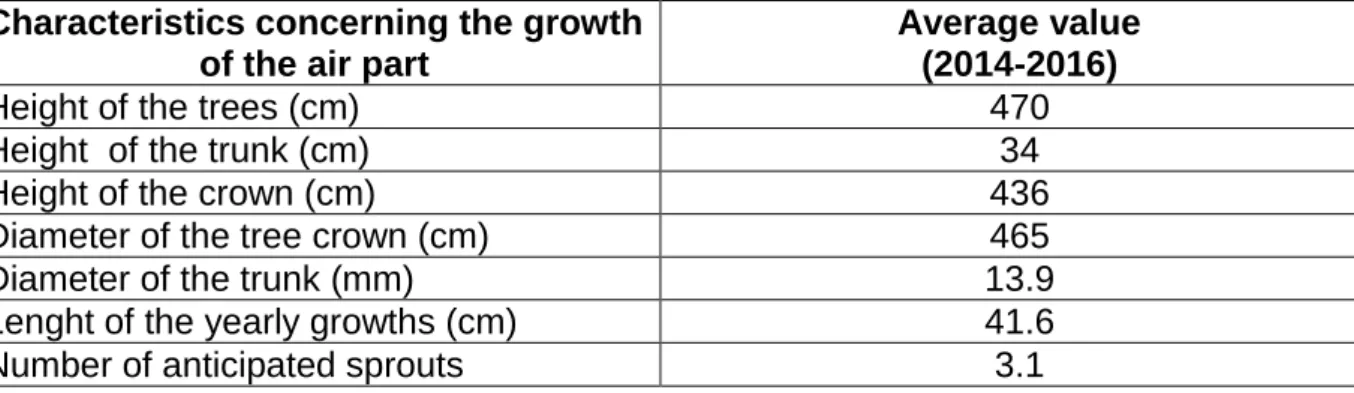
Regarding the growth of the air part, we found out the following (table 1) during our three-year study: the average height of the trees was 470 cm; the average height of the trunk was 436 cm; the average diameter of the crown (as an average value between the diameter of the tree crown between trees on a row and the diameter of the tree crown between the rows) was 465 cm; the average diameter of the trunk (measured at the height of 10 cm from the soil and representing the average value between the trunk diameter on the row direction and the trunk diameter between the rows) was 13.9 mm; the average length of the yearly growths was 41.6 cm and the average number of anticipated sprouts was 3.1.
Table 1
Characteristics concerning the growth of the air part
Average value (2014-2016)
Height of the trees (cm) 470
Height of the trunk (cm) 34
Height of the crown (cm) 436
Diameter of the tree crown (cm) 465
Diameter of the trunk (mm) 13.9
Lenght of the yearly growths (cm) 41.6
Number of anticipated sprouts 3.1
80
Table 2
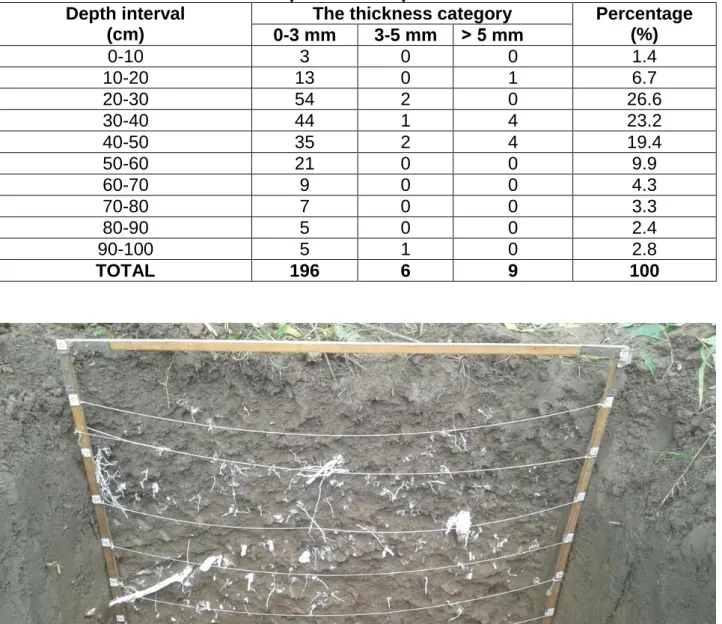
Root allotment on the depth intervals placed at 1m from the trunk Depth interval
(cm)
The thickness category Percentage (%)
0-3 mm 3-5 mm ˃ 5 mm
0-10 3 0 0 1.4
10-20 13 0 1 6.7
20-30 54 2 0 26.6
30-40 44 1 4 23.2
40-50 35 2 4 19.4
50-60 21 0 0 9.9
60-70 9 0 0 4.3
70-80 7 0 0 3.3
80-90 5 0 0 2.4
90-100 5 1 0 2.8
TOTAL 196 6 9 100
Figure 1.Root allotment on the depth intervals placed at 1m from the trunk
Regarding the thickness classification, we found that 196 roots were thick of 0-3 mm, 6 roots were thick of 3-5 mm and 9 roots were thick of over 5 mm.
81
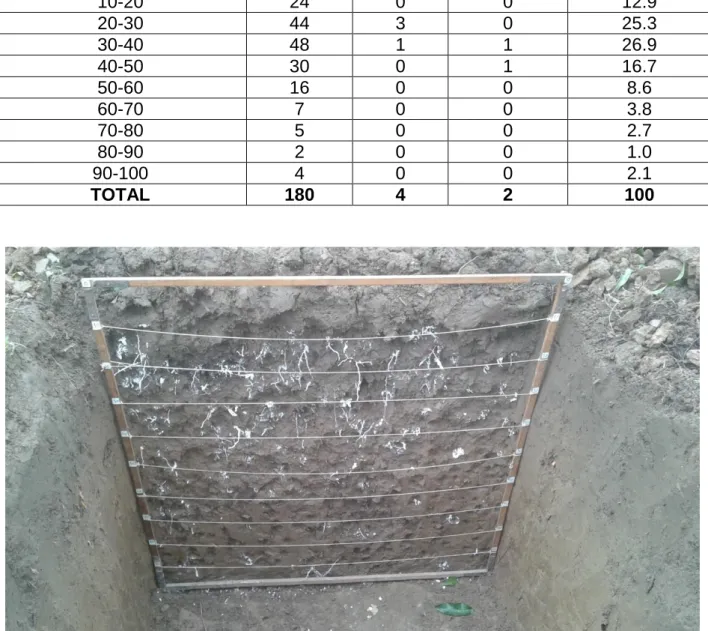
thicker than 5 mm; on the following intervals of depth, we only found roots thick of 0-3 mm, spread as follows: on the 50-60 cm interval – 16 roots; on the 60-70 cm interval – 7 roots; on the 70-80 cm interval– 5 roots; on the 80-90 cm interval – 2 roots and 4 roots on the last studied interval (90-100 cm).
From the total 186 roots that we found, 2/3 of them, respectively 68.9%,.were at a depth of 20-50 cm,
Concerning the thickness, the roots were classified as follows: 180 roots thick of 0-3 mm, 4 roots thick of 3-5 mm and 2 roots thicker than 5 mm.
Concerning the studied depth intervals, at 1m from the trunk most of the roots, that is 26.6% (56 roots), were found on the 20-30 cm interval of depth, and at 2m from the trunk, most of the roots, that is 26.9% (50 roots), were found on the 30-40 cm interval of depth.
Table 3
Root allotment on the depth intervals placed at 2m from the trunk Depth interval
(cm)
The thickness category Percentage (%) 0-3 mm 3-5 mm ˃ 5 mm
0-10 0 0 0 0
10-20 24 0 0 12.9
20-30 44 3 0 25.3
30-40 48 1 1 26.9
40-50 30 0 1 16.7
50-60 16 0 0 8.6
60-70 7 0 0 3.8
70-80 5 0 0 2.7
80-90 2 0 0 1.0
90-100 4 0 0 2.1
TOTAL 180 4 2 100
82
CONCLUSIONS
The Elberta peach variety has a good development of the overground part, that is the three height, the crown diameter, the trunk diameter, the length of the yearly growth, the number of anticipated sprigs.
The root system is well developed and allotted on the entire interval of depth that we studied (0-100 cm) at 1m from the trunk, while at 2m from the trunk there are no roots on the first interval of depth (0-10 cm).
At 1 m from the trunk we found 211 roots and 2/3 of them (69.2%) were found on the 20-50 cm interval of depth.
Concerning the thickness categories, we found 196 roots thick of 0-3 mm, 6 roots thick of 3-5 mm and 9 roots thicker than 5 mm.
At 2m from the trunk, on the 20-50 cm interval of depth, we found 68.9% of the total existent roots (186 roots), and their allotment on thickness criteria was the following: 180 roots thick of 0-3 mm, 4 roots thick of 3-5 mm and 2 roots thicker than 5 mm.
BIBLIOGRAPHY
1. Baciu A., – 2005 – Pomicultură generală. Editura Universitaria, Craiova.
2. Cichi M., – 2003 – Contribuții la îmbunătățirea sortimentului de soiuri și portaltoi de
prun în zona colinară a Olteniei. Teză de doctorat. Universitatea din Craiova.
3. Ligia Ion – 2007 – Pomicultura. Editura Ceres București.
4. Mihăescu Gr., - 1977 – Pomicultură specială. Editura Ceres, București
5. Popescu M. și colab. – 1992 – Pomicultură (generală și specială). Editura Didactică și
Pedagogică R.A., București.