Journal of Global Pharma Technology
www.jgpt.co.in
:
Available Online at
RESEARCH ARTICLE
The Effect of Special Exercises According to the Phosphate Energy
System in Developing the Rapid Ability to the Weapon Arm and
the Accuracy of the Epee Attack for Girls Players
Hussein Manati Sajit1, Haidar Abdulhassan Sajit2, Ahmed Khudair Abbas1, Hassanien
Abdul-Wahid Abbas Shuaila3
1. Republic of Iraq/University of Kerbala/Faculty of Physical Education and Sports Sciences.
2. Republic of Iraq//Ministry of Education / Directorate of Education / Babil Governorate.
3. Republic of Iraq/Al-Qasim Green University/ Department of Students Activities.
Abstract
The current study is of great importance as the aim of the research is to prepare phosphate-strength exercises to develop the rapid ability of the weapon arm and the accuracy of the epee attack for girls' players. Learn about the impact of exercises with phosphate effort to develop the rapid ability of the weapon arm and the accuracy of the epee attack for girls' players. The researchers use the experimental method - the two equal groups a pretest and posttest to the nature of the suitability of the study. Select the research community for girls players in the Alfahtat club in Baghdad to the fencing, totaling (20) player, as it has been selected (16) player and (80%) of the total research community as it has been divided into two groups (Control and experimental) and each group (8) players. In order to achieve the same conditions in the training modules and thus control the search variable, the two groups were trained together as a single group, in all parts of the training unit and under the direct supervision of the researcher, with the exception of the main section of the unit, the players are distributed to their groups, so that the experimental group undergoes these exercises prepared by the researchers, while the control remains on the same exercises given by the coach them. The training program took (6) weeks by (3) training units in the week a total of (18) training units, ranging training unit time (90 minutes), the duration of the proposed exercises by researchers range (30-35) minutes from the main section of the training unit time, in the exercise design, the researchers adopted a repetitive training method (90-95%) of the maximum intensity of the player. The researchers used the maximum exercise time to determine the intensity of the phosphate exercise the researchers conducted some exercises and measured the time of some player's days before the start of the main experiment and verify this during the application of his experience and exercises in the experiment so the intensity of exercise is known to researchers. One of the most important conclusions reached by the researchers is that the phosphate exercise used in research can positively affect the rapid ability of the female players in the fencing, thus positively affect the skill of accuracy of the attack and hence the proposed training exercises have achieved its proposed goals.
Keywords:Special exercises, phosphate energy system, rapid ability and epee.
Introduction
The current era is facing developed significant technology in all areas, including the area of physical education and sports, which clearly shows the level of athletic achievement, especially individual sports activities, where the sport of fencing is considered one of the individual sports, which is the best proof of this progress and this is confirmed by the fixed global levels of the results that we observe days after a day, and this development does not only include branches of sports that can be measured, but
nature when performing skills in terms of short time performance of the skill that is presented to the competitor may be expected to implement and at the same time to note the reaction of the competitor and try to avoid and deception by spyware to the weapon that holds player fencing in the weapon hand, trying his record touches on his opponent and at the same time using it to defend his goal all the piece speed and power requires super to overcome these resistors to perform the skill speed and strength necessary and then achieve the objective of the attack [2].
Fencing, like other sports, requires special physical and physiological abilities for its performance. The physical abilities under the anaerobic energy system play a key role in making the swordsman give maximum short-term ability with no oxygen by relying on anaerobic energy systems. The player can apply the plans and skills without the accuracy of the attack and tempting because it is very important capabilities for the purpose of access to the launch of the inaccuracy may not be useful because the weapon may not achieve the goal assigned to the accuracy of the most important elements in the sport of fencing so the trainers must portability fencing seen in general from this point to reach the desired level [3].
That training in the sport of fencing is an organized process related to other sciences such as physiology, nutrition and many other sciences aimed at developing fencing to achieve the best results and reach them to the high level. The researchers noted that they are interested in the field of fencing, and that there is weakness in the rapid ability of the weapon arm. This, in turn, is reflected in the accuracy of the performance of the attack, despite the fact that it is an important physical ability in the fencing.
It was noted that the exercises in the daily units did not take space from exercises with phosphate required in the curricula of trainers, despite their practical importance and adoption only on the training of stabs and the like, and this in turn reflected on the performance of the player in the competition or even in his daily exercises [4]. The researchers believed in using scientific research to solve this problem as the best way for them. The researchers saw the use of phosphate-specific exercises as an attempt to clarify whether there is an impact on using
these exercises to develop and improve the speed of weapon arms and accuracy of the attack. The sport of fencing depends on the offensive performance primarily as it is a real impact on the opponent's happening and gives the freedom to control the game was proceeding forward and subject them under his control and governed so that the attack with a positive effect leads to open gaps in the goal of the opponent and play as he wants striker. From this point of view, the importance of the present study is in the development of the rapid ability of the weapon arm and the accuracy of the epee attack for girls' players.
Research Objectives
Preparation of phosphate-strength exercises to develop the rapid ability of the weapon arm and the accuracy of the epee attack for girls' players.
To identify the effect of phosphate-strength exercises to develop the rapid ability of the weapon arm and the accuracy of the epee attack for girls' players.
Research Hypothesis
There is a positive effect of the exercises proposed in the rapid ability of the weapon arm and the accuracy of the epee attack for girls' players.
Research Methodology and Field
Procedures
Research Methodology
The researchers use the experimental method - the two equal groups a pretest and posttest to the nature of the suitability of the study.
Community and Sample Research
Select the research community girls players Alfahtat club in Baghdad, fencing, totaling (20) player from girls, as it has been selected (16) players and (80%) of the total research community as it has been divided into two groups (Control and experimental) and each group (8) players from girls.
Devices and Tools used in the Research The researchers used many devices and tools that helped them in their research, including: Metal measuring tape.
Portable computer type.
Weapon of the duel of Shish number (8). Colorful adhesive tape.
Whistle.
Stop hours number (2). The number of (8).
The Procedures of Field Research The Tests of used in Research
The Test of Rapid Ability to the Weapon
Arm [5]
Test Name
Test rapid ability to the weapon arm in a fencing in 10 seconds.
Purpose of the Test
Measuring the rapid ability to the weapon arm in the fencing.
Tools
Epee legal.
Barrier (ability 20 cm diameter). Electronic stopwatch.
Test Description
The laboratory stands in the standby mode at a suitable distance from the barrier so that it can touch the target (the circle drawn on the wall barrier) and by the elbow joint limit of the weapon arm only, taking into account the change of height of the barrier along the laboratory, The laboratory is in standby mode as well as the referee placing the palm of his hand behind the elbow of the laboratory arm, not to be adjacent to the waist of the player, in confirmation of bending the weapon arm after touching the target correctly for the purpose of repeated attempts.
Recording
The number of attempts to properly touch the barrier is calculated as a touch or failed attempt if it is outside the circle, and is also considered a failure if the referee does not contact the referee.
Measure the Velocity and Accuracy of
the 10 Seconds of Attack [6]
Objective of the Test
Measure the speed and accuracy of the performance of the attack.
Tools
Velocity and accuracy of the performance of the attack
A wall on which a device is installed. Rough floor.
Cut chalk.
Temporary watch. Performance Method
The laboratory stands the distance of the challenge between the evidence and the device and then returns to the position of motivation and then draw a line with the grind in front of the front comb and be the corner of the starting line that stands behind the player
The laboratory stands behind the starting line and is taken to position the stimulus and is aligned with the blade in the sixth position where the front instep touches the starting line
where the laboratory at the hearing of the start signal is doing a tempting attack by passing the fly sword from the bottom of the blade in the upper lines in a semi-circular movement and then follows the weapon arm with the challenge with a touch in the target and then repeat the attack several times during the specified dream
The arbitrator (1) calculates the number of times the lamp is lit and the function on the accuracy of the touches within the boundaries of the touch box.
The arbitrator (2) calculates the number of times the skill performance as a whole and the function on the speed of performance. The Conditions
Each duel gives an experimental attempt to adjust the distance.
The swordsman must perform the skill of the individual arm fully.
Prove the distance and immobility of the swordsman during performance.
Register
Record the number of times the lamp is lit between the start and stop indicators. Record the total skill count as between
The number of times the lamp is lighted is multiplied by the number of times the performance is performed and multiplied by 10.
Through the following equation: number of times the lamp light + the number of times of performance × 10.
Pilot Study
The researchers conducted the pilot study on a sample of (4) players from the research community on 5/10/2017. And through which has been achieved several purposes, including:
Clear the test instructions and understand the contexts applied by the players.
The appropriate duration of the test. The adequacy of the assistant team. Scientific Transactions for Testing Validity Test
Validity is that the test or the scale measures what prepared to measure) () researchers in the extraction of sincerity tests in his study on the virtual honesty adopted, where researchers only display candidate tests on a group of experts and specialists, experts have agreed on the sincerity of the tests in
achieving the purpose for which it developed Therefore, the researcher proved the truth of his test.
Stability Test
The test is intended to give the same results if applied to the same sample in two different periods and in similar circumstances. The researchers used the retest method to find the stability coefficient of the test by applying the tests to (4) players from girls and then reapplying them after a period of three days On 8/10/2017, and in the same circumstances and results, the researchers found the stability coefficients of the tests and their statistical evidence, as shown in Table (1). Objectivity Testing
Objectivity means "stability of the results of the self-rule of the subject. If more than one arbitrator gave the grade for the same test, the results of the evaluation must be". [8] Therefore, the tests were carried out on the survey sample and the results were reported by the arbitrators in order to give a real evaluation of the sample tests the results of these tests were very high indicating that these tests have high objectivity as shown in Table (1).
Table 1: Shows the stability and objectivity of the tests used in the research
Tests Stability coefficient Objective coefficient
Test of rapid ability to the weapon arm 0.89 0.88
Test of attack accuracy 0.873 0.887
Main Procedures
After the completion of the pilot study, and obtaining the results, and it became clear that the physical and professional tests have a high degree of stability and objectivity, as well as honesty, the researchers began the main procedures on (20/10/2017).
Pretests
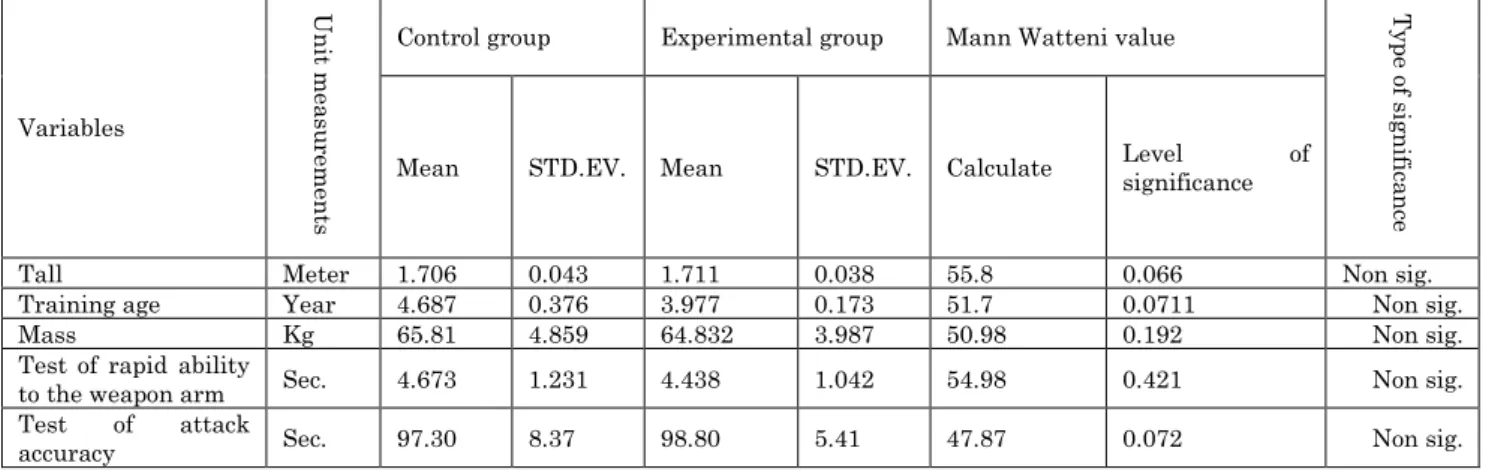
In order to reduce the differences between the two groups in the pretest test, thus making the starting point one, the researchers sought to find equivalence between the two groups in the tests applied to the players in the exploratory experiment, through the Mann Watteni test, for independent samples, Table (2).
Table 2: Shows the equivalence between the research sample
Variables
U
nit
m
ea
su
re
m
ents
Control group Experimental group Mann Watteni value
T
yp
e o
f signif
ica
nc
e
Mean STD.EV. Mean STD.EV. Calculate Level significance of
Tall Meter 1.706 0.043 1.711 0.038 55.8 0.066 Non sig.
Training age Year 4.687 0.376 3.977 0.173 51.7 0.0711 Non sig.
Mass Kg 65.81 4.859 64.832 3.987 50.98 0.192 Non sig.
Test of rapid ability
to the weapon arm Sec. 4.673 1.231 4.438 1.042 54.98 0.421 Non sig.
Test of attack
Exercise Prepared by the Researchers The duration of the training program was (6) weeks, with (3) training units per week with a total of (18) training units, and the duration of the training unit (90) minutes, the duration of the exercises suggested by the researchers (30-35) (90-95%) of the maximum intensity of the additive (1).
The researchers used the maximum exercise time to determine the intensity of the phosphate training. The researchers performed some exercise and measured the time for some of the exercises. Players days before the main experiment began and check it out during application his experience and
exercises in the experiment so was the intensity of exercise known to the researchers.
Posttest
After completion of the training modules for the research groups, the posttest was conducted on 21/11/2017 under the same conditions as the pre-test, where the results were proven and treated statistically.
Results
View and Analyze the Results of the
Pretest and Posttests of the
Experimental Group
Table 3: Shows the median and the spring deviations and the value of the Wilcoxon, and the statistical significance of the variables investigated for the experimental group
Variables
Pretest Posttest Wilcoxon Type of
significant
Median STD.EV. Median STD.EV. Calculate Significant
Test of rapid ability to the weapon
arm
4.438 1.042 6.875 1.984 1.786 0.000 Sig.
Test of attack
accuracy 98.80 5.41 122.987 6.983 1.042 0.000 Sig.
Table (3) shows the results of the tribal and remote tests to test the rapid strength of the weapon arm, with a mean value of 4.438, a spring deviation (1.042) in the tribal test, and the same tests in the posttest, respectively (6.875), (1.98) In addition, it obtained a median value of (122.987) and a spring deviation (1.042). This means that there are differences in the values of the two indices and for the purpose of knowing the truth
these differences were used by the nonlinear statistic (Wilcoxon) and the results showed that the value of Wilcoxon less than (3), the size of sample (8) and the significance level (0.05). This means that there are significant differences between the tests and for the posttest.
View and Analyze the Results of the Pretest and Posttests of the Control Group
Table 4: Shows the median and the spring deviations and the value of the Wilcoxon, the statistical significance of the variables investigated for the control group
Variables
Pretest Posttest Wilcoxon Type of
significant
Median STD.EV. Median STD.EV. Calculate Significant
Test of rapid ability to the weapon arm
4.673 1.231 5.999 1.872 2.232 0.021 Sig.
Test of
attack
accuracy 97.30 8.37
111.543 9.721 1.982 0.011 Sig.
Table (4) shows the results of the tribal and remote tests to test the rapid ability of the weapon arm of the control group. The mediator was (4.673) and by a spring deviation (1,231) in the tribal test, while the mediator reached 5.999 and the spring deviation for the post test (1,872) there were differences in the values of the two measures.
the post. The table also shows the value of the mediator for the test of the accuracy of the attack, as it reached the tribal measurement (97.30) and the spring deviation (8.37), while the median in the dimension measurement (111.543) and the spring deviation (9.721), which means that there are differences in the values of the standards, The results showed that the
calculated value of (1.982) was less than the numerical value of (3), the size of sample (8) and the significance level (0.05), which means that there are significant differences between the tests and the post.
View and Analyze the Differences between the Results of the Posttests of the Control and Experimental Groups
Table 5: Shows the values mean of the experimental and control groups (Mann Whitney), calculated and tabulated in posttests
Variables
Experimental group Control group Mann Whitney Type of
significant
Median STD.EV. Median STD.EV. Calculate Significant
Test of rapid ability to the
weapon arm 6.875 5.999 23.212 0.000 6.875 5.999 Sig.
Test of
attack
accuracy 122.987 111.543 44.042 0.000 122.987 111.543 Sig.
Table (5) shows the value of the medium to test the throwing of the ball. The median of the experimental measurement was (6.875) and the median of the control group was (5.999). This means that there are differences in the two values. 23.212), which is less than the scale value of (48) and the size of sample (16) and the level of significance (0.05). This means that there are significant differences between the tests and for the benefit of the experimental group.
Table (5) shows the value of the medium to test the accuracy of the challenge. The median of the experimental group reached (122.987) while the median reached the remote measurement of the control group (111.543). This means that there are differences in the two values. (44.042), which is less than the scale value of (48) and the size of sample (16) and the level of significance (0.05) which means that there are significant differences between the tests and for the benefit of the experimental group.
Discussion
Discuss the Results of Pretest and Posttests to the Research Variables
The results of the tables (3, 4 and 5) showed that there was an improvement in the experimental results (the rapid ability of the weapon arm and testing the accuracy of the attack) for the control and experimental groups in the telemetry. Before the coach), has positively influenced the search variables for dueling players.
These exercises have played a major role in improving the level of players in the skill
(accuracy of the attacking attack) by developing the element (the rapid ability of the weapon arm), which means that "skill traits can be developed through other physical properties"[9]. Abbas Abdel-Fattah [10]. Emphasizes that (a) developing the player to high levels requires a balanced preparation of all aspects of skill, physical and psychological and using the best methods to guide training in order to obtain high levels. As a result, many phenomena and problems have been solved.
To raise the level of sports, but there are many problems that require solutions based on scientific grounds in order to achieve a better level in various sporting events, including the sport of fencing as distinguished from the other games with muscular effort variable sensory to expose the player in the survival to the positions of jousting Which requires multiple responses and high accuracy in the performance of motor and coordination of the movements of the upper and lower limbs, and must have the swordsman the ability of the speed of the arm weapon to be able to perform the skills of motor better to reach optimal performance and get a point.
fencing, and often winning the game depends on the proportion of injury target of the skill. This movement often leads to a blockage of the defender, so the player needs to overcome this handicap to perform the movement successfully, and this is achieved through rapid progress and with the extension of the arm at the same time and speed of the opponent, this will allow the player to get rid of hindering the opponent.
Talha Hossam Alddin,[11] states that training near the maximum limit (i.e., aerobic exercise) reduces the depletion of calcification in the muscles, as well as reduces the accumulation of lactic acid in trained athletes compared to the unqualified, On the oxidation of free fatty acids as fuel in addition to the increase in the number and size of mitochondria, so trying to maintain this acid stock and rationing benefit in addition to reducing the accumulation of lactic acid are one of the most important factors aimed at anaerobic exercises to develop the tolerance of speed and for long periods. Accordingly, the exercises in question, has been directed towards the
strengthening of the muscles of the arms to improve the (rapid) ability, which was reflected in the development of the attack accuracy of marauding players fencing.
Conclusions
Within the scope of the research sample and the methodology used, and in light of the statistical treatments and the interpretation of their results, the researchers concluded the following:
The skill characteristics can be developed through other physical properties.
Phosphate exercises used in research can positively affect the rapid ability of the dueling players and thus positively affect the skill of accuracy of the attack. Hence, the proposed training exercises have achieved their proposed objectives.
It is possible to rely on the proposed training exercises (phosphates) in this study in the development of the rapid ability of the weapon arm and the skill of the fencing attack.
References
1. Harmenberg, Johan Epee (2007) 2.0: The Birth of the New Fencing Paradigm. Staten Island: SKA Swordplay Books,.
2. Hoffman J (2002) Physiological aspects of sport training and performance. Champaign, IL: Human Kinetics.
3. Roi GS, Bianchedi D (2008) The science of fencing: implications for performance and injury prevention. Sports Medicine, 38(6): 465-81.
4. McArdle WD, Katch FI, Katch V (2001) Exercise Physiology; Energy, Nutrition and Human Performance (5th edition). Baltimore: Lippincott, Williams and Wilkins, 1106.
5. Abdulkarim Fadel Abbas (2000) Effect of training with different weight weapons in the level of performance of some skills of fencing and fitness elements, (PhD thesis, University of Baghdad, Faculty of Education, 31-32. 6. Statement of Abdul Ali (and others) (2009) the
foundations of the sport of fencing, Baghdad, Dar Al-Arqam for printing, 49.
7. Audah Ahmed (1999) Measuring and evaluation in the teaching process, Edition1, Jordan, Dar Al Amal for publication and distribution, 330.
8. Zakaria Mohammed Al-Zaher (1991) Principles of Measurement and Evaluation in Education, Amman Dar Al-Thaqafa Library, 21.
9. Saad Mohsen (1996) The Effect of Training Methods to Develop the Explosive Potential of Men and Feet in the Precision of Remote Scoring by High Jumping in Handball, PhD Thesis, College of Physical Education, University of Baghdad, 162.
10. Abbas Abdel Fattah Ramli (1993) Fencing, Fencing, Cairo, Dar al-Fikr al-Arabi., 274. 11. Talha Hossam Alddin (1994) The
Appendix 1: Exercises prepared by the researchers and the user in the research
N Exercises
1. From laying the foundation when the whistler is heard, the player performs the appeal for 15 seconds and returns back to laying the foundation.
2. From the standby position and without the weapon to do the movement of appeal when the whistle be heard by the
coach. Exercise is repeated for 15 seconds.
3. From the standby mode progress three steps and return three steps also when you hear the whistle from the trainer and return for 15 seconds.
4. Stand in front of the checkpoint and perform the protest movement at the checkpoint 3 stabs and return to the original situation of "readiness". For 20 seconds.
5. Stand in the standby mode and when you hear the deal or click on the ground the player to challenge the colleague direct attack straight and the colleague removes the weapon and carry out a raider attack, for 20 seconds.
6. From the front-end position, perform 5 presses and then return to the position for 25 seconds.