Implementation of Health Care Monitoring System using low power
MCU’s
and ARM CORTEX A8
R.V.V. Krishna, R. Gnana Vargin Associate Professor, P.G Student
Department of Electronics and Communication Engineering Sri Sai Aditya Institute of Science and Technology
Abstract – The present common goal in the medical information technology is the design and implementation of telemedicine solutions, which provides a reliable and quality of services to patients. With the advent of recent development in sensors, low-power integrated circuits (IC’s), and wireless communications have brought the design of miniature, low-cost, and intelligent body sensor modules. These modules are capable of measuring, processing, communicating one or more physiological parameters, and can be integrated into a wireless personal area network. In this paper, we proposed a wireless body sensor module, based on low power microcontrollers and RF devices that perform the measurements and transmit the different bio sensors data to a Local Sensor Network server. Local Sensor Network (LSN) server will run a signal monitor application which receives the information from wireless sensor module and draw the signal graph on the display according to received data and further updated to central health care surveillance centre. The LSN server should be able to connect all the nearby sensor modules through wireless media and update its data periodically. Any sudden urge found in the signal will alarm the corresponding doctor. In order to handle such more number of sensor module connections, the Local sensor network server should be implemented with high performance processor. In this paper, the ARM Cortex A8 processor is one of the best choices to meet all the requirements of the LSN server.
I. Introduction
Now a days, the people in the world suffering with a lot of emotional stress[1]. The reasons are many, but these emotional stresses along with changes of life style result in chronic cardiovascular (CV) diseases and became the major adult illnesses. Therefore the evolution of degenerative diseases resulted in the medical cost increased rapidly. Mostly investigation has concentrated on the
monitored. With the advent of Telemedicine
Information systems, we experience a better
healthcare monitoring[4] and also save the medicine cost. The Body Sensor Network
(BSN)[3] technology makes the healthcare systems portable and allows the bio-signals to be monitored from remote location. A Bio-Information Node (BIN) can collect the bio-signals (like ECG, EEG, Blood, and Pressure) from the patient and submit the data to the healthcare center through the local sensor network. The Body sensor network (BSN) technology makes the healthcare systems portable, long term and allows the bio-signals to be monitored from remote location. A bio-information node (BIN) can collect the bio-signals (like ECG, EEG, Blood, and Pressure) from the patients and submit the data to the healthcare center through the local sensor network.
Fig. 1. Different aspects of the human body for monitoring
consumes as low as 1uA in a standby mode; it also has very fast wake up time of no more than 6us.
The IEEE 802.15.4 specification for low-rate wireless personal area networks has been a hailed choice for industrial, commercial, and home automation sensor network because of its
high density of nodes and simple protocol[7]. The ZigBee standard has been adopted for low-power consumption and low-cost effectiveness with standard-based wireless solution; the standard is operated at three industrial, science, and medical (ISM) bands, namely, the 868 MHz
and 915MHz
Fig.1. 1. Intelligent health care system
bands for Europe and the U.S., respectively, and the 2.4 GHz band for worldwide interchangeable. In the current paper, the wireless[8] solution is implemented by using the ready made zigbee module CC2500.
In the proposed system we present a wireless sensor module (or BIN) which is able to interface different sensors to it. The MSP430G2553 microcontroller acts as a central core for the wireless sensor module. The core internally contains the inbuilt analog to digital converter, using these converters the analog signal from different sensors will be sampled with proper nyquist rate, So that aliasing affect can be reduced in the signal. Further these sampled digital signal is passed through a digital filter (moving average, IIR or FIR) to filter out unwanted content in the digital signal. After applying the digital filter, the samples of the signal will passed through local sensor network[9] server via zigbee using serial communication with a standard baud rate 9600bps. The received digital sampled signal of a wireless sensor module is plotted on a GUI tool on the PC using MATLAB simulator tool. And further these samples are transferred to local sensor network server. The local sensor network
server should be capable to receive sensor information from different patients. Therefore it should handle and process large amount of data. And further it is used to connect large networks. To handle such complex data handling from different sensor and network connections the local sensor network server should be able to implement with high speed processor. Therefore, the local sensor network server was implemented with the use of high performance ARM + cortex A8 processor. On the beagle bone development board along this ARM processor, all other supporting interfacing mechanisms are readily made available. The Android operating system was ported on the beagle bone board, where as android application is designed to display the sensor information coming from the wireless sensor modules.
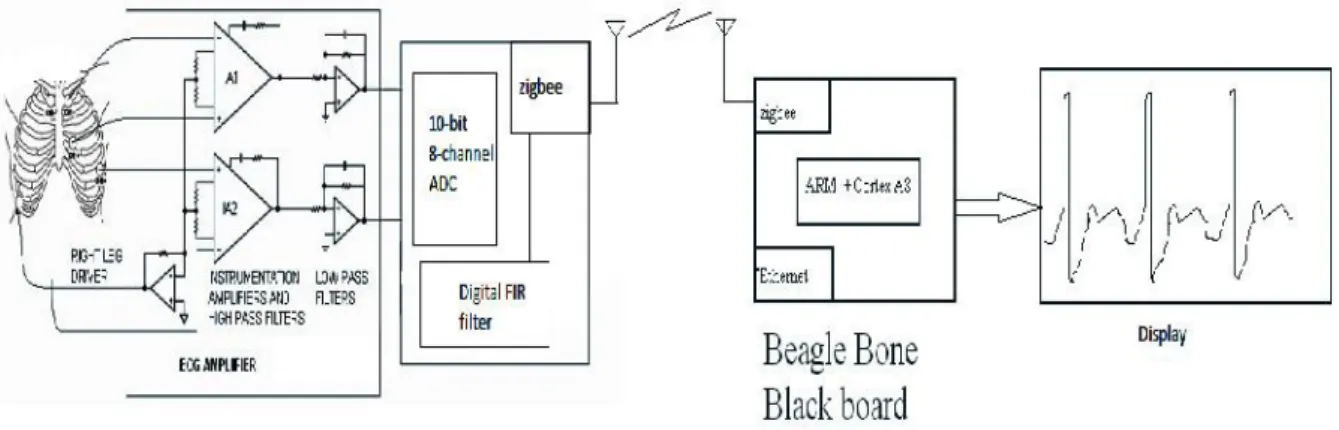
Fig 1.2. block diagram of wireless bio-signal acquisition system
II. Implementation of intelligent personal health care system
The entire system is divided into two parts: 1) wireless sensor module as transmitter. 2) ARM + Cortex A8 processor as local sensor network server. The block diagram of the system is shown in fig 1.2 The wireless sensor module is capable of acquiring the bio-signal, sampled, filtered and transmitted via wireless media. And the local sensor network server receives [1] the data from wireless transmitters and plotted on to the display device.
Fig.2.1. beagle bone black
2.1 Local sensor network server: Local sensor network server hardware was implemented with an embedded ARM platform, using ARM+Cortex A8 (AM335x 1GHz) from Texas instruments as the center core which is built upon the Linux operating
follows: 512MB DDR3 RAM, 4GB 8-bit eMMC on-board flash storage, 3D graphics accelerator, NEON floating-point accelerator, 2xPRU 32-bit microcontrollers, USB, Ethernet, HDMI ports also come with ad-on. In addition, ARM supports many kinds of Network protocols, such as TCP, UDP and other protocols for firmware upgrade. The software compatibility of this board is as follows: It can support Android, Debian, Ubuntu, etc.,
2.2 ECG acquisition node: ECG [10,11]signal acquired from the electrodes and it is amplified using amplifier, which gain of 1000, low input bias current, very low offset and filter with cut off frequency 150Hz. This block has ECG amplifier AC front end circuit. Some of the noise can be cancelled with a high-input-impedance instrumentation amplifier[12] (INA), like the INA333, which removes the AC line noise[13] common to both inputs and amplifies the remaining unequal signals present on the inputs. The wireless sensor module consists of a 16 bit MSP430G2553 micro controller and a zigbee module[14] along with this instrumentation amplifier. The internal inbuilt eight channels 10-bit ADC is used to sample the ECG sensor analog signal filtered and transmits to local sensor network server.
interfaced to the beagle bone board and MSP430G2553 devices. This device by default comes with 9600 baud rate and works on 2.4GHz ISM band[15]. It can cover up to 20 meters and runs with 5v power supply.
III. Implementation results:
In this paper a wireless sensor module was implemented using low power microcontroller MSP430G2553 and wireless zigbee module as shown in the fig.3. An instrumentation amplifier is an analog front end used to amplify the pulse sensor signal which is useful in health monitoring[16].
Fig.3.wireless sensor module
The digital sampled signal of a wireless sensor module[17] is plotted on a GUI tool on the PC using MATLAB simulator tool as shown in fig 3.1. This tool will receive the samples of a ECG signal[18,19] through wireless serial port. A signal is formed based on the received samples with a baud rate 9600 bps.
Fig.3.1.GUI tool in MATLAB simulator
Local Sensor Network Server was implemented using beagle bone black development board which consists of ARM + CORTEX A8 processor as
shown in fig 3.2. And it is interfaced with zigbee wireless receiver to receive the serial data from wireless sensor module through wireless medium.
Fig.3.2.LSN server implementation
An android application[20,21,22] as shown in fig.3.3. was designed to monitor the heart beat and temperature. This android application will run under beagle bone board as LSN server. This application periodically updates the heart beat and temperature from different wireless sensor modules[23,24].
Fig.3.3. Android health monitoring app
IV.Conclusion:
V. REFERENCES:
[1] Gullette, E., et al., ”Effects of mental stress on
myocardial ischemia during daily life”, American Medical Association, no. 277, pp.1521-1526, 1997 [2] T. Tamura, I. Mizukura, M. Sekine and Y. Kimura
“Monitoring andEvaluation of Blood Pressure Changes With a Home Healthcare System,” IEEE Trans. Inf. Technol. Biomed., vol. 15, no. 4, pp. 602–607, Jul. 2011.
[3] B. S. Lin, N. K. Chou, F. C. Chong and S. J. Chen,
“A real-time wireless physiological monitoring system,”
IEEE Trans Inf. Technol. Biomed., vol. 10, no. 4, pp. 647–656, Oct., 2006.
[4] L. Qiao and P. Koutsakis, “Adaptive Bandwidth
Reservation and Scheduling for Efficient Wireless
Telemedicine Traffic Transmission,”IEEE Transactions on Vehicular Technology, vol. 60, no.2, pp. 632-643, February, 2011.
[5] E. Jovanov, D. Raskovic, J. Price, A.Moore, J. Chapman and A. Krishnamurthy, ” Patient Monitoring
Using Personal Area Networks of Wireless Intelligent
Sensors”,Biomedical Sciences Instrumentation, vol. 37, no. 12, pp. 373-378, Dec. 2001.
[6] S. Y. Lee, L. H. Wang, and Q. Fang, “A low power
RFID integrated circuits for intelligent healthcare
systems,” IEEE Trans. Inf. Technol. Biomed., vol. 14, no. 6, pp. 1387-1396, Nov. 2010.
[7] IEEE Standard Part 15.4: Wireless Medium Access Control (MAC) and Physical Layer (PHY) Specification for Wireless Personal Area Networks (WPANs), IEEE standard 802.15.4-2003, 2003.
[8] C. S. Pattichis, E. Kyriacou, S. Voskarides, M. S. Pattichis, R. Istepanian and C. N. Schizas, ” Wireless
telemedicine systems: an overview”, IEEE Antennas and Propagation Magazine, vol. 44, no. 2, pp. 143-153, Apr. 2002.
[9] S. Y. Lee and S. C. Lee, “An implantable wireless
bidirectional communication micro stimulator for
neuromuscular stimulation,” IEEE Trans. on Circuits and System-I: Regular Paper, vol. 52, no. 12, pp. 2526-2538, Dec. 2005.
[10] Y. C. Su, H. Chen, C. L. Hung, and S. Y. Lee, ”
Wireless ECG detection system with low-power analog front-end circuit and bio-processing ZigBee firmware ”,
in Proc. IEEE Int. Symp. Circuits Syst., May 2010, pp.1216-1219.
[11] J. G. Webster, Medical Instrumentation: Application and Design. New York: Wiley, 1995.
[12] S. Y. Lee, C. J. Cheng, and M. C. Liang “A low -power bidirectional telemetry device with a near-field charging feature for a cardiac micro stimulator,” IEEE Trans. on Biomedical Circuits Syst. vol. 5, no.
4, pp. 357−367, Aug. 2011.
[13] T. H. Tsai, J. H. Hong, L. H. Wang, and S. Y. Lee,
“Low-Power Analog Integrated Circuits for Wireless
[14] L. H. Wang, T. Y. Chen, H. Chen, Y. Y. Chen, Q. Fang, and S. Y. Lee, “An IEEE 802.15.4 RF
Transmitter for 2.4 GHz ISM Band Healthcare
Applications,” 2011 International Symposium on Bioelectronics & Bioinformatics(ISBB), Nov. 2011, pp. 57-60.
[15] S. Y. Lee, L. H. Wang and Y. H. Lin, “A CMOS
quadrature VCO with subharmonic and injection-locked
techniques,”IEEE Trans.Circuits and Systems-II: Brief Paper, vol. 57, no. 11, pp. 843-847, Nov. 2010.
[16] Liang-Hung Wang1, Tsung-Yen Chen1, Shuenn-Yuh Lee1, Tai-Hsuan Yang, “A Wireless
Electrocardiogram Detection for Personal Health Monitoring”IEEE Nov. 2013.
[17] G.Z.Yang,Body Sensor Networks, 1st ed. London: Springer-Verlag, 2006, pp. 1–275.
[18]P.S.Pandian,K.Mohanavelu,K.P.Safeer,T.M.Kotres
h,D.T.Shakunthala,P. Gopal, and V. C. Padaki, “Smart
vest: Wearable multiparameter remote physiological
monitoring system,” Med. Eng. Phys., vol. 30, no.4, pp. 466–477, May 2008.
[19] T. Yilmaz, R. Foster, and Y. Hao, “Detecting vital signs with wearable wireless sensors,” Sensors, vol. 10,
no. 12, pp. 10837–10862, Dec. 2010.
[20] B. Massot, N. Baltenneck, C. Gehin, A. Dittmar, and E. McAdams, “EmoSense: An ambulatory device
for the assessment of ANS activityapplication in the
objective evaluation of stress with the blind,” IEEE
Sensors J., vol. 12, no. 3, pp. 543–551, Mar. 2012. [21] Y. T. Chen, I. C. Hung, M. W. Huang, C. J. Hou, and K. S. Cheng, “Physiological signal analysis for patients with depression,” in Proc.4th Int. Conf.
Biomed. Eng. Informat., Shanghai, China, 2011, pp. 805–808.
[22] T. Taleb, D. Bottazzi, and N. Nasser, “A novel
middleware solution to improve ubiquitous healthcare systems aided by affective information,” IEEE Trans.