Implementation Of “Bloom Filter” Using Cam Based Structure
Suravarapu Anusha1, M.Srihari2, M. Nagendra Kumar3 M.Tech(student)1, Assistant Professor2,HOD & Associate professor3 1
VLSI & Embedded systems,1,2,3Dept.of Electronics and Communication Engineering Kakinada Institute of Engineering and Technology for Women, Korangi, AP, INDIA.
Abstract—
Content addressable memory (CAM) utilizing a novel algorithm for associativity between the inputtag and the relating location of the output data. The proposed design depends on an as of late created meager bunched arrange utilizing double associations that all things considered takes out the majority of the parallel examinations per-framed amid an inquiry. Thusly, the dynamic vitality utilization of the proposed configuration is altogether lower contrasted and that of a routine low-control CAM plan. Given an information tag, the proposed engineering registers a couple of potential outcomes for the area of the coordinated tag and plays out the examinations on them to find a solitary legitimate match. Bloom filters (BFs) give a quick and proficient approach to check whether a given component has a place with a set. The BFs are utilized as a part of various applications, for instance, in correspondences and systems administration. There is likewise progressing exploration to stretch out and upgrade BFs and to utilize them in new situations. Dependability is turning into a test for cutting edge. Electronic circuits as the quantity of mistakes because of assembling varieties, radiation, and diminished clamor edges increment as innovation scales. In a word, it is demonstrated that BFs can be utilized to identify and rectify mistakes in their related data set. This permits a synergetic reuse of existing BFs to likewise distinguish and remedy mistakes. The proposed plot Content-addressable memory (CAM) is an exceptional sort of PC memory utilized as a part of certain fast seeking applications.
Index Terms—Bloom filters (BFs), mistake remedy, delicate errors.
I. INTRODUCTION
The essential structure of BFs has been reached out throughout the years. For instance, numbering BFs (CBFs) were acquainted with permit expulsion of components from the BF. To improve the transmission over the system, another expansion known as compacted Bloom filters was proposed. As of late Bloom channel (Biff) codes that depend on BFs have been proposed to perform blunder redress in huge data sets. By and large, BFs are actualized utilizing
electronic circuits. The contents of a BF are generally put away in a fast memory and required handling is done in a processor or in devoted hardware. The set used to build the BF is ordinarily put away in a lower speed memory. Errors brought about by impedances, radiation, and different impacts turn out to be more normal. Along these lines, alleviation procedures are utilized at various levels to guarantee that the circuits keep on operating dependably. For BF execution, recollections are the basic components. For recollections, changeless errors and imperfections are normally adjusted utilizing save lines and sections. In any case, delicate mistakes created for instance by radiation can influence any memory cell changing its esteem amid circuit operation. Delicate errors don't deliver harm to the memory gadget that keeps on working accurately however has the wrong esteem in the influenced cell. To manage delicate errors, the utilization of a for each word equality bit or more propelled mistake remedy codes (ECCs) has been regular in recollections for a long time .The BFs have likewise been proposed to alleviate errors in electronic circuits. For instance, if a BF is utilized to recognize the broken words in a nano memory. In, the utilization of a CBF is proposed to distinguish and remedy errors in content addressable recollections (CAMs).In this case, the CBF is utilized as a part of parallel with a CAM and the goal is to identify mistakes in the CAM sections. This is finished by checking the aftereffects of the CAM and the CBF to guarantee that they are steady. Whatever is left of this paper is sorted out as takes after. Area II depicts quickly on CAM. In Section III, outline of BF. In Section IV, the proposed Scheme is presented. Segment V recreation comes about. At last, conclusions are in Section VI.
II. CAM REVIEW
RAM, however the width of the memory can be stretched out similarly as sought. With CAM, the client supplies the data and gets back the address. The CAM seeks through the memory in one clock cycle and returns the address where the data is found. The CAM can be preloaded at gadget start up furthermore be revamped amid gadget operation. Since the CAM does not require deliver lines to discover data, the profundity of a memory framework utilizing CAM can be stretched out similarly as coveted, however the width is constrained by the physical size of the memory.CAM can be utilized to quicken any application requiring quick quests of data-base, records, or examples, for example, in picture or voice acknowledgment, or PC and correspondence plans. Therefore, CAM is utilized as a part of utilizations where seek time is exceptionally basic and must be short.
The CAM-cluster is separated into a few similarly estimated sub-pieces, which can be actuated autonomously. For a formerly prepared system and given an information tag, the classifier just uses a little part of the tag and predicts not very many sub-squares of the CAM to be initiated. Once the sub-squares are initiated, the tag is looked at against the couple of passages in them while keeping the rest deactivated and in this manner brings down the dynamic vitality dispersal.
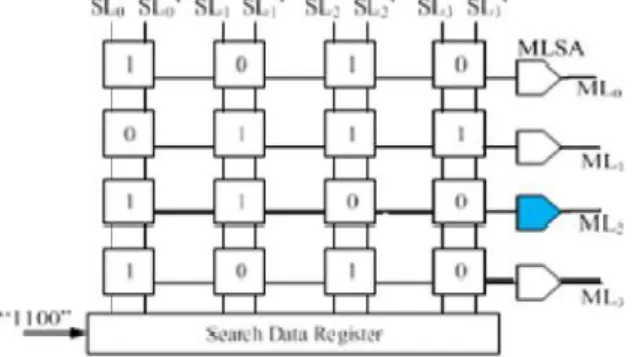
Fig. 1. Simple example of a 4 × 4 CAM array consisting of the CAM cells, MLs, sense amplifiers, and differential SLs.
In Fig.1 typical CAM array, comprising of four sections having 4 bits each, A hunt data enlist is utilized to store the information bits. The enroll applies the hunt data on the differential SLs, which are shared among the passages. At that point, the hunt data are analyzed against the majority of the CAM passages. Every CAM-word is connected to a typical match line (ML) among its constituent bits, which shows, whether or not, they coordinate with the info bits. Since the MLs are profoundly capacitive, a sense enhancer is ordinarily considered for every ML to expand the execution of the hunt operation.
Dissimilar to standard PC memory (irregular get to memory or RAM) in which the client supplies a memory address and the RAM gives back the data word put away at that address, a CAM is outlined to such an extent that the client supplies a data word and the CAM seeks its whole memory to check whether that data word is put away anyplace in it. In the event that the data word is found, the CAM gives back a rundown of at least one stockpiling addresses where the word was found (and in a few models, it likewise gives back the contents of that capacity address, or other related bits of data). Along these lines, a CAM is the equipment encapsulation of what in programming terms would be called an affiliated cluster. The data word acknowledgment unit was proposed by Dudley Allen Buck in 1955.
A noteworthy interface definition for CAMs and other system web indexes (NSEs) was indicated in an interoperability assention called the Look-Aside Interface (LA-1 and LA-1B) created by the Network Processing Forum, which later converged with the Optical Internetworking Forum (OIF). Various gadgets have been created by Integrated Device Technology, Cypress Semiconductor, IBM, Broadcom and others to the LA interface understanding. On December 11, 2007, the OIF distributed the serial look aside (SLA) interface assention.
typically executed with a double CAM so the goal port can be discovered rapidly, lessening the switch's idleness.
Ternary CAMs are regularly utilized as a part of system switches, where every address has two sections: the system address, which can differ in size contingent upon the subnet setup, and the host address, which involves the rest of the bits. Each subnet has a system cover that indicates which bits of the address are the system address and which bits are the host address. Steering is finished by counseling a directing table kept up by the switch which contains each known goal arrange address, the related system veil, and the data expected to course parcels to that goal. Without CAM, the switch thinks about the goal deliver of the parcel to be directed with every passage in the steering table, playing out an intelligent AND with the system cover and contrasting it and the system address. On the off chance that they are equivalent, the relating steering data is utilized to forward the parcel. Utilizing a ternary CAM for the directing table makes the query procedure exceptionally productive. The locations are put away utilizing "couldn't care less" for the host part of the address, so looking into the goal address in the CAM quickly recovers the right steering section; both the veiling and correlation are finished by the CAM equipment. This works if (a) the passages are put away all together of diminishing system cover length, and (b) the equipment returns just the main coordinating section; along these lines, the match with the longest system veil (longest prefix match) is utilized.
III. OVERVIEW OF BFS
A BF is developed utilizing an arrangement of k hash capacities to get to a variety of m bits. The hash capacities h1, h2, . . . , hk outline input component x to one of the m bits. The accompanying two operations are characterized in a BF.A issue with BFs is that a component can't be effectively evacuated. This is a direct result of a position in one of the exhibit can be shared by a few components and accordingly clearing the h1(x), h2(x),… , hk (x) positions for a component x may likewise influence different components in the BF. To address this issue, Counting Bloom Filters CBF which are speculation of BFs were presented. In a CBF, the variety of m bits are supplanted with a variety of whole numbers of b bits and the operations are characterized as takes after.
Insertion:
To insert an element x in the CBF, the integers in the array that correspond to the positions h1(x), h2(x),…, hk (x) are incremented by one.
1) Query:
To query for an element x in the CBF the integers in the array that correspond to the positions h1(x), h2(x),…,hk (x) are read and if
and only if all of them are larger than zero the element is considered to be in the CBF.
2) Removal:
To remove an element x from the CBF, the integers in the array that correspond to the positions h1(x), h2(x),…, hk (x) are decremented by one. The use of integers instead of bits allows the removal of elements now in each position of the array which stores the number of elements that share the position. The false positive rate of a properly dimensioned CBF is same as that of a standard BF.
IV. PROPOSED SCHEME
Fig2: CAM Block Diagram Using Comparator
Regularly, recollections are secured with a for every word equality bit or With a solitary piece mistake amendment code . This depends on the perception that most blunders influence a solitary piece or regardless of the possibility that they influence various bits, the mistakes can be spread among various words by the utilization of interleaving. Moreover, delicate blunders are uncommon occasions so that the time between mistakes is commonly substantial. The landing rate for earthbound applications is in the request of at any rate days or weeks and along these lines, it is normally accepted that mistakes are disconnected. That is, when a delicate blunder arrives any past delicate mistake has been redressed or recognized. This is a supposition that is required, for instance, when single piece mistake redress codes are utilized.
In the accompanying, one of these two most normal insurance alternatives is utilized. Specifically, it is expected that both the DRAM and the reserve are secured with a for each word equality bit that can identify single mistakes. As when utilizing single piece mistake rectification codes, it is additionally accepted that blunders are disengaged.
The objective for this execution is to accomplish the revision of single piece mistakes utilizing the CBF. That is, the CBF would empower single piece mistake remedy without bringing about in the cost of adding an ECC to the recollections.
The initial step to accomplish mistake remedy is to distinguish blunders. This is finished by checking the equality bit while getting to either the DRAM or the reserve. To guarantee prior identification of blunders, the utilization of scouring to occasionally read the recollections could be considered . Once a mistake is recognized, a rectification system is activated. On the off chance that the blunder happens in the CBF, it can be rectified by clearing the CBF and remaking it utilizing the component set. On the off chance that the mistake happens in the component set, the system is more mind boggling and can be partitioned in two stages that are portrayed in the accompanying areas. The thought is that the less difficult and speedier
mistake, the second more mind boggling blunder adjustment system is utilized along these lines.
Content-addressable recollections (CAMs) are equipment web crawlers that are much speedier than algorithmic methodologies for hunt escalated applications. CAMs are made out of traditional semiconductor memory (typically SRAM) with included correlation hardware that empower an inquiry operation to finish in a solitary clock cycle. The two most regular pursuit serious assignments that utilization CAMs are bundle sending and parcel characterization in Internet switches. I present CAM engineering and circuits by first portraying the use of address query in Internet switches. At that point we depict how to execute this query work with CAM.
The rest of this introdcution accept you have some nature with the operation of transistors and fundamental ciruit association of irregular get to memory (RAM). There are two essential types of CAM: double and ternary. Twofold CAMs bolster stockpiling and looking of parallel bits, zero or one (0,1). Ternary CAMs bolster putting away of zero, one, or couldn't care less piece (0,1,X). Ternary CAMs are in the blink of an eye the predominant CAM since longest-prefix directing is the Internet standard. Figure3 demonstrates a square graph of an improved 4 x 5 bit ternary CAM with a NOR-based engineering. The CAM contains the steering table from Table 1 to represent how a CAM actualizes address query. The CAM center cells are orchestrated into four level words, every five bits in length. Center cells contain both capacity and correlation hardware. The inquiry lines run vertically in the figure and communicate the pursuit data to the CAM cells. The matchlines run on a level plane over the cluster and show whether the hunt data coordinates the column's pledge. An actuated matchline shows a match and a deactivated matchline demonstrates a non-coordinate, called a jumble in the CAM writing. The matchlines are contributions to an encoder that produces the deliver relating to the match area.
Input is address location of the content that we are interested in it.
Output is the content of that address.
In CAM it is the reverse:
Input is associated with something stored in the memory.
Output is location where the associated content is stored.
Fig:4 Read operations in Traditional Memory and CAM
CAM can be utilized as a web index. We need to discover coordinating contents in a database or Table. A CAM look operation starts with precharging all matchlines high, putting them all briefly in the match state. Next, the pursuit line drivers communicate the inquiry data, 01101 in the figure, onto the hunt lines. At that point every CAM center cell analyzes its put away piece against the bit on its relating look lines. Cells with coordinating data don't influence the matchline yet cells with a confuse pull down the matchline. Cells putting away a X work as though a match has happened. The total result is that matchlines are pulled down for any word that has no less than one bungle. All different matchlines stay initiated (precharged high). In the figure, the two center matchlines stay initiated, showing a match, while alternate matchlines release to ground, demonstrating a jumble. Last, the encoder creates the hunt address area of the coordinating data. In the illustration, the encoder chooses numerically the littlest numbered matchline of the two initiated matchlines, producing the match address 01. This match address is
utilized as the info deliver to a RAM that contains a rundown of yield ports as delineated in Figure 5. This CAM/RAM framework is a total usage of an address query motor. The match address yield of the CAM is in actuality a pointer used to recover related data from the RAM. For this situation the related data is the yield port. The CAM/RAM hunt can be seen as a lexicon query where the pursuit data is the word to be questioned and the RAM contains the word definitions. With this outline of CAM operation, we now take a gander at the correlation hardware in the CAM center cells.Example Routing Table
Table1: Routing Table for CAM/RAM
The input to the system is the search word.
Encoder specifies the match location.
If multiple matches, a priority encoder selects the first match.
Hit signal specifies if there is no match.
V. RTL SCHEMATIC AND SIMULATION RESULT
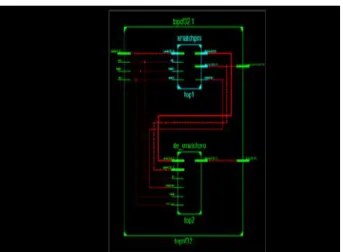
Rtl : The RTL SCHEMATIC gives the information about the user view of the design.The internal blocks contains the basic gate representaion of the logic.These basic gate realization is purely depend upon the corresponding FPGA selection and the internal database information.
Fig: RTL Schematic Internal schematic:
1 0 1 X X
0 1 1 0 X
0 1 1 X X
1 0 0 1 1
0 1 1 0 1
0 0
0 1
1 0
1 1
0 1
C o n t e n t A d d r e s s a b l e M e m o r y
1 0 1 X X
0 1 1 0 X
0 1 1 X X
1 0 0 1 1
0 1
0 0
0 1
1 0
1 1
0 1 1 0 X
Fig: Internal Representation of RTL Schematic SIMULATION:
In the simulations for measuring the energy consumption and the cycle time (/bit/search), on average half of the data bits were assumed to mismatch in case of a word mismatch.The relationship between the dynamic energy consumption of SCN-CAM and the tag length is depicted for various number of entries of the CAM in comparison with the conventional CAMs. The estimated energy consumption is obtained based on the extracted values for energy consumption using HSPICE simulations. As the value of q is increased, the energy consumption is decreased as well since the number of comparisons is reduced but up to a point until the energy consumption of the SCN-based classifier itself would dominate that of the CAM array. Therefore, the energy consumption of the SCN-based classifier is not dependent on the original tag length, and rather on the number of entries in the CAM array.
Fig: Bloom Filter output Design Using CAM
Device Utilization Summary
Table: Device Utilization Summary
Typically, memories are protected with a per word parity bit or with a single bit error correction code. This is based on the observation that most errors affect a single bit or even if they affect multiple bits, the errors can be spread among different words by the use of interleaving. In addition, soft errors are rare events so that the time between errors is typically large. The goal for this implementation is to achieve the correction of single bit errors using the CBF. That is, the CBF would enable single bit error correction without incurring in the cost of adding an ECC to the memories.
VI. CONCLUSION
In this application BLOOM FILTERS have been proposed. The idea is to use the BFs in existing applications to detect and correct errors in their associated element set. In particular, it is shown that CBFs can be used to correct errors in the associated element set. This enables a cost efficient solution to mitigate soft errors in applications which use CBFs. The configuration considered in this brief is that of a memory protected with a perword parity bit for which it is demonstrated that the CBF can be used to achieve single bit error correction. This shows how existing CBFs can be used to achieve error correction in addition to perform their traditional membership checking function.
REFERENCES
[1] B. Bloom, “Space/time tradeoffs in hash coding withallowable errors,” Commun. ACM, vol. 13, no. 7, pp. 422–426, 1970.
[2] A. Broder and M. Mitzenmacher, “Network applications of bloom filters: A survey,” in Proc. 40th Annu. Allerton Conf., Oct. 2002, pp. 636–646.
[3] A. Moshovos, G. Memik, B. Falsafi, and A. Choudhary, “Jetty: Filtering snoops for reduced energy consumption in SMP servers,” in Proc. Annu. Int. Conf. High-Perform. Comput. Archit., Feb. 2001, pp. 85–96. [4] C. Fay et al., “Bigtable: A distributed storage system for structured data,” ACM TOCS, vol. 26, no. 2, pp. 1–4, 2008.
counting bloom filters,” in Proc. 14th Annu. ESA, 2006, pp. 1–12.
[6] M. Mitzenmacher, “Compressed bloom filters,” in Proc. 12th Annu. ACM Symp. PODC, 2001, pp. 144– 150.
[7] M. Mitzenmacher and G. Varghese, “Biff (Bloom Filter) codes: Fast error correction for large data sets,” in Proc. IEEE ISIT, Jun. 2012, pp. 1–32.
[8] S. Elham, A. Moshovos, and A. Veneris, “L-CBF: A low-power, fast counting Bloom filter architecture,” IEEE Trans. Very Large Scale Integr. (VLSI) Syst., vol. 16, no. 6, pp. 628–638, Jun. 2008.