S U R V E Y
Attitudes, techniques and trends in endodontic treatment
by the house surgeons in dental institutes - Karachi
Talha M. Siddiqui1, Aisha Wali1, Azka Anwar2
1Department of Operative Dentistry, Ba qai Dental College, Sindh, Pakistan, 2House Surgeon, Baqai Dental College, Sindh, Pakistan
Abstract
Background: The attitudes, techniques and diff erent approaches toward endodontic
treatment refl ects the quality of the root canal treatment (RCT) performed by general dental practitioners. Endodontic therapy has been associated with the pre-operative diagnosis of the tooth, microbial factors, quality of RCT. Environmental factors in which the dentist works may also impact quality of RCT. Materials and Methods: The present cross-sectional study was conducted in October 2013 to evaluate the attitudes, techniques and trends in endodontic treatment procedures amongst the house surgeons in dental institutes of Karachi. A cluster sampling technique was employed, and 170 structured questionnaires were distributed to all registered house surgeons employed in six diff erent dental institutes of Karachi. All returned forms were evaluated by a single operator. Descriptive statistics and frequency distribution was analyzed using SPSS version 19. Results: From all given questionnaires, 150 fi lled questionnaires were collected from participants, which is 88.23% response rate. Conclusion: It was concluded that the recently graduated dental practitioners lacked expertise in certain regards. They were performing procedures that are deviated from the well acknowledged endodontic quality guidelines.
Keywords: Assessment of radiographs, Endodontic trends, general dental practitioners, root canal treatment
Correspondence:
Dr Talha M. Siddiqui, Department of Operative Dentistry, Baqai Dental College, Sindh, Pakistan. Phone: +(0)-3002320242, E-mail: [email protected]
Received 08 January 2015; Accepted 12 February 2015
doi: 10.15713/ins.ijcdmr.33
How to cite the article:
Talha M. Siddiqui, Aisha Wali, Azka Anwar, “Attitudes, techniques and trends in endodontic treatment by the house surgeons in dental institutes - Karachi,” Int J Contemp Dent Med Rev, vol. 2015, Article ID: 060115, 2015, doi: 10.15713.ins/ijcdmr.33
Introduction
The attitudes, techniques and diff erent approaches toward endodontic treatment refl ects the quality of the root canal treatment (RCT) performed by general dental practitioners.[1]
Success of endodontic treatment reported in some studies as high as 96% while in others it is as low as 60%.[2-5] In 2001, the European
Society of Endodontology (ESE) published guidelines for undergraduate curriculum that aimed to standardize the quality and quantity of education and clinical experience received during undergraduate training in dental schools in Europe.[6] Several
studies revealed that the majority of general dental practitioners do not follow the formulated guidelines on the quality of RCT.[7-10]
The quality of RCT performed by house surgeons refl ects the level of treatment provided to the community as there is a lack of guidance from senior supervisors may not be available.[11] In
Pakistan, only one study was done to assess the technical quality of RCT carried out by house surgeons.[12]
The purpose of this study was, therefore, to investigate the current trends and attitudes in endodontic treatment by house surgeons of diff erent dental institutes and to compare them to the international academic standards of treatment.
Materials and Methods
Results
From all given questionnaires, 150 fi lled questionnaires were collected from participants, which is 88.23% response rate. All of the respondents are current house offi cers in diff erent dental institutes.
Number of visits per endodontic treatment: Respondents results are shown in Graph 1. Most of them prefer multiple visits over single visit.
Radiography: Majority of the house offi cers 72% do not or occasionally bother to tell the radiologist about the technique and only 5.3% inform radiologist about the technique in which to take the radiography.
Pre-operative radiograph: Approximately, 87.3% routinely took pre-operative radiographs before commencing endodontic treatment. About 9.3% did so often, and only 2.7% occasionally did so. 0.7% never took pre-operative radiographs.
Master cone radiograph: However, 59.3% reported taking master cone radiograph while 20% taking no radiograph for determining the master apical cone.
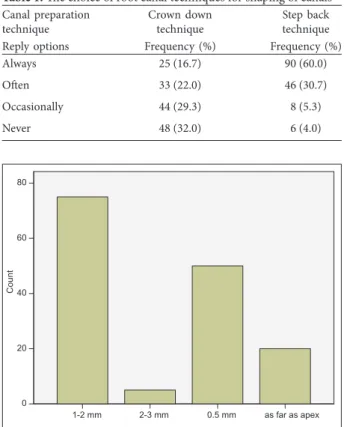
Working length: Graph 2 shows that 50% of the respondents took 1-2 mm working distance short of radiographic apex contrary to 13.3% that took working distance as far as radiographic apex.
Endodontic fi les: Graph 3 shows that about 93.3% of house offi cers properly sterilize their endodontic fi les before treatment while 6.7% often did so. Disposal of the endodontic fi les after single use was practiced by 18.7% only, and endodontic fi le was reused after sterilization by 50%.
Instrumentation and obturation technique: Table 1 shows that majority of dentist 60% instrumented the canal using the step-back technique and only 16.7% perform RCT by doing crown-down technique. About 50% never used Gates Glidden burs to aid entrance into the orifi ce. The majority of dentist 79.3% reported the use of lateral condensation technique for obturation.
Chair positioning during treatment: About 41.3% respondent often feel comfortable with their chair positioning while performing treatment, and approximately 38% often
found diffi culty while treating maxillary teeth and 47% of the respondent never feel diffi culty in treating the mandibular teeth.
Chamber opening: The number of dentists using round ended access burs for chamber opening are 43.3% while 11.3% never use round bur for opening chamber. However, 29.3% often prefer straight bur for opening chamber and 18.7% never. Almost 50% of the house offi cers felt that chamber opening is diffi cult then locating canals.
Table 1: Th e choice of root canal techniques for shaping of canals Canal preparation
technique
Crown down technique
Step back technique Reply options Frequency (%) Frequency (%) Always 25 (16.7) 90 (60.0)
Oft en 33 (22.0) 46 (30.7)
Occasionally 44 (29.3) 8 (5.3)
Never 48 (32.0) 6 (4.0)
Never Occasionally
0ften Always
70
60
50
40
30
20
10
0
Count
Graph 1: Do you prefer multiple visits over single visit?
as far as apex 0.5 mm
2-3 mm 1-2 mm
80
60
40
20
0
Count
Graph 2: What working distance you use from the radiographic apex
More than 5-6 patients 5-6 patients
single patient 80
60
40
20
0
Count
Canal irrigation: Over 65.3% of respondents irrigated root canals with sodium hypochlorite. About 34% used saline as primary irrigant. However, 40% occasionally used EDTA as an irrigant just prior to obturation.
Inter-appointment dressing: About 45.3% employed intracanal medicament between visits while 2% never use intercanal dressing.
Faults occurred during shaping and obturation of canals: Table 2 shows that majority of the house offi cers 47.3% occasionally transports the fi le while 41% never did so. However, 54.7% occasionally undergone a ledge formation, and 25% did not.
Obturation of 6% of the respondents is always under fi lled, and 14% never left the canals under fi lled while obturation of 2% of the house offi cers always overfi lled while 42% never did so.
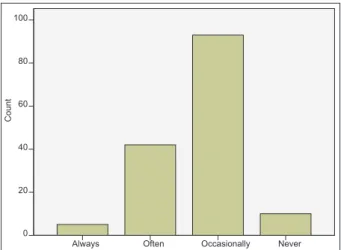
Complain of pain after initial fi lling: Respondents were asked to give an estimate of the no. of patients felt pain after initial fi lling in their second visit and result is shown in Graph 4.
Permanent restoration after RCT: Table 3 shows that 28% of the respondents preferred to wait for 1-week after obturation before placing the permanent coronal fi lling. While remainders 25.3% place the restoration immediately after completion of the treatment however 32.7% never did so.
Amalgam 38% was the most commonly placed post core endo restoration followed by composite 13.3% and glass ionomer cement (GIC) 14.7% for posterior teeth. About 65.3% of the house offi cers always recommend crown for every root canal treated tooth. While the remainders often, occasionally or never did so.
Use of systemic antibiotics: Table 4 shows that 68% always prescribe antibiotics in severe infection in conjunction with endodontic therapy while 40% routinely prescribe them.
De-occlusion of tooth: About 40.7% of the respondents always de-occlude the tooth before starting endodontic treatment while 18% never did so.
Recommendation for crown: About 65.3% of the house offi cers always recommend crown for every root canal treated tooth. While the remainders often, occasionally or never did so.
Discussion
The aim of this present study was to assess the attitudes, techniques and trends employed by the house surgeons from diff erent dental institutions in Karachi. The overall response rate was 88.23% in the present study which is higher when compared to diff erent surveys conducted in India
(67%),[13] Jordan (72%),[14] Turkey (43%),[15] but lower when
compared to Flemish dentists (99.4%).[16]
This study is fi rst of its kind that gathered information on attitudes, techniques and trends employed by House surgeons in Pakistan. Recent studies showed that endodontic treatment for single rooted or multi rooted teeth are conventionally done in a single visit.[13] Majority of the respondents do not practice
single visit RCT.[17] study done in USA[7] showed inclination to
single visit endodontics, especially in cases without periapical periodontitis. Single visit endodontic treatment nowadays have gained more popularity and an increase reliability in the preclinical end odontic teaching in USA and UK.[18] Due to
the lack of experience of clinical skills in performing single visit endodontic treatment, dentists rather prefer to treat in multiple visits.[10] and may wait till the complete subsidence of pain
occurs and other symptoms before obturating the canal. Another possible explanation could be that the initial visit was done for treating the pain and acute symptoms.[13] The present study
result showed that 63 (41.2%) of the respondents preferred multiple visits over single visit.
High-quality radiographs had been recommended for accurate diagnosis and helps in pre-operative assessment of potentially diffi cult cases,[19] but still, only about 81% of
the surveyed general dental practitioners routinely perform pre-operative radiographs.[13] The present study showed
that 131 (85.6%) of the respondents preferred taking pre-operative radiographs.
Table 2: Procedural accidents occurred during shaping and obturation of canals
Procedural accidents File transportation Ledge formation Obturation underfi lled Obturation overfi lled Reply options Frequency (%) Frequency (%) Frequency (%) Frequency (%)
Always 6 (4.0) 1 (0.7) 9 (6.0) 3 (2.0)
Oft en 11 (7.3) 29 (19.3) 45 (30.0) 17 (11.3)
Occasionally 71 (47.3) 82 (54.7) 75 (50.0) 67 (44.7)
Never 62 (41.3) 38 (25.3) 21 (14.0) 63 (42.0)
Never Occasionally
Often Always
100
80
60
40
20
0
Count
Working length determination is one of the most important step in RCT as it facilitates cleaning, shaping and obturation of the root canal.[20] Inaccurate determination of working length of
the root canal often results in apical perforation, overextension of irrigants or obturation materials into the periradicular tissues may also lead to incomplete instrumentation and obturation.[13]
The present study results showed that 50% of the respondents obtained working length radiographically keeping 1-2 mm distance short of the radiographic apex. The optimal working length in teeth with vital pulp appears to be 1-2 mm from the radiographic apex.[21]
A survey done in 2008 showed that 80% of the general dental practitioners prepared canals 0.5-1 mm short of the radiographic apex.[22] Whitten et al.[7] reported that 75% of
the respondents stated that they would instrument 0.5 mm short of the radiographic apex. In Flemish survey, 38.9% of the general dental practitioners prepared canals 1 mm short of the radiographic apex, independent of the pathology.[10] The quality
of the mechanical preparation of the root canal system is another critical step which infl uences the outcome of endodontic treatment.[23] Results of the present study showed that about
93.3% of respondents properly sterilize their endodontic fi les before treatment while 6.7% often did so. Mensudar et al.[24] in a
survey showed that only 16% of the respondents used glass bead sterilizer for endodontic fi les. About 80% of the respondents disposed their endodontic fi les after they see signs of distortion and 20% disposed their fi les when it becomes blunt, but none of them disposed endodontic fi les after single use. The present study showed that Disposal of the endodontic fi les after single use was practiced by 18.7% only, and endodontic fi le was reused after sterilization by 50%.
Mehta et al.[13] in a survey showed that only 2% of the
respondents disposed fi les after a single use, 33% reused
endodontic fi les after autoclaving, 27% after cold sterilization and 39% after glass bead sterilization.
The most common technique employed in the present study was step back technique. About 60% of the respondents prepared the canal by doing step back technique, and only 16.7% of the respondents prepared the canal using crown-down technique. About 50% never used Gates Glidden burs to aid entrance into the canal orifi ce. In another survey, majority of the general dental practitioners (59.66%) instrumented the canal using the step-back technique followed by crown down technique (23.66%).[13]
It is well documented that the root canal systems are complexed, and no instrumentation or methods for cleaning and shaping are available which can entirely fl ush out the tissue remnants or debris smeared on the canal walls.[25] Thus, an
antimicrobial irrigant is required to kill the bacteria by chemical means.[9] In the present study, 65.3% of respondents irrigated
root canals with sodium hypochlorite, while 34% used saline as primary irrigant. However, 40% occasionally used EDTA as an irrigant before obturation. Kaptan et al.[15] in a survey showed
that 90.2% of the respondents used sodium hypochlorite followed by EDTA (44.1%) and hydrogen peroxide (38.4%). Al-Omari in a survey showed that 14.5% of the respondents used sodium hypochlorite followed by 21.4% hydrogen peroxide.[14]
The same results were shown amongst dentists in Switzerland [26]
Calcium hydroxide is considered to be the standard intracanal medicament for inter-appointment dressing.[27] In
a survey done by Al-Omari, only 11.5% of the respondents used calcium hydroxide followed by 4.6% formaldehyde.[14]
The present study results showed that about 45.3% employed intracanal medicaments between visits while 2% never used intracanal dressings. Formaldehyde- containing products have been used for their antimicrobial and fi xative properties, as they are toxic to periradicular tissues[28] and may have mutagenic
and carcinogenic properties.[29] The use of calcium hydroxide,
as intracanal medication, should be encouraged among general dental practitioners in developing countries as it is eff ective against most root canal pathogens.[30,31] Kaptan et al.[15] in his
survey showed that 61.5% of the respondents used calcium hydroxide which is comparable to the 69.7% in Flanders[16]
and 63% in North Jordan[14] and more than 9% in USA[7]
and 7%[9] in UK.
It has been well documented that highly skilled operators are less likely to perform accidental mishaps that may ultimately compromise the prognosis.[32] About 47.3% of respondents
occasionally transport the fi le while 41% never did so. However, 54.7% occasionally undergone a ledge formation and 25% did not. A study done by Jawwad et al.[33] showed
that 45 (90%) of house surgeons did not transport the fi le while only 5 (10%) transport the fi le.
Root canal obturation prevents the entry of microorganisms into already cleaned root canal. Lateral condensation is the most common obturation technique that has produced good results, and it does not require expensive equipment.[18,34] A similar study
conducted in Saudi Arabia showed that 63.5% of the general dental practitioners used lateral condensation technique.[35]
Table 3: Type of post core endo restoration use for posterior teeth Post core endo
restoration
Composite Amalgam GIC
Reply options Frequency (%) Frequency (%) Frequency (%) Always 20 (13.3) 57 (38.0) 22 (14.7)
Oft en 44 (29.3) 40 (26.7) 25 (16.7)
Occasionally 41 (27.3) 27 (18.0) 34 (22.7)
Never 45 (30.0) 26 (17.3) 69 (46.0)
GIC: Glass ionomer cement
Table 4: Behavior regarding prescription of antibiotics Prescription
of antibiotics
Routinely prescribed
Prescribed only in severe cases Reply options Frequency (%) Frequency (%) Always 60 (40.0) 102 (68.0)
Oft en 49 (32.0) 27 (18.0)
Occasionally 35 (23.0) 12 (8.0)
The present study results showed that 79.3% of respondents performed obturation with lateral condensation technique. Underfi lled obturations were done by 6% of the respondents and 2% of the respondents showed overfi lled obturations.
The respondents were asked to indicate how long they would wait before commencing fi nal restoration of endodontically treated tooth. A study done in South Africa showed that 41% immediately restored the tooth after completion of RCT, 38% preferred waiting for 1-week, 47% preferred 2-6 weeks delaying fi nal restoration, 4% preferred 2 months and 11% preferred to wait for 3-6 months.[36] The present study results showed
that 28% of the respondents preferred to wait for 1-week after obturation before placing the permanent coronal fi lling. While remainders 25.3% place the restoration immediately after completion of the treatment however 32.7% never did so.
According to the ESE quality guidelines for endodontics,[1]
the tooth should be completely restored to prevent bacterial recontamination of the root canal or fracture of the tooth. A study done in 2012 showed that 79.8% of the respondents restored teeth using resin composite as the material of choice. Crown restoration was favored by almost half of the respondents (49.5%) followed by amalgam fi lling (25.8%).[37] The present study results showed
that Amalgam was the most commonly placed restoration 38%, followed by composite 13.3% and GIC 14.7%. 65.3% of the respondents always recommended crown for every root canal treated tooth. While the remainders often, occasionally or never did so. Economic considerations might be the reason most of the practitioners choose relatively cheaper resin composite restorations instead of crown or inlay/onlay restorations.
Systemic antibiotics are prescribed only if there has been systemic spread of infection. Otherwise, they may present more of a risk to the patient than the local infection. There is evidence that antibiotics are prescribed appropriately in general dental practices.[38] Recent review reveals that systematic
antibiotic alone off er no additional benefi t in the management of acute apical periodontitis and acute abscesses in a permanent dentition.[39] With the increasing worldwide problem of
antimicrobial resistance, there is a need to rationalize prescription of antibiotics.[13] The present study results showed that 68%
always prescribe antibiotics in severe infection in conjunction with endodontic therapy while 40% routinely prescribe them.
Conclusion
It was concluded that the recently graduated dental practitioners lacked expertise in certain regards. They were performing procedures that are deviated from the well acknowledged endodontic quality guidelines. House surgeons did not seem to keep up with recently introduced techniques but used more conventional methods. They worked in under less than optimal conditions. Unfortunately, it was noted that some of the house surgeons did not even bother to tell the radiologist about the direction in which to take the radiograph. Most of them felt diffi culty in chair positioning and considered chamber opening a challenging procedure. Majority of them performed obturations that were underfi lled and most commonly a ledge formation.
Clearly better training of the house surgeons as well as economic resources is necessary to obtain an improvement in the technical quality of the RCT and therefore, hopefully, decrease the frequency of apical periodontitis in root fi lled teeth.
This survey shows the importance of establishing higher training programs and continuing dental education in their 1-year house job period. There is a need to promulgate the latest concepts and practices of endodontics.
References
1. European Society of Endodontology. Quality guidelines for endodontic treatment: Consensus report of the European Society of Endodontology. Int Endod J 2006;39:921-30.
2. Friedman S. Treatment outcome and prognosis of endodontic therapy. In: Orstavik D, Pitt Ford TR, editors. Essential Endodontology. Oxford: Blackwell Science; 1998. p. 36-7401. 3. Marques MD, Moreira B, Eriksen HM. Prevalence of apical
periodontitis and results of endodontic treatment in an adult, Portuguese population. Int Endod J 1998;31:161-5.
4. De Moor RJ, Hommez GM, De Boever JG, Delmé KI, Martens GE. Periapical health related to the quality of root canal treatment in a Belgian population. Int Endod J 2000;33:113-20. 5. Eriksen HM, Kirkevang LL, Petersson K. Endodontic
epidemiology and treatment outcome: general considerations. Endod Top 2002;2:1-9.
6. European Society of Endodontology. Undergraduate curriculum guidelines for endodontology. Int Endod J 2001;34:574-80. 7. Whitten BH, Gardiner DL, Jeansonne BG, Lemon RR. Current
trends in endodontic treatment: Report of a national survey. J Am Dent Assoc 1996;127:1333-41.
8. Weiger R, Hitzler S, Hermle G, Löst C. Periapical status, quality of root canal fi llings and estimated endodontic treatment needs in an urban German population. Endod Dent Traumatol 1997;13:69-74.
9. Jenkins SM, Hayes SJ, Dummer PM. A study of endodontic treatment carried out in dental practice within the UK. Int Endod J 2001;34:16-22.
10. Slaus G, Bottenberg P. A survey of endodontic practice amongst Flemish dentists. Int Endod J 2002;35:759-67.
11. Ahmed A, Khattak O, Ali H, Maqbool A, Azhar G, Shamim A,
et al. Radiographic technical quality of root canal fi llings performed by house surgeons in the Islamic international dental college: A pilot study. Pak Oral Dent J 2008;28:271-4.
12. Muhammad NS, Hina ZR.Radiographic assessment of quality of root canal treatment. Pak Oral Dent J 2010;30:491-4. 13. Mehta N, Raisingani D, Gupta S, Sharma M.Endodontic trends:
Where we are and where we should be-A survey report.People’s J Sci Res 2013;6:30-7.
14. Al-Omari WM. Survey of attitudes, materials and methods employed in endodontic treatment by general dental practitioners in North Jordan. BMC Oral Health 2004;4:1. 15. Kaptan RF, Haznedaroglu F, Kayahan MB, Basturk FB. An
investigation of current endodontic practice in Turkey. Sci World J 2012;2012:1-6.
16. Hommez GM, Moor BM. Root canal treatment performed by Flemish dentists. Part 1- cleaning and shaping. Int Endod J 2002;35:1-8.
Infl uence of coronal restorations on the periapical health of endodontically treated teeth. Endod Dent Traumatol 2000;16:218-21.
18. Qualtrough AJ, Whitworth JM, Dummer PM. Preclinical endodontology: An international comparison. Int Endod J 1999;32:406-14.
19. Consensus report of the European Society of Endodontology on quality guidelines for endodontic treatment. Int Endod J 1994;27:115-24.
20. Weine FS. Calculation of working length. In: Endodontic Th erapy. 5th ed. St. Louis: Mosby; 1996. p. 395-422.
21. Kerekes K, Tronstad L. Long-term results of endodontic treatment performed with a standardized technique. J Endod 1979;5:83-90.
22. Ravanshad S, Sahraei S, Khayat A. Survey of Endodontic Practice amongst Iranian Dentists Participating Restorative Dentistry Congress in Shiraz, November 2007. Iran Endod J 2008;2:135-42. 23. Peciuliene V, Rimkuviene J, Aleksejuniene J, Haapasalo M,
Drukteinis S, Maneliene R. Technical aspects of endodontic treatment procedures among Lithuanian general dental practitioners. Stomatologija 2010;12:42-50.
24. Mensudar R, Julius A, Sukumaran G. Evaluation of current trends in endodontic treatment procedure among the dental practitioners. Indian J Multidiscip Dent 2011;1:311-4.
25. Kirkevang LL, Horsted-Bindslev P. Technical aspects of treatment in relation to treatment outcome. Endod Top 2002;2:89-102.
26. Barbakow F. Th e status of root canal therapy in Switzerland in 1993. J Dent Assoc S Afr 1996;51:819-22.
27. Chong BS, Pitt Ford TR. Th e role of intracanal medication in root canal treatment. Int Endod J 1992;25:97-106.
28. Gulabivala K. lntracanal medication and temporary seal. In: Color Atlas and Text of Endodontics. 2nd ed. London:
Mosby-Wolfe; 1995. p. 145-50.
29. Spangberg I. Intracanal medication. In: Malvern PA, editor Endodontics. 4th ed. USA: Williams and Wilkins; 1994. p. 627-40.
30. Bystrom A, Claesson R, Sundqvist G. Th e antibacterial eff ect of camphorated paramonochlorophenol, camphorated phenol and calcium hydroxide in the treatment of infected root canals. Endod Dent Traumatol 1985;1:170-5.
31. Sjögren U, Figdor D, Spångberg L, Sundqvist G. Th e antimicrobial eff ect of calcium hydroxide as a short-term intracanal dressing. Int Endod J 1991;24:119-25.
32. Bierenkrant DE, Parashos P, Messer HH. Th e technical quality of nonsurgical root canal treatment performed by a selected cohort of Australian endodontists. Int Endod J 2008;41:561-70. 33. Jawwad IA, Aliya E, Aaqil M. Comparison of root canal treatment
quality performed by house surgeons and postgraduate students. Pak Oral Dent J 2014;34:543-7.
34. Walton RE, Johnson WT. Obturation. In: Walton RE, Torabinejad M, editors. Principles and Practice of Endodontics. 3rd ed. Philadelphia, PA, USA: W. B. Saunders ; 2002. p. 239-67.
35. Iqbal A, Akbar I, Qureshi B, Sghaireen MG, Al-Omiri MK. A Survey of Standard Protocols for Endodontic Treatment in North of KSA. ISRN Dent 2014;2014:865780.
36. Lushen MN.A survey of attitudes, materials and techniques used in endodontic treatment by South African Dentists. M.Sc. Th esis. School of Oral Health Science, University of the Witwatersrand, Johannesburg; 2006.
37. Ahmed MF, Elseed AI, Ibrahim YE. Root canal treatment in general practice in Sudan. Int Endod J 2000;33:316-9.
38. Palmer NA, Pealing R, Ireland RS, Martin MV. A study of prophylactic antibiotic prescribing in National Health Service general dental practice in England. Br Dent J 2000;189:43-6. 39. Matthews DC, Sutherland S, Basrani B. Emergency management