Charge modulation as fingerprints of phase-string triggered interference
Zheng Zhu,1Chushun Tian,1Hong-Chen Jiang,2Yang Qi,1Zheng-Yu Weng,1,3and Jan Zaanen4
1Institute for Advanced Study, Tsinghua University, Beijing, 100084, China
2Stanford Institute for Materials and Energy Sciences, SLAC National Accelerator Laboratory,
2575 Sand Hill Road, Menlo Park, California 94025, USA
3Collaborative Innovation Center of Quantum Matter, Tsinghua University, Beijing, 100084, China
4The Institute Lorentz for Theoretical Physics, Leiden University, NL-Leiden, The Netherlands
(Received 12 December 2014; revised manuscript received 19 May 2015; published 7 July 2015) Charge order appears to be an ubiquitous phenomenon in doped Mott insulators, which is currently under intense experimental and theoretical investigations particularly in the highTc cuprates. This phenomenon is
conventionally understood in terms of Hartree-Fock-type mean-field theory. Here we demonstrate a mechanism for charge modulation which is rooted in the many-particle quantum physics arising in the strong coupling limit. Specifically, we consider the problem of a single hole in a bipartitet-J ladder. As a remnant of the fermion signs, the hopping hole picks up subtle phases pending the fluctuating spins, the so-called phase-string effect. We demonstrate the presence of charge modulations in the density matrix renormalization group solutions which disappear when the phase strings are switched off. This form of charge modulation can be understood analytically in a path-integral language with a mean-field-like approximation adopted, showing that the phase strings give rise to constructive interferences leading to self-localization. When the latter occurs, left- and right-moving propagating modes emerge inside the localization volume and their interference is responsible for the real space charge modulation.
DOI:10.1103/PhysRevB.92.035113 PACS number(s): 71.27.+a,74.72.−h,75.50.Ee
I. INTRODUCTION
The most ubiquitous form of order is the one involving the breaking of space translations and rotations leading to the solid form of matter. Dealing with the solids of everyday life, but also with the Wigner crystals formed in low density electron sys-tems, this is easily understood in terms of minimization of the potential energy associated with the interactions between the constituents. Since the 1950s it has been well understood that the order can also occur in highly itinerant systems in the form of the Peierls mechanism. This relies on the Hartree-Fock-type mean-field theory. The order parameter turns into a potential diffracting the electron waves of the nearly free system; the order is stabilized by the energy gain associated with opening a gap at the Fermi energy.
The Hartree-Fock-type theory is controlled at zero temper-ature by the diminishing of the collective quantum fluctuations of the order and it can therefore also be reliable when the interactions become strong. In the late 1980s it was discovered that according to the Hartree-Fock theory the electronic stripes should be formed in strongly coupled doped Mott insulators [1,2]. This refers to textures formed from antiferromagnetic Mott-insulating domains, separated by lines of charge (in two dimensions) which are at the same time domain walls in the spin background. Such insulating stripes turned out to be ubiquitous in generic doped Mott insulators (nickelates, cobaltates, manganites). In 1995 a stripelike ordering phenomenon was discovered in the 214 family of cuprate superconductors [3], but it became immediately clear that these were in crucial respects different from the Hartree-Fock variant: These turned out to be “half-filled” and associated with metallic and even superconducting states [4,5]. Quite recently there has been a resurgence of interest in this subject by the discovery of “stripelike” order in the 2212 and 123 families of superconductors, which is yet behaving
differently from the 214 stripes [5]. Despite the large body of theoretical proposals (e.g., Refs. [6–8]), it appears that these are yet far from being completely understood.
The next surprise happened in 1998, by the discovery of White and Scalapino that the density matrix renormalization group (DMRG) computations on the t-J model revealed stripes that appear to be quite literally like the ones experimen-tally observed in the 214 cuprates [9]. The very recent results obtained using the fanciful infinite projected entangled-pair state method add further credibility to this claim [10]. All along it has been obvious that the differences with the Hartree-Fock stripes are caused by the strong quantum nature of the spin one-half system. However, up to the present day an explanation of these numerical results in terms of a general physics principle has been lacking. Leaving a detailed analysis of this many-hole problem to future work, we focus here on this physics principle itself in the simplest possible setting, namely, thet-J model doped with a single hole.
αJ
t J
αt
FIG. 1. (Color online) The single-hole (empty circle) doped two-legt-Jladder. The interchain hopping and superexchange parameters aretandJ, respectively, while their intrachain counterparts areαt andαJ,α >0.
simple quantum mechanics, since they are inherently tied to the quantum many-body nature of the spin system. It was recently [19] demonstrated that this goes so far that even in the perfect translationally invariant case the hole is subjected to self-localization [20]. In Sec.IVwe will unveil the nature of the mechanism leading to this self-localization, resting on a general path-integral consideration and a mean-field-like approximation. It turns out to be a close cousin of the usual mechanism leading to Anderson localization [21]; the crucial difference is that it acts out in the presence of a perfect lattice translational symmetry, while the interference mechanism giving rise to enhanced backscattering can be directly traced to the phase strings. Along the same lines we will also demonstrate that this phase-string interference drives the spontaneous charge modulation in the single-hole case, representing a charge ordering mechanism which is uniquely tied to the many-body physics realized in strongly interacting doped Mott insulators.
In essence, at small length scales the phase strings give rise to a coherent propagation of the hole through the quantum spin background characterized by sharp single-particle momenta, with the momentum value set by the many-body physics of the quantum spin background. This coherent propagation is, however, confined on larger scales by the localization volume that acts like a box. This has in turn the consequence that the interference between the left- and right-propagating modes of the hole inside this volume can form standing waves corresponding to the charge modulations.
To convince the reader we will start out presenting nu-merical DMRG results in Sec. III for a two-leg t-J ladder system doped with a single hole (Fig.1) after introducing the model and the numerical method in Sec.II. To unambiguously identify the origin of the spontaneous charge modulations found in the numerical results we will employ the same strategy as used in the previous work [19]: By adding a simple spin dependence to the hopping term [see Eq. (5)] the effects of the phase strings are canceled out. Comparing the outcomes with those of the standard t-J model one immediately identifies the modulation of the hole density [Figs.2(a)–2(d)] as being caused by the phase strings. The highly unconventional origin of the charge modulation is also unveiled by its dependence on the strength of the rung couplingα(cf. Fig.1). This effectively tunes the density of spin flips and thereby the density of the phase-string signs. For smallα < αcthe hole delocalizes and
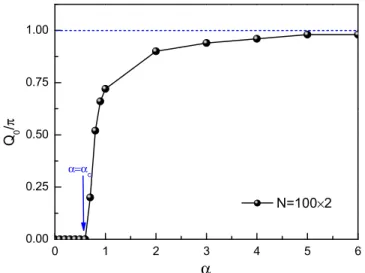
the modulation disappears [Figs.2(e)and2(f)]. It is found that in the self-localized regime (α > αc) the modulation period
rapidly increases withα(Fig.3). In Sec.IVwe will rest on the analogy with the theory of Anderson localization, devising
a path-integral method that makes it possible to analyze the interference phenomena caused by the phase strings in an analytical fashion. This revolves around the assertion that it is possible to assign anaveragephase-string sign to any hopping path of the hole, essentially a mean-field-like approximation. This maps the problem of the hole propagation on an effective quantum mechanics problem which is amenable to a path integral treatment, be it that the interference phenomena are now rooted in these phase-string signs.
From this construction we identify an analog of the mech-anism for the familiar Anderson localization, to subsequently unveil the origin of the spontaneous charge modulation in terms of interference of emergent left and right movers inside the localization volume. This analysis reveals the cause of the highly surprising dependence of the modulation period on the rung coupling: It is set by the probabilityp↑ for the hole (injected by removing a↓-spin electron) to exchange its position with an up(↑)-spin nearest neighbor, a quantity that measures effectively the density of phase-string signs in the spin vacuum. In Sec.Vwe will end with an outlook, discussing the potential ramifications of this mechanism for charge modulation in the broader context of the physics of doped Mott insulators. Some technical details are relegated to Appendix.
II. MODELS AND NUMERICAL METHODS Let us depart from the standardt-J model describing the basic physics of a doped Mott insulator in the strong coupling limit, with Hamiltonian Ht+HJ, where Ht describes that
the hole hops from one site to the other and HJ is the
superexchange interaction between nearest spins. These two terms read
Ht = −
ijσ
tij(ciσ† cj σ+H.c.), (1)
HJ =
ij
Jij
Si·Sj−
1 4ninj
, (2)
respectively. Heretij >0 is the hopping integral andJij >0
the superexchange coupling.ciσ is the electron annihilation
operator at sitei≡(x,y), withσ =↑,↓being the spin index, Si the spin operator, ni =
σciσ† ciσ the electron number
operator, andijdenotes the nearest neighbors. The Hilbert space is constrained by the no-double occupancy condition, i.e.,ni1. We consider the system doped by a single hole,
i.e.,ini =N−1 whereNis the number of lattice sites. In
our numerical simulations, the single-hole doping is realized by removing a↓-spin electron.
We focus on the ladder geometry of length Nx and leg
numberNy =2 (Fig. 1): This is the so-called rung model.
For simplicity we consider even Nx throughout this work.
Such t-J ladders have been recently employed with much success to establish numerically the phase-string-triggered self-localization effect [19] and the associated collapsing of the quasiparticle [22]. These ladders are particularly convenient for numerical investigations using the DMRG method [23]. The interchain hopping and superexchange parameters aret
0 10 20 30 40 50 60 70 80 90 100 0.000
0.005 0.010 0.015 0.020 0.025 0.030
0.0 0.5 1.0 1.5 2.0
-0.0004 -0.0002 0.0000 0.0002 0.0004 0.0006
0 20 40 60 80 100 120 140 160 180 200
0.000 0.005 0.010 0.015 0.020 0.025 0.030
0.0 0.5 1.0 1.5 2.0
-0.001 0.000 0.001 0.002
0 20 40 60 80 100
0.000 0.005 0.010 0.015 0.020 0.025
0.0 0.5 1.0 1.5 2.0
-0.001 0.000 0.001 0.002 0.003
(c)
α>α
c (a)α>α
cn
h (x)
x
N=100×2
N(q)
q/π
N=100×2
Q0 2π-Q0
N=200×2
n
h (x)
x
N=200×2
(d)
α>α
c (b)α>α
c2π-Q0
N(q)
q/π Q0
(e)
α<α
c N=100×2n
h (x)
x
N=100×2
(f)
α<α
cN(q)
q/π
FIG. 2. (Color online) (a) Simulation results show that forα > αcthe hole density profile across a two-legt-J ladder exhibits a charge
modulation, a (spatial) oscillation, which superposes on a smooth background localized at the sample center. (b) The Fourier transformation of the profile exhibits two peaks atQ0and 2π−Q0, implying that the oscillatory pattern has a period of 2π/Q0. (c) Upon introducing weak
impurities the hole density “collapses” into a localized profile pinned at the localization center [19]. (d) The profile shifted with the localization center notwithstanding, the peaks of the Fourier transformation of the profile remain unchanged, implying the invariance of the period of the charge modulation. (e) Simulations of the same system but withα < αcshow the absence of charge modulations concomitant with the hole
0 1 2 3 4 5 6 0.00
0.25 0.50 0.75 1.00
α=αc
Q0
/
π
α
N=100×2
FIG. 3. (Color online) Simulation results of Q0 for different
values of the rung couplingα.Q0is found to vanish forα < αc=0.7.
Above the threshold it increases monotonically withαand is found to approachπin the largeαlimit.
andαJ,α >0. In this case, Eqs. (1) and (2) are simplified to
Ht= −t
x,y,σ
(c†x,y,σcx,y+1,σ +αcx,y,σ† cx+1,y,σ)+H.c., (3)
with the abbreviation “H.c.” being the Hermitian conjugate, and
HJ =J
x,y,σ
(Sx,y·Sx,y+1−
1
4nx,ynx,y+1)
+α(Sx,y·Sx+1,y−
1
4nx,ynx+1,y)
, (4)
wherexdenotes the coordinate along the chain direction and
y the leg index. (We note that for the more physical Hubbard model with U/t1, one should replace the anisotropic parameter α in HJ by α2. These two models seem to
differ greatly in the limit of α1. But our preliminary investigations have shown that the results are qualitatively the same as those to be presented below provided that αis not much larger than one.)
The weapon of choice to isolate the effects of the phase strings is associated with the following modification of the hopping term, i.e., replacing Eq. (3) by
Ht= −t
x,y,σ
σ(c†x,y,σcx,y+1,σ +αc†x,y,σcx+1,y,σ)+H.c.
(5)
As discussed in Ref. [19], the effect of making the sign of the hopping spin(σ) dependent is precisely to cancel out the phase strings, and by comparing with the outcomes of the standard
t-Jmodel one can isolate the unique effects of the phase strings in an unambiguous way (see Sec.IVfor a detailed analysis).
Along these lines, it was found in Ref. [19] that the self-localization of an injected hole occurs in t-J ladders but not inσ ·t-J ladders. More precisely, it has been shown very recently [22] that for the t-J ladder there is a critical valueαcabove which the injected hole is self-localized, with
the consequence that the quasiparticle picture of the hole is invalidated. In sharp contrast, for theσ·t-J model the hole doped into the ladder behaves invariably in a quasiparticle manner for all values ofα.
Here we focus on another surprising feature that was overlooked in the earlier works [19,22]: the presence of spatial modulations of the hole density in the DMRG results for the standardt-J ladders. One could be tempted to associate these with Friedel oscillations coming from the open boundaries. However, the comparison with theσ·t-J results leaves no room for ambiguity: These modulations completely disappear when the phase strings are removed. Moreover, even for standardt-J ladders we find that these charge modulations only occur whenα > αc, i.e., in the self-localized regime.
We use in the remainder of this paper the standard DMRG method to simulate the ground state of these two systems. In doing so, we keep 300–5000 states in the DMRG block with around 10–40 sweeps to obtain converging results. The truncation error is10−8.
III. NUMERICAL RESULTS
The hole density profile across the ladder is defined as
nh(x)≡1−
y,σ
c†x,y,σcx,y,σ, (6)
where·denotes the ground-state average. The ground state is computed using the DMRG method implemented with open boundary conditions, from which the hole density is computed.
A. Thet-Jladders
1. The self-localized regime
Forα > αc the hole is known to be self-localized from
earlier numerical studies [19,22], as mentioned in the above. We present in Fig. 2(a)a typical result for the hole density profile along the ladder. One directly infers the presence of an oscillatory pattern which is superposed on a smooth profile. We computed the Fourier transformation of this profile, defined as
N(q)≡ 1
Nx Nx−1
x=0
nh(x)eiqx, (7)
where the Fourier wave number q =2π m/Nx,m=
0,1, . . . ,Nx−1. We find thatN(q) exhibits two sharp peaks.
Their positions are denoted byQ0and 2π−Q0, respectively [cf. Fig.2(b)]. It follows that the charge density corresponds to a single harmonic modulation and therefore must oscillat periodically (in space) with a period of 2π/Q0. Our simulation results further show thatQ0increases monotonically, converg-ing eventually to the limitQ0=πforα→ ∞(Fig.3).
Interestingly, impurities shuffle the modulation pattern, but leave its wave number/period unaffected [cf. Figs.2(c)
0.00 0.25 0.50 0.75 1.00 0.0
0.2 0.4 0.6 0.8 1.0
0.0 0.5 1.0 1.5 2.0
0.00 0.04 0.08 0.12 0.16 0.20 0.24 0.28 0.32 0.36
Q0=2κ0=2κ
Q (t=5J) Q (t=4J)
Q (t=3J)
α=2/3
α=53/75
α=107/150
α=18/25
α=11/15
α=23/30
α=4/5
α=5/6
α=13/15
α=9/10
α=14/15
α=1
2κ0(t=3J)
Q 0
/
π
,
2κ 0
/
π
2κ/π
α=1/2
α=3/4
α=1
α=5/4
α=3/2
α=3/5
α=4/5
α=1
α=6/5
α=2/3
α=11/15
α=4/5
α=13/15
α=14/15
α=1
(b)
2κ
1-n(
k
)
kx/π
α=2/5
α=11/15
α=1
α=4/3 (a)ky=0
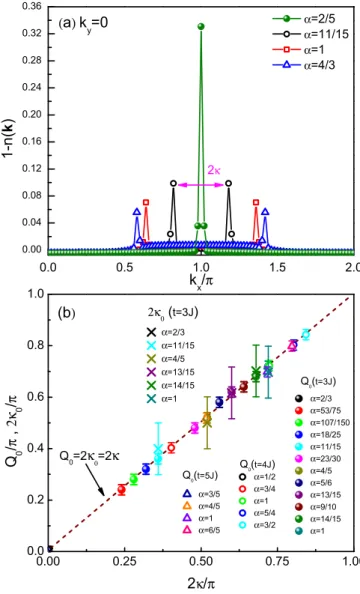
FIG. 4. (Color online) (a) The single-hole momentum distribu-tion (ky =0) for different values of α in the two-leg t-J ladder,
where t /J =3 and the critical value αc=0.7. For α below αc
the distribution displays a quasiparticle peak at kx=π; aboveαc
this quasiparticle peak splits into two symmetric with respect and of a distance κ to kx=π. (b) The wave number of the charge
modulationQ0and the peak distance of the single-hole momentum
distribution 2κare found to be identical to twice the wave number of the oscillation ofE1-hole
G (Nx), i.e.,Q0=2κ=2κ0(dashed line).
Note thatQ0=2κ=2κ0≡0 atα < αc.
To further investigate the relation between the charge modulation and the self-localization we compute the single-hole momentum distribution, defined as 1−σc†kσckσ ≡
1−n(k), wherec†kσandckσ are the Fourier transforms ofc†iσ
andciσ, respectively. As is seen in Fig.4(a), the quasiparticle
picture collapses forα > αc: The quasiparticle peak centered
atkx =πdisappears, split into two small peaks atkx =π±κ
which appear symmetrically relative tokx=π. We stress that
these two peaks are not quasiparticle peaks because they vanish in the thermodynamic limitNx → ∞. They represent instead
left- and right-moving hole waves with momentum of (π±κ) inside the localization volume. Our simulations reveal in ad-dition that the distance 2κbetween these two peaks coincides
12 16 20 24 28 32 36 40 44 48 52 56 60 -0.02
-0.01 0.00 0.01 0.02
0.00 0.25 0.50 0.75 1.00
-0.005 -0.004 -0.003 -0.002 -0.001 0.000
Δ
E
1-hol
e
G
(N
x
)
Nx
(a) Φ= π
(b)
Δ
E
1-hol
e
G
(k)
π−κ0 κ0
k/π
FIG. 5. (Color online) (a) The energy differenceE1-hole G (Nx) of
a single-hole doped two-legt-Jladder displays an oscillation inNx,
with the amplitude decaying exponentially whenNx approximately
is larger than 12. To calculate the energy we compactify the ladder by “gluing” its two ends and let a magnetic flux of=π pierce through it (upper right). (b) The Fourier transformation of this energy difference exhibits two peaks atκ0 andπ−κ0, respectively. Here,
α=13/15 andt /J =3.
with the wave number of the charge modulationQ0[Fig.4(b)]. This suggests that the charge modulation is caused by the interference between the left- and right-moving waves. This will be further elucidated in Sec.IVusing analytic methods.
Finally, we also studied the influence of periodic and antiperiodic boundary conditions on the ground-state energies. We define the difference in energy caused by these two differ-ent boundary conditions asE1-holeG (Nx) and results are shown
in Fig.5(a). The envelope ofE1-hole
G (Nx) turns out to decay
exponentially withNx, consistent with earlier findings [19].
More importantly, this energy difference displays an oscilla-tion inNxincluding a single harmonic: As shown in Fig.5(b)
its Fourier transformation, denoted asE1-holeG (k), exhibits two peaks atκ0andπ−κ0. As inferred from Fig.4(b),κ0=κ.
2. The delocalized regime
It is known that forα < αcthe hole is delocalized, behaving
like a quasiparticle [22], while it has a momentumkx =π
TABLE I. Comparison of main properties of two kinds of single-hole doped two-leg ladders. The notation +(−) stands for the presence (absence) of phenomena listed in the first column.
t-J σ·t-J
α < αc α > αc α >0
Quasiparticle + − +
Self-localization − + −
Charge modulation − + −
Phase strings +(but canceled out) + −
Fig. 2(e) (real space) and Fig. 2(f) (momentum space) the charge modulations disappear completely in this regime.
B. Theσ·t-Jmodel
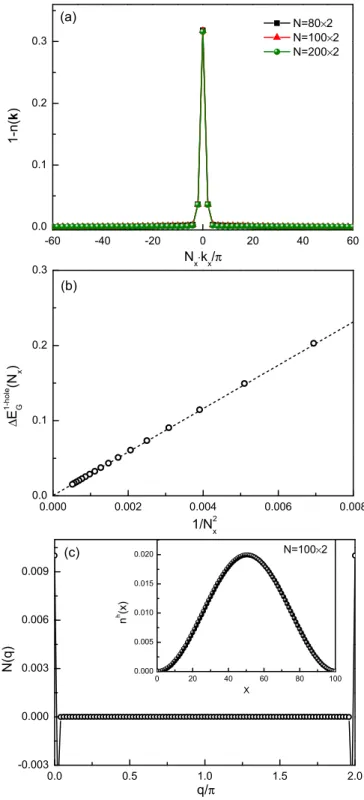
To prove that both the self-localization and the charge modulations are due to the phase strings we repeated the computations for the single-hole doped σ·t-J ladders. The main differences between the t-J and σ·t-J ladders are summarized in Table I. Consistent with the previous work [19], these results demonstrate that in the absence of the phase-string signs the injected hole behaves always as an impeccable quasiparticle with its spectrum exhibiting a sharp quasiparticle peak, irrespective of α and the number of rungs Ny. In fact, we find that upon rescaling according
to kx →Nxkx, the single-hole momentum distribution for
different ladders collapses onto a universal curve [Fig.6(a)] as long as the ladders are sufficiently long, while the finite-size scaling of the energy of the hole reflects that it propagates freely,E1-hole
G ∼Nx−2[Fig.6(b)]. What matters most in the
present context is there is no sign of charge modulations in the absence of the phase strings as illustrated in Fig.6(c). Let us now turn to the path integral considerations, which reveals the physics principle explaining these puzzling observations.
C. The spin response
So far we have only considered the charge response to the single-hole injection. Note that the injection also creates an ↑spin (by removing a ↓spin). Because of the coupling between charge and spin degrees of freedom, we expect that the charge modulation could have prominent consequences on the spin degree of freedom. Specifically, we also simulate the spin density,
Sz(x)≡
y,σ
σc†x,y,σcx,y,σ. (8)
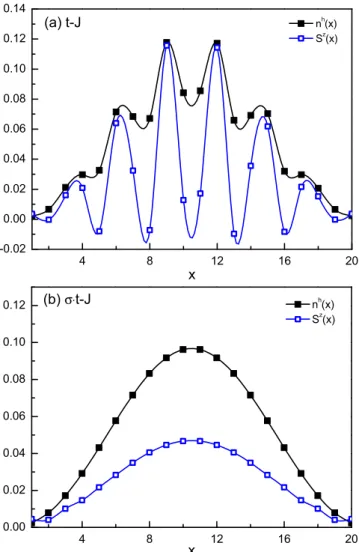
As shown in Fig.7, in thet-J ladders the charge modulation generally leads to a spin modulation. Consistent with this, in theσ ·t-J ladders where the charge modulation disappears, the spin modulation is not observed.
We remark that a modulated spin cloud has been known to accompany a static hole localized on a single site in a two-leg ladder and such modulations have been observed in experiments on Zn doped cuprate ladders (for a review see, e.g., Ref. [24]). This corresponds to the elimination of the hole’s hopping in the t-J andσ·t-J models. As such, these two models are reduced to the same Heisenberg spin
0 20 40 60 80 100
0.000 0.005 0.010 0.015 0.020
0.0 0.5 1.0 1.5 2.0
-0.003 0.000 0.003 0.006 0.009
0.000 0.002 0.004 0.006 0.008
0.0 0.1 0.2 0.3
-60 -40 -20 0 20 40 60
0.0 0.1 0.2 0.3
N=100×2
n
h (x
)
X
(c)
N(q)
q/π
Δ
E
1-hol
e
G
(N
x
)
1/N2x (b)
1-n(
k
)
Nx⋅kx/π
N=80×2
N=100×2
N=200×2
(a)
FIG. 6. (Color online) The simulation results for the single-hole dopedσ·t-J ladder. (a) The single-hole momentum distributions for different ladders fall into a universal curve displaying a sharp quasiparticle peak. (b) The hole’s energy also displays a “free-particle” -like behavior, i.e.,E1-hole
G ∼N−
2
x . (c) Both the spatial
resolution (inset) and the Fourier transformation (main panel) of the hole density profile show the absence of charge modulations. Here, α=1 andt /J=3.
4 8 12 16 20 -0.02
0.00 0.02 0.04 0.06 0.08 0.10 0.12 0.14
4 8 12 16 20
0.00 0.02 0.04 0.06 0.08 0.10
0.12 (b)σ⋅t-J
x
nh(x) Sz(x)
(a) t-J
x
nh(x)
Sz(x)
FIG. 7. (Color online) The simulation shows that int-J ladders the charge modulation is accompanied by the spin modulation (a) while in σ·t-J ladders they both disappear. Here, α=1 andt /J =3.
carried by the hole, which is smoothened in theσ·t-Jladder since the hole’s distribution is smooth. By contrast, in thet-J
ladder, because the hole’s density acquires a spatial modulation in the chain direction, the accompanying spin-1/2, with its dominant amplitude at the opposite site of the same rung in the static limit, exhibits a similar modulation. In other words, the spin modulation found here is directly related to the charge modulation due to the spin-charge correlation. This also explains why the wave numbers of these two modulations are approximately the same, in contrast to many conventional systems in which the charge modulation is usually observed to be the second harmonic of a spin modulation.
IV. PHASE-STRING WORLD HISTORIES: CHARGE MODULATION AND WAVE INTERFERENCE In the exposition of the numerical results it shimmers through that somehow the hole injected into thet-J model yields to the principles of free-particle quantum mechanics. However, very different from the “simple” wave interference mechanisms behind Anderson localization and the Friedel oscillations we are now dealing with a strongly interacting
system. The very origin of the interference phenomena encountered in this context is rooted in many-particle physics of a particularly hairy kind—it is about the way that fermion signs do their work in an extremely strongly coupled fermionic system. It has already been recognized for a long while that these can be conveniently enumerated in terms of the phase strings in the case of thet-J model [14–16], but this does not solve the problem in general terms. In this section we will demonstrate that for the particular problem of a single hole we can keep track of the way that these phase-string signs accumulate in world histories in terms of a simple mean-field-like average associated with long hopping paths of the hole. Departing from this assertion, the sum over histories turns into an effective quantum-mechanics-like wave interference affair that in turn explains semiquantitatively not only the self-localization but also the highly structured behavior in single-hole momentum space that is responsible for the charge modulations observed in the numerical DMRG results. We stress that there is no precedence elsewhere for this physics; the superficial similarities with simple quantum mechanics is deceptive in this regard.
We depart from the single-hole Green’s function, defined as
G(j,i;E)≡ ψ0|c†j↓(E−Ht−HJ)−1ci↓|ψ0, (9)
where ψ0 is the ground state at half filling. Physically, it describes the propagation of an injected hole (realized by removing a↓-spin electron) from sitei, to sitej. According to an exact theorem that applies to thet-J model [14–16], for
E <0 (which is satisfied in this context) this Green’s function can be expressed as
G(j,i;E)=(−1)j−i+1
p
ApeiSp, Sp =π Np↓, (10)
where the summation is over all the pathspconnectingiand
j,Np↓ counts the number of times that the hole exchanges
its position with ↓ spins along a given path p, while the amplitude Ap >0 is determined by all intermediate spin
configurations. Among others, this differs fundamentally from the standard first quantized path integral of quantum mechanics by the following fact: The “action” is associated with the hole acquiring a quantum phaseπ, every time that it exchanges its position with a↓spin. Each world history thereby carries a unique phaseSp that enumerates the sum of these phases
associated with this history, which are the so-called phase strings [14–16]. These correspond to oscillatory factors of a new kind appearing in the path integral, that survive even in Euclidean signature. We will see that these underlie the “quasi-quantum-mechanical” interference phenomena.
From this formulation it is immediately clear why the phase strings are completely canceled in theσ·t-J model, turning it into the powerful tool to isolate their specific influences in the numerical simulations (Fig.6). The additional sign in the hopping term (5) precisely compensates for the quantum phase
π, generated upon the exchange of the positions of the hole and the↓spin. This just amounts to the statement thatSp in
Eq. (10) vanishes identically,
A. The statistical averaging of phase strings and the self-localization
A priorione is dealing with a problem which is in principle very complicated: Different from the quantum mechanical case the phase acquired by the propagating hole is pending the configuration of the↓spins in the spin background, which in turn is subjected to quantum fluctuations on time scales which are typically short as compared to the time scales associated with the long hopping paths as of relevance to the self-localization. Yet, by the law of large numbers we could make a conjecture, i.e.,the phase strings acquire a mean valuein the case that the path is long. Although we have no definitive proof of this conjecture, which turns out to be a difficult task, the very existence of this statistical averaging is intuitively reasonable. Indeed, it reflects that at large time scales quantum spin fluctuations are self-averaged. This lays down a foundation of a mean-field-like approximation and effectively generates a spa-tially homogeneous spin background for the large-scale motion of the hole. In the meanwhile, the self-averaging implies that the quantum phaseSpno longer needs to be multipleπ.
These mean values determine in turn the properties of the coherent propagation of the hole while the fluctuations around this mean just lead to random contributions that cancel out. As we will see shortly, such statistical averaging gives rise to a self-localization mechanism which is a firm analog of the Anderson localization mechanism [21]. Strikingly, in this analog the phase-string mean value plays the role of the phase accumulated when the electron is multiply scattered by quenched disordered potentials. Even more significantly, we will demonstrate underneath that this particular averaging of the “dynamical signs” appears to be a necessary condition for the sharp quantization in the single-hole momentum space which underlies the charge modulations. The line of the argument is as follows: We will first hypothesize that the phase-string averages exist, to subsequently demonstrate that these explain both the self-localization, the sharp quantization in the single-hole momentum space, and the charge modulations on a semiquantitative level.
Although we have no definitive proof, the very existence of phase-string averages is intuitively reasonable. The phase strings are determined by the number of times the hole encounters a↓spin on a particular hopping path. The crucial ingredient required for the averaging is that in a given spin system the probability p↓ for a hole to exchange its position with a ↓-spin nearest neighbor has a well-defined average value. As we will discuss underneath, to establish this probability requires considerations which are specific for a particular spin system but this involves typically local physics that is tractable (e.g., the origin ofαc). Armed with
this hypothesis of statistical averaging we assert that for a hopping path much longer than the lattice constant the phase string associated with that path acquires a mean value, simply by multiplyingp↓with the length of the hopping path,
Sp≈πp↓
p
ds, (12)
wheredsis the line element of the pathpconnectingiandj: The phase associated with the path is just proportional to its length, with a constant of proportionalityp↓which represents
the average of the number of times of the “minus sign events” along this path. Substituting Eq. (12) into Eq. (10) gives
G(j,i;E)∼
p
Apeiπp↓
pds. (13)
Similar to the case of the canonical path integral of quantum mechanics, the exponent with the complex argument causes the world histories to interfere with each other. Notice that theAp
amplitudes are according to the theorem (10) positive-definite quantities for negative energies and therefore all low-energy interference phenomena are entirely due to the phase-string factors. We will see that this simple recipe suffices to explain all the phenomena that were revealed by the DMRG simulations. The “path-integral” formalism (13) makes it easy to mobilize the well-known interference picture for the study of Anderson localization [21]. Consider the spatial correlation of the hole density betweeniandj, given by
|G(j,i;E)|2∼
p,p
ApApeiπp↓(
pds−
pds)
=
p
A2p+
p=p
ApApeiπp↓(
pds−
pds), (14)
where the first and second sum in the second line are called the diagonal and off-diagonal contributions, respectively. The latter describes the interference between the path pair (p,p),
p=p, where p (p) represents the “quantum amplitude” corresponding to (the complex conjugate of) the Green’s function. Depending on both the value of p↓ and the path pair (p,p) the interference may be either constructive or destructive.
Before we demonstrate the specific mechanism behind the charge modulations, we can already discern the mechanism of the self-localization from this path integral formulation:
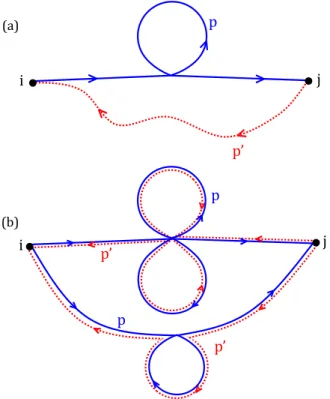
(1) In the special case ofp↓ =1, all paths have the same phase (modulo 2π) since they differ in an even number of hoppings. Consequently, all path pairs regardless of whether they are diagonal or off-diagonal constructively interfere with each other [Fig.8(a)]. This results in a free motion of the hole: All amplitudes are positive in the ground state corresponding with a perfectly delocalized state. This is consistent with the numerical finding of the existence of a quasiparticle forα < αc
in the two-legt-J ladder. In this regime the hole is bound to an↑spin, and this bound state exchanges with singlet dimers in such a way that the phase-string signs cancel, as we will discuss in more detail in the next paragraphs.
(2) For a generic value ofp↓, the phasesSp,p mismatch
FIG. 8. (Color online) Interference between the paths p (blue solid curve) andp(red dashed curve), wherep(p) represents the “quantum amplitude” corresponding to (the complex conjugate of) the single-hole Green’s function. (a) Forp↓=1 all path pairs (p,p), p=p, constructively interfere with each other. This gives rise to the delocalization of the injected hole. (b) Examples lead to constructive interference between path pairs (p,p),p=pfor generic values of p↓, giving rise to the self-localization of the injected hole.
the injected hole observed in the numerical simulations as reported first in Ref. [19] has the same interference picture as familiar Anderson localization, provided that the conjecture of phase-string averages is valid. However, we should stress that to mobilize the canonical analytical theories developed for Anderson localization is a much more difficult task.
B. The single-hole momentum distribution
Different from the standard Anderson localization mech-anism in quenched disordered systems, our numerical sim-ulations reported in the previous section revealed that the phase-string driven self-localization mechanism goes hand in hand with a rather precise quantization of the states in single-hole momentum space, i.e., the sharp peaks in the single-single-hole momentum distribution. The fact that the system retains perfect translational invariance is of course a necessary condition for this to happen. However, it is far from obvious that the single-particle momentum can survive the severe “annealed disorder” associated with the spin fluctuations “seeding” the phase-string interference. In addition, it has to be explained why these single-hole wave vectors are strongly dependent on
α, clearly a parameter controlling the spin fluctuations in the quantum spin background.
It turns out that these behaviors are an immediate conse-quence of our assumption that the phase strings can be treated in a statistical way. Consider again the single-hole Green’s
function (13) and set the coordinates i=(xi,0),j =(xj,0).
Takep↓=1 such that all paths have a positive sign, and it follows directly thatG(j,i;E)∼eiπ(xj−xi): The delocalizing hole behaves as a quasiparticle with ground-state momentum
kx=π. This agrees with the numerical results in this regime;
see the data corresponding toα=2/5 in Fig.4(a).
Taking generic values ofp↓<1 such that self-localization occurs, the exponent in Eq. (13) oscillates rapidly as the path is slightly deformed and these contributions will in general cancel out. Therefore, the sum is dominated by the paths with a stationary phase. Varying the phaseπp↓pds, we find that the resulting geodesic is a straight line connectingi andj. Therefore,
G(j,i;E)∼eiπp↓(xj−xi). (15)
This implies a peak at kx =πp↓ in the momentum
distri-bution. Next, we observe that Eq. (10) is not changed upon replacingSp by−Sp sincee−2iSp=e−2π iN
↓
p =1. Repeating the calculation for this choice, it follows that
G(j,i;E)∼e−iπp↓(xj−xi). (16)
This implies another peak in the momentum distribution, now at kx =2π−πp↓. This explains why the momentum
distribution exhibits two peaks atkx =π±κaccording to the
simulations in the self-localized regime [Fig.4(a)]. This also sheds light on the mysterious dependence on the rung coupling
αof the degree of the splitting of the momentum distribution into two peaks. According to our path-integral consideration,
κ=π(1−p↓)≡πp↑, (17)
with p↑ being the probability for the hole to exchange its position with an↑spin nearest neighbor. The rung coupling is just tuning the number of “spin fluctuations”p↓as of relevance to the “dynamical phasing” of the hole wave function.
Forα < αc the spin pair living on the same rung forms
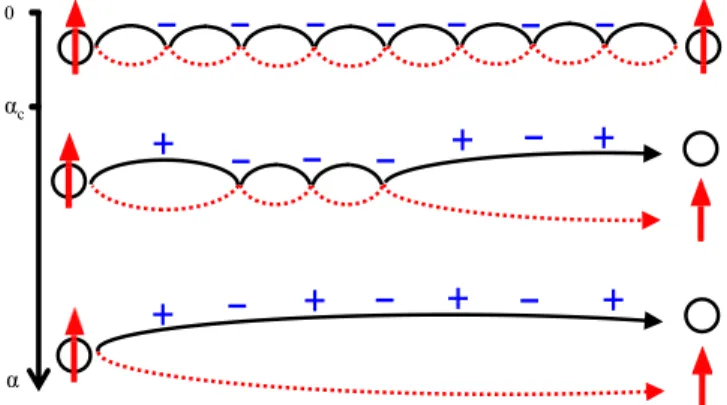
a singlet state. The hole is therefore always bound to an↑ spin (represented by the nodes in Fig.9) since a spin singlet is broken and an ↑ spin is left after removing the ↓-spin electron (the realization of the single hole in the simulations). Subsequently, this hole-↑-spin bound state exchanges its position with the spin singlet in the nearest rung, moving in the ladder as a quasiparticle (cf. Fig.9, top). In more detail, such an exchange is a two-step process: A hole-↓-spin exchange is followed by the recombination of↓and↑spins into the singlet. The former step gives rise to a sign ofeiπ = −1. Because the
hole—bound with an↑spin—could exchange its position only with↓spins,p↑=0 and thereforeκ =0, such thatkx =π.
The phase-string signs cancel out in this background formed by the “strongly bound” valence bond solid and the hole just turns into a quasiparticle which can be continued all the way in principle to a carrier living in an equivalent noninteracting band insulator.
When the rung coupling exceedsαc, the spin singlets in the
FIG. 9. (Color online) Upon injecting a hole an↑spin is left. The motions of the hole and the↑spin are represented by the solid and dashed lines, respectively. The signs,+/−, are the bookkeeping of the exchange of the hole and the↑/↓spins. (Top) Forα < αcthe
hole is always bound to the↑spin and they move together exchanging their position with spin singlets (nodes). (Middle) Forα > αcmany
spin singlets are broken. The hole and↑spin move separately and recombine whenever they exchange their positions simultaneously with spin singlets. (Bottom) Forα→ ∞they move separately in the entire course of time.
increases with α, to eventually saturate at 1/2 when the motions of the hole and the↑spin are fully uncorrelated (cf. Fig.9, bottom). As a result,κ increases withα, to acquire a limiting value ofπ/2, as found in the simulations [cf. Fig.4(a)]. We expect on general grounds that in the limit ofα→ ∞the two-leg ladders should behave essentially in the same way as the t-J model model defined on a strictly one-dimensional chain. It is a well-known result from Luttinger liquid theory that the single hole acquires a momentum κ=π/2 in this spin-charge separated case.
C. The charge modulation
We have collected all the pieces of the puzzle to explain the charge modulations observed in the DMRG simulations. On the one hand we have just learned that due to the annealed phase-string disorder the hole can still propagate coherently at short distances, characterized by sharp single-particle momenta (π±κ), whereκhas now an unconventional dynamical origin. However, at longer distances the phase-string “enhanced backscattering” interferences accumulate, resulting in the effect of the self-localization of the hole. Suppose that the hole wave moves right along thexdirection, as described by∼ei(π−κ)x where the irrelevant amplitude is
ignored and (π−κ) is the hole’s momentum. Next, for a confined motion to occur eventually the right-moving wave must necessarily be reflected, where the scattering arises from those phase-string fluctuations that mimic a disorder potential. The reflected momentum has to be (π+κ) since the momentum is quantized. The reflected wave has the general form, ˜rei(π+κ)x, where ˜r is the complex reflection amplitude.
As a result, the hole density becomes
nh(x)∼ |ei(π−κ)x+re˜ i(π+κ)x|2
=(1+ |r˜|2)−2|r˜|sin(2κx+δ), (18)
where ˜r≡i|r˜|eiδ. This shows that the self-localization in-evitably leads to an interference pattern composed of a single harmonic, with a wave number given by
Q0=2κ, (19)
in agreement with our numerical findings summarized in Figs.3and4(b).
In the long wavelength limit the hole undergoes many of the aforementioned scattering events. These events are independent and so are their scattering phases. Correspond-ingly, the oscillatory factor in Eq. (18) is replaced by sin(2κx+ni=1δi), wherei denotes the scattering event,δi
is the scattering phase, and n is the number of scattering events. For largenone may apply the law of large numbers to the modified factor, obtaining sin(2κx)e−(δ2−(δ2))n/2. The exponent implies that the amplitude of the charge modulation exponentially decays to zero sufficiently far away from the center, consistent with our DMRG simulations [cf. Fig.2(a)]. Since at each scattering event the momentum state (π±κ) is scattered into (π∓κ), the momentum distribution peaks do not need to be associated with quasiparticles. In addition, the self-localization may be considered as a consequence of multiple hole scattering.
We emphasize that the charge modulation cannot emerge from the coupling between spin-exciton excitation and the moving holes. Indeed, the spin-exciton (polaron) leads to similar effects for both t-J and σ·t-J models since these two models have the same spin gapped background. However, the charge modulation disappears totally for the latter model.
D. The oscillation of the ground-state energy in ladder’s length For completeness, let us finalize this section by the analysis of a finite-size effect observed numerically; see Fig.5[as well as Fig. 4(b)]. Specifically, we compactify the ladder into a “ribbon” by gluing its two ends together [cf. Fig.5(a), upper right], turning the system into a ring with a circumferenceNx.
The ground-state energy of this compactified ladder consists of one part associated with the quantum spin system and the other part associated with the hole. To study the latter we note that the hole is already self-localized within the ring. Following the canonical treatise of the finite size effects on the usual Anderson localization in 1D [30] we may view such self-localization—within the ring—as free propagation confined by tunneling barriers placed on both ends. Because of the afore-mentioned compactification the hole may circulate in the ring: This is equivalent to the motion in a 1D “perfect crystal” with a (spatial) period ofNx[Fig.10(a)], where the “unit cells” are
created by periodically placed tunneling barriers. The energy associated with this crystal will have a tight-binding-like band structure. The general form of the hole wave function will be ∼cos(qxNx) whereqxis the effective Bloch momentum.
Let a magnetic flux pierce through the ring. The ground-state energy of the ring will depend on by an amount E1-holeG (). Since the flux couples exclusively to the charge degree of freedom through qx →qx+/Nx,
leaving the spin system unaffected, the flux dependence of the energy directly measures the hole contribution:
E1-hole
G ()≡EG1-hole()−EG1-hole(0). For=π it follows
FIG. 10. (Color online) (a) By enforcing the periodic boundary condition on a ladder we obtain an infinite periodic system. The period of this 1D “crystal” isNx. The self-localized profile of the hole density
(blue solid curve) within a single unit cell implies that the unit cells are weakly coupled to each other via a symmetric tunneling barrier (gray area). (b) A plane wave of momentum (π−κ) incident on a single tunneling barrier is partially transmitted and reflected. The reflected wave has a momentum of (π+κ).
(see Appendix for the proof),
cos(qxNx)∝cos(κNx+δ). (20)
Note thatδis independent ofNx. Taking this into account we
obtain
EG1-hole(Nx)∼cos(κNx+δ). (21)
This shows thatE1-hole
G (Nx) oscillates inNx, with the wave
number,
κ =κ0. (22)
In combination with Eq. (19) this yields
Q0 =2κ=2κ0, (23)
in agreement with the numerical finding [Fig.4(b)].
V. DISCUSSION AND OUTLOOK
Viewed from a general physics perspective, the considera-tions in this work have unveiled a mechanism causing charge modulation associated with strongly interacting fermions at a high density—it is physics associated with the “fermion sign” problem. From this perspective, it is a cousin of the well-known Friedel oscillations of the free fermion gas. In the free case, the “fermion signs” just translate to the Pauli principle having the ramification that the states reacting to an impurity potential or an open boundary are quantum mechanical waves with a short wavelength inversely proportional to the Fermi momentum—this period exhibits itself in the conventional “wiggles.” When Mott-ness takes over for sufficiently strong Coulomb repulsions the basic rules of the fermion statistics is drastically altered: Because of the “stay-at-home” principle the fermions turn into spins at half filling, and spins are distinguishable particles. But in the presence of holes, fermion
exchanges are restored in the “intermediate vicinity” of the delocalizing holes: The phase strings just enumerate how fermion signs re-enter the problem [16–18].
In the single-hole case this boils down to the master rule that world histories in the path-integral formulation acquire an overall sign associated with the number of times that the hole exchanges with a down-spin. As we demonstrated in Sec.IV, for a particular path one can adopt the mean-field-like approximation of averaging over these “dynamical signs.” Strikingly, with this approximation, a quantum-mechanical-like dynamics automatically emerges. For this “emergent quantum mechanics” a disordered potential is self-generated by the fluctuating spin background, and the phase arises from phase strings. By fundamental principles of physics of quantum disordered systems one may naturally expect the occurrence of Anderson localization-like phenomenon. Indeed, we have shown an interference picture for self-localization which is the same as that for familiar Anderson localization. Of course, whether the quantitative behavior, such as the single parameter scaling [26], exists here calls for more sophisticated investigations. The charge modulations occur automatically in this self-localized regime. The averaging of phase strings makes it possible for the hole to propagate in a quantum mechanical fashion, characterized by wave vectors that are determined by the spin fluctuations. These in turn have in common with the usual Friedel oscillations that an effective finite volume is needed for them to form standing waves corresponding to the charge modulations; otherwise the hole would spread out over the entire system and the charge modulations would diminish. However, completely different from the canonical quantum mechanics behind the Friedel oscillations, the modulation period is not at all set by density via the Fermi momentum, but instead by the severity of the quantum spin fluctuations in the vacuum.
We emphasize that the mechanism is anchored in general principle and it should be very robust: By tailoring the right conditions it should be observable in the laboratory. Ideally one would like to depart from an experimental realization of a two-leg ladder system characterized by a rung couplingα
which is strong enough. By electrolyte gating one could then force in holes keeping the system very clean. The interest would be in the regime of very low carrier density, avoiding a metalliclike behavior. The reason is that the long-ranged Coulomb interaction should be kept strong enough to prohibit the pairing tendencies. Ideally a Wigner crystal would be realized; in the vicinity of the carriers one would then expect our charge modulations which are in principle measurable by scanning tunneling spectroscopy. Their modulation wave-length could then be related to the properties of the spin system by carefully quantifying the latter by inelastic neutron scattering and so forth.
This appears to be related to a particular self-averaging of the scattering phaseδcaused by the gapless spin fluctuations, smearing the interference patterns associated with the left-and right-moving propagating modes. The charge modulation is expected to reemerge in a gapless spin system only at finite doping, when the spin-spin correlation in the background becomes short ranged due to the doping.
Given that we are dealing with a strongly interacting, dense fermion system it isa priorinot obvious whether the physics of a single carrier in isolation has dealings with the physics of the system at any finite density. One immediate “complication” is by now well established: Two holes in a t-J ladder will immediately bind in a “Cooper pair,” where yet again the phase strings play a crucial role in the binding mechanism [27]. Turning to the truly finite density case on many-rung ladders (or the 2D square lattice) the DMRG computations already showed a long time ago the 214-like stripes [9]. These appear to be formed in essence from the preformed pairs and these are not supposed to show the single-hole modulations, as we just argued. However, we have preliminary indications that the phase strings also control the truly co-operative translational symmetry breaking in this case, although the precise mechanism appears to be different. Upon switching off the phase strings by employing theσ ·t-J model, we find that the stripes do disappear. We leave a precise analysis of this physics to a future publication.
We wish to mention that discussions on the weak coupling two-leg Hubbard ladders have been well documented where, notably, a standard quasiparticle picture works well [28,29]. An outstanding problem left by the present work is, i.e., how to connect such a weak coupling regime with the strong coupling regime, especially in the parameter regime where the half-filled ground state remains fully gapped in both weak and strong coupling. Based on our present results, we expect that the weak and strong coupling limits might be smoothly connected in the strong rung regime, where the quasiparticle behavior is well established at α < αc in the t-J ladder. Whereas at
α > αc, a “phase transition” in Mott nature is expected so that
the quasiparticle behavior for weak coupling could be replaced by the charge localization for strong coupling observed in this work. This issue is currently under investigation.
Note added. A DMRG paper has recently appeared in Ref. [32], where critical comments on the present work were made. First of all, the numerical simulations in that work confirm some of the main results reported here and in an earlier work [22], namely the charge modulation and the existence of a quantum critical point in the anisotropic t-J ladders. However, the authors of that paper made a drastically different interpretation about the physics happening atα > αc. They
claim that the quasiparticle picture is still valid accompanying the momentum splitting shown in Fig. 4(a) at α > αc, in
contrast to the quasiparticle collapsing and localization picture discussed here. Their arguments are based mainly on the numerical finding of the finiteness of Z =i|φ|c†i↓||2
on both sides ofαc(here|φand|denote the undoped and
one-hole ground states, respectively). But we point out that a finite quasiparticle spectral weight should be associated with the quantityZk= |φ|ck†↓||2, not Z. For a translationally
invariant system, these two quantities are indeed equivalent since the ground state has a well-defined Bloch momentum.
But in the presence of localization and accompanied charge modulation, the translational symmetry is spontaneously broken. Hence, one cannot validate the quasiparticle picture by a finite Z because it may be contributed by a spectrum of momenta in the ground state (recalling Z=kZk). As
a matter of fact, in Fig. 5 we have compared the ground-state energy difference between the periodic and antiperiodic boundary conditions imposed on the charge sector, and the envelope of this energy deviation (as a function of ladder length
Nx) decays exponentially withNx. This Thouless-like criterion
for Anderson localization is a direct characteristic of the hole localization. In particular, the energy difference oscillates with
Nx with a characteristic momentum precisely locked with
the half ofQ0 for the charge modulation [Fig. 4(b)], which has been also naturally explained based on the localization picture in Sec. III D. As one more step, we have further examined theσ·t-J ladder which differs from thet-J ladder solely by switching off the phase-string effect. There, the quasiparticle behavior is recovered: Both charge modulation and localization disappear together with the quantum critical pointαc. This clearly established the connection between the
phase-string effect and the new phase atα > αc.
Finally, we wish to point out that whether the charge modulation is due to the quantum interference of the phase-string effect discussed here or is simply attributed to a standing wave of the quasiparticle as suggested in Ref. [32] has far reaching different physical implications. The authors in Ref. [32] have introduced a phenomenological model claimed to enable adiabatically connecting two phases with a noninteracting band model. However, it has been shown [22] that the two-hole binding energy becomes finite and substantial in the regime ofα > αc. This would be contradictory to the
above quasiparticle picture, where the two-hole state would be adiabatically connected to an unpaired state of the band model given in Ref. [32].
ACKNOWLEDGMENTS
We acknowledge discussions with L. Fu, T. L. Ho, D. H. Lee, J. W. Mei, D. N. Sheng, and X. G. Wen. C.T. would like to thank Yu. P. Bliokh and V. D. Freilikher for teaching him the resonator model of Anderson localization. Work done at Tsinghua University was supported by the NSFC (Grants No. 11174174 and No. 11104154), by the NBRC (973 Program, Grants No. 2010CB923003, No. 2011CBA00108, and No. 2015CB921000), and by the Tsinghua University ISRP. Work by H.C.J. was supported by the Department of Energy, Office of Science, Basic Energy Sciences, Materials Sciences and Engineering Division, under Contract No. DE-AC02-76SF00515. J.Z. acknowledges support of a grant from the John Templeton foundation. The opinions expressed in this publication are those of the authors and do not necessarily reflect the views of the John Templeton foundation.
APPENDIX: PROOF OF EQ. (20)
Similar to Anderson localization in 1D disordered sys-tems [30], the self-localization of the hole injected into at-J
ladder is compactified by a periodic boundary condition, the tunneling barrier, denoted asV(x), is replicated infinite times and periodically positioned in thexdirection: Effectively, we obtain a 1D perfect “crystal” with the “unit cell” of sizeNx
[Fig.10(a)]. In this case the hole’s energy must form a band. Below we largely follow the method of Ref. [31] to study this band.
Suppose that only one tunneling barrier is present, which is assumed to be located atx =0 without loss of generality, and that a plane wave of momentum (π−κ) is incident on the barrier from the left [Fig.10(b)]. The scattered wave must have the form,
ψL(x)=
ei(π−κ)x+re˜ i(π+κ)x, x −Nx 2 , ˜
t ei(π−κ)x, x Nx 2 ,
(A1)
where ˜r and ˜t are the (complex) reflection and transmis-sion amplitudes, respectively. Since the tunneling barrier is symmetric with respect to its center, the following scattered wave,
ψR(x)=
˜
t ei(π+κ)x, x −Nx 2 ,
ei(π+κ)x+re˜ i(π−κ)x, x Nx 2 ,
(A2)
has the same energy [indeed, ψR(−x)=ψL(x)]. In the
scattering region,|x| Nx
2, the wave functionψ(x) must be the superposition ofψL,R(x).
Since the Hamiltonian of the crystal in the region of |x| Nx
2 is identical to that with single tunneling barrier, the wave function in this region must be the same asψ(x). Then, by the Bloch’s theorem we findψ(Nx
2 )=e
iqxNxψ(−Nx 2 ) anddxd ψ(x)|x=Nx2 =e
iqxNx d
dxψ(x)|x=−Nx2 . Recall thatqxis the
Bloch momentum. Substituting Eqs. (A1) and (A2) into these two relations we obtain
cos(qxNx)=
˜
t2−r˜2 2˜t e
iκNx+ 1 2˜te
−iκNx. (A3)
For the self-localization,|t˜|is exponentially small forNxmuch
larger than the localization length. Because of this|t˜| |r˜| ≈ 1, and Eq. (A3) is simplified to
cos(qxNx)=
1 2˜t(−r˜
2eiκNx+e−iκNx). (A4)
Since the left-hand side is real, ˜t and ˜rmust take the general forms of ˜t = |t˜|eiδ and ˜r=i|r˜|eiδ. Substituting them into
Eq. (A4) gives Eq. (20).
[1] J. Zaanen and O. Gunnarsson,Phys. Rev. B40,7391(R) (1989). [2] K. Machida,Physica C158,192(1989).
[3] J. M. Tranquada, B. J. Sternlieb, J. D. Axe, Y. Nakamura, and S. Uchida,Nature (London)375,561(1995).
[4] J. Zaanen, in 100 Years of Superconductivity, edited by H. Rochalla and P. H. Kes (Chapman and Hall, London, in press).
[5] B. Keimer, S. A. Kivelson, M. R. Norman, S. Uchida, and J. Zaanen, Nature (London) 518, 179 (2015) and references therein.
[6] L. E. Hayward, D. G. Hawthorn, R. G. Melko, and S. Sachdev, Science343,1336(2014).
[7] H. Meier, C. P´epin, M. Einenkel, and K. B. Efetov,Phys. Rev. B89,195115(2014).
[8] L. Zhang and J. W. Mei, arXiv:1408.6592, and references therein.
[9] S. R. White and D. J. Scalapino,Phys. Rev. Lett. 80, 1272 (1998).
[10] P. Corboz, T. M. Rice, and M. Troyer,Phys. Rev. Lett.113, 046402(2014).
[11] L. N. Bulaevskii, E. L. Nagaev, and D. L. Khomskii, Zh. Eksp. Teor. Fiz.54, 1562 (1968) [,Sov. Phys. JETP27, 836 (1968)]. [12] W. F. Brinkman and T. M. Rice, Phys. Rev. B 2, 1324
(1970).
[13] S. Schmitt-Rink, C. M. Varma, and A. E. Ruckenstein,Phys. Rev. Lett.60,2793(1988); C. L. Kane, P. A. Lee, and N. Read, Phys. Rev. B39,6880(1989); G. Martinez and P. Horsch,ibid.
44,317(1991).
[14] D. N. Sheng, Y. C. Chen, and Z. Y. Weng,Phys. Rev. Lett.77, 5102(1996).
[15] Z. Y. Weng, D. N. Sheng, Y. C. Chen, and C. S. Ting,Phys. Rev. B55,3894(1997).
[16] Z. Y. Weng,Int. J. Mod. Phys. B21,773(2007), and references therein.
[17] K. Wu, Z. Y. Weng, and J. Zaanen,Phys. Rev. B77,155102 (2008).
[18] J. Zaanen and B. J. Overbosch,Phil. Trans. R. Soc. A369,1599 (2011).
[19] Z. Zhu, H. C. Jiang, Y. Qi, C. S. Tian, and Z. Y. Weng, Sci. Rep. 3, 2586 (2013).
[20] Z. Y. Weng, V. N. Muthukumar, D. N. Sheng, and C. S. Ting, Phys. Rev. B63,075102(2001).
[21] E. Abrahams (ed.),Fifty Years of Anderson Localization(World Scientific, Singapore, 2010).
[22] Z. Zhu and Z. Y. Weng,arXiv:1409.3241. [23] S. R. White,Phys. Rev. Lett.69,2863(1992). [24] E. Dagotto,Rep. Prog. Phys.62,1525(1999).
[25] C. Tian, A. Kamenev, and A. Larkin,Phys. Rev. B72,045108 (2005).
[26] E. Abrahams, P. W. Anderson, D. C. Licciardello, and T. V. Ramakrishnan,Phys. Rev. Lett.42,673(1979).
[27] Z. Zhu, H. C. Jiang, D. N. Sheng, and Z. Y. Weng, Sci. Rep.4, 5419 (2014).
[28] H. Endres, R. M. Noack, W. Hanke, D. Poilblanc, and D. J. Scalapino,Phys. Rev. B53,5530(1996).
[29] R. Konik and A. W. W. Ludwig,Phys. Rev. B64,155112(2001). [30] K. Yu. Bliokh, Yu. P. Bliokh, and V. D. Freilikher, J. Opt. Soc. Am. B 21, 113 (2004); K. Yu. Bliokh, Yu. P. Bliokh, V. Freilikher, S. Savel’ev, and F. Nori,Rev. Mod. Phys. 80, 1201(2008).
[31] N. W. Aschroft and N. D. Mermin,Solid State Physics(Harcourt College Publishers, Fort Worth, 1976).