Intestinal parasitic infection alters bone
marrow derived dendritic cell inflammatory
cytokine production in response to bacterial
endotoxin in a diet-dependent manner
Stacey L. BurgessID1*, Akihiko OkaID2, Bo Liu3, David T. Bolick1, David Noah Oakland1, Richard L. Guerrant1, Luther BarteltID2,3
1 Division of Infectious Diseases and International Health, Department of Medicine, University of Virginia,
Charlottesville, Virginia, United States of America, 2 Center for Gastrointestinal Biology and Disease and the Departments of Medicine, University of North Carolina at Chapel Hill, Chapel Hill, North Carolina, United States of America, 3 Division of Infectious Diseases, Department of Medicine, University of North Carolina, Chapel Hill, North Carolina, United States of America
Abstract
Giardia lamblia is a common intestinal parasitic infection that although often acutely asymp-tomatic, is associated with debilitating chronic intestinal and extra-intestinal sequelae. In previously healthy adults, a primary sporadic Giardia infection can lead to gut dysfunction and fatigue. These symptoms correlate with markers of inflammation that persist well after the infection is cleared. In contrast, in endemic settings, first exposure occurs in children who are frequently malnourished and also co-infected with other enteropathogens. In these children, Giardia rarely causes symptoms and associates with several decreased markers of inflammation. Mechanisms underlying these disparate and potentially enduring outcomes following Giardia infection are not presently well understood. A body of work suggests that the outcome of experimental Giardia infection is influenced by the nutritional status of the host. Here, we explore the consequences of experimental Giardia infection under conditions of protein sufficiency or deficiency on cytokine responses of ex vivo bone marrow derived dendritic cells (BMDCs) to endotoxin stimulation. We show that BMDCs from Giardia- chal-lenged mice on a protein sufficient diet produce more IL-23 when compared to uninfected controls whereas BMDCs from Giardia challenged mice fed a protein deficient diet do not. Further, in vivo co-infection with Giardia attenuates robust IL-23 responses in endotoxin-stimulated BMDCs from protein deficient mice harboring enteroaggregative Escherichia coli. These results suggest that intestinal Giardia infection may have extra-intestinal effects on BMDC inflammatory cytokine production in a diet dependent manner, and that Giardia may influence the severity of the innate immune response to other enteropathogens. This work supports recent findings that intestinal microbial exposure may have lasting influences on systemic inflammatory responses, and may provide better understanding of potential mechanisms of post-infectious sequelae and clinical variation during Giardia and entero-pathogen co-infection. a1111111111 a1111111111 a1111111111 a1111111111 a1111111111 OPEN ACCESS
Citation: Burgess SL, Oka A, Liu B, Bolick DT,
Oakland DN, Guerrant RL, et al. (2019) Intestinal parasitic infection alters bone marrow derived dendritic cell inflammatory cytokine production in response to bacterial endotoxin in a diet-dependent manner. PLoS Negl Trop Dis 13(7): e0007515.
https://doi.org/10.1371/journal.pntd.0007515
Editor: Alessandra Morassutti, PUCRS, BRAZIL Received: November 1, 2018
Accepted: June 4, 2019 Published: July 1, 2019
Copyright:©2019 Burgess et al. This is an open access article distributed under the terms of the
Creative Commons Attribution License, which permits unrestricted use, distribution, and reproduction in any medium, provided the original author and source are credited.
Data Availability Statement: All relevant data are
within the manuscript and its Supporting Information files.
Funding: Work supported by National Institutes of
Author summary
Giardiais a leading cause of gut infection worldwide, with wide variation in acute symp-toms.Giardiainfection in non-endemic regions has also been associated with debilitating chronic intestinal and extra-intestinal sequelae, such as irritable bowel syndrome, often occurring weeks or months after exposure and after the parasite has cleared. Mechanisms underlying howGiardiaresults in an increased risk of chronic intestinal and extra-intesti-nal sequelae are not currently well understood. However, an emerging body of research suggests that intestinal microbial exposures may have long term influences on inflamma-tory cytokine production from innate immune cells, and that this process may help explain persistent inflammatory responses following pathogen infection. We therefore hypothesized thatGiardiainfection could alter innate immune system cells to be more pro-inflammatory. In this work we demonstrate thatGiardiaexposure in a murine model changes the inflammatory profile of bone marrow derived innate immune cells in in a diet dependent manner and in response to bacterial stimuli. These data suggest thatGiardia infection might alter the responsiveness of innate immune cells to other infectious agents or natural products of the host microbiota such as endotoxin. This work may therefore provide better understanding of potential immune mechanisms underlying gut dysfunc-tion following traveler’s diarrhea, as well as variadysfunc-tion in disease severity in endemic regions.
Introduction
Giardia lambliais one of the most commonly reported intestinal parasitic infections world-wide [1–3]. Exposure results in a wide spectrum of outcomes, ranging from asymptomatic colonization, to acute or chronic diarrhea. Increasingly, post-infectious sequelae have been observed that include development of conditions that may be associated with altered inflam-matory profiles [4,5] such as irritable bowel syndrome and chronic fatigue syndrome [6–11]. Mechanisms that might account for the broad range of clinical manifestations of giardiasis are poorly understood. However, there appear to be patterns of clinical and post-infectious out-comes that associate with global regions of high and low enteropathogen burden and malnutri-tion.Giardiainfection outbreaks in adults in resource-abundant regions, including the USA [3] and Norway [10,12], increase risk for post-infectious irritable bowel syndrome (IBS) [3], duodenitis [10,11], persistent elevation of fecal calprotectin [12], and even lingering elevations in serum sCD14 [3,12]. In children living in resource-limited endemic settings with a high prevalence of recurrent and persistent infection, however,Giardiadoes not associate with diar-rhea or routine markers of intestinal inflammation [2,13,14]. Rather, in these children who often have restricted dietary protein intake,Giardiaassociates with increased intestinal perme-ability, but decreased levels of myeloperoxidase (MPO). Also, in endemic settings,Giardia infection is associated with decreased levels of the serum inflammatory mediator CRP [2,13,15,16]. These diminished markers of inflammation associate withGiardiainfection in endemic areas despite the presence of other potentially pro-inflammatory co-enteropathogen exposures such as enteroaggregativeEscherichia coli(EAEC) [17].
We have shown that outcomes during persistent experimentalGiardiainfection in mice are diet dependent [18]. Chronically infected, fully nourished animals develop lymphocytic duo-denitis similar to some chronic infections in adults in low endemicity settings. However, mice fed a protein deficient diet do not [17]. This diet-dependent immune discrepancy is opposite of the otherwise robust mucosal and systemic responses toCryptosporidiumor EAEC seen in
Gut infection alters the cytokine profile of ex vivo bone marrow derived cells
Competing interests: The authors have declared
this protein malnutrition model [17]. Further,Giardiachallenge is sufficient to partially diminish calprotectin responses and MPO responses to EAEC [16–18]. There is an emerging body of research suggesting that previous intestinal exposures such as vaccination, alteration of the microbiota, or pathogen exposure, may have long term influences on systemic inflam-matory cytokine production from innate immune cells [19]. We have previously shown that this process may help explain persistent inflammatory responses and disparate outcomes dur-ing pathogen infection and malnutrition [20–22].
Herein, we hypothesize that the unique immune profiles observed during persistentGiardia infection reflectGiardia-mediated alterations in innate, antigen presenting cell responses [23,24], and that host nutritional status influences these responses.Ex vivo, GM-CSF expanded bone marrow derived dendritic cells (BMDCs) represent a heterogeneous mix of terminally differentiated cells that can provide anin vitromodel of characteristics of the innate antigen presenting cell population in an animal [25–27]. Therefore, we profiled the cytokine response of BMDCs fromGiardiachallenged mice on either a protein deficient or a protein sufficient control diet to explore how diet andGiardiainfection might influence cytokine production following exposure to endotoxin. We also explored the relationship betweenGiardia coloniza-tion followed by co-infeccoloniza-tion with EAEC during malnutricoloniza-tion, as these co-infeccoloniza-tions are com-mon in malnourished children in endemic settings.
Results
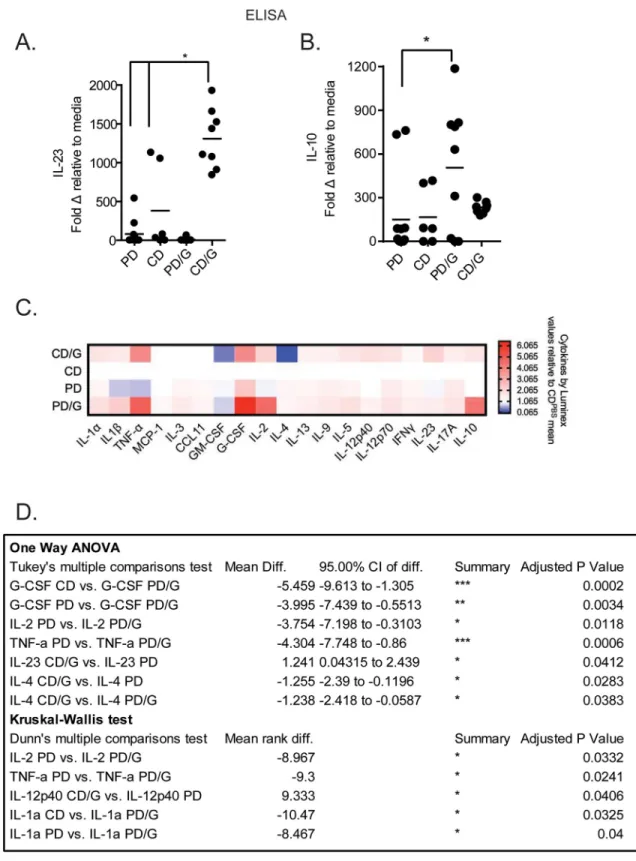
In order to test howGiardiainfection during protein deficiency and sufficiency influences cytokine production fromex vivomarrow cells we isolated bone marrow from infected and uninfected mice, expanded BMDCs, challenged with LPS, and measured cytokine production via ELISA and a multiplex Luminex assay. We show that BMDCs fromGiardia-challenged mice produce more IL-23 in response to endotoxin than uninfected controls (Fig 1A, 1C and 1D) as measured via ELISA and Luminex. In contrast, BMDCs fromGiardia-challenged mice fed a protein deficient (PD) diet do not exhibit this increase and produce more IL-10 as mea-sured via ELISA (Fig 1B).Giardia-challenged mice on a protein deficient diet (PD) also pro-duce more G-CSF, TNF-a, IL-1a and IL-2 than uninfected mice as measured by Luminex (Fig 1C and 1D). BMDCs fromGiardiachallenged mice on the protein sufficient control diet (CD) produce higher levels of IL-23, as mentioned above, as well as IL-12p40 (but decreased IL-4) as measured via Luminex (Fig 1C and 1D).
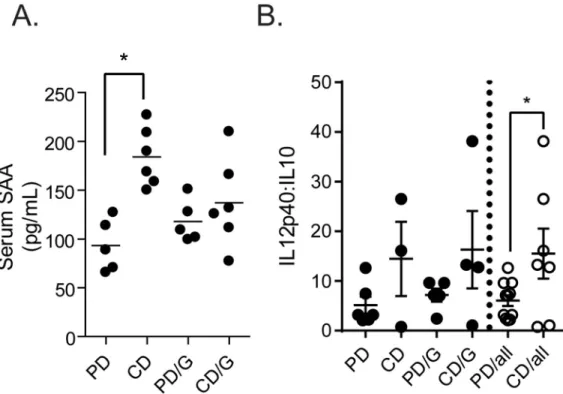
Previous studies have suggested that serum mediators, such as the damage associated molecular pattern molecule serum amyloid A (SAA) produced by the host, may increase IL-23 production fromex vivoLPS stimulated BMDCs [28]. In these experiments, uninfected mice fed the control diet (CD) have significantly higher levels of serum SAA than those fed the pro-tein deficient (PD) diet (Fig 2A). Macrophages and myeloid derived antigen presenting cells (APCs), which BMDCs partially model, can be differentially polarized towards a Th1 or Th2 cytokine producing phenotype, with a continuum of phenotypes in between [29]. Therefore, we utilized the IL-12p40:IL-10 ratio as a marker of potential dendritic cell/macrophage polar-ity [30,31], and found reduced IL-12p40:IL-10 ratios in LPS-stimulated BMDCs from mice fed the PD diet (Fig 2B).
Fig 1. Cytokine production by BMDCs in response to endotoxin is altered during giardiasis in a diet dependent manner. Bone
marrow cells were harvested from male C57BL/6 mice on a control (CD) or protein deficient diet (PD) that were challenged (CD/G, PD/
G) or free ofGiardia lamblia(CD, PD). Cells were cultured in RPMI with 10% FBS, supplemented on days 0 and 3 with GM-CSF (10ng/
mL; Peprotech), and harvested on day 6. 2.5x10⁵cells were plated per well of a round bottom 96-well dish, and treated with cell culture
media or LPS for 24h. Cytokine levels in the supernatants were determined by ELISA (A, B) and Luminex (C, D). For ELISA data, values
in (A, B) represent fold change of cytokines after LPS treatment (1mcg/mL) compared to unstimulated media control.�= p<0.05
IL-23 in response to LPS (Fig 3). However, priorGiardiacolonization attenuated IL-23 responses in BMDCs from EAEC infected mice.
Discussion
Previous studies have suggested thatGiardiamay exacerbate colitis in genetically pre-disposed hosts (IL10-/-mice) through increased IL12p40/IL-23 production [32]. Our results suggest thatGiardiainfection led to extra-intestinal effects on BMDC inflammatory cytokine responses to LPS stimulation in a diet-dependent manner. Precise mechanisms underlying these differences in cytokine profile are not yet understood. Intestinal infection with one organism, or vaccination [21], may persistently alter innate immune populations to provide a more robust response to infection with unrelated pathogens in a process coined “trained immunity” [19,33]. The mechanism of trained immunity is not well understood, but may epi-genetic changes in genes important in innate immunity have been implicated [34–37]. These changes might include methylation of H3K27 and H3K4 histones associated with promotor regions of multiple genes, including, but not limited to, IL-23 [36].
Way ANOVA with Tukey post-test. For Luminex data, Cytokine values were normalized using fold-change relative to the mean value of the control group (C, D) for each cytokine and then compared using One-Way ANOVA, Kruskal-Wallis and Tukey or Dunn’s post-test (D), p-value is as reported in D. A,B N = 6–12 mice, C,D n = 3–6 mice.
https://doi.org/10.1371/journal.pntd.0007515.g001
Fig 2. Serum SAA levels and IL-12p40: IL-10 ratios are altered by diet. Male C57BL/6 mice on a control (CD) or
protein deficient diet (PD) were challenged (/G) or free ofGiardia lambliaand serum level of SAA in each group was
determined by ELISA (A). Bone marrow cells were harvested from male C57BL/6 mice on a control (CD) or protein
deficient diet (PD) that were challenged (/G) or free ofGiardia lamblia. Cells were cultured in RPMI with 10% FBS,
supplemented on days 0 and 3 with GM-CSF (10ng/mL; Peprotech), and harvested on day 6. 2.5x10⁵cells were plated per
well of a round bottom 96-well dish, and treated with cell culture media or LPS for 24h. Cytokine levels in the
supernatants were determined by ELISA (B)�= p<0.05 One-Way ANOVA, Tukey posttest. n = 5–6 mice.
Fig 3.Giardiaco-infection during protein deficiency andEnteroaggregative Escherichia coli(EAEC) infection suppresses increased IL-23 production by EAEC. Bone marrow cells were harvested from male C57BL/6 mice that
were on a protein deficient diet (PD) upon arrival at 3 weeks of age and then challenged withG.lamblia7 days later.
Six days afterG.lambliaexposure mice were challenged with enteroaggregativeE.coli(EAEC) and euthanized on day
21 followingGiardiainfection. Cells were cultured in RPMI with 10% FBS, supplemented on days 0 and 3 with
GM-CSF (10ng/mL; Peprotech), and harvested on day 6. 2.5x10⁵cells were plated per well of a round bottom 96-well
Epigenetic effects may underlie the phenotype observed in our data, and this will be exam-ined in future studies. In our experiments, mice on a control diet (CD) have significantly higher levels of SAA than those fed the protein deficient (PD diet). Disparate serum levels of host derived damage associated molecular pattern molecules (DAMPs) such as the acute phase protein serum amyloid A (SAA), are induced by the microbiota or infection and have been shown to be important in upregulating expression of epigenetic mediators such as histone demethylases and IL-23 in both myeloid cell lines and bone marrow [28,36,38–40]. SAA treat-ment preferentially increases secretion of IL-23, but not IL-12, in peripheral blood monocytes and the THP-1 monocytic cell line [40]. Increased serum levels of SAA, and direct culture with SAA, has been associated with increased IL-23 production in murine dendritic cells [28]. Thus, the decreased SAA during protein deficiency could limit IL-23 production from BMDCs followingGiardiainfection. Interestingly, decreased serum SAA associates with linear growth restriction early in life in endemic areas, but as enteric infection exposures likeGiardia accumulate, elevated SAA predicts poorer subsequent growth [41].
Altered serum SAA may not fully explain our result as other metabolites or mediators may play a significant role in modulating cytokine production. Indeed, we observed increased IL-10 production by BMDCs fromGiardia-infected mice fed the protein deficient diet. Further-more, using the IL-12p40:IL-10 ratio as a marker of potential dendritic cell/macrophage polar-ity [30,31], we found reduced IL-12p40:IL-10 ratios in LPS-stimulated BMDCs from mice fed the PD diet. These data suggest that the combination ofGiardiaand protein deficiency leads to an altered inflammatory environment. This in turn, might influence the inflammatory pro-file of innate immune cells during co-infection with another enteropathogen. Thus, to deter-mine whether harboringGiardiaduring protein deficiency altered BMDC responses following EAEC co-infection, BMDCs from mice infected withGiardiaalone, EAEC alone, orGiardia and then EAEC or were stimulated with LPS. Again,Giardiaalone did not significantly increase IL-23 in these protein deficient mice, whereas EAEC alone did. PriorGiardia coloni-zation, however, resulted in a minimal IL-23 response to EAEC. These data are consistent with our previous finding thatGiardiaalters intestinal calprotectin production during EAEC co-infection, and points toGiardia-mediated changes in myeloid cell activation [17]. IL-10 signal-ing dursignal-ingGiardiainfection has recently been shown to be important in preventing develop-ment of colitis in mice [32]. Interestingly, our results suggest that during malnutritionGiardia infection may induce innate IL-10 production, that might partially attenuate inflammatory responses induced by enteropathogens that cause enterocolitis.
Previousin vitroco-culture experiments have demonstrated thatGiardiacan directly mod-ulate cytokine production from dendritic cells, with disparate outcomes depending on culture conditions, agonists, and cell type [9,42]. To our knowledge this is the first demonstration that a non-invasive intestinal protozoa alters systemic cytokine profiles of BMDCs and in a diet-dependent manner. Our work suggests thatGiardiainfection during, or in the absence of pro-tein malnutrition, might persistently alter the responsiveness of innate immune cells to later challenge with infectious agents or their products, as measured via cytokine production (Fig 4). Limitations of the work involve the model system of innate bone marrow immune derived cells (BMDCs). Thus, we were unable to define the specific cell within the BMDC culture responsible for the functional response. Future studies will examine the influence ofGiardia infection on proliferation, trafficking and inflammatory potential of hematopoietic and dis-tinct intestinal myeloid immune populations [39].Giardiainfection may also influence
dish, and treated with cell culture media or LPS for 24h. Cytokine levels in the supernatants were determined by ELISA
(B)�= p<0.05 One-Way ANOVA, Tukey posttest. n = 9 mice.
hematopoietic cells, as previous studies have suggested that changes in the cytokine respon-siveness of BMDCs mediated by the microbiota also correlate with changes in myeloid precur-sor cells in the marrow [28,39]. This work is beyond the scope of the current investigation however. In conclusion, we demonstrate that intestinalGiardiainfection has extra-intestinal effects on BMDC inflammatory cytokine production in a diet dependent manner. Further-more,Giardiainfection during protein deficiency and co-infection attenuates innate IL-23 responses elicited by the co-infecting enteropathogen (EAEC). Ultimately these studies may help provide better understanding of potential immune mechanisms underlying a range of post-infectious gut dysfunction, environmental enteric dysfunction [43] and other extra-intes-tinal sequelae due to enteropathogen infection, as well as clinical variability.
Materials and methods
Giardia lamblia
and enteroaggregative
Escherichia coli
preparations
Gerbil-passaged purifiedG.lambliaH3 (Assemblage B) cysts were purchased from Water-borne, Inc. (New Orleans, LA). Cysts were washed and diluted in PBS and used within 48 hours of arrival. The EAEC strain 042 was originally obtained from James Nataro at the Uni-versity of Virginia. For each experiment, a separate inoculum of 109/mouse was grown from a glycerol stocked maintained at -80˚C and prepared in DMEM high glucose medium. All path-ogen preparations were maintained on ice until administered via oral gavage using 22-gauged feeding needles in 100μL volumes. Uninfected controls were similarly gavaged with either 100 μL of PBS (forGiardia) or DMEM high glucose (for EAEC) control.
Fig 4. Diet-dependent changes in bone marrow derived dendritic cell inflammatory cytokine production occur during bothGiardiaandGiardia
and enteroaggregativeE.coli(EAEC) co-infection. We observed increased inflammatory cytokine production (IL-23) from bone marrow derived
DCs isolated fromGiardiaInfected mice when the mice were on a protein sufficient diet compared to uninfected mice (1). EAEC infected mice on a
protein deficient diet also produced more IL-23 (2). BMDCs derived fromGiardiainfected mice on a protein deficient diet produced more IL-10 when
compared to uninfected mice however (3). The increase in IL-23 observed during EAEC infection was lost when the mice were infected withGiardia
prior to EAEC (4). This data suggests thatGiardiainfection during protein sufficiency may alter the inflammatory profile of bone marrow derived
cells. Conversely, the parasite may attenuate increased IL-23 production from marrow derived cells during malnutrition and coinfection with other enteric pathogens.
https://doi.org/10.1371/journal.pntd.0007515.g004
Animals, diets, and infection. All experiments were performed using weaned male
C57BL/6 mice received from Jackson Laboratories at 3 weeks of age. Mice were initiated on either a protein deficient diet (PD; 2% protein, Teklad, Envigo) or an isocaloric control diet (CD; 20% protein, Teklad, Envigo) upon arrival. Mice were randomized into weight-matched groups and continued on experimental diets ad libitum throughout the duration of the experi-ment. Mice were challenged with 107purifiedG.lambliacysts (Assemblage B, H3, Water-borne, Inc) after 21 days on diet (day of life 42). For EAEC experiments C57BL/6 males were initiated on the protein deficient diet upon arrival at 3 weeks of age and then challenged with G.lamblia7 days later. Six days afterG.lambliamice were challenged with enteroaggregative E.coli(EAEC). Uninfected controls received PBS-PBS sham gavages at each infection time-point. Mice were euthanized and tissues were harvested in two batches consisting of equal numbers of mice from each of the four experimental groups, on either day 20 or 21 after Giardiachallenge. N = 3–12 mice per group were utilized for all experiments and all data is included inS1 Data.
Bone marrow derived dendritic cell (BMDC) culture. Bone marrow cells were harvested
and immediately cryopreserved on-site at UNC-CH according to prior published methods [28]. Cryopreserved cells were transported on dry ice to the University of Virginia and stored at -80 ˚C. Cells were thawed and cultured in RPMI with 10% FBS supplemented on days 0 and 3 with GM-CSF (10 ng/mL; Peprotech), and harvested on day 6. Forin vitroexperiments, 2.5x10⁵cells were plated per well of a round-bottom 96-well dish, and treated with lipopolysac-charide (Ultra-pure LPS-EK, Invitrogen, 1mcg/mL) for 24h. Cytokines in the supernatants were determined by ELISA (IL-23, IL-10 R&D Systems) and Luminex (DropArray 96 plate for Bio-PlexTM, Curiox). Cells from at least three mice per group, in duplicate, were utilized. Results were analyzed using One Way ANOVA or, Kruskal-Wallis test with Turkey or Dunn’s post -test, based on Shapiro–Wilk test for normality, in Graphpad Prism 7 software (San Diego, CA).
Serum SAA was measured by ELISA (Abcam, Cambridge, England, ab157723).
Ethics statement
All experiments and procedures were approved by the Institutional Animal Care and Use Committee of the University of North Carolina at Chapel Hill (IACUC # 15–345). All experi-ments were performed according to provisions of the USA Animal Welfare Act of 1996 (Public Law 89.544).
Supporting information
S1 Data. All data presented in this manuscript is available in digital format in an excel xlsx worksheet.
(XLSX)
Acknowledgments
Appreciations to Rose Viguna Thomas-Beckett and Carlton Anderson at UNC for technical help with experiments. Thanks to James Nataro for providing EAEC.
Author Contributions
Conceptualization: Stacey L. Burgess, Akihiko Oka, David T. Bolick, David Noah Oakland,
Data curation: Stacey L. Burgess, David Noah Oakland, Richard L. Guerrant, Luther Bartelt.
Formal analysis: Stacey L. Burgess, Akihiko Oka, Bo Liu, David T. Bolick, David Noah
Oak-land, Luther Bartelt.
Funding acquisition: Stacey L. Burgess, Richard L. Guerrant, Luther Bartelt.
Investigation: Stacey L. Burgess, Akihiko Oka, Bo Liu, David T. Bolick, David Noah Oakland,
Luther Bartelt.
Methodology: Stacey L. Burgess, Akihiko Oka, Bo Liu, David T. Bolick, David Noah Oakland,
Richard L. Guerrant, Luther Bartelt.
Project administration: Stacey L. Burgess, Luther Bartelt.
Resources: Stacey L. Burgess, Luther Bartelt.
Software: Stacey L. Burgess.
Supervision: Stacey L. Burgess, Luther Bartelt.
Validation: Stacey L. Burgess, David Noah Oakland, Luther Bartelt.
Visualization: Stacey L. Burgess, David Noah Oakland, Luther Bartelt.
Writing – original draft: Stacey L. Burgess, Akihiko Oka, Bo Liu, David T. Bolick, David
Noah Oakland, Richard L. Guerrant, Luther Bartelt.
Writing – review & editing: Stacey L. Burgess, Akihiko Oka, Bo Liu, David T. Bolick, David
Noah Oakland, Richard L. Guerrant, Luther Bartelt.
References
1. Kotloff KL, Nataro JP, Blackwelder WC, Nasrin D, Farag TH, Panchalingam S, et al. Burden and aetiol-ogy of diarrhoeal disease in infants and young children in developing countries (the Global Enteric Multi-center Study, GEMS): a prospective, case-control study. Lancet. Elsevier; 2013; 382: 209–22.https:// doi.org/10.1016/S0140-6736(13)60844-2
2. Rogawski ET, Bartelt LA, Platts-Mills JA, Seidman JC, Samie A, Havt A, et al. Determinants and Impact of Giardia Infection in the First 2 Years of Life in the MAL-ED Birth Cohort. J Pediatric Infect Dis Soc. Oxford University Press; 2017; 6: 153–160.https://doi.org/10.1093/jpids/piw082PMID:28204556
3. Nakao JH, Collier SA, Gargano JW. Giardiasis and Subsequent Irritable Bowel Syndrome: A Longitudi-nal Cohort Study Using Health Insurance Data. J Infect Dis. Oxford University Press; 2017; 215: 798– 805.https://doi.org/10.1093/infdis/jiw621PMID:28329069
4. Komaroff AL. Inflammation correlates with symptoms in chronic fatigue syndrome. Proc Natl Acad Sci U S A. National Academy of Sciences; 2017; 114: 8914–8916.https://doi.org/10.1073/pnas.1712475114 PMID:28811366
5. Sinagra E, Pompei G, Tomasello G, Cappello F, Morreale GC, Amvrosiadis G, et al. Inflammation in irri-table bowel syndrome: Myth or new treatment target? World J Gastroenterol. Baishideng Publishing Group Inc; 2016; 22: 2242–55.https://doi.org/10.3748/wjg.v22.i7.2242PMID:26900287
6. Muhsen K, Cohen D, Levine MM. Can Giardia lamblia infection lower the risk of acute diarrhea among preschool children? J Trop Pediatr. Oxford University Press; 2014; 60: 99–103.https://doi.org/10.1093/ tropej/fmt085PMID:24158113
7. Veenemans J, Mank T, Ottenhof M, Baidjoe A, Mbugi E V, Demir AY, et al. Protection against diarrhea associated with Giardia intestinalis Is lost with multi-nutrient supplementation: a study in Tanzanian chil-dren. PLoS Negl Trop Dis. Public Library of Science; 2011; 5: e1158.https://doi.org/10.1371/journal. pntd.0001158PMID:21666789
8. Solaymani-Mohammadi S, Singer SM. Giardia duodenalis: the double-edged sword of immune responses in giardiasis. Exp Parasitol. NIH Public Access; 2010; 126: 292–7.https://doi.org/10.1016/j. exppara.2010.06.014PMID:20599999
9. Bartelt LA, Sartor RB. Advances in understanding Giardia: determinants and mechanisms of chronic sequelae. F1000Prime Rep. Faculty of 1000 Ltd; 2015; 7: 62.https://doi.org/10.12703/P7-62PMID: 26097735
10. Wensaas K-A, Langeland N, Hanevik K, Mørch K, Eide GE, Rortveit G. Irritable bowel syndrome and chronic fatigue 3 years after acute giardiasis: historic cohort study. Gut. 2012; 61: 214–9.https://doi. org/10.1136/gutjnl-2011-300220PMID:21911849
11. Hanevik K, Wensaas K-A, Rortveit G, Eide GE, Mørch K, Langeland N. Irritable Bowel Syndrome and Chronic Fatigue 6 Years After Giardia Infection: A Controlled Prospective Cohort Study. Clin Infect Dis. 2014; 59: 1394–400.https://doi.org/10.1093/cid/ciu629PMID:25115874
12. Hanevik K, Hausken T, Morken MH, Strand EA, Mørch K, Coll P, et al. Persisting symptoms and duode-nal inflammation related to Giardia duodeduode-nalis infection. J Infect. 2007; 55: 524–530.https://doi.org/10. 1016/j.jinf.2007.09.004PMID:17964658
13. Donowitz JR, Alam M, Kabir M, Ma JZ, Nazib F, Platts-Mills JA, et al. A Prospective Longitudinal Cohort to Investigate the Effects of Early Life Giardiasis on Growth and All Cause Diarrhea. Clin Infect Dis. Oxford University Press; 2016; 63: 792–797.https://doi.org/10.1093/cid/ciw391PMID: 27313261
14. Campbell DI, McPhail G, Lunn PG, Elia M, Jeffries DJ. Intestinal inflammation measured by fecal neop-terin in Gambian children with enteropathy: association with growth failure, Giardia lamblia, and intesti-nal permeability. J Pediatr Gastroenterol Nutr. 2004; 39: 153–7. Available:http://www.ncbi.nlm.nih.gov/ pubmed/15269619PMID:15269619
15. Cotton JA, Motta J-P, Schenck LP, Hirota SA, Beck PL, Buret AG. Giardia duodenalis infection reduces granulocyte infiltration in an in vivo model of bacterial toxin-induced colitis and attenuates inflammation in human intestinal tissue. Wallace J, editor. PLoS One. Public Library of Science; 2014; 9: e109087. https://doi.org/10.1371/journal.pone.0109087PMID:25289678
16. Cotton JA, Amat CB, Buret AG. Disruptions of Host Immunity and Inflammation by Giardia Duodenalis: Potential Consequences for Co-Infections in the Gastro-Intestinal Tract. Pathog (Basel, Switzerland). Multidisciplinary Digital Publishing Institute (MDPI); 2015; 4: 764–92.https://doi.org/10.3390/ pathogens4040764PMID:26569316
17. Bartelt LA, Bolick DT, Mayneris-Perxachs J, Kolling GL, Medlock GL, Zaenker EI, et al. Cross-modula-tion of pathogen-specific pathways enhances malnutriCross-modula-tion during enteric co-infecCross-modula-tion with Giardia lam-blia and enteroaggregative Escherichia coli. PLoS Pathog. Public Library of Science; 2017; 13: e1006471.https://doi.org/10.1371/journal.ppat.1006471PMID:28750066
18. Bartelt LA, Roche J, Kolling G, Bolick D, Noronha F, Naylor C, et al. Persistent G. lamblia impairs growth in a murine malnutrition model. J Clin Invest. American Society for Clinical Investigation; 2013; 123: 2672–2684.https://doi.org/10.1172/JCI67294PMID:23728173
19. Netea MG, Joosten LAB, Latz E, Mills KHG, Natoli G, Stunnenberg HG, et al. Trained immunity: A pro-gram of innate immune memory in health and disease. Science (80-). American Association for the Advancement of Science; 2016; 352: aaf1098–aaf1098.https://doi.org/10.1126/science.aaf1098 PMID:27102489
20. Burgess SL, Gilchrist CA, Lynn TC, Petri WA. Parasitic protozoa and interactions with the host intestinal microbiota. Infect Immun. American Society for Microbiology; 2017; IAI.00101-17.https://doi.org/10. 1128/IAI.00101-17PMID:28584161
21. Bartelt LA, Bolick DT, Kolling GL, Roche JK, Zaenker EI, Lara AM, et al. Cryptosporidium Priming Is More Effective than Vaccine for Protection against Cryptosporidiosis in a Murine Protein Malnutrition Model. PLoS Negl Trop Dis. Public Library of Science; 2016; 10: e0004820.https://doi.org/10.1371/ journal.pntd.0004820PMID:27467505
22. Burgess SL, Lu M, Ma JZ, Naylor C, Donowitz JR, Kirkpatrick BD, et al. Inflammatory markers predict episodes of wheezing during the first year of life in Bangladesh. Respir Med. 2015; 110: 53–57.https:// doi.org/10.1016/j.rmed.2015.11.009PMID:26631486
23. Kamda JD, Singer SM. Phosphoinositide 3-kinase-dependent inhibition of dendritic cell interleukin-12 production by Giardia lamblia. Infect Immun. American Society for Microbiology; 2009; 77: 685–93. https://doi.org/10.1128/IAI.00718-08PMID:19047410
24. Obendorf J, Renner Viveros P, Fehlings M, Klotz C, Aebischer T, Ignatius R. Increased expression of CD25, CD83, and CD86, and secretion of IL-12, IL-23, and IL-10 by human dendritic cells incubated in the presence of Toll-like receptor 2 ligands and Giardia duodenalis. Parasit Vectors. 2013; 6: 317. https://doi.org/10.1186/1756-3305-6-317PMID:24499474
25. Lutz MB, Inaba K, Schuler G, Romani N. Still Alive and Kicking: In-Vitro-Generated GM-CSF Dendritic Cells! Immunity. 2016; 44: 1–2.https://doi.org/10.1016/j.immuni.2015.12.013PMID:26789912
26. Helft J, Bo¨ttcher JP, Chakravarty P, Zelenay S, Huotari J, Schraml BU, et al. Alive but Confused: Het-erogeneity of CD11c + MHC Class II + Cells in GM-CSF Mouse Bone Marrow Cultures. Immunity. 2016; 44: 3–4.https://doi.org/10.1016/j.immuni.2015.12.014PMID:26789913
28. Burgess SL, Buonomo E, Carey M, Cowardin C, Naylor C, Noor Z, et al. Bone Marrow Dendritic Cells from Mice with an Altered Microbiota Provide Interleukin 17A-Dependent Protection against Entamoeba histolytica Colitis. MBio. 2014; 5: e01817.https://doi.org/10.1128/mBio.01817-14PMID:25370489
29. Labonte AC, Tosello-Trampont A-C, Hahn YS. The role of macrophage polarization in infectious and inflammatory diseases. Mol Cells. Korean Society for Molecular and Cellular Biology; 2014; 37: 275–85. https://doi.org/10.14348/molcells.2014.2374PMID:24625576
30. Torres D, Ko¨hler A, Delbauve S, Caminschi I, Lahoud MH, Shortman K, et al. IL-12p40/IL-10 Producing preCD8α/Clec9A+ Dendritic Cells Are Induced in Neonates upon Listeria monocytogenes Infection. Coers J, editor. PLOS Pathog. Public Library of Science; 2016; 12: e1005561.https://doi.org/10.1371/ journal.ppat.1005561PMID:27074026
31. Ma X, Yan W, Zheng H, Du Q, Zhang L, Ban Y, et al. Regulation of IL-10 and IL-12 production and func-tion in macrophages and dendritic cells. F1000Research. Faculty of 1000 Ltd; 2015; 4.https://doi.org/ 10.12688/f1000research.7010.1PMID:26918147
32. Dann SM, Le CHY, Hanson EM, Ross MC, Eckmann L. Giardia Infection of the Small Intestine Induces Chronic Colitis in Genetically Susceptible Hosts. J Immunol. American Association of Immunologists; 2018; ji1700824.https://doi.org/10.4049/jimmunol.1700824PMID:29898958
33. Hong M, Sandalova E, Low D, Gehring AJ, Fieni S, Amadei B, et al. Trained immunity in newborn infants of HBV-infected mothers. Nat Commun. 2015; 6: 6588.https://doi.org/10.1038/ncomms7588 PMID:25807344
34. Saeed S, Quintin J, Kerstens HHD, Rao NA, Aghajanirefah A, Matarese F, et al. Epigenetic program-ming of monocyte-to-macrophage differentiation and trained innate immunity. Science (80-). 2014; 345: 1251086–1251086.https://doi.org/10.1126/science.1251086PMID:25258085
35. van der Meer JWM, Joosten LAB, Riksen N, Netea MG. Trained immunity: A smart way to enhance innate immune defence. Mol Immunol. 2015; 68: 40–44.https://doi.org/10.1016/j.molimm.2015.06.019 PMID:26597205
36. Yan Q, Sun L, Zhu Z, Wang L, Li S, Ye RD. Jmjd3-mediated epigenetic regulation of inflammatory cyto-kine gene expression in serum amyloid A-stimulated macrophages. Cell Signal. 2014; 26: 1783–1791. https://doi.org/10.1016/j.cellsig.2014.03.025PMID:24703936
37. Yoshida K, Maekawa T, Zhu Y, Renard-Guillet C, Chatton B, Inoue K, et al. The transcription factor ATF7 mediates lipopolysaccharide-induced epigenetic changes in macrophages involved in innate immunological memory. Nat Immunol. 2015; 16: 1034–1043.https://doi.org/10.1038/ni.3257PMID: 26322480
38. De Santa F, Narang V, Yap ZH, Tusi BK, Burgold T, Austenaa L, et al. Jmjd3 contributes to the control of gene expression in LPS-activated macrophages. EMBO J. 2009; 28: 3341–52.https://doi.org/10. 1038/emboj.2009.271PMID:19779457
39. Burgess SL, Saleh M, Cowardin CA, Buonomo E, Noor Z, Watanabe K, et al. Role of Serum Amyloid A, GM-CSF and Bone Marrow Granulocyte-Monocyte Precursor Expansion in Segmented Filamentous Bacteria-mediated Protection from Entamoeba histolytica. Infect Immun. American Society for Microbi-ology; 2016; IAI.00316-16.
40. He R, Shepard LW, Chen J, Pan ZK, Ye RD. Serum amyloid A is an endogenous ligand that differen-tially induces IL-12 and IL-23. J Immunol. 2006/09/05. 2006; 177: 4072–4079. 177/6/4072https://doi. org/10.4049/jimmunol.177.6.4072PMID:16951371
41. Guerrant RL, Leite AM, Pinkerton R, Medeiros PHQS, Cavalcante PA, DeBoer M, et al. Biomarkers of Environmental Enteropathy, Inflammation, Stunting, and Impaired Growth in Children in Northeast Bra-zil. PLoS One. 11: e0158772.https://doi.org/10.1371/journal.pone.0158772PMID:27690129
42. Lee H-YH-Y, Kim J, Noh HJ, Kim H-PH-P, Park S-JS-J. Giardia lamblia binding immunoglobulin protein triggers maturation of dendritic cells via activation of TLR4-MyD88-p38, and ERK1/2 MAPKs. Parasite Immunol. 2014; 36: 627–646.https://doi.org/10.1111/pim.12119PMID:24871487
43. Arndt MB, Walson JL. Enteric infection and dysfunction—A new target for PLOS Neglected Tropical Diseases. Ryan ET, editor. PLoS Negl Trop Dis. Public Library of Science; 2018; 12: e0006906.https:// doi.org/10.1371/journal.pntd.0006906PMID:30592716