CWTS Working Paper Series
Paper number CWTS-WP-2013-005
Publication date September 25, 2013
Number of pages 33
Email address corresponding author [email protected]
Address CWTS Centre for Science and Technology Studies (CWTS) Leiden University
P.O. Box 905 2300 AX Leiden The Netherlands
www.cwts.leidenuniv.nl
A smart local moving algorithm for large-scale
modularity-based community detection
A smart local moving algorithm for large-scale
modularity-based community detection
Ludo Waltman and Nees Jan van Eck
Centre for Science and Technology Studies, Leiden University, The Netherlands {waltmanlr, ecknjpvan}@cwts.leidenuniv.nl
We introduce a new algorithm for modularity-based community detection in large networks. The algorithm, which we refer to as a smart local moving algorithm, takes advantage of a well-known local moving heuristic that is also used by other algorithms. Compared with these other algorithms, our proposed algorithm uses the local moving heuristic in a more sophisticated way. Based on an analysis of a diverse set of networks, we show that our smart local moving algorithm identifies community structures with higher modularity values than other algorithms for large-scale modularity optimization, among which the popular ‘Louvain algorithm’ introduced by Blondel et al. (2008). The computational efficiency of our algorithm makes it possible to perform community detection in networks with tens of millions of nodes and hundreds of millions of edges. Our smart local moving algorithm also performs well in small and medium-sized networks. In short computing times, it identifies community structures with modularity values equally high as, or almost as high as, the highest values reported in the literature, and sometimes even higher than the highest values found in the literature.
PACS: 89.75.Hc, 02.10.Ox
1. Introduction
The problem of community detection in networks has received a lot of attention in
the network science literature (Fortunato, 2010). Communities are clusters of closely
connected nodes within a network. A popular approach to community detection is
based on the idea of optimizing a modularity function. Modularity functions were
introduced by Newman and Girvan (2004), and the idea of detecting communities by
optimizing a modularity function was proposed by Newman (2004a). Nowadays,
These variants for instance deal with directed or weighted networks (Leicht &
Newman, 2008; Newman, 2004b), or they offer a resolution parameter (Reichardt &
Bornholdt, 2006) that makes it possible to customize the granularity level at which
communities are detected and to mitigate the so-called resolution limit problem
(Fortunato & Barthélemy, 2007). Also, some variants of the modularity-based
community detection approach use modularity functions with a somewhat modified
mathematical structure (e.g., Reichardt & Bornholdt, 2006; Traag, Van Dooren, &
Nesterov, 2011; Waltman, Van Eck, & Noyons, 2010).
Optimizing modularity is an NP-hard problem (Brandes et al., 2008). Exact
algorithms (Aloise et al., 2010; Brandes et al., 2008; Xu, Tsoka, & Papageorgiou,
2007) can be used only for small networks. Many different heuristic algorithms have
been proposed for modularity optimization (Fortunato, 2010), for instance based on
agglomerative hierarchical clustering (Clauset, Newman, & Moore, 2004; Newman,
2004a), simulated annealing (Guimerà, Sales-Pardo, & Amaral, 2004; Reichardt &
Bornholdt, 2006), extremal optimization (Duch & Arenas, 2005), spectral
optimization (Newman, 2006a, 2006b), mean field annealing (Lehmann & Hansen,
2007), and conformational space annealing (Lee, Gross, & Lee, 2012). However,
most of the algorithms proposed in the literature are suitable only for small and
medium-sized networks.
In this paper, we introduce an optimization algorithm that produces high-quality
results even for very large networks (e.g., with tens of millions of nodes and hundreds
of millions of edges). For small and medium-sized networks, our algorithm can be
considered more or less competitive with the best algorithms presently available. The
algorithm that we introduce builds on ideas from existing algorithms for large-scale
modularity optimization (Blondel, Guillaume, Lambiotte, & Lefebvre, 2008; Rotta &
Noack, 2011). These algorithms will be used as benchmarks for assessing the
performance of our algorithm. We refer to our proposed algorithm as a smart local
moving (SLM) algorithm. As discussed in detail below, this is because our algorithm
relies heavily on a well-known local moving heuristic. Compared with existing
algorithms, our SLM algorithm uses this local moving heuristic in a more
sophisticated way, and it therefore produces more accurate results.
This paper is organized as follows. In Section 2, we discuss two existing
algorithms for large-scale modularity optimization. We also introduce an iterative
We compare the performance of the various algorithms in Section 4. We first consider
small and medium-sized networks, and we then focus on large networks. We
summarize the conclusions of our research in Section 5.
2. Existing algorithms
Before introducing our SLM algorithm, we first discuss two existing algorithms
for large-scale modularity optimization. One is the algorithm proposed by Blondel et
al. (2008), often referred to as the Louvain algorithm. The other is an extension of the
Louvain algorithm with a so-called multilevel refinement procedure, as proposed by
Rotta and Noack (2011). Moreover, for both algorithms, we introduce an approach
that allows the results of the algorithms to be improved further. Basically, this
approach consists of running the algorithms in an iterative fashion, with the output of
each run serving as input for the next run.
Both in this section and in the next one, we use the well-known karate club
network of Zachary (1977) to illustrate the various algorithms. The karate club
network represents the friendships between 34 members of a karate club.
Modularity
The modularity function of Newman and Girvan (2004) can be written as
( )
∑
− = j i j i j iij c c
m k k A m Q , , 2 2 1
δ
, (1)where ci denotes the community to which node i has been assigned, Aij denotes
whether there is an edge between nodes i and j (Aij = 1) or not (Aij = 0),
∑
= j ij i A k (2)denotes the degree of node i, and
denotes the total number of edges in the network. The function
δ
(ci, cj) indicateswhether nodes i and j belong to the same community. It equals 1 if ci = cj and 0
otherwise. The modularity function in (1) also applies to weighted networks
(Newman, 2004b). The only difference is that in the case of a weighted network Aij
may take any non-negative value. Higher values of the modularity function in (1) are
supposed to indicate a better community structure. Given a network of n nodes, the
idea of modularity-based community detection therefore is to try to find values of c1, …, cn that maximize (1). These values of c1, …, cn are considered to represent the optimal community structure for the given network.
A number of variants of the modularity function in (1) have been proposed in the
literature. These variants for instance include a resolution parameter (Reichardt &
Bornholdt, 2006), or they have a somewhat modified mathematical structure (e.g.,
Reichardt & Bornholdt, 2006; Traag et al., 2011; Waltman et al., 2010). In general,
optimization techniques developed for the original modularity function can also be
applied to the alternative modularity functions discussed in the literature. In this
paper, our focus is on the optimization of the original modularity function, but our
proposed approach extends to other modularity functions as well.
Local moving heuristic
A frequently used approach to modularity optimization is the local moving
heuristic. The idea of the local moving heuristic is to repeatedly move individual
nodes from one community to another in such a way that each node movement results
in a modularity increase. The local moving heuristic iterates over the nodes in a
network in a random order. For each node, it is determined whether it is possible to
increase modularity by moving the node from its current community to a different
(possibly empty) community. If increasing modularity is indeed possible, the node is
moved to the community that results in the largest modularity gain. The local moving
heuristic keeps moving nodes until a situation is reached in which there are no further
possibilities to increase modularity through individual node movements. The local
moving heuristic has been quite popular in the literature (Barber & Clark, 2009;
Blondel et al., 2008; Liu & Murata, 2010; Mei, He, Shi, Wang, & Li, 2009; Rotta &
Noack, 2011; Schuetz & Caflisch, 2008; Ye, Hu, & Yu, 2008), probably in part
because it can be implemented in an efficient way (Blondel et al., 2008). The local
large-scale modularity optimization discussed below and in our SLM algorithm introduced
in the next section.
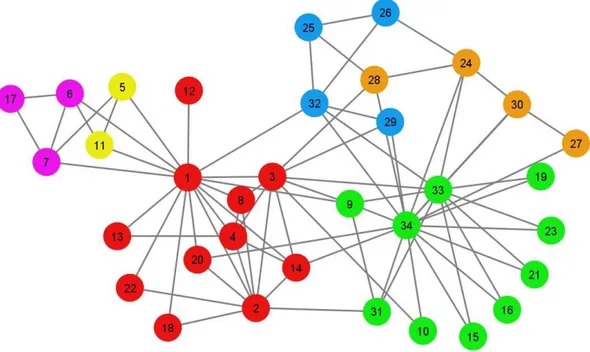
Figure 1 shows the karate club network, using colors to indicate an example of a
community structure that has been obtained using the local moving heuristic. Starting
from a situation in which each of the 34 nodes in the network belongs to its own
community, the local moving heuristic has identified a solution in which the nodes are
organized into six communities. This solution has a modularity value of 0.3791. The
solution has the property that it is not possible to increase modularity by moving an
individual node from one community to another. In other words, the solution is
locally optimal with respect to individual node movements. We emphasize that the
solution shown in Figure 1 is not unique. Depending on the order in which the local
moving heuristic iterates over the nodes in the network, other solutions may be
obtained as well.
Louvain algorithm
The Louvain algorithm proposed by Blondel et al. (2008) starts with each node in
a network belonging to its own community. So initially each community is a
singleton, consisting of one node only. The algorithm then uses the local moving
heuristic to obtain an improved community structure. Hence, individual nodes are
moved from one community to another until no further increase in modularity can be
achieved. At this point, a reduced network is constructed (Arenas, Duch, Fernández,
& Gómez, 2007). This is a network in which each node corresponds with a
community in the original network. In the reduced network, the weight of an edge
between two nodes equals the total weight of all edges between the nodes in the two
corresponding communities in the original network. Edges between nodes in the same
community in the original network result in self links in the reduced network. As a
consequence of the close relation between the original network and the reduced one,
merging communities in the original network is equivalent to grouping the
corresponding nodes in the reduced network together in a community.
The Louvain algorithm proceeds by assigning each node in the reduced network to
its own singleton community. Next, the local moving heuristic is applied in the
reduced network, in exactly the same way as was done before in the original network.
Based on the resulting community structure, a second reduced network is constructed.
network. Hence, the local moving heuristic is applied and another reduced network is
constructed. The Louvain algorithm continues in this way until a network is obtained
that cannot be reduced further. One now has a sequence of successively smaller
networks. This sequence of networks corresponds with a sequence of mergers of
smaller communities into larger ones, and in this way it determines the final
assignment of the nodes in the original network to communities.
Figure 2 summarizes the main steps of the Louvain algorithm.1 As can be seen,
the algorithm can be conveniently written in a recursive form. The initial assignment
of nodes to communities is not specified in Figure 2. However, as explained above,
the Louvain algorithm normally starts with each node in a network belonging to its
own community. We will get back to this below.
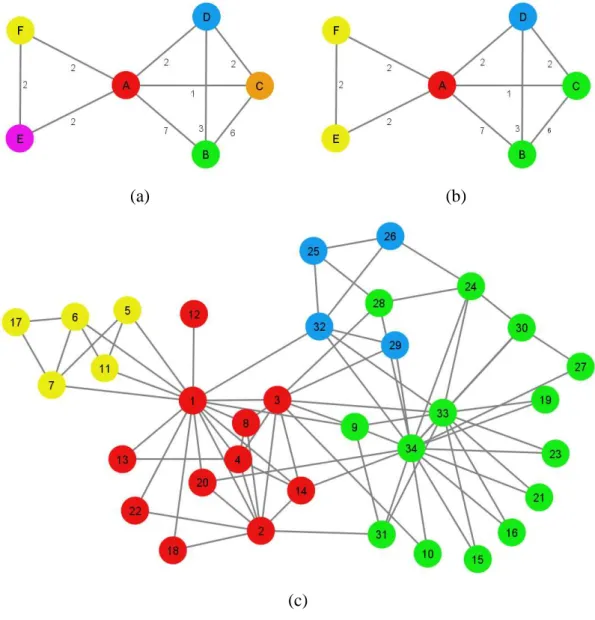
Figure 3 illustrates the application of the Louvain algorithm to the karate club
network. First, the local moving heuristic is used. Suppose this gives the community
structure shown in Figure 1. As already mentioned, this community structure has a
modularity value of 0.3791. Figure 3(a) shows the reduced network corresponding
with the community structure shown in Figure 1. The result of applying the local
moving heuristic in the reduced network is shown in Figure 3(b). As can be seen, the
local moving heuristic has assigned nodes B and C in the reduced network to the same
community. The same holds for nodes E and F. The community structure shown in
Figure 3(b) has a modularity value of 0.4151. Based on this community structure, a
second reduced network can be constructed and again the local moving heuristic can
be applied. However, it turns out that no further increase in modularity is possible.
Figure 3(c) shows the final community structure in the original network.
Louvain algorithm with multilevel refinement
When a community structure has been obtained using the Louvain algorithm, one
can be sure that the community structure cannot be improved further by merging
communities. In other words, the Louvain algorithm finds solutions that are locally
optimal with respect to community merging. However, solutions found by the
Louvain algorithm need not be locally optimal with respect to movements of
1
individual nodes between communities. It may be possible to improve a solution by
moving an individual node from one community to another.
An extension of the Louvain algorithm with a multilevel refinement procedure
was proposed by Rotta and Noack (2011). The multilevel refinement procedure
improves solutions found by the Louvain algorithm in such a way that they become
locally optimal with respect to individual node movements. To accomplish this, the
local moving heuristic is used not only for creating an initial community structure for
the nodes in a network but also for refining the final community structure. Moreover,
this is done not only at the level of the original network but also at the level of each of
the reduced networks.
A summary of the main steps of the Louvain algorithm with multilevel refinement
is provided in Figure 4. As can be seen, the Louvain algorithm with multilevel
refinement is identical to the original Louvain algorithm except that at each level of
the recursion the local moving heuristic is used twice instead of once. Like in the
original Louvain algorithm, the local moving heuristic is used for creating an initial
community structure, but in addition it is also used for refining the final community
structure. In this way, it is guaranteed that a community structure is obtained that
cannot be improved further by moving individual nodes from one community to
another.
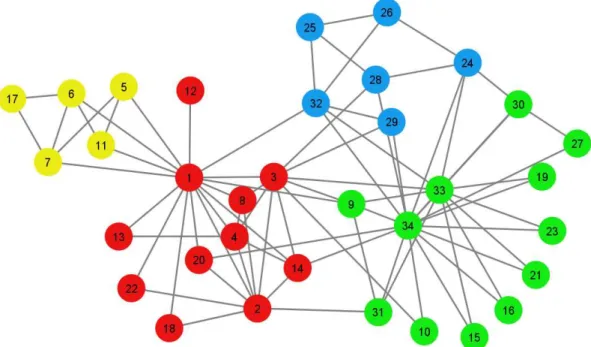
In the case of our karate club example, extending the Louvain algorithm with the
multilevel refinement procedure has the effect that, after the result shown in Figure
3(c) has been obtained, the local moving heuristic is applied a second time in the
original network. It turns out that modularity can be increased by moving node 28
from the green to the blue community. Next, another modularity increase is possible
by also moving node 24 to the blue community. This yields the community structure
shown in Figure 5. This community structure corresponds with a modularity value of
0.4198. No further increase in modularity turns out to be possible through individual
node movements. In fact, the community structure shown in Figure 5 is known to be
globally optimal (Aloise et al., 2010).
Iterative variant of the Louvain algorithm
So far, we have discussed two algorithms for large-scale modularity optimization:
extended with the multilevel refinement procedure of Rotta and Noack (2011). We
now introduce an approach that aims to further improve the results of both algorithms.
The basic idea of our proposed approach is to run the algorithms in an iterative
way, where the output of each iteration is used as input for the next iteration. In the
case of the original Louvain algorithm, we start by assigning each node in a network
to its own community, and we then run the algorithm as specified in Figure 2. This is
the first iteration of the algorithm. After the first iteration has been completed, we run
the algorithm a second time, but this time we do not start with each node belonging to
its own community. Instead, we start with the community structure obtained in the
first iteration of the algorithm. This means that the second iteration allows individual
nodes to move between the communities produced in the first iteration. After the
second iteration has been completed, we run the algorithm a third time, using the
community structure obtained in the second iteration as input. In this way, more and
more iterations of the algorithm can be performed. The iterative approach can be
stopped as soon as performing an additional iteration of the algorithm does not result
in a modularity increase. Alternatively, the approach can be stopped after a certain
maximum number of iterations. Of course, the same iterative approach can also be
applied to the Louvain algorithm with multilevel refinement.
As we have discussed, the Louvain algorithm finds solutions that are locally
optimal with respect to community merging, but these solutions need not be locally
optimal with respect to individual node movements. On the other hand, solutions
found by the Louvain algorithm with multilevel refinement are locally optimal with
respect to individual node movements, but they need not be locally optimal with
respect to community merging. However, when our iterative approach is applied to
the Louvain algorithm, either with or without multilevel refinement, it becomes
possible to find solutions that are locally optimal with respect to both community
merging and individual node movements. When the iterative approach has converged
(i.e., the last iteration did not result in a modularity increase), one can be sure to have
a community structure that cannot be improved further either by merging
communities or by moving individual nodes from one community to another.
3. Smart local moving algorithm
Using the above discussed iterative approach, the Louvain algorithm, either with
respect to both community merging and individual node movements. Solutions will in
general not be locally optimal with respect to community splitting or with respect to
movements of sets of nodes from one community to another. Like the iterative variant
of the Louvain algorithm, the SLM algorithm that we introduce in this section
identifies solutions that are locally optimal with respect to both community merging
and individual node movements. In addition, however, the SLM algorithm also
searches for possibilities to increase modularity by splitting up communities and by
moving sets of nodes from one community to another. As we will see, this is
accomplished by using the local moving heuristic in a more sophisticated way than is
done in the Louvain algorithm.
Like the Louvain algorithm, the SLM algorithm starts with each node in a network
being assigned to its own singleton community. Also like the Louvain algorithm, the
SLM algorithm uses the local moving heuristic to obtain an improved community
structure. However, after the local moving heuristic has been applied, the SLM
algorithm takes a different approach than the Louvain algorithm. As we have seen in
the previous section, the Louvain algorithm proceeds by constructing a reduced
network. The SLM algorithm will also construct a reduced network, but before it does
so, it first takes some other steps.
The SLM algorithm iterates over all communities in the present community
structure. For each community, a so-called subnetwork is constructed. This is a copy
of the original network that includes only the nodes belonging to the specific
community of interest. The SLM algorithm then uses the local moving heuristic to
identify communities in the subnetwork. Each node in the subnetwork is first assigned
to its own singleton community, and then the local moving heuristic is applied. In
some cases, this yields a community structure consisting of one big community that
includes all nodes in the subnetwork. In other cases, a community structure is
obtained consisting of multiple communities that each include some of the nodes in
the subnetwork.
After a community structure has been obtained for each of the subnetworks, the
SLM algorithm constructs a reduced network. In the reduced network, each node
corresponds with a community in one of the subnetworks. The SLM algorithm then
performs an initial assignment of the nodes in the reduced network to communities.
same community in the reduced network. Hence, for each subnetwork, there is one
community in the reduced network.2
At this point, the entire process starts all over again, but this time based on the
reduced network rather than the original one. So first the local moving heuristic is
applied in the reduced network, and then for each community in the reduced network
a subnetwork is constructed and communities in the subnetwork are identified. This is
the starting point for the construction of a second reduced network, after which the
entire process again repeats itself. The SLM algorithm moves on in this way until a
network is obtained that cannot be reduced further.
Figure 6 offers a summary of the main steps of the SLM algorithm. The algorithm
is again written in a recursive form. The SLM algorithm is similar to the Louvain
algorithm outlined in Figure 2 except that, due to the idea of applying the local
moving heuristic at the level of subnetworks, communities can be split up and sets of
nodes can be moved from one community to another. In this way, the SLM algorithm
has more freedom in searching for high-quality solutions to the modularity
optimization problem.
To illustrate the SLM algorithm, we again consider our karate club example. We
first go back to Figure 1. This figure shows the community structure obtained by
applying the local moving heuristic in the original network. There are six
communities, each indicated using a different color. As explained above, after
applying the local moving heuristic in the original network, for each community a
subnetwork is constructed. The six subnetworks that are obtained in this way are
shown in Figure 7(a). The local moving heuristic is applied in each of these
subnetworks. In the green, blue, purple, and yellow subnetworks, this results in all
nodes being assigned to the same community. This is not the case for the red and
orange subnetworks. These subnetworks are each split up into two communities. In
Figure 7(a), this is indicated by displaying some nodes using circles and others using
squares.
2
Figure 7(b) shows the reduced network that is obtained. There are eight nodes in
the reduced network, one for each community in a subnetwork. Nodes corresponding
with communities in the same subnetwork are initially assigned to the same
community in the reduced network. The result of applying the local moving heuristic
in the reduced network is shown in Figure 7(c). As can be seen, nodes A1 and A2 in
the reduced network have remained in the same community. However, node C1,
which initially was in a community with node C2, has been assigned to the same
community as node D. The next step is to construct subnetworks based on the
community structure shown in Figure 7(c), to apply the local moving heuristic in each
subnetwork, to construct a second reduced network, and to apply the local moving
heuristic in this network. However, we do not show any further results, since it turns
out that the community structure shown in Figure 7(c) cannot be improved further.
The corresponding community structure in the original network is shown in Figure 5.
Hence, in this particular example, the SLM algorithm identifies the same community
structure as the Louvain algorithm with multilevel refinement. As mentioned before,
this community structure is known to be globally optimal.
Like the Louvain algorithm, the SLM algorithm can be run in an iterative way. In
the first iteration of the algorithm, we start from an initial situation in which each
node in a network is assigned to its own community. In the second iteration, we start
with nodes being assigned to the communities obtained in the first iteration. In the
third iteration, the communities obtained in the second iteration are our starting point,
and so on. There is one important difference with the iterative variant of the Louvain
algorithm. At some point, the iterative variant of the Louvain algorithm, either with or
without multilevel refinement, converges. This happens when a community structure
is obtained that cannot be improved further either by merging communities or by
moving individual nodes from one community to another. In the case of the iterative
variant of the SLM algorithm, there is no convergence like this. When running the
SLM algorithm in an iterative way, the algorithm keeps searching for possibilities to
increase modularity by splitting up communities and by moving sets of nodes from
one community to another. Hence, in the case of the iterative variant of the SLM
algorithm, it may always be possible to obtain further improvements in community
4. Results
In this section, we compare the performance of our SLM algorithm with the
performance of the Louvain algorithm, both with and without multilevel refinement.
The performance of the algorithms is compared using 13 small and medium-sized
networks and six large networks. In the case of the small and medium-sized networks,
we also make a comparison with the best results reported in the literature. All
networks that we use are unweighted and undirected and do not have loops. Some
networks have more than one connected component. In that case, all connected
components are included, not only the largest one.
The results presented in this section were obtained using our own implementations
of the original Louvain algorithm, the Louvain algorithm with multilevel refinement,
and the SLM algorithm. The algorithms were implemented in Java. The
implementations along with some documentation can be downloaded from
www.ludowaltman.nl/slm/. Although in this paper our focus is on unweighted
networks, the implementations also support weighted networks. In addition, support is
offered for a resolution parameter (Reichardt & Bornholdt, 2006) that can be used to
customize the granularity level at which communities are detected.
All calculations reported below were performed on a system with an Intel Xeon
CPU (L5520 @ 2.27 GHz) and 64 GB internal memory.
Results for small and medium-sized networks
To analyze the performance of our SLM algorithm in the case of small and
medium-sized networks, we take an approach that is similar to the one used by Lee at
al. (2012). Lee et al. introduced a new algorithm for modularity optimization referred
to as conformational space annealing (CSA). They used 13 small and medium-sized
networks to evaluate the performance of their algorithm. It turned out that for each of
the 13 networks the CSA algorithm was able to identify a solution with a modularity
value higher than or equal to the highest modularity value reported in the literature.
Because of the excellent performance of the CSA algorithm, we use it as a
benchmark for assessing the performance of the SLM algorithm. We also use the
same 13 networks as were used by Lee et al. (2012). The first columns of Table 1
report for each of these networks the number of nodes and edges as well as the highest
increasing order of their number of nodes. The modularity values reported in Table 1
for the CSA algorithm have been taken from Tables 2 and 3 in the paper by Lee et al.
For each of the 13 networks, we tested three algorithms: The original Louvain
algorithm, the Louvain algorithm with multilevel refinement, and the SLM algorithm.
Each algorithm was run 100 times using different random numbers.3 Each algorithm
run consisted of 100 iterations. For each combination of a network and an algorithm,
we determined the highest modularity value obtained at the end of the 100th iteration
of the 100 algorithm runs. In addition, in order to analyze the effect of performing
multiple iterations of an algorithm, we also determined the highest modularity value
obtained at the end of the first iteration of the 100 algorithm runs.
All results are reported in Table 1. The table does not show the modularity values
themselves. Instead, the table shows the difference between a modularity value and
the corresponding modularity value obtained using the CSA algorithm. Negative
values indicate that an algorithm is performing worse than the CSA algorithm.
Positive values indicate a better performance than the CSA algorithm. In the case of
an equal performance, no value is shown.
Based on Table 1, the following observations can be made:
• In the case of the smallest networks, the original Louvain algorithm, the Louvain algorithm with multilevel refinement, and the SLM algorithm all
perform equally well as the CSA algorithm, even with only one iteration per
algorithm run. In fact, in the case of the first four networks listed in Table 1,
all algorithms identify solutions with modularity values equal to those
obtained using exact algorithms (Aloise et al., 2010).
• With 100 iterations per algorithm run, the SLM algorithm can be considered more or less competitive with the CSA algorithm. There are four networks for
which the SLM algorithm performs worse than the CSA algorithm, but the
differences are small (at most 0.2% difference in modularity value). On the
other hand, there is one network for which the SLM algorithm outperforms the
CSA algorithm, but again the difference is not very large (0.5% difference in
modularity value). Except for the smallest networks discussed above, the SLM
algorithm consistently outperforms the original Louvain algorithm and the
Louvain algorithm with multilevel refinement, with differences in modularity
value of at most 1.0%. Notice that the original Louvain algorithm and the
Louvain algorithm with multilevel refinement have (almost) the same
performance.
• With only one iteration per algorithm run, the SLM algorithm performs significantly worse than the CSA algorithm (except for the smallest networks).
Moreover, the SLM algorithm is also significantly outperformed by the
Louvain algorithm with multilevel refinement. The SLM algorithm performs
at about the same level as the original Louvain algorithm. Notice that the
Louvain algorithm with multilevel refinement has (almost) the same
performance regardless of the number of iterations (1 or 100) per algorithm
run.
In summary, it can be concluded that in the case of small and medium-sized networks
the SLM algorithm is able to compete with the best algorithms presently available, but
in order to do so it is crucial to perform a sufficiently large number of iterations per
algorithm run.
The importance of performing a sufficiently large number of iterations of the SLM
algorithm is also illustrated in Figure 8. Based on 1300 runs of the SLM algorithm
(i.e., 100 runs for each of the 13 networks), the figure shows for each iteration the
percentage of all runs that resulted in a modularity increase. The same statistics are
also reported for the original Louvain algorithm and for the Louvain algorithm with
multilevel refinement. In the case of the original Louvain algorithm, it turns out that
after four iterations all 1300 algorithm runs had converged. In the case of the Louvain
algorithm with multilevel refinement, it took only three iterations for all 1300
algorithm runs to converge. The results obtained using the SLM algorithm are quite
different. As discussed in Section 3, the SLM algorithm keeps searching for
possibilities to increase modularity. Indeed, Figure 8 shows that in iteration 10 still
about 19% of the 1300 runs of the SLM algorithm resulted in a modularity increase.
Even in iteration 100, a modularity increase still took place in almost 2% of the
Finally, let us consider the issue of computing time. It turns out that in terms of
computing time the SLM algorithm compares quite favorably with the CSA
algorithm. The total time required to perform 100 runs of the SLM algorithm was less
than 10 seconds for the nine smallest networks (in terms of number of nodes), less
than one minute for the E-mail and Erdos02 networks, and less than two minutes for
the PGP network. For the condmat2003 network, the largest network among our 13
small and medium-sized networks, it took 555 seconds to perform 100 runs of the
SLM algorithm. Because of the use of different computer systems, these computing
times are not directly comparable with the ones reported by Lee et al. (2012, Table 2)
for the CSA algorithm. Nevertheless, it is clear that for larger networks the SLM
algorithm is computationally much more efficient than the CSA algorithm. In the case
of the condmat2003 network, for instance, 50 runs of the CSA algorithm require
about 100 times more computing time than 100 runs of the SLM algorithm (57 609
vs. 555 seconds).
From a computational point of view, the original Louvain algorithm and the
Louvain algorithm with multilevel refinement perform even better than the SLM
algorithm, especially when working with somewhat larger networks. For instance, in
the case of the condmat2003 network, these algorithms require only about 25% of the
computing time of the SLM algorithm. Of course, the difference in computing time
between the SLM algorithm and the Louvain algorithm strongly depends on the
number of iterations performed per algorithm run, since the Louvain algorithm tends
to converge after a few iterations while the SLM algorithm keeps trying to find
possibilities to increase modularity. Below, in our analysis of large networks, we will
compare the computational performance of the SLM algorithm, the original Louvain
algorithm, and the Louvain algorithm with multilevel refinement in more detail.
Results for large networks
The main focus of our SLM algorithm is on community detection in large and
very large networks. We have selected six large networks, originating from a number
of different domains, to analyze the large-scale performance of the SLM algorithm.
The following networks are considered:
• DBLP. Co-authorship network obtained from the DBLP computer science
bibliography (Yang & Leskovec, 2012).
• IMDb. Network of actors playing in the same movie obtained from the Internet Movie Database (Barabási & Albert, 1999).
• LiveJournal. Friendship network of the LiveJournal online blogging community (Yang & Leskovec, 2012).
• WoS. Citation network of all scientific articles in the Web of Science database in the period 2002–2011. This network is similar to the citation network that
we studied in an earlier paper (Waltman & Van Eck, 2012).
• Web uk-2005. Web network obtained from a crawl of the .uk domain in 2005. The crawl was performed using UbiCrawler (Boldi, Codenotti, Santini, &
Vigna, 2004), and the network is made available by the Laboratory for Web
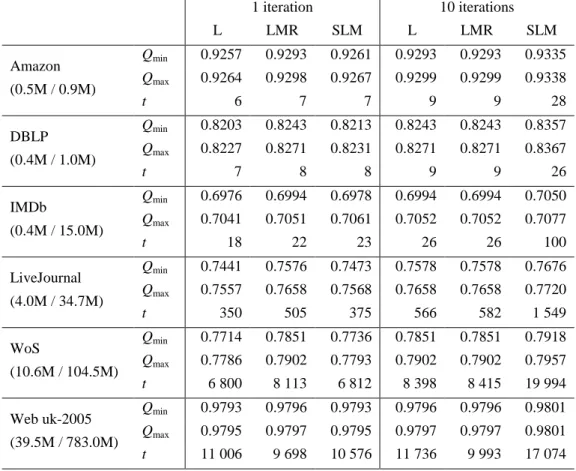
Algorithmics at http://law.di.unimi.it. The network was also used by Blondel
et al. (2008) to evaluate the performance of the Louvain algorithm.
Table 2 shows the number of nodes and edges in each of the above networks. The
number of nodes ranges between 0.4 million (DBLP and IMDb) and 39.5 million
(Web uk-2005). The number of edges ranges between 0.9 million (Amazon) and
783.0 million (Web uk-2005).
Like in the case of the small and medium-sized networks, we compare the SLM
algorithm with the original Louvain algorithm and with the Louvain algorithm with
multilevel refinement. Since community detection in large networks can be
computationally quite expensive, the number of algorithm runs that were performed is
smaller than in the case of the small and medium-sized networks. Instead of 100 runs,
for each of the six large networks we performed 10 runs of each algorithm. Moreover,
each algorithm run consisted of 10 rather than 100 iterations. Modularity values were
calculated at the end of the first and the 10th iteration of each algorithm run. For each
combination of a network and an algorithm, we report not only the highest modularity
value obtained in 10 algorithm runs but also the lowest one. In the case of large
networks, it may in practice not always be feasible to perform multiple runs of an
algorithm. The lowest modularity value obtained in 10 runs of an algorithm provides
an indication of the worst-case performance that can be expected when the algorithm
The modularity values obtained for the six large networks are reported in Table 2.
Computing times are reported as well. For each combination of a network and an
algorithm, the table shows the average number of seconds it took to perform one
algorithm run.
Our observations based on Table 2 can be summarized as follows:
• With 10 iterations per algorithm run, the SLM algorithm consistently outperforms the original Louvain algorithm and the Louvain algorithm with
multilevel refinement. The difference in modularity value is largest for the
DBLP network (more than 1%) and almost negligible for the Web uk-2005
network (about 0.04%). Interestingly, for all networks except IMDb, the worst
run of the SLM algorithm still gives better results than the best run of each of
the other two algorithms. Like in the case of the small and medium-sized
networks, the original Louvain algorithm and the Louvain algorithm with
multilevel refinement have (almost) the same performance.
• With only one iteration per algorithm run, the SLM algorithm slightly outperforms the original Louvain algorithm, but the difference is almost
negligible. On the other hand, the SLM algorithm generally performs worse
than the Louvain algorithm with multilevel refinement, sometimes with a quite
significant modularity difference of more than 1%. Notice that the
performance of the Louvain algorithm with multilevel refinement is hardly
affected by the number of iterations (1 or 10) per algorithm run.
• In terms of computing time, when only one iteration per algorithm run is performed, the SLM algorithm is about equally expensive as the original
Louvain algorithm and in general somewhat less expensive than the Louvain
algorithm with multilevel refinement. When performing 10 iterations per
algorithm run, the original Louvain algorithm and the Louvain algorithm with
multilevel refinement require more or less the same amount of computing time
and the SLM algorithm requires considerably more. In the case of the IMDb
network, the SLM algorithm even needs almost four times as much computing
time as the other two algorithms. The relative difference in computing time is
smallest for the Web uk-2005 network, which is the largest network in our
analysis. In the case of this network, a run of the SLM algorithm on average
Louvain algorithm and about 70% more than a run of the Louvain algorithm
with multilevel refinement.
Based on the above observations, it is clear that the SLM algorithm is able to
identify better community structures, in terms of modularity, than the original
Louvain algorithm and the Louvain algorithm with multilevel refinement. To identify
high-quality community structures, it is essential to use the iterative variant of the
SLM algorithm. This is in line with our findings for small and medium-sized
networks. From the point of view of computing time, the iterative variant of the SLM
algorithm is more expensive than the iterative variants of the other two algorithms.
However, it turns out that a single run of the SLM algorithm typically gives better
results than multiple runs of the other two algorithms, meaning that in the case of the
SLM algorithm there is less need to perform multiple algorithm runs. Hence, although
from a computational perspective a single run of the SLM algorithm is relatively
expensive, this is counterbalanced by the fact that fewer algorithm runs need to be
performed.
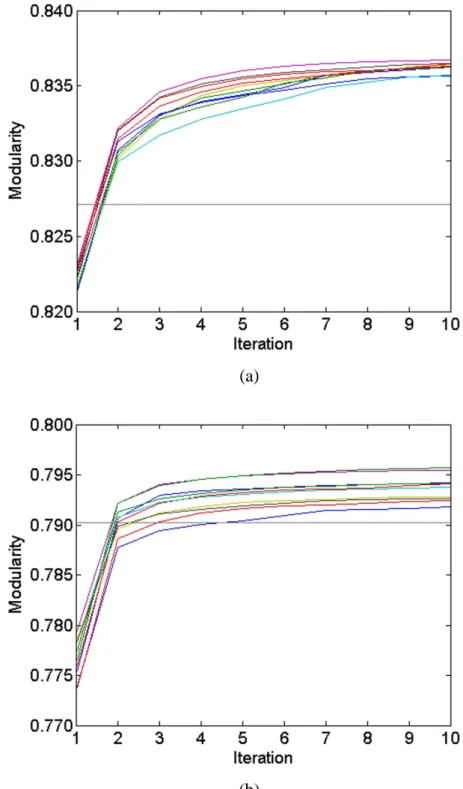
Figure 9 offers some additional insight into the effect of performing multiple runs
and multiple iterations of the SLM algorithm. For two networks, DBLP and WoS, the
figure shows the modularity value at the end of each of the 10 iterations in each of the
10 runs of the SLM algorithm. For both networks, the figure also shows the highest
modularity value obtained using the iterative variants of the original Louvain
algorithm and the Louvain algorithm with multilevel refinement. We note that in the
case of the latter two algorithms convergence always took place within at most four
iterations.
As can be seen in Figure 9, in the case of the DBLP and WoS networks,
modularity increases in each iteration of the SLM algorithm, but after the second
iteration increases in modularity tend to be relatively small. For both networks, the
highest modularity value at the end of the second iteration turns out to be higher than
the highest modularity value obtained using the Louvain algorithm. (Although not
shown in Figure 9, the same observation can be made for the other four large
networks included in our analysis.) In the case of the DBLP network, even the lowest
modularity value at the end of the second iteration is higher than the highest
modularity value obtained using the Louvain algorithm. (The same observation can be
made for the Amazon and Web uk-2005 networks.) In the case of the WoS network, it
algorithm exceeds the highest modularity value obtained using the Louvain algorithm.
The general picture emerging from Figure 9 is that a few iterations of the SLM
algorithm are usually sufficient to outperform the Louvain algorithm. Additional
iterations of the SLM algorithm lead to further increases in modularity, but the gain
tends to be relatively small.
5. Conclusions
In this paper, we have introduced our SLM algorithm for modularity-based
community detection. Our algorithm is intended primarily for community detection in
large networks, and we have therefore focused on comparing our algorithm with two
other algorithms for large-scale modularity-based community detection: The Louvain
algorithm proposed by Blondel et al. (2008) and an extension of the Louvain
algorithm with a so-called multilevel refinement procedure, as suggested by Rotta and
Noack (2011). In addition to introducing a new algorithm, we have also proposed
iterative variants of the original Louvain algorithm and of the Louvain algorithm with
multilevel refinement.
Despite being interested mostly in community detection in large networks, we
have also analyzed the performance of our SLM algorithm in small and medium-sized
networks. In the case of these networks, we have compared the SLM algorithm not
only with the original Louvain algorithm and the Louvain algorithm with multilevel
refinement but also with the CSA algorithm introduced by Lee et al. (2012). The CSA
algorithm is among the best algorithms presently available for modularity
optimization in small and medium-sized networks. For a range of different networks,
Lee et al. show that the CSA algorithm is able to identify community structures with
modularity values higher than or equal to the highest values reported in the literature.
Because of its computational demands, the CSA algorithm does not seem suitable for
modularity optimization in large networks.
Based on an analysis involving 13 small and medium-sized networks and six large
and very large networks (with up to 40 million nodes and up to 800 million edges),
we conclude that our SLM algorithm consistently outperforms the original Louvain
algorithm and the Louvain algorithm with multilevel refinement. Only in the case of
very small networks, we find that all three algorithms perform equally well. The
original Louvain algorithm and the Louvain algorithm with multilevel refinement, the
SLM algorithm then turns out to require considerably more computing time to
perform a single algorithm run. However, this is counterbalanced by the fact that in
the case of the SLM algorithm there is less need to perform multiple algorithm runs.
In the analysis of the six large networks, we find that a single run of the SLM
algorithm almost always yields a higher modularity value than 10 runs of the original
Louvain algorithm or the Louvain algorithm with multilevel refinement.
In the case of the 13 small and medium-sized networks, we find that our SLM
algorithm can be considered more or less competitive with the CSA algorithm of Lee
et al. (2012). There are four networks for which the CSA algorithm gives slightly
better results than the SLM algorithm, but there is also one network for which the
SLM algorithm yields better results. Furthermore, for the medium-sized networks, the
SLM algorithm turns out to require much less computing time than the CSA
algorithm. This means that there may be room to further improve the performance of
the SLM algorithm by performing more algorithms run and more iterations per
algorithm run.
Finally, let us note that in this paper we have restricted ourselves to the use of the
SLM algorithm for optimizing the original modularity function of Newman and
Girvan (2004). We emphasize, however, that the SLM algorithm can also be used for
optimizing many of the variants of this function that have been proposed in the
literature, for instance variants that include a resolution parameter (Reichardt &
Bornholdt, 2006) or that have a somewhat modified mathematical structure (e.g.,
Reichardt & Bornholdt, 2006; Traag et al., 2011; Waltman et al., 2010).
References
Aloise, D., Cafieri, S., Caporossi, G., Hansen, P., Perron, S., & Liberti, L. (2010).
Column generation algorithms for exact modularity maximization in networks.
Physical Review E, 82(4), 046112.
Arenas, A., Duch, J., Fernández, A., & Gómez, S. (2007). Size reduction of complex
networks preserving modularity. New Journal of Physics, 9, 176.
Barabási, A.-L., & Albert, R. (1999). Emergence of scaling in random networks.
Science, 286(5439), 509–512.
Barber, M.J., & Clark, J.W. (2009). Detecting network communities by propagating
Blondel, V.D., Guillaume, J.-L., Lambiotte, R., & Lefebvre, E. (2008). Fast unfolding
of communities in large networks. Journal of Statistical Mechanics: Theory and
Experiment, 10, P10008.
Boldi, P., Codenotti, B., Santini, M., & Vigna, S. (2004). UbiCrawler: A scalable
fully distributed Web crawler. Software: Practice and Experience, 34(8), 711–
726.
Brandes, U., Delling, D., Gaertler, M., Görke, R., Hoefer, M., Nikoloski, Z., &
Wagner, D. (2008). On modularity clustering. IEEE Transactions on Knowledge
and Data Engineering, 20(2), 172–188.
Clauset, A., Newman, M.E.J., & Moore, C. (2004). Finding community structure in
very large networks. Physical Review E, 70(6), 066111.
Duch, J. & Arenas, A. (2005). Community detection in complex networks using
extremal optimization. Physical Review E, 72(2), 027104.
Fortunato, S. (2010). Community detection in graphs. Physics Reports, 486(3–5), 75–
174.
Fortunato, S., & Barthélemy, M. (2007). Resolution limit in community detection.
Proceedings of the National Academy of Sciences, 104(1), 36–41.
Guimerà, R., Sales-Pardo, M., & Amaral, L.A.N. (2004). Modularity from
fluctuations in random graphs and complex networks. Physical Review E, 70(2),
025101.
Lee, J., Gross, S.P., & Lee, J. (2012). Modularity optimization by conformational
space annealing. Physical Review E, 85(5), 056702.
Lehmann, S., & Hansen, L.K. (2007). Deterministic modularity optimization.
European Physical Journal B, 60(1), 83–88.
Leicht, E.A., & Newman, M.E.J. (2008). Community structure in directed networks.
Physical Review Letters, 100(11), 118703.
Liu, X., & Murata, T. (2010). Advanced modularity-specialized label propagation
algorithm for detecting communities in networks. Physica A, 389(7), 1493–1500.
Mei, J., He, S., Shi, G., Wang, Z., & Li, W. (2009). Revealing network communities
through modularity maximization by a contraction–dilation method. New Journal
of Physics, 11, 043025.
Newman, M.E.J. (2004a). Fast algorithm for detecting community structure in
Newman, M.E.J. (2004b). Analysis of weighted networks. Physical Review E, 70(5),
056131.
Newman, M.E.J. (2006a). Finding community structure in networks using the
eigenvectors of matrices. Physical Review E, 74(3), 036104.
Newman, M.E.J. (2006b). Modularity and community structure in networks.
Proceedings of the National Academy of Sciences, 103(23), 8577–8582.
Newman, M.E.J., & Girvan, M. (2004). Finding and evaluating community structure
in networks. Physical Review E, 69(2), 026113.
Reichardt, J., & Bornholdt, S. (2006). Statistical mechanics of community detection.
Physical Review E, 74(1), 016110.
Rotta, R., & Noack, A. (2011). Multilevel local search algorithms for modularity
clustering. Journal of Experimental Algorithmics, 16(2), article 2.3.
Schuetz, P., & Caflisch, A. (2008). Efficient modularity optimization by multistep
greedy algorithm and vertex mover refinement. Physical Review E, 77(4), 046112.
Traag, V.A., Van Dooren, P., & Nesterov, Y. (2011). Narrow scope for
resolution-limit-free community detection. Physical Review E, 84(1), 016114.
Waltman, L., & Van Eck, N.J. (2012). A new methodology for constructing a
publication-level classification system of science. Journal of the American Society
for Information Science and Technology, 63(12), 2378–2392.
Waltman, L., Van Eck, N.J., & Noyons, E.C.M. (2010). A unified approach to
mapping and clustering of bibliometric networks. Journal of Informetrics, 4(4),
629–635.
Xu, G., Tsoka, S., & Papageorgiou, L.G. (2007). Finding community structures in
complex networks using mixed integer optimisation. European Physical Journal
B, 60(2), 231–239.
Yang, J., & Leskovec, J. (2012). Defining and evaluating network communities based
on ground-truth. IEEE 12th International Conference on Data Mining (ICDM),
745–754.
Ye, Z., Hu, S., & Yu, J. (2008). Adaptive clustering algorithm for community
detection in complex networks. Physical Review E, 78(4), 046115.
Zachary, W.W. (1977). An information flow model for conflict and fission in small
LouvainAlgorithm
input:
A: Adjacency matrix of a network
c: Initial assignment of nodes to communities
output:
c: Final assignment of nodes to communities
// Run the local moving heuristic. c ← LocalMovingHeuristic(A, c)
if NumberOfCommunities(c) < NumberOfNodes(A) then
// Construct a reduced network. Areduced ← ReducedNetwork(A, c)
creduced ← [1…NumberOfNodes(Areduced)]
// Perform a recursive call to identify the community structure of the reduced network. creduced ← LouvainAlgorithm(Areduced, creduced)
// Merge communities based on the community structure of the reduced network. cold ← c
for i ← 1 to NumberOfCommunities(cold) do
c(cold = i) ← creduced(i)
end for
end if
(a) (b)
(c)
Figure 3. Result of applying the Louvain algorithm to the karate club network. (a)
Reduced network before applying the local moving heuristic. (b) Reduced network
after applying the local moving heuristic. (c) Final solution in the original network.
LouvainAlgorithmWithMultilevelRefinement
input:
A: Adjacency matrix of a network
c: Initial assignment of nodes to communities
output:
c: Final assignment of nodes to communities
// Run the local moving heuristic. c ← LocalMovingHeuristic(A, c)
if NumberOfCommunities(c) < NumberOfNodes(A) then
// Construct a reduced network. Areduced ← ReducedNetwork(A, c)
creduced ← [1…NumberOfNodes(Areduced)]
// Perform a recursive call to identify the community structure of the reduced network. creduced ← LouvainAlgorithmWithMultilevelRefinement(Areduced, creduced)
// Merge communities based on the community structure of the reduced network. cold ← c
for i ← 1 to NumberOfCommunities(cold) do
c(cold = i) ← creduced(i)
end for
// Run the local moving heuristic. c ← LocalMovingHeuristic(A, c)
end if
Figure 4. Summary of the main steps of the Louvain algorithm with multilevel
Figure 5. Result of applying the Louvain algorithm with multilevel refinement to the
SmartLocalMovingAlgorithm
input:
A: Adjacency matrix of a network
c: Initial assignment of nodes to communities
output:
c: Final assignment of nodes to communities
// Run the local moving heuristic. c ← LocalMovingHeuristic(A, c)
if NumberOfCommunities(c) < NumberOfNodes(A) then
// For each community, construct a subnetwork and run the local moving heuristic. // Construct a reduced network based on the community structure of the subnetworks. cold ← c
j ← 0
for i ← 1 to NumberOfCommunities(cold) do
Asub ← Subnetwork(A, cold, i)
csub ← [1…NumberOfNodes(Asub)]
csub ← LocalMovingHeuristic(Asub, csub)
c(cold = i) ← csub + j
creduced([j + 1]…[j + NumberOfCommunities(csub)]) ← i
j ← j + NumberOfCommunities(csub)
end for
Areduced ← ReducedNetwork(A, c)
// Perform a recursive call to identify the community structure of the reduced network. creduced ← SmartLocalMovingAlgorithm(Areduced, creduced)
// Merge communities based on the community structure of the reduced network. cold ← c
for i ← 1 to NumberOfCommunities(cold) do
c(cold = i) ← creduced(i)
end for
end if
(a)
(b) (c)
Figure 7. Result of applying the SLM algorithm to the karate club network. (a) Six
subnetworks. Using the local moving heuristic, the red and orange subnetworks have
been split up into two communities. Nodes in these subnetworks are displayed using
either a circle or a square, depending on the community to which they belong. (b)
Reduced network before applying the local moving heuristic. (c) Reduced network
after applying the local moving heuristic. Notice that self links in the reduced network
Figure 8. Effect of performing multiple iterations of an algorithm for 13 small and
medium-sized networks. For each iteration, the percentage of all 1300 algorithm runs
that resulted in a modularity increase is shown. The algorithms are the original
Louvain algorithm (L), the Louvain algorithm with multilevel refinement (LMR), and
(a)
(b)
Figure 9. Modularity value at the end of each of the 10 iterations in each of the 10
runs of the SLM algorithm. The horizontal line indicates the highest modularity value
obtained using the iterative variants of the original Louvain algorithm and the
Table 1. Results for 13 small and medium-sized networks. For each network, the number of nodes and edges is reported as well as the highest
modularity value QCSA obtained using the CSA algorithm of Lee et al. (2012). In addition, results are reported for the original Louvain algorithm
(L), the Louvain algorithm with multilevel refinement (LMR), and the SLM algorithm. These results are based on 100 algorithm runs consisting
of either one or 100 iterations. The values that are shown are the differences between the highest modularity values obtained using the L, LMR,
and SLM algorithms and the highest modularity values obtained using the CSA algorithm. Negative (positive) values indicate that an algorithm
is performing worse (better) than the CSA algorithm. In the case of an equal performance, no value is shown.
Nodes Edges QCSA 1 iteration 100 iterations
L LMR SLM L LMR SLM Dolphins 62 159 0.5285
Les Misérables 77 254 0.5600 Political books 105 441 0.5272 College football 115 613 0.6046 Jazz 198 2 742 0.4451
USAir97 332 2 126 0.3682 -0.0015 -0.0006 -0.0002 -0.0006 -0.0006 Netscience_main 379 914 0.8486 -0.0004 -0.0002 -0.0005 -0.0002 -0.0002
C. elegans 453 2 025 0.4533 -0.0060 -0.0045 -0.0064 -0.0045 -0.0045 -0.0004 Electronic circuit (s838) 512 819 0.8194 -0.0157 -0.0039 -0.0197 -0.0039 -0.0039 -0.0018 E-mail 1 133 5 451 0.5828 -0.0055 -0.0021 -0.0061 -0.0021 -0.0021
Table 2. Results for six large networks. For each network, the number of nodes and edges is shown in the first column. Results are reported for
the original Louvain algorithm (L), the Louvain algorithm with multilevel refinement (LMR), and the SLM algorithm. These results are based on
10 algorithm runs consisting of either one or 10 iterations. Qmin and Qmax denote, respectively, the lowest and the highest modularity value
obtained in 10 algorithm runs, and t denotes the average computing time per algorithm run (in seconds).
1 iteration 10 iterations L LMR SLM L LMR SLM
Amazon (0.5M / 0.9M)
Qmin 0.9257 0.9293 0.9261 0.9293 0.9293 0.9335
Qmax 0.9264 0.9298 0.9267 0.9299 0.9299 0.9338
t 6 7 7 9 9 28
DBLP (0.4M / 1.0M)
Qmin 0.8203 0.8243 0.8213 0.8243 0.8243 0.8357
Qmax 0.8227 0.8271 0.8231 0.8271 0.8271 0.8367
t 7 8 8 9 9 26
IMDb
(0.4M / 15.0M)
Qmin 0.6976 0.6994 0.6978 0.6994 0.6994 0.7050
Qmax 0.7041 0.7051 0.7061 0.7052 0.7052 0.7077
t 18 22 23 26 26 100
LiveJournal (4.0M / 34.7M)
Qmin 0.7441 0.7576 0.7473 0.7578 0.7578 0.7676
Qmax 0.7557 0.7658 0.7568 0.7658 0.7658 0.7720
t 350 505 375 566 582 1 549
WoS
(10.6M / 104.5M)
Qmin 0.7714 0.7851 0.7736 0.7851 0.7851 0.7918
Qmax 0.7786 0.7902 0.7793 0.7902 0.7902 0.7957
t 6 800 8 113 6 812 8 398 8 415 19 994
Web uk-2005 (39.5M / 783.0M)
Qmin 0.9793 0.9796 0.9793 0.9796 0.9796 0.9801
Qmax 0.9795 0.9797 0.9795 0.9797 0.9797 0.9801