HISTORIANS’ EXPERIENCES USING DIGITIZED ARCHIVAL PHOTOGRAPHS AS EVIDENCE
Alexandra M. Chassanoff
A dissertation submitted to the faculty of the University of North Carolina at Chapel Hill in partial fulfillment of the requirements for the degree of Doctor of Philosophy in the School
Information and Library Science.
Chapel Hill 2016
Approved by: Christopher A. Lee Sandra Hughes-Hassell Matthew Kirschenbaum Ryan Shaw
ii ©2016
iii
ABSTRACT
Alexandra M. Chassanoff: Historians’ Experiences Using Digitized Archival Photographs as Evidence
(Under the direction of Christopher A. Lee)
Widespread digitization has presented scholars with unprecedented access to archival sources. In particular, the availability of archival photographs through online collections has been championed as an opportunity to fill in underrepresented histories absent from archival collections. Yet the degree to which scholars are using digital visual sources, and how they are using them, is relatively unexplored in the literature. In part, this can be attributed to the difficulties of modeling visual information use; no empirical models currently link scholarly interpretive practices to how scholars actually use visual materials.
This dissertation sought to address these gaps in the literature by examining the experiences of one group – self-identified historians using digitized archival photographs as evidence in their scholarly activities. This study uses an embedded case study approach to explore how and why historians use images in the construction of their arguments. Fifteen participants were recruited during the spring and summer of 2015. I conducted semi-structured interviews with each participant, eliciting descriptions about their image practices and specific experiences related to image use. I used thematic analysis and thematic synthesis to reveal salient aspects of historians’ experiences as they interpret and decide to use (or not use) materials. To strengthen and verify the analysis, I used triangulation strategies at different stages in the study.
iv
findings disclose the various factors that matter to historians in their experiences interacting with archival photographs in digital environments. Examples of image use are largely absent from the historical literature; the case studies presented in this research help to illustrate the functional ways historians currently use digitized photographs in both research and instructional capacities. Each case also sheds light on the processes and practices historians employ as they construct evidence from photographs and supplementary materials.
This research also makes important theoretical contributions to the LIS literature. While there has been unquestionable growth in access to digital sources, few empirical studies have examined scholarly interactions with digitized archival materials. Toward that end, this study introduces a conceptual framework for exploring how and why historians use digitized
photographs. It presents a holistic methodology that focuses attention on information experiences as spaces for meaning-making in digital environments. Attending to my participants'
v
vi
ACKNOWLEDGEMENTS
I am immensely grateful to the fifteen participants who contributed their time and perspective over the course of fifteen months to participate in this research study. Their particular insights and lived experiences were essential components in telling this story.
This dissertation would not have been possible without the guidance, advice, and patience of my advisor, Dr. Christopher (Cal) Lee. Cal continually kept an open mind as I talked through various ideas and strategies, providing structure and endless suggestions for sculpting a
dissertation topic out of vague connections of interest. Simply put, Cal made me a better writer, editor, and researcher. I am grateful for his support and guidance. I am also extraordinarily lucky to have been able to assemble a superior group as my committee members: Matthew Kirschenbaum, Sandra Hughes-Hassell, Ryan Shaw, and Helen Tibbo. Your careful attention and feedback at different points in this process were essential contributions. Thank you to SILS faculty member Diane Kelly for providing methodological guidance early-on. I’d also like to thank my good friend and colleague, Kaitlin Costello, for endless support, timely feedback, and simply “just getting it.”
vii
TABLE OF CONTENTS
LIST OF FIGURES………....xi
LIST OF TABLES……….xii
CHAPTER 1: INTRODUCTION………...……….1
1.1 Statement of the Problem……….4
1.2 Purpose of the Study and Research Questions……….………5
CHAPTER 2: LITERATURE REVIEW……….………....7
2.1 Information Practices of Historian Scholars Using Primary Source Materials……..…….7
2.1.1 Research practices of humanities scholars………..….8
2.1.2 Information behavior of historians in archival settings……….10
2.1.3 Scholarly use of digital collections………...….14
2.2 Describing Photographs in Archival Collections: History, Methods, and Implications…16 2.2.1 Institutions and photographic materials……….17
2.2.2 Descriptive approaches to photographic print materials………18
2.2.3 Descriptive standards for digital image collections………...…28
2.2.4 The problem with visual materials: Implications for archival access………36
2.3 LIS Approaches to Studying Image Use……….……….……..…39
2.3.1 Query analysis………...……….40
2.3.2 Task-based analysis………...42
viii
2.4Historians and the Use of Photographs as Evidence……….……….50
2.4.1 Concepts of evidence in modern historiography………...51
2.4.2 Historians and photographic use………....60
2.4.3 How historians approach photographs as visual evidence……….…62
2.4.4. Methods for analyzing historical photographs………...67
2.4.5 Case studies: Historians using photographs as visual evidence……….68
2.4.6 The current state of historical practice: Summary and implications………….….72
2.5The Experience of Information: Methodological Approaches………..………73
2.5.1 Information as material practice: a short history………...75
2.5.2 Information use in digital environments………81
2.5.3 Theoretical approaches to understanding experiences in digital environments….84 2.5.3 Information use as emergent experience………....91
CHAPTER 3: METHODOLOGY……….95
3.1 Methodological Approach..………...95
3.2 Rationale for Methodological Approach………..……….…96
3.3 Participants………...101
3.4 Data Collection……...……….104
3.5 Data Management………...……….108
3.6 Data Analysis………...………109
3.7 Reliability and Validity….………..………….115
CHAPTER 4: FINDINGS AND DISCUSSION……….……120
4.1 Summary of Cases………...………120
ix
4.3 Potential Image Use..………...135
4.3.1 Research practices in digital environments ………....135
4.3.2 Motivations in potential image use……….139
4.3.3 Factors that matter in potential image use………..142
4.4 Evidential Image Use…...………....149
4.4.1 Constructing modes of historical evidence……….151
4.4.2 Case vignettes……….152
4.5 A Conceptual Framework for Studying Historians’ Image Use……….….190
CHAPTER 5: CONCLUSION………...…….….191
5.1 Significance of the Study………….………..……….….191
5.2 Limitations of the Study………...193
5.3 Implications and Future Work……..……….………...196
APPENDIX A: INTERVIEW RECRUITMENT POST…………...……….……….203
APPENDIX B: INTERVIEW RECRUITMENT EMAIL…………..……….204
APPENDIX C: FACT SHEET……….……….……….…..205
APPENDIX D: VERBAL CONSENT SCRIPT………..…207
APPENDIX E: SEMI-STRUCTURED INTERVIEW PROTOCOL………….……….208
APPENDIX F: PHOTO-ELICITATION INTERVIEW PROTOCOL………...210
x
LIST OF FIGURES
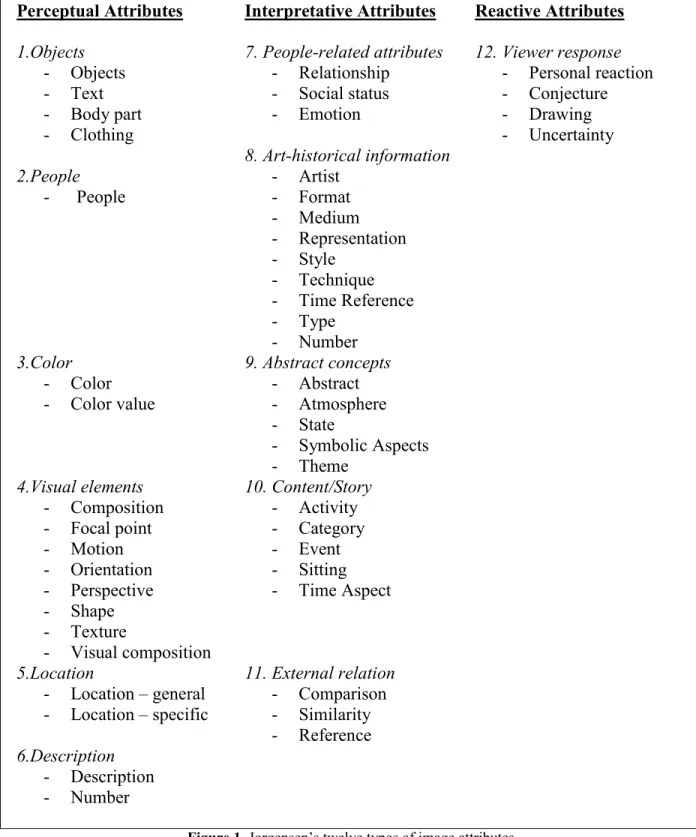
Figure 1. Jorgensen’s twelve types of image attributes………...27
Figure 2. Stages of analysis and interpretation………....114
Figure 3. Thematic analysis and synthesis of historians’ experiences………....132
Figure 4. Thousand Mile Tree, 1000 Miles West of Omaha..………..154
Figure 5. Thousand Mile Tree, 1000 Miles West of Omaha, Looking West...155
Figure 6. Thousand Mile Tree, 1000 Miles West of Omaha, Looking East………156
Figure 7. Debris at P.R.R. Stone Bridge……….157
Figure 8. Young Russian Jewess at Ellis Island……….….160
Figure 9. Minnie Hauk………....162
Figure 10. They Asked For Food and Got This………...164
Figure 11. Home of a Rebel Sharpshooter………165
Figure 12. Far Away Moses………..167
Figure 13. Japanese Captured in Raid……….…168
Figure 14. Griffin Children of West Alabama Land Use Project……….169
Figure 15. High School Student Taylor Washington is Arrested……….….170
Figure 16. Clip from power-point presentation………...172
Figure 17. Sailors dancing with each other aboard the U.S.S. Olympia………..173
Figure 18. Our Vision of Chinatown mural………...175
Figure 19. Carl Akeley creating model of Bull Elephant……….….176
Figure 20. William Temple Hornaday………...177
xi
Figure 22. Camp of 31st Pennsylvania Infantry near Washington DC……….179
Figure 23. Vase, or Dial Rocks, Red Buttes….……….181
Figure 24 Front Office of Wright Company……….182
Figure 25. Dog Sled………...……….183
Figure 26. Hawthorn Hill Living Room……….………...184
Figure 27. Orville’s Reading Chair………...185
Figure 28. Ferry on the Ocklawaha………...…...187
Figure 29. Memphis and Charleston Depot………...…...188
xii
LIST OF TABLES
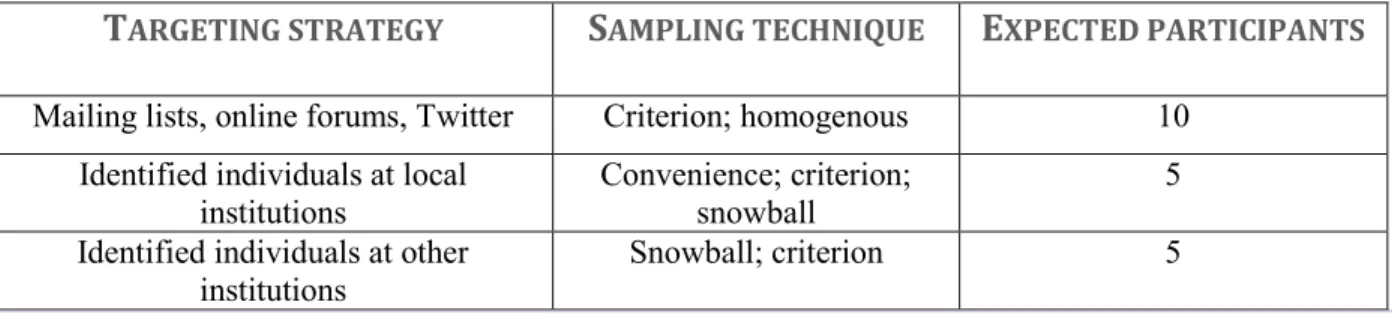
Table 1. Recruitment strategies………...104
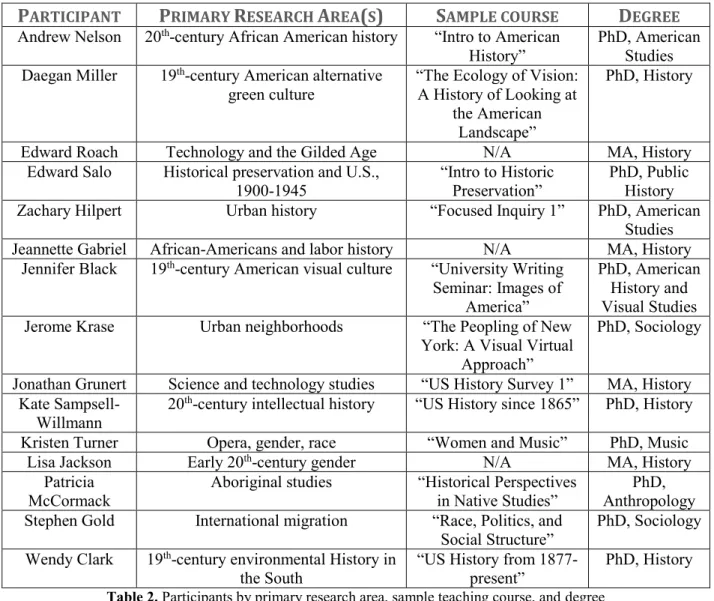
Table 2. Participants by primary research area, sample teaching course, and degree…...106
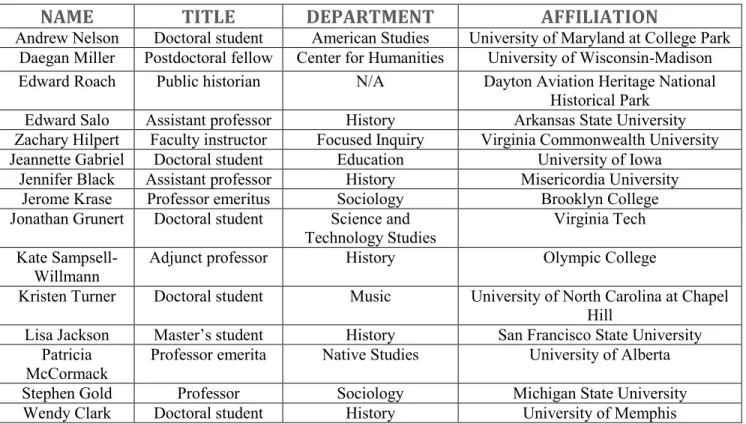
Table 3. Participants by title, department, and institutional affiliation………...120
Table 4. Analytical themes in potential image use….……….…..134
Table 5. Historical research practices in digital environments………..135
Table 6. Motivations in potential image use………...……...139
Table 7. Factors that matter in potential image use.…….………...…….…….143
Table 8. Perceived usefulness as a construct……….146
1
CHAPTER 1: INTRODUCTION
There have been widespread changes in access to primary source materials during the last decade. Institutions around the world have active digitization programs, and they regularly provide online access to digital materials. A 2012 survey of the Association of Research Libraries’ (ARL) special collections and archives in the US and Canada found that 80% of institutional directors agreed that digitized special collections are “critical to our current strategic direction(s).”1 In particular, visual materials have grown dramatically in size. Since 1998,
special collections have seen a 300% mean increase in holdings of visual materials and a 76% increase in use.2
Presumably, such changes in the information environment have impacted how scholars interact with, and use, primary source materials. In the discipline of history, where scholars craft arguments from examination of archival sources, increased access to materials through
digitization has been celebrated as the “democratization of historical research.”3 Postmodernists’
and poststructuralists’ critical examination of the historical canon as discourse helped orient historians away from the study of significant figures and toward the “history of ordinary people
1 Nancy Maron and Sarah Pickle, Appraising Our Digital Investment: Sustainability of Digitized Special Collections
in ARL Libraries (Washington, DC: Association of Research Libraries, 2013): 11.
2 Jackie M. Dooley and Katherine Luce, Taking Our Pulse: The OCLC Research Survey of Special Collections and
Archives. (Dublin, Ohio: OCLC Research, 2010): 10, 37. In their report, Dooley and Luce define visual materials as architectural materials, drawings, ephemera, paintings, photographs, postcards, prints, and slides/transparencies.
3 Cheryl Bolick, “Digital Archives: Democratizing the Doing of History,” The International Journal of
2
and everyday life.”4 These shifts in focus toward new kinds of subjects and subject matter
encouraged the use of different types of source materials as historical evidence.5
Historians studying class, gender, and race regard photographic archives as critical resources in establishing the so-called “new history.”6 Photographs in archives can provide
evidence to fill in under-developed, underrepresented or misrepresented cultural histories. In his introduction to a special issue in the Journal of Pacific History from 2006 on photography and history, Quanchi explains that “visual histories based on photographic evidence might reveal for the first time, quite different stories, incidents, memories, attitudes and cross-cultural
relationships.”7 Writing in 1988 in the Radical History Review, Eric Margolis argues,
“Photographic evidence has the potential not just to illustrate but to illuminate; historical
processes, meanings, ideologies and conflicts can be gleaned from photographic analysis, just as they are generated from the study of written texts.”8
Yet with few exceptions, historical scholarship has failed to seize upon the photograph. Despite the so-called “visual turn,” Sarah Farmer explains, “Historians of the western experience in the nineteenth and twentieth centuries still overwhelmingly depend on text-based archives.”9
4 Katharine Martinez, “Imaging the Past: Historians, Visual Images and the Contested Definition of History,” Visual
Resources 11, no. 1 (1995): 24.
5 Philipp Muller, “Understanding History: Hermeneutics and Source-Criticism in Historical Scholarship,” in
Reading Primary Sources: The Interpretation of Texts from 19th and 20th-Century History, eds. Miriam Dobson and Benjamin Ziemann (Abingdon, UK: Routledge, 2009), 23.
6 The term “new history” can be traced to the writings of James H. Robinson, a historian writing in the early 20th
century. See: James H. Robinson, The New History: Essays Illustrating the Modern Historical Outlook (New York: Macmillan, 1912).
7 Max Quanchi, “Visual Histories and Photographic Evidence,” The Journal of Pacific History 41, no.2 (2006): 165.
doi:10.1080/00223340600826052.
8 Eric Margolis, “Mining Photographs: Unearthing the Meanings of Historical Photos,” Radical History Review 40
(1988): 34.
9 Sarah Farmer, “Going Visual: Holocaust Representation and Method,” American Historical Review 115, no. 1
3
In a review of image use in historical journals from 2000-2009, Valerie Harris and Peter Hepburn note that “use of images has remained at a relatively consistent level year to year.”10
Rather than considering photographs as documents capable of investigation and analysis,
historians have used them primarily as illustrations. According to Hayden White, historians have not “exploited the possibilities of using images as a principal medium of discursive
representation, using verbal commentary only diacritically, that is to say, to direct attention to, specify, and emphasize a meaning conveyable by visual means alone.”11
In the library and information science (LIS) discipline, empirical investigations of visual information use have been similarly scarce. In fact, the phenomenon of visual information (including visual methodologies) has received scant attention overall in LIS, though there is indication that is changing.12 Joan Beaudoin explains:
Due to the visual nature of images, aspects surrounding use are markedly different than those of textual materials. The library and information science community has only recently begun to address visual information, and while there have been many successful forays into discerning the phenomena surrounding image retrieval, research to date has failed to adequately address image users’ needs and how or why images are being used.13
10 Valerie Harris and Peter Hepburn, “Trends in Image Use by Historians and the Implications for Librarians and
Archivists,” College and Research Libraries 74, no. 3 (2013): 276.
11 Hayden White, “Historiography and Historiphoty,” The American Historical Review 93, no. 5 (1988): 1194.
12 See Jenna Hartel, and Leslie Thomson. “Visual Approaches and Photography for the Study of Immediate
Information Space.” Journal of the American Society for Information Science and Technology 62, no. 11 (2011): 1– 11; Jamie Snyder, “Image-Enabled Discourse: Investigating the Creation of Visual Information as Communicative Practice,” (PhD diss, Syracuse University, 2012).
13 Joan E. Beaudoin, “A Framework of Image Use among Archaeologists, Architects, Art Historians and Artists,”
4
1.1 Statement of the Problem
Digitization of primary sources presents both practical and hermeneutic challenges for historians doing archival research in the 21st century. Navigating digital archival research
environments to find and use sources requires competent fluency at varying levels of the interaction, including: interfaces, digitization quality, overall orientation to the collection, and domain-specific heuristics.14 As spaces of knowledge production, digital archival research
environments must support interpretive and evaluative practices in the midst of numerous factors.
However, limited work has been conducted in LIS to explore how individuals encounter and make sense of digital information.15 Empirical research in digital environments tends to
focus on single components of the interaction as they relate to specific aspects of information behavior, or to conceptualize information use as the successful fulfillment of stated information needs. Yet user information needs can shift depending on emergent contextual factors.
Examining tasks that motivate image selection or identifying relevance criteria employed by users can thus only offer a partial view into the user experience in the specific information space. These perspectives do not attend to the influence that multiple ecological factors (e.g, interface, work context, task, user, image quality) may have on user interactions with materials.
14 Elizabeth Yakel and Deborah Torres conceptualize some of these dimensions as forms of “archival intelligence,”
an advanced level of expertise in navigating and using archives. See: Elizabeth Yakel and Deborah Torres, “AI: Archival Intelligence and User Expertise,” The American Archivist 66, no. 1 (2003): 51–78.
15 Two notable exceptions are: Marcia Bates, “The Cascade of Interactions in the Digital Library Interface,”
5
1.2 Purpose of the Study and Research Questions
The purpose of this research was to explore the experiences of historians using digitized photographs as forms of evidence. I chose an embedded case study approach to examine how and why historians are using digitized photographs in their scholarly activities. I defined two units of analysis. The main unit of analysis was identified as: “a historian’s experiences using digitized photographs as evidence.” An embedded unit of analysis, or subunit, was defined as “a historian’s specific use of a digitized photograph as evidence in research or instruction.”
I employed three types of purposive sampling strategies to recruit fifteen self-identified historians. I conducted a semi-structured interview lasting approximately 1.5 hours with each participant. I used photo-elicitation interviewing and concurrent verbal probing techniques to elicit participants’ descriptions of their experiences selecting, interpreting, evaluating, and using images. I also gathered supplementary materials related to how each participant used images as historical evidence in teaching and instructional capacities. Collected documents included conference presentations, teaching syllabus, dissertation chapters, journal articles, and
monographs. I used thematic analysis to surface descriptive themes and thematic synthesis to generate analytical themes within and across cases.
The central research question that guided this study is:
RQ1: What are the experiences of historians using digitized archival photographs as evidence in their scholarly pursuits?
Two additional sub-research questions guided this study:
6
SubRQ2: Why do historians choose to use (or not to use) digitized archival photographs as evidence in scholarly pursuits?
A holistic approach exploring historians’ information experiences permitted me to see how and why historians were using images as evidence in the construction of arguments. As a framing device, the notion of information experiences proved useful for revealing various socio-material factors that matter to them as they decide to use (or not use) images. Attending to their interactions showed what made their experiences meaningful, or “the difference that makes a difference.”16
16 This expression is commonly attributed to Gregory Bateson, from his text Steps to an Ecology of Mind (Chicago:
7
CHAPTER 2: LITERATURE REVIEW
This literature review describes five topical areas related to my research questions. First, I describe humanities scholars’ research practices, historians’ information behavior in archival settings, and the scholarly impact of digital collections. Next, I trace the history of collecting and describing photographic materials in archival institutions, including a discussion of current descriptive standards for digital image collections. I also consider how varying levels of
description impact access to archival materials. In my third section, I focus specifically on LIS approaches to the empirical study of image collection use. My fourth section describes concepts of evidence in modern historiography, moving into an overview of how historians have theorized the use of photographs. I also provide a discussion of three case studies that use photographs to make scholarly arguments. Finally, I explore the socio-material complexities of understanding visual information use in digital environments. I review a series of theoretical frameworks and methodological approaches for conceptualizing information use in digital environments as an emergent experience.
2.1 Information Practices of Historian Scholars Using Primary Source Materials
More than twenty years ago, in a user study on researchers in women’s history, Diane Beattie lamented that archivists had done very little research on “how users actually locate archival materials, and therefore have no way of measuring the usefulness of current descriptive systems.”17 This continues to be the case today. Studies exploring the information behavior of
8
historians in archives were undertaken nearly a decade ago,18 in the early stages of archival
digitization efforts. Empirical work that examines historians’ use of digitized primary source materials is either limited to citation analysis19 or lumped into a wider discussion of how
humanities scholars use electronic resources.
This section reviews the literature in the following areas: (1) the larger context of humanities scholars’ research practices, including information-seeking behavior; (2) how historians search for and use primary source materials in archival environments; and (3) assessing the scholarly impact of digital collections.
2.1.1 Research practices of humanities scholars
The development of effective scholarly infrastructures depends on understanding the evolving information behaviors and research practices of scholars.20 Humanities scholars’ needs
may range from broad exploratory searches to in-depth examination and analysis of source documents. In an influential study from 1982, Sue Stone calls for an exploration of how humanities scholars use the information they acquire.21 In the current scholarly climate, such
questions become more pressing as we begin to understand and assess how digital tools and
18 Helen Tibbo, “Primarily History in America: How US Historians Search for Primary Materials at the Dawn of the
Digital Age,” The American Archivist 66, no. 1 (2003): 9–50; Ian Anderson, “Are You Being Served? Historians and the Search for Primary Sources,” Archivaria 58 (2004): 88-129; Wendy Duff and Catherine Johnson, Accidentally Found on Purpose: Information-Seeking Behavior of Historians in Archives,” Library Quarterly 72, no. 4 (2002): 472–496; Wendy Duff, Barbara Craig, and Joan Cherry, “Finding and Using Archival Resources: A Cross-Canada Survey of Historians Studying Canadian History,” Archivaria 58 (2004): 51-80.
19 Donghee Sinn, “Impact of Digital Archival Collections on Historical Research,” Journal of the American Society
for Information Science and Technology 63, no. 8 (2012): 1521-1537. Sinn evaluates the impact of digital archival collection use by historians through the measurement of citations in academic history journals. While useful for quantifying usage statistics, such an approach does not shed light on the information behavior of historians working with digitized archival materials.
20 Christine Borgman, Scholarship in the Digital Age: Information, Infrastructure and the Internet (Cambridge: MIT
Press, 2007), 262.
9
technologies have impacted workflow and information behavior. What are the information needs and uses of humanities scholars? How do needs and uses change when searching for and using digital sources? What structures are needed to support and enable scholarly inquiry?
While the literature on humanities scholars’ research practices is rich and varied, there are emergent themes that help shed light on their information needs and use. One highly touted perspective is that humanities scholars work independently.22 Humanities scholars tend to
perform information-seeking tasks themselves rather than delegate to others, as such activities are seen as paramount to their interpretative abilities.23
At the same time, a strong sense of collaboration among peers emerges from the literature, particularly in the online realm. Scholarly Work in the Humanities and the Evolving Information Environment, a 2002 report on changing humanities research practices, notes the importance of the “grapevine” as “crucial for supplying references to recent books or articles that might not yet be indexed or cited.”24 Access to online tools such as email, mailing lists, blogs,
and wikis can facilitate collaboration and communication among scholars.25 The presence of an
invisible college, or an informal network of colleagues, enables researchers with limited time to “opt for those techniques that have the highest reward-cost ratio.”26
22 Stone, “Humanities Scholars: Information Needs and Uses”; American Council of Learned Societies, Our
Cultural Commonwealth: The Report of the American Council of Learned Societies Commission on
Cyberinfrastructure for the Humanities and Social Sciences (New York: American Council of Learned Societies and Andrew W. Mellon Foundation, 2006).
23 Stone, “Humanities Scholars: Information Needs and Uses,” 294-295.
24 William Brockman, Laura Neumann, Carole Palmer, and Tonyia Tidline, Scholarly Work in the Humanities and
the Evolving Information Environment (Washington, DC: Digital Library Federation and Council on Library and Information Resources, 2002), 11.
25 Carole Palmer and Laura Neumann, “The Information Work of Interdisciplinary Humanities Scholars:
Exploration and Translation,” Library Quarterly 72, no.1 (2002): 85-117.
26 Stephen Stoan, “Research and Information Retrieval among Academic Researchers,” Library Trends 39, no. 3
10
Research pursuits are characterized by divergent and unpredictable routes; methods typically involve “tracing intellectual paths, ‘excavating’ textual references from documents, and item-by-item review of artifacts held in relevant archival collections.”27 Consequently, browsing
is a particularly instrumental function in scholarly workflows. Scholars perform interpretation through the critical practices of reading, browsing, and annotating. They produce “extensive marginal notes, annotating photocopies or personal copies or attaching adhesive notes to a text.”28
Humanities scholars tend to use a wide array of primary and secondary source
materials.29 Consulting related works (often called “footnote chaining”) is essential. Secondary
materials are often consulted for background information or to gain awareness of current research in a field. A critical function of humanities scholarship involves selecting and structuring together meaningful groups of materials to enable interpretation. Authenticity and reliability of materials are the hallmark of trustworthy humanities research endeavors. Even among the earliest user studies, humanist scholars express a strong preference for having access to original documents.30
2.1.2 Information behavior of historians in archival settings
Historical research in archives is a multi-stage, iterative process. Historians may use a “path-breaking,” broad approach to research wherein they propose new ways of looking at old problems, or they may opt for a “micro-historic” narrow approach, in which they examine or
27 Neumann and Palmer, “The Information Work of Interdisciplinary Humanities Scholars,” 98.
28 Brockman, Neumann, Palmer, and Tidline, Scholarly Work in the Humanities, 7.
29 Karl Weintraub, “The Humanistic Scholar and the Library,” The Library Quarterly 50, no. 1 (1980): 22-39.
30 Carole Palmer, “Thematic Research Collections,” in A Companion to Digital Humanities (Oxford: Blackwell
11
document a specific community of interest or problem.31 Research activities can go on
concurrently and may span multiple research projects. Historians often begin their research in archives by orienting themselves to collections; as they build on contextual knowledge and acquire relevant material they further refine and develop their information needs.32 Charles
Cole’s investigation of forty-five history doctoral students formulating their theses finds two essential components at work for students processing information: the picture and the jigsaw. As Cole explains, “The jigsaw appears to be the Ph.D. history student's conceptual thesis and the picture is the background ‘data’ from which the jigsaw emerges.”33 Cole’s research shows how
the cognitive aspects of information processing can impact knowledge formulation in historical research.
Research practices within archival settings appear to be changing due to the impact of modern digital technologies. In addition to the fact that many archives provide online access to digitized versions of primary source materials, personal capture devices are now permitted in many reading rooms. The use of digital cameras, flatbed scanners, and laptops enables historians to personally document archival materials of interest. A recent survey investigating the changing research practices of historians found widespread use of digital cameras and scanning equipment to capture primary source materials, claiming it was “perhaps the single most significant shift in research practices among historians, and one with as-yet largely unrecognized implications for
31 Donald Case, “The Collection and Use of Information by Some American Historians: A Study of Motives and
Methods,” Library Quarterly 61, no. 1 (1991): 71.
32 Wendy Duff and Catherine Johnson, “Accidentally Found on Purpose: Information-Seeking Behavior of
Historians in Archives,” Library Quarterly 72, no. 4 (2002): 492.
33 Charles Cole, “Information Acquisition in History Ph.D. Students: Inferencing and the Formation of Knowledge
12
the work of historical research and its support.”34 Numerous publications on best practices for
digital capture activities over the last decade suggest that new kinds of workflows have begun to emerge in archival settings.35
Historians typically consult a large number of institutions during the archival research process.36 Archival institutions may include public or university libraries, academic special
collections/repositories, state or local historical societies, museums, and state or government archives. Not surprisingly, the types of institutions historians consult may depend significantly on their specific topics of historical research. In his citation analysis study on social historians, Frederic Miller finds a low use of state and local archives, calling them “the most underutilized resources in the nation’s archival system.”37 Meanwhile, Wendy Duff, Barbara Craig and Joan
Cherry, also looking at social historians, find a high use (90%) of provincial archives.38 Their
specific focus on Canadian history rather than an overall focus on social history topics may explain the high use.
Similarly, the types of archival materials used by historians often relates to their topic of research. Historians working on biographical research, for example, tend to use
“collection-34 Jennifer Rumer and Roger C. Schonfeld, Supporting the Changing Research Practices of Historians, Final Report
from ITHAKA S+R (2012), 11.
35 Kirklin Bateman, Sheila Brennan, Douglas Mudd, and Paula Petric, “Taking a Byte Out of the Archives: Making
Technology Work For You,” Perspectives: Newsletter of the American Historical Association 43, no. 1 (2005); Richard J. Cox, “Machines in the Archives: Technology and the Coming Transformation of Archival Reference,”
First Monday 12, no. 11 (2007); Lisa Miller, Stephen K. Galbraith, and RLG Working Group, “Capture and Release”: Digital Cameras in the Reading Room (Dublin, OH: OCLC Research, 2010).
36 Case, “The Collection and Use of Information by Some American Historians: A Study of Motives and Methods,”
74.
37 Frederic Miller, “Use, Appraisal, and Research: A Case Study of Social History,” The American Archivist 49,no.
4 (1981): 381.
38 Wendy Duff, Barbara Craig, and Joan Cherry, “Finding and Using Archival Resources: A Cross-Canada Survey
13
oriented tools” like finding aids.39 In some cases, limited archival holdings on subjects may
force historians to use non-traditional types of sources. Diane Beattie’s study on Canadian historians studying women’s history shows frequent use of photographs and oral history recordings; she attributes this to the dearth of archival materials related to women’s history.40
The literature does not provide conclusive evidence on historians’ preferred search and retrieval strategies in archival settings. When asked about the techniques most often used to locate primary sources, historians describe the consultation of published finding aids,41
communication with an archivist,42 and following leads or citations found in printed books.43 In
part, the discrepancies could be attributed to different goals in each research study. For example, Tibbo and Anderson are concerned with the impact of digital tools on historians’ search
behaviors. Thus, they categorize each search method as either print or electronic. Other semantic differences complicate effective comparisons across studies. What historians might consider to be the most useful methods for locating materials does not necessarily translate into the most frequently used. In Beattie’s study, historians claim that they most frequently consult archivists in their search for materials but cite finding aids to be the most useful in their search.44
Another complicating factor is a tendency in research studies to collapse the individual tasks associated with information search, retrieval, and use into a single behavior (often,
39 Tibbo, “Primarily History in America,” 21.
40 Beattie, “An Archival User Study,” 42.
41 Margaret Stieg-Dalton and Laurie Charnigo, “Historians and Their Information Sources,” College and Research
Libraries 65, no. 4 (2004): 407; Wendy Duff, Barbara Craig, and Joan Cherry, “Historians Use of Archival Sources: Promises and Pitfalls of the Digital Age,” The Public Historian 26, no. 2 (2004): 14.
42 Beattie, “An Archival User Study,” 43.
43 Anderson, “Are You Being Served?” 95; Tibbo, “Primarily History in America,” 20.
14
“information-seeking”) that fails to account for multiple steps in the research process. A
historian may begin his or her search by talking to an archivist, who then may point him or her to an electronic database where he or she might retrieve a source. Finally, many studies do not account for the fact that the methods historians use to search for unknown materials may be quite different from how they search for known materials. Duff’s characterization of a historian who “orients” herself in archives would suggest that search behavior might differ according to familiarity.45
2.1.3 Scholarly use of digitized collections
Overall, the emergence of digitized primary source collections is generally portrayed as positive for humanities scholarship. Some of the major advantages of digital collections include: the portability of digital formats, fast access, and better searching techniques.46 Access to
primary source materials is especially beneficial for scholars; preliminary browsing of digital library collections can save time and money for scholars in judging the relevance of materials to their research.47
At the same time, scholars also acknowledge challenges that can arise from working with digitized primary source materials in online environments. The LAIRAH (Log Analysis of Internet Resources in the Arts and Humanities) project, a fifteen-month inquiry into the factors that determine use (and neglect) of digital materials in the arts and humanities, found that users require a tremendous amount of information to discern both context and relevance. In the
45 Duff and Johnson, “Accidentally Found on Purpose,” 472–496.
46 Weiyin Hong, James Thong, Wai-man Wong, and Kar-yan Tam, “Determinants of User Acceptance of Digital
Libraries: An Empirical Examination of Individual Differences and System Characteristics,” Journal of Management Information Systems 18, vol. 3 (2002): 99.
15
absence of a physical browsing space, the authors note it can be difficult to comprehend both the coverage and extensiveness of the resource. They explain, “Scholars can browse a library shelf or journal issues and quickly determine the approximate extent of the resources available, and thus be sure that they do not miss anything important, but this is much more difficult in the case of digital resources.”48
The general lack of empirical data about digital collection usage is problematic. One study on digital resource use, conducted in 2006 at the University of California at Berkley, reports, “The ‘build it and they will come’ approach has resulted in a widely acknowledged supply-driven movement,” but it is not yet clear just how much scholars are using available digital collections. The authors assert the importance of studying use and reuse, particularly to assuage the fears of funding agencies that are “concerned about the low level of use of available digital resources among the teaching faculty of our institutions.”49
The research that has been conducted on scholarly use of digital collections tends to focus primarily on quantifying use through transaction log analysis or citation analysis, rather than exploring scholarly use of, and satisfaction with, digital resources. While the former is helpful for uncovering usage patterns, it is not appropriate for understanding experiential aspects of information use. As Laura Sheble and Barbara Wildemuth point out, transaction logs “cannot tell us anything about the users’ cognitive or affective responses during the system interaction.”50
48 Claire Warwick, Melissa Terras, Paul Huntington, and Nikoleta Pappa, “If You Build It Will They
Come? The LAIRAH Study: Quantifying the Use of Online Resources in the Arts and Humanities through Statistical Analysis of User Log Data,” Literary and Linguistic Computing 23, no. 1 (2008): 99.
49 Diane Harley, Jonathan Henke, Shannon Lawrence, Ian Miller, Irene Perciali, and David Nasatir, Use and Users
of Digital Resources: A Focus on Undergraduate Education in the Humanities and Social Sciences (UC Berkeley: Center for Studies in Higher Education, 2006): 2-1.http://escholarship.org/uc/item/8c43w24h.
50 Laura Sheble and Barbara Wildemuth, “Transaction Logs,” in Applications of Social Research Methods to Questions
16
Citation analysis is only partially helpful as an indicator of information use; scholars may consult a number of primary source materials in the course of their research but not necessarily cite them.
Particular challenges lie in building effective infrastructure for historians to use digitized archival materials. In order to provide a seamless experience for historical research,
infrastructure should support both historical practices and technological efforts. In their report summarizing the history of computer-aided historical research, Onno Boonstra, Leen Breure and Peter Doorn explain the importance and the intricacies of achieving this delicate balance:
Better infrastructure is needed in order to guarantee a transfer of results from the methodological and technical level to the daily practice of historical research. On the contrary, denying these challenges and opportunities will, in the long run, segregate the study of history from the technical capabilities currently being developed in the
information society and will turn ‘the computer’ into an awkward tool with limited use and usability for historians.51
How do the archivist and the historian, each possessing different domain expertise, effectively work together? What role does the archivist play in constructing authentic digital environments? How should historical materials be displayed and presented so that context is not lost? These are pressing questions. Continued research on the evolving information needs of academic
historians can aid the construction of successful archival research environments.
2.2 Describing Photographs in Archival Collections: History, Methods and Implications
This section discusses the historical context, theoretical basis, and practical concerns related to the description of and access to photographic materials in archival institutions. First, I provide an overview of the collecting of photographic materials by American institutions. Next, I briefly summarize the development of archival and library standards for cataloging visual
51 Onno Boonstra, Leen Breure and Peter Doorn, “Past, Present, and Future of Historical Information Science,”
17
materials, moving into a review of current metadata standards for describing photographs and image collections overall. Finally, I explore how archivists propose describing photographs and investigate critiques which claim that a failure to develop and implement appropriate descriptive models prevents adequate access to, and use of, photographic materials.
2.2.1 Institutions and photographic materials
Institutions in the United States have long recognized the importance of acquiring and collecting photographic materials as documentation. One of the earliest and most widespread uses of photography in an institutional context was the capture and recording of war activities. Writing in the American Archivist in 1958, Joe Thomas describes an 1860 U.S. expedition to Japan that used daguerreotypes to document governmental activities wherein “an agency of the United States Government in connection with the transaction of public business had consciously created photographic records that were appropriate for preservation as evidence of its operations or as the embodiment of valuable information.”52 In 1874, the photographic collection of noted
civil war photographer Matthew Brady was purchased by the United States Department of War. In fact, the Comptroller went on to sanction the publication of the photographs as “official records” of the war, claiming that “the photographic views of the war, showing battlefields, military divisions, fortifications, etc. are among the most authentic and valuable records of the rebellion.”53 Brady’s collection was transferred to the War Department’s library in 1888.
Cultural heritage institutions were also readily acknowledging the importance of
photographs as documentation. The Library of Congress (LOC) added photographs to the list of
52 Joe D. Thomas, “Photographic Archives,” The American Archivist 21, no.4 (1958): 420.
53 United States, David Fitzgerald, and A. W. Greely, List of the Photographs and Photographic Negatives Relating
18
copyrighted items required for deposit in 1865.54 The Metropolitan Museum of Art reported a
nearly 14,000-item photograph collection in 1906 (with 12,000 items added that year).55 In
1914, due to increased public requests, the Circulation Department at the New York Public Library began gathering materials for its “Picture Collection”; by the close of that year, the collection amassed nearly 18,000 items.56 The U.S. National Archives began collecting
photographs from federal agencies shortly after its inception in 1934 and even housed a separate division called Photographic Archives.57 In 1944, the LOC’s newly renamed Print and
Photographs Division acquired more than one-hundred thousand photographs and negatives as part of the Farm Security Administration-Office of War Information collection, which
documented the life of American farmers between 1935 and 1943. The collection has gone on to become one of the most iconic in American history.
2.2.2 Descriptive approaches to photographic print materials
Institutions establishing visual collections in the late nineteenth and early twentieth centuries had to develop their own standards for cataloging materials. An early and influential publication which provided guidance is John Cotton Dana’s The Picture Collection, published in 1910. Dana oversaw the creation of the first so-called picture collection at the Denver Public Library in 1888; he went on to become the chief librarian at the Newark Public Library in 1902. The Picture Collection advised cataloging materials by alphabetized subject headings.
54 Renata V. Shaw, A Century of Photographs, 1846-1946 (Washington DC: The Library of Congress, 1980),
Introduction.
55 Charles Ammi Cutter, Library Journal 32 (New Jersey: R.R. Bowker Company, 1907), 235.
56 Anthony T. Troncale, “Worth Beyond Words: Romana Javitz and the New York Public Library's Picture
Collection,” New York Public Library Website. http://www.nypl.org/locations/tid/45/node/62019.
57 Barbara Lewis Burger, Guide to the Holdings of the Still Picture Branch of the National Archives and Records
19
Our experience has led us always to the same conclusion; that no arrangement is as good as an alphabetical one by subject because the pictures under this arrangement need no catalog and are self-indexing. They are filed vertically, like cards in a catalog, and the names of the subjects under which they are arranged are written near the tops of the mounts. They can thus be easily consulted and pictures on any desired subject easily found.”58
The book specifies nearly 2000 subject headings for use in classification. Dana goes on to note that while he originally intended to use American Library Association subject headings, he instead chose to base headings on “local conditions and observation of the use of the Picture Collection by borrowers.”59
Card catalog subject access, however, presented a problem for finding materials: patron requests had to match already-conceptualized subject headings. As Anthony Troncale explains, Dana’s particular subject heading classifications presented barriers to access:
In his idiosyncratic filing system, for example, one would have to look under "F" for "Forms of Land and Water" to find "Niagara Falls," a situation reflecting nineteenth-century bibliographical practice and hierarchical mind-set. A reassessment of subject headings would be needed to reflect the fast-changing styles and fashions of the machine age and their new nomenclatures.60
The limitations of the subject classification approach were recognized by the New York Public Library’s Romana Javitz, who began working at the Picture Collection in 1924. She employed a myriad of creative approaches to improve subject access to visual materials. To overcome a language barrier, she instituted a policy in 1931 requiring all patrons to draw or describe picture requests on call slips. She also used Works Progress Administration (WPA) artist-trained workers to provide subject descriptions for an ever-increasing number of visual items acquired
58 John Cotton Dana, The Picture Collection (Woodstock, Vermont: Elm Tree Press, 1910), 26.
59 Ibid, 28.
20
by the Picture Collection. Javitz introduced the use of new schemes (based on regions, styles, types and year) to provide even greater flexibility in access.61
The Minnesota Public Library adopted Dana’s approach for use in “Minneapolisiana,” the historical photograph collection they created in 1940. The subject index approach provided library visitors the ability to browse through a multitude of images. As Ruth Thompson, the head of the Minnesota Historical Collection, pointed out: “Often patrons do not ask for a specific picture, but need the inspiration which comes from looking over different folders on a variety of subjects.”62
The Library of Congress began using subject categorization to organize photographic collections in 1943, following the appointment of its first curator of photography. Photographs were initially sorted according to subject categories and then grouped into lots – or “batches of pictures which fall into logical groups by virtue of their creator or donor, the overall title of a picture story, or the unifying subject matter.”63 The next ten years saw the acquisition of many
important collections, including photographic documentation of the Crimean War, Civil War, and Nazi Germany. During the 1960s, the Library set forth new guidelines to distinguish between artistic and documentary photographic collections; the former were arranged and grouped as “Master Photographs.”64
The development of the Machine-Readable Cataloging (MARC) standard in the mid-1960s at the LOC was a watershed moment for librarians and archivists. MARC enabled the
61 Ibid, paras. 13-18.
62 Ruth Thompson, “The Collection and Preservation of Local Historical Pictures in the Minneapolis Public
Library,” The American Archivist 9, no. 4 (1946): 223.
63 Shaw, 2.
21
storage of machine-readable, exchangeable bibliographic information about institutional holdings.65 A companion to MARC, the publication of The Anglo-American Cataloging Rules
(AACR) in 1967 provided guidance for institutions in creating and describing bibliographic information in a standardized format. The second edition of the book, AACR2, was published in 1978 and served as the standard for use in describing library materials for nearly thirty-five years. In March 2013, the Library of Congress introduced a new cataloging standard, the Resource Description and Access Framework (RDA).66
The widespread adoption and use of MARC and AACR2 by librarians during the 1970s also revealed limitations in their structures. Both AACR2 and MARC were originally designed to accommodate book formats; meanwhile, institutions had been collecting many different types of materials in varying formats. In 1978, an Independent Research Libraries Association (IRLA) Ad-Hoc committee formed to evaluate how well the MARC format met the needs of catalog users. In particular, the committee sought to investigate whether MARC accurately represented audiovisual (AV) materials. On the one hand, the current MARC standard stipulated that subject headings be as specific as possible to enable better access points. However, most users of AV materials required the ability to search and use materials in a broad, interdisciplinary manner.67
The IRLA committee report thus proposed the addition of two auxiliary MARC fields, “genre” and “publishing/physical characteristics” to better describe, and provide access to, specialized materials. The committee also recommended the creation of a controlled vocabulary thesaurus for indexing terms.
65 Walt Crawford, MARC for Library Use (Boston, MA: GK Hall, 1989), 1.
66 See W3C, “The Resource Description Framework Homepage,” http://www.w3.org/RDF/.
22
In 1980, the Thesaurus for Graphic Materials I (TGM 1) was created at the Library of Congress to provide a controlled vocabulary for describing the subjects of pictorial works. TGM 1 originated from the work of the Prints and Photographs’ Division cataloger Elizabeth Betz Parker, who culled together subject headings used to describe division holdings from the
previous fifty years.68 The subject terms are collection-driven and thus have grown significantly
since inception; new terms can be proposed through a submission process on the LOC’s website. A companion volume, Thesaurus for Graphic Materials 2 (TGM 2), appeared in 1986. TGM2 aimed to enable additional access points to visual collections by providing fixed vocabulary terms for describing both genre and physical format characteristics.69 In 2007, TGM1 and TGM2
were combined into a single thesaurus, Library of CongressThesaurus for Graphic Materials (LCTGM).
Betz Parker also developed Graphic Materials: Rules for Describing Original Items and Historical Collections in 1982. The manual was created in an attempt to unite archival principles with library cataloging approaches, for use in describing graphic materials in standardized
formats. In her introduction to the manual, Betz Parker explains the impetus behind the creation of separate cataloging guidelines for such materials:
The concepts of “chief source of information” and “prescribed sources” used in traditional book cataloging has been redefined here for original and historical graphic materials because they often have little or no text to transcribe. The major reason for documenting graphics is to provide the researcher with as complete an identification of the material as possible. This is done by translating the visual information into a verbal description of the material's physical nature and image content.70
68 Arden Alexander and Tracy Meehleib, “The Thesaurus for Graphic Materials: Its History, Use, and Future,”
Cataloging & Classification Quarterly 31, no.3-4 (2001): 191.
69 For a helpful discussion of the implications and importance of describing the physical characteristics of archival
materials, see: Helena Zinkham, Patricia D. Cloud, and Hope Mayo, “Providing Access by Form of Material, Genre, and Physical Characteristics: Benefits and Techniques,” The American Archivist 52 (Summer 1989): 315.
70 Elisabeth Betz-Parker, Graphic Materials: Rules for Describing Original Items and Historical Collections
23
Betz Parker goes on to acknowledge the equal importance of cataloging items at both the item and the collection-level, noting that the latter is essential for understanding and preserving the context of the former.
The Arts and Architecture Thesaurus (AAT) was also developed during the early 1980s, from joint efforts in the library and art/architectural history communities. It has been maintained by the Getty Research Institute since 1983, and currently contains more than 34,000 concepts and 130,000 terms. Concepts are linked to related terms and arranged in a hierarchal fashion, from general to specific. Seven facets are used to enable access points at multiple levels of description: associated concepts, physical attributes, styles and periods, agents, activities, materials, and objects.71 In her comparison between LCGTM and AAT, Greenberg notes the
latter is a “very specialized source with terminology specifically for the built environment, furnishings and equipment, and visual and verbal communication” while the former provides greater use for a broader audience.72
During the mid to late 1980s, a number of theoretical approaches for describing visual materials emerged from the LIS community in an attempt to counter problems with access. Sara Shatford-Layne’s work at the Library of Congress represents one of the first attempts to put forth a framework to deal with the inherent complexities of visual materials. Drawing on the work of art historian Erwin Panofksy, as well as approaches first articulated by Ranganathan’s Colon Classification, and later on at the Bibliotheque Nationale de France (BnF), Shatford-Layne‘s
71 For an in-depth exploration of AAT’s seven facets, see: Michael Joseph, “Information Technology and Access to
Visual Images in Printed Books,” Visual Resources 11, no.1 (1995): 78-80.
72 Jane Greenberg, “Intellectual Control of Visual Archives: A Comparison between the Art and Architecture
Thesaurus and the Library of Congress Thesaurus for Graphic Materials,” Cataloging & Classification Quarterly
24
framework identifies and classifies the kinds of subjects used to describe pictorial works. She writes:
The different facets for the classification of the subjects of pictures may be defined initially as containing the answers to a series of questions asking Who? What? When? and Where? Each of these basic facets may then be subdivided into aspects based on Of in the specific sense, Of in the generic sense, and About.73
Importantly, Shatford-Layne’s approach enables both a specific and generic approach to subject classification of pictures. For example, a photograph of the Sears Tower can be described both as a specific object of interest (“The Sears Tower”) and in terms of its generic ofness
(“Skyscraper”). Such distinctions are critical in describing visual materials, which can be
perceived at multiple levels of description and thus should accommodate varying entry points for access.
As an example of how this plays out in descriptive practice, consider the LOC’s Herblock Collection, which contains editorial cartoon drawings by Washington Post cartoonist Herbert L. Block. The collection consists of 14,000 original ink and graphite drawings. One item from the collection, “Well, everything helps,” has two vastly different format descriptions: “Editorial cartoons--1930-1940” and “Ink drawings--1930-1940.” 74 The former addresses the content of
the item while the latter addresses the medium. Enabling both levels of access through
description is important because they serve different functions depending on information needs. Art historians, for example, may want to look explicitly at materials of a certain format or medium. Social or cultural historians, however, may want to use to these materials as sources
73 Sara Shatford-Layne, “Analyzing the Subject of a Picture: A Theoretical Approach,” Cataloging & Classification
Quarterly 6, no. 3 (March 1986): 48.
74 Herbert Block, “Well, Everything Helps,” cartoon, Library of Congress Prints and Photographs Online Catalog,
25
for examining editorial representations in mainstream media, to better understand popular sentiment at the time.
Shatford-Layne’s framework also distinguishes between subject analysis of a medium (e.g., how to describe a painting) and subject analysis of the reproduction of that medium (e.g., how to describe a photograph of that painting). She introduces the concept of the Represented Work as a means for addressing these conceptual differences. A Represented Work is “a
particular kind of subject that a picture can have, but that a text cannot. A picture is Of a tangible object in a way that a text, composed of words, can never be.”75 Shatford-Layne goes on to
critique traditional cataloging practices, which she claims confuse reproductions with original works in catalog descriptions of materials.
The work of Karen Markey during the mid to late 1980s represents another attempt to theoretically address the complexities of visual material description through the establishment of baseline attributes.76 Markey claims that the increasing availability of MARC data is beneficial
for expanding access points. Like Shatford-Layne, Markey invokes Panofsky’s three levels of meaning to suggest enhanced descriptions for additional points of subject access to visual
materials.77 Rather than limit description to secondary subject matter (based on the norm, due to
traditional design constraints of the card cataloging system), Markey suggests that through the use of MARC data and the training of catalogers, primary subject matter can also be described easily and efficiently to expand access.
75 Shatford-Layne, “Analyzing the Subject of a Picture,” 51.
76 Karen Markey, Subject Access to Visual Resources Collections (Greenwood Press: The University of Michigan,
1986); Karen Markey, “Access to Iconographical Research Collections,” Library Trends 37, no. 2 (1988).
77 The art historian Erwin Panofsky formulates three different kinds of “meaning” which can be experienced in a
work of art: primary matter (objects, events, forms); secondary matter (types, themes, concepts); and intrinsic meaning (cultural symptoms, symbols, essential tendencies). See: Erwin Panofsky, Meaning in the Visual Arts
26
A conceptual framework proposed in the mid-1990s by Corrine Jorgensen examines the types of attributes participants used to describe images while performing three different types of tasks.78 The primary focus of her research is to identify useful indexing attributes for end users
of image retrieval systems. Her analysis concludes that twelve different types of attributes can be used to describe images (see Figure 1). She then categorizes each of the twelve attributes into three categories: perceptual, interpretive, and reactive. One of Jorgensen’s most interesting conclusions is that respondents tend to describe images within a specific context - what she terms “a story” using attributes such as “activity” and “setting.”79
78 Corinne Jorgensen, “Image Attributes: An Investigation”(PhD diss., Syracuse University, 1995); Corinne
Jorgensen, “Attributes of Images in Describing Tasks,” Information Processing & Management 34, no. 2/3 (1998).
27
Perceptual Attributes Interpretative Attributes Reactive Attributes
1.Objects - Objects - Text - Body part - Clothing
7. People-related attributes - Relationship
- Social status - Emotion
12. Viewer response - Personal reaction - Conjecture - Drawing - Uncertainty 2.People
- People
8. Art-historical information - Artist
- Format - Medium - Representation - Style
- Technique - Time Reference - Type
- Number 3.Color
- Color - Color value
9. Abstract concepts - Abstract - Atmosphere - State
- Symbolic Aspects - Theme
4.Visual elements - Composition - Focal point - Motion - Orientation - Perspective - Shape - Texture
- Visual composition
10. Content/Story - Activity - Category - Event - Sitting - Time Aspect
5.Location
- Location – general - Location – specific
11. External relation - Comparison - Similarity - Reference 6.Description
- Description - Number
28
2.2.3 Descriptive standards for digital image collections
The growth of digital library projects during the 1990s introduced massive amounts of electronic information for consumption. One of the most pressing needs facing digital libraries was how best to enable resource discovery in this vast landscape. Indeed, a 1995 workshop on digital libraries held by the newly inaugurated Information Infrastructure Technology and
Applications (IITA) named “resource discovery” to be one of its critical research items. 80 In the
Strawman Report from the workshop, Hector Garcia-Molinaexplains,“The challenge is to characterize the information contents (e.g., meta-information) and service capabilities of libraries in a compact and meaningful way.”81 The capture of meta-information, or “metadata” emerged
as the primary mechanism for managing digital objects. Metadata acts as a surrogate for digital objects by describing their properties as discrete elements. It can be defined as “data about data that supports the discovery, use, authentication, and administration of information objects.”82
Metadata schemas provide appropriate organizational structures for elements, helping to define and standardize attributes to describe, and enable access to, materials.
The development and use of metadata schemas enables digital libraries to describe digital objects and exchange information about holdings. One of the first widely used metadata
schemas adopted for use in digital libraries was the Dublin Core, originating out of an
80 The IITA was a subset of the National Information Infrastructure (NII), a nationwide initiative in the early 1990s
to support networked infrastructure. One of the IITA’s goals was to develop the underlying technology for the NII’s efforts. For a brief history of the IITA and its relationship to digital library efforts, see: Stephen M. Griffin,
“NSF/DARPA/NASA Digital Libraries Initiative: A Program Manager’s Perspective,” D-Lib Magazine, July/August 1998, http://www.dlib.org/dlib/july98/07griffin.html.
81 Hector Garcia-Molina, “Digital Libraries Research Agenda Report: A Strawman Report for the IITA Digital
Libraries Workshop,” para. 5, http://dbpubs.stanford.edu:8091/diglib/pub/reports/iita-dlw/appendix2.html.
82 Jane Greenberg, “A Quantitative Categorical Analysis of Metadata Elements in Image-Applicable Metadata