AVALANCHES OF ATTENTION: POSITIVE FEEDBACK IN MEDIA COVERAGE OF SOCIAL MOVEMENT ORGANIZATIONS
Charles F Seguin
A thesis submitted to the faculty of the University of North Carolina at Chapel Hill in partial fulfillment of the requirements for the degree of master of art in the Department of Sociology.
Chapel Hill 2011
ii ABSTRACT
Avalanches of Attention:
Positive Feedback in Media Coverage of Social Movement Organizations (Under the direction of Kenneth Andrews)
I present a positive feedback model to explain why media attention to SMOs is so unequal, volatile and unpredictable. Receiving some degree of media attention helps groups to receive still more—a cumulative advantage, or rich-get-richer, process. The model presents two empirically verifiable implications: (1) levels of media attention will be power-law distributed across SMOs and (2) coverage dynamics will be path-dependent and thus
potentially sensitive to small events early in organization histories. Using new methodology from statistical physics I show that media attention is indeed power-law distributed within three large datasets describing counts of media stories to SMOs spanning multiple
movements, time periods and media outlets. I then explore the path dependent nature of media coverage with a comparative analysis of the Black Panther Party and the
iii
Table of Contents
Introduction ... 7
Events, Tactics, Organization Characteristic, Attention Cycles and Media Coverage ... 7
Media Effects on Movements ... 14
Positive Feedback ... 16
Formal Model ... Error! Bookmark not defined. Power Law Distributions ... 20
Path Dependence ... 20
Analysis ... 26
Methods and Data ... Error! Bookmark not defined. Inequality in Media Attention ... Error! Bookmark not defined. Results: Power Law Analysis ... 32
Results: Comparative Case Study ... 34
iv
1967 ... 37
1968 ... 42
1969 ... 43
Discussion ... 47 Conclusions ... Error! Bookmark not defined.
5
LIST OF TABLES
6
LIST OF FIGURES
1. Waves Measurement Strategy……….………..19
2. Inequality in Media Coverage……….……….26
3. Power Law Distribution in NY……….………30
4. Power Law Distribution in Television News ……….………..19
5. Power Law Distribution in Local Papers……….……….26
Introduction
Why is media attention to social movement organizations so unequal, volatile and unpredictable? Quantitative studies show that media attention to social movement
organizations (SMOs) is highly unequal (Amenta et al. 2009; Andrews and Caren 2010:850; Vliegenthart, Oegema, and Klandermans 2005:373). Qualitative studies have shown that media attention may be highly volatile and unpredictable. Initially small groups, such as Students for a Democratic Society, The Black Panther Party and The National Organization for Women can be abruptly thrust into the media spotlight, receiving attention that is
radically disproportionate to their (initial) size and influence (Freeman 1973; Gitlin 1980; Rhodes 2007). In this paper I propose and test a process model, based on positive feedback, which can make sense of these puzzling findings.
8
Democratic Society, Gitlin argues that media coverage to the group led to greater
recruitment, the use of more disruptive tactics, and a host of other factors that eventually led
to its destruction (1980). Sobieraj argues that movements “bend over backwards” to employ media-friendly tactics (2010). Vliegenthart and colleagues find that media coverage to SMOs increases their membership numbers (2005). Scholars have further argued that, since
movements are more dependent on the media than the media is on movements, the movements are the more likely to change to accommodate the media than vice-versa
(Gamson and Wolfsfeld 1993). Further, there is a tendency for media coverage to reproduce itself endogenously; journalists are more likely to report on a group or an issue if it has already been given substantial attention— net of any characteristics of the issue or group (Baumgartner and Jones 2009; Fishman 1978; Gitlin 1980; Koopmans and Vliegenthart 2010). A model that can integrate these diverse findings to explain the broad structure and dynamics of media attention is thus an important contribution to this literature.
In this paper, I propose and test a process model of media coverage to SMOs based on positive feedback1. The model embodies the simple idea that initial media coverage is likely to result in more media coverage—thus those SMOs already “rich” in media attention will tend to get richer still. The positive feedback model does not claim to tell us which SMOs will receive more coverage than others; indeed it suggests that such prediction may be quite difficult. The positive feedback model does give us an explanation of the volatility and
1
inequality in media attention. It also yields some important, empirically testable, implications which I discuss below.
The paper is structured as follows; I first review and synthesize literature on media and movements. I then develop and formalize the positive feedback model, drawing on specific mechanisms found in the literature. I derive two key implications of the model: (1) that levels of coverage will be power-law distributed across SMOs and (2) coverage dynamics will be path-dependent and thus potentially highly sensitive to small events early in organization histories. I test these implications using mixed methods and multiple data-sets. Drawing on data-sets containing counts of articles and television stories mentioning SMOs, and using new methodology from statistical physics, I find that media attention to SMOs is power-law distributed. I then present a comparative historical analysis of the Black Panther Party and Revolutionary Action Movement—showing that their divergent media coverage trajectories were the result of positive feedback processes, and contingent on key decisions and events early on in their histories. Analyses broadly support the implications of the positive feedback model.
Events, Tactics, Organization Characteristics, Attention Cycles and Media
Coverage
10
Tuchman 1973, 1976). This work showed that journalists held ideal-typical American values and differentially covered elite actors, large events and events that fit within extant cultural frameworks (Galtung and Ruge 1965; Gans 1979). Utilizing this work on the social
construction of news, collective action scholars began to take a methodological interest in news coverage, but asserted that populations of collective actions existed independently of their media representations (Danzger 1976; Tuchman 1976). This early work argued that, similar to other events, the media differentially cover collective action events that are large, associated with elite actors, and are closer to media outlets (Danzger 1975; Snyder and Kelly 1977). More recent work has shown that the presence of violence, the presence of
counterdemonstrators or police, sponsorship by SMOs, the political process, and the political orientation of news outlets all affect the chances of an event being covered (Davenport 2010; Earl et al. 2004; Oliver and Maney 2000; Oliver and Myers 1999; Sigelman 1973).
11
The extent and character of bias in media coverage to social movements is sometimes stable over time (Barranco and Wisler 1999; Earl et al. 2004; McCarthy et al. 2008) and sometimes not (Myers and Caniglia 2004; Ortiz et al. 2005; Woolley 2000). Certain days (generally Monday) are slow news days where competition for space is limited and thus events are more likely to be covered. Bias towards different protest forms also varies with political process cycles (Oliver and Maney 2000).
Media bias is also subject to issue attention cycles. The phrase “attention cycle” was coined by Downs (1972), but current understanding of attention cycles bears little resemblance to his original formulation. The contemporary understanding of attention cycles focuses on
endogenous positive feedback processes within the news media. Because news values are implicit and emerge through interaction, they are neither wholly fixed, nor totally known a priori to journalists (Lester 1980). As such, one of the best indicators of news-worthiness for journalists covering social issues is the extent and character of past coverage (Baumgartner and Jones 2009:101; Hilgartner and Bosk 1988:67; Koopmans and Vliegenthart 2010). As Gamson puts it: “Being visible and quoted defines for other journalists […] who really matters” (2004:251). Attention cycles have been studied for a number of different
feedback in the media—one journalist’s attention to an issue increases other journalists’ attributions of its news worthiness.
To summarize, media attention unfolds in a dynamic process as journalist’s attributions of newsworthiness are continuously updated to reflect new events, as well as ongoing stories. Many aspects of media bias are enduring and stable, but coverage of specific issues, events or organizations are subject to attention cycles in which current coverage may be as much a product of prior attention as it is to any inherent and static conception of newsworthiness.
Media Effects on Movements
Media representation of a movement changes the movement in important ways. Nascent SMOs and movements generally lack a well-developed communications network to reach potential supporters and constituents2—the news media constitute such a communications network. Media coverage can thus potentially function as “free advertising” for SMOs (McCarthy and Zald 1977). Small groups, such as the early Students for a Democratic Society or the National Organization for Women, have sometimes received extremely high levels of attention in the media, which they parlayed into organizational growth (Freeman 1973; Gitlin 1980). Dutch environmental organizations generally experience growth after receiving media coverage (Vliegenthart et al. 2005) and US abolitionist movement
organizations were more likely to emerge in areas with readier access to the press (King and Haveman 2008). Thus, although much recruitment occurs through social networks (Snow, Zurcher, and Olson 1980), organization recruitment is also aided by media coverage.
2 A movement’s own media may serve this purpose. However its reach is limited by the availability of
13
Media attention is also necessary for movements to reach elites and publics. Activist
networks, however well-developed, rarely contain key political elites or large sections of the public. As a result, protest generally needs to be projected through the news media to reach broader audiences (Lipsky 1968). Studies in political communication have shown that media attention can influence public opinion through agenda setting (McCombs and Shaw 1972) and framing (Chong and Druckman 2007; Kellstedt 2000; Nelson, Clawson, and Oxley 1997). Social movements may thus influence public opinion on political issues through media attention (Beyeler and Kriesi 2005; Gamson and Modigliani 1989). Media attention has been shown to influence presidential agendas (Edwards and Wood 1999), the outcomes of campaigns against corporations (Soule and King 2007) and to aid the organizing effort of unions (Ryan 1991:234). Because political actors rely on the media for information about the movement they will largely react to movements not as they are, but as they are represented in the media (Gitlin 1980; Koopmans 2004).
Positive Feedback
The literature reviewed above points to three key mechanisms that shape media coverage to SMOs:
(1) As an SMO receives more coverage journalists come to see the SMO as more newsworthy.
(2) When an organization receives coverage it becomes more visible to other actors such as the state and potential supporters.
(3) When an SMO’s tactics are successful at attracting media coverage, they are more likely to repeat those tactics.
15
Despite finding much support in prior work, positive feedback may have limited effects, and thus not be a viable explanation of the structure of media attention to SMOs. Many theories of media coverage emphasize the role of the limited space within media outlets: the “news hole”. Simply put, there is a limited amount of space in a newspaper, or time in a television broadcast, and as that space fills competition for attention intensifies (Koopmans 2004). This implies negative feedback, as an SMO receives more and more attention it will begin to fill the available space in a news outlet, and find it more and more difficult to receive additional coverage. The size of the news-hole has been shown to be negatively related to the
probability of coverage of collective action events (Oliver and Maney 2000). While the news hole is clearly important on short time scales, on longer time scales its constraining effect on positive feedback remains an open question.
Thus, the implications of positive feedback on the distribution of coverage of SMOs remain relatively unexamined. Studies that suggest the existence of positive feedback have not fully developed its implications for the distribution of coverage across SMOs. Gitlin (1980), for instance, focuses solely on a single organization (SDS). At the same time, studies that look at broad distributions of coverage to SMOs have not considered positive feedback (Amenta et al. 2009; Andrews and Caren 2010; for an exception see: Vliegenthart et al. 2005). In what follows I formalize the positive feedback argument, develop its implications for the
Formal Model
The positive feedback model can be written thus:
( )
Where Y is the variable of interest, in this case media attention, λ is a random growth term that sometimes takes values greater than zero, and ε is a random variable (Gabaix
1999).Substantively the equation can be interpreted as implying that “current levels of accumulation have a direct causal relationship on future levels” (DiPrete and Eirich 2006:272).
The positive feedback model can make sense of the massive inequality between SMOs in media attention. Because the amount of coverage in the next period is an increasing
(stochastic) function of the level of past coverage the process conforms to what Diprete and Eirich (2006) call a “strict cumulative advantage process”3—a mechanism for generating inequality (Allison, Long, and Krauze 1982; Merton 1968; Salganik, Watts, and Dodds 2006). Importantly, this formal model has additional empirically testable implications, to which I now turn.
Power Law Distributions
Positive feedback processes generate power-law distributions, making a power-law distribution of attention across SMOs a key prediction of the positive feedback model
3
17
(Newman 2005; Simon 1955). Despite their increasing prevalence within the physical and biological sciences, linguistics, political science and economics, power-law distributions have rarely been analyzed in sociology (but see Biggs 2005). As such it is useful to discuss some distinctive properties of power-law distributions. A power-law distribution is one in which the probability density function (pdf) is defined as follows:
( )
Where is a normalizing constant and α is a positive scaling parameter.
Power-laws are unique among distributions in being scale free, or fractal—meaning that the shape of the distribution is the same regardless of which scale one examines it (Mandelbrot 1983; Newman 2005:334). In concrete terms, scale free means that if we observe power-law distributed phenomenon in process its chance of doubling remains constant, no matter how large it becomes. For instance, because forest fire size is power-law distributed, knowing that a forest fire has already burnt 20 acres, we know its probability of growing to 40 acres is equal to that of a 1 acre fire growing to 2 acres. Power laws are also fat-tailed or heavily right skewed—many parameterizations of power-law distributions have infinite, or undefined, mean and variance (α<2 no mean or variance, α<3 no variance).
18
Gleditsch 2007) and price movements in stock markets (Gabaix et al. 2003; Mandelbrot 1963); for reviews see Gabaix (2009) and Newman (2005).
These diverse phenomena all share a strong positive feedback component—and scholars use power-laws as a way to analyze cross-sectional or pooled cross-sectional data with regard to the dynamic positive feedback process that generates those data4. As cities grow, for
instance, more people follow relatives or find employment there and add to the population (Gabaix 1999). As a labor strike begins to grow, other laborers see the chances of its success as higher, and the potential consequences of not participating become greater, encouraging them to join the strike (Biggs 2005). As a scientific paper receives more citations, it becomes incumbent upon future authors to cite the paper (Price 1965). In many of these literatures the findings of power-law distributions have challenged much of the dominant theory. The power-law distribution of government budget changes is incompatible with a standard incremental model of steady government spending adjustment (Jones et al. 2009). Power law distributed stock market movements are incompatible with the efficient market hypothesis (Gabaix et al. 2003; Mandelbrot 2004). Previous equilibrium theories of warfare are incompatible with the power-law of conflict size (Cederman 2003). Power laws in strike waves are not compatible with models of strikes based on exogenous variables (Biggs 2005).
It is rare to find power-laws across the entire range of the data; generally power-laws are found only in the right tail (although in many cases the “tail” encompasses most of the distribution) (Newman 2005). This is for a variety of reasons, some theoretical, and some
4
practical. On the practical level, the power law distribution predicts the existence of many small cases, and small cases are more likely to be missing from imperfect data. Theoretically, multiple processes may be giving rise to the data and thus result in a mixture distribution. While feedback processes will tend to dominate other effects in the tail of the distribution, they will not necessarily do so elsewhere.
Path Dependence
Positive feedback processes are path dependent (Arthur 1989; Pierson 2000). As defined by Mahoney, path dependence “characterizes specifically those historical sequences in which contingent events set into motion institutional patterns or event chains that have deterministic properties” (2000:507). Put another way, positive feedback processes ‘remember’ their history—errors or random shocks, especially early on in these processes, do not average or cancel out like they would in processes subject to the law of large numbers (Brian Arthur, Ermoliev, and Kaniovski 1987). Once set upon a particular path, path dependence means it will be harder and harder to deviate from the path as time goes on (Levi 1997). Positive feedback processes were initially studied by economic historians who argued that
technologies characterized by increasing returns to scale, such as the QWERTY keyboard or VHS tapes, become increasingly “locked in” as more and more users adopt the technology (David 1985). Many historical processes are characterized by positive feedback and thus only understandable in terms of path dependence (Mahoney 2000; Pierson 2004). The key
historical moments at which these contingent events push processes onto specific paths are called turning points, or critical junctures (Abbott 2001:240–260; Lipset and Rokkan 1967).
small events at critical junctures may induce turning points, after which organizations become highly visible and coverage becomes self-perpetuating.
Methods and Data
I employ a mixed method design to test the multiple expectations of the positive feedback model. I test for power-law distributions of media coverage using quantitative data on a large number of movements, across multiple media outlets and over different periods of time. I then explore path dependence with an historical analysis of the media trajectories of two SMOs over a relatively short period. Using this mixed method approach is ideal because broad quantitative evidence shows that the hypothesized mechanism is a plausible explanation of the resulting distribution of media coverage across SMOs, while qualitative methods allow me to observe the process and mechanisms directly (Bennett and Elman 2006; George and Bennett 2005). Table one, below, summarizes these analyses and the data they employ.
21
I use three datasets containing counts of news stories about SMOs to test the quantitative expectations. The first dataset contains counts of articles mentioning specific SMOs in 11 local newspapers for a representative cross sectional sample of 187 North Carolina environmental movement organizations during 2004 and 2005 yielding 2,095 articles (Andrews and Caren 2010). The second data set contains counts of 298,359 NYT articles mentioning 1,247 unique SMOs over the entire twentieth century gathered by an electronic search (Amenta et al. 2009). The third data set is new and gives counts of SMO mentions from the abstracts of the Vanderbilt Television News Archives. The abstracts are descriptions of evening news stories that aired on the major television networks (NBC, ABC, CBS) from 1968 to 2009. This data-set was generated by searching for the SMO names used in Amenta et al (2009) and contains 15,858 stories mentioning 395 distinct SMOs. In all three datasets I measure counts of articles or newscasts mentioning specific organizations.
22
proportion of collective action events (Oliver and Myers 1999) and thus be less susceptible to positive feedback. Television news may cover less activism, and that news may be more structured around coherent themes (Smith et al. 2001). Using these three distinct sources of data thus minimizes the risk of over-generalizing results from one media source.
Using counts as a measure of media attention has two key limitations. First, they do not account for the tone or content of the attention. The quantitative analysis speaks thus solely to the amount of attention. A second limitation to using counts is that they ignore the length and placement of articles, as well as the presence/absence of photos. This is important since many articles may include only a passing mention of an SMO (see e.g.: Sobieraj 2011:72). Communications studies show that readers pay more attention to more prominently placed newspaper articles, as well as those with photos or headlines (Bogart 1989; Garcia and Stark 1990). Despite these limitations however, counts tend to be highly correlated with more sophisticated measures of attention, and thus may be a valid proxy. The correlation between counts of front page and other articles for the thirty most covered organizations in the NYT is .97 (Amenta et al. 2009:641). Andrews and Caren (2010) find that using a more sophisticated measure of attention, including length of articles, placement and the presence of absence of photos, does not change their results; the correlation between this measure and the raw counts is .95.
23
relatively rapid rises in media attention such as that to the Black Panthers or Students for a Democratic society unfold over a period of years—short periods of inattention do not necessarily indicate a substantive break in the wave. For these reasons, as well as a
substantive interest in larger waves, I define waves as consecutive periods of high attention to an SMO. For the NYT I operationalized the duration of waves of coverage to SMOs as consecutive years where a group received at least 50 articles, for Television news I set the cut-off at 5 stories. The local papers data are cross sectional, so I simply aggregated counts across media outlets for these data. I then counted the number of stories or articles in each wave, and analyzed the size distribution of these waves. Any cut-off is necessarily
somewhat arbitrary; those that are too large will miss smaller waves, while those that are too small will aggregate distinct waves. To ensure that these cut-offs do not drive substantive results I conducted extensive robustness checks with a wide range of different cut-offs (including zero), results are remarkably robust to alternative specifications. Figure one illustrates the wave measurement strategy on some key SMOs in the NYT.
24
25
The second expectation for the positive feedback model is that the process of gaining media attention will, at times, exhibit contingency and path dependence. To investigate path-dependency I focus on one case of divergence in media outcomes—the Black Panther Party (BPP) and Revolutionary Action Movement (RAM) from 1964-1969. I used activist
memoirs, secondary historical accounts, the population of NYT articles mentioning either group from 1965-1969 (965 articles total) and other media accounts from the period to construct an event catalogue. I then analyzed these data in light of the positive feedback model and other relevant theories, using both comparison and process tracing methodology (Bennett and Elman 2006; George and Bennett 2005).
Current quantitative work would explain the divergence in media trajectories between the two groups in terms of exogenous characteristics of the organizations and events themselves. The positive feedback model, on the other hand, suggests that early coverage for one group built upon itself in an endogenous process that led to eventual divergence in media attention. These groups were very similar initially both in terms of theoretically relevant variables and in levels of media attention. By the end of the twentieth century however the BPP had been mentioned in roughly eighty times as many NYTarticles as had RAM. These competing theories thus have strong predictions for the cause(s) of this divergence in media trajectories; as such it is not a representative, but a crucial case for these theories. Such crucial cases are potential “smoking guns” and even one such case can provide strong support for one theory over another (Eckstein 1975; Gerring 2007). On the virtues of selecting an extreme case see also Stinchcombe (2005: 39-41).
covariates. Positive feedback predicts that the lagged value of the dependent variable would have a positive and significant effect net of a number of controls. However a lagged
dependent variable can be significant for many reasons which are unrelated to positive feedback. One major reason is unobserved heterogeneity—if SMOs are more attractive to the media in an unmeasured, time-varying way, then we will observe a spurious positive effect of past coverage on present coverage. Given that data quality is limited for even extremely visible organizations such as the Black Panther Party; unobserved heterogeneity is likely to be a large problem in any dataset. Further, even in the unlikely event of a finding of zero auto-correlation, positive feedback could still be operating through the control variables because the direction of causality between coverage and organization characteristics is unclear. Finally, there is a technical reason not to employ linear regression methods: strong positive feedback implies an autocorrelation parameter of greater than 1, a unit-root, which violates a critical time-series assumption (Granger and Newbold 1974). As such, in the presence of positive feedback time series and panel models will be unreliable. See also Baumgartner and Jones on the dangers of fitting regression models to positive feedback processes (2009:307–310). This is not to say that regression cannot be useful for the study of positive feedback (see e.g.: Koopmans and Vliegenthart 2010)
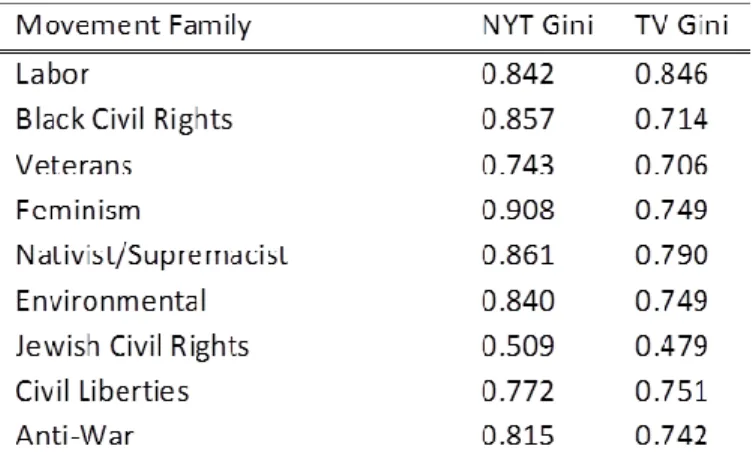
Inequality in Media Attention
27 Figure Two
Table Two
Supplementary analyses, available from the author, show that inequality is higher when total attention to the movement family is higher—in those crucial moments when attention to the movement is high, it is generally concentrated in only a few organizations.
Results: Power Law Analysis
I estimated power-laws for the distributions of media coverage in the three datasets via maximum likelihood (Clauset et al. 2009; Goldstein et al. 2004). Figures 3-5 below show the power-law fit to the observed data on log-log plots5. These plots show a very good fit to the tails of the data for the NYT and the television news data, the visual fit to the North Carolina local papers is somewhat less convincing, I therefore confirm these results with formal statistical tests.
5
29 Figure Three
31 Figure Five
I tested the power-law fit using Kolmogorov-Smirnov tests; I also tested against the lognormal distribution using likelihood ratio tests (Clauset et al. 2009). Table three below displays p-values of the null hypothesis for the power-law distribution, estimates for the scaling parameter (α), and p values of likelihood ratio tests against the log-normal
power-law in favor of the lognormal. It is worth mentioning that following this method led the authors of the original article to reject a host of prominent findings of power-laws across a number of disciplines (Clauset et al. 2009). Nevertheless, the results from the local North Carolina papers should be taken with a grain of salt, given the relatively small sample size.
Table Three
These results show that the distribution of media coverage to SMOs is what we would expect from a positive feedback process; it is highly unequal and the distributions conform to a power-law. I now turn to an in-depth analysis of the dynamic which, I argue, gives rise to this structure of media attention.
Results: Comparative Case Study
At the start of 1966 the nascent Black Power movement was not characterized by the dominance of any formal organization, rather the movement was described as “diffuse” and “reticulate” (Gerlach and Hine 1970). Structural conditions that may have favored the emergence of a large Black Power organization such as widespread police brutality and a large economically repressed urban black population, existed in many cities such as Detroit, Cincinnati, Philadelphia and New York. That a single organization from Oakland California, founded in 1966 by a handful of individuals with few resources, in the face of few
opportunities and much state repression, came to quickly overshadow all other Black SMOs in media attention is a puzzle from the perspective of current theories.
Data P Power-Law P Reject for Log-Normal Alpha Range
New York Times 0.256 0.553 1.81 104-60277
Television 0.535 0.731 2.12 35-1291
33
Here I present a comparative analysis of the dynamics of the media coverage to two Black Power SMOs: the Revolutionary Action Movement (RAM) and the Black Panther Party (BPP) from 1965-1970. RAM and the BPP were, initially, similar in the dimensions we would expect to matter for newsworthiness. Both groups were small, had few resources, employed similar tactics, and faced few political opportunities. Yet, the Panthers would eventually receive eighty times as many articles in the NYT. I show here that the divergence in media attention to these two groups is best accounted for through positive feedback as opposed to exogenous variables.
RAM: Origins, Ideology and Organization
The Revolutionary Action Movement (RAM) was founded in January of 1963 in Philadelphia by activists Maxwell Stanford, Wanda Marshall and Stan Daniels6. The
inspiration for RAM came when Marshall and Stanford were advised by Malcolm X, then a prominent leader in the Nation of Islam, that they could do more for the movement by organizing outside of the Nation. The group was initially comprised mostly of students and intellectuals in Philadelphia; it later spread to cities such as Detroit, New York and Chicago and took seasoned activists and war veterans into its leadership (Ahmad 2006:253–255). RAM’s ideology and plans for action were summarized in their twelve point program which stressed the need to develop movement infrastructure, black autonomy and armed self-defense (Kelley 2002). RAM’s ideology was heavily influenced by intellectuals such as Franz Fanon, movement leaders Malcolm X and Robert Williams, and foreign leaders such as Mao Tse-Tung. Their politics could be summarized as “Black Internationalism”; they linked the black struggle in the US to the international struggle of third world peoples (Joseph 2003:189)
RAM was structured in three types of cells, which they called Area, Work and Political. Area cells worked to build influence in local communities, work cells were set up in work places to organize black workers, and political cells were organized to infiltrate and radicalize the Civil Rights Movement and lead the eventual revolution (Ahmad 2006:255–256). Heavily
6
35
influenced by Mao’s ideas of guerrilla warfare, RAM was not a public organization (Joseph 2003:189; Kelley 2002:86–89): recruitment into RAM was made by personal contact only; members first had to prove themselves through working at one of RAM’s various front groups around the country (Ahmad 2006).
RAM attracted the attention of authorities early on in their history. In May of 1963 RAM leaders Maxwell Stanford and Stan Daniels were arrested in Philadelphia for inciting a riot and attacking police officers during an NAACP rally (Countryman 2006:139–140). After their arrest Stanford phoned Malcolm X from jail and informed him of what had transpired. X then spread word of the protest on the radio, and organized a collection for bail money (Ahmad 2006:257). During 1964 and 1965, RAM members were involved in radicalizing Civil Rights organizations such as the NAACP in Philadelphia (Countryman 2006:140) and the Student Non-Violent Coordinating Committee (Forman 1997:374,375 440). Ram promoted armed self-defense among black farmers in the Mississippi delta (Hill 2004:19; Jeffries 2009:190). RAM was also embedded in activist networks in Detroit (Boggs 1998:125; Joseph 2003:190).
1966 marked RAM’s entrance into the national media spotlight. On June 10th
Life magazine ran an article largely focused on RAM entitled “Plotting a War on Whitey: If Negro
Leadership Fails, Extremists are Set and Eager for Violence”. The cover of the magazine proclaimed “PLOT TO GET ‘WHITEY’: Red-hot young Negroes plan a ghetto war”. The article characterized RAM as “an umbrella like fraternity with an estimated 1,000 violence bent brothers dispersed through the Negro ghettoes of the East Coast”. The article
covered in 4 NYTarticles in 1966 as well: one prominent article discusses talks between RAM and Stokely Carmichael, then leader of SNCC, while others linked RAM to urban riots and street gangs in Chicago.
Black Panther Party: Origins, Ideology and Organization
The Black Panther Party for Self Defense (BPP)7 was founded in Oakland, California in October of 1966 by Huey Newton and Bobby Seale. Newton took the title of Minister of Defense with Seale taking the title of Party Chairman. Because the Panthers were at war with the white power structure, the minister of defense was the highest ranking position (Seale 1991:59–69). Seale and Newton had belonged to a RAM front group, the Soul Student Advisory Committee. Seale became a full-fledged RAM member but Newton was denied membership (Ogbar 2004:84; Seale 1991). Newton and Seale had attempted to convince RAM to start armed neighborhood patrols to monitor the police and attract the press. RAM members who had been jailed early in the movement and forced underground for their open display of weapons considered the move “suicidal” (Austin 2006:32–33). Following this rebuff Newton and Seale organized the BPP around their ten point program, heavily influenced by RAM ideology (Ogbar 2004:81); the program stressed the need for black autonomy as well as the necessity of ending police brutality. (Seale 1991:66–68).
The Panther’s organization structure was a nested hierarchy, which was eventually replicated in state and local groups. The Minister of Defense and the Chairman were on top, after which the hierarchy branched out to Field Marshall, Minister of Culture, and Communications Secretary. Beneath the Minister of Culture were Lieutenants, Captains, Officer of the Day,
7
with the Rank and File forming the bottom of the pyramid (Austin 2006:37–39). Recruitment took place through BPP offices, and members began at the rank-and-file.
Early Panther activities focused on armed neighborhood patrols of Oakland, which they adapted from similar, although unarmed, patrols in the Watts neighborhood of LA (Bloom and W. Martin:52–53 Forthcoming; Austin 2006). Panthers sought to show that blacks could obtain protection from corrupt police by organizing (Newton and Blake 2009:127–135). Armed Panthers would follow police patrol cars, observe any stops or arrests made, and inform those arrested of their rights. If someone was arrested on the Panthers’ watch they would try to raise money for bail (Austin 2006:53–56).
1967
38
2006:78). Images of Sacramento would follow the Panthers everywhere - when the Panthers began to set up a chapter in Harlem, for instance, media images of Sacramento had already swayed some potential members (Bloom and W. Martin:204). In 1973 Newton would write:
Sacramento was certainly a success […] in attracting national attention; even those who did not hear the complete message saw the arms, and this conveyed enough to Black people. The Bay Area became more aware of the Party, and soon we had more members than we could handle. From all across the country calls came to us about establishing chapters and branches; we could hardly keep track of the requests. In a matter of months we went from a small Bay Area group to a national organization (Newton and Blake 2009 (1973):159).
The Panthers successfully translated media coverage surrounding the protest in Sacramento into organizational growth and influence8.
On May 17th RAM took the spotlight again when the NYT ran two prominent stories entitled “Hoover Links Carmichael to Negro Leftist Group” and “Army for Ghettoes”. The first story detailed FBI chief Jay Edgar Hoover’s testimony to congress in February of that year claiming that Stokely Carmichael was in close contact with Max Stanford of RAM. Hoover characterized RAM as a “Highly secret, all-negro, Marxist-Leninist, Chinese Communist-oriented organization” which was “dedicated to the overthrow of the capitalist system of the United States, by violence if necessary”. Hoover estimated RAM membership at 50 with organized units in many larger cities. “Army for Ghettoes” sought to introduce readers more fully to RAM, characterizing the organization as a “proposed underground army within Negro ghettoes across the nation”. The article painted RAM as highly secretive, anti-white, and having stockpiles of weapons but currently unprepared for a full scale war with white America.
8 Panthers sometimes found that new recruits were more interested in propagating the dramatic media
39
Following about a month of silence, on June 22nd the NYT announced the arrest of 16 RAM members, including leader Max Stanford, on charges of plots to burn a subway station and to kill the executive directors of the NAACP and National Urban League: Roy Wilkins and Whitney Young. RAM allegedly believed these leaders were not sufficiently radical. The article noted that “seized with the prisoners were more than thirty weapons, more than one thousand rounds of ammunition, explosive materials, 275 packets of heroin, radio receivers and transmitters, walkie-talkies and subversive literature.” The article featured a photo of an assault rifle allegedly seized from the militants. The next day the NYT ran a short article announcing the arrest of 8 more RAM members in Philadelphia. At the end of June, Time magazine ran a short account of the arrests in an article titled “Busting RAM”. In July, after being released from jail, Stanford returned to Philadelphia to announce the formation of the Black Guard, an openly armed wing of RAM, and was arrested again for inciting a riot (Ahmad 2006; Countryman 2006:234). Over the next month, August, the police and FBI in Philadelphia would arrest another 35 RAM members (Countryman 2006:235).
Attention to the Panthers also picked up in August, with “Call of the Panthers,” a lengthy feature written in the NYT’s Sunday magazine on August 6th
40
suicide: to kill police in self-defense and to die if necessary when the time came. The iconic photo of Newton would go on to appear in other papers such as the LA Times. At the same time however, the article characterized the Panthers as "pitifully small in numbers", with "meager" organizational resources and lacking widespread support in the black community. The article closed thus: "The fate of the Panthers as an organization is not the issue. What matters is that there are a thousand black people in the ghetto thinking privately what any Panther says out loud". As Rhodes has argued, this article was ultimately most significant in establishing Newton as a media personality and setting the stage for a media frenzy at his later trial cite (Rhodes 2007:83–84).
41
NYT articles in early October focused on a new round of arrests of RAM members. The arrests of four RAM members, occurring on the 27th, were based on accusations that RAM had planned a mass poisoning of policeman and officials in the city of Philadelphia - the lead article claimed that the militants had been caught with enough cyanide to kill 4,500 people.
Frey9 was killed. While the Frey shooting was only given four paragraphs of newsprint at the time, and would not be mentioned in the NYT for another four months, the subsequent murder trial of Huey Newton marks the beginning of sustained high levels of attention to the Panthers.
Following these events, the NYT ran relatively few stories on both groups until June of 1968. Thus, at the end of 1967 both groups had received largely commensurate attention in the NYT. Yet the media coverage for the Panthers set the stage for increased coverage later on: the coverage of protest in Sacramento led to dramatically increased recruitment nationwide, while the substantial attention to their leader, Huey Newton, fashioned him into a household name. At the same time, the attention to RAM did little to increase further coverage. The events covered were dramatic: assassination plots, mass poisoning plots and mass arrests. Yet, this media attention neither increased RAM’s recruiting capacity, nor increased their exposure to journalists. RAM’s recruiting policy meant that those interested in joining the organization as a result of its media coverage would not know where to find them. Their leader, Stanford, was reclusive while Ferguson denied involvement in RAM, ensuring that journalists were unable to find a spokesperson for the organization.
1968
Neither group received much coverage from the NYT during the first half of 1968. The Panthers received one important article on a police-panthers shoot-out in which their Minister of Information, Eldridge Cleaver, was arrested, and a young Panther, Bobby Hutton was killed. RAM received 7 articles in June, mostly covering the trial of Herman Ferguson.
9
Having its roots in the media attention from 1967, July of 1968 was a turning point in the two groups’ fate in the media. RAM did not receive any articles in July, while the Panthers
received 23; the Panthers received 127 articles over August and September, while RAM again received none. This is not because events surrounding the two groups were
substantively much different. The NYT covered the Newton trial in great detail, while the trials of Ferguson and Harris, the defendants in the alleged plot to kill Roy Wilkins, received relatively little coverage. In September, RAM members would become involved in a shoot-out in Philadelphia where a four year old girl was injured, an incident that went unreported in the NYT (Countryman 2006:267). Similar Panthers shoot-outs received heavy coverage. Ferguson and Harris fled the country to avoid imprisonment, but the NYT did not report on that in connection to RAM until 1989, when Ferguson returned to the US. The flight of Elridge Cleaver, spokesperson for the BPP, attracted considerable attention immediately.
In October of 1968 RAM dissolved. They decided to cease using the name RAM partially since “right wing journalists [were] using the name RAM as an excuse to attack the
movement” (Ahmad 2007:160). RAM had been considerably weakened by repression at this point, and unlike the Panthers were unable to make up for it with increased recruitment.
1969
44
December article entitled "Panther Lawyer Finds Job Fulfilling" discusses attorney Charles Garry’s job satisfaction; an April article reports an airport car theft, in which one of the theives allegedly had a Panther’s membership card - the story was more about the membership card than the car theft; in January an article discussed the police stopping Panther leader Kathleen Cleaver on a bridge to ask her some questions.10 Other articles linked the Panthers to events which they did not cause—such as urban riots—in effect making the Panthers the organizational voice of the larger black power movement.
Yet, many events were manifestly important.Many were Panthers-police shootouts in which is it difficult to say who initiated (Davenport 2010). Crucial to the positive feedback
argument however, these stories unfolded in interaction with the media in such a way that their early newsworthiness encourgaged further newsworthiness. Space considerations dictate I cannot treat all of these events here, I therefore treat one of the manifestly most important events—the assassination of the leader of the Chicago BPP branch, Fred Hampton, on the orders of the Cook County State Attorney Edward Hanrahan.
The assassination took place at 4am on December 4th 1969 as Hampton and other panthers slept in his apartment. The next day the NYT ran a large article describing the event, giving preference to the version offered by Chicago police wherein a drawn out gun battle took place, in which Panthers fired first; local coverage in Chicago was similar (Arlen 1973:20). Panthers responded by giving tours of the apartment where Hampton was killed and, as the local press saw the evidence for themselves, it became clear to them that nearly all the firing had been done by the police (Bloom and W. Martin Forthcoming:298; Arlen 1973:21–22;
10
45
Rhodes 2007:279). The next day, following local press coverage in Chicago, the NYT ran a lengthy article suggesting foul play, followed soon after by a large article detailing an
autopsy report which suggested that Hampton was killed in his sleep. The NYT ran 3 articles during the following days, echoing calls for inquiries into the slaying. In light of the
sympathetic coverage, Panthers chose to follow a media strategy, rather than violent
The Panthers would go on to receive over 4,000 articles in the NYT. In 1970 alone they were mentioned in over seven hundred articles. That they could have risen from an obscure local Oakland group in 1967, to that level of prominence (no other Civil Rights/Black Power ever received that much attention in a single year) speaks to the resonance of their politics (Bloom and W. Martin Forthcoming), and how those politics were rapidly diffused through the media in an endogenous process of positive feedback.
Discussion
In accounting for the eighty fold difference in the amount of articles dedicated to RAM and the BPP the positive feedback model succeeds where theories based on exogenous
characteristics of organizations fail. Three positive feedback mechanisms account for the increased attention to the Panthers: 1) The Panthers organization grew in response to media attention, and they translated this growth into further coverage 2) the Panthers became a news institution—events became newsworthy simply because the Panthers were involved 3) Panthers tactics evolved in response to media coverage—the response to coverage was generally to seek more coverage. Much the opposite could be said for RAM, although they had otherwise similar tactics, their secretive nature prevented them from using the media as a recruitment tool, the media was unable to locate a spokesperson for RAM, and RAM
The positive feedback model allows for small causes to sometimes have big effects. Early events that launched the Panthers as a national organization were the protest at the California State Legislature, which greatly facilitated organization recruitment, and the shooting of John Frey. Absent these events, or without their key individual leader, Huey Newton, the history of the Black Power movement and its representation in the media would likely have been quite different. The positive feedback model allows us to see why this should be so: through a number of mechanisms the early media coverage of the Black Panthers led to greater and greater coverage in a self-reinforcing process such that a few key events at the beginning of their history came to have large and enduring consequences.
Conclusion
This study develops a positive feedback model of media attention to SMOs. This simple model suggests that when SMOs receive some attention, this initial coverage may lead to more. Positive feedback is constituted by three mechanisms: 1) as an organization receives more coverage it is exposed to more journalists, and is constructed as more news-worthy as journalists make sense of their own and others’ past coverage of the organization. 2) When an organization receives coverage it becomes more visible to other actors such as the state and potential supporters, thus potentially becoming more influential and attracting more resources to leverage for future coverage. 3) When an organization’s tactics are successful at attracting media coverage they are more likely to repeat those tactics.
48
The first was that, like realizations from other positive feedback systems, such as forest-fires, avalanches or city sizes, total media attention would be power-law distributed across SMOs. Second, following historical sociologists and economic historians, I argued that SMO media attention trajectories would be path dependent: contingent on key events early on in historical process which might set SMOs on paths wherein media attention largely reinforced itself.
I tested these expectations using mixed methods and multiple sources of data. First, I used new methodology from statistical physics to show that, across a variety of media sources, media attention to SMOs is characterized by a power-law distribution. Second, I used the comparative case of the Revolutionary Action Movement and the Black Panther Party to show that media attention to SMOs can be contingent on key events and small initial differences in the characteristics of groups. These two groups were initially very similar in terms of media representation and relevant organization characteristics such as resources, framing of their goals, tactics, the political opportunity structure they faced and their relationship with the state. Yet, by the end of the twentieth century the Black Panther Party had received roughly eighty times as many articles in the NYT as RAM had. Through the reconstruction of process, and comparison across these groups, I argued that positive feedback made more sense as an explanation than did exogenous variables.
49
(Marwell and Oliver 1993; Biggs 2005), and those studying contingent, path dependent histories (Mahoney 2000; Pierson 2000; Sewell 1996).
Despite the model’s fit with the evidence here, a number of qualifications are in order. First, certain types of SMOs (e.g. labor unions) that interact directly with targets will be less dependent on, and thus less affected by, the media. Second, the positive feedback model tells us little about when groups will receive media attention. In part this reflects the inherent unpredictably of positive feedback processes (Salganik et al. 2006), however the question of what ‘sparks’ positive feedback processes should be addressed by future work. Finally, while, positive feedback does not imply that growth continues on forever unboundedly, it does lack an account of how coverage ends.
50 References
Abbott, Andrew. 2001. Time matters : on theory and method. Chicago: University of Chicago Press,.
Ahmad, Muhammad. 2006. “The Revolutionary Action Movement.” in Black power in the belly of the beast, edited by J. L. (. L. ) Jeffries. Urbana: University of Illinois Retrieved
(http://search.lib.unc.edu.libproxy.lib.unc.edu?R=UNCb4959663; Table of contents only (http://www.loc.gov.libproxy.lib.unc.edu/catdir/toc/ecip068/2006003040.html)).
Ahmad, Muhammad. 2007. We will return in the whirlwind : black radical organizations 1960-1975. 1st ed. Chicago: Charles H. Kerr Pub. Co.,.
Allison, Paul D., J. Scott Long, and Tad K. Krauze. 1982. “Cumulative Advantage and Inequality in Science.” American Sociological Review 47(5):615–625.
Amenta, Edwin, Neal Caren, Sheera Joy Olasky, and James E. Stobaugh. 2009. “All the Movements Fit to Print: Who, What, When, Where, and Why SMO Families Appeared in the New York Times in the Twentieth Century.” American Sociological Review 74(4):636–656. Andrews, Kenneth T., and Michael Biggs. 2006. “The Dynamics of Protest Diffusion: Movement Organizations, Social Networks, and News Media in the 1960 Sit-Ins.” American Sociological Review 71(5):752–777.
Andrews, Kenneth T., and Neal Caren. 2010. “Making the News.” American Sociological Review 75(6):841–866.
Arlen, Michael J. 1973. An American verdict. [1st ed.]. Garden City, N.Y., Doubleday, 1973.: Doubleday,.
Arthur, W. Brian. 1989. “Competing Technologies, Increasing Returns, and Lock-In by Historical Events.” The Economic Journal 99(394):116–131. Retrieved April 15, 2011.
Austin, Curtis. 2006. Up against the wall : violence in the making and unmaking of the Black Panther Party. Fayetteville: University of Arkansas Press Retrieved
(http://search.lib.unc.edu?R=UNCb4948068; Table of contents only (http://www.loc.gov/catdir/toc/ecip0619/2006026040.html)).
Bak, P. (Per). 1996. How nature works : the science of self-organized criticality. New York, NY, USA: Copernicus,.
Barabasi, Albert-Laszlo, and Reka Albert. 1999. “Emergence of Scaling in Random Networks.” Science 286(5439):509.
51
Baumgartner, Frank R., and Bryan D. Jones. 2009. Agendas and instability in American politics. Chicago: University of Chicago Press Retrieved
(http://search.lib.unc.edu.libproxy.lib.unc.edu?R=UNCb5945582).
Bennett, Andrew, and Colin Elman. 2006. “QUALITATIVE RESEARCH: Recent Developments in Case Study Methods.” Annual Review of Political Science 9(1):455–476. Retrieved June 17, 2011. Beyeler, Michelle, and Hanspeter Kriesi. 2005. “Transnational Protest and the Public Sphere.” Mobilization: An International Journal 10(1):95–109.
Biggs, Michael. 2005. “Strikes as Forest Fires: Chicago and Paris in the Late Nineteenth Century.” American Journal of Sociology 110(6):1684–1714.
Bloom, Joshua, and Waldo Martin. Forthcoming. Black Against Empire: The History and Politics of the Black Panther Party. University of California Press.
Bogart, Leo. 1989. Press and public : who reads what, when, where, and why in American newspapers. 2nd ed. Hillsdale, N.J.: L. Erlbaum Associates,.
Boggs, Grace Lee. 1998. Living for change : an autobiography. Minneapolis: University of Minnesota Press,.
Brian Arthur, W., Yu.M. Ermoliev, and Yu.M. Kaniovski. 1987. “Path-dependent processes and the emergence of macro-structure.” European Journal of Operational Research 30(3):294–303. Retrieved April 15, 2011.
Cederman, Lars-Erik. 2003. “Modeling the Size of Wars: From Billiard Balls to Sandpiles.” The American political science review 97(01):135.
Chong, Dennis, and James N. Druckman. 2007. “Framing Theory.” Annual Review of Political Science 10(1):103–126. Retrieved June 14, 2011.
Clauset, Aaron, Cosma Shalizi, and Mark Newman. 2009. “Power-Law Distributions in Empirical Data.” SIAM Review 51(4):661–703.
Clauset, Aaron, Maxwell Young, and Kristian Gleditsch. 2007. “On the Frequency of Severe Terrorist Events.” The Journal of conflict resolution 51(1):58–87.
Cleaver, Kathleen. 1982. “How TV Wrecked the Black Panthers.” Communication Channels. Countryman, Matthew. 2006. Up south : civil rights and Black power in Philadelphia. Philadelphia: University of Pennsylvania Press Retrieved
(http://search.lib.unc.edu?R=UNCb4788583).
52
Danzger, M. Herbert. 1975. “Validating Conflict Data.” American Sociological Review 40(5):570– 584. Retrieved May 23, 2011.
Davenport, Christian. 2010. Media bias, perspective, and state repression : the Black Panther Party. Cambridge ;New York: Cambridge University Press Retrieved
(http://search.lib.unc.edu?R=UNCb6046063).
David, Paul A. 1985. “Clio and the Economics of QWERTY.” The American Economic Review 75(2):332–337. Retrieved April 14, 2011.
DiPrete, Thomas A., and Gregory M. Eirich. 2006. “Cumulative Advantage As a Mechanism for Inequality: A Review of Theoretical and Empirical Developments.” Annual Review of Sociology 32:271–297.
Downs, Anthony. 1972. “Up and Down with Ecology–The ‘Issue-Attention Cycle’.” 28:38–50. Drossel, B. B., and S. Schawbl. 1992. “Self-organized critical forest-fire model.” Physical Review Letters 69(11):1629–1632.
Earl, Jennifer, Andrew Martin, John McCarthy, and Sarah A. Soule. 2004. “The Use of Newspaper Data in the Study of Collective Action.” 30:65–80.
Eckstein, H. 1975. “Case Study and Theory in Political Science.” in Handbook of political science, edited by Fred I Greenstein and Nelson W Polsby. Reading, Mass.: Addison-Wesley Pub. Co.,. Edwards, George C., and Dan B. Wood. 1999. “Who influences whom? The president, Congress, and the media.” The American political science review 93(2):327–344.
Fishman, Mark. 1978. “Crime Waves as Ideology.” Social Problems 25(5):531–543. Retrieved October 12, 2011.
Forman, James. 1997. The making of Black revolutionaries. Seattle: University of Washington Press Retrieved (http://search.lib.unc.edu?R=UNCb4543216).
Freeman, Jo. 1973. “The Origins of the Women’s Liberation Movement.” American Journal of Sociology 78(4):792–811. Retrieved May 26, 2011.
Gabaix, Xavier. 2009. “Power Laws in Economics and Finance.” Annual review of economics 1(1):255–293.
Gabaix, Xavier. 1999. “Zipf’s law for cities: An explanation.” The Quarterly journal of economics 114(3):739–767.
Gabaix, Xavier, Parameswaran Gopikrishnan, Vasiliki Plerou, and H. E. Stanley. 2003. “A theory of power-law distributions in financial market fluctuations.” Nature 423. Retrieved
(http://find.galegroup.com.libproxy.lib.unc.edu/gtx/infomark.do?&contentSet=IAC-53
Documents&type=retrieve&tabID=T002&prodId=AONE&docId=A187717597&source=gale&srcp rod=AONE&userGroupName=unc_main&version=1.0).
Galtung, Johan, and Mari Holmboe Ruge. 1965. “The Structure of Foreign News.” Journal of Peace Research 2(1):64–91. Retrieved May 22, 2011.
Gamson, William A. 2004. Protest in Time and Space The Blackwell companion to social movements. Malden, MA: Blackwell Pub Retrieved
(http://search.lib.unc.edu.libproxy.lib.unc.edu?R=UNCb4434409; Table of contents only (http://www.loc.gov.libproxy.lib.unc.edu/catdir/toc/ecip049/2003020377.html)).
Gamson, William A., and Andre Modigliani. 1989. “Media Discourse and Public Opinion on Nuclear Power: A Constructionist Approach.” American Journal of Sociology 95(1):1–37. Gans, Herbert J. 1979. Deciding what’s news : a study of CBS evening news, NBC nightly news, Newsweek, and Time / Herbert J. Gans. Evanston, IL: Northwestern University Press,.
Garcia, Mario R, and Margaret Mary Stark. 1990. Eyes on the news. St. Petersburg, Fla.: Poynter Institute for Media Studies,.
George, Alexander L, and Andrew Bennett. 2005. Case studies and theory development in the social sciences. Cambridge, Mass.: MIT Press,.
Gerlach, Luther P., and Virginia Hine. 1970. People, power, change; movements of social transformation. Indianapolis, Bobbs-Merrill [1970] Retrieved
(http://search.lib.unc.edu.libproxy.lib.unc.edu?R=UNCb1035465).
Gerring, J. 2007. “Is There a (Viable) Crucial-Case Method?” Comparative Political Studies 40(3):231–253. Retrieved June 28, 2011.
Gitlin, Todd. 1980. The whole world is watching : mass media in the making & unmaking of the New Left. Berkeley: University of California Press Retrieved
(http://search.lib.unc.edu?R=UNCb4284748).
Goldstein, M. L., S. A. Morris, and G. G. Yena. 2004. “Problems with fitting to the power-law distribution.” The European physical journal.B, Condensed matter physics 41(2):255–258. Granger, Clive, and P. Newbold. 1974. “Spurious regressions in econometrics.” Journal of Econometrics 2(2):111–120. Retrieved February 22, 2012.
Haas, Jeffrey. 2010. The assassination of Fred Hampton : how the FBI and the Chicago police murdered a Black Panther. Chicago, Ill.: Chicago Review Press Retrieved
(http://search.lib.unc.edu?R=UNCb6033560).
54
Hill, Lance. 2004. The Deacons for Defense : armed resistance and the civil rights movement. Chapel Hill: University of North Carolina Press Retrieved
(http://search.lib.unc.edu?R=UNCb4447944).
Jeffries, Hasan Kwame. 2009. Bloody Lowndes : civil rights and Black power in Alabama’s Black Belt. New York: New York University Press,.
Jones, Bryan D. et al. 2009. “A General Empirical Law of Public Budgets: A Comparative Analysis.” American Journal of Political Science 53(4):855–873.
Joseph, Peniel E. 2003. “Dashikis and Democracy: Black Studies, Student Activism, and the Black Power Movement.” The Journal of African American History 88(2):182–203. Retrieved May 15, 2011.
Kelley, Robin D. G. 2002. Freedom dreams : the Black radical imagination. Boston: Beacon Press Retrieved (http://search.lib.unc.edu?R=UNCb4161045).
Kellstedt, Paul M. 2000. “Media Framing and the Dynamics of Racial Policy Preferences.” American Journal of Political Science 44(2):245–260. Retrieved May 23, 2011.
King, Marissa, and Heather Haveman. 2008. “Antislavery in America: The Press, the Pulpit, and the Rise of Antislavery Societies.” Administrative Science Quarterly 53(3):492–528.
Koopmans, Ruud. 2004. “Movements and Media: Selection Processes and Evolutionary Dynamics in the Public Sphere.” Theory and society 33(3-4):367–391.
Koopmans, Ruud, and Susan Olzak. 2004. “Discursive Opportunities and the Evolution of Right-Wing Violence in Germany.” American Journal of Sociology 110(1):198–230.
Koopmans, Ruud, and Rens Vliegenthart. 2010. “Media Attention as the Outcome of a Diffusion Process—A Theoretical Framework and Cross-National Evidence on Earthquake Coverage.” European Sociological Review. Retrieved April 18, 2011
(http://esr.oxfordjournals.org/content/early/2010/06/25/esr.jcq032.abstract).
Lester, Marilyn. 1980. “Generating Newsworthiness: The Interpretive Construction of Public Events.” American Sociological Review 45(6):984–994.
Levi, Margaret. 1997. “A model, a method, and a map: Rational choice in comparative and historical analysis.” in Comparative politics : rationality, culture, and structure, edited by Mark Irving Lichbach and Alan S. Zuckerman. Cambridge, U.K. ;New York, NY, USA: Cambridge University Press,.
55
Lipsky, Michael. 1968. “Protest as a Political Resource.” The American Political Science Review 62(4):1144–1158.
Mahoney, James J. 2000. “Path dependence in historical sociology.” Theory and society 29(4):507–548.
Mandelbrot, Benoit. 2004. The (mis)behavior of markets : a fractal view of risk, ruin, and reward. New York: Basic Books Retrieved (http://search.lib.unc.edu?R=UNCb4489793).
Mandelbrot, Benoit. 1983. The fractal geometry of nature. San Francisco: W.H. Freeman Retrieved (http://search.lib.unc.edu?R=UNCb1892655).
Mandelbrot, Benoit. 1963. “The Variation of Certain Speculative Prices.” The Journal of Business 36(4):394–419. Retrieved June 10, 2011.
Marwell, Gerald, and Pamela Oliver. 1993. The critical mass in collective action : a micro-social theory. Cambridge ;New York: Cambridge University Press,.
McAdam, Doug, and Dieter Rucht. 1993. “The Cross-National Diffusion of Movement Ideas.” Annals of the American Academy of Political and Social Science 528(, Citizens, Protest, and Democracy):56–74.
McCarthy, John, Clark McPhail, and Jackie Smith. 1996. “Images of Protest: Dimensions of Selection Bias in Media Coverage of Washington Demonstrations, 1982 and 1991.” American Sociological Review 61(3):478–499.
McCarthy, John, Larissa Titarenko, Clark McPhail, Patrick Rafail, and Boguslaw Augustyn. 2008. “Assessing Stability in the Patterns of Selection Bias in Newspaper Coverage of Protest During the Transition from Communism in Belarus*.” Mobilization: An International Quarterly 13(2):127–146. Retrieved June 10, 2011.
McCarthy, John, and Mayer N. Zald. 1977. “Resource Mobilization and Social Movements: A Partial Theory.” American Journal of Sociology 82(6):1212–1241.
McCombs, Maxwell E., and Donald L. Shaw. 1972. “The Agenda-Setting Function of Mass Media.” Public Opinion Quarterly 36(2):176. Retrieved June 15, 2011.
Merton, R. K. 1968. “The Matthew Effect in Science: The reward and communication systems of science are considered.” Science 159(3810):56–63. Retrieved June 13, 2011.
Myers, Daniel. 2000. “The Diffusion of Collective Violence: Infectiousness, Susceptibility, and Mass Media Networks.” American Journal of Sociology 106(1):173–208.
56
Nelson, Thomas E., Rosalee A. Clawson, and Zoe M. Oxley. 1997. “Media Framing of a Civil Liberties Conflict and Its Effect on Tolerance.” The American Political Science Review 91(3):567– 583. Retrieved June 14, 2011.
Newman, Mark. 2005. “Power laws, Pareto distributions and Zipf’s law.” Contemporary physics 46(5):323–351.
Newman, Mark. 1996. “Self-Organized Criticality, Evolution and the Fossil Extinction Record.” Proceedings: Biological Sciences 263(1376):1605–1610. Retrieved April 18, 2011.
Newton, Huey P, and J. Herman Blake. 2009. Revolutionary suicide. New York: Penguin Books,. Ogbar, Jeffrey Ogbonna Green. 2004. Black power : radical politics and African American identity. Baltimore, Md.: Johns Hopkins University Press Retrieved
(http://search.lib.unc.edu?R=UNCb4549014; Table of contents only (http://www.loc.gov/catdir/toc/ecip0413/2004000433.html)).
Oliver, Pamela, and Gregory Maney. 2000. “Political Processes and Local Newspaper Coverage of Protest Events: From Selection Bias to Triadic Interactions.” American Journal of Sociology 106(2):463–505.
Oliver, Pamela, and Daniel Myers. 1999. “How Events Enter the Public Sphere: Conflict, Location, and Sponsorship in Local Newspaper Coverage of Public Events.” American Journal of Sociology 105(1):38–87.
Ortiz, David G., Daniel Myers, N. Eugene Walls, and Maria-Elena D. Diaz. 2005. “Where Do We Stand with Newspaper Data?” Mobilization: An International Journal 10(3):397–419.
Pierson, Paul. 2000. “Increasing returns, path dependence, and the study of politics.” The American political science review 94(2):251.
Pierson, Paul. 2004. Politics in time : history, institutions, and social analysis. Princeton: Princeton University Press,.
Price, Derek. 1965. “Networks of Scientific Papers.” Science (New York, N.Y.) 149(3683):510–&. Rhodes, Jane. 2007. Framing the Black Panthers : the spectacular rise of a Black power icon. New York: New Press : Distributed by W.W. Norton Retrieved
(http://search.lib.unc.edu?R=UNCb5311825; Table of contents only (http://www.loc.gov/catdir/toc/ecip0713/2007010436.html)).
Richardson, L. F. 1948. “Variation of the Frequency of Fatal Quarrels With Magnitude.” Journal of the American Statistical Association 43(244):523.